If you’ve ever been betrayed, share your story below. What was your turning point, and who helped you rebuild today?
PART I
The Alley at 11:47 p.m.
I found my daughter sleeping on the street at 11:47 p.m. on a Tuesday in October, curled in an alley behind a CVS on Morrison Avenue while the cold air drifted down from the river and settled between the brick walls like a quiet punishment meant for anyone unfortunate enough to be outside that late.
At first I thought she was just another stranger trying to stay warm on the concrete, because Portland has no shortage of people who end up in places like that when life bends in ways no one expects.
Then the streetlight flickered above the alley entrance and caught a streak of copper-red hair, the same color my wife Catherine used to brush every night in front of our bedroom mirror, and in that instant my stomach dropped hard enough that I had to grab the side of the brick wall just to steady myself.
“Emma?” I whispered, the word barely leaving my throat because some part of me still hoped I was wrong.
She stirred slowly, blinking up at me through swollen eyelids, her face streaked with grime and dried tears that looked like thin gray rivers cutting through the dust on her cheeks.
When recognition reached her eyes, her entire expression collapsed.
“Dad…” she choked, pushing herself upright with shaking arms. “He sold the house.”
For a moment the world felt silent enough that I could hear the wind scraping a loose piece of plastic against the alley dumpster.
“He took everything,” she whispered.
The words hung there between us like broken glass.
David Morrison.
My son-in-law.
The man who had once stood in my living room wearing a borrowed suit and promised me he would protect my daughter for the rest of his life.
PART II
Bringing Her Home
Emma could barely stand when I helped her into the passenger seat of my car, and the moment she settled against the leather cushion I realized how frighteningly light she felt when I wrapped an arm around her shoulders.
Her hands trembled the entire drive home.
I didn’t ask questions because the answers were already written across her exhausted face, and because sometimes the most important thing a parent can do is simply get their child somewhere safe before the explanations begin.
When we reached my house I guided her inside, ran hot water in the bathtub, and placed a folded towel on the counter while the bathroom filled with steam that smelled faintly of lavender soap.
She stayed in the water for nearly thirty minutes.
When she finally came out wearing one of Catherine’s old robes, she looked like someone who had been wandering through a storm and had only just found the first light of morning.
I made scrambled eggs and toast while she sat at the kitchen table staring at nothing.
She finished half the plate before exhaustion took over.
“Come on,” I said gently, guiding her toward the hallway. “You can sleep in your old room tonight.”
She collapsed onto the mattress within seconds.
By the time I pulled the blanket over her shoulders, she was already asleep.
PART III
The Phone on the Table
I did not sleep that night.
Instead I sat at the kitchen table with Emma’s phone charging beside my coffee mug, listening to the quiet hum of the refrigerator while waiting for the device to power back on.
When the screen finally lit up, the truth appeared piece by piece.
Emails.
PDF files.
Property records.
The house Catherine had left to Emma in her will—the small white place with the maple tree in the front yard where Emma had grown up—had been transferred into David’s name through a deed transfer filed three months earlier.
There was a notary stamp.
There was a signature.
But it was not Emma’s handwriting.
My daughter has been left-handed since the day she first learned to hold a pencil, and I have watched her sign her name thousands of times across school permission slips, birthday cards, and bank forms.
The signature on that document leaned the wrong direction.
It looked too smooth.
Too confident.
It was a forgery.
I kept scrolling.
Wire transfer confirmations appeared next.
David had sold the house for five hundred eighty-seven thousand dollars in what real estate agents call a “fast close,” which meant the buyer had paid cash and skipped most of the normal waiting periods.
Then the money had vanished into an offshore account in the Cayman Islands.
My jaw tightened slowly as the details stacked together into a single ugly picture.
He had changed the locks while Emma was at work.
He had left a note telling her she had thirty days to collect her belongings from a storage unit.
And then he had moved into a luxury apartment downtown with another woman.
By the time the sun rose over the rooftops outside my kitchen window, grief had hardened into something sharper.
I was not going to let my daughter be erased.
PART IV
The Phone Call
At eight o’clock that morning I called Benjamin Caldwell, the estate attorney who had handled Catherine’s will after her death five years earlier.
Ben listened quietly while I explained everything.
When I finished, he exhaled slowly.
“Thomas,” he said, “this is felony fraud.”
He paused long enough for the words to settle.
“Forgery. Wire fraud. Possibly identity theft. We can go civil and criminal with this, but it’s going to get ugly.”
“It’s already ugly,” I answered.
“My daughter slept behind a pharmacy like she had no one in the world.”
Ben was silent for several seconds.
Then he said something that steadied me more than he probably realized.
“Bring Emma to my office this afternoon,” he said. “We’ll preserve every document and involve the police. And Thomas… don’t confront David yourself.”
I promised him I would be careful.
I did not promise him I would be gentle.
PART V
Riverside Towers
That evening, while Emma sat with Ben’s legal team preparing her statement, I drove downtown toward the glass-and-steel skyline where the city’s wealth liked to hide.
Riverside Towers rose thirty floors above the river like a monument to expensive mistakes.
David’s new address was apartment 8C.
The elevator ride felt longer than it probably was.
When the doors opened, soft music drifted from somewhere down the hallway.
I could hear laughter.
The clink of glasses.
I walked to the door and knocked once.
The lock turned.
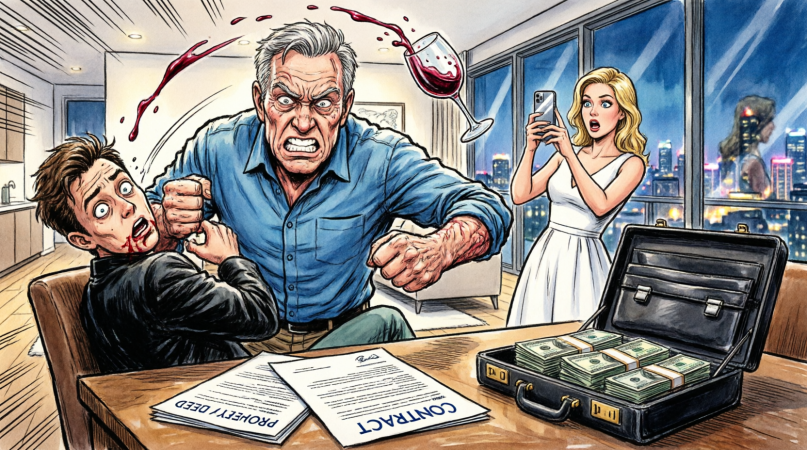
David opened the door wearing designer loungewear and holding a glass of red wine.
His expression carried the relaxed confidence of a man who believed he had already won.
I met his eyes.
“I found Emma sleeping behind a CVS last night,” I said quietly.
His smile twitched.
“So now I’m here,” I continued, “to take back everything you stole.”
PART VI
The Beginning of the End
David tried to laugh the accusation away.
He claimed Emma had signed the documents willingly.
He insisted the house had become “shared property.”
He even suggested she was exaggerating the situation to gain sympathy.
But confidence has a strange way of evaporating when facts arrive.
I showed him the case number Detective Laura Fisher had issued that afternoon.
I explained that the forged signature had already been flagged.
I described the offshore transfer records.
By the time I finished speaking, the wine glass in his hand was trembling badly enough that the liquid inside rippled against the rim.
Behind him, his girlfriend—Ashley—appeared in the hallway with a confused expression and one hand resting on her pregnant stomach.
“Inherited?” she asked when I mentioned Catherine’s will.
David did not answer.
He could not.
Because lies collapse quickly when confronted with the truth.
PART VII
Justice
The investigation moved faster than even I expected.
Financial Crimes traced the offshore account within forty-eight hours.
Three hundred fifty-three thousand dollars remained frozen before David could move it again.
The rest had already been used as a down payment on the very apartment where he now lived.
Federal agents joined the case once wire fraud crossed state lines.
Within a week David Morrison was arrested at his office while coworkers watched in stunned silence.
Emma did not celebrate.
When I told her the news she simply closed her eyes and released a slow breath that sounded like her body finally remembered it was allowed to relax.
PART VIII
The Trial
Six months later the courtroom filled with reporters and quiet spectators curious about the man who had forged his wife’s signature and sold her inheritance behind her back.
The prosecution’s evidence left little room for interpretation.
Forensic handwriting analysts confirmed the forgery.
Banking records traced every dollar.
Email timestamps showed David coordinating the sale while Emma believed they were still repairing their marriage.
When Emma took the stand she spoke calmly.
“I did not sign that document,” she said.
Her voice never shook.
The jury returned a guilty verdict on every count.
David Morrison was sentenced to six years in federal prison and ordered to repay the full value of the stolen property along with additional damages.
The apartment downtown was seized.
The offshore funds were returned.
Justice did not erase the pain.
But it restored something important.
Dignity.
PART IX
Rebuilding
A year later Emma bought a small bungalow in a quiet neighborhood filled with tall trees and narrow sidewalks where children rode bicycles in the afternoon sun.
She paid for the house in cash using the recovered funds.
Watching her unlock the front door for the first time felt like witnessing the beginning of a life she should never have lost.
On moving day she laughed when I nearly dropped a box of kitchen dishes.
That laugh sounded like something returning home.
PART X
What a Father Never Forgets
Some nights I still think about that alley behind the pharmacy.
I remember the way Emma looked when she first lifted her head under the yellow streetlight.
I remember how small she seemed curled against the cold brick wall.
And I remember the promise I made to myself in that moment.
No one erases my daughter.
Not while I am still breathing.
Emma sleeps safely in her own home now.
That is the only ending I ever needed.