Part 1
She took a bite of her mother-in-law’s special Thanksgiving gravy and immediately knew something was wrong.
Bitter. Metallic. A taste she recognized from her years as an FBI agent. A taste that meant only one thing.
Poison.
Dorothia Hartwell had seen a pregnant woman, a daughter-in-law she had never approved of, an easy target. She had not known that Vivien had spent 2 years undercover with the Russian mafia. She had not known that Vivien had caught serial killers. She had not known that Vivien could identify poison profiles the way most women identified wine.
She had definitely not known that her Thanksgiving surprise would unravel 40 years of dark family secrets. Murders disguised as natural deaths. Victims who stayed silent. A pattern of evil hidden behind charity galas and society smiles.
The gravy boat trembled in Dorothia Hartwell’s hands as she smiled at Vivien.
“I made this one special just for you, dear.”
The words floated across the mahogany dining table like a blessing wrapped in silk.
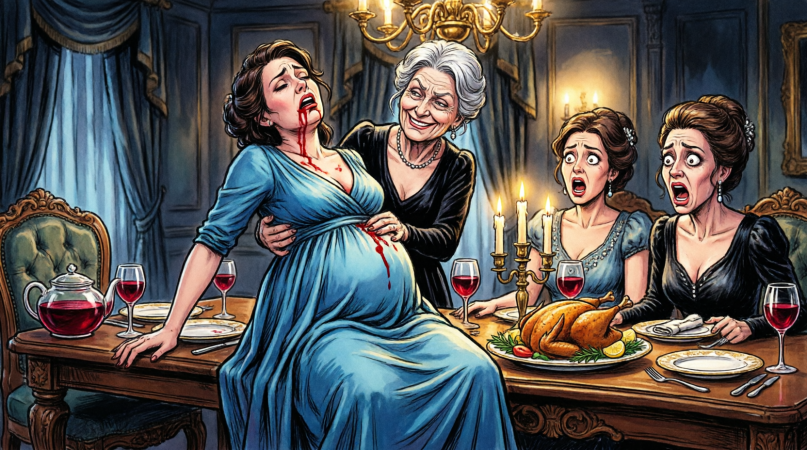
22 faces turned toward Vivien. Crystal chandeliers cast warm honey light across the Hartwell estate’s formal dining room. The scent of roasted turkey mingled with cinnamon, cloves, and the sharp bite of winter air drifting through a cracked window. Somewhere in the kitchen, a timer beeped. A grandfather clock in the hallway chimed 7 times.
Vivien Hartwell pressed her hand against her swollen belly. She was 7 months pregnant and exhausted from the case she had just closed 3 days earlier. The Brennan kidnapping. 3 children recovered alive. 1 suspect in custody. 47 hours without sleep. She wanted nothing more than to be home in pajamas, eating leftover Chinese food and watching terrible reality television.
But Grant had insisted.
His hand had found hers that morning, his blue eyes pleading.
“Please, Viv. Thanksgiving with my family is not optional. Mom has been planning this for months.”
So she was there, stuffed into a maternity dress that made her feel like an overstuffed sausage, sitting at a table that cost more than her first car, surrounded by Hartwells and their perfect teeth, perfect hair, and perfect judgmental silences.
“Thank you, Dorothia,” Vivien said, keeping her voice warm. “That’s very thoughtful of you.”
Her mother-in-law’s smile did not reach her eyes. It never did.
In the 3 years since Vivien had married Grant Hartwell, Dorothia had perfected the art of sweetness that cut like glass. Every compliment had a barb. Every kindness had a condition. Every smile was a warning dressed in pearls and Chanel.
The gravy boat landed in front of Vivien’s plate with a soft clink against the fine china. Dark brown, thick, steam rising in lazy curls that caught the candlelight.
“I used a new recipe,” Dorothia continued, her voice carrying the practiced warmth of a politician’s wife. “Extra herbs, rosemary, thyme, a touch of sage. Your favorite, dear. You need your strength. Growing my grandchild takes so much out of a woman.”
Vivien caught the emphasis on the word my. Not your baby. Not the baby. Not even our grandchild. My grandchild. As if Vivien were merely the vessel, the incubator, the temporary housing for the next generation of Hartwell DNA.
She had learned to let such things go, to smile and nod and pretend not to notice the tiny cuts that bled out slowly over 3 years of holidays and family dinners and helpful suggestions about everything from her career to her hair to the way she held her fork.
But tonight, something felt different.
Vivien picked up the silver ladle, heavy and engraved with the Hartwell family crest, a lion rampant. How appropriate.
The gravy coated her mashed potatoes in a slow deliberate pour, rich and dark like chocolate sauce but savory. The steam carried hints of meat drippings and herbs and something else, something beneath the familiar smells, something metallic.
Across the table, Grant smiled at her. His blond hair was perfectly combed, parted on the left the way his mother liked it. His blue eyes sparkled with wine and family warmth. He looked happy, relaxed, home.
He had no idea.
Vivien lifted her fork.
The first bite touched her tongue.
Bitter. Wrong.
7 years of FBI training kicked in before her conscious mind could catch up. 4 years in the Behavioral Analysis Unit studying killers and their methods. 2 years undercover with the Koslov crime family, watching people die in ways that looked like accidents. She knew poison profiles the way other women knew wine pairings, the way chefs knew spice combinations, the way musicians knew chord progressions.
This was not herbs. Not rosemary or thyme or sage.
This was something that did not belong in food.
She swallowed the small amount in her mouth, smiled, and took another tiny bite for show, just enough to maintain appearances, just enough not to raise alarm.
Across the table, Dorothia watched her. Her eyes tracked every movement of Vivien’s fork, counted every bite that passed her lips. Not with warmth. Not with the pride of a grandmother-to-be watching the mother of her future grandchild enjoy a special meal.
With anticipation.
The way a cat watched a mouse approach a trap. The way a spider watched a fly test the first strands of a web.
Vivien’s hand found Grant’s under the table. She squeezed once, then twice. Their signal from the early days of dating.
I need to talk to you now.
He glanced at her, confused. She shook her head slightly.
Later.
“Excuse me,” she said, her voice perfectly controlled. “I need to use the restroom. The baby is pressing on my bladder again.”
Polite laughter rippled around the table. Aunt Patricia. Uncle William. Grant’s brother Preston and his wife Caroline. Various cousins and family friends whose names Vivien had stopped trying to remember.
“Of course, dear,” Dorothia said, her smile never wavering. “Take your time. We’ll save your plate.”
I’m sure you will, Vivien thought. You’ll be watching to see how much more I eat.
She walked calmly down the hallway, her heels clicking against the marble floor. Family portraits watched her pass, generation after generation of Hartwells, blue eyes, blond hair, wealth, and privilege painted in oil and framed in gold.
Her face was in none of them.
After 3 years of marriage, she remained a footnote, a temporary addition not yet deemed permanent enough to commemorate.
She closed the bathroom door behind her, locked it, waited 3 seconds, and listened for footsteps in the hallway. Nothing.
Then she moved fast.
She spat the remaining food into the toilet, rinsed her mouth with sink water, spat again, used her finger to trigger her gag reflex and brought up what little she had swallowed, rinsed again, spat again.
Her hands trembled as she reached into her purse.
Even at Thanksgiving, Special Agent Vivien Hartwell carried evidence bags. It was a habit from her undercover days. You never knew when you might need to preserve something. A note. A receipt. A sample.
A sample of gravy that tasted like death.
She scraped the residue from her tongue with a tissue, bagged it, and sealed it, writing the date and time in black marker.
November 28, 6:47 p.m. Hartwell estate. Thanksgiving dinner.
Her reflection stared back from the gilded mirror above the sink. Pale skin. Dark circles under her eyes that no amount of concealer could hide. Hair beginning to go gray at the temples at 30. The face of a woman who had seen too much, done too much, and had just realized something unthinkable.
Her mother-in-law had just tried to poison her.
No.
Vivien pressed her palms against the cool marble counter. The baby kicked hard, right against her bladder, as if to remind her there was something more important than her racing thoughts.
No, that was insane. That was the kind of paranoid thinking that got agents pulled from cases.
Dorothia was difficult, controlling, manipulative, passive-aggressive in ways that made Vivien want to scream into a pillow at 2 in the morning. But she was not a murderer.
Was she?
Vivien stared at the evidence bag in her hand, at the brownish residue, at the bitter taste still lingering on her tongue despite the rinsing.
Her FBI training did not lie. Her instincts did not lie.
She had trusted those instincts to keep her alive during 2 years with the Koslovs, surrounded by men who would have killed her without hesitation if they had known who she really was.
And right now, those instincts were screaming.
She tucked the bag into the hidden pocket of her purse, fixed her lipstick in the mirror, smoothed her maternity dress, practiced a smile that did not reach her eyes, and walked back to the dining room with steady steps.
The table had moved on to discussing Preston’s promotion at the investment firm. Grant’s older brother was holding court, gesturing with his wine glass, his perfect teeth gleaming as he described his latest triumph. His wife Caroline nodded along with practiced boredom, her eyes glazed in a way that suggested she had heard the story many times before.
Vivien sat down. The chair creaked slightly under her weight. At 7 months pregnant, she still was not used to the extra pounds, the way her body had changed, the way it no longer felt like hers.
She looked at her plate, the gravy glistening on the mashed potatoes, the turkey arranged just so, the cranberry sauce that Dorothia made from scratch every year.
She could not eat any of it now, not knowing what might be hiding beneath the surface.
So she rearranged the food on her plate instead, a skill she had learned in childhood, when dinner with her alcoholic father had been a battlefield. Push the mashed potatoes to one side. Spread the turkey thin. Cut everything into small pieces. Move things around without actually eating.
The illusion of appetite.
Her father had been too drunk to notice. Dorothia would not be.
But Vivien had no choice.
Across the table, her mother-in-law glanced at her plate and counted the missing bites. Her smile widened slightly, satisfied.
“How is it, dear? The gravy?”
“Delicious,” Vivien said.
The lie tasted worse than the poison.
“As always, you’ve really outdone yourself this year.”
“I do try.” Dorothia’s voice was honey and cream. “I want everything to be perfect for my boys and for my grandchild, of course.”
Her hand found her own belly briefly, a gesture of maternal pride that looked almost genuine.
Almost.
But Vivien saw the calculation behind it, the performance, the way Dorothia’s eyes never matched her smile. She had spent 4 years studying psychopaths for the FBI. She knew what it looked like when someone was playing a role.
Dorothia Hartwell was playing the role of doting mother-in-law, which meant there was something else underneath.
Grant squeezed her hand under the table.
“You okay, babe? You look pale.”
She looked at her husband, at his mother, at the family portrait above the fireplace where her own face had never been added.
3 years of marriage, and she remained invisible. A Hartwell by name only. A placeholder until someone better came along.
“Fine,” she said. “Everything is fine.”
But nothing would ever be fine again.
The rest of the dinner passed in a blur of anxiety and forced smiles. Pumpkin pie. Vivien declined. Morning sickness, she said, still bothering her even in the third trimester. Margot had told her about a friend who had it all 9 months.
Coffee. She accepted a cup but did not drink it. She held it for warmth, for something to do with her hands.
Dorothia’s famous apple crumble, the recipe that had been in the Hartwell family for 4 generations. Vivien claimed she was too full.
Grant shot her a concerned look. She ignored it.
At 9:30, she finally convinced him it was time to leave. The baby. She was tired. The drive home was long.
In the car, Grant reached for her hand across the center console.
“You were quiet tonight. Everything okay with the baby?”
Vivien watched the streetlights streak past the window. Yellow, orange, yellow, orange. A steady rhythm that matched her heartbeat.
“Just tired,” she said. “The Brennan case took a lot out of me.”
“I know. 3 kids. God, I can’t imagine.” He squeezed her fingers. “But you saved them. That’s what matters.”
“Yeah.”
“Mom noticed you didn’t eat much.”
Of course she had. She had been counting every bite Vivien did not take.
“Morning sickness,” Vivien said again. “It comes and goes, even this late.”
Grant nodded, satisfied with the simple answer. He always was.
He saw the world in simple terms. Good and bad. Right and wrong. His mother loved him, therefore his mother was good. He did not understand that love could be a weapon, that the people who hurt you most were often the ones who claimed to care.
He turned up the radio. Christmas music filled the car. Bing Crosby dreaming of a white Christmas. Frank Sinatra wishing upon a star.
Vivien pressed her hand against her belly. The baby rolled, a tiny elbow or knee pressing against her palm.
I’m going to protect you, she thought. Whatever it takes. Whatever I have to do.
The evidence bag sat in her purse like a grenade with the pin pulled.
Tomorrow she would know the truth. Tomorrow she would have proof.
Then she would do what she always did when something was wrong.
She would investigate.
That night, she could not sleep.
Grant snored softly beside her, his arm draped across the pillow she used to support her belly. He looked peaceful, innocent, the boy she had fallen in love with 5 years earlier at a charity gala, before she knew what his family was really like.
She stared at the ceiling. Shadows shifted as cars passed on the street below. The house creaked and settled, old bones adjusting to the cold November night.
At 2:14 a.m., she finally gave up pretending.
She eased out of bed, careful not to wake Grant, and padded downstairs to the kitchen in bare feet. The tile was cold against her soles. She made chamomile tea she did not drink and sat at the breakfast bar in the dark. The only light came from the microwave clock.
3:17.
Her phone glowed on the counter.
She picked it up. Put it down. Picked it up again. Unlocked it. Locked it. Unlocked it again.
Waiting for something.
She did not know what.
A text from Grant’s mother confessing everything. An article explaining that bitter gravy was a normal side effect of new herbs.
She opened the browser and typed with one thumb.
Ethylene glycol taste.
The results loaded slowly. Her heart pounded.
Sweet at first, then bitter. Often described as antifreeze.
She scrolled.
Causes kidney failure within 72 hours. Initial symptoms include nausea, vomiting, and confusion. Often misdiagnosed as food poisoning or flu.
She typed another search.
Antifreeze poisoning symptoms.
Nausea, vomiting, confusion, seizures, coma, death.
Her hands shook so badly she nearly dropped the phone.
One more search. The one she did not want to type. The one she had to know.
Can antifreeze hurt unborn baby?
The results made her close the browser, set the phone face down on the counter, and press both hands against her belly as if she could shield her daughter from words on a screen.
Fetal death. Spontaneous abortion. Birth defects.
At 3:41, she finally went back to bed.
Grant had not moved.
She lay beside him, watching the rise and fall of his chest. The man she had married. The man she had left undercover work for. The man she had given up the career she loved for because he had asked her to, because he said he could not handle knowing she was in danger, because she had loved him enough to change everything.
And now his mother might have just tried to kill her.
She did not close her eyes until the sun came up.
Black Friday morning arrived gray and cold. Mall crowds fought over televisions and discounted electronics. Social media filled with videos of people shoving each other for deals. The American tradition of thankfulness followed immediately by greed.
Grant had gone golfing with Preston at 7.
“Brother bonding,” he had called it, kissing her forehead before he left. “You rest, babe. Take care of yourself. Take care of our little one.”
Vivien was 2 hours outside the city by 9:15.
The FBI field office sat in an unremarkable building off Highway 12, gray concrete, tinted windows reflecting the overcast sky, a flag snapping in the cold wind, its fabric worn at the edges. If you did not know what the building was, you would drive right past it. That was the point.
Margot Dawson met her in the parking garage on level 3, section C, the camera blind spot they had used a dozen times for sensitive conversations. The spot where Vivien had told Margot about the Koslov assignment before anyone else. The spot where Margot had told Vivien about her miscarriage.
Sacred ground in its way.
“You look like hell,” Margot said by way of greeting.
She was leaning against a concrete pillar, coffee cup in hand, her dark hair pulled back in the functional ponytail she always wore when she was not on duty. Jeans. Georgetown sweatshirt. The casual uniform of a federal agent on her day off.
“Good morning to you, too,” Vivien said.
“Seriously, you look like you haven’t slept in days.”
“Just one night. But it was a long one.”
Margot’s expression shifted from teasing to concern.
“What’s going on?”
“I need the lab. Off the books.”
Silence.
Margot did not ask questions. Not yet.
She had known Vivien for 7 years. Partners for 5 of them. She knew that face. The face Vivien had worn when they found the Brennan children in the basement with duct tape over their mouths and fear in their eyes. When they caught the Riverside Strangler after 4 months of dead ends. When Vivien figured out that Agent Morrison was feeding information to the Koslovs.
The face that said something unthinkable had happened.
“Follow me,” Margot said.
They walked through back corridors that smelled like floor wax and stale coffee. Security doors opened with Margot’s badge. Each beep echoed in the empty hallways.
The lab was nearly deserted. Holiday skeleton crew. Just Dr. Lydia Brennan running samples on a counterfeiting case, white coat slightly rumpled, glasses pushed up on her forehead.
She looked up when they entered.
“Dawson. Hartwell.”
Her eyes dropped to Vivien’s belly.
“I heard congratulations are in order. How far along?”
“7 months.”
“Boy or girl?”
“Girl.”
“Wonderful.” Lydia smiled, genuine warmth on her face. She was one of the few people at the bureau who seemed to have a normal emotional range. “What brings you in on a holiday?”
Vivien glanced at Margot. Margot nodded once.
“I need a favor,” Vivien said. “Rush analysis. Completely off the record.”
Lydia’s smile faded. Her professional mask slid into place.
“What am I looking for?”
Vivien reached into her purse, pulled out the evidence bag, the brownish residue visible through the clear plastic.
“Poison. I think ethylene glycol, antifreeze, but I need to be sure.”
Lydia took the bag and held it up to the fluorescent light. Her brow furrowed.
“Where did you get this?”
“My Thanksgiving dinner.”
The silence that followed was heavy, the kind that falls after someone says something that cannot be unsaid.
Lydia’s face cycled through confusion, concern, and then the professional determination of a scientist facing a puzzle that mattered.
“Well, I can have preliminary results in 4 hours,” she said. “Full analysis by tomorrow morning.”
“Preliminary is fine for now.”
“Vivien,” Lydia said, setting the bag on her workstation, “are you telling me someone tried to poison you?”
“I’m telling you I tasted something wrong. I’m hoping you’ll tell me I’m being paranoid.”
But she knew she was not.
“I’ll call you as soon as I have something,” Lydia said.
Vivien and Margot sat in the break room with stale coffee from a pot that had been brewing since yesterday and vending machine crackers that tasted like cardboard. The fluorescent lights hummed overhead, casting everything in a harsh institutional glow.
Margot waited until they were alone before speaking.
“You going to tell me what’s really going on?”
Vivien stared at her hands. Her wedding ring caught the light. 3 carats. Princess cut. Grant had proposed at sunset on a beach in Maui. It had felt like a fairy tale at the time.
Fairy tales were lies parents told children to make them feel safe.
“My mother-in-law made me special gravy,” she said finally. “Just for me. Said it was my favorite. And I’ve never told her my favorite anything. In 3 years of marriage, she’s never once asked what I like, what I want, what I prefer.”
Her voice was flat, controlled.
“But yesterday she made gravy special just for me. Watched me eat it like she was counting every bite.”
Margot leaned back in her plastic chair.
“That’s not evidence. That’s weird, but it’s not evidence.”
“No, but the taste is. Bitter underneath the herbs. Wrong. I know poison profiles, Margot. I spent 2 years with the Koslovs watching people die from exactly this. Antifreeze in coffee, in vodka, in soup. It was Mikhail’s favorite method because it looked like natural causes.”
“You think Dorothia Hartwell tried to poison you?”
The words hung in the air. Heavy. Impossible. True.
“I think I need proof before I know what to think.”
The clock on the wall ticked. 10:32. 10:33. 10:34.
Margot reached across the table and squeezed Vivien’s hand. Her fingers were warm, solid, real.
“Whatever it is,” she said, “we’ll figure it out together. That’s what we do.”
Vivien nodded. She did not trust herself to speak.
Together, she hoped, would be enough.
The results came back at 2:17 in the afternoon.
Vivien was in the parking garage, sitting in her car with the engine running and the heater blowing lukewarm air. She had been staring at the concrete wall for an hour, her mind running through possibilities.
Maybe she was wrong. Maybe the herbs had been off. Maybe Dorothia had used some specialty ingredient that tasted unusual. Maybe this was pregnancy hormones and paranoia.
Her phone rang.
Lydia’s name on the screen.
Vivien answered on the first ring.
“What did you find?”
Lydia’s voice was steady, professional, but there was something beneath it. A tremor Vivien recognized.
Fear.
“Ethylene glycol,” Lydia said. “Antifreeze. The concentration in this sample is significant. Based on the amount you described consuming, we’re looking at a dose designed to cause kidney failure within 72 hours.”
Vivien’s ears rang. The parking garage tilted around her. She gripped the steering wheel to anchor herself.
“Are you sure?”
“I ran it 3 times. Different methodologies. Same result every time.”
“And the baby?”
Silence on the line.
Then, carefully, Lydia said, “In a pregnant woman, the effects would be accelerated. The fetus would be affected first. Miscarriage within 48 hours. Then maternal organ failure.”
Failure.
A pause.
“Vivien. Who gave you this sample? Who tried to poison you?”
Vivien stared at the lab report on the passenger seat. Ethylene glycol. Antifreeze. Attempted murder.
Her mother-in-law had tried to kill her.
“My family,” she said.
Part 2
She called Grant from the parking lot at 2:47.
Her hands were not shaking. Her voice did not crack. 7 years of FBI training had taught her how to compartmentalize, how to set aside emotion when emotion would get you killed.
Right now, emotion would get her killed.
“Hey, babe.”
Grant’s voice was warm, happy, the voice of someone who had just spent 4 hours golfing with his brother and was pleasantly exhausted.
“How are you feeling? Any better?”
“I need to talk to you tonight. It’s important.”
A pause. The warmth in his voice cooled slightly.
“What’s wrong? Is it the baby?”
“The baby is fine. I just need to talk to you in person.”
“Can it wait? Mom wants us for leftovers. She made that turkey soup you liked last year.”
The laugh that escaped Vivien was sharp and broken, like glass shattering on marble.
“No, Grant. It cannot wait.”
“Viv, you’re scaring me. What’s going on?”
“Just come home, please. I’ll explain everything when you get here.”
She hung up before he could ask more questions.
She sat in the car with the engine still running, the heater still blowing air that did not touch the cold spreading through her chest. The lab report lay on the passenger seat. Ethylene glycol. Antifreeze. Attempted murder.
Her mother-in-law had tried to kill her.
The words felt impossible, like trying to hold water in clenched fists. Every time she grasped the reality, it slipped through her fingers.
Dorothia Hartwell. Society matron. Charity board member. Volunteer at the children’s hospital. Grandmother-to-be.
Murderer.
No. Not murderer. Not yet.
Vivien had survived. The baby had survived. They were still alive, which meant there was still time to figure out what to do next.
She touched her belly and felt the baby move, a slow roll like a wave under her skin.
“I’m going to protect you,” she whispered. “I promise. I’m not going to let anyone hurt you.”
But even as she said it, she knew the poison was only the beginning. Whatever Dorothia had been hiding, whatever she was capable of, Vivien had only scratched the surface. The truth, when it came, would destroy everything she thought she knew about her marriage, her husband, and the family she had tried so hard to join.
Grant arrived home at 7:43.
Vivien heard his car in the driveway. The familiar rumble of the BMW’s engine. The garage door groaning open. His footsteps in the mudroom, lighter than usual because he was still in his golf shoes.
“Viv? Where are you?”
“Living room.”
She had been sitting in the same spot for 3 hours, the folder on the coffee table in front of her, the evidence bag beside it, the lab report on top, Lydia’s precise handwriting filling the margins with technical notes. She had not turned on the lights. The room was dim, lit only by the glow from the streetlights outside the window.
Grant appeared in the doorway, still in his golf clothes, cheeks pink from the cold, blond hair slightly windblown. He looked so normal. So innocent. So completely unaware of what was about to happen.
“Why are you sitting in the dark?”
He reached for the light switch.
“Leave it.”
Something in her voice stopped him. His hand fell to his side.
“What’s going on?” he asked. “You sounded strange on the phone. You’re scaring me.”
Vivien gestured to the chair across from her, the wingback that had been his grandmother’s, the one Dorothia had given them as a wedding present, along with a subtle reminder that it was a family heirloom worth more than Vivien’s entire childhood home.
“Sit down, Grant.”
He sat. His eyes traveled to the folder, the evidence bag, the papers with their official letterhead and technical jargon.
“What is all that?”
Vivien took a breath. She had rehearsed this conversation a dozen times in her head, had tried to find the right words, the gentle way to say something that could not be said gently.
There was no right way. There was only the truth.
“Yesterday at Thanksgiving, your mother made me special gravy. Just for me.”
Grant nodded slowly.
“I remember. She was excited about it. Spent all morning perfecting the recipe.”
“I tasted something wrong. Bitter. My training kicked in. I took a sample.”
His face shifted, confusion deepening.
“A sample. Of gravy?”
“I had it tested today at the FBI lab, off the record.”
She slid the report across the coffee table and watched him pick it up, watched his eyes scan the words, watched the color drain from his face.
“Ethylene glycol,” she said, her voice steady. “Antifreeze. Enough to cause kidney failure within 72 hours. In a pregnant woman, miscarriage would come first, then death.”
Grant’s hands trembled. The paper shook. He looked up at her with eyes she did not recognize.
“This is—”
He could not finish.
“I know.”
“My mother wouldn’t—”
He tried again.
“She couldn’t.”
“The test doesn’t lie, Grant. Lydia ran it 3 times. Different methodologies. Same result every time.”
He stood abruptly. The chair scraped against the hardwood floor. He paced to the window, then back, and ran his hands through his hair, the gesture he always made when he was stressed, when he was trying to process something that did not fit into his neat categories of right and wrong.
“There has to be an explanation,” he said. His voice was desperate, pleading. “The gravy got contaminated somehow. Old equipment in the kitchen. Something in the pipes. A mistake.”
“Ethylene glycol doesn’t appear by accident, Grant. It doesn’t contaminate food through pipes or equipment. Someone put it there deliberately, in the gravy that only I was served.”
“Not my mother.”
The shout echoed off the walls.
Vivien did not flinch. She had been prepared for this. Had known it was coming.
“I am a federal agent.” Her voice was ice and control, the voice she used in interrogations. “I analyze evidence for a living. This is what I do. I look at facts and draw conclusions.”
“Evidence that your mother-in-law is trying to murder you.”
He laughed, a sharp ugly sound that had nothing to do with humor.
“Do you hear yourself? Do you understand how insane that sounds?”
“I hear myself telling you what the lab results show. I hear myself telling you that someone put antifreeze in my food. I hear myself asking you to consider the possibility that the person who did it was the person who made the food.”
“The possibility?” Grant’s voice cracked. “You’re asking me to consider the possibility that my mother tried to kill my wife and my unborn child.”
“Yes.”
“That’s crazy. That’s absolutely crazy.”
The word hit like a slap.
Crazy. The word men used to dismiss women who saw things they did not want to see. The word that had been used against her when she first reported corruption in the Morrison case. The word her father had used when her mother tried to tell people about the bruises.
“Don’t call me crazy.”
“I’m not saying you’re crazy. I’m saying the situation is crazy. There has to be another explanation. Something we’re not seeing.”
“Then explain it. Explain how antifreeze ended up in gravy that only I was served. Explain why your mother watched me eat like she was counting every bite. Explain the look in her eyes when she handed me that gravy boat. She was proud of her cooking?”
“She was anticipating something. I’ve spent 4 years studying psychopaths, Grant. I know what it looks like when someone is wearing a mask, when they’re playing a role. Your mother isn’t the warm loving grandmother-to-be she pretends to be. There’s something else underneath.”
Grant stared at her. She watched him struggle, watched the war play across his face.
Some part of him wanted to believe her. She could see it in the way his hands shook, the way his eyes kept returning to the lab report, the way his certainty cracked at the edges.
But the rest of him could not accept it. Could not let go of the mother he had loved his entire life, the woman who had raised him, protected him, told him he was special.
“I need to call her,” he said finally.
“Grant—”
“I need to hear her side. I need to give her a chance to explain.”
Vivien’s heart sank, but she nodded. There was no point in fighting that.
“Fine. Call her.”
Grant put the phone on speaker. Vivien stood by the window with her arms crossed and watched him dial.
Dorothia answered on the 3rd ring.
“Grant, darling.” Her voice was warm and bright, the voice of a loving mother who had no idea anything was wrong. “How was golf? Preston said you played wonderfully. He was so proud of that eagle on the 7th hole.”
“Mom, I need to ask you something about yesterday.”
A pause so brief it was almost imperceptible.
Vivien caught it.
“Of course, sweetheart. What is it?”
“The gravy you made for Vivien. Where did you get the ingredients?”
“From the kitchen, of course. Why do you ask?”
Grant glanced at Vivien. She nodded.
Keep going.
“She says it tasted strange.”
“Strange?” Dorothia’s voice dripped wounded sweetness. “I made it special for her. I even called Margaret. You remember Margaret? The caterer we used for your cousin’s wedding? I called her for tips on what pregnant women like. I wanted to make something nice, something special for the mother of my grandchild.”
“I know, Mom. It’s just Vivien had it tested.”
The silence stretched. 1 second. 2. 3. 4.
“Tested?” Dorothia’s voice shifted, cooled. “Tested for what?”
Vivien stepped forward.
“The test found ethylene glycol. Antifreeze. Enough to cause organ failure.”
Another pause. Longer this time.
“Vivien.” Dorothia’s voice changed again, gentle now, concerned, patient, like a mother explaining something to a slow child. “Sweetheart, I don’t know what you think you found, but I would never hurt you. You’re carrying my grandchild, my first grandchild. Why would I do anything to harm either of you?”
“The lab results must be wrong or contaminated. You know how these laboratories can be. Human error, mixed-up samples, clerical mistakes. It happens all the time. I read an article just last month about a woman who was diagnosed with cancer because someone mislabeled her blood work.”
“I supervised the test myself.”
“Well, there you go.” Dorothia’s voice was silk over steel. “You’re under so much stress, darling. The pregnancy, your job, those horrible cases you work on. It’s a lot for any woman. Sometimes our minds play tricks on us. Sometimes we see threats that aren’t there.”
Grant nodded.
Actually nodded, as if his mother’s words made perfect sense.
Vivien’s stomach dropped.
“Grant, darling,” Dorothia continued, “I think your wife needs rest. Pregnancy hormones can cause all sorts of issues. Anxiety. Paranoia. Episodes. I’ve seen it before. My friend Patricia, you remember Patricia Morrison? Her daughter-in-law had a complete breakdown during her pregnancy. Started accusing everyone of trying to hurt her baby. She ended up in a facility for 3 months.”
The implication was clear.
Vivien was having a breakdown. Vivien was unstable. Vivien needed help.
“That might be a good idea,” Grant said slowly. “Some rest. Time away from work.”
“I don’t need rest,” Vivien said, her voice hard. “I need you to believe me.”
Grant turned to look at her. His face was torn and anguished, a man caught between the 2 women who had shaped his life.
“I believe something happened,” he said carefully. “I believe you found something. I just don’t believe my mother did it.”
The distinction felt like a knife between her ribs.
“Grant—”
“We’ll figure this out. We’ll find out what really happened. But I know my mother. I’ve known her my entire life. She’s not capable of what you’re suggesting.”
“You don’t know what she’s capable of.” Vivien’s voice cracked, the first sign of emotion she had allowed. “None of us do.”
“I know she loves me, loves us, loves the baby. She’s been planning for this grandchild for years. She wouldn’t do anything to hurt it.”
It.
“The baby is an it to you now,” Vivien said quietly. “Not her. Not our daughter.”
“That’s not what I meant.”
“That’s exactly what you meant. The baby is a Hartwell. The baby matters. I’m just the vessel, just like your mother always says.”
“That’s not fair.”
“None of this is fair, Grant. None of this is fair at all.”
That night, Vivien sat in her parked car in the driveway.
She had stormed out after the phone call, could not stay in the same house as Grant, could not look at the face of a man who had chosen his mother’s lies over his wife’s evidence.
The house lights glowed warm through the windows, yellow and inviting, the house they had bought together 2 years earlier, the house where they had planned to raise their family.
She pressed her hands against her belly. The baby kicked, restless, picking up on her mother’s distress.
“I know,” Vivien whispered. “I know. I’m sorry.”
For 37 minutes, she did not move. She just breathed in and out, watching her breath fog the windshield, listening to the heater hum.
The silence was heavy, the kind that falls when everything changes.
She thought about the woman she had been before Grant, the undercover agent who had infiltrated the Koslov crime family, who had spent 2 years pretending to be someone else, playing a role every minute of every day, never dropping the mask. She had been so good at it, so good at becoming someone else, so good at surviving impossible situations.
And now she was sitting in her driveway, pregnant and terrified, married to a man who thought she was crazy.
I’m not crazy, she thought. I know what I tasted. I know what the test showed. I’m not paranoid. I’m not imagining things. The evidence doesn’t lie.
When she finally went inside at 10:47, Grant was asleep on the couch. The television flickered with some football game he had stopped watching. The lab report was on the coffee table where she had left it.
She covered him with a blanket, stood for a long moment and watched him breathe, watched his face in the blue light from the TV. He looked peaceful, young, the boy she had fallen in love with.
But boys grew up. Boys became men, and men made choices.
Grant had made his.
She went upstairs, lay in their bed, and stared at the ceiling.
The memory came unbidden. Their wedding day. Dorothia’s toast, the champagne glass raised high, crystal catching the light.
“Welcome to the family, dear. We’ll make a proper Hartwell of you yet.”
Everyone had laughed. Grant had beamed with pride. Vivien had smiled and clinked glasses and told herself it was a joke, just her new mother-in-law’s way of welcoming her.
But it had never been a joke.
Dorothia did not want to make her a proper Hartwell.
Dorothia wanted her gone.
She had always wanted her gone, the wrong kind of woman for her precious son. Too common. Too independent. Too much.
And now Vivien had proof of how far Dorothia would go to get rid of her.
Saturday morning broke gray and cold.
Grant had already left by the time Vivien woke. A note waited on the kitchen counter.
Went to Mom’s to talk. We’ll call later. Love you.
He was at Dorothia’s house getting his story straight, having his doubts soothed away by his mother’s gentle reassurances.
Vivien crumpled the note and threw it in the trash.
Fine. Let him go. Let him believe whatever lies Dorothia told him.
She had work to do.
She made herself breakfast, eggs and toast she forced down despite having no appetite, and sat at the kitchen table with her laptop. If Dorothia had tried to poison her, it probably was not the first time she had done something like that.
People did not wake up one morning and decide to commit murder. There was always a history. A pattern. A trail of smaller crimes that led to the bigger ones.
Vivien intended to find it.
She started with public records, news archives, social media, the building blocks of any investigation.
Dorothia May Hartwell, born Dorothia May Caldwell, March 15, 1963. Daughter of Robert Caldwell, owner of Caldwell Hardware, and Mary Caldwell, elementary school teacher. Unremarkable childhood. Middle-class upbringing. Nothing that suggested future wealth or ambition.
Then, in 1982, everything changed.
Dorothia Caldwell married Richard Hartwell, one of the richest men in the state, heir to a real estate fortune built over 3 generations. The wedding announcement in the local paper described it as a fairy tale come true.
Richard Hartwell was 41 years old.
Dorothia was 19.
Vivien made a note. Large age gap. Young bride marrying rich older man.
The marriage produced 2 sons. Preston in 1984. Grant in 1987.
Then, in December 1987, Richard Hartwell died.
Kidney failure. Natural causes. No autopsy. He was 46.
Vivien stared at the death certificate she had pulled from public records.
Kidney failure. The same thing ethylene glycol caused.
Her stomach turned.
One coincidence. That was all. Maybe Richard had existing health problems. Maybe he was a heavy drinker. Maybe there was a perfectly innocent explanation.
She dug deeper.
Dorothia’s sister Barbara Caldwell Manning had married James Manning in 1979. He was a successful businessman who owned several car dealerships across the state.
In 1994, James Manning died. Organ failure. Natural causes. No autopsy. He was 46.
2 months before his death, he had voted against Dorothia’s request for a loan from the family trust.
Vivien’s hands trembled on the keyboard.
One more, she thought. She needed one more.
David Porter. She had heard the name at family gatherings. One of the original members of the Hartwell Foundation board, a man who had known Richard Hartwell since childhood.
His obituary from 2003 said he had passed away peacefully after a short illness and was survived by his wife and 3 children.
The short illness had been organ failure.
The death had been ruled natural causes.
No autopsy.
David Porter was 52 and, by all accounts, had been in perfect health.
6 weeks before his death, he had voted against Dorothia’s proposal to redirect charitable funds from the Hartwell Foundation.
3 deaths, all connected to Dorothia. All benefiting Dorothia. All with symptoms consistent with ethylene glycol poisoning. All ruled natural causes because no one had bothered to look deeper.
Vivien called Margot at 11:47.
“I need you to pull files.”
“Viv, it’s Saturday. I’m still in my pajamas.”
“I know. I’m sorry, but this is important.”
A sigh on the other end.
“What kind of files?”
“Cold cases. Unsolved deaths. Anything connected to the Hartwell family in the last 40 years.”
Silence. Then Margot’s voice sharpened.
“Is this about the gravy?”
“It’s about a pattern. 3 people dead, all connected to Dorothia, all with symptoms consistent with antifreeze poisoning. All ruled natural causes.”
“3 people?”
“Her first husband, her brother-in-law, a business partner who opposed her on the foundation board.” Vivien paused. “And now me. I’m number 4.”
Margot exhaled sharply.
“Jesus Christ.”
“Can you pull the files?”
“I can try, but Viv, if this is what you think it is—”
“Then my mother-in-law is a serial killer, and she’s been getting away with it for 36 years.”
The files arrived Monday morning.
Margot had worked through the weekend. 2 years as Vivien’s partner had taught her when questions were useless. When Vivien was on a trail, you either helped or got out of the way.
They met at a coffee shop an hour outside the city, neutral ground, a place where no one would recognize them.
Vivien ordered decaf, doctor’s orders, though she had not slept enough to need the caffeine restriction. Margot ordered a triple espresso, her 3rd of the day if the circles under her eyes were any indication.
“I found more,” Margot said. “Not just deaths. Patterns.”
She slid a folder across the table. Inside were newspaper clippings, medical records obtained through channels Vivien did not want to ask about, and interview transcripts from cases that had been closed years earlier.
“Grant’s first girlfriend in college,” Margot said. “Jennifer Walsh. Hospitalized for unexplained gastrointestinal illness in 2004. Severe abdominal pain, vomiting, symptoms that mimicked food poisoning but never resolved. She broke up with Grant 2 weeks after she got out of the hospital.”
Vivien flipped to the next page.
“His fiancée before you, Samantha Reed. Engaged in 2012. Developed sudden severe anxiety 3 months into the engagement. Panic attacks. Insomnia. Doctors couldn’t find a physical cause. She called off the wedding 3 months before the date, moved to Seattle, changed her phone number.”
Next page.
“The nanny who raised Grant and Preston, Margaret Holloway. Worked for the family 12 years. Fired in 1991 after a mysterious illness left her bedridden for 3 months. Never worked as a nanny again. Lives alone in a small town in Vermont now.”
Vivien looked up.
“Where is Jennifer Walsh now? And Samantha?”
“Jennifer is married, 2 kids, lives in Ohio. I reached out through a mutual contact. She didn’t want to talk about her time with Grant. Said she had moved on and didn’t want to revisit old memories. And Samantha’s dead. Suicide. 2015. 3 years after she broke off the engagement.”
The sounds of the coffee shop faded. The clatter of cups. The hiss of the espresso machine. Everything receded until there was only the folder in front of her and the pattern taking shape.
“There are others,” Margot continued. “A maid who quit after 2 months. A gardener who moved across the country. A private chef who now refuses to cook for any private clients. All of them got sick while working for the Hartwells. All of them left quietly. All of them stayed silent.”
All connected to Dorothia. All connected to anyone who got too close to her sons or opposed her in any way.
Vivien closed the folder. Her decaf sat untouched, cold by then.
“She’s been doing this for decades,” she said, her voice calm, almost detached, the way she sounded when a case came into focus. “Anyone who threatens her control, anyone who gets too close to Grant or Preston, she poisons them. Not always enough to kill. Sometimes just enough to scare them away.”
“Except when she wants them dead.”
“Except then.”
Margot leaned forward, eyes intense.
“What are you going to do?”
Vivien touched her belly. The baby shifted, a tiny elbow or knee pressing against her palm, a reminder that there was more at stake than her own life.
“She’s been getting away with murder for 36 years. I’m not going to be another name on her list.”
“And Grant?”
The question hung in the air. Heavy. Unavoidable.
“Grant thinks I’m having a breakdown,” Vivien said flatly. “Pregnancy hormones. His mother suggested I might need time in a facility like Patricia Morrison’s daughter-in-law.”
“Then he’s an idiot.”
“He’s her son. She’s been manipulating him his entire life. He’s never known anything different.”
“That’s not an excuse.”
“No.” Vivien met Margot’s eyes. “It’s not.”
She stood and gathered the folder, the evidence of decades of hidden crimes.
“I’m going to build a case. A real case. With evidence that even Grant can’t ignore. With testimony from the women who survived. With lab results and patterns and proof.”
“And if he still doesn’t believe you?”
Vivien’s jaw tightened.
“Then I’ll know exactly where I stand.”
That night, Grant came home late. He said he had been at a client dinner, something about the Morrison acquisition. Vivien did not ask questions. Did not ask why he smelled faintly of his mother’s perfume. Did not ask why he could not meet her eyes.
She sat in the nursery instead. The room they had painted pale yellow together. The crib that Grant’s father had supposedly sent, or rather that Dorothia had sent in Franklin’s name. The mobile of stars and moons that Vivien had picked out before she knew what kind of family she had married into.
She rocked in the glider. Back and forth. Back and forth.
The motion soothed her. Soothed the baby.
She thought about the women in the files. Jennifer Walsh with her unexplained illness. Samantha Reed with her panic attacks that ended in suicide. Margaret Holloway, alone in Vermont, her career destroyed.
She thought about Caroline, Grant’s sister-in-law, the woman who sat at family dinners with empty eyes, who never spoke unless spoken to, who had been married to Preston for 6 years without getting pregnant.
What had Dorothia done to her?
What had she done to all of them?
I’m not crazy, Vivien thought. She’s been doing this for years. I’m not the crazy one. She is.
The baby kicked. Vivien smiled, the first genuine smile in days.
“We’re going to be okay,” she whispered. “I’m going to figure this out. I’m going to stop her.”
Outside, the wind howled through the bare trees. Winter was coming. Darkness pressed against the windows.
But Vivien felt warm.
She had a purpose now. A mission. A case to build.
And she was very, very good at her job.
Tuesday evening, 6 days after Thanksgiving, Grant found the files.
Vivien had been careless, exhausted from nights of poor sleep and days of research. She had left the folder on the kitchen table while she napped, thinking she would only close her eyes for 20 minutes.
She woke 3 hours later to the sound of papers being slammed against granite.
“What the hell is this?”
She came downstairs still groggy, her mind slow to catch up.
Grant stood in the kitchen, the folder open in front of him. His face was red. His hand shook.
“Research,” she said, her voice raspy.
He held up a photograph.
Jennifer Walsh’s college ID.
“This is my ex-girlfriend from 15 years ago. You’re investigating people I dated in college?”
“I’m investigating a pattern.”
“A pattern?” He laughed, and the sound was ugly and broken. “A pattern of what? My mother secretly poisoning everyone I ever cared about? Every woman who’s ever gotten close to me?”
“Yes. Exactly that.”
Grant stared at her. The kitchen light was harsh and fluorescent. It carved shadows into his face that made him look older, harder.
“You need help,” he said. “Professional help. This isn’t normal, Vivien. This isn’t healthy behavior.”
“What’s not healthy is ignoring evidence that your mother has been systematically harming people for decades, that she killed 3 people, that she tried to kill me.”
“There’s no evidence. There are conspiracy theories and coincidences and you connecting dots that don’t exist.”
“3 people are dead, Grant.”
Her voice rose, the calm she had held for days finally cracking.
“All connected to your mother. All with symptoms of antifreeze poisoning. All ruled natural causes because nobody bothered to look deeper.”
“My father died of kidney failure. He was sick for years. Everyone knew that.”
“He was 46 years old, perfectly healthy, until his kidneys suddenly started failing. No family history. No risk factors. No explanation.”
“That doesn’t mean—”
“Your Aunt Barbara’s husband, James, voted against your mother in a trust dispute. Dead 6 weeks later.”
“Uncle James had a drinking problem. Everyone knew that, too.”
“David Porter opposed your mother on the foundation board. Healthy, 52 years old. Dead in 6 weeks.”
Grant slammed his palm on the counter. The sound echoed like a gunshot.
Vivien flinched.
“Stop it. Just stop.”
“I can’t stop.”
Her voice dropped, cold now, controlled.
“She tried to kill me, Grant. She tried to kill our baby, and I’m going to prove it.”
Silence stretched between them, thick and impossible to breathe through.
When Grant spoke again, his voice was quiet and dangerous in its calmness.
“I spoke to my mother today.”
Vivien’s stomach dropped.
“About what?”
“About you. About your behavior.”
He pulled out his phone and scrolled through messages.
“She showed me the harassment reports. Former employees you’ve contacted. Old family friends. People who haven’t thought about the Hartwells in decades.”
“I’m investigating a pattern of suspicious deaths. That’s what investigators do.”
“Your job is to catch criminals, not manufacture them out of your paranoid fantasies about my mother.”
Paranoid fantasies.
The words hit like a physical blow.
All the times her father had told her mother she was imagining things, making mountains out of molehills, being dramatic. All the cases she had solved. All the killers she had caught. All the times her instincts had been right when everyone else doubted her.
And here was her husband, the man who had promised to love and cherish her, the man who had sworn to stand by her side, the man she had given up her career for.
Calling her paranoid.
“Get out,” she said.
“What?”
“Get out of this house right now. I can’t look at you.”
“Vivien—”
“You just called me paranoid after everything I’ve shown you. After the lab results. After the pattern. After all of it.”
Her voice cracked. Tears burned in her eyes, but she refused to let them fall.
“You’re choosing her again. You’re always choosing her.”
Grant’s face crumbled. For a moment, she saw the man she had married, the man who had held her hand during the Koslov trial when she testified against Mikhail, the man who had promised to stand by her forever.
Then it was gone.
“Maybe I should stay at my parents’ house for a few days,” he said. “Give us both some space.”
“Maybe you should.”
He went upstairs. She listened to the sounds from their bedroom. Drawers opening. Hangers scraping against the closet rod. The zipper of his suitcase. The familiar rhythm of a marriage falling apart.
When he came downstairs with his bag, he paused at the front door.
“I love you. I do. But I can’t support this. It’s destroying you. It’s destroying us.”
She said nothing.
The door closed. The car started. The headlights swept across the window, illuminating the living room for a brief moment before disappearing into the darkness.
Vivien stood alone in the kitchen, the files scattered across the table, the evidence of decades of murder, the proof that her husband would never believe her.
She did not cry.
But after his car disappeared down the street, she slid down the wall and sat on the cold tile floor, her back against the cabinets, her knees drawn up as far as her belly would allow.
She stayed there until the sun came up.
Wednesday morning, the phone rang at 8:17.
Vivien had finally dragged herself off the kitchen floor around 6:00, showered, changed clothes, and made coffee she stared at without drinking.
Agent Russell Kincaid. Her supervisor. The man who had given her the Brennan case 3 weeks earlier. The man who had championed her promotion last year.
“Hartwell.”
His voice was gruff and businesslike.
“My office. Now.”
“Sir, I’m on maternity leave now.”
“Hartwell.”
The line went dead.
She drove to the field office in a haze. Her body moved automatically. Hands on the wheel. Eyes on the road. Mind somewhere else entirely.
The FBI parking lot was half empty. Holiday skeleton crew.
Kincaid’s office was on the 3rd floor, glass walls, view of the highway, a desk covered with papers and framed photographs of his 2 daughters, both in college now, both who sent him Father’s Day cards that made him tear up.
He was one of the good ones. Everyone said so.
“Close the door,” he said when she entered.
She closed it.
“Sit down.”
She sat.
“I received a complaint yesterday.” His voice was heavy and tired, like he had been awake all night dealing with something he did not want to deal with. “Anonymous. Alleging that one of my agents is using federal resources for a personal vendetta, harassing private citizens, abusing her position to conduct unauthorized investigations.”
Vivien’s heart hammered, but her face stayed neutral. 20 years of practice.
“What’s the complaint about specifically?”
“Requests for sealed records. Inquiries about cold cases. Contact with witnesses who haven’t been relevant to any active investigation.”
He leaned forward, his eyes sharp.
“The complaint alleges that this agent believes her mother-in-law is a serial killer and that she’s trying to manufacture evidence to support that delusion.”
There it was. Dorothia’s counterattack.
“Sir, I have—”
“I’m not done.”
His voice snapped.
“The complaint came with documentation. Times and dates of database access. Contact logs from former Hartwell employees. Evidence that someone has been building an unofficial case file on a private citizen.”
Vivien met his eyes.
“I have evidence of multiple homicides spanning 3 decades.”
“Committed by your mother-in-law.”
“Yes, sir.”
The silence stretched. The clock on the wall ticked. Highway traffic hummed in the distance.
“Vivien,” Kincaid said, his voice softening slightly, “you’re one of my best agents. Your work on the Brennan case was exceptional. You saved those kids. But this—”
“This is real.”
He rubbed his temples.
“The pattern is real. The lab results on the gravy sample showed ethylene glycol. Someone is killing people, sir. And I know who it is.”
“I have to put you on administrative leave. Pending investigation.”
“Sir—”
“It’s out of my hands. Internal Affairs is going to look at everything. The database access, the contacts, the unofficial investigation.” He paused. “If you’re right, they’ll find it. If you’re wrong—”
He did not finish.
He did not need to.
If she was wrong, her career was over.
“I understand,” Vivien said.
“Go home. Rest. Take care of that baby. And for God’s sake, stop investigating your own family.”
She stood and walked to the door, then paused with her hand on the knob.
“Sir. If I’m right, if there’s a serial killer who’s been getting away with murder for 36 years, if she tries again while I’m on leave, if she kills someone else, then it’ll be on my conscience.”
Kincaid’s voice was tired and defeated.
“Go home, Hartwell.”
She went home. The house was empty. Grant’s absence echoed in every room.
She stood in the nursery, the room they had prepared together. The crib. The changing table. The mobile of stars and moons. The mobile had been a gift from Margot, a joke about raising the next generation of FBI agents.
“Start them young,” Margot had said, laughing.
That felt like a lifetime ago.
Vivien thought about the woman she had been 6 months earlier. Happy. In love. Excited about the baby. Excited about the future.
That woman felt like a stranger.
At 2:37 in the morning, she gave up trying to sleep.
She reorganized the nursery instead, folding and refolding tiny onesies until the creases were perfect, sorting them by color, by size, by the memories attached to each one.
The pink one her mother had sent from Florida. Her mother, who had escaped her own violent marriage when Vivien was 12, who had raised her daughter to be strong and independent, the kind of woman who did not take abuse from anyone.
Mom would be proud, Vivien thought. Mom would tell me to fight.
The yellow one with FBI Baby that Margot had bought as a joke.
The white one, expensive cashmere and soft as clouds, from Dorothia. A baby-shower gift.
“Only the best for my grandchild.”
The smile that did not reach her eyes. The way she had watched Vivien open the present as if it were a test.
Vivien held the white onesie for a long moment. The fabric was soft against her fingers. The stitching perfect. The kind of thing only money could buy.
She threw it in the trash.
Thursday afternoon, there was a knock at the door.
Vivien was not expecting anyone. She had spent the day in a fog, making lists of evidence she could not pursue, staring at walls, feeling the baby kick, trying to convince herself that everything would be okay.
The knock came again, more insistent.
She considered not answering. What if it was Dorothia? What if Grant had sent her to check on his unstable wife?
But she was an FBI agent. She did not hide from knocks on doors.
She looked through the peephole.
Caroline Hartwell stood on the porch.
Preston’s wife. The woman who had barely spoken to Vivien in 3 years of family gatherings. The woman who sat at dinners with empty eyes and said nothing of substance. The woman who smiled on cue and laughed at Preston’s jokes and disappeared into the background like a piece of furniture.
What did she want?
Vivien opened the door.
“We need to talk,” Caroline said.
Her voice was different. Stronger. Not the soft passive tone she used at family events.
“About what?”
Caroline’s eyes swept the street, left, right, checking for watching neighbors, for familiar cars.
“Not out here. Can I come in?”
Vivien hesitated, then stepped aside.
Caroline entered. Her designer coat was buttoned tight against the cold. Her blond hair was pulled back in a perfect ponytail. She looked like she had stepped out of a country-club catalog.
But her hands were shaking.
“Coffee?” Vivien asked.
“Please.”
They sat at the kitchen table, the same table where Vivien had researched Dorothia’s victims, the same table where Grant had found the files, the same table where everything had fallen apart.
Caroline wrapped her hands around the coffee mug but did not drink.
“I believe you,” she said.
Vivien’s heart stopped.
“What?”
“About Dorothia. The poison. All of it.”
Caroline’s voice was steady, but her eyes were wet.
“I believe you.”
The words hung in the air. Heavy. Impossible. True.
Vivien had imagined that moment so many times in the past week. Someone believing her. Someone seeing the truth. Someone standing on her side.
She had never imagined it would be Caroline.
“Why?” she asked. “Why do you believe me?”
Caroline’s composure cracked. A tear spilled down her cheek. She wiped it away quickly and angrily.
“Because she did it to me, too.”
The story poured out. 5 years of silence finally breaking.
“Preston and I got pregnant in 2019,” Caroline said, her voice flat and mechanical, the voice of someone telling a story she had told herself a thousand times. “It wasn’t planned. We had only been married 2 years. Dorothia didn’t approve.”
“She told you that?”
“Not directly. Never directly. That’s not how she operates.”
Caroline gave a bitter laugh.
“It was the comments about how young we were, how Preston’s career was just taking off, how a baby would be a distraction, how I should wait a few more years until I was really ready.”
Vivien nodded. She knew those comments. Had been collecting them for 3 years. The constant drip of criticism disguised as concern.
“I was 12 weeks along when I started getting sick,” Caroline said. “Nausea. Weakness. Fatigue that went beyond normal pregnancy exhaustion. I thought it was just bad morning sickness. The doctor wasn’t concerned at first.”
“What happened?”
“I miscarried at 14 weeks.”
Her voice cracked.
“The doctor couldn’t explain it. Everything had been fine at the 12-week ultrasound. Strong heartbeat. Good development. And then suddenly…”
She stopped and took a breath.
Vivien did not push.
“3 days after the miscarriage,” Caroline continued, “I found something. I was cleaning out the refrigerator, throwing away all the food I couldn’t look at anymore, and I found a smoothie container.”
“A smoothie container?”
“I make protein smoothies every morning. Have for years. It’s part of my routine. During the pregnancy, I added extra vitamins, extra nutrients. Dorothia kept commenting on how dedicated I was, how she admired my discipline.”
Her hands tightened around the mug.
“That container was almost empty. I was going to throw it away, but there was residue at the bottom, and something made me look. I don’t know why. I should have just thrown it away, but something made me look.”
“What did you find?”
“It smelled wrong. Sweet, but chemical. Like antifreeze.”
Vivien’s heart stopped.
“I saved it,” Caroline said. “I don’t know why. I kept telling myself I was being paranoid. That grief was making me see things that weren’t there. Preston certainly thought so.”
“You told Preston?”
“I tried.” Caroline’s laugh was sharp and broken. “He said the same thing Grant is saying to you, that his mother would never, that I was upset, that I needed rest, that maybe I should talk to someone about my anxiety.”
“And you believed him?”
“I wanted to believe him.” Caroline met Vivien’s eyes. For the first time, Vivien saw the woman under the perfect exterior, the woman who had been fighting alone for 5 years. “I wanted to believe that my mother-in-law wasn’t capable of killing her own grandchild. I wanted to believe I was crazy.”
She reached into her purse and pulled out a Ziploc bag. Inside was a small plastic container, pink and green, a smoothie cup like the ones sold in every health-food store in America.
“I’ve been carrying this for 5 years,” Caroline said. “5 years of telling myself I imagined it. 5 years of watching Dorothia play the perfect grandmother to everyone else’s children. 5 years of knowing the truth and being too afraid to say it out loud.”
Vivien took the bag. Her hands trembled.
“Have you ever had it tested?”
“No. I was too afraid of what it would show. Too afraid of what it would mean for my marriage, for my life.” Caroline met her eyes. The country-club wife was gone. The empty-eyed dinner companion was gone. In her place was someone harder, someone who had survived 5 years of quiet torment. “Now I want to help you destroy her.”
They talked for 3 hours.
Caroline’s evidence. Vivien’s evidence. The pattern stretching back decades.
Caroline had more than the smoothie container. She had photos from the refrigerator that day. A journal she had started keeping after the miscarriage. Every strange comment Dorothia made. Every suspicious kindness. Every time something felt wrong.
“The pregnancy hasn’t happened again,” Caroline said, her voice hollow. “5 years of trying. 3 rounds of IVF. Nothing works. The doctors can’t explain it. Everything looks fine on paper, but nothing takes.”
“Do you think—”
“I think she damaged something that day. Whatever was in that smoothie. Whatever she gave me.” Caroline’s jaw tightened. “She took more than my baby. She took the chance to ever have one.”
Vivien reached across the table and squeezed her hand.
“We’re going to stop her,” she said. “Together.”
“How?” Caroline asked, desperation breaking through. “She’s a Hartwell. She owns judges, politicians, half the charity boards in the city. She’s untouchable.”
“She’s not untouchable. No one is.” Vivien’s voice was steady. “I’m an FBI agent. I know how to build cases that stick. And with your evidence and mine, we have enough to start asking questions she won’t be able to deflect.”
“The FBI put you on leave.”
“Administrative leave pending investigation. They didn’t fire me. And when I bring them proof of a serial killer, they’ll have to listen.”
Caroline studied her for a long moment. Something shifted in her expression.
Hope.
“What do you need from me?”
“Everything you have. The smoothie container, the photos, the journal, all of it.” Vivien paused. “And one more thing.”
“Name it.”
“I need you to help me find more victims. There have to be others. Women Dorothia scared away. People who got sick and never knew why. We need to build a case so solid that no one can deny it.”
Caroline smiled, the first real smile Vivien had ever seen from her.
“I already have a list.”
That night, for the first time in more than a week, Vivien did not feel alone.
She sat in the nursery with Caroline’s smoothie container on the table beside her.
Proof that she was not crazy. Proof that she was not alone.
She did this before, Vivien thought. She would have done it again.
The baby kicked. Vivien pressed her hand against the movement.
“We’re going to be okay,” she whispered. “I have help now. I have an ally.”
The investigation was only beginning.
But for the first time since Thanksgiving, Vivien felt hope.
Part 3
Friday morning, Margot called at 8:42.
“I found something,” she said without preamble. “The 1987 death. Dorothia’s first husband. There’s a witness statement buried in the archives.”
Vivien sat up straighter. She had been at the kitchen table since 6, reviewing Caroline’s journal, page after page of observations and suspicions spanning 5 years.
“What kind of statement?”
“A housekeeper. Eleanor Mitchell. She worked for the Hartwells in the 80s. She gave a statement to police after Richard Hartwell died. Said she saw something the week before he died. Something suspicious.”
Vivien’s heart raced.
“What did she see?”
“The statement is vague. Heavily redacted. Someone clearly didn’t want it getting attention.” Margot paused. “But she’s still alive. 83 years old. Living in a retirement community in Florida.”
“Where?”
“Sunrise Palms in Clearwater. She’s lucid, according to facility records. Sharp as a tack. The nurses say she remembers everything.”
Vivien was already standing, already reaching for her car keys.
“I need to talk to her.”
“Viv, you’re on administrative leave. This isn’t an official investigation.”
“This is a personal visit to an elderly woman in Florida. A family friend.”
The lie came easily.
“I’ll be back by tomorrow.”
Margot sighed.
“You’re going to do this with or without my help, aren’t you?”
“Yes.”
“Then at least let me set up a video call first. Save you the trip. If she’s willing to talk, she can do it from her own room. Safer for everyone.”
Vivien hesitated. The drive would be long, exhausting, potentially dangerous for a woman 7 months pregnant.
“Fine. Set it up.”
The video call connected at 2:15 in the afternoon.
Vivien sat at her laptop in the living room, Caroline beside her as a silent witness.
Eleanor Mitchell appeared on the screen with white hair and sharp blue eyes that seemed to look straight through the camera. She wore a pink cardigan over thin shoulders despite the Florida heat. Behind her, Vivien could see a neat apartment, photographs on the walls, and a vase of fresh flowers on a side table.
“You’re the FBI agent,” Eleanor said. Her voice was strong and clear, not the voice of a frail old woman. “The one who married into the Hartwell family.”
“Yes, ma’am. How did you know?”
“I keep track of them,” Eleanor said. Her eyes narrowed. “All these years, I’ve kept track. Every death. Every illness. Every strange coincidence. I’ve been waiting 40 years for someone to come asking questions.”
Vivien leaned forward.
“Mrs. Mitchell, can you tell me what you saw in 1987?”
Eleanor’s expression hardened. The memories were old, but the pain was fresh.
“I worked for the Hartwell family from 1981 to 1988. 7 years. Housekeeper, cook sometimes, whatever they needed. I was 36 when I started, just trying to make a living, support my daughter after my husband left.”
“And Richard Hartwell?”
“Mr. Richard was a good man.” Eleanor’s voice softened. “Kind. Fair. Paid better than any employer I’d ever had. Treated the staff like human beings, not servants. He remembered our birthdays. Asked about our families. When my daughter got into college, he helped pay her tuition. Never asked for anything in return.”
“What about his wife?”
“Mrs. Dorothia was different.” The warmth drained from Eleanor’s voice. “Cold. Calculating. Everything had to be perfect. The house, the dinners, the appearances. She smiled all the time, but it never reached her eyes. I used to think she was just stressed. Managing such a big house. 2 young boys.”
“What changed your mind?”
Eleanor’s hands trembled slightly, the only sign of emotion on her composed face.
“The week before Mr. Richard died. I came into the kitchen early one morning. 4 a.m., maybe 4:15. I had forgotten my glasses the night before. Needed them for my daughter’s graduation that weekend. I let myself in through the service entrance, quiet as I could. Didn’t want to wake anyone.”
“What did you see?”
“Mrs. Dorothia standing at the counter. She was in her robe, hair down. I’d never seen her less than perfectly put together before. She had a small bottle in her hand. Brown glass. No label.”
Vivien’s pulse quickened.
“What was she doing?”
“Pouring something into Mr. Richard’s coffee maker. He made a pot every morning, same time. 6 sharp. It was his ritual. Mrs. Dorothia knew that.”
“Could you see what was in the bottle?”
“Not clearly. It was dark. But I saw the color of the liquid. Greenish. She was being so careful, so precise, measuring it out drop by drop, like she was following a recipe.”
“What did you do?”
“I left.” Eleanor’s voice was steady, the voice of someone who had made peace with her choices long ago. “Quiet as I came in. She didn’t see me. I convinced myself I had imagined it. Or misunderstood. Mrs. Dorothia was difficult, but I couldn’t believe she was capable of what I thought I’d seen.”
“But you watched Mr. Richard that week.”
“I watched.”
Eleanor nodded.
“He started getting sick. Dizzy. Confused. His color went bad. His kidneys started failing. The doctor said it was sudden, unexplained, a tragedy.”
“And after he died?”
“I told the police.” Eleanor’s jaw tightened. “I gave a statement. Told them exactly what I saw. The detective nodded and wrote everything down. Said he would look into it, said they took all reports seriously. But nothing happened.”
Her laugh was bitter.
“Nothing ever happens to the Hartwells. The detective retired 2 months after I gave my statement. Full pension. New house. The case was closed as natural causes, and I was quietly let go.”
“Dorothia fired you?”
“Mrs. Dorothia said they needed to reduce staff after the funeral. Budget concerns.” Eleanor looked straight into the camera. “But she looked at me when she said it. Looked right into my eyes. She knew I had talked. She knew I had seen something.”
“Did she threaten you?”
“Not directly. Never directly. That’s not her way.” Eleanor shook her head. “But I got a letter a month later from a law firm reminding me about the confidentiality agreement I had signed when I was hired. Reminding me that spreading false accusations could result in legal consequences. Reminding me that the Hartwell family had very good lawyers.”
“So you stayed quiet for 40 years.”
“But I never forgot.” Eleanor’s eyes met the camera, sharp and unbroken. “And I never stopped keeping track.”
She reached off-screen and came back with a worn leather journal, stuffed with newspaper clippings and handwritten notes.
“I started this after Mr. Richard’s funeral. Every time I heard something about the Hartwells in the news, every strange death, every mysterious illness, every person who got too close and then disappeared.”
She opened the journal and held it up to the camera. Page after page of handwritten notes, dates, names, details, newspaper clippings pasted into the margins. A map of bodies stretching back 4 decades.
“Mrs. Dorothia’s sister’s husband, 1994. Started getting sick after he refused to loan her money. Dead in 2 months.” She turned the page. “David Porter, 2003. Voted against her on the foundation board. Dead in 6 weeks.” Another page. “Young women who dated her sons. At least 4 that I know of. All got mysteriously ill. They all left. All stayed quiet.”
She looked up. Her eyes were wet.
“40 years of watching. 40 years of knowing. 40 years of being powerless to stop it. I knew someday someone would need this. Someday someone would be strong enough to stop her. I prayed for it every night.”
Vivien’s throat tightened.
“Mrs. Mitchell, would you be willing to testify? If I can build a case.”
Eleanor answered immediately.
“I’ve been waiting 40 years to testify. I’ll be there. You just tell me when and where.”
Vivien ended the call. She sat in stunned silence. The journal. The witness statement. Caroline’s smoothie container. The lab results from Thanksgiving.
40 years of evidence. 40 years of Dorothia getting away with murder.
Her phone rang.
Margot.
“Did you see it?” Margot asked.
“I saw it.”
“There’s more. I’ve been digging into the financial records. The 1994 death, James Manning. He had a life insurance policy for $300,000. Beneficiary was his wife, Barbara, Dorothia’s sister, who then loaned $50,000 to Dorothia 2 months later to help with charitable expenses.”
“So Dorothia killed her sister’s husband for money.”
“It looks that way. And David Porter? He was blocking a real estate deal that would have made the Hartwell Foundation $5 million. After he died, the deal went through.”
Pattern upon pattern. Murder upon murder.
“I need to bring this to Kincaid.”
“You’re on leave.”
“Then it goes through you. Officially. As your investigation.”
Silence on the line. Margot processing.
“If I do this,” she said slowly, “and I’m wrong, if the evidence doesn’t hold up, if the Hartwells lawyer up and make this disappear, my career is over.”
“If we’re right, you’ll have caught a serial killer who’s been operating for 4 decades.”
“And if they bury it like they’ve buried everything else?”
Vivien thought about Eleanor Mitchell, 83 years old, waiting 40 years for justice.
“Then at least we tried. At least we didn’t stay silent.”
Another pause.
“Send me everything you have. I’ll talk to Kincaid Monday morning.”
That night, Kincaid called.
His voice was different, sharper, more alert.
“Dawson brought me some interesting material.”
“Yes, sir.”
“The witness statement from 1987. The journal. The pattern analysis. The financial connections.” He paused. “It’s compelling.”
“Yes, sir.”
“I’m clearing you for limited duty. Monday morning, I want you in my office at 8. We’re going to go through everything you have.”
Vivien closed her eyes. Relief hit hard enough to make her grip the counter.
“Thank you, sir.”
“Don’t thank me yet. This could still blow up in all our faces. But if there’s a chance you’re right, if there’s even a possibility that someone has been getting away with murder for 40 years—”
“There is, sir. I’m certain of that.”
“Then let’s catch her.”
The case came together faster than anyone expected.
3 weeks of intensive investigation. Federal warrants. Court orders. Exhumation requests that took 2 weeks to process because no one wanted to dig up old graves based on the accusations of one pregnant FBI agent against her wealthy mother-in-law.
But the evidence kept piling up.
Richard Hartwell’s remains were exhumed on December 15. The toxicology report came back 5 days later. Traces of ethylene glycol metabolites still present in the bone marrow after 37 years.
James Manning. Same results.
David Porter. Same results.
3 confirmed murders. 1 attempted murder. Decades of coverups finally exposed.
The warrant for Dorothia Hartwell was signed on December 23.
Christmas Eve Eve.
Kincaid called Vivien into his office.
“We have enough,” he said. His voice was heavy, the voice of a man who had seen a great deal of terrible things but was still capable of being surprised. “Murder one, 3 counts. Attempted murder, 2 counts. 1 for you. 1 for Caroline Hartwell. Possibly more charges as the investigation continues.”
Vivien nodded. Her heart should have been racing. Instead, she felt strangely calm.
“When do we move?”
“Tomorrow. Christmas Eve. She’s hosting her annual party at the estate. 50 guests. String quartet. Champagne. The whole society scene.” He paused. “Best time to catch her with nowhere to run. All her supporters will see exactly who she really is.”
“I want to be there.”
Kincaid studied her.
“You sure about that? It’s your husband’s family. Your mother-in-law. It’s personal.”
“That’s exactly why I need to be there. I started this. I should finish it.”
He held her gaze for a long moment, then nodded.
“Be at the Hartwell estate at 7:30. Backup will be in position. We go in at 8:00.”
Grant called that afternoon, the first time since he had moved out 3 weeks earlier, the first real conversation they had attempted.
“Viv.” His voice was hoarse and broken. “I just heard there are federal agents all over town. Warrants. What’s happening?”
She stood at the window of her empty house, the house they had bought together, the life they had planned together.
“I did my job.”
“They’re saying Mom is being arrested for murder.”
“Yes.”
“That’s insane. There must be some mistake.”
“The evidence. There’s no mistake. We have lab results, witness testimony, financial records, exhumation reports from 3 graves, 40 years of evidence.”
Silence on the line. Heavy. Broken.
“I should have believed you.” His voice cracked. “From the beginning. I should have listened.”
“Yes. You should have.”
“Can we talk? Can I come over?”
Vivien thought about all the nights she had waited for that call, all the time she had wanted him to choose her, all the ways she had loved him.
“Not tonight. I have work to do.”
She hung up before he could respond.
Christmas Eve, 7:45 p.m.
The Hartwell estate glowed with fairy lights. Crystal chandeliers were visible through tall windows. A string quartet played Handel inside. Valets parked luxury cars in the circular driveway. Women in furs and men in tuxedos ascended the marble steps.
50 guests. The cream of society. Gathered to celebrate the holidays with one of the most prominent families in the state.
None of them knew what was about to happen.
Vivien stood at the edge of the property in a black jacket over her maternity dress, FBI badge clipped to her belt. Margot stood beside her. 4 more agents were positioned around the perimeter.
Margot touched her arm.
“You ready for this?”
Vivien touched her belly. The baby kicked. 8 months now. Almost time.
“I’ve been ready for this since Thanksgiving.”
They moved toward the house.
The front doors opened. The warmth of the party spilled out like a wave. Music, laughter, the clink of champagne glasses, the scent of pine and cinnamon and expensive perfume.
Vivien walked in with 6 federal agents behind her.
The room went silent.
50 faces turned toward the door. Shock. Confusion. Recognition dawning as they saw the badges, the guns, the serious expressions of federal agents about to make an arrest.
Dorothia Hartwell stood near the massive Christmas tree. 61 years old. Silver hair perfectly coiffed. A red velvet dress that probably cost more than most people’s monthly mortgage. A champagne flute in her hand. Diamonds glittering at her throat.
The picture of elegance, wealth, and respectability.
When she saw the badges, when she saw Vivien, when she understood what was happening, the champagne flute fell and shattered on the marble floor. Crystal and golden liquid spread across the white stone.
“Dorothia Hartwell,” Vivien said. Her voice carried across the silent room, steady and clear, the voice of justice finally arriving after 40 years. “You are under arrest for the murders of Richard Hartwell, James Manning, and David Porter. You are under arrest for the attempted murders of Caroline Hartwell and Vivian Hartwell.”
Gasps rippled through the crowd. Whispers. Someone dropped a glass. Someone else started crying.
“You have the right to remain silent. Anything you say can and will be used against you in a court of law. You have the right to an attorney. If you cannot afford an attorney, one will be provided for you.”
Dorothia did not move. Her face cycled through shock, denial, and fury, the mask cracking, the real woman emerging underneath.
“This is absurd.” Her voice was ice, sharp enough to cut. “I don’t know what lies you’ve been telling, but I will have your badge for this. I will have your career. I will destroy you.”
“We have evidence, Mrs. Hartwell.”
Vivien stepped forward.
“Lab results from the gravy you served me at Thanksgiving. Toxicology reports from 3 exhumed bodies. Witness testimony going back 40 years. Financial records showing motive for each killing.”
“Witness testimony?” Dorothia laughed, sharp and mocking. “From whom? Former servants with grudges? Jealous women who couldn’t hold on to my sons?”
“From Eleanor Mitchell. Your former housekeeper. She saw what you did to your first husband.”
Dorothia’s face went pale.
For the first time, real fear flickered in her eyes, the fear of someone who had kept a secret for 40 years and just realized it was finally coming out.
“That’s impossible.” Her voice dropped, desperate. “She signed a confidentiality agreement.”
“Which doesn’t cover criminal activity.”
Vivien stepped closer, close enough to smell Dorothia’s Chanel No. 5, close enough to see the fine lines around her eyes, the cracks in the perfect facade.
“You’ve been getting away with murder for 40 years, Dorothia. It ends tonight.”
2 agents moved forward, handcuffs ready.
“Don’t touch me.”
Dorothia’s composure shattered completely.
“Do you know who I am? Do you know what I can do to your careers? To your pathetic little lives? I am Dorothia Hartwell. I built this community. I gave millions to charity. You can’t do this to me.”
“You can explain all of that to a judge.”
Vivien’s voice was calm, almost gentle.
“Take her.”
The handcuffs clicked shut around Dorothia’s wrists.
She screamed then, a raw sound of rage and disbelief, the sound of someone who had never been told no, who had never faced consequences, who had spent 40 years believing she was untouchable.
“You.” She spun toward Vivien, finger pointed like a weapon. “You common, grasping little nobody. You think you’ve won? The Hartwells own this town. We own judges, lawyers, politicians. You’ll never make this stick. I’ll be out by morning, and then I’ll come for you. I’ll come for that baby. I’ll—”
“That’s enough.”
Kincaid stepped forward, his voice sharp and commanding.
“Get her out of here.”
The agents led her toward the door. She was still screaming, still threatening, still convinced her money and connections would save her.
They would not.
Vivien watched her go, the woman who had tried to kill her, who had killed at least 3 people, who had destroyed lives for 4 decades.
She did not feel triumphant. She did not feel vindicated.
She only felt tired.
The party guests dispersed quickly. No one wanted to be associated with the scene they had just witnessed. The champagne went flat. The music stopped. The fairy lights kept twinkling, but the warmth had drained out of the room.
Within 30 minutes, the estate was empty except for agents collecting evidence and taking photographs.
Vivien stood alone in the library. Christmas tree lights reflected off the polished wood, red, gold, green. Ornaments gleamed.
She walked to the tree and found Grant’s ornament. His name in gold script. 5 years old. The year his father had died. Next to it, Preston’s ornament, 2 years old.
No ornaments for spouses. No ornaments for grandchildren.
Just the Hartwell sons. Just what Dorothia considered her real family. Everyone else was expendable.
Vivien took Grant’s ornament from the tree and held it in her palm. The gold was cold against her skin. She did not know why she took it or what she would do with it, but it felt important, a piece of the boy Grant had been before his mother shaped him into the man who could not believe his wife, could not choose her, could not stand up for what was right.
She put it in her pocket.
Outside, the first snowflakes of the season began to fall.
The trial began in March.
Dorothia Hartwell pleaded not guilty. She hired the best defense attorneys money could buy, a team of 7 lawyers from 4 firms, media consultants, jury experts, expert witnesses ready to testify that the evidence was flawed, the toxicology unreliable, the witness testimony motivated by grudges.
It did not matter.
The evidence was overwhelming.
Dr. Lydia Brennan testified about the toxicology. 3 hours on the stand, explaining in precise scientific detail how ethylene glycol metabolites could persist in bone marrow for decades, how the concentrations found were consistent with lethal doses, how there was no innocent explanation for what she had found.
Eleanor Mitchell testified about what she had seen in 1987. 83 years old, sharp as a blade, her voice steady as she described watching Dorothia pour something into her husband’s coffee maker.
The defense tried to discredit her. Too old. Memory unreliable. 40 years had passed.
Eleanor did not waver.
“I’ve been waiting 40 years to tell this story,” she said. “I remember every detail. I remember the bottle in her hand. I remember the color of the liquid. I remember the look on her face when she thought no one was watching.”
Caroline testified about the smoothie, the miscarriage, and 5 years of suspecting the truth and being too afraid to speak.
The defense tried to paint her as mentally unstable, a bitter woman who could not get pregnant and needed someone to blame.
Caroline did not waver either.
“She took my baby,” she said, voice shaking but strong. “And then she took my ability to ever have another one. I’m not bitter. I’m telling the truth.”
Then Vivien testified.
6 hours on the stand. Every detail, every piece of evidence, every moment of Dorothia’s systematic cruelty laid bare for the jury.
The defense attorney tried everything, tried to paint Vivien as a vindictive daughter-in-law with an agenda, a federal agent abusing her position for personal revenge, a pregnant woman whose hormones had clouded her judgment.
Vivien answered every question calmly, thoroughly, without anger.
“Mrs. Hartwell, isn’t it true that you had a contentious relationship with the defendant from the beginning of your marriage?”
“It’s true that the defendant never fully accepted me into her family. It’s also true that she tried to kill me and my unborn child.”
“And you expect this jury to believe that a prominent society matron, a pillar of this community, a woman who has given millions to charity, is secretly a serial killer?”
“I expect this jury to believe the evidence. The lab results. The witness testimony. The financial records. The pattern of suspicious deaths spanning 4 decades.”
Vivien met the lawyer’s eyes.
“The evidence speaks for itself. I’m just the person who finally listened.”
The defense had no response.
The jury deliberated for 3 days.
3 days of waiting. 3 days of uncertainty. 3 days of wondering whether justice would finally be served.
Vivien spent those days in her apartment with Elise.
Her daughter had been born 2 weeks before the trial started.
7 pounds, 4 ounces. Dark hair. Blue eyes that would probably change. Perfect.
Vivien named her Elise Margot Hartwell, for the woman who had believed her when no one else would.
On the 3rd day, the call came.
Verdict ready.
Courtroom C. 2:15 p.m.
Vivien dressed carefully, put Elise in the carrier Margot had given her, and drove to the courthouse with steady hands.
The courtroom was packed. Media. Spectators. Hartwells and their supporters on one side. Vivien’s allies on the other. Caroline. Margot. Eleanor, who had flown up from Florida for this moment.
The jury filed in. 12 unreadable faces.
The foreman stood.
“On the count of murder in the first degree in the death of Richard Hartwell, we find the defendant guilty.”
A gasp rippled through the courtroom.
“On the count of murder in the first degree in the death of James Manning, we find the defendant guilty.”
Dorothia’s face went pale.
“On the count of murder in the first degree in the death of David Porter, we find the defendant guilty.”
“On the count of attempted murder of Caroline Hartwell, we find the defendant guilty.”
“On the count of attempted murder of Vivian Hartwell, we find the defendant guilty.”
Guilty on all counts.
Dorothia’s mask cracked completely. She stood and screamed, the same rage she had shown at her arrest.
“This is a travesty. This is a conspiracy. That woman destroyed my family. She poisoned my sons against me.”
The irony was not lost on anyone.
“Order.”
The judge’s gavel came down hard.
“Mrs. Hartwell, you will control yourself or you will be removed.”
“I am Dorothia Hartwell. I built this community. I gave millions to charity. You can’t do this to me.”
“The evidence was clear, Mrs. Hartwell. The jury has spoken. Sentencing will be in 2 weeks.”
Guards moved to restrain her. She fought them, kicked, scratched, screamed obscenities that seemed impossible coming from the mouth of a society matron.
They dragged her away.
The door closed.
Silence.
Sentencing came 2 weeks later.
Life without the possibility of parole.
The judge spoke for nearly an hour about the severity of the crimes, the time Dorothia had evaded justice, the victims who had never received closure.
Dorothia listened in silence this time. She did not scream or fight. She sat perfectly still, head high, still proud, still certain of her own righteousness.
When they took her away, she walked with dignity, the mask back in place, society matron to the end.
At the door, she turned. Her eyes found Vivien in the gallery.
“This isn’t over,” she mouthed.
Vivien met her gaze directly, unafraid.
“Yes,” she said softly, knowing Dorothia could read her lips. “It is.”
The door closed.
Afterward, Vivien sat in the courthouse hallway. Elise slept in the carrier beside her, 2 months old now, getting bigger every day, oblivious to the drama that had surrounded her birth.
The trial was over. Justice had been done. Four decades of murder had finally been answered.
She should have felt victorious. Triumphant. Satisfied.
She felt empty.
Margot sat down beside her.
“How are you doing?”
“I don’t know.” Vivien watched her daughter sleep, the tiny fingers, the rosebud mouth. “It doesn’t feel like I thought it would.”
“What did you think it would feel like?”
“Like winning. Like closure. Like something.”
Margot nodded.
“Sometimes justice doesn’t feel like anything. Sometimes it’s just the absence of injustice. The wrong thing stopped from continuing.”
“That’s profound.”
“I read it in a fortune cookie.”
Despite everything, Vivien smiled.
Grant was waiting outside the courthouse.
He looked older. Worn. 3 months of watching his family destroyed, his mother’s secrets exposed, his father’s murder revealed, his entire childhood recast as the product of a serial killer’s manipulation.
His eyes were red. His suit was rumpled. He had not shaved in days.
“Vivien.”
She stopped.
“Grant.”
“I don’t know what to say.” His voice cracked. “I should have believed you from the beginning. I should have listened.”
“Yes. You should have.”
“I was blind. She was my mother. I couldn’t see what she was. I didn’t want to see.”
“I know.”
“Can we…” He stepped forward. “Can we try to fix this? To be a family?”
Vivien looked at the man she had married, the man she had loved, the man who had chosen his mother over her safety and over their child.
She thought about forgiving him, about trying again, about being a family. She thought about all the nights she had spent alone, scared, doubting herself, fighting for her life while he stayed at his mother’s house.
“No,” she said.
The word was quiet. Final.
“Vivien—”
“I’m not the same woman you married, Grant. That woman trusted you. Believed in you. Thought you would stand by her no matter what.” She shook her head. “I can’t be that woman anymore. Too much has happened. Too much has changed.”
“What about Elise? She’s my daughter, too.”
“We’ll work out custody. Joint. Fair. I won’t keep her from you.” Vivien met his eyes. “But you and me? That’s over. It was over the moment you chose your mother over me.”
“I didn’t—”
“You did.” Her voice was gentle but firm. “You called me paranoid. Delusional. You moved out. You left me alone, pregnant, terrified, fighting for my life and the life of our baby. And you chose her.”
Grant’s face crumbled. Tears spilled down his cheeks.
“I’m sorry.”
“I know you are.” Vivien touched his arm briefly. “But sorry doesn’t change what happened. Sorry doesn’t make me trust you again. Sorry doesn’t make this marriage something worth saving.”
She started to walk away, then stopped and turned back.
“You’re not your mother, Grant. You’re not evil. You were manipulated, controlled, shaped by her from the day you were born. But you’re also weak. You let her control you your whole life. And until you deal with that, until you figure out who you are without her, until you become the kind of man who would fight for his wife instead of abandoning her, you’re not someone I can be with.”
She walked to her car. Elise stirred in the carrier and made a soft sound.
Vivien did not look back.
6 months later, in September, the new apartment was smaller than the house she had shared with Grant. 2 bedrooms instead of 4. A galley kitchen instead of the gourmet one she had never used anyway. Street noise instead of suburban quiet.
But it was hers.
Every piece of furniture had been chosen by her. Every photograph on the walls placed by her. Every decision made by her alone.
Elise’s room was painted sage green. Vivien’s mother had helped choose the color over video call.
“Something calming,” she had said. “Something hopeful. Something that feels like growth.”
Photos covered the walls.
Vivien and Elise at the park. Margot holding Elise at the office, pretending to brief her on a case. Caroline visiting with her rescue dog, Biscuit, both of them finally free. Eleanor Mitchell cradling Elise during her visit the month before, tears in her eyes as she held the baby whose life she had helped save.
The divorce had been finalized in July.
Grant had not fought it. Had not fought anything. He had moved to another state, started therapy, sent child support on time, and called for video chats twice a week. He was trying to be better.
Vivien could see it. The man underneath the manipulation was slowly emerging.
Maybe someday they could be friends. Co-parents. Something functional and healthy.
But they would never be husband and wife again.
Agent Kincaid called on a Tuesday morning.
“Hartwell. My office when you get a chance.”
She arrived at 10:30. Elise was with the daycare at the office, one of the benefits of working for an agency that actually supported working mothers.
Kincaid gestured to the chair across from his desk.
“How’s the baby?”
“Growing. Crawling everywhere. Eating things she shouldn’t eat.”
“Sounds about right. My girls were the same.”
He smiled. It softened his weathered face.
“I have something for you.”
He slid a folder across the desk.
Vivien opened it and read the words once, then again.
Supervisory Special Agent.
“Youngest in the division,” Kincaid said. “You earned it, Hartwell. The Dorothia case opened 4 cold cases. Other wealthy families with suspicious deaths. Other patterns missed because nobody wanted to look too closely at powerful people.” He paused. “You saved lives, past and future. You deserve this.”
Vivien stared at the paperwork, her name on the official documents, a salary increase, a team of her own, the culmination of everything she had worked for.
“I have a condition,” she said.
Kincaid raised an eyebrow.
“Name it.”
“I want to build a task force. Domestic poisoning. Intimate partner violence that doesn’t look like violence. The cases that fall through the cracks because the perpetrators are wealthy or connected or just good at hiding what they do.”
“That’s a big ask.”
“It’s the cases no one else is looking at. The victims no one believes. The patterns everyone misses because they don’t want to see.”
She met his eyes.
“Someone has to see them.”
Kincaid studied her for a long moment.
“Write up a proposal. I’ll take it to the director.”
October came with falling leaves, pumpkin spice, and the 1-year anniversary of the worst Thanksgiving of Vivien’s life.
She did not think about Dorothia much anymore. The woman was in federal prison, maximum security, no possibility of parole. The Hartwell estate had been sold. The fortune divided among lawyers and victims’ families and charitable organizations Dorothia had never cared about.
The dynasty was finished.
But Vivien’s work continued.
The task force had been approved.
She had a team of 4 agents, a budget, an office with her name on the door, cases coming in from across the country. Women poisoned by husbands. Men drugged by wives. Children slowly sickened by caregivers. Invisible victims of invisible crimes.
She could not save everyone. The cases were complex. The evidence often circumstantial. The perpetrators skilled at appearing innocent.
But she could save some.
And some was enough.
Thanksgiving Day.
Vivien’s apartment.
12 people around a table she had bought secondhand and refinished herself.
Margot Dawson and her husband, Tom. Caroline, glowing and 5 months pregnant with a baby conceived through a new round of IVF, and a new husband named Daniel, who looked at her as if she hung the moon. Eleanor Mitchell, who had flown up from Florida and was staying through Christmas. Dr. Lydia Brennan, who had become a close friend. 2 women from the support group Vivien had started for domestic poisoning survivors. A therapist named Beth, who had helped Vivien process everything that had happened. And Elise, 14 months old, sitting in her high chair covered in mashed potatoes she seemed more interested in wearing than eating.
Vivien laughed, a real laugh, the kind that came from deep inside, the kind she had once thought she would never feel again.
“She’s got good aim,” Margot observed as another handful of potatoes hit the floor. “Future FBI agent for sure.”
“God help us all,” Tom replied.
The turkey was golden. The gravy was store-bought. Nobody commented on that.
Vivien stood at the head of the table and looked at the faces around her, the people who had believed her, supported her, stood by her when everything fell apart.
“Before we eat,” she said, “I want to say something.”
The table quieted. Elise babbled happily, oblivious to the solemnity of the moment.
“A year ago, I sat at a different table in a different house with a different family. And I thought that was what family meant. Blood. Marriage. Obligation.”
She took a breath.
“I was wrong.”
Caroline’s eyes were wet. Eleanor nodded slowly. Margot squeezed Tom’s hand.
“Family is the people who believe you when no one else does. Who stand with you when it’s hard. Who see who you really are and love you anyway. Who don’t require you to be small or quiet or grateful. Who fight alongside you instead of against you.”
She raised her glass.
“I’m grateful for the people who believed me when it mattered. For the people who stood with me. For this little girl who made me brave enough to fight.”
She looked at each face around the table.
“And for second chances.”
The table echoed it.
“Second chances.”
Glasses clinked. Elise threw more mashed potatoes. Laughter filled the room.
Later, after the dishes were washed, after the guests had gone, after Elise was asleep in her crib, Vivien stood at the window. City lights twinkled below. Somewhere a siren wailed. Somewhere a car honked. Life continued.
She thought about the woman she had been a year earlier, scared, doubting herself, waiting for someone else to save her, waiting for her husband to believe her, waiting for the world to see what she saw.
The woman in the window’s reflection was different. Tired, yes. But certain. Whole. Complete in a way that had nothing to do with a husband or a marriage or a name.
She had never needed saving.
She had never needed someone else to believe first.
She had only needed to remember who she was, to trust herself, to fight.
The baby monitor crackled. Elise made a soft sound, a happy dreaming sound.
Vivien walked to the nursery and stood over the crib, watching her daughter sleep. 14 months old. A whole life ahead of her. A world full of possibilities and dangers and choices.
“You’re going to know your worth,” Vivien whispered. “From the very beginning. You’re going to trust your instincts. Believe in yourself. Never let anyone make you doubt what you know to be true.”
She touched her daughter’s cheek. Soft. Warm. Alive.
“You’re going to be strong and kind and brave. And if anyone ever tries to hurt you, you’re going to fight back with everything you have.”
The baby sighed in her sleep, content and safe.
“I promise.”
Vivien turned off the light.
Tomorrow there was work to do. Cases to solve. Women to save.
But tonight was enough.

