Part 1
The first call came while the sun was sinking into the ocean like it had finally decided to quit trying.
The villa’s infinity pool caught the last light and turned it into copper. The glass walls behind me reflected a woman I barely recognized—barefoot on white stone, hair twisted up with a careless clip, a drink sweating in her hand like it belonged there. There were no balloons. No cake. No crowd singing and fumbling through my name.
Just the ocean breathing, in and out, steady as a promise.
My phone buzzed across the marble counter and stopped near the edge. The screen lit up with my son’s name.
Ethan.
I watched it ring until the silence swallowed it.
The second call came thirty seconds later, like he couldn’t stand the idea of being ignored. Then a third. Then a fourth, a string of missed calls piling up like confessions.
By the tenth call, I smiled.
Not because it hurt less. Because it finally made sense.
Every year, the same quiet erasure. My birthday drifting past like a day that didn’t matter. Every year, the same excuse delivered with rehearsed gentleness, the way a child says “please” while already assuming the answer.
We’re traveling. It’s her birthday. You understand, right?
He always said it like understanding was my role, like I’d been built for it.
I used to understand. I trained myself to. That’s what you do when you raise a child alone and your love has to cover both parents’ shadows.
I raised Ethan after his father left with a suitcase and a promise he never cashed. Ethan was eight. His sneakers had holes in the toes. His math homework made him cry. He’d crawl into my bed during thunderstorms and press his forehead into my shoulder like he could borrow my calm.
I became the calendar in our house. Doctor appointments, school picture day, parent-teacher conferences, birthday parties for kids whose names I couldn’t remember but whose allergy lists I could recite. I taught Ethan how to set reminders. I taught him how to show up for people.
Irony is cruel like that.
The forgetting didn’t start all at once.
It began as fragments.
A delayed call. A text sent late. A gift mailed instead of delivered, always with a note that sounded like someone else had written it.
Happy bday mom. Love you! Sorry busy.
Then the trips began.
Same week every year. Same cheerful photos. Same captions about family and making memories. Same location tags that looked like postcards: Napa, Sedona, Cabo, Paris once—because apparently you can forget your mother’s birthday all the way across an ocean.
The first year he missed it, he called the next day with that soft, apologetic laugh.
“Mom, I’m the worst,” he said. “We got caught up with Darlene’s birthday stuff. You know how Samantha’s family is.”
Darlene. My daughter-in-law’s mother. Her birthday was always the same week as mine, like the universe had set a trap and my son kept stepping into it with both feet.
“It’s fine,” I told him.
It wasn’t fine, but I said it anyway because mothers learn to swallow their disappointment without chewing.
The second year, I baked my own cake and ate a slice standing at the counter, pretending the sweetness didn’t taste like loneliness.
The third year, I hosted a dinner for myself and invited friends, and when they sang, I smiled so hard my cheeks hurt.
The fourth year, I didn’t plan anything. I waited. I watched the day pass like a slow train. My phone stayed silent until midnight. Then Ethan texted: Sorry, crazy day. Love you.
Love you, like a signature on a letter he never read.
I never complained. That was my mistake.
Silence teaches people what they can get away with.
The proof that it wasn’t innocent arrived by accident last year, slipped into my inbox like a knife wrapped in tissue paper. Ethan had forwarded an itinerary—except he’d meant to send it to someone else. A full schedule with reservations, addresses, surprise notes.
Birthday week: don’t forget Darlene’s surprise dinner.
Birthday week: spa appointment.
Birthday week: family photo session
My name wasn’t anywhere. Not even as an afterthought. Not even as a “call Mom.”
That was the line that settled it.
Not the trip. The surprise.
It wasn’t that he forgot. It was that he remembered someone else loudly.
I didn’t cry. I didn’t call to accuse. I closed the email, sat in my quiet house, and began counting.
Because I had something I’d never spoken about.
An inheritance.
My mother—stern, brilliant, private—had left it in a trust that required patience. She’d told me once, years before she died, “Money changes the way people listen. If you want the truth, let them speak while they think you’re ordinary.”
The trust matured on my last birthday.
Not a coincidence. My mother loved symbolism the way some people love dessert.
I could have told Ethan. I could have announced it, watched his eyes widen, watched Samantha’s smile sharpen. I could have used it to buy attention.
But I wanted to know something first.
If I stopped offering, would they still come?
So I waited. Another year passed. Another birthday approached. And like clockwork, Ethan called a week before, voice casual.
“Hey Mom,” he said. “Just a heads-up, we’re traveling next week. Darlene’s birthday. Big family thing.”
I listened to the familiarity of the script.
“And my birthday?” I asked quietly.
There was a pause that lasted half a second too long.
“Oh—yeah—right, yours is that week too,” he said, laughter quick and forced. “We’ll celebrate when we get back. You understand, right?”
The old me would’ve said yes.
This year I said, “Have a good trip.”
No warmth. No bitterness. Just a sentence that sounded like a door closing.
That night I opened the trust documents, the ones I’d kept in a folder labeled Taxes because that’s where no one looks.
My mother’s handwriting was on the last page, a note she’d attached like a final conversation.
Use it when you’re ready to stop waiting for permission.
Two weeks later I bought the villa.
Three million dollars. Ocean-facing glass walls. White stone that caught the light like it was designed to be seen. A terrace that made the horizon look closer than it had any right to be. It wasn’t just a house. It was a statement written in architecture.
I signed the papers myself. No fanfare. No announcement. No asking anyone’s opinion.
On the morning of my birthday, I woke up to the sound of waves and the kind of silence that feels expensive. I made coffee in a kitchen bigger than my old living room and drank it on the terrace while the sun rose like something beginning.
Then I posted three photos.
The pool.
The terrace.
The view that swallowed the horizon.
Caption: Finally learned to celebrate myself.
Within hours, my phone became a confession booth.
Ethan called first. Then Samantha. Then Darlene—bold, that one. Texts stacked like dominoes.
Why didn’t you tell us?
We could have been there.
Are you okay?
This is so selfish.
This is amazing!!!
Call me back now.
The loudest they’d ever been.
I watched the missed calls pile up. My fingers were steady.
For years, my silence had been a gift to them. It had made their choices easier. It had made my absence feel harmless.
Today, my silence was something else.
Today it was a mirror.
And mirrors make people frantic when they’re not proud of what they see.
Part 2
When the phone rang for the fourteenth time, I finally picked it up—not because I owed them, but because I wanted to hear what they would say when they realized the old version of me wasn’t answering.
“Mom!” Ethan’s voice exploded into the line, breathless like he’d been running. “What is going on? Why didn’t you tell me you were buying a house? A villa? Mom, the photos—are you in California? Where is this?”
I let him talk. I listened to the panic wrapped in concern wrapped in entitlement.
“It’s my birthday,” I said.
Silence hit like a dropped plate.
“Right—yeah—of course,” he stammered. “Happy birthday. I was going to call, I just—”
“You forgot,” I said calmly.
“I didn’t forget,” he insisted immediately, too fast. “I just… we’re traveling. Darlene’s birthday, you know how it is. I was going to call later today.”
I leaned back in a chair that cost more than my first car and watched the ocean roll like it had nowhere to be.
“Ethan,” I said, “you’ve been forgetting for years.”
“No, I haven’t,” he said, voice rising. “That’s not fair. I always—”
“You always what?” I asked. “Text me at midnight? Mail a card three days late? Say we’ll celebrate later and then never schedule it?”
His breathing turned sharp. “Mom, don’t do this right now. I’m trying to talk about the villa. How did you afford that? Are you… are you in trouble?”
There it was. The pivot.
Not: I’m sorry.
Not: I hurt you.
Not: I’ve been taking you for granted.
How did you afford that?
I smiled, small. “I’m not in trouble,” I said. “I’m in sunlight.”
“Mom—”
“I had an inheritance,” I said. “From Grandma. It matured this year.”
Another pause. This one longer. He was doing the math, and I could almost hear his mind rearranging the world around that number.
“You never told me,” he said, wounded now, as if my privacy was betrayal.
“I never needed to,” I replied. “It was mine.”
“But—Mom—why would you do this without telling us?” His voice softened into what he probably thought was tenderness. “We could’ve celebrated with you. We could’ve been there.”
I held the phone away from my ear for a second and stared at it, amazed at the audacity.
“You were in Cabo,” I said. “At Darlene’s surprise dinner.”
“That’s different,” he snapped, then immediately softened again. “I mean, it’s family. Samantha’s family. We’re with them every year because—”
“Because it’s easier,” I finished for him.
“No,” he said, but he didn’t sound sure.
“It’s easier to disappoint me,” I said. “Because you think I’ll understand forever.”
He went quiet. When he spoke again, his voice was smaller. “Mom, I didn’t mean—”
“I know what you meant,” I said. “You meant to keep your life smooth. You meant to keep Samantha happy. You meant to avoid an argument. And you used my love as the cushion.”
He swallowed. “I wanted you to be proud,” he said finally, and the lie was softer this time, like he’d polished it into something gentler.
“I am proud,” I replied. “Proud of how clearly you showed me where I stand.”
He made a sound like pain. “That’s not true.”
“It is,” I said. “And this villa isn’t an invitation. It’s a boundary made of stone and sunlight.”
His voice sharpened. “So what, you bought a three-million-dollar house to punish me?”
I laughed once—quiet, almost surprised. “No,” I said. “I bought it to stop punishing myself.”
He started talking faster, trying to regain control. “Mom, listen, this is… this is crazy. We should talk in person. Samantha is freaking out. Darlene—”
“Darlene is calling me?” I asked, genuinely amused.
“She’s just… she feels blindsided,” he said.
“Blindsided,” I repeated. “By my birthday.”
He exhaled, frustrated. “You could’ve told us. We could’ve helped you pick a place. We could’ve—”
“Helped,” I echoed, and my voice stayed calm. “You mean you could’ve inserted yourselves into it. You could’ve made it about you.”
“Mom, that’s not fair.”
“Ethan,” I said, and my tone changed—not louder, just firmer. “You didn’t forget. You chose. Every year you chose. You chose the trip. You chose the photo captions. You chose not to call. You chose silence.”
He went quiet again. This time, the silence felt heavy, like he was staring at a truth he didn’t like.
“I’m sorry,” he said at last, but it sounded like someone paying a fee, not someone feeling regret.
“Thank you,” I replied, because I wasn’t going to fight over the quality of it. “But I’m done waiting to be remembered.”
“What does that mean?” he asked, cautious now.
“It means I’m not competing with people who never saw me as competition,” I said. “I’m not the backup celebration. I’m not the ‘we’ll do it later.’”
He tried to interrupt. “Mom, please—”
“I’m going to finish,” I said, and he stopped. “If you want a relationship with me, it will be on purpose. Calls that aren’t emergencies. Time that isn’t leftover. A birthday that isn’t an inconvenience.”
His breathing slowed. “Okay,” he whispered.
Then, inevitably: “Can we come?”
There it was.
Not: Can I make it right?
Not: Can I take you to dinner?
Not: Can I be a better son?
Can we come.
“Our flights are next week,” he rushed on. “We can stay with you. You have space. It would be… it would be so nice. We could make it up to you. Darlene would love it too—she’s never been to—”
I cut him off gently. “No.”
“What?” His voice rose.
“No,” I repeated. “The villa isn’t a family resort. Not right now.”
“Mom, don’t be like that,” he pleaded, and it sounded exactly like he sounded when he was ten and wanted candy before dinner.
“I’m being like a woman who finally heard herself,” I said. “I’m not hosting the same people who couldn’t host one phone call.”
He went quiet, then his voice turned sharp. “So you’re just going to shut us out?”
“I’m shutting out the entitlement,” I said. “Not you. There’s a difference.”
He inhaled to argue, and then I heard another voice in the background—Samantha’s—tight, angry.
“Tell her it’s cruel,” she snapped, not caring that I could hear. “Tell her she’s being petty.”
Ethan covered the phone, but not well enough. The word petty slipped through like poison.
My daughter-in-law had always been polite to me in the way people are polite when they don’t consider you important. She stood close to Ethan in photos, close enough to block my shadow. The first time I met her, she’d smiled and said, “Ethan talks about you all the time,” while her eyes scanned my small house like she was measuring it.
I heard her now, and something inside me settled. Not anger. Confirmation.
“Put her on,” I said.
Ethan hesitated. “Mom, maybe not—”
“Put her on,” I repeated, calm as a judge.
A rustle. Then Samantha’s voice, sweetened. “Hi, Linda.”
She still called me by my first name, never Mom, never even Mrs. Hart. Like I was a distant coworker.
“Samantha,” I said. “Happy birthday week to your mother.”
Silence. Then: “Thank you.”
“I’m hearing you think I’m petty,” I continued. “Do you want to say it to me?”
She exhaled, annoyed. “I just think this is… dramatic,” she said. “You bought a mansion and posted it to make a point.”
“I bought a home,” I replied. “And yes, it made a point. The point is I exist even when you’re not looking.”
“Linda—”
“And another point,” I added, still calm. “You don’t get to treat me like a calendar inconvenience and then demand a vacation on my property.”
Her voice sharpened. “We’re family.”
“You’re my son’s wife,” I said. “Family is behavior, not a label. Your behavior has been to take my son away on my birthday and call it tradition.”
“That is not fair,” she snapped.
“It’s accurate,” I replied. “If you want access to me, you start with respect. And you can start by not calling my boundary cruel.”
There was a long pause. Then Samantha said, colder, “Fine. Do what you want. But don’t expect Ethan to just… forget this.”
I smiled again, because she had finally said the quiet part out loud: affection as leverage.
“I don’t expect anything,” I said. “That’s what freed me.”
I handed the phone back—metaphorically—and said, “Ethan, I love you. But I’m done bargaining.”
Then I hung up.
My phone rang again immediately. Darlene this time.
I stared at her name and laughed softly.
For years, my birthday had been treated like a scheduling inconvenience.
Now, suddenly, it was a family emergency.
I let it ring. Then I blocked the number.
One by one, I blocked them all.
Not forever. Not as revenge.
As a pause. A boundary.
That night, I opened the sliding doors and let ocean air flood the villa. I slept with the sound of waves and the doors unlocked, not because I was reckless, but because for the first time in years I didn’t feel hunted by disappointment.
My birthday felt real.
Not because someone remembered.
Because I did.
Part 3
The next morning, the sun arrived with no apology.
It poured into the villa and lit the white stone until everything looked clean, as if the house itself refused to hold yesterday’s tension. I made coffee and stood at the edge of the pool, watching the horizon. My phone stayed quiet for almost an hour, and I could feel my nervous system slowly unclench, like a fist opening.
Then the emails started.
Not from Ethan. From people I hadn’t heard from in years.
A cousin: Are you okay? Heard there’s family drama.
A church friend: Linda, I saw the photos! Congratulations! Call me!
A neighbor from my old street: Wow! When did you become a millionaire? lol
And then, inevitably, a message from Samantha’s cousin, a woman I’d met once at a wedding.
I’m sorry you’re going through this. Samantha said you’re having some kind of episode.
Episode.
I stared at the word until it stopped looking like English. There it was: the smear, dressed up as concern. If a woman sets a boundary, she must be unstable. If a mother stops giving, she must be sick.
I didn’t reply. I didn’t defend myself with paragraphs. I did what my mother taught me with that trust note: I let them reveal themselves.
At noon, the front gate buzzed.
I didn’t have a front gate at my old house. I had a porch with peeling paint and a welcome mat I’d replaced twice because it wore down faster than my hope. The villa had a gate and a camera and a voice that came through a speaker.
A man’s voice. “Hello? We’re here to see Linda Hart.”
My stomach dipped. I tapped the screen on the wall panel and the camera feed opened.
Ethan stood outside with two suitcases.
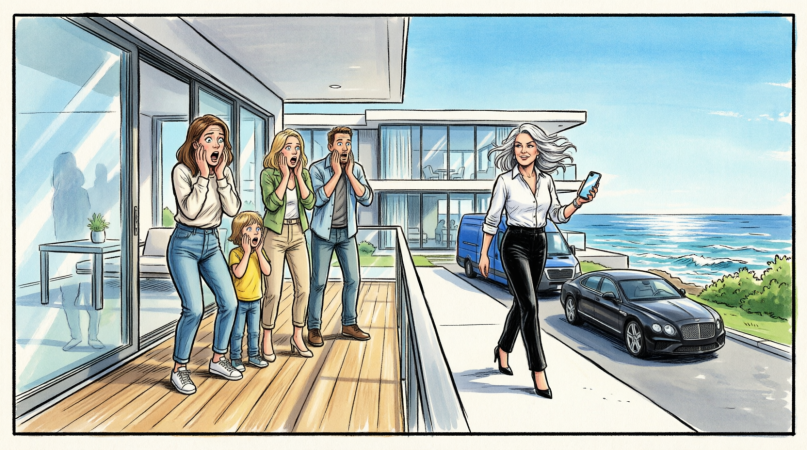
Samantha stood beside him in sunglasses, mouth tight. Behind them, Darlene leaned forward, peering up at the camera like she was inspecting a product.
They weren’t supposed to arrive until next week.
They’d changed flights.
They’d come anyway.
The gate speaker crackled. “Ma’am? They say they’re family.”
I took a breath. I could feel the old reflex, the one that said: Fix it. Don’t embarrass anyone. Let them in so it doesn’t become a bigger thing.
Then I looked at the ocean.
And I remembered how it felt to sit alone on my birthdays while my son posted photos of someone else’s celebration.
I pressed the button. “No,” I said into the speaker. “They’re not expected.”
Ethan’s head snapped up as the speaker carried my voice. He looked directly into the camera like he could see me through it.
“Mom,” he called, loud, performing grief for the gate. “Please. We flew out here to talk.”
Darlene stepped forward and lifted her hands like she was pleading to an audience. “Linda, honey,” she called, voice syrupy. “This is all a misunderstanding.”
Samantha tilted her face away from the camera like she didn’t want her expression documented.
Ethan’s shoulders rose and fell. He was already irritated, I could tell. He wasn’t here humbled. He was here to regain control.
I didn’t open the gate.
I walked to the front door anyway, not because I was letting them in, but because I wanted to face this moment like a woman who owned her own life. I stepped out onto the terrace and looked at them through the iron bars of the gate, the distance a physical boundary that matched the one in my chest.
Ethan’s face changed when he saw me. For a second, surprise flickered—like he’d expected me to crumble, to rush, to be grateful.
Instead, I stood still.
“Mom,” he said, softer now, “please.”
Samantha pushed her sunglasses up onto her head. “We just want to talk,” she said, as if my refusal was childish.
Darlene smiled wide. “Happy birthday, sweetheart,” she added, the words so late they felt like an insult.
I folded my arms loosely, calm. “Why are you here?” I asked.
Ethan blinked. “To see you. To celebrate you.”
“With luggage,” I said.
His jaw tightened. “We thought we’d stay a few days. It’s a big house. You’re alone. We—”
“You thought,” I repeated.
Samantha’s voice turned sharp. “Are you really going to keep us outside like criminals?”
“I’m keeping you outside because you didn’t ask,” I replied. “You arrived after I said no. That’s not love. That’s pressure.”
Ethan exhaled, frustrated. “Mom, come on. I said I’m sorry.”
“You said it because you saw photos,” I answered. “Not because you missed me.”
Darlene stepped closer to the bars. “Linda, you’re being stubborn,” she scolded, like I was a child refusing vegetables. “Families don’t do this. Families share.”
I looked at her and finally understood what she’d been all along: a person who mistook proximity to my son for authority over me.
“Darlene,” I said, voice steady, “you’ve taken my birthday week for years.”
She gasped theatrically. “Taken? Oh, please. We invite Ethan. He comes because he wants to.”
“And he comes because it’s easier to keep you happy than to keep me from being hurt,” I said.
Ethan flinched. Samantha’s eyes narrowed.
“This is ridiculous,” Samantha snapped. “You’re making it a competition.”
“I’m not making it anything,” I said. “It already is. It’s been one for years. You just liked the scoreboard.”
Ethan raised his hands. “Mom, stop. We’re here. We want to make it right.”
“Then start with the truth,” I said.
Ethan blinked. “What truth?”
“Say out loud that you didn’t forget,” I replied. “Say you chose not to call.”
His face tightened. He glanced at Samantha, then back at me. “I didn’t think it mattered that much,” he said.
There it was. The sentence that cracked something open.
I felt my chest go cold. Not because it surprised me. Because it confirmed the deepest fear: that my love had been so reliable it became invisible.
“I see,” I said quietly.
Ethan stepped forward. “Mom, I didn’t mean—”
“Don’t,” I said gently. “Don’t rush to soften it. Sit in it. You didn’t think it mattered.”
Darlene made a disapproving noise. “You’re too sensitive.”
I laughed once, dry. “That’s interesting,” I said. “Coming from someone who requires a surprise dinner every year.”
Samantha’s face reddened. “Excuse me?”
“I’m not excusing anything,” I replied. “I’m clarifying something. This villa isn’t available. Not to you. Not to your mother. Not as a reward for showing up late with luggage.”
Ethan’s voice rose. “So you’re really going to do this? After everything I’ve done—”
I tilted my head. “Everything you’ve done?” I repeated.
He stopped. He realized what he’d said.
Samantha jumped in, voice cold. “Ethan has a family now. He has responsibilities. You can’t expect to be prioritized the same way.”
“I don’t expect to be prioritized over his wife,” I said. “I expect to be acknowledged as his mother. I expect a phone call on my birthday. I expect honesty.”
Ethan’s eyes flashed. “We’re here now!”
“Yes,” I said. “Because you want the villa.”
Darlene’s smile vanished. “Linda, don’t be ugly.”
I leaned closer to the bars, letting my calm sharpen. “You don’t get to call me ugly in my own life,” I said. “And you don’t get to demand access to a home you didn’t earn.”
Samantha’s voice turned sweet in the way sweet can be threatening. “So what, you’ll just cut Ethan off? You’ll punish him?”
“I’m not punishing,” I replied. “I’m rebalancing.”
Ethan’s hands clenched. “Mom, you’re acting like money changes everything.”
“It doesn’t change everything,” I said. “It reveals everything.”
I pulled out my phone and tapped a few times. A security company had walked me through the villa’s system on closing day. One button could call the property manager. Another could call local security.
Ethan saw the motion and stiffened. “Seriously?”
“Yes,” I said. “Because you came to my gate after I said no. That’s not a conversation. That’s an ambush.”
Darlene’s eyes widened. “You wouldn’t.”
I looked at her. “Watch me.”
I pressed the button for the gate speaker. “Please ask them to leave,” I said calmly to the security line. “They’re trespassing.”
Ethan’s face went pale. Samantha swore under her breath. Darlene sputtered, “This is unbelievable!”
Ethan slammed a hand against the bars, not hard enough to hurt himself, just hard enough to express rage. “Mom!” he snapped. “What happened to you?”
I met his eyes through the gate and let the truth be plain. “I stopped begging,” I said.
He stared at me, breath heavy, and I saw something shift. Not remorse. Not yet. Confusion. The disorienting feeling of a person realizing the rules changed without his permission.
Security arrived quickly—a polite man in a uniform, voice firm. “Sir, ma’am, you need to step away from the gate,” he said.
Ethan’s mouth opened, ready to argue. Samantha grabbed his arm. Darlene kept talking, trying to negotiate like she was used to getting her way.
“I just want to talk to her,” Ethan said, voice cracking, and for a second I heard the child he used to be.
But then Samantha hissed, “Ethan, stop humiliating yourself.”
And the child vanished. His jaw tightened. His eyes hardened. He picked up the suitcases like weapons and turned away.
As they walked back toward their rental car, Darlene looked over her shoulder and threw one last line like a curse.
“You’ll regret this when you’re old and alone!”
I watched them go. My heart pounded, but my hands were steady.
When the car disappeared down the coastal road, I didn’t feel victory.
I felt grief.
Not for losing them. For realizing how long I’d been losing myself.
That night, Ethan texted from a new number.
You didn’t have to embarrass me.
I stared at the message, then typed back one sentence.
You embarrassed me for years. I just stopped hiding it.
Then I turned the phone off and went to the terrace.
The ocean kept breathing, indifferent and faithful. I listened until my heartbeat matched it.
Part 4
The next day, the consequences arrived dressed in concern.
My sister called first. “Linda, what is going on?” she asked, voice tight. “Ethan says you locked them out and called security.”
“I didn’t lock them out,” I replied. “I didn’t let them in.”
“That’s basically the same thing,” she snapped.
“It’s not,” I said. “One is exclusion. The other is boundaries.”
My sister sighed like I was exhausting. “He’s your son.”
“And I’m his mother,” I replied. “Which should mean something other than a wallet and a convenient forgiving person.”
She went quiet, then tried another angle. “Samantha’s family is telling people you’re unstable,” she warned.
“I know,” I said. “They called it an episode.”
My sister hesitated. “Well… are you okay?”
I looked out at the water. “I’m better than I’ve been in years,” I said.
She didn’t know what to do with that. She ended the call quickly, as if calm was suspicious.
Then came the texts from extended family.
It’s just a birthday.
You only get one son.
Be the bigger person.
I didn’t respond. I’d spent a lifetime being the bigger person. All it ever earned me was being stepped on.
Three days passed. The villa, quiet and luminous, began to feel like it belonged to me, not like a stage I’d built out of spite. I went into town and bought groceries I liked, not groceries that made sense for someone else’s diet. I filled the fridge with fruit and good cheese and a bottle of wine I didn’t save for company.
On the fourth day, Ethan called again. This time, he used his own number.
I stared at it for a long moment before answering.
“Hi,” I said.
His voice sounded different—less rage, more fatigue. “Hi, Mom.”
We sat in silence, both of us hearing years in the gap.
“I didn’t come to fight,” he said finally.
“You came with luggage,” I replied.
He exhaled. “I know. That was… Samantha’s idea.”
“And you agreed,” I said gently.
“Yes,” he admitted. “I did.”
I let the admission land. “Why?” I asked.
He hesitated. “Because it’s easier,” he said, and I heard shame in it this time. “It’s easier to do what Samantha wants. It’s easier to go along with Darlene. They make things… loud.”
“And I make things quiet,” I said.
“Yes,” he whispered. “You make things safe. And I took advantage of that.”
My throat tightened. Not because the words fixed anything, but because they were the first true ones he’d said.
“I’m sorry,” he said. “Not because of the house. Not because people are mad. I’m sorry because I made you feel invisible.”
I closed my eyes. My heart ached in a way that was almost familiar—like the ache of loving someone who doesn’t know how to hold it.
“Thank you,” I said softly.
He swallowed. “Samantha is furious,” he admitted. “She thinks you’re trying to control us.”
“I’m trying to control my own life,” I corrected.
“I know,” he said quickly. “I’m starting to see that.”
A beat of silence.
“Do you hate me?” he asked, voice small.
The question cracked something open. He’d been defensive for so long, I’d almost forgotten he could sound like my son.
“I don’t hate you,” I said. “But I’m done being treated like an afterthought.”
“I want to fix it,” he said.
“Then you start with consistency,” I replied. “Not a dramatic gesture. Not a vacation. Consistency.”
He exhaled. “Okay.”
“And you don’t get to use my house as proof you love me,” I added. “Love is behavior. It’s not a photo op.”
“I understand,” he said.
I could hear him shifting somewhere, maybe pacing. Then he said, “Can I come alone? Just… me. No Samantha. No Darlene. Can we talk face to face?”
My instinct was to say yes immediately, to grab any chance at closeness like it might evaporate.
I didn’t.
I breathed. I remembered the gate.
“Yes,” I said finally. “But not to stay. You can come for lunch. We can talk. Then you leave.”
He was quiet for a moment, then: “That’s fair.”
The next afternoon, Ethan arrived alone.
No suitcases.
Just him, standing at my gate with his hands empty, looking older than I remembered. Or maybe I was seeing him clearly for the first time in years, without the noise of everyone else around him.
I opened the gate.
He walked up the path slowly like he was entering a place he didn’t deserve.
When he reached the terrace, he stopped and stared at the view, then at me. His eyes got wet, and he blinked fast, embarrassed.
“I didn’t know you could do this,” he whispered.
“That’s the point,” I said.
He swallowed. “I thought you were… just… Mom,” he admitted, and the words were clumsy but honest. “Like you’d always be there, same house, same routine. Like your life was… waiting.”
I nodded. “A lot of people think that about mothers,” I said. “We become furniture.”
He flinched. “I didn’t mean—”
“I know what you meant,” I said. “And I’m telling you the truth. It hurt.”
We ate lunch at the outdoor table. He picked at his food at first, then finally looked at me with something raw in his expression.
“Samantha’s mom makes everything about her,” he confessed. “Her birthday week is… a whole production. If we don’t go, she cries. She calls Samantha ungrateful. Samantha panics. And then I… I just go along so it stops.”
“And my birthday?” I asked quietly.
He looked down. “You never made it loud,” he said. “You never punished me. You always said it was fine.”
“I said it was fine because I didn’t want to beg my own son,” I said.
He pressed his fingers to his forehead, like he needed to hold himself together. “I’m sorry,” he said again, this time with weight. “I didn’t realize silence could be pain.”
I watched him and felt something complicated move through me—love, grief, anger, tenderness. Motherhood is never one thing.
“What do you want now?” I asked.
He looked up. “I want to be better,” he said. “I want to show up. But I don’t know how to do it without blowing up my marriage.”
“That’s your work,” I said gently. “Not mine.”
He nodded slowly, absorbing the boundary.
“I can’t keep funding your peace,” I continued. “If your peace requires my disappearance, it’s not peace.”
Ethan’s eyes filled. “What if Samantha never changes?” he asked.
“Then you decide what kind of man you want to be,” I said. “One who avoids loud people by sacrificing quiet ones, or one who learns to stand.”
He sat back, stunned. “You sound like Grandma,” he whispered.
I smiled, small. “She gave me this inheritance,” I said. “And she gave me her backbone with it.”
When he left, he hugged me at the gate.
Not the quick, polite kind. The kind that lingers, like he was trying to memorize what it felt like to hold his mother without rushing.
“I’ll call you tomorrow,” he said quietly.
I nodded. “I’ll answer,” I replied.
After he drove away, I stood in the driveway and let the sun warm my face. For the first time, I didn’t feel like my love was a trap. It felt like a choice again.
Over the next weeks, Ethan did call. Not every day, but often enough to matter. He asked about my mornings. He asked what I was reading. He asked what I liked about the villa besides the view. He listened to my answers instead of racing to the end of the conversation.
Samantha didn’t call.
Instead, she posted vague quotes online about toxic parents and boundaries being manipulation. People commented hearts. Darlene shared it with a caption about “narcissists.”
I didn’t respond.
I didn’t need to.
Because my life was no longer a debate in someone else’s comment section.
Two months later, on an ordinary Thursday, my phone buzzed with a text from Ethan.
Samantha wants to talk to you. Not about the house. About us. I told her it has to be respectful or it doesn’t happen.
I stared at the message. My heart pounded, but it wasn’t fear. It was the sensation of something changing shape.
I wrote back.
We can talk. One hour. If it turns into insults, I hang up.
Ethan replied: Thank you.
That call didn’t fix everything. Samantha was stiff, defensive, and careful with her tone like she was reading from a script. She apologized in the way people apologize when they’re still deciding if they’re wrong.
But she heard me say, clearly, that I would not compete with her mother for my son’s basic kindness. She heard me say that my birthday mattered because I mattered, not because it was a date to manage.
And she didn’t hang up.
That was a start.
On my next birthday, I woke up to sunlight and the ocean, and my phone buzzed at 7:03 a.m.
Happy birthday, Mom. I’m calling at lunch. I already cleared it.
No excuses. No “later.” No mention of Darlene.
At noon, Ethan called. He sang—badly, laughing at himself—and I laughed too, surprising myself with how easy it felt.
That evening, I hosted a small dinner at the villa. Friends, neighbors I’d gotten to know, people who didn’t treat love like a transaction. I lit candles. I made food I enjoyed. I let myself be celebrated without guilt.
Later, alone on the terrace, I looked out at the dark ocean and understood something my younger self never could have accepted.
Sometimes the loudest revenge is simply living a life that doesn’t require permission………
Part 5
The first birthday I celebrated at the villa without waiting for permission felt like a miracle.
The second one revealed what miracles always reveal: how many people believe your joy must be negotiated through them.
A week after that quiet dinner with my friends, a package arrived at my gate with no return address. The security system pinged my phone with a photo of the delivery—plain brown box, ordinary tape, ordinary enough to be suspicious.
I brought it inside, set it on the kitchen island, and stared at it like it might speak.
I didn’t open it.
Instead, I called the property manager and asked them to send someone from security to look at it. The man who arrived was polite, careful, and unromantic about danger. He wore gloves, checked seams, then opened the box with the calm of someone who’d done it before.
Inside was a photo album.
Not an old one, not sentimental. New. Glossy cover. A printed title in silver letters.
Family Memories.
I felt my stomach tighten.
The security man glanced at me. “Do you know who sent this?”
“I have a guess,” I said.
He flipped it open carefully, like paper could cut. The first page was a collage of pictures from Ethan and Samantha’s trips: vineyards, beaches, fancy dinners. And then, like a jump scare, there were screenshots.
My villa photos.
My caption.
My face from an old Christmas picture, cropped and blown up, the kind of thing you do when you want to make someone look small.
Underneath, in neat typed text:
When you isolate, you lose.
I didn’t touch the album. My throat went cold, not with fear, but with recognition.
This wasn’t Ethan.
This was Darlene.
Darlene had always collected power through insinuation. She didn’t confront; she curated. She didn’t argue; she planted. When Samantha married Ethan, Darlene came with her like luggage you aren’t allowed to set down.
I’d seen it in the first year of their marriage. Darlene would call during dinner and Samantha would answer on the first ring, voice instantly brighter, as if she’d been waiting for permission to exist. Ethan would roll his eyes, but he’d sit through it. He’d learned, the way so many men learn, that letting women fight is easier than stepping between them.
My phone buzzed as if summoned.
Unknown number.
I didn’t answer.
It buzzed again. Then again. And when I finally looked at the voicemail transcription, I laughed once, short and humorless.
Darlene: Linda, I’m very concerned about your mental state. I think we need to talk, as a family.
My mental state.
I stared at the ocean through the glass wall and felt something settle into my bones.
This was what they did when they couldn’t control you: they diagnosed you.
I texted Ethan a photo of the album cover and one sentence.
This arrived today. If you didn’t send it, you need to know your wife’s mother is escalating.
He called within sixty seconds.
“Mom,” he said, voice sharp, “did you open it?”
“I had security open it,” I replied. “It’s not a gift.”
His breathing turned fast. “I didn’t send that. Samantha didn’t either.”
“Then who did?” I asked, already knowing.
A pause. Then Ethan swore under his breath. “Darlene,” he said.
“Ethan,” I said quietly, “this is harassment.”
“I know,” he said, and his voice sounded like someone who had been trying not to know something for years.
I could hear movement in the background—drawers, footsteps, a door shutting. He was pacing, the way he used to pace before tests in high school, restless and scared of failing.
“She’s been… weird since your post,” he admitted. “She keeps saying you’re trying to ‘buy’ Ethan away from us. Like you’re competing.”
“I’m not competing,” I said. “I’m living.”
“I know,” he said again, and this time it sounded like a promise he was trying to keep. “Mom, I’m going to handle this.”
“Good,” I replied. “And I’m going to protect myself.”
There was a beat of silence.
“Are you going to… sue her?” he asked, uneasy.
“I don’t know,” I said. “But I’m documenting everything.”
“Mom,” he pleaded softly, “please don’t blow this up.”
I closed my eyes. The old me would’ve softened instantly. The new me felt the boundary like a wall.
“You mean please don’t make it loud,” I said. “Because loud makes you uncomfortable.”
Ethan didn’t deny it. He just exhaled. “Yes,” he admitted. “It does.”
“Then learn to sit in discomfort,” I said. “Because I’ve been sitting in pain quietly for years, and nobody cared until it got loud.”
His voice cracked. “I care.”
“Then prove it,” I replied.
Two days later, Samantha called me for the first time in weeks.
Her tone was careful, like she was stepping onto ice. “Linda,” she said, “I want to apologize if my mom has upset you.”
If my mom has upset you.
Not: I’m sorry she did this.
Not: That’s wrong.
Not: I will stop it.
I listened to her words and heard the leash.
“Samantha,” I said calmly, “your mother sent me a harassment package.”
“She was just trying to…” Samantha’s voice faltered. “She gets emotional.”
“She gets controlling,” I corrected. “And you’ve been trained to translate that as love.”
Samantha’s breath sharpened. “You don’t know my mother.”
I almost smiled. “I know what she does,” I said. “And I know what it did to my son.”
Silence. Then Samantha said, defensive, “Ethan is a grown man. He chooses.”
“He chooses the path of least resistance,” I replied. “And your mother built herself into a mountain.”
Samantha’s voice tightened. “So what do you want?”
The question was sharp, like she expected me to demand something unreasonable so she could label me. I chose simplicity.
“I want your mother to stop contacting me,” I said. “No calls. No packages. No posts. No gossip. If she wants to speak to Ethan, she can speak to Ethan. I’m not her target.”
Samantha scoffed. “You’re acting like she’s dangerous.”
“She’s not physically dangerous,” I said. “She’s emotionally predatory. And I’m done being prey.”
Another pause.
“She just wants the family together,” Samantha said, softer now, the line she’d been taught.
“Then she can try respect,” I replied. “Because intimidation isn’t togetherness.”
Samantha’s voice cooled. “Ethan thinks you’re being harsh.”
“I’m sure he does,” I said. “Because harsh is what boundaries feel like to people who benefit from your lack of them.”
I hung up before she could answer. Not out of spite. Out of self-respect.
That night, Ethan called again, voice heavy.
“I talked to Darlene,” he said.
“And?” I asked.
“She cried,” he admitted. “She said you humiliated her. She said you’re trying to ‘replace’ her.”
I stared at the dark ocean, its surface glittering with moonlight. “I didn’t know she needed replacing,” I said.
Ethan exhaled a laugh that sounded like pain. “Mom, she’s—she’s intense.”
There was the word again, passed down like a curse.
I said nothing for a moment, letting him hear what it sounded like when the label lived in his mouth.
Finally he whispered, “I get it.”
“Do you?” I asked.
“Yes,” he said, and his voice turned firmer. “I told her she can’t contact you. I told her if she does it again, I’ll cut contact.”
My chest tightened. “That’s a big promise,” I said.
“I know,” he replied. “But I’m serious.”
“And Samantha?” I asked.
A long pause. “Samantha says I’m choosing you over her,” he admitted.
“I’m not asking you to choose,” I said. “I’m asking you to stop sacrificing me.”
His voice cracked. “I didn’t see it that way.”
“I know,” I said softly. “That’s why it kept happening.”
The next week, the smear campaign shifted.
Instead of calling me unstable, Darlene started calling me selfish. She told people I’d bought the villa “to flaunt” and that I was refusing to share because I was “stingy.” Samantha’s aunt posted a vague status about how some people forget where they came from. Darlene’s church friend messaged my cousin asking if I’d joined a cult.
It was almost funny, the creativity of their discomfort.
Then the letter arrived.
Not a package this time. A formal envelope, crisp, thick paper. A law firm letterhead.
I sat at the dining table with the ocean behind me and opened it slowly, expecting something ridiculous.
It was ridiculous.
It claimed I was “emotionally manipulating” Ethan with my wealth. It requested that I stop posting “provocative content.” It suggested I meet with a mediator “to restore healthy family dynamics.” It threatened “further steps” if I continued to “alienate” my son.
Alienate.
I laughed out loud, a sharp sound in my empty house.
They were trying to weaponize legal language to recreate the old order: me quiet, them comfortable.
I forwarded the letter to my attorney.
Then I forwarded it to Ethan with one line.
Your mother-in-law hired a lawyer to tell me to stop living.
Ethan called immediately, and his voice was not calm.
“What the hell is this?” he demanded.
“I’m glad you’re angry,” I said. “Hold onto it.”
“She didn’t tell me,” he snapped. “Samantha didn’t tell me.”
“Because they don’t want you involved,” I said. “They want you obedient.”
I heard his breathing, heavy. “Mom, I’m so sorry.”
“Don’t apologize,” I said. “Act.”
There was a beat of silence, and then I heard something I hadn’t heard from him in years.
Resolve.
“I’m coming over,” he said.
“No,” I replied instantly. “Not as a reaction. Not as a dramatic gesture.”
“I’m not coming to stay,” he insisted. “I’m coming to talk. And then I’m going home and having a conversation I’ve been avoiding for too long.”
I hesitated, then nodded even though he couldn’t see it. “Fine,” I said. “Lunch. Two hours.”
When Ethan arrived, he looked like a man carrying a storm in his chest. He didn’t admire the view this time. He didn’t comment on the house. He sat at the table like the ocean was irrelevant.
He slid his phone across to me.
On the screen was a text thread between Samantha and Darlene.
Darlene: If she won’t share, make her.
Samantha: Ethan is getting suspicious.
Darlene: Then distract him. This is our chance.
Samantha: She’s going to leave everything to charity if we don’t move fast.
Darlene: Use the grandbaby card if you have to.
My throat went cold.
“You don’t have kids,” I said quietly.
Ethan’s jaw tightened. “No,” he said. “But they’ve been talking about it like a tool.”
I stared at the texts, and the room felt suddenly smaller, like the glass walls were closing in.
Ethan swallowed hard. “I’m sorry,” he said, voice raw. “I didn’t know my life was… a strategy meeting.”
I looked at him—my son, the boy I’d taught to remember dates, the man who’d learned to disappear into other people’s demands—and I felt something like grief and relief collide.
“This is why I didn’t tell you about the inheritance,” I said softly. “Because I needed to know who you were when you thought I had nothing.”
Ethan’s eyes filled. “And who am I?” he whispered.
I held his gaze. “You’re someone who forgot me,” I said. “But you’re also someone who can still choose to stop.”
He nodded slowly, tears slipping down his cheek in a way he didn’t try to hide. “I’m going to confront Samantha,” he said.
“Don’t just confront,” I replied. “Decide.”
He swallowed. “I love her.”
“I know,” I said. “Love doesn’t excuse complicity.”
Ethan left the villa with his shoulders set differently, as if he’d finally picked up a spine that had been waiting for him.
That evening, he called me from his car.
“I told Samantha we’re doing counseling,” he said. “And I told her Darlene is no longer part of our decision-making.”
“And what did Samantha say?” I asked.
He exhaled. “She said I’m choosing you,” he admitted. “And I said, ‘No. I’m choosing me.’”
My throat tightened. “That’s a big sentence,” I said.
“It felt like jumping off a cliff,” he replied. “But I didn’t fall. I’m still here.”
Two months later, Samantha sent me a message that didn’t sound like a script.
Linda, I’m sorry. Not for being upset. For treating you like an obstacle. I’m in therapy. I’m trying to learn the difference between loyalty and fear.
I read it three times. I didn’t reply immediately.
I wanted to. I wanted to forgive, because forgiveness was my oldest habit. But I’d learned something in the villa’s quiet.
You don’t reward words. You watch for behavior.
So I replied with one line.
Thank you. Show me.
Part 6
The ocean doesn’t care about your family drama.
It keeps moving, keeps breathing, keeps reminding you that your life is both small and sacred. In the months after the lawyer letter, I stopped treating the villa like a fortress and started treating it like what it was meant to be: a home built for my peace, not my revenge.
I joined a local book club. I learned the names of my neighbors. I found a bakery in town that made cinnamon rolls so good they felt illegal. I planted jasmine by the terrace and watched it climb, slow and stubborn, the way healing does.
Ethan and Samantha began counseling. Ethan called me once a week, not as a duty, but as a habit he was building on purpose. Sometimes we talked about practical things—his job, a leaky sink, the kind of boring details that used to be our only safe territory. Other times he surprised me.
“I’ve been thinking about when Dad left,” he said once, voice quiet. “I think I learned that love is something you chase. Something you earn by being easy.”
My chest tightened. “You didn’t have to earn me,” I said.
“I know,” he replied. “But I think that’s why I treated you like… an always. Like gravity. Like I could ignore it and it would still hold me.”
Silence hung between us. Then he added, “I’m trying to stop living like that.”
I didn’t fix him. I didn’t soothe him. I let him do his own work, because that’s what adults do when they finally mean their apologies.
Samantha stayed quieter. She didn’t send long explanations. She didn’t post vague quotes anymore. She stopped using the internet as a courtroom.
And Darlene… Darlene went nuclear.
She showed up at Ethan’s house one Sunday with a cake and a smile that looked like a weapon. When Ethan told her she couldn’t come in without calling first, she screamed on the porch. When he told her she needed to stop contacting me, she cried loud enough for neighbors to peek through their blinds.
Then she did what controlling people always do when they’re losing power.
She played the victim in public.
A week later, I got a call from a woman I hadn’t spoken to in ten years—someone from the old neighborhood.
“Linda,” she said, voice hesitant, “I hope you don’t mind me asking… are you okay? Darlene said you’re being… isolated. That Ethan is worried.”
I closed my eyes and let the anger pass through me like a wave.
“I’m more than okay,” I said. “And Ethan knows exactly where I am.”
After that call, I made a decision my mother would have applauded.
I protected the future.
I met with my attorney and set up my own trust.
Not to punish Ethan. Not to hide money like a secret weapon. But to remove money from the emotional battlefield entirely.
I designated a portion to a scholarship fund for kids raised by single parents, because I knew exactly what it cost to keep a household running when you’re the only adult in the room. I designated a portion to my own care, because growing older shouldn’t be treated like a threat someone can use against you. And I designated a portion that would go to Ethan only under one condition: it would be controlled by him alone, not by any spouse, not by any in-law, not by any “family council.”
My lawyer raised an eyebrow. “That’s specific,” she said.
“It’s protective,” I replied.
When I told Ethan, he didn’t argue. He looked relieved.
“I don’t want your money,” he said quietly. “I want you.”
The sentence hit me hard, not because it was perfect, but because it was new.
“I want you too,” I admitted. “But I want us without leverage.”
He nodded. “Me too.”
The first time Samantha came to the villa again was six months after the gate incident.
She didn’t arrive with luggage. She didn’t arrive with her mother. She didn’t arrive like she owned anything.
She arrived with Ethan, hands empty, shoulders tense, and eyes that looked like they’d been opened wider than comfort.
At the gate speaker she said, “Linda, it’s Samantha. We’re early. If this isn’t a good day, we can leave.”
I paused, hand on the control panel, and felt something unfamiliar: choice without guilt.
I opened the gate.
When they walked up the path, Samantha looked around at the stone and glass and ocean, then looked at me as if she was seeing the real problem for the first time: I wasn’t small.
“Thank you for letting me come,” she said, voice careful.
“Thank you for asking,” I replied.
We sat on the terrace with iced tea sweating in the sun. Ethan spoke first, because he always had been the bridge. But Samantha surprised me by not hiding behind him.
“I grew up thinking love is obedience,” she said, staring at her hands. “My mom trained me. If she was happy, I was safe. If she was angry, I felt like I was dying.”
I didn’t interrupt.
Samantha continued, voice shaking. “When Ethan chose your birthday less and less, I… I liked it,” she admitted, and the honesty was sharp. “Because it proved he’d choose my world over yours. I didn’t even know I was doing that. I thought I was building a family. But I was… competing.”
Ethan’s jaw tightened. He didn’t defend her. He let her speak.
Samantha looked up at me, eyes wet. “I’m sorry,” she said. “I’m sorry I treated you like a threat. I’m sorry I used your silence as proof you didn’t mind. I’m sorry I let my mom turn you into a villain.”
The apology wasn’t pretty. It was real.
I felt my throat tighten. “Thank you,” I said quietly. “I accept that.”
Samantha exhaled like she’d been holding her breath for years.
Then I added, gently but firmly, “And I need you to understand something. My forgiveness doesn’t mean we go back. We build something new.”
Samantha nodded immediately. “I want that,” she said, voice rough. “I do.”
Ethan’s eyes filled. He looked between us like he couldn’t believe the room wasn’t exploding.
That afternoon, when they left, Ethan hugged me and whispered, “I’m proud of you.”
“For what?” I asked.
“For not slamming the door,” he said. “For slamming it when you needed to.”
That night, my phone buzzed with a notification from the security camera at the gate.
Motion detected.
I opened the feed and felt my stomach drop.
Darlene stood outside with a man in a polo shirt holding a clipboard, as if she could bring authority like a costume. She pointed toward my gate, speaking animatedly. The man nodded, uncomfortable.
A second later, the gate speaker buzzed.
“Ma’am,” the property manager’s voice came through my panel, tense, “there’s someone here claiming she has a right to access. She’s with a process server.”
Process server.
I felt my heartbeat spike, then flatten into calm. I’d expected this. Controlling people don’t accept boundaries. They litigate them.
I pressed the speaker button. “Darlene,” I said evenly, “you are not permitted on my property.”
Her face lifted toward the camera like she knew I was watching. She smiled, bright and mean.
“Oh, Linda,” she called, voice theatrical, “don’t be dramatic. I’m here for family business.”
“There is no family business,” I said. “There is only your obsession with control.”
The process server shifted awkwardly, like he’d rather be anywhere else.
Darlene’s smile faltered. “You can’t keep Ethan from us,” she snapped.
“I’m not keeping Ethan from anyone,” I replied. “Ethan is a grown man. And he has chosen to stop being managed by you.”
Her face twisted. “He would never—”
“He already did,” I said. “Now leave.”
Darlene’s voice rose. “You think that house makes you powerful?”
I leaned closer to the panel, letting my voice stay calm. “No,” I said. “The house proves I was always powerful. I just stopped pretending I wasn’t.”
The process server cleared his throat and held up papers toward the camera as if that would make them official. “Ma’am,” he called, “I have documents—”
“You can leave them at the gate,” I said. “My attorney will respond.”
Darlene sputtered. “Attorney? Of course you’d hide behind lawyers.”
I almost laughed. “You brought one,” I replied.
She stared at the gate, then at the camera, then finally spun on her heel like a woman storming off stage when the audience won’t clap.
The papers she left were laughable: a petition claiming “grandparent rights” to future grandchildren, as if she could trademark Ethan’s unborn child. A demand letter insisting I stop “interfering” with family travel traditions. A threat that she would “expose” my finances to public scrutiny.
I forwarded everything to my attorney and went back to my life.
Because this was the most important lesson the villa had taught me: you don’t have to attend every argument you’re invited to.
A year passed.
Darlene’s threats faded when she realized they weren’t getting traction. Ethan and Samantha moved farther away from her. They didn’t cut her off completely—Ethan wasn’t ready for that kind of finality—but they stopped letting her steer.
And then, quietly, Samantha did something that told me her therapy was real.
She planned my birthday.
Not a big production. Not a show. A plan.
A week before my birthday, Ethan called and said, “We want to come for dinner. Just us. No luggage. One night at a hotel in town. We’ll bring food. We’ll leave if you say no.”
I sat on my terrace, jasmine blooming, ocean steady beyond it. I felt my chest tighten with something I hadn’t expected to feel again.
Anticipation without dread.
“Yes,” I said. “You can come.”
On my birthday morning, I woke up to sunlight and a message from Ethan at 7:03 a.m., like last year, but warmer.
Happy birthday, Mom. I’m grateful you’re here.
Samantha’s message came a minute later.
Happy birthday, Linda. Thank you for teaching me what boundaries look like.
In the afternoon, they arrived with a small cake from that bakery in town and a photo album that wasn’t a weapon.
It was full of pictures from Ethan’s childhood that I’d forgotten existed. Me holding him in a Halloween costume. Him on my shoulders at a parade. A crayon drawing labeled Mom’s House with a stick figure smiling so wide it looked like the whole paper might tear.
Ethan handed it to me with shaking hands. “I found these in storage,” he said. “I realized I’ve been acting like my childhood just… happened. Like you weren’t the reason it was safe.”
Tears filled my eyes. I didn’t wipe them away. I let them be honest.
Samantha set plates on the table, moving quietly, respectfully, like she knew she was earning trust, not claiming it.
At dinner, Ethan raised his glass. His voice trembled once.
“To my mom,” he said. “Who raised me alone and still kept love in the house. Who taught me how to show up. And who finally taught me what happens when you don’t.”
I laughed through tears. “That’s a dramatic toast,” I said.
“It’s a dramatic truth,” he replied.
Later, after cake and conversation and a sunset that turned the pool copper again, Ethan and Samantha left, hugging me at the door. Ethan held on a second longer.
“I’m sorry it took a villa to wake me up,” he whispered.
“It didn’t take a villa,” I replied. “It took me stopping the pattern.”
When they drove away, I stayed on the terrace alone, the ocean breathing like it always did.
My phone was quiet.
Not because I was forgotten.
Because I was at peace.
I thought about my mother’s note in the trust documents, the one that had waited for me to be ready.
Use it when you’re ready to stop waiting for permission.
I smiled at the horizon and whispered into the wind, “I’m ready.”
And for the first time in a long time, that felt like a beginning, not a defense.
THE END!
Disclaimer: Our stories are inspired by real-life events but are carefully rewritten for entertainment. Any resemblance to actual people or situations is purely coincidental.