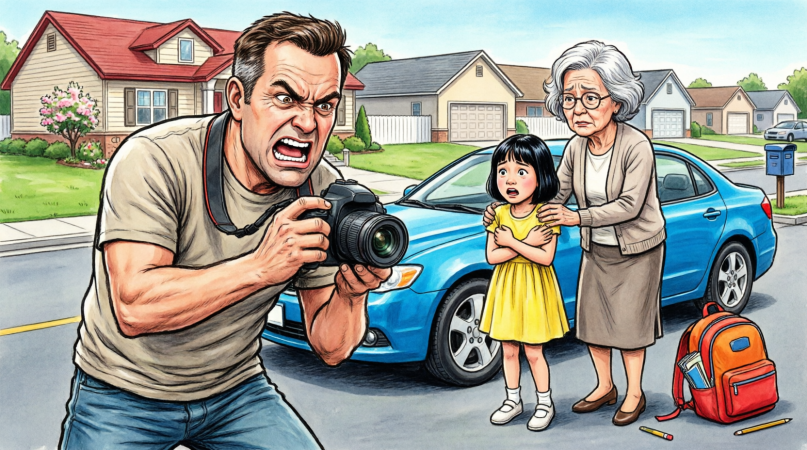
My Daughter Begged Me Not To Go On My Business Trip. “Daddy, When You Leave, Grandma Takes Me Somewhere. She Tells Me Not To Tell You.” I Canceled My Flight. Told No One. Parked Down The Street. At 9 Am, My Mother-in-law Pulled Into The Driveway. She Took My Daughter’s Hand And Walked Toward Her Car. I Followed Them. When I Saw Where She Took Her,…
 To read the FULL story and discover what happens next:
 Like this post
 Tap “ALL C0MMENTS” to check C0mment with FULL ST0RY
 Type “KITTY” To Read The Full Story. When We Reach 30 Comments “KITTY” The Full Story Will Be Revealed.

The Tuesday morning sun filtered through the kitchen blinds as Tony Glass poured coffee into his daughter’s favorite mug, the one with the cartoon elephants. Emma sat at the breakfast table, pushing scrambled eggs around her plate, her seven-year-old face drawn tight with worry.
She hadn’t touched her food, and that was the first sign something was wrong. Emma loved breakfast. Dad. Her small voice cut through the quiet kitchen sounds. Tony turned from the counter. Yeah, baby. Do you really have to go to Boston? It was the third time she’d asked since last night.
The Pittsburgh documentary film conference was important for his career. 3 days of networking, potential clients, funding discussion for his next project about urban renewal in rust belt cities. He’d been working as an independent documentarian for 12 years, building a reputation for thorough research and compelling storytelling that exposed uncomfortable truths.
But Emma’s expression made him hesitate. It’s just 3 days, M. You’ll stay with mom and grandma Agnes. You love spending time with them. Something flickered across Emma’s face. Fear. Unmistakable fear. Tony sat down his coffee and knelt beside her chair. What’s wrong? Emma’s eyes welled up. She glanced toward the doorway, checking if anyone was listening, then leaned close to whisper.
When you leave, Grandma Agnes takes me somewhere. She tells me not to tell you or mommy. She says, “It’s our special secret.” The words hit Tony like ice water. His documentary work had taken him into dark corners of society. He’d exposed corruption, abuse, negligence. He developed instincts for when something was deeply fundamentally wrong. Those instincts screamed now.
Where does she take you? He kept his voice calm, steady, even as his heart hammered. I don’t know what it’s called. It’s a big house with a blue door. There are other kids there sometimes. And grown-ups who make us do things. Tony’s blood went cold. What kind of things? Emma’s lip trembled. They take pictures.
They make us wear different clothes and smile and touch each other and she burst into tears. Tony pulled her into his arms, his mind racing. Helen, his wife of 9 years, was already at her law office downtown. Agnes Taylor, Helen’s mother, had been living in the guest house behind their property for the past 6 months after her husband died.
The arrangement had seemed perfect. Family support, help with Emma when both parents work demanding schedules. Emma, listen to me. Tony held her face gently. You did the right thing telling me you’re so brave. I’m not going to Boston, okay? I’m going to stay here and fix this. Grandma said if I tell, something bad will happen to you and mommy. Nothing bad is going to happen.
I promise you. Tony had made a career of exposing predators. He’d filmed interviews with trafficking survivors, documented evidence of abuse rings, worked with law enforcement to bring down operations that exploited vulnerable people. He understood how these networks functioned. The threats, the secrecy, the careful grooming, the fact that it was happening to his own daughter, orchestrated by his wife’s mother, made him want to vomit.
He texted his conference contact with an excuse about a family emergency, then called his wife. Tony, what’s wrong? Helen’s voice carried concern. I need you to come home now. It’s about Emma. Is she sick? Hurt? Just come home. Don’t tell your mother. There was a pause. My mother? Tony? What? Please, Helen.
Trust me. 30 minutes later, Helen Glass walked through their front door, her professional composure cracking when she saw Tony’s expression. She was a corporate attorney, sharp and logical, someone who dealt in evidence of facts. He need both from her now. They sat in his home office while Emma watched cartoons in the living room with the door closed.
Tony had spent the waiting time checking his video equipment, his mind already planning. He told Helen everything Emma had said, watching his wife’s face drain of color. That’s impossible, Helen whispered. My mother wouldn’t. She loves Emma. She’s been taking care of her since. She stopped. Oh, God. since you started traveling more for work last year.
Tony opened his laptop and pulled up Emma’s therapy drawings. He noticed them recently, disturbing images his daughter had created during sessions with her school counselor after displaying anxiety. The counselor had attributed it to adjustment issues after her grandfather’s death. But now, looking at the drawings again, Tony saw what he’d missed before.
A blue door, multiple stick figures, a camera. I documented everything Emma told me this morning. He showed Helen the recording on his phone. We’re going to the police. Wait. Helen’s lawyer instincts kicked in. We need more than a child’s testimony and some drawings. You know how these cases work. It’ll be his word against hers.
Except she’s seven and Agnes is a 62-year-old widow. They’ll say Emma has an active imagination or misunderstood something innocent. Tony had already thought of this. Then I’ll get more evidence. Helen looked at him. Ow. I’m supposed to fly out tomorrow morning at 7:00. I’ll tell your mother I’m leaving as planned.
I’ll even have you drive me to the airport, but I’ll come back. I’ll follow Agnes when she takes Emma. That’s dangerous. Helen said, “If this is real, if there are other people involved, I’ve documented war criminals.” Helen, I’ve interviewed cartel members. I know how to stay unseen and capture everything on camera. He paused.
And if what Emma says is true, those people are hurting our daughter. I don’t care about danger. Helen closed her eyes. When she opened them, they were hard. Then I’m coming with you. No, you need to act normal. If Agnes suspects anything, she’ll disappear and we’ll never find where she takes Emma. You have to go to work tomorrow like everything’s fine.
Trust me to handle this. They spent the rest of the day crafting their plan. Tony would pack for Boston, make a show of leaving. Helen would maintain her schedule. They’d tell Agnes nothing. Tony had years of experience conducting covert surveillance for his documentaries. He knew how to be invisible…
That night, as he tucked Emma into bed, she clung to him. “You’re not really leaving, are you, Daddy? I’m going to protect you,” he said. “No one will ever hurt you again.” After she fell asleep, Tony sat in his office assembling his equipment. two small highdefinition cameras, a long range directional microphone, his phone with tracking capabilities, and a digital recorder.
He’d spent his career documenting truth. Tomorrow, he document something that would either destroy his family or save it. Helen appeared in the doorway. My mother just texted. She’s asking what time you’re leaving tomorrow. Tell her 7. Tell her you’re driving me to the airport, Tony. Helen’s voice cracked.
What if we’re wrong? What if there’s an explanation? He thought of Emma’s tears, her fear, the specific details she’d shared. Details no 7-year-old should know. We’re not wrong. The next morning unfolded like a carefully staged performance. Tony loaded his suitcase into Helen’s Mercedes at 6:30 while Agnes waved from the guest house window.
Emma ate breakfast quietly, shooting him meaningful glances. Helen kissed him goodbye in the driveway with Oscar worthy authenticity. “I’ll miss you,” she said loud enough for Agnes to hear. “3 days,” Tony replied. “I’ll call tonight.” He climbed into the passenger seat. Helen drove him away from the house toward the interstate.
They didn’t speak until they were several blocks away. “This feels surreal,” Helen said. “Park at the airport long-term lot. I’ll take an Uber back to the neighborhood.” Tony had already mapped out his surveillance position, a spot three houses down with clear line of sight to their driveway, hidden by an overgrown hedge. The owner was on vacation.
Tony had checked. At the airport, they sat in the parking structure. Helen gripped the steering wheel. If this is real, if my mother is really, she couldn’t finish. Then we protect Emma and make sure Agnes and everyone involved pays for it. Tony’s voice was cold. He’d seen too much evil in his career to be surprised by human depravity, but having it infiltrate his own home ignited something dark and focused inside him.
He kissed Helen, got out, and watched her drive away. Then he called an Uber. 40 minutes later, Tony was positioned behind the hedge with his cameras ready. His phone showed 8:47 a.m. Through the viewfinder, he could see his house, the driveway, the guest house. Agnes emerged at 8:55 wearing a cardigan and carrying her purse.
She walked to the main house and let herself in with her key. Tony’s finger hovered over the record button. 5 minutes later, Agnes emerged holding Emma’s hand. His daughter wore a yellow sundress Tony didn’t recognize. Agnes must have brought it. They walked to Agnes’s silver Honda Civic. Emma looked small and resigned as Agnes buckled her into the back seat.
Tony started recording. The Honda backed out of the driveway. Tony had already hotwired his neighbor’s old motorcycle. He’d apologize and compensate later and followed at a careful distance. Agnes drove with relaxed confidence, taking surface streets through their suburb of Mapleton Heights. They headed toward the industrial district on the eastern edge of town, an area Tony knew from a documentary he’ made 5 years ago about urban decay.
abandoned warehouses, scattered small businesses barely hanging on, and a few residential pockets that time had forgotten. Agnes turned onto warehouse row, a street lined with brick buildings from the 1950s. She pulled into the driveway of a converted warehouse, commercial space that had been renovated into what looked like studio apartments.
Tony parked a motorcycle behind a dumpster half a block away, grabbed his equipment, and moved to a position behind a rusted chainlink fence. Through his telephoto lens, he watched Agnes lead Emma to his side entrance, the blue door. Emma had been telling the truth about every detail. Tony’s hands were steady as he recorded Agnes using a key to unlock the door. They disappeared inside.
He checked the time. 9:23 a.m. He couldn’t go in. Not yet. He needed to document who else was involved. Needed evidence that would be irrefutable. So he waited, filming, watching. 11 minutes later, another car pulled up. A man in his 50s, graying hair expensive suit. Tony zoomed in on his face, capturing clear footage.
The man entered through the same blue door without knocking. He had his own key, then another car. A woman in her 40s, carefully dressed, nervous body language. She carried a large bag, also had a key. Tony’s stomach churned. This was organized, established, multiple people with access, scheduled arrivals. This wasn’t Agnes’ operation.
She was part of something bigger. He called Dennis Hatch, a detective he’d worked with on previous documentaries. Dennis had been the key law enforcement contact for Tony’s film about human trafficking routes through Pennsylvania. Tony, thought you were in Boston. I need you at this address right now. I’m documenting what appears to be a child exploitation ring.
And my daughter is inside. Tony’s voice didn’t waver, but his chest felt like it was being crushed. Silence. Then give me the address. Don’t do anything. I’m calling it in and I’ll be there in 10 minutes with backup. Tony sent his location and continued filming. Two more people arrived. Both men, both entering with keys like they belong there.
Five adults total, plus Agnes, plus Emma, and God knew how many other children. His phone buzzed with texts from Dennis. Units on route. Stay position. Don’t engage. But Tony was already moving closer, circling the building to find windows. He found him on the far side. High basement windows, dirty, but transparent enough.
He positioned his camera and looked through the viewfinder. What he saw made him almost drop the equipment. a large basement room painted white with professional lighting equipment set up. Several children, he counted five, including Emma, standing against a white backdrop. Agnes was adjusting Emma’s dress.
The man in the suit was handling a high-end camera on a tripod. The others were arranging props, directing the children into poses. Tony recorded it all, his jaw clenched so tight his teeth achd. The children looked scared, compliant. This was practiced routine. How long had this been happening? Sirens in the distance.
The people inside heard them, too. Through the window, Tony saw them panic. The suited man started grabbing equipment. Agnes pulled Emma toward a back door. Tony sprinted around the building. He wasn’t letting them escape. He reached the back entrance just as Agnes burst through, dragging Emma. When she saw Tony, her face went white, then twisted into something ugly.
You hissed. You couldn’t just leave well enough alone. Let go of my daughter. Tony’s voice was lethal. Agnes tightened her grip on Emma. Do you have any idea what you’ve ruined? Do you know how much money? Emma twisted and bit Agnes’s hand. The old woman yelped and loosened her grip.
Emma ran to Tony, who caught her and pulled her behind him, never taking his eyes off Agnes. “It’s over,” he said. Agnes laughed bitterly. “You think this is over? You think I’m the only one? We’re connected to people you can’t imagine. Lawyers, judges, business owners. They’ll destroy you for this. They’ll destroy your career, your reputation, your marriage.
Police cars screeched into the lot. Officers poured out, weapons drawn. Dennis Hatch arrived right behind them, taking in the scene with sharp eyes. “Tony, step back,” Dennis ordered. Tony didn’t move, keeping Emma shielded. Agnes was still talking, her voice rising hysterically as officers surrounded her. He set this up. He’s been stalking us.
This is all a misunderstanding. We’re just taking photographs for a children’s modeling portfolio. Shut up and put your hands where I can see them, an officer commanded. They handcuffed Agnes. She fought, screaming obscenities. They had to physically restrain her to get her into the patrol car. The other adults were being led out of the building in handcuffs.
The suited man, the nervous woman, the two others, all of them trying to explain, to justify, to lie. Dennis approached Tony. You get what you needed? Tony held up his camera. Every second, every face, their system, their schedule, everything. Good man. Dennis looked down at Emma, softening. Hey there. You’re safe now. We’re going to make sure those people never hurt anyone again.
Emma pressed her face against Tony’s stomach. He could feel her shaking. I need to get her out of here, Tony said. Soon we need statements. Need to document everything properly. But Tony, Dennis lowered his voice. What you did was reckless. If they’ve been armed, if they grabbed Emma as a hostage, they were hurting my daughter.
Tony’s eyes were hard. I’d do worse than this. Dennis studied him, then nodded. Let’s get your statement and get Emma to a forensic interviewer who specializes in children. She’ll be gentle, I promise. And Tony, you just brought down something we’ve been trying to find for 2 years. This operation we suspected existed, but could never locate it.
Your footage might be the key to unraveling the whole network. The next 6 hours were a blur. Emma was interviewed by a kind woman named Dr. of Sarah Chun, who made the process as painless as possible. Tony gave his statement three times, turned over all his footage, and provided every detail he could remember. Helen arrived within an hour, having left her office the moment Tony called.
She sat with Emma, holding their daughter’s hand, her face a mask of controlled fury. By evening, they were home. Agnes was in jail. Bale denied. The four other adults were also in custody. The initial search of the warehouse had revealed extensive computer equipment, hard drives full of images, financial records showing payments and transactions.
Dennis called Tony with updates throughout the evening. The man in the suit is Kenneth Booth. He’s a freelance photographer who’s been on our radar before, but we could never make anything stick. The woman is Patricia Dyer, a former social worker. The other two are clients who paid for custom shoots. Tony, this thing goes deeper than we thought.
How deep? We found client lists. People in six states. Agnes was one of several coordinators who supplied children. Your mother-in-law wasn’t just involved. She was recruited specifically because she had access to a grandchild. Tony sat in his darkened office processing this. Who recruited her? We’re still figuring that out. But Tony, there’s something else.
We found messages on Agnes’ phone. She was planning to escalate. The next session was supposed to involve more than photographs. The implication hung in the air. Tony felt sick. You stopped something much worse from happening. Dennis said, “That little girl, your daughter, she’s going to be okay because you listened to her and you acted.
” After Dennis hung up, Tony went to Emma’s room. She was asleep. Finally, curled up with her stuffed elephant. Helen sat in the chair beside the bed, redeyed from crying. How can my mother do this? Helen whispered. How could she look at Emma everyday? And I don’t know. Tony knelt beside his wife. But she’s never going to touch Emma again.
None of them are. Helen looked at him. What you did today, following them, documenting everything, not waiting for the police, was necessary, was dangerous, was worth it. Tony’s voice was firm. Every second of risk was worth it to protect our daughter. Helen took his hand. What happens now? Now we make sure they all pay for what they’ve done and we help Emmy heal.
But as Tony sat there in the quiet of his daughter’s room, he knew the legal system moved slowly. Justice was uncertain. Agnes and her associates would have lawyers, would claim misunderstandings, would try to minimize their crimes. Kenneth Booth had evidently evaded charges before. The documentary filmmaker in him, the part that had spent years exposing corruption and evil, was already planning.
The evidence he’d captured was damning. But what if it wasn’t enough? What if somehow someway these predators found a way to slip through the cracks of the justice system? Tony had built a career on revealing truth, on making sure that evil had nowhere to hide. As he watched his daughter sleep, he made a decision.
He would document everything about this case, every detail, every connection, every person involved. And if the legal system failed, he had other ways to ensure these people face consequences. He’d spent his career as an observer, a witness, someone who recorded truth and trusted others to act on it.
But this was his daughter, his family. This wasn’t a documentary subject. This was personal. And Tony Glass was done being just an observer. The real work was about to begin. Two weeks passed in a strange suspension of normaly. Emma saw a child therapist three times a week. Helen took leave from her law firm. Tony turned his home office into a war room, dedicating himself to building an airtight case that would destroy everyone involved in the network.
Dennis Hatch had been right. The evidence from Tony’s surveillance had cracked open something massive. The FBI had gotten involved. Kenneth Boo’s computers reveal connections to at least 30 other individuals across six states. Patricia Dyer had been documenting everything in meticulous spreadsheets tracking children sessions payments.
It was prosecutorial gold, but there were problems. The defense attorneys are already filing motions, Dennis told Tony during one of their frequent meetings. They sat in a coffee shop three blocks from the police station speaking in low voices. They’re claiming your footage was obtained illegally, that you were trespassing, that the arrest was fruit of the poisonous tree.
That’s It’s legal strategy. It might work. Dennis rubbed his face. Look, we have enough other evidence to prosecute, but your footage is the smoking gun. It shows intent, organization, the act itself. Without it, we’re relying on testimony from traumatized children and digital evidence that expensive lawyers will spend months trying to suppress or explain away.
Tony sipped his coffee, his mind racing. What about the client list? Can’t you arrest them? We’re working on it. But most of them were careful using encryption cryptocurrency for payments pseudonyms. It’s going to take time to identify everyone. And meanwhile, they’re spooked. Destroying evidence, lawyering up, fleeing the country.
So, well, they might get away with it. Dennis didn’t answer, which was answer enough. That night, Tony couldn’t sleep. He got up at 2:00 a.m. and went to his office, pulling up all the files he compiled, names, faces, addresses, financial connections. Kenneth Booth lived in an upscale neighborhood in Pittsburgh, 40 minutes away.
Patricia Dyer had a house in the suburbs. Agnes was in jail, but her associates were out on bail, confined to their homes with ankle monitors. The legal system was working exactly as designed, slowly, carefully, with every protection for the accused, Tony understood why these protections existed. But right now, thinking of Emma’s nightmares, thinking of the other children whose parents might not even know what happened to them, he wanted something faster, something definitive. His phone bust.
A text from Marty Holloway, his oldest friend and collaborator on several documentaries. Saw the news. Are you and Emma okay? Need anything? Tony stared at the text. Marty was a video editor, but he was also a skilled investigator in his own right. They’d worked together on sensitive projects, including one documentary that exposed a corrupt city councilman through careful surveillance and creative evidence gathering.
The councilman had resigned in disgrace before formal charges were even filed. His reputation destroyed by public exposure. Tony typed back, “Can you come over tomorrow? Need to discuss something?” “Of course.” “Morning good. Perfect.” Tony set down his phone and opened his video editing software. He had hours of footage from the warehouse, from his surveillance from the aftermath.
He had names, faces, connections. He had the skills to create something devastating. The legal system would do its job eventually, but Tony Glass had his own form of justice to consider. Marty Holloway arrived at 8:00 a.m. carrying his laptop and a concerned expression. Tony had known him since film school. Marty was the calm, methodical one, while Tony was the passionate crusader.
They balanced each other well. Helen had taken Emma to therapy, giving Tony privacy for this conversation. He led Marty to his office and closed the door. “This is bad, isn’t it?” Marty said, looking at the documents and photos covering the walls. “Worse than bad,” Tony explained everything. The network, the evidence, the legal challenges they were facing.
Marty listened, his face growing harder. “What do you need from me? I need you to tell me I’m wrong about what I’m thinking,” which is Tony pulled up his footage on the computer. The legal system moves slowly. These people have expensive lawyers. Some of them might walk. Others might take plea deals and get minimal sentences.
And the clients on that list, most will never be identified or charged. Okay. But what if we expose them ourselves? A documentary that names names, shows faces, lays out the entire operation, we release it online, make sure it goes viral. Even if they avoid prison, they’ll face social consequences. Public shame, unemployment, their own families will know what they are.
Marty was quiet for a long moment. That’s not journalism, Tony. That’s vigilantism. It’s documentation. It’s truth. It’s also potentially illegal. You’d be interfering with an active investigation, potentially taining jury pools, opening yourself up to defamation suits. Only if what we publish isn’t true.
And every single frame would be verifiable fact. Marty sat back. You really thought about this? Every night for two weeks, Tony met his friend’s eyes. These people hurt my daughter, Marty. They’re part of a network that’s been hurting children for years. If there’s even a chance they escape real justice, I get it. I do. Marty rubbed his jaw. But think about Emma.
Think about what happens if you end up in legal trouble or worse. She needs her father. She needs her father to protect her, to make sure the people who hurt her can never hurt anyone else. They sat in tense silence. Finally, Marty said, “Show me what you have.” They spent the next 3 hours reviewing footage and documents.
Marty’s editor brain was already piecing together how it could be structured. A devastating expose that laid out the network, showed the key players, documented the evidence. It would be powerful. It would be undeniable. The problem, Marty said, is timing. If you release this before the trial, you’ll definitely compromise the prosecution.
Even if you wait until after, you could face lawsuits from anyone who wasn’t convicted. And if you include the clients who haven’t been charged yet, that’s seriously dangerous legal ground. Tony had considered all of this. What if we don’t release it publicly? What if we send it directly to people who matter? Employers, professional associations, family members. That’s worse.
That’s targeted harassment, no matter how justified. So, I’m supposed to do nothing. Just trust that the system will work. You’re supposed to trust that the evidence you gathered will be enough. You already did the hard part, Tony. You documented the crime. You got those people arrested. Let the system finish the job.
But Tony couldn’t shake the feeling that it wouldn’t be enough. He’d seen too many cases where predators found loopholes, where lawyers created reasonable doubt, where wealth and connections meant different outcomes. Kenneth Booth had evaded charges before. What if he did it again? After Marty left, promising to think about options, Tony sat alone with his thoughts.
He pulled up Agnes Taylor’s arrest photo on his screen. his mother-in-law, the woman who had held Emma as a baby, who had attended birthday parties and family dinners, who had seemed like a loving grandmother. How had she been recruited into this network? Dennis had mentioned she was specifically targeted because she had access to a grandchild.
That meant someone had approached her, assessed her, convinced her to participate. Who? Tony started digging through the evidence files Dennis had shared with him. Financial records showed regular payments to Agnes’ account from a shell company. He traced the company through public records. It was registered in Delaware, owned by another company, owned by another.
Standard money laundering structure, but there was a name at the end of the chain. Clayton Deleó, CEO of Deleó Consulting Group. Tony searched the name. Clayton Deleó was a management consultant based in Philadelphia specializing in nonprofit organizations. His professional website showed a smiling man in his 50s, credentials from prestigious business schools, testimonials from satisfied clients.
There were photos of him at charity events, giving talks, receiving community awards. Tony felt his stomach turn. This was how these networks operated. They hid behind respectability, built reputations that made accusations seem impossible. Clayton Deleó probably had hundreds of people who would vouch for his character, who would be shocked and disbelieving if accused. He dug deeper.
Deleó consulting group had worked with several organizations that provided services to children, after school programs, youth sports leagues, foster care agencies. Perfect access points, perfect hunting grounds. Tony found daily social media profiles, his business associates, his family. He had a wife, two adult children, grandchildren.
He lived in an expensive neighborhood, drove a luxury car, belonged to an exclusive country club, and he was, according to the evidence Tony was piecing together, likely the person who had recruited Agnes and possibly others, the one who organized and profited from the whole operation. Tony called Dennis Clayton Deleó. Tell me you know who that is. A pause.
Where did you find that name? Is he on your radar? He’s a person of interest. We’re building a case, but it’s complicated. He’s insulated himself. Well, multiple corporate layers, no direct communication with the ground level operators. We need to flip someone to testify against him. Agnes would testify. She’s facing serious time.
Offer her a deal. Her lawyer won’t let her talk. And even if she did, a defense attorney would shred her credibility. Desperate woman tries to shift blame to save herself. We need more. Then let me help. Let me investigate him. Absolutely not. Tony, you’ve already pushed the boundaries.
Don’t make me arrest you for obstruction. After hanging up, Tony sat staring at Clayton Deleó’s photo. This man had orchestrated trauma for dozens, maybe hundreds of children. He’d built a business around exploitation hidden behind corporate legitimacy and community standing. and he might never face consequences unless someone made sure he did.
The next morning, Tony drove to Philadelphia. He told Helen he was meeting with Dennis about the case. It wasn’t entirely a lie. He’d be advancing the case, just not in an official capacity. Clayton Deleó’s office was in a modern building downtown. Tony wore a hidden camera, a technique he’d perfected over years of documentary work.
He made an appointment under a false name, claiming to represent a youth mentorship program interested in consulting services. Deleó’s secretary ushered him into a plush office with windows overlooking the city. Clayton Deleó himself was exactly as his photo suggested, polished, charming, with the easy confidence of someone who’d never faced real consequences. Mr.
Glass is it? Deleó extended a hand. Tony shook it. Fighting revulsion. Tony Glass. Thank you for seeing me. Always happy to discuss how we can support youth development programs. Deleó gestured to a chair. Tell me about your organization. Tony had prepared a cover story about a nonprofit in Pittsburgh. He delivered it smoothly, watching Deleó’s reactions. The man was good.
Nothing in his demeanor suggested anything sinister. He asked intelligent questions, offered insights into program structure and funding models. The key, Deleó said, is building relationships with families. Parents need to trust you with their children. Once you have that trust, you can really make an impact.
The words made Tony’s skin crawl. He kept his expression neutral. Do you work directly with the children in the programs you consult for? Sometimes I like to understand the full experience. Daily own smiled. Children are surprisingly honest. They’ll tell you what’s working and what isn’t. And you’ve consulted for programs across multiple states. Oh, yes.
My client list spans from Maine to Virginia. I believe in hands-on assessment. Really getting to know the organization from the inside. Tony leaned forward slightly. I’m curious. Do you ever face challenges with background checks? Some of our board members have concerns about ensuring all consultants are thoroughly vetted when they’ll be around vulnerable populations.
Something flickered across Deleó’s face just for a second. Then the smooth mask was back. Of course, I maintain all necessary clearances. Child’s safety is paramount. They talked for another 20 minutes. Tony gathered business cards, brochures, enough material to seem legitimate. As he was leaving, he made sure to get clear footage of Deleó’s office, the company logos, everything that established legitimacy.
In his car, Tony reviewed the footage. It wasn’t a confession, but it was something. Deleó’s carefully crafted persona, his talking points about building trust with families and getting to know organizations from the inside. In context of what Tony knew about the network, it was damning. He spent the rest of the day conducting surveillance on Deleó’s office, documenting who came and went.
Several well-dressed men and women carrying briefcases looking like ordinary business associates. But Tony photographed all of them, planning to cross reference with known associates of Kenneth Booth and Patricia Dyer. By evening, he’d assembled a preliminary dossier on Clayton Deleó’s network. It was circumstantial, but it was a start.
Driving back to Pittsburgh, his phone rang. Dennis Hatch, “We got a break.” Dennis said, “Patricia Dyer is cooperating. She’s giving us everything in exchange for a reduced sentence.” And Tony, you were right about Clayton Deleó. He’s the organizer. She’s testified that he recruited her 5 years ago, that he’s been running this network for at least a decade. That’s great.
When are you arresting him? That’s the problem. Dyer’s testimony alone isn’t enough. She’s a co-conspirator cutting a deal. We need corroborating evidence. We’re getting warrants, but his lawyers are fighting them. This could take months. Months where he’s free to destroy evidence. Yes. Tony gripped the steering wheel.
What if I told you I have footage of him talking about his work with youth programs, discussing building trust with families, emphasizing hands-on assessment, silence? Then, where the hell are you, Tony? Driving home from a very productive business meeting in Philadelphia. Jesus Christ. You want to see him? Do you have any idea how dangerous I was never in danger? He has no idea who I am or what I know.
And now you have more evidence. Dennis exhaled sharply. Send me everything you got. And Tony, stop investigating. I mean it. You’re a documentary filmmaker, not a cop. Let’s do our jobs. I will as soon as I’m sure the job gets done right. He hung up before Dennis could respond. The case built momentum over the following weeks.
Patricia Dyer’s cooperation led to three more arrests. Coordinators in other cities who’d been recruiting vulnerable children through various access points. Kenneth Booth was denied bail after prosecutors successfully argued he was a flight risk. Agnes Taylor remained in jail, refusing all plea deals, insisting she’d done nothing wrong.
Her lawyer was arguing that she was simply accompanying her granddaughter to modeling sessions, that she had no knowledge of any illegal activity. The strategy was transparent, create doubt, make it seem like she was a naive grandmother caught up in something she didn’t understand. Tony attended every court hearing, sitting in the gallery with his camera bag, documenting everything.
He’d become known to the prosecutors, the defense attorneys, the court staff. Some found his presence helpful, a victim’s family member showing the human cost of these crimes. Others found it unsettling. Helen had conflicted feelings about his obsession with the case. They argued about it one night after Emma was asleep. You’re not eating.
You barely sleep. You’re spending every waking moment on this,” she said. Emma needs her father present, not consumed by revenge. “It’s not revenge. It’s justice. It’s become an obsession.” Helen’s voice was sharp. I understand the impulse. God knows I feel it, too. But we have to trust the system to work. The system failed to catch these people for years.
The system almost let them hurt Emma even more than they did. Why should I trust it now? Because the alternative is what? You become a vigilante. You risk going to jail yourself and leaving Emma without a father. Tony had no answer to that. But he also couldn’t stop. Every time he tried to step back to focus on normal life, he’d see Emma wake up screaming from a nightmare.
Or he’d read another detail in a court filing about what had been done to other children. Or he’d think about Clayton Deleó, still free, still untouched. The breaking point came on a Thursday afternoon. Dennis called with news. Deleó’s lawyer cut a deal. He’s pleading to conspiracy charges, reduced sentence, no admission of direct involvement with any children.
15 years eligible for parole in seven. That’s it. 7 years for orchestrating a child exploitation network. It’s the best we could get without a trial we might lose. His lawyers were good, Tony. They created enough doubt about his direct involvement that the prosecutors were worried about conviction. This way he goes to prison. It’s something.
It’s not enough. It’s what we have. Tony hung up feeling hollow. Kenneth Booth was facing 30 years. Patricia Dyer had gotten 12 years for cooperation. Agnes would likely get 20 or more if convicted, but Clayton Deleó, the architect of the entire network, would be out in seven years with good behavior. maybe sooner. That night, Tony made a decision.
He spent three days editing footage into a comprehensive documentary. Not for public release, not yet, but as insurance, as a weapon held in reserve. He included everything. His original surveillance of the warehouse, interviews he’d conducted with other parents whose children have been victimized, financial documents showing money trails, footage of his meeting with Deleó, court testimony.
He created a devastating 50-minute film that laid out the entire network, named every person involved, showed their faces and their crimes. He titled it The Blue Door. He didn’t release it. Instead, he made multiple copies, stored them securely in different locations, and sent encrypted copies to Marty and to two journalists he trusted with instructions.
If anything happened to him, if the case fell apart, if Clayton Deleó somehow got out early or the appeals process led to reduced sentences, release it. It was his insurance policy, his guarantee that even if the legal system failed, these people would face consequences. Helen found out about it when she saw him updating the files one night.
What is this backup plan? She watched some of the footage, her face growing pale. You can’t release this. The lawsuits alone would destroy us. I’m not releasing it unless I have to. Tony, this is She stopped searching for words. This is you playing God, deciding what justice looks like. Someone has to.
The courts are doing that. Deleó got 7 years, Helen. 7 years for creating a network that traumatized dozens of children. You think that’s justice? She didn’t answer because they both knew it wasn’t. But she also understood the dangerous line he was walking. If you release this, you’ll face legal consequences. We could lose everything.
Our home, your career, our stability. Emma needs stability right now. Emma needs to know her father protected her. But the people who hurt her faced real consequences. Helen looked at him for a long moment. You’ve changed. This has changed you. She was right. Tony had spent his career documenting injustice from a safe distance, trusting that exposure would lead to change.
But when injustice targeted his own daughter, when the systems consequences felt inadequate, something had shifted. He was no longer content to be an observer. Maybe that’s not a bad thing, he said. Agnes Taylor’s trial began on a cold Monday in November. Tony and Helen attended every day. Emma staying with Helen’s sister, who’d flown in from California.
The prosecution presented overwhelming evidence. Testimony from Emma and four other children, digital evidence from the warehouse, financial records, and most damning of all, Patricia Dyer’s detailed account of Agnes’ role in the network. Agnes’ defense attorney attempted to portray her as a naive widow, manipulated by more sophisticated criminals.
He suggested she was suffering from grief induced depression after her husband’s death. That she’d been exploited by people who took advantage of her vulnerability. It was a strategy that might have worked in a different era before cameras documented everything. Before digital trails were so extensive, but the evidence was too thorough.
The jury deliberated for 3 hours. Guilty on all charges. Agnes showed no emotion as the verdict was read. She stared straight ahead, her expression blank. But when the baleiff led her away in handcuffs, she turned and looked directly at Tony. The hatred in her eyes was pure and venomous. Sentencing would come later, but the prosecutor had requested the maximum, 30 years without possibility of parole.
Given the nature of the crimes and Agnes’ lack of remorse, it seemed likely she’d get it. Outside the courthouse, reporters surrounded Tony and Helen. He’d become a public figure through this case. The father who’d saved his daughter, who’d exposed the network, who’d attended every hearing and documented everything. “Mr.
Glass, how do you feel about the verdict?” “My daughter was vindicated today.” The jury recognized the truth of what happened to her. “What message do you have for other parents?” Tony looked directly into the camera. “Listen to your children. Believe them when they tell you something’s wrong. and if someone is hurting them, do whatever it takes to protect them. Whatever it takes.
That night, news outlets replayed his statement. Some praised his dedication to his daughter. Others questioned whether whatever it takes was appropriate language given the need for due process and legal boundaries. Tony didn’t care about the controversy. He cared that Agnes would spend the rest of her life in prison.
That Kenneth Booth and the others were facing decades behind bars. that the network had been dismantled, but Clayton Daily own still nodded at him. 7 years, the mastermind would be out while Emma was still a teenager. Two weeks after Agnes’ conviction, Tony received a call from an unknown number. Mr. Glass, this is Ruby Crawford.
I’m a producer for the television program Deep Dive. We do investigative journalism pieces. I’ve been following your case. Okay. I’d like to do a story about child exploitation networks, how they operate, how they recruit, how families can protect themselves, and I’d like you to be involved both as a source and potentially as a co-producer given your documentary background.
Tony’s mind immediately went to his own documentary, The Blue Door, sitting encrypted and ready. What angle are you taking? Comprehensive. I want to show how sophisticated these networks are, how they hide behind legitimacy. I want to interview survivors, prosecutors, law enforcement, and I want to name names, all the people who’ve been convicted, show their faces, make sure the public understands exactly who these predators are.
What about people who haven’t been convicted, like those who took plea deals? Ruby was quiet for a moment. That’s legally complicated. But if we stick to public record, court testimony, documented evidence, we can report facts without facing defamation suits. What about someone like Clayton Deleó? Especially people like Clayton Deleó. His plea deal is public record.
His role in the network is documented in court testimony. We can report all of that factually. Tony felt something shift inside him. This was better than his backup plan. This was official exposure through a respected media outlet. This was his documentary essentially, but with the legal protection and reach of a major television program.
I’m interested. Let’s talk. They met the following week. Ruby Crawford was a veteran journalist, mid50s, with a reputation for thorough investigation and ethical reporting. She’d won awards for previous exposees on corruption and abuse. Tony showed her some of his footage. She was impressed. This is incredible documentation.
You were essentially conducting a journalistic investigation while law enforcement was catching up. I was protecting my daughter. You were doing both. Ruby leaned forward. I want to be clear about something. This program will be hard-hitting. We’ll show the public exactly how these networks operate, but we have to be scrupulously factual.
Everything we report has to be verifiable and documented. Can you work within those constraints? That’s how I’ve always worked. They shook hands. Over the next two months, Tony collaborated with Ruby’s team, providing footage, contacts, and analysis. They interviewed other families whose children have been victimized.
They spoke with prosecutors and law enforcement. They brought in experts on child protection and trauma, and they built a comprehensive profile of every person convicted in the network, including Clayton Deleó. The episode aired on a Sunday night in January, exactly one year after Emma had first warned Tony about the secret trips with her grandmother.
Deep Dive: The Blue Door Network was 90 minutes of devastating journalism. It opened with Tony’s footage of the warehouse, the Blue Door, the people arriving with keys. It showed Agnes leading Emma inside. It documented the arrests. Then it expanded outward showing the full scope of the network. Multiple cities, dozens of victims, years of operation.
Clayton Daily own segment was particularly damning. They showed his professional website, his community involvement, his respectable facade. Then they detailed his role as organizer, his recruiting of coordinators like Agnes, his sophisticated methods of evading detection. They reported his plea deal, his reduced sentence, the fact that he’d be eligible for parole in 7 years.
The program ended with Tony speaking directly to the camera. These networks exist because they exploit trust and hide behind respectability. They count on shame keeping victims silent and on the legal system moving too slowly to stop them. But when we expose them, when we name them, when we make impossible for them to hide, we take away their power.
Clayton Deleó and people like him rely on shadows. We’re bringing them into the light. The episode generated massive response. Social media exploded with outrage. People contacted their legislators demanding stronger laws. Several victims from other cases came forward emboldened by the exposure. and Clayton Deleó, sitting in a federal prison, watched his carefully constructed reputation burn to ash.
3 days after the episode aired, Tony received a message through his attorney. Clayton Deleó wanted to meet. The federal prison was 2 hours away. Tony drove there on a Friday morning, cold February sunlight, glinting off snow. He debated whether to go. What could possibly say that mattered? But curiosity went out.
He wanted to look the man in the eye. They sat across from each other in a visitation room, separated by plexiglass, speaking through phones. Deleó looked diminished in his prison jumpsuit, his polish gone, his confidence eroded. “You destroyed me,” Deleó said flatly. “You destroyed yourself. I took a plea deal. I’m certain my time.
Your documentary, it was unnecessary. Your plea deal was inadequate. 7 years for what you orchestrated. The legal system determined my sentence and the court of public opinion is determining your legacy. Tony leaned forward. Every single person who knew you now understands what you are. Your family, your colleagues, everyone you’ve ever worked with.
They all know you’ll never hide again. Daily own’s jaw tightened. You’ve made yourself into a vigilante. I’ve made myself into a witness. Everything in that documentary was true. It was vindictive. It was necessary. Tony met his gaze steadily. You built a network that traumatized children for profit. You recruited my wife’s mother to deliver my daughter into that network.
You did this for years, hiding behind corporate structures and community respect. Someone needed to make sure the world knew exactly who you are. And what about rehabilitation? What about redemption? You’ve ensured I’ll never have a normal life again, even after I serve my sentence. Good. Deleó’s mass cracked. Anger flashed across his face. Real raw anger.
You think you’re a hero? You’re just a man who got lucky, who was in the right place at the right time to play hero for his daughter. It doesn’t make you special. I don’t need to be special. I just need to be a father who protected his child and made sure the people who hurt her couldn’t hurt anyone else. They stared at each other through the plexiglass.
Finally, Deleó said, “Why did you come here to gloat?” “To make sure you understand something,” Tony said. I have more footage, more evidence, more connections documented. If you ever ever have contact with children again after you’re released, if I ever hear your name connected to anything remotely suspicious, I’ll release everything.
And it will make that documentary look gentle. That’s a threat. It’s a promise. Tony stood to leave. Deleó called after him. What about forgiveness? Tony turned back. Asked the children you hurt. If they forgive you, I’ll consider it. He walked out and didn’t look back. Sentencing for Agnes Taylor came in March. The courtroom was packed.
Emma’s case had become symbolic of the broader network, and media attention was intense. The judge was a woman in her 60s, severe but fair. She listened to victim impact statements. Emma was too young to give one herself, but Tony and Helen both spoke and she addressed Agnes directly.
Miss Taylor, you had a sacred trust. As a grandmother, you were expected to protect and nurture your grandchild. Instead, you delivered her into the hands of predators. You betrayed not just her, but every principle of family and humanity. The court finds no mitigating factors in your conduct. You have shown no remorse, no understanding of the harm you’ve caused.
Agnes stared straight ahead, her expression blank. I hereby sentence you to 30 years in federal prison without the possibility of parole. You will be remanded to custody immediately. As the baiff led her away, Agnes looked one final time at Tony and Helen. Her expression was empty now. All the hatred, all the fight drained away. She was a woman facing the rest of her life in a cell.
Her reputation destroyed, her family relationships shattered, her name synonymous with evil. Outside the courthouse, Emma waited with Helen’s sister. When Tony and Helen emerged, Emma ran to them. Is it over, Daddy? Tony knelt down, looking at his daughter. She’d been through hell, but she was resilient. Her therapist said she was making remarkable progress.
The nightmares were less frequent. She’d started smiling again. It’s over, baby. The bad people are going away for a very long time. All of them. All of them. It wasn’t entirely true. Several members of the network had taken lesser deals or were still awaiting trial in other jurisdictions.
But the core operation was destroyed. Agnes, Kenneth Booth, Patricia Dyer, Clayton Deleó, all of them were facing significant prison time. The children they’d victimized were receiving therapy and support. The network that had operated in shadows for years had been dragged into the light and destroyed. That night, Tony sat in his office for the last time, looking at the walls covered in documents and photos. Tomorrow, he’d take it all down.
The investigation was over. The case was closed. He thought about the man he’d been a year ago, a documentary filmmaker who observed injustice from a safe distance, who believed that exposure alone could create change. He’d learned differently. Sometimes change required more than observation. Sometimes it required action, risk, personal involvement. He crossed lines.
He’d conducted surveillance that wasn’t entirely legal. He’d confronted criminals directly. He’d created a documentary designed not just to inform, but to destroy reputations. He’d operated outside the system when the system moved too slowly. Was he proud of all of it? Not entirely. But would he do it again to protect Emma? Without hesitation, Helen appeared in the doorway. You come to bed.
Soon, she came to stand beside him looking at the walls. You know what I think? What? I think you stopped being a documentary filmmaker this year. You became something else. What’s that? I don’t know, but it’s someone who doesn’t just record injustice. Someone who fights it directly. Tony considered this. Is that a good thing for Emma? Yes.
For you? I’m not sure yet. They stood together in silence. Then Helen said that producer Ruby Crawford called today. She wants to do another story about a different case. She wants you involved. What kind of case? a corporate whistleblower being harassed by his former employer. Death threats, intimidation.
Ruby thinks you’d be good at documenting it, maybe even helping him build a case. Tony felt something stir. That same drive that had pushed him to follow Agnes, to confront Deleó, to do whatever was necessary. What did you tell her? That you’d think about it, and what do you think I should do? Helen smiled slightly. I think you’ll do whatever you believe is right regardless of what I say.
That’s who you are now. She was right. Something had changed in him. He discovered he couldn’t stand by when people he cared about were threatened. Couldn’t trust the system to always deliver justice. Couldn’t be content with being just an observer. I’ll call Ruby tomorrow, he said. But tonight, he went upstairs to Emma’s room.
She was asleep, peaceful, her stuffed elephant tucked under her arm. He stood in the doorway, watching her breathe, feeling the fierce, protective love that had driven everything he’d done this past year. Agnes was in prison. Kenneth Booth was in prison. Patricia Dyer was in prison. Clayton Deleó was in prison. The network was destroyed. Emma was safe.
Tony had won. Not through the legal system alone, though that had been essential, but through his own actions, his own investigation, his own willingness to do whatever was necessary. He learned something important this year. Sometimes the best way to document injustice is to fight it directly, to be not just a witness, but a warrior.
And he was okay with that. As he closed Emma’s door and headed to bed, Tony thought about the next case. Another person in trouble. Another chance to do more than just observe. Another opportunity to make sure that when bad things happened to good people, someone was there to fight back. He’d spent his career telling other people’s stories.
Now he was living his own, and it was far from over. And there you have it. Another story comes to an end. What did you think? I’d love to hear your thoughts in the comments below. If you enjoy this story, consider joining our community by subscribing. It means the world to us.