The words lingered in the air long after I’d finished reading them. I was never forgotten. I was loved all along. They sat heavy on my tongue, tasting of salt and regret and something I hadn’t felt in a decade: grace. I folded the letter carefully, pressing it against my chest as if I could somehow absorb the warmth of a man who had been gone for five years. Margaret didn’t speak. She simply sat across from me in that quiet living room, her hands wrapped around a cooling cup of tea, watching me breathe through the collapse of my own narrative.
For half a decade, I had carried a story in my bones. It was a story of abandonment, of cold pragmatism, of a man who measured thirty-seven years of shared life in a three-hundred-dollar card and walked away without a backward glance. I had worn that story like a coat in winter, letting it weigh me down, letting it justify every hungry night, every aching joint, every time I turned away my children’s offers because I refused to be pitied. I had made my suffering a monument to his indifference.
And all the while, he had been dying.
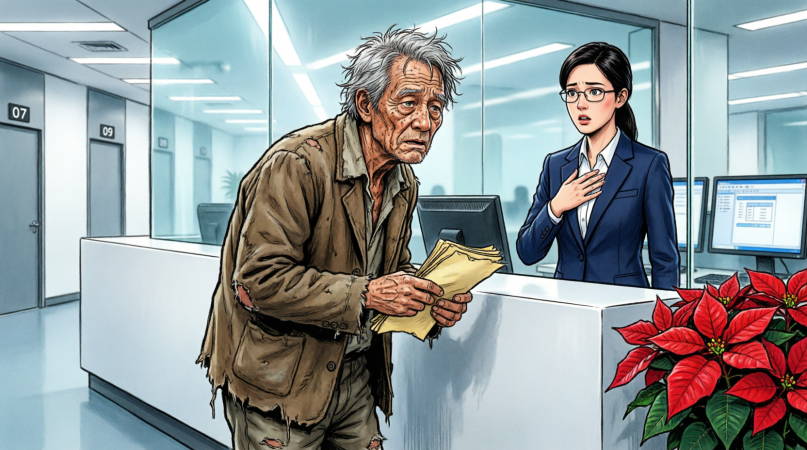
I don’t remember the drive back to Cleveland. The highway blurred into streaks of gray and green, the tires humming a steady rhythm against the pavement. My hands gripped the wheel, but my mind was miles away, sitting in a hospital room I’d never seen, watching a man I loved refuse to let me watch him die. I kept seeing his face that morning in the courthouse. The unreadable expression. The quiet voice. “This should help you for a while.” I had heard it as dismissal. It had been a promise.
When I finally pulled into the alley behind the grocery store, the damp walls of my room seemed to lean inward, suffocating. The mildew smell hit me first, then the damp chill that had seeped into my clothes, my blankets, my bones. I stood in the doorway for a long time, looking at the thin mattress, the cracked mirror, the single bulb that flickered when the wind blew. This was what I had chosen. This was the altar I had built to my pride.
I packed a single suitcase. Not much. A few worn sweaters, the photograph of Daniel from our anniversary trip to Lake Erie, the wooden box Margaret had given me, and the bank card. I left the rest. The damp room, the clanging pipes, the ghosts of my own stubbornness—they belonged to a woman who didn’t know the truth yet. I was someone else now.
I didn’t go back to that apartment. Instead, I found a small, sunlit place on the second floor of a brick building near the park. Two bedrooms, a kitchen with a window that caught the morning light, hardwood floors that creaked in familiar places. The landlord was an older man with kind eyes and a slow way of speaking. He didn’t ask why I needed it right away. He just handed me the keys and said, “Sometimes a fresh start is just a different door.”
The first night, I sat on the floor of the empty living room and cried. Not the quiet, stifled tears I’d grown accustomed to, but deep, shuddering sobs that came from somewhere beneath my ribs. I cried for the years I had wasted in bitterness. I cried for the meals I had skipped, the warmth I had denied myself, the children I had kept at arm’s length. I cried for Daniel, who had carried the weight of a terminal diagnosis alone, who had chosen to break my heart so I wouldn’t break watching his body fail him. I cried until my throat was raw and my face was wet, and when the tears finally stopped, I felt hollowed out, but clean. Like a room after a storm has washed away the dust.
The next morning, I went to the grocery store. Not to collect bottles. Not to scan the discount rack for day-old bread. I bought oranges. Real ones, bright and heavy in my hands. I bought fresh chicken, leafy greens, a loaf of crusty bread, a small jar of honey. I carried the bags up the stairs slowly, feeling the weight of them, feeling alive in a way I hadn’t in years. I cooked a simple meal. Sat at the table. Ate slowly. Tasted everything. When I finished, I placed my hand over my stomach and whispered, “I’m eating well, Daniel.”
It felt like the first step in a long walk back to myself.
I returned to Margaret a week later. This time, I didn’t come with questions. I came with presence. She welcomed me in without a word, led me to the kitchen, and poured two cups of coffee. We sat in silence for a while, listening to the refrigerator hum, watching dust motes drift through the morning light.
“I need to see his things,” I said finally.
She nodded. Went to the closet. Returned with two cardboard boxes and a leather-bound journal.
“He kept everything,” she said softly. “Letters he never sent. Medical papers. Receipts. Sketches. He said writing to you kept him sane.”
I opened the first box. Inside were stacks of envelopes, each addressed to me in his careful, slanting handwriting. Eleanor. My name. He had written to me every month for five years. I didn’t open them. Not yet. Some truths need to be approached like fire: slowly, with respect, or they burn.
The second box held the practical remnants of his secret life. Bank statements showing the establishment of the account. A notarized document directing the monthly transfers. A list of assets he had liquidated quietly: a vintage watch from his father, a piece of land he’d inherited but never used, a small portfolio he’d managed without telling anyone. He had planned this down to the month. He had worked with a financial advisor under a false name, setting up a trust that would automatically deposit funds into my card, ensuring I wouldn’t be tempted to withdraw it all at once out of panic or grief, ensuring the money would last, ensuring I would have a foundation, not a windfall.
Then there were the medical records. Stage four pancreatic cancer. Diagnosed fourteen months before the divorce. Prognosis: twelve to eighteen months. He had chosen a quiet decline over aggressive treatment that would have left him bedridden, dependent, and in constant pain. He had refused to let me become his nurse. He had refused to let our final months be defined by antiseptic, IV lines, and the slow erosion of the man I had married.
I picked up the leather journal. The cover was worn, the spine cracked. I opened it to the first page.
March 12. Found out today. The doctor spoke in careful words, but the truth is blunt. I have less than two years. I don’t want Ellie to watch me disappear. I don’t want her last memory of me to be a skeleton in a hospital bed, begging for relief. I have to leave. It will break her. But it will break me more if I stay. I will give her everything I can, quietly. Let her think I’m cold. Let her think I don’t care. Better her anger than her sorrow.
I turned the pages slowly. Month by month, he documented his decline. The pain. The fatigue. The weight loss. The days he couldn’t get out of bed. The nights he wrote letters to me instead of taking painkillers. He sketched me from memory: laughing at a kitchen table, reading by a window, standing in the rain outside our old house. On every page, the same refrain: I love her. I have to let her go.
By the time I closed the journal, my hands were trembling. Not from grief, but from awe. How does a man carry that much love in silence? How does he choose to be hated by the only person he ever truly cared for, just to spare her pain?
I went to the cemetery that afternoon. It was raining lightly, the kind of drizzle that soaks into your clothes without you noticing. I found his plot near a row of old oak trees. The stone was simple: Daniel Arthur Hayes. 1951–2021. A quiet man who loved deeply. I knelt in the damp grass, my knees protesting, my back aching, but I didn’t care. I placed a single white rose against the stone. I laid the bank card on top of it.
“I’m here,” I whispered. “I finally came.”
I talked to him for hours. Not in grand declarations, but in the quiet, rambling way you talk to someone who already knows you. I told him about the damp room. The hunger. The nights I stared at the ceiling and wondered what I had done wrong. I told him about the hospital, the doctor’s voice, the moment I finally swallowed my pride. I told him about the apartment with the sunlit window. The oranges. The honey. I told him I was angry, yes, but that the anger had nowhere left to live. It had been starved out by the truth.
When the rain grew heavier, I stood up, brushed the grass from my coat, and walked back to the car. I didn’t look back. I knew he was with me. Not as a ghost, but as a presence woven into the fabric of my days, into the quiet choices I would make from now on.
The hardest part wasn’t facing the past. It was facing my children.
Mark and Sarah. My son, forty-two, living in Chicago with his wife and two teenagers. My daughter, thirty-nine, a teacher in Columbus, raising a daughter of her own. They had visited when they could, sent money when they could, called when they remembered. I had never blamed them. Life is heavy, and the young carry it differently than the old. But I had also built a wall between us, a quiet fortress of independence that kept them at a distance. I had told myself it was to spare them my struggles. The truth was, I was too proud to let them see me broken.
I called them both on a Sunday evening. I didn’t give them a reason to come. I just said, “I need you here. Please.”
They arrived two days later. Mark first, then Sarah, both looking older than I remembered, both carrying the same cautious expression they’d worn since the divorce. They hugged me tightly, lingering a second longer than usual, as if testing whether I was really there, really whole.
We sat in my new living room. The afternoon light poured through the windows, painting warm squares on the floor. I made tea. They waited. I knew what they were thinking: Why now? What’s wrong? Is it illness? Is it money?
“I collapsed,” I said finally. “Five months ago. Malnutrition. Dehydration. The doctors said I was weeks away from organ failure.”
Mark’s face went pale. Sarah’s hand flew to her mouth.
“I was living in a room behind a grocery store,” I continued, my voice steady despite the tremor in my chest. “I cleaned offices at four in the morning. I collected bottles. I went to bed hungry more nights than I care to admit. And I never told you. I thought I was protecting you. I thought I was being strong.”
I reached into my bag and pulled out the leather journal. Placed it on the coffee table.
“Your father didn’t leave me with three hundred dollars,” I said. “He left me with nearly a million. He deposited it monthly, in secret, for five years. He divorced me because he was dying. He didn’t want me to watch him fade. He didn’t want your last memories of him to be pain. He chose to be the villain in my story so I wouldn’t have to live through the tragedy of his.”
Silence. Thick, heavy, absolute.
Sarah was the first to cry. Not quietly. Deep, wrenching sobs that seemed to come from somewhere ancient and buried. Mark stared at the journal, his jaw clenched, his eyes glassy. I reached across the table and took their hands. They didn’t pull away.
“He should have told us,” Mark finally said, his voice rough. “We could have helped. We could have been there.”
“I know,” I said. “But he wasn’t trying to be a martyr. He was trying to be a father. And a husband. In his own flawed, broken way, he was trying to love us the only way he knew how: by carrying the weight alone.”
We sat in the fading light, holding onto each other, letting the years of silence dissolve into shared grief. There was no blame. Only understanding. Only the slow, painful recognition that love doesn’t always speak in clear voices. Sometimes it whispers. Sometimes it hides. Sometimes it breaks your heart to save it.
Over the next few weeks, we rebuilt. Not the past—that was gone, sealed in hospital rooms and quiet goodbyes—but the present. We hired a financial advisor, not to grow the money, but to structure it wisely. We paid off my medical debts. We set up education trusts for the grandchildren. We bought a small house near the park, with a garden in the back and a porch that caught the evening sun. I insisted on keeping things simple. I didn’t want luxury. I wanted peace.
Mark and Sarah started visiting weekly. Not out of obligation, but out of choice. We cooked together. Watched old movies. Argued over crossword puzzles. Laughed until our sides ached. The hollow spaces in my life began to fill, not with noise, but with presence.
One evening, Sarah found me sitting on the porch, staring at the sky. She handed me a mug of chamomile tea and sat beside me.
“Do you miss him?” she asked quietly.
“Every day,” I said. “But not the way I used to. I don’t miss the man I thought he was. I miss the man he actually was. The quiet one. The one who loved in silence. The one who chose my future over his own comfort.”
She leaned her head against my shoulder. “He loved you so much, Mom.”
“I know,” I whispered. “And I’m finally learning how to love myself the same way.”
Daniel’s letter had three instructions: Eat well. Live fully. Laugh again. I took them seriously.
I enrolled in a cooking class at the community center. Not because I needed to learn how to boil water, but because I wanted to remember the joy of creating something with my hands. I met women my age, some widowed, some divorced, some simply tired of eating alone. We shared recipes, stories, laughter. We became a circle. A quiet sisterhood of survivors.
I started volunteering at a local hospice. Not as a caregiver, but as a companion. I sat with patients. Held hands. Listened. Brought flowers. Read aloud. I learned that death doesn’t have to be a cold, clinical thing. It can be gentle. It can be witnessed. It can be met with grace. I told them stories of Daniel, of the man who chose love over presence, of the quiet sacrifices we make for the people we care about. Some cried. Some smiled. All of them felt less alone.
I traveled. Not to distant continents, but to places Daniel and I had always talked about. A coastal town in Maine, where we walked the rocky shore and watched the tide roll in. A botanical garden in Ohio, where we sat under a canopy of cherry blossoms and listened to the wind. A small bookstore in Pittsburgh, where I bought a first edition of a novel he had loved in college. I took photographs. I wrote in a journal. I sent postcards to my grandchildren. I lived.
And I laughed. Not the polite, restrained laughter I had grown accustomed to, but deep, unguarded, belly-shaking laughter. I laughed at my own clumsiness when I dropped a tray of muffins in the community center kitchen. I laughed when Mark tried to fix a leaky faucet and flooded the hallway. I laughed when Sarah’s daughter asked me if I’d ever been young, and I said, “Darling, I’m still trying to figure out how to be.”
The money became a tool, not a trophy. I founded the Daniel Hayes Quiet Care Initiative, a small nonprofit that provides financial and emotional support to families facing terminal illness. We help with medical bills, housing, counseling, and respite care. We operate on a simple principle: no one should have to choose between loving someone and losing everything. The monthly deposit model that Daniel had used became the foundation of our funding strategy: steady, predictable, sustainable. We don’t give windfalls. We give lifelines.
I visited Daniel’s grave every month. Not to mourn, but to update him. I told him about the foundation. About the garden. About the way my hands felt when I planted tomatoes. About the grandkids’ school plays. About the quiet mornings with coffee and birdsong. I told him I was eating well. Living fully. Laughing again. I told him I forgave him. I forgave myself. And that forgiveness, I was learning, wasn’t a single event. It was a practice. A daily choice to lay down the weight of the past and step into the light of the present.
Five years passed. Then seven. I turned seventy, then seventy-two. My hair grew completely white. My steps grew slower, but my heart grew lighter. The foundation thrived. The house filled with visitors. The garden bloomed every spring. I wrote a book, not for fame, but for clarity. The Card He Gave Me. It wasn’t a bestseller. It didn’t need to be. It was a love letter to quiet devotion, to the sacrifices we make in silence, to the people who choose to break their own hearts to spare someone else’s.
One autumn evening, I sat on the porch with a blanket over my knees, watching the leaves turn gold and red. The air was crisp, carrying the scent of woodsmoke and damp earth. Mark and Sarah had just left, taking the grandkids home after a weekend of baking and board games. The house was quiet, but not empty. It was full of echoes. Full of memory. Full of life.
I pulled out the original bank card. It was worn now, the edges softened by time, the magnetic strip faded. I held it up to the fading light. I thought about the woman who had kept it in a drawer for five years, letting it symbolize abandonment. I thought about the woman who had finally walked into a bank and seen the truth. I thought about the man who had chosen silence over suffering, love over presence, a broken heart over a broken body.
I placed the card on the porch railing. Let the wind catch it. Let it rest.
“I’m still here,” I whispered to the empty yard. “I’m still living. I’m still loving you.”
The trees rustled. A bird called from the fence. The sky deepened to violet, then indigo. Stars began to appear, one by one, like quiet promises.
I closed my eyes. I breathed in the cool air. I felt the weight of seventy-two years settle into my bones, not as a burden, but as a testament. To survival. To forgiveness. To love that doesn’t demand to be seen to be real.
Daniel was right. If there’s another life, he would still choose me. And I, in this one, would still choose him. Not the ghost of a memory, but the truth of a man who loved me enough to let me go.
I opened my eyes. The porch light glowed warm against the dark. I stood up slowly, my joints protesting, my back aching, my heart full. I went inside. Locked the door. Turned off the lamp. Climbed the stairs to bed.
And for the first time in my life, I slept without waiting for the other shoe to drop. I slept in the quiet certainty that I had been loved. That I had loved. That love, even when hidden, even when delayed, even when spoken in silence, always finds its way home.
The card had never been about money. It had been a promise. A quiet, steadfast promise that I would never truly be alone. That even in his absence, he was still caring for me. Still watching over me. Still choosing me, month after month, year after year, until his very last breath.
I am sixty-five when this story begins. I am seventy-three when it ends. But the truth doesn’t age. It only deepens.
I was never forgotten.
I was loved all along.
And now, at last, I am free……………..