At Sunday Dinner, My Sister’s Kid Kicked The Chair And Said, “SERVANTS DON’T SIT WITH US.” The Family Table Erupted In Laughter. I Left Without A Sound. That Night, Sister Texted: “Finally Gone.” I Replied, “Like Your Inheritance?” By Dawn, The Eviction Notice Arrived…
Part 1
The sound that split the room was wood against hardwood, sharp enough to make every fork pause in midair.
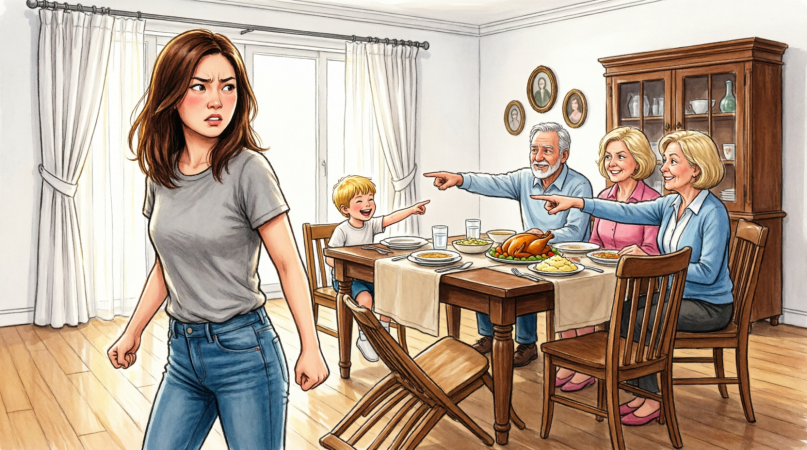
I had one hand on the back of my chair and the other around my wineglass when Carter kicked the chair out from under me.
He was eleven, all elbows and expensive sneakers, with the same sandy hair my sister had spent years pretending came from “our side of the family,” as if blondness itself were a family heirloom. His sneaker hit one chair leg with surprising force. The chair shot back across Vanessa’s polished dining room floor and scraped loud enough to sting my teeth.
“Servants don’t sit with us,” he said.
He said it with the confidence of a child repeating something he had heard enough times to believe it. Not mean in the wild, accidental way kids can be. Mean with structure. Mean with a source.
Then he added, looking right at me, “Mom said so.”
For one strange second, the room held still as a photograph. Seventeen people around a long table lit by low amber pendant lights. Silverware glinting. Steam rising off rosemary potatoes and a glazed ham. The smell of butter, garlic, red wine, and candle wax. My mother’s pearls catching the light. My brother Thomas with his napkin tucked into his collar because he thought it was funny. Uncle Richard already halfway into a second bourbon. Jennifer, my cousin, frozen with a forkful of green beans near her mouth.
At the far end of the table, Vanessa lowered her wineglass. There was a pale red lip print on the rim.
“Carter,” she said, but she said it like a person says don’t spoil your dinner, not don’t dehumanize your aunt in front of the family.
He frowned. “But you said Aunt Margot basically does all the serving.”
That was when Richard laughed.
A big barking laugh, too quick to be nervous, too comfortable to be shocked.
Thomas joined him a second later. Then Jennifer, smaller and guilty-looking, but still laughing. My brother-in-law Scott snorted into his drink. My mother covered her mouth with one hand and looked down at her plate, shoulders shaking. Even Emma, Vanessa’s middle child, let out a confused little giggle because children laugh when adults teach them that cruelty is the shape of a joke.
The laughter spread around that big table like grease fire.
I did not look at Carter first. I looked at Vanessa.
She met my eyes and gave me a tiny shrug, one shoulder lifting under a cream cashmere sweater. It was the shrug that hurt most. Not shock. Not shame. Not even annoyance. Just that little movement that said, What do you want me to do? Kids say things.
The thing is, Sunday dinners at Vanessa’s house had always run on a layer of performance. The house itself looked like the cover of a magazine—white colonial, black shutters, a winding stone path, hydrangeas planted in perfect rows. Inside, it smelled faintly of lemon polish and whatever expensive candle she had burning near the entryway. Every room had the careful clutter of money trying to look effortless: stacked design books nobody read, bowls of artful pears nobody ate, throw blankets folded into exact thirds.
Vanessa loved to say these dinners kept the family close.
What they actually did was give everybody a stage.
At those dinners, Thomas played the overworked dad with a sarcastic streak. Richard played the loud uncle who “told it like it is,” which mostly meant he was rude after his second drink. My mother played peacemaker and martyr, two roles she had somehow been cast in for thirty years without ever auditioning. And I played the quiet one. The single one. The one who worked “with computers” in some vague way no one cared enough to understand.
If I spoke too much, I was intense. If I stayed quiet, I was cold. If I brought a thoughtful gift, Vanessa called it “very efficient of you,” like thoughtfulness was a software feature. If I arrived empty-handed, someone joked I had forgotten that “real people” cooked and hosted and had lives outside email.
I had learned how to get through those dinners by making myself smaller without physically disappearing.
Apparently, even that had not been enough.
Carter had planted his foot over the empty space where my chair had been, ready to kick it again if I tried to pull it back.
I noticed stupid things in that moment. A smear of honey glaze on the serving spoon. The tiny ticking sound of Vanessa’s dining room clock. The way the chandelier light caught in the cut crystal water glasses and threw broken circles onto the tablecloth. Emma picking cheese out of her roll with careful fingers. My own pulse, steady and cold, in the base of my throat.
No one told him to apologize.
No one pulled the chair back for me.
My mother said, “Let’s all settle down,” while smiling into her napkin.
That was the exact moment something in me locked.
Not shattered. Not burst. Locked.
I set down my untouched glass. I walked to the entryway. I picked up my purse from the antique side table Vanessa always bragged she’d found at an estate sale in Connecticut. Behind me, someone said my name. I think it was Jennifer. Then Richard said, “Well, now we’ve done it,” in a tone that suggested entertainment, not remorse. A few people laughed again.
I opened the front door.
Cold October air hit my face, carrying the smell of wet leaves and somebody’s fireplace from across the street. The sky was black and clean above the neighborhood, and the windows of Vanessa’s house glowed gold behind me like a postcard version of belonging.
I got in my car and sat there with both hands on the steering wheel.
Through the front windows, I could see shadows moving around the dining room. Heads bending, glasses lifting, life resuming. It looked warm from the outside. That was the lie of my family. From the sidewalk, from the driveway, from any polite distance, we looked warm.
My phone buzzed once while I was backing out, but I didn’t check it.
I drove home through streets slick with old rain. Every red light felt unreal. Every storefront I passed looked too bright. At one intersection, a teenager in a burger uniform was mopping the floor behind a glass window, and for one ugly second I thought: at least nobody there is pretending he belongs while laughing when he gets humiliated.
When I got home, my apartment smelled faintly like cedar from the candle I had burned that morning. Clean. Quiet. Mine.
I kicked off my heels in the kitchen and finally looked at my phone.
A text from Vanessa.
Finally gone.
That was it. Two words. No question mark. No softening sentence after it. Not Are you okay? Not Carter got carried away. Not I’m sorry.
Finally gone.
I read it three times, as if one more read might reveal a different language beneath the first.
Then I set my phone face down on the counter, walked past the dark living room, and went into my office.
The office light hummed once before fully coming on. Against the far wall stood a tall gray metal filing cabinet I had owned since my first startup, when I couldn’t afford stylish storage and needed something that locked.
I knelt, slid open the third drawer, and pulled out a thick folder.
On the tab, in my own blocky handwriting, were four words I had not looked at in months.
Harrison Family Trust.
I stood very still, folder in both hands, while the apartment settled around me with soft nighttime noises—the refrigerator motor starting, a car door slamming somewhere below, the faint rattle of pipes in the walls.
Then my phone buzzed again on the desk behind me, and this time the screen lit up with my sister’s name.
I didn’t answer. I opened the folder instead, and the first thing I saw was my own signature at the bottom of page one.
Part 2
Seven years earlier, I had signed those documents at a long walnut conference table while rain slid down the windows of my lawyer’s office in silver threads.
I was twenty-nine, newly rich, badly slept, and still adjusting to the fact that I could walk into a grocery store and buy berries out of season without checking the price.
Two months before that meeting, I had sold my company.
Not my job. My company.
I had co-founded a cybersecurity firm with two other people out of a converted warehouse in Seattle where the bathroom door never shut properly and the heater made a noise like an asthmatic dog all winter. For five years I lived on protein bars, coffee that tasted like burnt pennies, and the kind of adrenaline that fools you into thinking your body is optional. We built the product, lost clients, found better ones, almost died in diligence twice, and eventually sold to a larger firm for more money than my younger self had ever let herself picture.
After taxes and the dust settled, my share was enough to make almost every practical fear in my life go quiet at once.
The silence was not as peaceful as people imagine.
When you grow up in a family like mine, money is never just money. It is proof, apology, leverage, hierarchy, rescue, debt. It is the thing people mention indirectly and feel directly. My mother clipped coupons even when we were fine because thrift was one of her moral performances. Vanessa loved the appearance of wealth long before she had any. Thomas treated every dollar like an insult because there were never enough of them at the right moment. My father, before he died, used to say money only reveals character faster.
I thought mine had been revealed as generosity.
I had sat in David’s office that rainy afternoon and said, “I want to make sure my family never has to panic over tuition or medical bills or losing a house.”
David, who had been a trust attorney for three decades and had the expression of a man who had seen every version of family disappointment available under law, folded his hands and asked, “Do you want them to know the money comes from you?”
“No,” I said too quickly.
He tilted his head. “Why not?”
Because I knew my family.
If they knew I had made that much money, nothing between us would stay human. Every interaction would become a disguised negotiation. Every holiday would become a grant application with mashed potatoes. Vanessa would start narrating her needs in a sweeter voice. Thomas would get defensive before I even offered help. My mother would tell people she was proud of me with one side of her mouth and use me like an emergency fund with the other.
Also—and this part was harder to say out loud—I wanted their gratitude to belong to something abstract, not to me. I wanted to care for them without being turned into a machine they resented while using.
So I invented Great-Uncle Bernard.
A fake branch of the family tree. Wealthy, eccentric, childless, recently deceased. The kind of relative people accept immediately because money arriving from the dead feels classier than money arriving from the awkward daughter you never quite learned how to value.
Vanessa had laughed when I first told the story over coffee. “Bernard? We had a Bernard?”
“Dad mentioned him once,” I lied.
“Oh my God,” she had breathed, already in love with the myth. “That is such old-money behavior.”
The trust I funded with twelve million dollars.
It was generous to the point of stupidity.
Vanessa received one hundred twenty thousand a year. Thomas got eighty. My mother received sixty. Each of Vanessa’s three children had education funds seeded at five hundred thousand. Thomas’s two children had the same. There were smaller distributions for cousins, emergency medical provisions, and language about housing support if catastrophe hit. I designed the structure the way I designed systems back then—trying to anticipate failure before it hurt anybody.
Love disguised as architecture.
And because I had never needed them to admire me, just to stop worrying, I let them keep thinking I was merely “doing well in tech.”
That phrase had followed me for years like a boring houseplant. Doing well in tech. As though I were a middle manager who occasionally made PowerPoints about encryption. Nobody had ever asked enough questions to find out otherwise.
Nobody really wanted to know me. They wanted me legible.
The folder in my hands held all of it: grantor, trustee, revocable at my discretion.
I carried it to the desk, opened my laptop, and stared at David’s name in my contacts for longer than I needed to.
My phone buzzed three more times. Vanessa. Then Thomas. Then my mother.
I ignored all three and opened a new email.
David,
Please prepare immediate revocation documents for the Harrison Family Trust. Remove all beneficiaries and dissolve the trust effective immediately. Transfer all assets back into my personal accounts tonight if possible.
I stared at the cursor blinking after possible.
Then I added: I am certain.
His call came in less than four minutes.
I answered on the second ring.
“Margot,” he said, voice rough with surprise. “I just read your email. Tell me you sent that angry and not carefully.”
“I sent it carefully.”
A pause. I could hear paper shifting on his end, maybe the trust file being pulled from a cabinet, maybe his hand rubbing over his forehead.
“What happened?”
So I told him.
I told him about the chair scraping across polished floorboards. About Carter’s sneaker planted like a little gatekeeper’s flag. About “servants don’t sit with us.” About the laughter, not one person stepping in, my mother smiling into her hand, Vanessa shrugging, the text waiting for me when I got home: Finally gone.
David did not interrupt.
When I finished, the line went so quiet I thought for a second we had disconnected.
Then he exhaled and said, very softly, “Jesus.”
“I need it done tonight.”
“It can be filed electronically,” he said, voice settling into the clean practical tone lawyers use when emotion has to step aside for procedure. “The transfers can begin overnight. But, Margot… this is the support structure for almost your entire family.”
“I know.”
“Vanessa’s household relies heavily on that annual distribution. Your brother too, from what I recall.”
“I know.”
“The education subtrusts—”
“I know exactly what’s in it, David. I built it.”
Another pause.
Then, more gently, “Are you asking me as your lawyer or as someone who has known you for a long time?”
“Both.”
“As your lawyer, yes, you have absolute authority to revoke. It is clean. As someone who has known you a long time, I need to ask whether you want to wait twenty-four hours and see whether this still feels like clarity tomorrow morning.”
I looked around my office. The brass desk lamp. The stack of unopened mail. The framed photo from my company’s launch party, all of us younger and too excited to hide it. Outside the window, the city was a scatter of white lights against black glass.
Then I looked at Vanessa’s text again.
Finally gone.
“No,” I said. “This already is tomorrow morning in my head.”
He made a low sound in his throat, halfway between regret and agreement. “All right. I’ll prepare the revocation now.”
“Thank you.”
“Margot?”
“Yes?”
“This will devastate them.”
A month earlier, I might have heard that sentence as a warning against action. Tonight I heard it as a description of reality.
“They were not worried about devastating me.”
He did not argue after that.
We hung up. I sat at my desk while city noises thinned and midnight drew itself over the windows. At 10:57 p.m., David sent the first set of documents. I reviewed them line by line, signed electronically, sent them back. At 11:24, he sent the second set, including the transfer instructions. At 11:41, I signed those too.
At 12:08 a.m., I opened my text thread with Vanessa.
My thumbs hovered over the screen.
All I typed was: Like your inheritance.
I did not send anything else. I turned off my phone and carried it facedown into the bedroom like a plate with something poisonous on it.
Sleep came in thin, broken strips. I dreamed of chairs missing from rooms and every person at every table pretending not to notice.
At 6:14 a.m., the first vibration on my nightstand woke me.
Vanessa.
I let it ring.
It rang again immediately. Then again.
By the time I had made coffee, the screen showed fourteen missed calls, three voicemails, and a wave of texts rising so fast I could barely read them as they appeared.
Call me right now.
Something is wrong with the trust account.
Margot answer me.
What did you do?
At 6:22, my email refreshed.
Trust revocation complete, David wrote. All assets transferred. Beneficiary balances now zero. County filing accepted. Attached please find confirmation documents.
I took my first sip of coffee. It was too hot and bitter, and it felt wonderful.
At 6:45, Vanessa texted again.
Carter’s fund is showing zero. Emma’s too. What is happening?
At 7:02, Thomas called.
This time, I answered.
His first breath came in hard and loud, as if he had already been shouting before I picked up.
“What the hell is going on, Margot?”
I walked to the window with the phone pressed to my ear and looked down at the city waking below me—delivery trucks, a woman in a red coat walking a black dog, steam rising from a street grate.
“The trust is gone,” I said.
There was a stunned silence on the line.
Then Thomas said, “What do you mean, gone?”
“I revoked it.”
Another silence, longer this time. He seemed to be trying to fit the sentence into a version of the world that didn’t have room for it.
Finally he said, “You can’t revoke family money.”
I closed my eyes.
In the kitchen, my phone buzzed again and again against the countertop like a trapped insect.
Then Thomas added, with absolute certainty, “That money wasn’t yours.”
I opened my eyes and looked out at the pale morning sky.
He had no idea how wrong he was.
Part 3
“There is no Great-Uncle Bernard,” I said.
Thomas laughed once, a short, ugly noise. “What?”
“He never existed. I made him up. I funded the trust. Every dollar.”
The line went dead quiet except for his breathing. I could picture him in his kitchen in Columbus, phone against his ear, one hand gripping the edge of the counter hard enough to whiten his knuckles. He always breathed louder when he got angry. Even as a kid.
“That’s not funny.”
“It isn’t a joke.”
“That money came from family.”
“It did. Mine.”
He swore under his breath.
Then he said, slower now, as if each word might force the world back into the shape he preferred, “You are telling me that for seven years you just… what? Secretly paid all of us?”
“Yes.”
“You expect me to believe that?”
“I don’t care what you believe. David can send copies of the trust documents to your attorney if you hire one.”
He didn’t respond right away. I heard cupboard doors opening and closing in the background, maybe his wife asking what happened, maybe one of the kids wandering in for cereal. Domestic noise. The kind of noise all my money had quietly cushioned for years.
Then his voice came back, thinner and meaner. “Why would you do something this insane?”
Because I had loved them in the least visible way possible. Because I thought invisibility might keep love clean. Because apparently I had not hidden the money so much as hidden myself inside it.
But I said only, “Because last night your nephew kicked a chair away so I couldn’t sit down and told me servants don’t sit with the family.”
“He’s eleven.”
“He is informed.”
“He repeated something without understanding it.”
“He understood enough to stop me from taking a seat.”
Thomas made a frustrated noise. “Margot, for God’s sake, Vanessa says it was a joke.”
“Then your family has a very specific sense of humor.”
“She did not mean you were literally a servant.”
I looked down at the street, at a man unloading flowers from the back of a van. Purple mums, yellow daisies, orange marigolds in black plastic trays.
“What was the joke then?” I asked. “Explain it to me.”
He said nothing.
“That’s what I thought.”
“Okay,” he snapped. “So you’re angry. Fine. Be angry. But the kids’ college money? Mom’s annual support? You can’t blow up everyone’s life because your feelings got hurt.”
I let that sentence sit between us.
Then I said, “My feelings did not get hurt, Thomas. I got publicly humiliated by a child who learned from the adults in this family that I am beneath them. And I am not blowing up anyone’s life. I am ending financial support for people who laugh while I am treated like staff.”
The phone went silent again.
When he finally spoke, his voice had changed. It had gone pleading in the way people’s voices do when they see a door closing and still think emotion is a key.
“Vanessa depends on that money.”
“Then Vanessa should have been careful about how she treated the person providing it.”
“She didn’t know.”
“She knew enough to text me finally gone.”
I heard him inhale sharply. He had not known about the text.
“She sent what?”
I repeated it.
There was a long pause.
Then, weakly: “She was angry.”
“So was I.”
At 7:41, I hung up.
By 8:00, I had thirty-seven missed calls.
Vanessa. Thomas. My mother. Unknown numbers. Richard. Even Scott, who almost never called me unless he needed help understanding a software update.
At 8:53, somebody started pounding on my apartment door.
Not knocking. Pounding. Fast, flat-palmed hits that rattled the frame.
I looked through the peephole.
Vanessa stood in the hallway in navy pajama pants, a camel coat thrown over a white T-shirt, hair tangled, mascara smudged at the outer corners. She had driven into the city without brushing her hair. That was how panicked she was.
“Margot!” she shouted. “Open the door.”
I stayed where I was.
“Margot, I know you’re in there.”
Her voice cracked on the last word. I had heard Vanessa cry exactly four times in my life. Once when our father died. Once when she found out Scott had been texting another woman, though she took him back before the month was over. Once when a contractor ruined imported tile in her mudroom and she acted like she had been widowed. And once when Emma broke her arm and Vanessa fainted at the X-ray machine.
She cried now with the same helpless outrage she had in the tile incident.
I opened the inner lock but not the door itself. “What?”
“What do you mean what?” she shouted through the wood. “Every account says zero. Carter’s fund, Emma’s fund, Jackson’s fund. Mine too. The quarterly distribution account is empty.”
“Yes.”
“Yes?” Her voice rose into disbelief. “That’s all you have to say?”
I leaned one shoulder against the wall near the door. The hallway on my side smelled faintly of coffee and dust. Somewhere down the corridor, an elevator dinged and then closed again.
“This is because of last night,” she said. “Because of one stupid thing Carter said.”
“One stupid thing,” I repeated.
“He’s a child.”
“He’s your child.”
“He said something out of context.”
“What context makes servants don’t sit with us acceptable?”
Silence.
Then I heard her slide one hand against the door, as if touching the wood might soften me through it. Her voice dropped lower.
“I did not mean it like that.”
“How did you mean it?”
“I don’t know. I was venting. I said you always help with everything and sometimes it feels like you like to organize people.”
I laughed once. I couldn’t help it. It came out colder than I expected.
“Organize people?”
“You know what I mean.”
“No,” I said. “I don’t. Explain it.”
She did not.
Instead she said, “You always make things tense at dinner.”
That actually stunned me.
I straightened away from the wall. “Excuse me?”
“You sit there all quiet and judging everyone and then when somebody says anything you get this look on your face like you’re above all of it.”
The sheer audacity of it made my skin go cold.
“I sit quietly,” I said, “because when I speak, Richard asks why I’m still single, Mom says I work too much to be lovable, and you ask whether I’ve considered freezing my eggs like it’s cocktail conversation.”
“That is not fair.”
“At Easter, Thomas asked if I was secretly in love with my laptop.”
“He was joking.”
“At your birthday brunch, Scott asked if I even knew how to cook something that didn’t come from an app.”
“Oh my God, Margot—”
“And last night your son kicked my chair away.”
Her breathing changed. Became shallower.
Then she tried a different angle, one I had expected sooner. “So you’re punishing my children because your pride got bruised?”
“No,” I said. “I am ending a gift.”
“A gift?” she said, incredulous. “That money was how I paid for their schools. Carter’s hockey travel team. Emma’s piano lessons. Jackson’s tutoring. We budget around that money.”
“You budget around money you did not earn,” I said. “That was a choice.”
On the other side of the door, she started crying harder, but there was frustration in it, not remorse.
“Please,” she said. “Fix this.”
“There is nothing to fix.”
“We can talk to Carter. We can make him apologize.”
That, more than anything, almost made me open the door—not to forgive her, but to look directly into her face and see whether she heard herself.
Apologize, as if the problem were a boy’s manners and not the entire system of contempt that had produced them.
“I’m not interested in staged remorse,” I said.
“We’ll get lawyers,” she snapped suddenly, the plea falling away so fast it was almost graceful. “You can’t just steal the family trust.”
“Try,” I said. “Please. I would enjoy watching your attorney explain revocable discretionary trusts to you.”
She went quiet.
Then, so softly I barely heard it, “You’re really doing this.”
“Yes.”
I heard fabric rustle. Maybe she had sunk down to the floor. Maybe she had covered her face with both hands. My chest tightened in one hard, unwelcome turn. Vanessa was still my sister. Bodies remember before minds do.
But memory is not the same thing as surrender.
After several minutes, she said in a hoarse voice, “Mom is devastated.”
I thought of my mother’s shaking shoulders behind her hand at the table.
“That makes two of us.”
Another long silence.
Then she said, “You are going to end up alone.”
I put my hand on the lock.
“Better alone,” I said, “than seated where I’m not wanted.”
I relocked the door.
She stayed in the hallway another ten minutes, crying on and off, making one phone call I could hear but not fully make out. Then her footsteps moved toward the elevator. The building went quiet again.
At noon, I made soup because I needed my hands occupied. Onions in olive oil. Garlic. Carrots, celery, thyme. The smell filled the apartment in a way that made it feel steadier, more real. I chopped too finely and salted too much. It didn’t matter.
By late afternoon, the backlash had formed its first clean shape.
My mother left a voicemail asking me to think of the children.
Richard left one calling me “dramatic and vindictive.”
Scott texted: This is getting out of hand.
Thomas sent a message three paragraphs long about family duty and emotional overreaction and how I was “weaponizing money.”
And at 5:16 p.m., a number I didn’t recognize called and left a clipped, professional voicemail identifying itself as the office of an attorney retained by Vanessa Harrison.
I deleted the voicemail without listening to the end.
At 6:03, another message came in. This time from Jennifer.
I know I don’t deserve a response, it read, but I’m sorry. What happened last night was wrong. Not awkward. Not exaggerated. Wrong.
I stared at the message for a long time.
Then a second message arrived.
Also, you should know this before anyone spins it differently: Vanessa told people after you left that maybe now you’d stop acting like you owned all of us. I didn’t understand what she meant then. I think I do now.
The soup on the stove let out a soft bubbling sigh.
I stood there with Jennifer’s words glowing in my hand, and for the first time since the dinner, I felt the outline of a different question rising through all the anger.
If Vanessa had always believed I wanted to own them, what exactly had she been saying about me when I wasn’t in the room?
Part 4
The next week arrived like weather you can smell before you see.
Every morning my phone lit up with new combinations of outrage, grief, blame, and accidental honesty. Family group texts split into smaller family group texts, and then into private side channels, as if they were all trying to triangulate the same disappearing island from different shores.
My mother showed up on Tuesday afternoon in a camel coat and lipstick the color of dried roses. She still believed appearances could turn any conversation civilized.
I let her in because a locked door between a mother and daughter carries its own damage, and at that point I still thought there might be a version of this where at least one person in my family could speak to me like a human being.
She stood in my entryway looking around my apartment the way she always did: taking inventory while pretending not to. The framed photography. The clean lines of the furniture. The abstract painting above the sofa she had once called “expensive sadness.” She still had no idea what any of it cost, and that ignorance suddenly felt almost sweet compared to what I now knew about everything else.
“I won’t stay long,” she said.
That usually meant she intended to stay exactly as long as needed to win.
I made tea because there are some habits daughters perform even while bleeding.
In the kitchen, the kettle hissed. My mother perched on a stool at the island, hands folded around her handbag. She looked smaller than she had at dinner, but not because guilt had hollowed her. Worry had. The kind of worry that grows when resources vanish.
When I set the mug in front of her, she sighed as if I had confirmed something useful.
“You’ve always taken care of things,” she said.
There it was. Not You’ve always been kind. Not You didn’t deserve that. Just the family mythology in polished language: I was competent, useful, reliable. The daughter who could be trusted to absorb inconvenience and call it love.
“Say what you came to say, Mom.”
She flinched at the bluntness, then rearranged her face into soft concern.
“The children are innocent in this.”
“They sat and watched.”
“They’re children.”
“Which is when people learn what a person is worth.”
She picked up her tea, didn’t drink it, put it back down. “Carter was showing off. Vanessa should have corrected him immediately. I agree.”
“You laughed.”
Her eyes shifted. “I was uncomfortable.”
“No,” I said. “You were amused.”
“That is not fair.”
“Neither was Sunday.”
The air between us changed. Less mother-daughter now, more negotiation between two women who knew each other too well for performance to stay pretty.
She reached into her bag and pulled out a folded piece of paper. A handwritten list. Monthly expenses, from the look of it. Mortgage. Tuition. Insurance. Something about piano. Another line about medication.
“Vanessa is in a real bind,” she said quietly. “So is Thomas. He used his last distribution to pay off part of Nora’s medical bill this summer. They count on these funds, Margot.”
I stared at the page but did not touch it.
It was such a perfect family move, really. Translate dignity into spreadsheet. Turn my humiliation into a budget problem. Present me with columns and totals as if arithmetic itself were moral pressure.
“And what exactly,” I asked, “did Vanessa count on while teaching her son to call me the help?”
“Don’t use that word.”
“He did.”
“He is a boy.”
“He is a mirror.”
My mother rubbed at the bridge of her nose. “You have always had a dramatic way of saying things.”
I almost laughed. There it was again, the lifelong trick: hurt me, then critique my reaction until the original wound becomes impolite to mention.
“When Dad died,” I said, “who filled out your insurance paperwork?”
She looked up.
“When Thomas got behind on taxes, who fixed it?”
Her mouth tightened.
“When Vanessa’s contractor sued over unpaid invoices three years ago, who quietly paid for the attorney?”
She did not answer.
“When you needed a new roof and didn’t want anyone to know you were behind, who wired the money?”
Still nothing.
I leaned forward. “Do you know what’s interesting? I never once expected gratitude. But I did assume I would at least be allowed a chair.”
Her eyes filled then, but not in a way that moved me. They filled because the truth had cornered her, not because she had finally opened toward it.
She said, “You always make generosity feel like accounting.”
“And you always make cruelty feel like manners.”
That ended the visit.
She left the handwritten expense sheet on my counter like a guilt offering. After the door closed, I tore it in half and threw it away.
Wednesday brought a five-page email from Thomas cataloging every family kindness since 2008. Holiday invitations. A weekend he helped me move apartments. The time Vanessa brought soup when I had the flu, conveniently omitting that she stayed twelve minutes, took selfies in my kitchen, and left before the soup cooled. Under his logic, every ordinary act of family participation had become a debt marker redeemable against my self-respect.
Richard called me a vindictive bitch in a voicemail so slurred David later guessed he had been on his third drink by lunch.
Scott sent a text pretending to be reasonable: Let’s get everybody in a room and calm this down.
By Thursday I stopped reading most of it.
Jennifer, though, I did answer.
She called during the late afternoon while rain tapped softly at my windows, and when I picked up, she didn’t waste time on performance.
“I’m sorry,” she said immediately. “Not for the situation. For me. I laughed.”
I sat on the edge of my sofa and listened.
“I laughed because everyone else did,” she said. “And because in this family if you don’t laugh, suddenly you’re the problem. I’ve done that my whole life and I’m ashamed of it.”
The honesty of that landed harder than any apology so far.
“Thank you,” I said.
“I’m not asking for the money back.”
“I assumed.”
“I just needed to tell you that what happened was vile. And Vanessa…” Jennifer hesitated. “Margot, I think she’s been saying worse things than you know.”
My fingers tightened around the phone.
“What things?”
“I don’t have everything. But over the summer, at the lake house, she joked to some of Scott’s friends that you were ‘basically the family operations assistant with a bigger apartment.’ Everybody laughed. I thought it was ugly then. I should have said something.”
The room seemed to sharpen around me. Rain. Lamp glow. The hum of the dishwasher in the kitchen. The smell of the basil plant by the window needing water.
“How long?” I asked.
“A while, I think.”
After we hung up, I sat there for a long time with all the old moments rearranging themselves in my head like furniture finally revealing the real floor beneath it. The requests Vanessa made so casually. Can you help me review this school contract? Can you compare these mortgage terms? Can you set up the vacation spreadsheet? Can you just handle reservations for Thanksgiving since you’re so good at logistics? Every favor delivered with a bright smile that suggested admiration while quietly shrinking me into function.
By evening, the anger in me had cooled into something far more useful.
Precision.
I emailed David.
I want to establish three new education trusts for Carter, Emma, and Jackson, I wrote. Five hundred thousand each. Access at twenty-five, not eighteen. Conditions: completion of a four-year degree and one full year of documented service work. Independent trustee. Vanessa gets no control and no notification until each child turns eighteen.
I stared at the screen, then added one more sentence.
I refuse to fund entitlement, but I will not punish children for inheriting their mother’s values.
David responded within thirty minutes: Understood.
At 9:12 that night, I opened a fresh message to Vanessa.
Your children’s original education funds are gone. I have, however, created new restricted trusts for them under separate terms. You will not control them. You will not know the amount. They will learn about them when they are adults. Your annual distribution and everyone else’s are permanently terminated. Live on what you earn. And for the record, I didn’t destroy this family. You did that when you taught your son there are people who serve and people who deserve seats.
Her reply came so quickly I knew she had been staring at our thread like a hunter at a trail camera.
I hope you enjoy dying alone with your money.
I typed back: Better than eating with people who laugh when I’m humiliated.
Then I blocked her.
The apartment went wonderfully quiet.
I stood at the window and watched headlights smear along wet streets below. For the first time in years, Sunday sat in my mind not as obligation but as open territory. No drive to the suburbs. No overcooked salmon or performative warmth. No little barbs tucked into jokes. No paying, silently, for the privilege of being tolerated.
Freedom, it turned out, did not arrive trumpeting. It arrived like a room after a refrigerator stops humming. You notice the quiet first. Then you notice your body unclenching inside it.
At 10:47 p.m., my building concierge called upstairs.
“There’s a courier here for you, Ms. Harrison.”
I went down in socks and signed for a thick envelope.
Return address: Whitmore & Clay LLP.
Vanessa had not wasted any time.
I carried the envelope back upstairs, set it on my kitchen island under the pendant light, and slit it open with a butter knife.
Inside was a formal notice on heavy cream paper accusing me of wrongful interference, breach of implied family obligation, and intentional infliction of financial harm.
I read the first page twice.
Then, halfway through page two, I saw the line that made the back of my neck go cold:
Our clients contend that Ms. Harrison has recently displayed erratic behavior inconsistent with her past financial judgment and may be acting under undue influence or diminished capacity.
I read that sentence again, slower.
They were not just coming for the money.
They were coming for my mind.
Part 5
The legal notice made one thing very clear: my family still did not understand me.
If they had, they would have known that accusing a woman who built a company and negotiated a nine-figure acquisition of diminished capacity was not going to frighten her into folding. It was going to focus her.
David came to my apartment the next morning with his tie slightly crooked and a box of pastries from the bakery downstairs because, as he said while shrugging off his coat, “I’ve learned bad family litigation goes better with almond croissants.”
We sat at my dining table—the irony not lost on either of us—while morning light stretched pale and thin across the wood.
He spread out the notice, my trust documents, revocation filings, and three yellow legal pads covered in his compact handwriting.
“This,” he said, tapping the family lawyer’s letter, “is not a serious legal argument. It is pressure in a nice suit.”
“But?”
“But people do ugly things when money evaporates. Vanessa has told her attorney you behaved irrationally after a minor family disagreement.”
I almost smiled. “A minor family disagreement.”
“She says you have been isolated lately, emotionally volatile, and secretive about your finances.”
“Secretive,” I said. “How sinister of me to privately fund half their lives.”
He slid a fresh page toward me. “I need every piece of documentation that establishes your capacity, your ownership, and the history of the trust. Easy enough. What I also need is context, because family court-adjacent disputes have a nasty habit of turning facts into theater.”
“I can do context.”
“Yes,” he said dryly, “I’ve met your relatives.”
For two hours we built a file thick enough to stun a horse. Original trust instrument naming me as grantor and trustee. Wire records from my brokerage into the trust. Tax filings. The acquisition agreement from my company sale. Emails from years earlier showing David advising me on beneficiary structure. My last five years of corporate board minutes and philanthropic commitments, all of which made “diminished capacity” look especially ridiculous.
Then he asked, “Do you want to attend the family meeting?”
I looked up. “What family meeting?”
He reached into his briefcase and handed me my mother’s latest email, which he had printed because she had copied him in a showy attempt at seriousness.
Sunday brunch. My house. We need to talk face-to-face as a family and stop hiding behind lawyers.
I laughed, actual laughter this time. “Hiding behind lawyers? From the woman who hired one forty-eight hours after her son called me a servant?”
“Are you going?”
My first instinct was no. Protect the boundary. Refuse the theater.
But another part of me—the part that had spent years sitting quietly while people defined me in the room—felt suddenly tired of absence being used as evidence against me.
“Yes,” I said. “I’m going.”
Sunday at my mother’s house smelled exactly like my childhood: coffee, furniture polish, and pot roast cooked too early. The wallpaper in the entryway was still the same pale blue pattern of little climbing vines. The umbrella stand still held umbrellas no one used because my mother hated how they dripped. The grandfather clock in the hall still ticked with smug regularity, as if time itself approved of her.
Everybody was there.
Vanessa in a dark green sweater, eyes swollen but makeup professionally restored. Scott beside her, jaw clenched. Thomas leaning against the mantel with crossed arms. Richard in a sport coat he wore whenever he wanted to look respectable enough to be believed. My mother near the dining room archway, fingers worrying a handkerchief. Jennifer on the sofa, visibly unhappy. Even the older kids drifting on the staircase landing upstairs, pretending not to listen.
Carter was there too. One hand on the banister. Expression hard in that careful way children adopt when they know adults are talking about them.
No one offered me a drink.
No one asked how I was.
My mother said, “Thank you for coming,” as though we were at a mediation retreat.
I set my bag on a side chair and stayed standing. “Let’s not pretend this is gracious.”
Vanessa flinched first. Good.
Richard cleared his throat. “We all agree things got out of hand.”
“Did we?” I asked. “That’s nice progress.”
Thomas pushed off the mantel. “Can you stop doing that? The sarcasm?”
“Can you stop pretending I’m the one who created this?”
Scott stepped forward then, palms out in that corporate-man way of acting neutral while protecting his own assets. “We need to be practical. The trust was relied upon in good faith.”
I turned to him. “By whom?”
“By all of us.”
“Interesting,” I said. “Because none of you knew where it came from.”
My mother said softly, “Margot.”
“No. I’m done helping everyone avoid the shape of this.”
The room tightened.
So I said it plainly. “For seven years, I funded every distribution. I funded the children’s education accounts. I funded your support, Mom. Your emergency repairs. Thomas’s annual distributions. Vanessa’s.”
Richard let out a disbelieving scoff. “That is absurd.”
David, who had insisted on coming and now stood quietly by the doorway like the grim ghost of paperwork future, opened his briefcase and handed out copies.
Watching their faces while they read may be the most clarifying thing I have ever experienced.
Vanessa’s eyes moved fast at first, then slower. Thomas actually sat down. My mother’s mouth fell open in a small, stunned oval. Richard took off his glasses, wiped them, and put them back on like cleaner lenses might produce a different document.
Scott was the first to recover. “Why would you hide this?”
“Because I knew exactly what would happen if I didn’t.”
Jennifer looked up from her pages and, to her credit, met my eyes with shame.
Vanessa’s voice came out thin. “You lied to us.”
“Yes,” I said. “About the source of the money. Because I wanted to support you without becoming your ATM in human form.”
“You already were,” Richard muttered.
The room went dead still.
He seemed not to realize he had said it out loud until three separate heads turned toward him.
“What?” he said. “Come on. Everyone knew Margot liked taking care of things. She’s always been most useful that way.”
Useful.
Not loved. Not brilliant. Not generous. Not family.
Useful.
The word landed with a dull, final weight because it did not surprise me. It only named what had always been underneath the jokes.
My mother whispered, “Richard…”
But he had already given the game away.
I turned to Vanessa. “Did you tell Carter I was the help?”
She looked stricken, then angry at being made to look stricken. “I said you always serve everybody. You do. You organize everything. You fix everything. He twisted it.”
“No,” I said quietly. “He distilled it.”
Carter shifted on the staircase.
Out of the corner of my eye, I saw him looking from his mother to me to the papers in everyone’s hands. He was old enough to understand numbers if not ethics. Old enough to feel the floor shifting.
Thomas rubbed both hands over his face. “Jesus Christ.”
Scott said, “This doesn’t justify cutting off the kids.”
“I didn’t,” I said. “I restructured protection for your children in a way that does not reward their parents.”
Vanessa jerked her head up. “What does that mean?”
“It means exactly what I told you in writing.”
Her face drained.
My mother took a step toward me. “Margot, please. We can fix this.”
And there it was again, that family word. Fix. As if I were a leak. A glitch. A loose hinge. Something useful again, if only turned the right way.
“No,” I said. “You cannot fix people after teaching your children to rank them.”
On the staircase, Carter suddenly blurted, “Mom, did she really pay for my school?”
No one answered him.
He looked at Vanessa again, and this time what I saw on his face was not arrogance. It was confusion, sharp and painful. The confusion of a child learning that the adults who narrate the world to him are not reliable cartographers.
I picked up my bag.
As I turned toward the door, Carter spoke once more, voice smaller now.
“Aunt Margot?”
I stopped, hand on the brass knob.
“When Mom said you were the help,” he asked, “was she lying about you, or lying to me?”
Part 6
There are questions children ask that make every adult in the room suddenly look like a bad actor under bright light.
That was one of them.
No one moved. Even Richard, who could usually bluff his way through any moral failure with volume, shut his mouth.
I turned back slowly.
Carter was halfway down the stairs now, one hand still on the banister. Up close, he looked younger than he had at Vanessa’s table. His ears were pink. There was a faint scrape on one knee from whatever sport or roughhousing had marked him that week. His jaw was trying very hard to be stubborn, but his eyes had lost the certainty that had made him dangerous.
Vanessa found her voice first. “Carter, go upstairs.”
“No,” he said.
That surprised all of us.
Scott took a step forward. “Buddy, not now.”
“You said she wasn’t really family,” he said to his mother, not looking at me. “You said she was just around because she didn’t have her own life.”
The room changed shape around those words.
It was one thing to know Vanessa had mocked me. Another to hear the exact sentence, in a child’s voice, with all the adult varnish stripped away.
My stomach went cold.
Vanessa whispered, “That is not what I said.”
“Yes, it is,” he shot back, and now he was crying in the furious way some boys do, as if tears themselves are insulting. “You said she likes doing stuff for us because nobody needs her at home.”
Jennifer made a sound under her breath, barely audible. My mother closed her eyes.
I should say that I did not feel triumphant. That would be a lie, but not the whole lie. What I felt was stranger and sadder: the ugly satisfaction of hearing your private wound confirmed by the least filtered witness available.
I looked at Carter and saw two things at once. The boy who had kicked my chair away. And the boy who had been fed a story about me until he believed I had no life beyond carrying plates to tables where he belonged more than I did.
“Carter,” I said.
Vanessa snapped, “Don’t talk to him.”
I turned to her. “You lost the right to manage this conversation when you used your child as an echo chamber.”
Scott said my name in warning. I ignored him.
I crouched a little so I wouldn’t be speaking down at Carter. “I am your aunt. I have my own life. A very full one, actually. And no, I am not the help.”
He swallowed. “Then why do you always do everything?”
Children ask practical questions when adults are drowning in symbolism.
“Because I used to think taking care of people was the same thing as being loved,” I said.
He stared at me, not fully understanding, but understanding enough.
Vanessa covered her face with one hand. Whether from shame or fury, I couldn’t tell.
I straightened. “I’m leaving.”
This time nobody tried to stop me.
Outside, the air had that thin November bite that catches at the inside of your nose. My heels clicked against the front walk. Halfway to my car, I heard the front door open behind me.
“Margot!”
It was Jennifer.
She jogged down the steps in a long gray coat, breath clouding, and grabbed my arm lightly once she caught up.
“I’m sorry,” she said again, and because she had already said it once without bargaining, this one mattered more. “Also, you need to know one more thing.”
I waited.
She glanced back at the house, then lowered her voice. “Vanessa and Scott are in deeper financial trouble than anyone’s admitting. They refinanced twice. They put Carter in that academy league. They’ve been using the trust distribution to cover the second mortgage.”
I stared at her. “Second mortgage?”
“She thought she’d always have the money. I overheard Scott say the bank will start calling within a month if they can’t reshuffle.”
For a second I saw the full architecture of Vanessa’s life the way a storm illuminates a house from the inside: the designer kitchen, the colonial façade, the private school tuition, the team sports, the lessons, the vacations, the way she always ordered the nice wine but sighed over bills for theater. A lifestyle inflated around the assumption that somebody else’s invisible support would remain politely invisible forever.
“Thank you,” I said.
Jennifer nodded, eyes wet. “I know it doesn’t fix anything.”
“No,” I said. “It doesn’t.”
That night, for the first time in years, I took a walk without checking whether I needed to be somewhere for someone else. The city had already switched into early dark. Storefront windows glowed. A bakery near my block smelled like butter and cinnamon and hot sugar. People moved with grocery bags, dog leashes, tired faces, scarves tucked into coats. Life happening without reference to my family drama felt almost indecently soothing.
When I got home, there was a voice message from an unknown number.
I almost deleted it.
Instead I pressed play.
A little breath. Then Carter’s voice.
“Aunt Margot, it’s me. Mom doesn’t know I’m calling. I got your number from Nana’s phone.” A pause. “I know I’m probably not supposed to say sorry in a voicemail because it sounds dumb. But I am sorry. I thought… I don’t know. I thought if everybody laughed then it meant it was okay. And I didn’t know about the money, but I know about lying and I think Mom lied.” Another pause, longer this time. “Also Emma cried because she thought you’d hate her forever, and Jackson asked if servants are people in our family or other families, which was weird. Okay. Sorry. Bye.”
I sat down on the edge of my bed and listened to it again.
Children are not innocent in the abstract. They are specific. They inherit scripts. Some repeat them. Some, if they get lucky, hear the script crack early enough to ask questions before it hardens into identity.
I did not call him back that night.
Instead I forwarded the voicemail to a secure folder and then opened the trust drafts David had sent for the kids. I read each provision carefully, changing small language. Service work had to be real, not performative. Academic completion could include trade certification for Jackson if college wasn’t his path. The independent trustee would be a former colleague of mine who had spent years working in education access and had no patience for entitled parents.
I was still reviewing clause language when my phone rang again, close to midnight.
My mother.
I let it ring twice, then answered.
Her voice was ragged. “Vanessa is in the emergency room.”
My fingers tightened around the phone.
“What happened?”
“Panic attack. At least they think so. She couldn’t breathe.”
I closed my laptop slowly.
“She keeps asking for you.”
That sentence was so familiar in form and so manipulative in function that I almost admired its craftsmanship. Crisis as hook. Daughter as solution. Pain as summons.
Still, my body reacted before my mind did. I was already standing.
“Which hospital?”
She told me.
I threw on a coat, grabbed my keys, and was halfway to the elevator when a second thought cut through the adrenaline.
Vanessa in an ER bed. My mother wringing her hands. Scott performing worry. Everybody suddenly tender because fear had entered the room. Everybody expecting me to walk back into my old role because there is nothing families trust more than the reliability of the person they use.
I stopped in the hallway, one hand on the cold metal elevator door, and stood there listening to my own breathing.
Then I turned around and went back inside.
At 12:17 a.m., I texted my mother: I hope she’s medically okay. I’m not coming.
Her reply came a minute later.
I can’t believe you can be this cold.
I stared at the words.
Then I put the phone down and looked at my reflection in the dark window over my desk. Pale face. Tired eyes. Jaw set hard.
Cold, I thought, was a family that laughed while an eleven-year-old took away your chair.
And somewhere between that thought and sleep, another one arrived.
If Vanessa was panicking this badly, what had she already promised creditors using money that was never hers?
Part 7
The answer arrived forty-eight hours later in the form of a bank manager with good posture and a bad poker face.
Her name was Elise Warren, and she asked whether I could come by the downtown branch “to discuss a matter connected to prior trust disbursement patterns.” That phrase alone told me two things: one, Vanessa had been naming the trust in financial applications, and two, the bank was trying very hard not to sound embarrassed about needing me.
Elise met me in a glass-walled office on the twentieth floor. The room smelled faintly of coffee and printer toner, and from the window I could see the river cutting through the city like a strip of hammered silver.
She folded her hands on the table.
“Ms. Harrison, thank you for coming. I’ll be direct. Your sister, Mrs. Harrison, has listed recurring trust distributions as support income in multiple refinancing and credit extension documents.”
“Multiple?”
“Yes.”
She slid copies across the table.
I recognized Vanessa’s signature instantly. A confident, looping signature that looked more decisive on paper than she ever did in life. There it was beside income declarations, projected asset continuity, and one especially astonishing line item referencing “anticipated continuation of family trust support for a minimum ten-year horizon.”
I looked up. “She promised money she didn’t control.”
Elise gave the tiny nod of a person who cannot officially say yes because saying yes would create liability. “The bank relied in part on the represented stability of those distributions.”
“And now?”
“And now those distributions no longer exist.”
I leaned back in my chair.
The office was warm, but my hands felt cold. Not because I regretted revoking the trust. Because I was seeing the degree of Vanessa’s self-story more clearly than ever. She had not treated the trust as windfall or cushion. She had built a whole identity around it, then leveraged that identity against the future.
People like Vanessa rarely think of themselves as greedy. They think of themselves as maintaining standards.
“Are you asking me to assume the obligations?” I said.
“No,” Elise said quickly. “We are clarifying the source and continuity of funds. You are under no obligation.”
Under no obligation. Music.
I left the bank with copies of the applications in my bag and a new calm in my chest. Not softness. Not pity. Clarity again, deeper this time. Vanessa’s crisis was not caused by one lost yearly payment. It was caused by a life built on the certainty that someone else’s invisible labor would continue supporting her visible ease.
That evening, Scott called.
I hadn’t heard from him directly since the brunch at my mother’s, which meant he had either exhausted the diplomatic angle or finally accepted that diplomacy was only one of his costumes.
I answered out of curiosity.
“Margot.”
His voice was flatter than usual.
“Scott.”
“I heard you spoke to the bank.”
“You heard correctly.”
A pause. He switched tactics fast. “I’m trying to understand what your endgame is.”
“My endgame is to no longer fund people who degrade me.”
“That sounds satisfying in theory. In reality, you are destabilizing three children.”
“You and Vanessa did that.”
“That’s convenient.”
“No,” I said. “Convenient was building your mortgage assumptions around money you thought would arrive forever.”
He was silent for a beat too long.
Then: “So the bank told you.”
“Yes.”
He exhaled through his nose. “Look, I’m not defending what happened at dinner.”
“You kind of are.”
“I’m saying it was ugly and stupid and Vanessa handled it badly. But there’s still a difference between being hurt and burning down a family.”
I walked to my kitchen window with the phone at my ear. Rain had started again, blurring taillights into red commas below.
“If your family depends for survival on insulting one member while she quietly pays for everything,” I said, “then it was already on fire.”
He said my name in that weary, managerial tone men use when they think emotion is cluttering the real issue.
Then, quietly, “The house may have to go.”
There it was.
Not I’m sorry.
Not Carter was wrong.
Not you didn’t deserve that.
The house.
I closed my eyes. In my mind I saw Vanessa’s kitchen island the size of a boat, the imported brass hardware she made every guest touch, the mudroom cubbies with each child’s monogram, the swing set in the landscaped backyard, the front porch where she posed for Christmas cards in coordinated sweaters.
A whole lifestyle, and beneath it, one ugly assumption: Margot will keep paying.
“I guess then,” I said, “you should start deciding what you can actually afford.”
He hung up on me.
Over the next week, the pressure shifted from legal to social.
A woman from my mother’s church whom I barely knew sent me a paragraph about grace.
A cousin in Arizona texted that “money changes people,” which would have been more persuasive if that cousin had not once asked me for a down payment loan.
Someone posted a vague Facebook status about “wealthy relatives forgetting where they came from,” and three different family friends liked it.
I deleted social media from my phone and spent Saturday morning at a community kitchen downtown where I had recently started volunteering after making a large donation. I had not told my family. It was mine.
The kitchen was housed in an old brick building with fogged windows and floors scarred by decades of traffic. It smelled like coffee, onions, bleach, and warm bread. Stainless-steel counters. Industrial sinks. Volunteers moving in practiced choreography with trays and ladles and crates of produce. No one there cared what my family thought of me. No one cared what I was worth. They cared whether the rice was hot enough, whether the line moved, whether the older man near the back got the low-sodium option because his daughter had asked.
It was the most honest room I had been in all month.
Halfway through service, while I was handing out bowls of stew, I heard a familiar voice behind me.
“Aunt Margot?”
I turned.
Emma stood there in a navy school uniform and white tights under her coat, clutching the hand of a volunteer chaperone from what looked like a private-school service day. Her hair was in two loose braids. Her cheeks were pink from the cold outside. Behind her, a line of children from her school shuffled in carrying canned goods and looking vaguely alarmed by industrial soup quantities.
For a second, neither of us spoke.
Then Emma said in a rush, “I didn’t laugh because it was funny. I laughed because everybody else did, and then later I cried in the bathroom.”
The chaperone looked startled. I almost felt bad for her.
I set down the ladle.
“Hi, Emma.”
She looked like she might cry now too, but was trying not to do it in front of classmates, which I respected more than most adult dignity strategies I had seen lately.
“I told Mom I wanted to say sorry,” she whispered. “She said to leave you alone because you like drama.”
Of course she had.
I crouched a little, same way I had with Carter. “Thank you for telling me the truth.”
“Do you hate us?”
There was stew steam between us and the smell of black pepper and onions and fresh bread. Behind Emma, one of her classmates was trying not to stare.
“I don’t hate you,” I said. “But I am very disappointed in what happened.”
She nodded hard.
Then the chaperone touched her shoulder and guided her line forward.
Emma went, but before she disappeared into the volunteer group, she turned back once and asked, “Were you already coming here before our school made us?”
“Yes.”
That seemed to matter to her.
After they left, I stood still long enough for another volunteer to nudge my elbow and say, kindly, “You okay?”
Not really, I thought. But also more than I had been.
That afternoon, when I got home, there was an envelope slipped under my door with no stamp and no return address.
Inside were printed screenshots.
Texts from Vanessa to Jennifer. Messages to a friend from her tennis club. Comments in a family side thread I had never been included in.
Margot loves feeling needed.
She acts humble but she judges all of us.
Honestly she’s useful because she doesn’t have her own family.
If she ever stops helping, she’ll have nobody left and she knows it.
The last screenshot was from six months earlier.
She’ll never walk away. She needs us more than we need her.
I sat down right there on the floor in my hallway, coat still on, and read that line until the letters blurred.
Then my phone buzzed with a new text from an unsaved number.
It was Jennifer.
You didn’t get those from me, it said. But I thought you should know what they really say when you’re not in the room.
I leaned my head back against the wall.
My building’s radiator hissed softly. Somewhere upstairs, a dog barked twice and stopped.
I had thought the dinner was the rupture. Now I understood it was only the reveal.
And once you know you were never misread, only strategically reduced, there is no going back to confusion.
There is only the next decision.
By the time I stood up from the hallway floor, I knew exactly what mine would be.
Part 8
I have always believed there are two kinds of truth.
The first kind is private truth—the one you carry in your ribs for years, even while everyone around you keeps narrating your life wrong. The second kind is public truth—the one you choose to say out loud when silence starts functioning as consent.
Until that week, I had lived almost entirely in the first kind.
On Monday morning I moved into the second.
I sat at my desk with the screenshots spread around my keyboard like evidence bags. Outside, the sky was the color of wet newspaper. Inside, my apartment smelled like the coffee I had forgotten to drink while it was hot. I opened a blank email addressed to the full family list plus the attorney Vanessa had hired, plus David.
I did not write angry. Angry is easy to dismiss. Women especially know this. Write angry and people say hurt feelings. Write precise and they have to wrestle with content.
So I wrote precise.
I explained that seven years earlier I had funded the Harrison Family Trust in full using proceeds from the sale of my company. I attached documentation proving grantor status, funding sources, and revocation authority. I stated that I had dissolved the trust after enduring a public humiliation at family dinner in which my nephew physically prevented me from taking a seat and referred to me as a servant while multiple adults laughed and no one meaningfully intervened.
Then I attached the screenshots.
I identified them simply as representative examples of how I had been discussed and diminished behind my back for years while simultaneously expected to continue offering unpaid labor, emotional tolerance, and substantial financial support.
I wrote that the issue was not one child’s outburst. It was a family culture of contempt.
I wrote that I would not entertain further demands, character attacks, or legal threats.
I wrote that separate protected educational provisions for the minors had been established independently and were no longer open for discussion.
And then I wrote the sentence that took me longest because it was the truest:
I am not withdrawing from the family because I value money more than people; I am withdrawing because too many of you have shown that you value me only when my money and labor remain available to you.
I hit send.
Then I turned off my phone, put on sneakers, and walked six blocks in a hard cold wind to a bakery where they made cardamom buns warm enough to fog the paper bag. I stood outside eating one while commuters passed and buses roared by and a woman near me laughed into her earbuds at something only she could hear. It felt like standing in weather after years underground.
When I turned my phone back on, the explosion was already underway.
Thomas: This is completely unnecessary and humiliating.
Richard: You’ve lost your damn mind.
Scott: Sharing private messages is a new low.
Jennifer: I deserved to be included in that. I’m not angry.
My mother: Call me now.
Vanessa sent nine messages in less than five minutes. First denial, then blame, then grief, then fury.
You are destroying me.
Those were private messages.
People vent.
You’re acting insane.
I said things in frustration.
How could you do this to your own sister?
You have always been jealous.
You always wanted to embarrass me.
I hope this feels worth it.
Then, finally, the one that mattered most because it had no makeup on:
You always hated that I was the one people loved first.
I stared at that screen for a long time.
That sentence reached further back than the trust. Further back than Sunday dinner. It reached into our childhood house with the slanted driveway and the crabapple tree and the kitchen where my mother used to braid Vanessa’s hair while telling me to set the table. It reached into every holiday photo where Vanessa stood centered and glowing and I stood slightly turned, as if even then I had begun the long practice of self-erasure.
It also reached for something I had spent years refusing to name because naming it felt childish.
My family had not just treated me as useful. They had built their internal hierarchy around it.
Vanessa had been the pretty, easy one. Thomas the difficult but still beloved one. I had been the competent spare. The daughter you call when something breaks. The daughter who doesn’t ask for much. The daughter who can absorb more.
My mother called again.
This time I answered.
Her voice came in sharp and trembling. “How dare you.”
“What part are you objecting to?” I asked. “The facts or the screenshots?”
“You sent private family ugliness to everyone.”
“I sent reality to the people invested in denying it.”
“You blindsided us.”
I almost laughed. “Mom, I was blindsided by an eleven-year-old kicking away my chair while you laughed.”
“That was one horrible moment.”
“No. That was one visible moment.”
She was crying now, or performing crying. With my mother the distinction could blur.
“Do you know what you’ve done?” she whispered. “Your sister is shattered. Thomas is furious. People are choosing sides.”
“Good,” I said. “Then at least they’ll have to admit there are sides.”
She made a sound that was almost a gasp. Then, low and venomous in a way I had heard only twice before in my life, she said, “You always were the spare one. And now you’re proving exactly why.”
Everything in me went still.
When people talk about devastating words, they often imagine shouting. This was quieter than that. Almost conversational. Which made it land deeper.
The spare one.
Not untrue in family terms. Not accidental. A title. A role. The explanation underneath years of preference presented as personality.
I did not speak.
Maybe she realized, too late, that she had finally taken the mask fully off, because her next breath came ragged and frightened.
“Margot, I didn’t mean—”
“Yes,” I said. My voice sounded strange to my own ears. Very calm. “You did.”
Then I hung up.
For a while I just sat there on the edge of my bed with the phone in my hand and let the sentence settle where it wanted to settle. Not in the dramatic center of me. Somewhere older. Somewhere I had been carrying without language.
Around three in the afternoon, someone knocked softly at my door.
It was not Vanessa. Not my mother. Not a courier.
It was my neighbor, Mrs. Alvarez, seventy-three and always wearing sweaters that smelled faintly of lavender and tomato sauce.
“I made too much chicken soup,” she said, holding out a container. “And you look like you could use feeding.”
That nearly undid me.
Not because it was grand. Because it wasn’t.
No ledger. No implied debt. No hierarchy hidden in kindness. Just soup. Just noticing.
I took it with both hands and thanked her, and after she left I stood in my kitchen with tears finally coming, hot and ridiculous and late.
That night I called my therapist, whom I had not seen in eight months because I had convinced myself I was “managing fine.”
The next morning, I booked the earliest available appointment.
I also emailed a realtor.
And when David called at noon to say Vanessa’s attorney was “suddenly much less enthusiastic” after the full family email, I told him I would be adding one more instruction to my estate planning.
“No member of my immediate family,” I said, “is to have medical power of attorney, financial authority, or any decision-making role over anything in my life ever again.”
He was quiet for one beat.
Then he said, “That sounds wise.”
It was wise.
It was also heartbreak with paperwork.
And before the week was over, Vanessa herself would show up one last time—not crying this time, not bargaining, but carrying the one thing she had left that she thought might still open me.
The truth about my father.
Part 9
Vanessa came on Friday evening just after sunset, when the city outside my windows had turned into a scatter of reflected headlights and office towers lit like stacked aquariums.
She was dressed too carefully for a crisis. Camel coat, heeled boots, hair blown out, lipstick neutral and expensive. That was Vanessa’s preferred war uniform: polished enough to imply reason. But her eyes were bloodshot, and one thumbnail had been chewed raw. The mask had seams.
I almost didn’t let her in.
Then she said, through the barely opened door, “I know something about Dad.”
And because grief is one of the few locks siblings still know how to pick, I stepped back.
She entered slowly, looking around my apartment with that same assessing glance Mom always used, but tonight there was fear in it too. Fear of the scale of a life she had never bothered to understand. Fear, maybe, of how complete my world looked without her in it.
“What about Dad?” I asked.
She pulled a manila envelope from her bag.
“I found these in Mom’s cedar chest,” she said. “Old letters. Some are from the year before he died.”
I did not move closer.
“Why are you bringing them to me?”
Her face tightened. “Because they mention you. And because I think you should know what Mom did.”
Now I did step forward.
I took the envelope and slid out the papers. My father’s handwriting hit me like a smell from another decade—slanted, square, steady. The kind of handwriting that looked like it belonged to a man who repaired things carefully.
The first letter was addressed to my mother. It was dated three months before he died.
Ellen,
If anything happens to me, Margot needs to know she was never second in my eyes. She will act like she’s fine because that child survives by becoming useful, but usefulness is not the same thing as being cherished. Don’t let Vanessa turn into the sun of the family just because she needs attention louder.
I had to stop reading.
My father had not been a poetic man. He was practical, dry, deeply observant in a way that could make you feel either loved or overexposed depending on the day. Seeing that sentence in his handwriting—usefulness is not the same thing as being cherished—felt like someone reaching through time to touch the exact bruise I had been pressing on all week.
I sat down.
Vanessa remained standing.
“There’s more,” she said quietly.
I read the next pages with my pulse in my throat.
A note about college savings bonds he wanted divided equally, though he suspected Mom would “direct more help toward the child who asks louder.” A page describing me as “the one who notices who hasn’t eaten and who needs fixing and then forgets to ask for anything herself.” One scrap of paper, maybe never sent, that simply said: Tell Margot I see her.
My vision blurred.
I set the papers in my lap and looked up at Vanessa. “Why are you giving me this now?”
She folded her arms tightly, not out of confidence but because she was cold inside herself.
“Because Mom lied,” she said. “About a lot. And because if I’m being honest…” She let out a breath that shivered. “Because I thought if you knew she made us into this, maybe you’d stop looking at me like I built the whole machine by myself.”
That was the closest Vanessa had ever come to self-awareness in my presence.
“Did she?” I asked. “Make you?”
“No,” she said after a long pause. “But she rewarded it.”
I waited.
She sat finally, on the far end of the sofa, still in her coat.
“When Dad died, Mom got weird with both of us in different ways. You became the capable one. I became the one she fussed over. I liked it.” She gave a jagged little laugh. “Of course I liked it. She made being wanted feel like survival.”
I said nothing.
“She always said you didn’t need as much. You were ‘self-sufficient.’ She said you didn’t mind helping because it made you feel important.” Vanessa swallowed. “I think after a while I believed that. I think I liked believing it. It made taking from you feel almost… generous. Like I was letting you matter.”
The honesty of that was so hideous it almost circled back into clean air.
“You trained your son with it,” I said.
She closed her eyes. “I know.”
For one tiny, dangerous moment, I felt the pull of old sibling tenderness. Not forgiveness. Just recognition. We had grown up in the same weather. Been sorted differently inside it.
Then she opened her mouth again and ruined that moment completely.
“The bank is giving us thirty days to restructure,” she said. “If you would just help us bridge six months—”
I actually laughed. Not because it was funny. Because the whiplash of it was almost artful.
“There it is.”
“Margot, please.”
“You brought me my father’s words as leverage?”
“No!” she said too loudly. “I brought them because you deserved them and because I need help and both things can be true.”
I stood.
She looked up at me, and I saw at last the exact shape of who she was: not a monster, not a cartoon villain, not even uniquely cruel. Just a woman so thoroughly trained to translate every relationship into resource that even truth arrived with a hidden invoice.
“Do you hear yourself?” I asked.
Tears rushed into her eyes. “I am trying.”
“No,” I said. “You are panicking.”
“That’s easy for you to say from up here.”
“Up here?” I repeated. “You mean in the life I built while you laughed at me?”
She stood too now, coat shifting, face blotched. “You always think suffering makes you superior.”
“And you always think need makes you entitled.”
For a second we just stood there, sisters in a room too nice for the conversation happening in it, breathing hard.
Then she said the sentence that finished it.
“You owe us something for letting you belong.”
My whole body went cold and clear.
There it was. The deepest rule. The family’s private theology. Belonging had never been birthright. It had been conditional access. I had been permitted near the warmth in exchange for labor, money, management, silence. And because I had accepted that arrangement for too long, they thought I would keep paying rent on my own blood.
I walked to the door and opened it.
Vanessa stared at me.
“Take the letters,” she said weakly.
“No,” I said. “Those stay.”
“Margot—”
“I am grateful you brought them. For that, truly, thank you.” My voice shook once and steadied. “But hear me very clearly. I do not owe you for a seat at a table I was born at. And I will never again pay for your version of family.”
She stood there another second, maybe hoping my face would soften.
It did not.
When she left, the hallway smelled briefly of her perfume and cold air, then only cold air.
I locked the door, carried my father’s letters to my bedroom, and sat on the floor with them spread around me under the lamplight.
I read every line twice.
Then I called David and added another instruction.
“No loans. No emergency discretionary gifts. No exceptions,” I said. “If they contact you, the answer is no.”
“Understood,” he said.
Later that night, long after the city quieted, my phone lit up with one final message from my mother.
I know what I said. I was angry. But you know I love you in my own way.
I looked at the screen and felt nothing but fatigue.
Love in your own way, I thought, is a phrase people use when they want credit for damage they refuse to repair.
I did not answer.
Instead, I opened a fresh document on my laptop and titled it: New Sunday Plan.
Because for the first time in my life, I was beginning to understand that cutting off a family is not one dramatic act.
It is a thousand practical choices made after.
Part 10
Three months later, the trees along my new street were dropping the last of their leaves into the gutters like burnt paper.
I had moved.
Not far enough to become a different person, but far enough that no one from my family could “accidentally” swing by on the way to anything. I bought a brownstone apartment on a quieter block near the river, with tall windows, old radiators that clanked when the heat kicked on, and a kitchen big enough for other people without making me feel trapped. The first night there, I ate takeout noodles on the floor and listened to the unfamiliar settling noises of the building, and it felt less like loneliness than like fresh drywall after demolition.
Therapy twice a week had stripped a lot of romance out of my old habits.
I learned, among other things, that competence can become camouflage. That some children survive family systems by becoming excellent and undemanding, then grow into adults who call overfunctioning generosity because the alternative would require admitting how badly they want straightforward love. My therapist, Dr. Singh, said that in a calm voice while sunlight fell across a plant in her office and I tried very hard not to cry because crying in striped armchairs feels embarrassingly cinematic.
I volunteered every Sunday now.
Not to prove anything. Not to become morally luminous. Just because feeding people in a room where dignity was handled plainly did something restorative to me. At the community kitchen, nobody assigned me a family role. I chopped carrots, served trays, stocked shelves, answered phones, and sometimes sat at the folding table in the back doing grant applications for the nonprofit’s expansion. Work there made immediate sense. Need, response, completion. No invisible contempt hidden inside thanks.
By December, I had formally established the Harrison Relief Foundation with five million dollars—housing support, food access, small emergency grants for single caregivers, and education programs tied to community service. I left my own last name in the title intentionally. Not as tribute to my family. As reclamation.
That month, David called with updates I had half expected.
Vanessa and Scott had sold the colonial.
Not by choice. The phrase “strategic downsizing” appeared in one email Scott sent to extended relatives, which made me laugh out loud in my kitchen. They moved into a rental across town. Thomas picked up consulting work on weekends. My mother put her house on the market but then withdrew it after deciding she “couldn’t bear strangers in the halls,” which translated roughly to hoping someone would rescue her before she had to accept market reality.
No one sued me.
No one contacted me directly except once—an email from Thomas that began with I still think you went nuclear but ended with Maybe we all got used to leaning on you in ways we never named. It was the closest thing to truth he had ever written, and even then it arrived dressed like a compromise. I did not answer.
On the first Sunday in January, snow came down in soft dry sheets over the city. The community kitchen windows fogged from the inside while volunteers stamped snow off their boots and shook it from hats. The room smelled like tomato soup, wet wool, and yeast rolls warming in the oven.
I was in the pantry checking inventory when someone knocked lightly on the open doorframe.
It was Carter.
He had grown in those three months—children do that when you aren’t looking. Taller. Less round in the face. He wore a borrowed volunteer apron over a puffer coat and held a box of canned corn against his chest.
Behind him stood Emma, similarly aproned, with her braids tucked into a knit hat. A teacher from their school lingered a few feet back, giving them the kind of polite distance adults offer when they know they’ve escorted children into emotionally loaded territory.
“Hi,” Carter said.
“Hi.”
He shifted the box in his arms. “We have mandatory service hours now because of a school program.”
I raised an eyebrow. “Mandatory?”
Emma piped up, “Mom says it’s because rich people feel guilty, but our principal says it’s because community matters.”
Somewhere inside me, a very small bell rang.
“And what do you two think?” I asked.
They exchanged a glance.
Emma said, “I think the soup smells good.”
Carter said, “I think carrying boxes is harder than it looks.”
That almost made me smile.
Their teacher stepped in then. “We can work elsewhere if this is uncomfortable.”
I looked at the kids.
Carter’s gaze didn’t slide away this time. Emma clutched the apron hem with both hands, anxious but not retreating.
“It’s fine,” I said. “They can help stock shelves.”
For the next hour, I showed them how to rotate cans by date, how to keep allergens separated, how to flatten cardboard without slicing your hand on a staple. They worked harder than I expected. Emma hummed under her breath. Carter asked efficient questions. Neither mentioned the dinner, the trust, the house, or their mother.
At the end, while we stood by the sink washing our hands, Carter cleared his throat.
“Mom says you ruined everything,” he said.
I dried my hands slowly. “And what do you think?”
He looked down at the water spiraling into the drain. “I think stuff was already weird before you left. We just didn’t talk about it.”
That answer belonged to someone older than eleven. Maybe to someone who had spent the last months hearing adult panic through walls.
Emma said, very softly, “The rental house has a smaller table.”
I looked at her.
She added, “But nobody says where people can sit anymore.”
There it was. The smallest possible crack of hope.
Not redemption. Not my job. Just evidence that consequences had entered the room and rearranged some furniture in their minds.
Before they left, Carter said, “Are you still my aunt?”
The question landed almost exactly where his question on the staircase had landed months earlier, but it felt different now. Less like accusation. More like orientation.
“Yes,” I said. “I am.”
He nodded once, as if cataloging a fact.
After they left, I stood at the industrial sink while snow tapped the windows and volunteers moved around me with trays and pots and easy purpose. I thought about how badly I had once wanted my family to see me. Not use me. Not admire me from a safe distance. Just see me.
The grief of realizing they mostly hadn’t was real. But so was the relief of no longer shaping my life around winning a vision they were invested in withholding.
That evening, back at my apartment, I cooked for six people.
Not relatives. Chosen people. Mrs. Alvarez from my old building, who still texted me recipes. Jennifer, who had done the difficult work of apologizing without invoice. David and his husband, who brought wine and bad legal jokes. Dr. Singh was not there, obviously, but I silently thanked her while whisking vinaigrette. And Leah, the operations director from the community kitchen, came carrying a loaf of crusty bread and laughing before she even got her coat off. There was no romance between us yet, though something warm and unhurried had begun to gather at the edges of our conversations. I did not push it. For once in my life, I wasn’t starving any connection into a shape it had not chosen.
The table in my new dining room was smaller than Vanessa’s had been. Oak instead of mahogany. Mismatched chairs I deliberately loved. Candlelight that made everybody look soft rather than curated. The room smelled like roast chicken, thyme, lemon, and bread still warm in its towel.
When everyone sat down, nobody hesitated.
Nobody assigned worth.
Nobody made me earn my place by serving first and disappearing second.
Mrs. Alvarez raised her glass and said, “To good food and decent company.”
“Amen,” David said.
We laughed.
Not the sharp, safe laughter of people uniting around a target. The other kind. The kind that opens instead of closes.
My phone buzzed once in the kitchen during dinner.
I checked it later while loading plates into the dishwasher.
It was from my mother.
Sunday felt strange without you.
I looked at the screen for a long moment. Then I set the phone face down beside the sink and returned to the table.
It was not my job to soothe the emptiness left by my absence from places that had treated my presence as utility.
Leah was telling a story about a volunteer who nearly set off the fire alarm trying to flambé pears for a fundraiser no one had asked to be glamorous. Jennifer was laughing so hard she had one hand over her mouth. David was arguing that all event planning is just crisis management in nicer shoes. Mrs. Alvarez was asking for more gravy.
There was room for me in that noise.
Real room.
And when I sat back down, I realized something as simple and world-changing as a hand finding the right coat pocket in winter.
I was no longer trying to get back to a table that had rejected me.
I had built a different one.
Part 11
By spring, the whole thing had settled into family legend.
Not my version, obviously. Families rarely preserve the truth when a prettier distortion can do the same social work. In some branches of the extended clan, I had become cold and money-drunk. In others, I was the brilliant but difficult aunt who had finally “snapped.” In one especially ridiculous retelling, I had apparently joined a cult of minimalist philanthropists and renounced worldly attachment while buying real estate, which was at least imaginative.
I stopped caring.
That was not a dramatic moment either. It happened the way old bruises stop aching: one day you press the spot and there is memory, but not pain.
The formal boundaries held.
David routed all family inquiries through his office and answered each one with efficient variations of no. My updated estate documents were signed, notarized, sealed, and stored. My mother sent three birthday texts over four months, all with the careful gentleness of someone testing whether a fence is electric. I replied to none. Thomas sent one article about tax law with a note—Thought this might interest you—which was either an olive branch or a way to avoid saying anything meaningful. I deleted it.
Vanessa sent nothing.
That silence told me more than an apology ever would have. People who are truly sorry reach for repair even when pride makes it ugly. People who believe they were entitled to your labor usually just resent the invoice finally arriving.
The only family contact I kept was through the children, and even that was narrow, supervised by circumstance more than intention. The independent trustee for their future education accounts had begun the legal structure. When each turned eighteen, they would learn what existed and under what terms. Until then, I allowed small, ordinary things. A birthday card for Emma. A science kit mailed anonymously to Jackson because Leah mentioned the shelter’s robotics night and I remembered he liked building things. A note to Carter through his school’s service coordinator recommending him for a summer volunteer leadership slot after he showed up three Saturdays in a row and never once complained about hauling food crates.
I did none of it to redeem their parents.
I did it because children are still being written, and I had learned the difference between abandoning a system and abandoning every person born inside it.
One bright April Sunday, almost exactly six months after the dinner, the community kitchen hosted its annual neighborhood meal in a church basement two blocks away while renovation work closed the main hall. Long folding tables. Paper flowers made by local elementary kids. Big metal coffee urns sending up dark, bitter steam. Trays of baked ziti, salad, garlic bread, and sheet cake with too much frosting. The air carried overlapping smells of tomato sauce, detergent, old hymn books, and rain drying off umbrellas by the door.
I was arranging name tags when I looked up and saw Vanessa standing in the doorway.
Not for me, I realized immediately. For the children.
Carter, Emma, and Jackson were already there with a school-community team. She had come to pick them up after their service shift.
She looked different. Smaller somehow. Not physically—Vanessa had always been slim—but socially, the way people look when some scaffolding has been removed and they have not yet figured out what holds them up now. Her coat was nice but not new. Her hair was clipped back in a plain way I had never seen on her. No dramatic makeup. No armor polished to a shine. Just a tired woman at the edge of a crowded room smelling like coffee and wet pavement.
Our eyes met across the tables.
She hesitated.
Then she walked toward me.
I kept stacking name tags.
When she reached the end of the table, she stopped with both hands wrapped around her purse strap.
“Hi,” she said.
“Vanessa.”
There was so much noise around us that nobody nearby would have heard if either of us had whispered. Kids laughing. Chairs scraping. Somebody dropping a tray in the kitchen and swearing softly.
She looked at the rows of folded chairs, the serving line, the volunteers moving with practiced efficiency. Leah passed behind me carrying a box of napkins, gave Vanessa one neutral glance, and kept going.
“I didn’t know you’d be here,” Vanessa said.
“I’m usually here.”
A tiny muscle jumped in her jaw. Another old fact she had never bothered to learn.
She nodded once. “The kids asked to keep doing this.”
“I know.”
“I almost told them no.”
I looked at her then.
“Why?”
Her mouth twisted. “Because every time they come home from volunteering, they sound…” She searched for the word. “Different.”
“Good different?”
“That depends who you ask.”
For one suspended second, I thought maybe she had actually come to say something true. Something like I was wrong. Something like I see it now. Something usable.
Instead she said, “Carter talks back more.”
There it was again. Her private compass. Any growth that inconvenienced authority registered as damage.
I almost smiled, but not kindly. “Children asking questions can be unsettling.”
She flushed.
“I know I can’t fix this,” she said after a moment.
“No,” I said. “You can’t.”
She nodded as if she had expected the answer and still hoped the ground would change.
Then, very quietly, “I did laugh.”
I waited.
“At dinner,” she said. “I laughed. And when I saw your face, I knew I should stop it. I just… didn’t.”
No excuses after. No because. No you know how it is. Just that bare sentence.
It was the nearest she had ever come to an apology.
And maybe if she had brought it months earlier, before the legal threats, before the leverage, before you owe us something for letting you belong, it might have opened some small human door between us.
But timing is part of truth.
“I know,” I said.
Tears filled her eyes but didn’t fall. “I keep thinking about that.”
“Good.”
She looked like I had slapped her.
Maybe I had, in the cleanest way available.
She swallowed. “Do you ever think there’s a way back?”
I set down the last name tag.
The church basement hummed around us. Someone in the kitchen laughed loudly. A little girl with frosting on her cheek ran past chasing her brother. At the far table, Carter was showing Jackson how to fold napkins into triangles. Emma was helping Mrs. Alvarez open creamers for the coffee station and listening with serious concentration to a story about growing tomatoes on a fire escape.
I looked at all of it, then back at my sister.
“There is no way back,” I said. “There might be a way forward for you. But I won’t be the road.”
She closed her eyes once.
When she opened them, she looked older. More ordinary. Less like the center of a room.
Then she nodded.
“Okay.”
And that was it.
No hug.
No cinematic collapse.
No restoration. No sisterhood reborn over steam-table pasta in a church basement.
Just a boundary held long enough to become architecture.
She turned and went to collect the kids. Carter waved awkwardly before leaving. Emma mouthed thank you when her mother wasn’t looking. Jackson, who had once asked whether servants belonged to our family or another one, carried an empty tray to the kitchen without being told and then ran after them.
I watched them go.
Leah came up beside me with a fresh stack of paper cups. “You okay?”
I looked at the doorway where Vanessa had disappeared into daylight.
Then I looked at the room full of people eating and talking and taking second helpings and making room for one another without ranking who belonged.
“Yes,” I said. And this time it was true.
That night, back home, I opened the windows even though the air was still cool. Rain had washed the city clean. Somewhere below, a saxophone player on the corner was working through a slow rough version of “Stand by Me,” missing enough notes to make it human.
I set the table for one.
Then, as often happened lately, one became three. Leah texted asking if I had extra lemons; she came up with a bottle of wine. Mrs. Alvarez arrived ten minutes later with flan because she had made two “by accident,” which fool no one. We ate leftover ziti from the event with salad and warm bread under the kitchen light while traffic murmured below and laughter rose easily in my own home.
At some point Leah said, “You know, you’re very good at making people feel welcome.”
The old version of me would have heard that as a task.
This version heard it as a compliment without assignment.
I smiled and passed the bread.
Later, after they left and the apartment had gone soft and quiet, I stood alone in the kitchen rinsing plates. My phone was on the counter nearby, dark and still. No emergency. No family summons. No demands dressed as affection.
Just the ordinary end of an ordinary Sunday.
I dried my hands and looked at my reflection in the window over the sink. Not calm in the numb way I had been the night I left Vanessa’s house. Calm in the earned way. A woman who had finally believed her own measurements.
Some people spend their whole lives trying to buy a better seat at the wrong table.
I had done something harder.
I got up and left.
And when I built my own table, I learned the thing my family never did:
Love is not who lets you stay.
Love is who makes room and does not send you a bill for the chair.
THE END!
Disclaimer: Our stories are inspired by real-life events but are carefully rewritten for entertainment. Any resemblance to actual people or situations is purely coincidental.