Part 1
Somewhere over the Atlantic, the cabin lights dimmed and everyone around me did that restless, half-sleep thing people do when they can’t fully let go. I stayed awake on purpose.
It was easier to stare at the seatback screen and pretend I was just another tired traveler than admit I was rehearsing a conversation I’d already had a hundred times in my head. The version where Mom opened the door and hugged me so hard my ribs complained. The version where the house smelled like pine and cinnamon, where the holidays were what she always insisted they were supposed to be.
I let myself believe her anyway.
“You haven’t been home in two years,” she’d said over the phone a week earlier. Her voice had sounded smaller than I remembered, like she’d been folded up and put away somewhere. “It won’t feel like the holidays without you.”
I’d almost laughed. Not because it was funny. Because it was familiar. That particular kind of sentence always came with a hidden job attached, like a gift box that rattled with screws and obligations when you shook it.
Still, I booked the flight. I told myself I was being generous. I told myself people could change. I told myself the hardest thing about boundaries was that you had to keep choosing them, over and over, even when you were tired.
Ten hours later, stiff, underslept, and smelling like recycled airplane air, I stood on the porch of my childhood home with my suitcase beside my foot. The wreath on the front door was the same one from last year, slightly lopsided, the bow faded. I knocked, and for a second I felt twelve again, the kid who always came home first from school so she could start dinner before Mom got in.
The door swung open.
Mom didn’t smile. She didn’t say my name. She stepped aside like I was a delivery.
“You’ll babysit your brother’s kids,” she said, already turning away. “We’re leaving in an hour.”
No hello. No hug. Just logistics.
I stood there with the cold sneaking under my coat and my suitcase handle digging into my palm, waiting for the rest of the sentence. Maybe the part where she realized what she’d said and laughed it off. Maybe the part where she hugged me anyway.
It didn’t come.
“Excuse me?” was all I managed.
“Your brother booked a last-minute ski trip,” she said over her shoulder. She was walking toward the kitchen like the conversation was already settled. “It came together quick. You’ll stay here with the kids. It’ll be good bonding time.”
Bonding time. Like I was a glue stick.
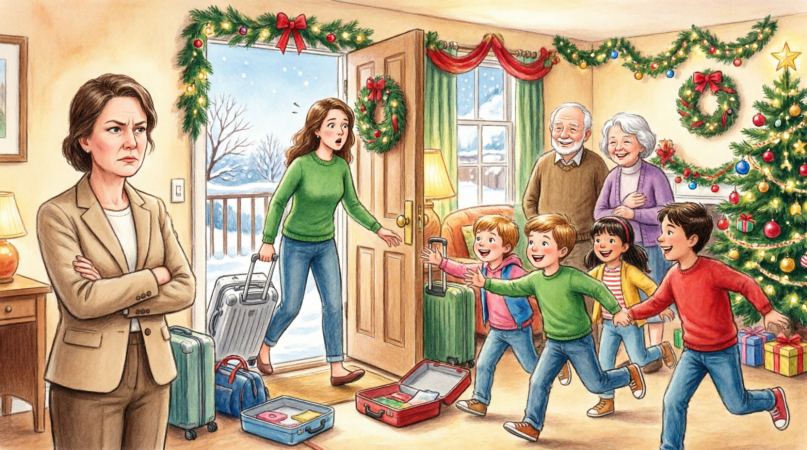
Inside, the house looked staged. Not decorated. Staged. The tree was lit, yes, and stockings were hung, yes, but the entryway was crowded with neatly packed suitcases lined up like they were waiting for inspection. A stack of lift tickets sat on the console table next to the mail, right on top like someone had wanted to make sure they were seen.
So much for last-minute.
My brother Dylan was in the living room, zipping up a brand-new winter jacket like he was in a commercial. His wife, Kendra, was tightening a strap on a small helmet while their kids ran in circles, shrieking and slipping on the hardwood.
Mason, six, had a runny nose that looked like it had been runny since September. Lily, four, was wearing a sparkly dress and snow boots because apparently rules didn’t apply in my family unless they were my rules.
Dylan glanced up, saw me, and grinned like I was the missing puzzle piece.
“Perfect timing,” he said. Then, without lowering his voice at all, he called to his kids, “Don’t wipe your snot on her, kids.”
He nodded toward me like I was a piece of furniture that had been moved back into the room.
“She’s allergic to responsibility,” he added.
Kendra laughed, that polite wife laugh that was half agreement and half survival. Mom didn’t correct him. She didn’t even flinch.
They all laughed.
And it was like something in me clicked into place. Not anger. Recognition. The kind you feel when you find your old coat in the closet and slip your arms into the sleeves and remember exactly how heavy it always was.
This wasn’t spontaneous. This wasn’t accidental. This wasn’t a misunderstanding.
“You knew about this,” I said quietly to Mom.
She busied herself at the counter, opening a drawer that didn’t need opening. “It just… came together,” she said. “Dylan needed a break. Kendra’s been stressed. You understand.”
You understand.
That was the phrase they used when they wanted me to swallow something sharp.
I set my suitcase down carefully, like if I didn’t do it carefully I might throw it. I’d been the extra pair of hands since I was twelve. The one who stayed home while they traveled. The one who rearranged her schedule. The one who didn’t make a fuss. The one who could understand.
And I had understood for years.
I walked into the kitchen, took a glass from the cabinet like I still lived here, and poured myself water. No one stopped talking. They were discussing traffic conditions, dinner reservations near the resort, whether the rental had a hot tub. Dylan mentioned a lodge that did fondue, like fondue was a constitutional right.
I took a sip, let the cold water steady me.
“I won’t be staying,” I said.
Dylan snorted. “Jet lag. Flight got you cranky.”
“No,” I said evenly. “I won’t be staying with the kids.”
Silence flickered through the room like a power surge, and then everyone’s faces shifted into that look I knew too well. The look that said, How dare you not play your part.
Mom’s voice went softer, dangerous-soft. “We counted on you.”
Counted.
I’d learned recently to pay attention to language. People told you what they believed you were for, if you listened.
Three weeks earlier, when she first begged me to come home, she’d emailed asking me to confirm my travel dates “so we can coordinate plans.” Something in that vagueness had made my stomach tighten.
So I’d replied with my dates and attached a simple agreement I’d drafted at first as a joke, the kind of joke you only make when you’re scared it isn’t a joke.
It was plain and boring on purpose. No drama. No insults. Just expectations.
I would not be responsible for childcare without prior written consent. If childcare was requested, it would be compensated at a set hourly rate. Any schedule changes required notice. Basic respect, spelled out like a workplace memo because apparently that was the only language my family consistently honored.
Mom had replied with a thumbs up emoji and, Sounds fine.
I doubted she’d opened the attachment. I knew she hadn’t read it.
Now I pulled my phone from my pocket and unlocked it with my thumb.
“I won’t be staying,” I repeated. “But the kids won’t be unattended.”
Dylan’s grin flattened. “What does that even mean?”
It meant I’d stopped trusting my family’s definition of the word family.
When Mom’s tone had gone urgent and vague, when she’d tried to pull me home like a rope, I’d called a licensed holiday childcare agency in town. I’d explained the situation in neutral terms. I’d scheduled coverage for the exact days I’d be here, just in case.
Not because I planned to use it.
Because I planned not to be trapped.
The agency had required signed authorization from the homeowner. I’d forwarded the agreement Mom had already approved in email, plus the agency’s service contract through a digital signature platform. Mom had clicked and signed like she always did when paperwork got in the way of what she wanted.
At 3:05 p.m., the doorbell rang.
No one moved at first. It took a second for the sound to register, like reality had knocked and my family didn’t recognize it.
I walked to the door and opened it.
A woman stood on the porch in a navy coat with an ID badge clipped to her collar. Behind her, a compact car with a tasteful logo on the side idled quietly in the driveway. Snow had started falling in thin, steady flakes, dusting the porch railing like powdered sugar.
“Good afternoon,” the woman said pleasantly. “We’re here for scheduled childcare services.”
I stepped aside and gestured toward the living room.
Dylan blinked like he’d forgotten how doors worked.
“What is this?” he demanded.
“Backup,” I said.
The woman held out a printed copy of the service contract and an invoice sheet with holiday rates clearly listed. She turned slightly so Mom could see the signature line.
Mom stared at the paper like it was a snake.
Her face drained of color in a slow wave that started at her forehead and slid down into her cheeks.
Then she whispered, barely audible, like she was saying it to herself.
“No… no… no way.”
Part 2
Dylan let out one short laugh, sharp enough to cut. It wasn’t his usual laugh. It had no humor in it. It was the sound someone makes when their world doesn’t behave the way it’s trained to.
“You’re charging us?” he said, like I’d announced I was charging admission to breathe.
“I’m ensuring you have coverage,” I replied.
Kendra took a step back from the paperwork like it could stain her sweater. “This is insane.”
The childcare provider remained exactly where she was, calm as a metronome. She didn’t glare. She didn’t smirk. She just waited, professional and steady, which somehow made everything feel more serious.
Mom’s hands hovered near the contract but didn’t touch it, like she was afraid it might burn.
“You signed,” I said gently, because I didn’t need to be cruel to be firm.
“I didn’t—” Mom started, and then stopped, because the signature was right there. Her name, her looped J and the messy tail on the t, the little flourish she added when she wanted to feel official.
The provider spoke with the kind of polite clarity that belonged in courtrooms and customer service desks. “Ma’am, we have your authorization on file. If you’d like to cancel, there is a same-day cancellation fee as outlined in section four.”
Mom’s eyes darted to me, full of panic and fury and something else I couldn’t name yet.
“No way,” she whispered again, louder this time, like volume could undo ink.
Dylan shoved his hands in his pockets, trying for swagger and landing on tantrum. “This is family. You don’t make family sign contracts.”
“I flew ten hours because Mom told me it wouldn’t feel like the holidays without me,” I said. “Not because you needed a sitter.”
Kendra’s mouth tightened. “So what, you just wanted to humiliate us?”
“No,” I said. “I wanted to be treated like a person, not a resource.”
Dylan scoffed. “You’re being dramatic.”
The provider cleared her throat softly. “Just to clarify,” she said, “our standard holiday package is daytime care. If the guardians will be out of town overnight, we require either a live-in arrangement with additional staffing and fees, or a designated local guardian who remains within thirty minutes of the home.”
Dylan’s face froze.
Kendra’s eyes widened. “Wait. What?”
Mom’s lips parted, and for the first time since I’d stepped through the door, she looked genuinely lost.
The provider continued, still calm, still polite. “How many nights will the guardians be away?”
Dylan’s voice came out clipped. “Four.”
The provider nodded like she was confirming a reservation. “Then you will need the overnight addendum, which includes two caregivers rotating to comply with state rest requirements. The total estimate is attached. If you’d like, I can email it.”
Dylan stared at the invoice like it had personally betrayed him.
Kendra said, “We can’t—” and then stopped, because she could, if they’d planned for it. If they hadn’t planned on me.
Mom’s whispering started up again, frantic, under her breath. “No. No. No way.”
And that was when they went crazy.
Not screaming right away. First came the outrage, layered and righteous.
“This is extortion,” Dylan snapped.
“This is ridiculous,” Kendra said, but her eyes kept flicking to Dylan, like she was watching him for which emotion would be safest.
Mom finally lifted the contract and scanned it, her eyebrows knitting as she read words she’d ignored in digital form. Her breathing sped up.
“You did this on purpose,” she said, voice rising. “You tricked me.”
“I sent you the document,” I said. “You chose not to read it.”
Dylan stepped closer, lowering his voice like intimidation would work better than volume. “You think you’re better than us because you live overseas and write little agreements.”
I looked at him, really looked. The expensive jacket. The lift tickets. The assumption that I would absorb whatever inconvenience made his life smoother.
“I think I’m done being volunteered,” I said.
His eyes flashed. “So what, you’re just leaving? You’re going to ruin Christmas?”
The provider shifted her weight slightly, the only sign she was human. “If I may,” she said, “our services can begin immediately. The children can stay here with us if the household remains. If the household will be vacant, we cannot legally assume sole custody without the overnight addendum and emergency contacts.”
The word custody made Mom flinch like she’d been slapped.
Kendra swallowed. “Dylan, maybe we should just take the kids.”
Dylan snapped his head toward her. “To a ski resort? With them?” He pointed at Mason, who had started picking at his sleeve, confused, and Lily, who was now clutching a stuffed reindeer and staring at me like she was trying to read my face.
“They’re your kids,” I said quietly.
That landed heavier than anything else I’d said.
Dylan’s jaw worked. He looked at the lift tickets again, then at the invoice. For a moment, I saw calculation flicker behind his eyes. The math of entitlement meeting the math of reality.
Mom’s voice dropped into that pleading register she’d perfected. “Sweetheart. Please. We just… we thought you’d understand.”
I did understand. Too well.
I picked up my suitcase.
“I’m staying at a hotel,” I said. “I’ll come by tomorrow if you want dinner. But I won’t be the built-in solution anymore.”
Dylan scoffed. “Unbelievable.”
Kendra’s eyes followed my suitcase like it was a suitcase full of grenades.
Mom stepped toward me, finally, like she might grab my arm. Then she stopped herself. Her fingers curled into her palm.
“Don’t do this,” she whispered.
“I didn’t,” I said. “You did. You just didn’t think I’d notice.”
I walked out into the falling snow. The air was cold enough to sting, clean enough to feel like breathing for the first time.
Behind me, through the cracked-open door, I heard Mom’s voice again, low and frantic, repeating like a prayer she didn’t believe in.
“No way. No way. No way.”
At the hotel, I dropped my suitcase on the bed and sat on the edge, shoes still on, staring at the bland landscape painting on the wall. I waited for the guilt to swallow me whole.
It didn’t.
Instead, something steadier settled in my chest. Not joy. Not triumph. More like a locked door I’d finally stopped trying to pry open with my bare hands.
My phone buzzed. A text from Dylan: You really embarrassed us.
I stared at it, then set the phone face-down.
A few minutes later, Mom called.
I let it ring twice before answering.
“You could have just told me no,” she said, and her voice sounded tired now, stripped of performance.
“I have,” I replied. “For years.”
Silence stretched between us, not peaceful, not hostile. Just real.
Then Mom’s voice came softer. “We didn’t think you’d… do this.”
“That’s the problem,” I said. “You didn’t think about me at all.”
I hung up before she could turn it into a fight, and for the first time in my life, I didn’t immediately regret it.
The next morning, I drove back to the house for dinner the way I’d offered, not because I owed them, but because I wanted to prove something to myself.
I wanted to show up as a person, not a tool.
When I pulled into the driveway, the compact car with the agency logo was gone. The suitcases were still by the door, but now they looked less triumphant and more like abandoned props after a play nobody clapped for.
Inside, Mason ran toward me first, snot and all.
Dylan’s voice rang out from the living room, sharp. “Don’t wipe your—”
He stopped himself.
His eyes flicked to me, and for a split second, he looked unsure. Like he’d finally realized the old script might not work anymore.
Mom stood in the kitchen, hands wrapped around a mug she wasn’t drinking from. She didn’t smile, but her shoulders were tense in a way that felt like fear, not control.
On the counter, near the salt and pepper, lay the printed contract from yesterday. And next to it, a business card I hadn’t seen before.
Renee Caldwell, it read.
Mom’s fingers trembled as she pushed the card slightly out of sight, like hiding it could erase it.
Under her breath, almost to herself, she whispered again, different this time. Less angry. More shaken.
“No… no… no way.”
Part 3
Dinner was spaghetti, because spaghetti was what Mom made when she wanted comfort without effort. It was also the meal she’d leaned on my whole teenage life, the one she’d taught me to make at twelve because “it’s easy” and “Dylan’s picky” and “you’re so capable.”
We ate at the same table where I’d done homework and balanced bills and listened to Mom complain about work while Dylan disappeared into his room. The only difference now was that I wasn’t pretending this was normal.
Dylan didn’t talk much. He kept checking his phone, scrolling like the screen might offer an escape hatch. Kendra fed Lily small bites and kept her voice bright, too bright, like she could glitter-glue the tension back into something festive.
Mom kept looking at me like I was a stranger who happened to know where the forks were.
“You didn’t have to involve… strangers,” she said finally, stabbing a meatball.
“They weren’t strangers,” I said. “They were professionals. That’s what you should’ve planned for.”
Dylan snorted. “Professionals. Listen to you.”
“Listen to me,” I echoed, calm. “That’s new.”
He opened his mouth, then closed it again, like he couldn’t decide whether to fight or pretend nothing happened.
Mason slurped a noodle and asked, innocent as gravity, “Are we still going to snow mountain?”
Kendra’s smile cracked. “Not this time, baby.”
Mason’s face crumpled. “Why?”
Dylan’s eyes flicked to me, and for a heartbeat I could see the blame rising like a tide.
But then Lily said, “Aunt Erin came,” like that was the obvious reason for everything, and something in my chest tightened in a way that wasn’t painful. Just… present.
After dinner, the kids begged me to play. Dylan didn’t volunteer to help. He just sat back with his phone like parenting was something that happened around him, not because of him.
I followed Mason and Lily into the living room anyway, not because I’d been assigned, but because I wanted to. There was a difference, and I needed my body to learn it, not just my brain.
We built a lopsided fortress out of couch cushions. Mason declared himself the “king of the blanket castle.” Lily insisted I be the dragon and then squealed when I roared too loudly. For twenty minutes, the house felt almost warm.
Then the doorbell rang again.
Everyone froze, like the sound had been wired directly into yesterday’s panic.
Mom moved first, too fast. She wiped her hands on a dish towel and reached the door before I could stand.
When she opened it, a gust of cold air rushed in, carrying snowflakes and the faint scent of pine.
The woman from the agency stood on the porch again, navy coat, ID badge. Calm expression. Renee Caldwell.
“I’m sorry to bother you,” she said. “We had a follow-up item. A document left unsigned.”
Mom’s face went pale so quickly it was almost scary.
“No,” she whispered, and then, like she couldn’t help herself, “no… no way.”
Renee’s gaze flicked past Mom and landed on me. Her eyes held a flicker of recognition that didn’t fit the situation, like she’d seen me before somewhere that wasn’t a porch with a contract.
“Erin?” she said, softly.
My stomach dropped. Not because she knew my name. The agency knew my name. It was on the intake form.
It was the way she said it. Like it meant something to her.
“Yes,” I answered cautiously.
Renee’s mouth tightened, and for a moment her professionalism slipped, replaced by something rawer. Then she recovered and lifted a folder.
“This is just a standard emergency contact authorization,” she said, voice careful. “It’s required if services extend beyond one day. Yesterday, it wasn’t completed.”
Mom reached for the folder with shaking hands. “We’re not using your services,” she said quickly.
Renee nodded. “Understood. Then there’s nothing further.” She paused, then added, quieter, “I’m sorry for the disruption.”
She turned to leave, but before she stepped off the porch, her gaze met mine again.
“If you have a moment,” she said, barely above a whisper, “I’d like to speak with you. Not about the contract.”
Dylan stood up abruptly. “Nope. No more of this.”
Kendra looked between us, confused.
Mom’s voice went sharp. “There’s nothing to talk about.”
Renee’s expression didn’t change, but her eyes sharpened. “Ma’am, I’m not here to argue. I’m asking Erin.”
My name in her mouth again. Not customer-service Erin. Something else.
I swallowed. “We can talk outside,” I said.
Mom’s hand shot out and grabbed my wrist. Her grip was tight, desperate. “Don’t,” she whispered.
Her eyes were wet.
That stopped me harder than any guilt trip ever had.
“Why?” I asked, quietly enough that only she could hear.
Mom’s lips parted, and for a second she looked like she might tell the truth. Then she shook her head, almost violently.
“No,” she said. “No way.”
I gently pulled my wrist free. I wasn’t yanking away. I wasn’t making a scene. I was just… not letting myself be held in place anymore.
Outside, the air was sharp, the snow thicker now, softening the edges of everything. Renee stood near the bottom step, her breath visible.
“I know this is strange,” she began. “But when you called our agency… you told the receptionist your mother’s address. And your voice—”
She stopped, then said, “Do you know the name Mark Caldwell?”
My heart did something it hadn’t done in years. A hard, sudden thud, like a door slamming.
I stared at her. “Why are you asking me that?”
Renee’s eyes glistened, and she blinked fast, like she was fighting something. “Because Mark Caldwell is my father,” she said. “And he used to talk about a little girl named Erin like she was the brightest thing he’d ever seen. And because your mother’s face when she saw my badge…”
She glanced back at the house, where Mom’s silhouette stood rigid behind the glass.
“She looked like she’d seen a ghost.”
My mouth went dry. “My father’s name was Mark,” I said slowly. “But he hasn’t been in my life since I was eight.”
Renee nodded once, like she’d expected that answer. “I figured.”
She reached into her coat pocket and pulled out a folded piece of paper, then held it out.
“This is my number,” she said. “If you want the story from someone who isn’t your mother.”
I didn’t take it right away. My fingers felt numb.
Inside the house, I could see Mom pacing in the entryway like a trapped animal. Dylan had moved behind her, his face hard, his mouth moving as he spoke. Kendra hovered with the kids, trying to keep them distracted.
Renee followed my gaze.
“He was in the car yesterday,” she said suddenly.
I snapped back to her. “What?”
Renee’s voice dropped. “He drove me. Holiday coverage. We were short-staffed. He didn’t come to the door. He didn’t want to push. He just… wanted to see if you were real.”
The porch seemed to tilt under me.
I thought of the compact car idling in the driveway. The tinted windows. The way I’d been so focused on the contract and my family’s faces that I hadn’t looked twice.
“He was there,” I whispered.
Renee nodded. “Your mother didn’t know. Not until she saw my name.”
My chest tightened, not with sadness exactly. With collision. Like two timelines had crashed into each other and nobody had cleaned up the debris.
Renee held the paper closer. “I’m not trying to ambush you,” she said. “I’m sorry it happened like this. But… you deserve the truth.”
I took the paper.
The moment my fingers touched it, Mom yanked the door open.
“Erin!” she called, voice cracking.
I turned, paper in my hand, and for the first time I saw Mom not as the authority in my childhood story, but as a person who had been holding something back so long it had warped her.
“I need air,” I said. “I’ll be back later.”
Mom’s face crumpled. “No,” she whispered. “No… no way.”
I walked to my car on shaking legs, Renee’s number folded in my palm like a match I didn’t know whether to strike.
That night, back at the hotel, I stared at the paper until the numbers blurred.
My father had been in the driveway.
My mother had begged me to come home.
And now I didn’t know which part of the weekend had been planned… and which part had been waiting for me like a trapdoor all along.
Part 4
Dublin felt like another planet after that.
The first morning back, I walked along the River Liffey with my hands shoved deep into my coat pockets, letting the damp wind slap me into focus. People hurried past with coffee cups and headphones, living their lives like the ground under them wasn’t shifting.
At work, my emails piled up. Contracts, compliance reviews, boring problems with clean solutions. The kind of work I’d chosen because it rewarded clarity.
My family didn’t.
Mom texted twice in the days after I left.
You hurt us.
Please don’t talk to anyone.
The second message made my skin prickle.
Anyone.
She didn’t write Renee’s name. She didn’t have to.
Dylan didn’t text at all. Kendra sent a single photo of the kids wearing pajamas with tiny reindeer on them. No caption. Just the image. It felt like an olive branch and a warning at the same time.
I didn’t respond to any of it right away.
Instead, on the third night, I unfolded Renee’s number again and stared at it until my thumb smudged the ink.
Then I called.
She answered on the second ring. “Erin?”
My throat tightened at the sound of my name in her voice, like she’d been waiting.
“It’s me,” I managed.
We didn’t do small talk. We didn’t talk about the weather. Renee’s voice softened.
“Thank you for calling,” she said.
I sat on my couch, staring at the dark window where my reflection hovered. “Start from the beginning,” I said. “And don’t protect me from it.”
Renee exhaled slowly. “Okay.”
Her story came in pieces at first, careful and measured, like she was laying out fragile objects.
Mark Caldwell was her father. He’d built the childcare agency with his second wife after he left construction work. He was the kind of man who showed up early, who fixed things, who made pancakes shaped like animals.
He also carried a quiet grief Renee had grown up sensing but not understanding.
“When I was little,” she said, “I’d hear him talking to someone in the garage. Like he was practicing a speech. He’d say your name.”
My stomach clenched. “What did he say?”
Renee hesitated. “He’d say he was sorry. He’d say he hoped you were okay. He’d say he didn’t know if you’d ever want to see him again.”
I gripped the phone tighter. “Why didn’t he come back?”
Renee’s voice sharpened, not with anger, but with certainty. “Because your mother made sure he couldn’t.”
Silence filled my living room like smoke.
Renee continued carefully. “He told me the story when I turned sixteen. He said your mom and he fought. Badly. He said he wasn’t innocent. He said he left the house after an argument and when he came back, the locks were changed. He said she filed for an emergency protective order.”
My stomach dropped. “A protective order?”
Renee’s voice went quiet. “He said there was no violence. He said he never touched her. He said she claimed he did.”
I swallowed hard, memories flashing—Mom’s stories of “your father’s temper,” the way she’d always described him like an unpredictable storm. The way I’d learned early not to ask questions, because questions made her eyes go glassy and her mouth go thin.
Renee said, “He didn’t fight it like he should have. He says that’s his shame. He got scared. He thought if he pushed, he’d make it worse. He thought maybe you’d be safer if he stayed away until it cooled down.”
“And then it didn’t,” I whispered.
“No,” Renee said. “Then your mom moved on. And he… did too, but not really. Not inside.”
I sat there, shaking, as if my bones were rearranging.
“Why now?” I asked. “Why did he drive you to my mom’s house?”
Renee’s voice cracked. “Because he heard you on the phone when you booked services. You used Mom’s address. You said your name. He froze. He made me repeat it. He didn’t believe it.”
She took a breath. “He didn’t want to go. He didn’t want to disrupt your life. But he wanted to see you, even if it was through a windshield like a coward.”
My eyes burned. “And my mom saw your badge and—”
“And realized she couldn’t control what you’d learn,” Renee finished softly.
I pressed my knuckles against my mouth, trying not to make a sound.
Renee didn’t rush me. She waited the way a good caregiver waited, steady and patient.
Finally, I asked the question that had been lodged in my throat since the porch.
“Is he sick?” I said.
Renee hesitated again, and that told me enough before she spoke.
“Yes,” she admitted. “It’s treatable, but it’s serious. He’s doing chemo. He’s tired a lot. He kept saying he didn’t want to show up in your life looking… like that.”
My chest tightened. Anger flared, hot and bright, not just at my mother, but at time itself. At the years that could never be returned.
Renee said quietly, “He asked me not to push. But I’m pushing anyway because I watched your mom use you like a tool in your own house, and I thought… if you can draw a boundary with her, you can handle the truth.”
I laughed once, breathless and ugly. “You saw that.”
Renee’s voice held something like pride. “Yeah. I saw you.”
After we hung up, I sat for a long time in the dark.
The weekend replayed itself in my head, but now the details rearranged.
Mom’s panic at the contract. Not just money panic. Exposure panic.
The way she’d begged me to come home and then opened the door like she didn’t want to look at me.
The way she’d whispered no way, no way, no way, like she was trying to press the past back into the walls.
My boundaries hadn’t just interrupted a ski trip.
They’d cracked a seal.
The next day, I booked another flight.
Not for the holidays this time.
For the truth.
Part 5
When I landed, the air in my hometown smelled like cold leaves and car exhaust, the kind of scent that used to mean I was home. Now it just meant I was back.
I didn’t go to Mom’s house first.
I went to a small diner off the highway where Renee said Mark liked to sit because the coffee was cheap and the waitress didn’t ask questions.
My hands shook as I pushed the door open.
The place was almost empty. A few older men in caps, a tired couple sharing pancakes, a teenager wiping tables with slow resentment.
And then I saw him.
He was thinner than the father in my childhood memory, his shoulders narrower, his hair more gray than dark. But his posture was the same, slightly forward like he was always ready to stand up and help. His hands were wrapped around a mug like it was an anchor.
He looked up when the bell above the door jingled.
And his eyes—his eyes were mine.
He stood halfway, like his body moved before his mind could catch up.
“Erin,” he said.
Hearing my name in his voice did something strange to me. It didn’t feel like reunion. It felt like recognition, delayed by decades.
I stopped a few feet away, chest heaving like I’d run.
He didn’t come closer. He didn’t reach for me. He just looked, like he was trying to memorize my face in case it disappeared.
“I didn’t know if you’d come,” he said.
“I didn’t know you existed,” I replied, and the sharpness in my voice surprised even me.
His shoulders flinched. “That’s fair.”
We sat in a booth. He slid into the seat across from me like he didn’t deserve to take up space.
For a long moment, neither of us spoke.
Then he said, quietly, “I’m sorry.”
It wasn’t a grand apology. No theatrics. Just two words, spoken like they weighed something.
I swallowed. “Why didn’t you fight for me?”
His jaw tightened. He stared at his hands. “Because I was weak,” he said. “Because I was scared. Because I thought I could wait it out and then come back when it was calmer. And then… time started moving without me.”
My throat burned. “Mom told me you left because you didn’t want us.”
Mark’s face crumpled, just for a second. “I wanted you,” he said. “I wanted you so much it hurt to breathe sometimes.”
The waitress came by, and Mark ordered coffee for both of us like muscle memory. I let him. I needed something ordinary to hold onto.
He told me pieces of his side, careful not to paint himself as a hero.
He admitted he’d yelled during fights. He admitted he’d punched a wall once. He admitted he’d stormed out because he didn’t know how to stay without exploding. He admitted he’d trusted the system to be fair and learned too late that fairness wasn’t automatic.
“When the order came through,” he said, voice rough, “they told me if I violated it, I’d lose any chance. So I listened. And I hated myself for listening.”
I stared at him, trying to match this man to the faceless villain Mom had built in my head. It didn’t fit cleanly.
Nothing fit cleanly.
“Renee,” I said, and my voice cracked. “She’s your daughter.”
He nodded. “She’s a good kid.”
“She drove up to Mom’s porch with a contract and a badge,” I said, and despite everything, a strangled laugh slipped out. “That’s one way to meet your half-sister.”
Mark’s lips twitched, sadness and humor tangled. “I told her not to. She doesn’t listen.”
“Sounds familiar,” I muttered, and then I realized what I’d said and my eyes stung again.
Mark watched me carefully. “Did she treat you okay?” he asked, and the question was so parental, so instinctive, it broke something open.
I pressed my palm to my forehead. “She treated me like… staff,” I said. “Like I was a tool she kept in a drawer.”
Mark’s face tightened. “I’m sorry,” he repeated, and this time it sounded like it meant everything he couldn’t undo.
We talked for two hours. About my life in Dublin. About his life here. About Renee. About the childcare agency, how he’d started it because he wanted to build something gentle, something that took care of people instead of breaking them.
When I told him about the agreement I’d emailed Mom, about the way she’d signed without reading, Mark let out a low whistle.
“You always were smart,” he said, and something in his tone made me sit up straighter, like that compliment had been missing from my bones.
After the diner, I drove to Mom’s house.
My hands didn’t shake this time. They felt steady, heavy with purpose.
Mom opened the door like she’d been standing behind it the whole time, listening for my footsteps.
Her face looked older than it had during the holidays. Not just age-old. Worn-out-old.
“You went to him,” she said.
It wasn’t a question.
“Yes,” I replied.
Mom’s mouth trembled. “He’s filling your head.”
“No,” I said. “You emptied mine.”
She flinched.
I stepped inside, not waiting for permission. The house smelled the same, but now it felt like a set built around a secret.
“Why?” I asked. “Why did you lie to me?”
Mom’s eyes filled, and for a moment she looked like the small-voiced woman from the phone call over the Atlantic. “Because I was angry,” she whispered. “Because I was hurt. Because he left.”
“He left for a night,” I said. “And you made it forever.”
Mom’s breathing hitched. She sank onto the entryway bench like her legs gave out.
“I didn’t think you’d ever find him,” she admitted, voice cracking. “And then you did, because of a babysitter invoice.”
I stared at her. “You begged me home,” I said slowly. “Was it really about the holidays?”
Mom’s silence answered before her words did.
Finally, she whispered, “I knew he was sick. Renee called me a month ago. I thought… I thought if you came home, maybe… maybe you’d see him. Maybe it would happen naturally. I didn’t know how to tell you.”
“And instead,” I said, voice sharp, “you tried to dump kids in my lap and run away.”
Mom’s eyes squeezed shut. “I panicked.”
I stood there, feeling rage and pity wrestle inside me.
“You don’t get to use me as your escape hatch,” I said. “Not anymore.”
Mom’s whisper surfaced again, that same phrase like a broken charm. “No… no way.”
This time, it didn’t mean refusal.
It meant she was realizing she’d lost control.
Part 6
The next Christmas looked nothing like the ones I grew up with.
That was the point.
I rented a small cabin two hours away, tucked in a patch of snow-dusted woods where the trees stood quiet and honest. There was a fireplace, mismatched mugs, and enough space that nobody could corner me in a hallway.
I invited Dylan and Kendra and the kids. I invited Mom. And I invited Mark and Renee.
I didn’t do it because I was pretending everything was fixed.
I did it because I wanted the future to be built on truth, even if the truth was awkward.
The first hour was a mess of cautious greetings and hovering bodies.
Dylan arrived late, carrying a bag of gifts like a shield. Kendra looked exhausted in a way I hadn’t noticed before, not because she’d changed, but because I’d never looked beyond my own role in their chaos. Mason sprinted through the cabin shouting about the loft. Lily declared the couch “the queen bed.”
Renee showed up with homemade cookies and a calm smile that made her seem older than me even though she wasn’t. Mark came behind her, moving slower than he had in the diner, but his eyes were bright when they found mine.
Mom came last.
She stood in the doorway for a long moment, staring at Mark like she couldn’t decide whether to cry or run.
Mark didn’t move toward her. He just nodded once, respectful, tired, present.
Mom’s hands clasped and unclasped. Under her breath, so quietly I almost missed it, she whispered, “No… no… no way.”
I watched her say it, and I realized something with surprising calm: she wasn’t whispering it at me anymore.
She was whispering it at reality.
Dinner was chili and cornbread because I refused to play the role of holiday martyr. We ate in a messy, loud cluster, kids talking over adults, adults interrupting themselves to pass napkins. Nobody was perfectly polite. Nobody performed a magazine-cover holiday.
It was better.
At one point, Mason accidentally smeared a streak of snot on my sleeve.
He froze, eyes wide, bracing for anger.
Dylan opened his mouth automatically, and I saw the old joke lining up on his tongue.
I looked at Mason and said, “Hey, buddy. Let’s get you a tissue.”
Mason blinked, relief flooding his face.
Dylan’s mouth closed.
Kendra exhaled like she’d been holding her breath for years.
Later, when the kids were upstairs building a blanket fort big enough to qualify as architecture, Dylan stepped onto the back porch with me. The air was sharp and clear, the stars hard and bright above the trees.
He leaned on the railing, looking out at nothing.
“I was a jerk,” he said finally.
I didn’t answer right away. I let the words sit in the cold like they deserved to.
Dylan swallowed. “I thought you’d always just… do it,” he admitted. “Because you always did.”
“I know,” I said.
He huffed a laugh. “When you didn’t, it felt like the ground moved.”
“It did move,” I said. “I moved it.”
Dylan nodded slowly. “We didn’t go on that ski trip,” he confessed. “Not because of the money. Because Kendra said… she said if we left the kids behind again, she was leaving me.”
My eyebrows rose.
Dylan’s shoulders slumped. “And she was right.”
For a second, the cold night felt like it had teeth. Then Dylan added, quieter, “We started counseling.”
That surprised me more than I expected.
I glanced through the cabin window where Kendra sat on the rug with Lily, helping her wrap a scarf around a stuffed reindeer. Mom hovered near the sink, not needed, not in charge, just there. Mark sat in an armchair, smiling softly at Mason’s laughter from upstairs. Renee handed Mom a dish towel like it was an offering, not an order.
Dylan rubbed his face. “I thought family meant you don’t keep score,” he said.
“Family means you don’t treat someone like they don’t count,” I replied.
He nodded, eyes damp in the porch light. “I’m trying,” he said. “I don’t know if I’m good at it. But I’m trying.”
Inside, the kids stampeded down the stairs and shoved something into my hands. A card, folded crooked, covered in crayons.
It read: Thank you for making our house quiet again.
Below it, in Mason’s messy handwriting: Thanks for making Mom and Dad be parents.
My throat tightened so fast I had to blink hard.
Dylan looked over my shoulder and made a sound like he’d been punched, not with pain, but with realization.
Kendra appeared behind him, saw the card, and covered her mouth.
Renee watched from the doorway, eyes soft.
Mom’s face crumpled. She pressed a hand to her chest like she was trying to keep her heart from falling out.
And then she whispered it again, but this time the words didn’t sound like denial.
They sounded like awe.
“No… no… no way.”
I smiled, not sharp, not triumphant.
Just real.
Because the twist wasn’t that my family had secretly planned a trip, or that I’d hired a babysitter, or even that my father had been sitting in a car in the driveway.
The twist was that one sentence I’d said—one boundary spoken out loud—had forced everyone to stop pretending the old story was the only one we could live.
And now, in a cabin full of imperfect people trying anyway, the holidays finally felt like something I could come home to.
Not because they needed me.
Because they saw me.
Part 7
In Dublin, January didn’t arrive with fireworks. It arrived with wet sidewalks and gray mornings that looked like someone had erased the sky. I went back to my routine because that’s what I’d trained myself to do whenever my family made a mess: leave, reset, pretend I wasn’t still smelling the smoke.
But the cabin Christmas clung to me.
Not the chili or the blanket fort or Mason’s crooked card, though those things mattered. It was the way Dylan had stood on the porch and admitted the ground had moved. It was the way Kendra’s shoulders had looked lower, like she’d finally put down a weight she’d been carrying alone. It was the way Mark had looked at me across the room, not demanding anything, not trying to buy forgiveness, just staying present.
And it was the way Mom had hovered at the sink, holding a dish towel like it was a life raft, whispering no way under her breath like she was trying to negotiate with time.
I told myself I could hold all of that and still be a person with a job and friends and a grocery list.
For the first two weeks, I succeeded. I worked late. I answered emails. I went out for coffee with Maeve from the office and nodded at her stories about her loud neighbors. I didn’t cry in public, which felt like a victory in the small, private Olympics of adulthood.
Then, one Tuesday morning, I got an email from my bank.
Unusual activity detected. Please verify.
My stomach tightened before I even clicked it. I told myself it was a scam. I told myself it was nothing. I clicked anyway and went through the secure login because anxiety makes you do things that don’t feel smart until later.
There was a charge attempt on a credit card I didn’t recognize.
Not my debit. Not my travel card. Something else, with my name on it.
I stared at the screen, pulse thudding in my ears.
Sometimes, when you grow up in a family like mine, you learn to doubt your own perception. It’s a survival skill. It keeps you from calling every strange thing a crisis.
But I’d also learned a new skill: taking my own alarms seriously.
I called the bank. I asked questions. I made them spell out the last four digits. I repeated them out loud, like saying them might make them become familiar.
They didn’t.
When I hung up, my hands were cold. I opened my credit report, expecting to feel silly, expecting to find nothing, expecting the relief of being wrong.
The report loaded slowly, like it enjoyed suspense.
There were accounts I didn’t open.
A department store card from three years ago. A furniture financing line. A small personal loan that had been paid off late, twice. Another credit card, this one maxed near its limit and then kept afloat with minimum payments.
All under my name. All tied to an address in my hometown.
Mom’s town.
My apartment felt too quiet, like it was holding its breath with me. I sat back in my chair and stared at the screen until the numbers stopped looking like numbers and started looking like fingerprints.
I thought about Mom signing the childcare contract without reading it. How casual she’d been about attaching her name to a legal document.
I thought about her second text: please don’t talk to anyone.
Anyone.
And I thought about the way she’d begged me to come home, the way she’d tried to pull me across an ocean with urgency and vagueness. At the time, I’d assumed it was about babysitting, about being used in the old familiar way.
Maybe it had been about something else entirely.
My phone buzzed. Renee.
You okay? Dad’s had a rough week. Not an emergency, just… low energy. He keeps saying he’s fine. He’s not always fine.
I stared at her message, and my chest tightened in two directions at once: fear for Mark and a new, colder fear for myself.
I typed back: I’m okay. Can I call you later?
She replied immediately: Anytime.
I didn’t call her yet. I needed to do something first, something practical, something that didn’t require me to hold my emotions with both hands.
I froze my credit. I disputed the accounts. I set up alerts. The process was clinical, full of menus and confirmation numbers, and I clung to that clinical feeling like a railing.
Then, when the paperwork was in motion, I sat on my couch with my laptop on the coffee table and stared at my hometown address on the report.
My name. My mother’s town. Accounts I didn’t open.
I heard Dylan’s voice in my head from years ago, teasing, lazy: Erin’s the responsible one.
I’d thought it was a joke.
Now it sounded like a plan.
That night, I called Renee.
Her voice came soft through the speaker. “Hey.”
I swallowed. “Did Mark ever mention money?” I asked. “Or… paperwork?”
Renee was quiet for a beat. “Not like that,” she said carefully. “He hates debt. He’s weirdly intense about credit scores. Why?”
I stared at the dark window again, my reflection floating there, older than the girl who used to believe her mother’s stories.
“I think my mom opened accounts in my name,” I said.
Renee’s inhale was sharp. “Erin.”
“I don’t know yet,” I added quickly. “But my credit report says it happened. And it’s tied to her town.”
Renee didn’t jump into solutions. She didn’t tell me to calm down. She didn’t make excuses for someone she barely knew.
She said, steady, “What do you need?”
The question hit me harder than the fraud.
“I need the truth,” I said. “And I think I need to come back.”
Renee’s voice softened. “Okay,” she said. “I’ll help you. Dad will too.”
I closed my eyes.
Outside, rain tapped at the glass like impatient fingers. In my chest, something old and familiar tried to rise: the urge to minimize, to smooth, to handle it quietly so nobody would be upset.
I let that urge pass like weather.
Then I booked a flight.
Part 8
I didn’t tell Mom I was coming.
Part of me felt cruel about that, the way secrecy in my family was always presented as betrayal. But another part of me was tired of announcing myself just to have my words used as a warning system.
I landed, rented a car, and drove straight from the airport without stopping at the house, without stopping for coffee, without stopping to breathe. The roads were edged with dirty snow and salt-streaked slush. Every mile closer felt like a tightening rope.
The county courthouse sat on a bland stretch of downtown, square and beige, as if it wanted to be unmemorable. I walked in with my passport and my driver’s license and asked, politely, for records related to my name and any credit filings.
The clerk gave me a look like she’d seen this story before, then handed me a form.
Filling out paperwork in a courthouse has its own smell. Toner and old carpet and stale authority. I wrote my name carefully, the way you do when you’re trying to prove you belong to yourself.
When the clerk returned, she slid a thin packet across the counter.
“I can’t give you everything,” she said. “But you can request the full file if you want. This is what’s available today.”
I opened the packet in the lobby and stood there, breathing too fast.
There it was: my name on an application. My social security number. My signature.
Except it wasn’t my signature.
It was Mom’s version of it. The same looped letters, the same messy tail, just trying to pretend it was mine.
I felt a strange calm settle over me, like my brain had stopped arguing with itself.
This wasn’t a misunderstanding.
This was theft.
I drove to Mom’s house next, the rental tires crunching over the driveway gravel. Her car was in the garage. Dylan’s truck was parked on the street, half in front of the neighbor’s mailbox like it had always been entitled to space.
My hands didn’t shake this time either. They felt heavy, deliberate.
I knocked once.
Mom opened the door quickly, like she’d been watching through the window. Her face brightened in automatic surprise, then tightened when she saw my expression.
“Erin,” she said, voice rising into that anxious sing-song that used to mean she was about to tell me everything was fine. “You didn’t say you were coming.”
“I wasn’t asking permission,” I said.
Her mouth opened, closed. “Is everything okay?”
Dylan’s voice drifted from the living room. “Who is it?”
Mom moved like she could block me with her body. “It’s just—”
I stepped past her.
Dylan was on the couch, remote in hand, like he’d never left. Kendra wasn’t there. The kids weren’t there. He looked up, saw me, and his face shifted into practiced irritation.
“What now?” he asked.
I held up the packet from the courthouse.
“This,” I said.
Dylan’s eyes flicked to it, then away too fast.
Mom’s breath hitched. Her fingers curled into the doorframe. “What is that?”
“You tell me,” I said.
She didn’t answer. Her gaze locked on the paper like it was a weapon.
Dylan stood up slowly. “You went digging?”
“I went verifying,” I replied. “There’s a difference.”
Mom’s voice went thin. “We can talk about this calmly.”
“We can talk about it honestly,” I said. “Calm comes after.”
I flipped the packet open and held it so she could see the signature line.
“That’s not my signature,” I said. “It’s yours.”
Mom’s face drained the way it had on the porch when the childcare invoice appeared. That same slow wave of panic.
“No,” she whispered. “No… no…”
There it was again. The chant. Like if she said it enough times, reality would back off.
Dylan’s jaw tightened. “You’re overreacting,” he snapped, but his voice didn’t have conviction.
I looked at him. “Did you know?”
He didn’t answer. He didn’t have to.
Mom lunged toward the papers, as if grabbing them would erase what they said. “I was going to fix it,” she insisted. “It was temporary.”
“Temporary theft,” I said. “Temporary fraud.”
Mom’s eyes filled. “I had to,” she said, and the words came out like a confession and a plea at the same time. “You were gone. You weren’t using your credit here. We needed—”
“We,” I repeated.
Dylan’s shoulders lifted defensively. “It wasn’t like that.”
I turned to him. “Then explain it.”
He took a step toward me, face hard. “You don’t understand,” he said. “You think everything’s simple because you live overseas and send emails with agreements.”
I felt my mouth curve, small and cold. Not because it was funny.
Because it was familiar.
“I understand exactly,” I said. “You counted on me again.”
Mom’s whisper broke into a frantic tremble. “No… no way… Erin, please—”
I held up my hand.
“One thing,” I said. “Just one thing.”
They froze, the way they had when I’d told them I wasn’t staying with the kids. The way people freeze when the old script fails.
“I already reported it,” I said.
Dylan’s face changed first. Shock, then fury, then something close to fear.
Mom made a sound in her throat like she’d been punched.
And then they went crazy.
Part 9
Dylan exploded into motion like anger could reverse time.
“You did what?” he barked, stepping closer, voice loud enough to rattle the framed family photos on the wall.
Mom stumbled back against the entryway table, knocking a small bowl of pinecones onto the floor. The scent of cinnamon spray rose as the pinecones scattered, sweet and wrong.
“No,” she whispered again, rapid-fire now. “No, no, no way, no way—”
I stood still. I’d expected the volume. I’d expected the accusations. When you take away someone’s access to you, they often act like you stole something from them.
Dylan jabbed a finger toward my chest. “You’re trying to ruin us.”
“I’m trying to protect myself,” I said.
“It was just help,” Mom insisted, hands fluttering uselessly. “It wasn’t like we were—”
“It was exactly like you were,” I cut in. “You put debt in my name.”
Dylan’s face went red. “We were going to pay it off.”
“You already missed payments,” I said, and watched his eyes flicker, startled that I knew. “That’s why I found it. Because the bank flagged it.”
Mom’s lips trembled. She looked smaller, not in a sympathetic way, but in a revealing way. Like the person she’d been pretending not to be was showing through.
Dylan paced two steps, then spun back. “You know what’s insane?” he snapped. “You show up once a year and suddenly you’re the moral police.”
“I showed up because you dragged me home for babysitting,” I said. “And now I’m showing up because you put my future at risk.”
Dylan’s laugh was sharp. “Your future. Always your future.”
I stared at him. “Yes,” I said simply. “My future. Mine.”
Mom’s voice cracked. “Erin, please. Please don’t do this. We can handle it privately.”
Privately. Quietly. In the dark. Where they could control the story.
“No,” I said.
Dylan’s eyes narrowed. “So what, you’re going to press charges against your own mother?”
“I reported fraud,” I said. “The bank and the credit bureaus will investigate. I’m not going to lie to cover you.”
Mom slid down onto the bench like her legs quit. She pressed her palms to her face, and for a second I saw something like shame.
Then it twisted into anger.
“You always wanted to punish me,” she spat, voice suddenly venomous. “Ever since you were little. You always acted like you were better than me.”
The accusation landed in an old bruise. I’d heard versions of it my whole life. It was the story she told whenever I asked for anything that looked like fairness.
I exhaled slowly. “This isn’t about better,” I said. “This is about boundaries.”
Dylan scoffed. “There it is. Your favorite word.”
“It’s my favorite because it works,” I said.
He moved toward the kitchen, yanking open drawers like the house itself was responsible. “You know what,” he said, voice rising again, “I’m done being judged by you. You left. You abandoned us. You don’t get to come back and—”
“Abandoned,” I repeated, and my voice went quiet.
Dylan froze for half a second. Mom’s eyes darted to me, wary.
I stepped closer, not aggressive, just present. “I didn’t abandon you,” I said. “You pushed me out whenever I stopped being useful.”
Mom flinched.
Dylan snapped, “That’s not true.”
I looked at Mom. “Did you ever ask me to come home just to see me?” I asked. “Not to babysit, not to sign something, not to cover a shift, not to fix a mess?”
Mom’s mouth opened. Closed. Her gaze slid away.
That was answer enough.
A knock came at the door.
All three of us froze again.
Mom’s eyes went wide. Dylan’s face went hard.
The knock came again, firmer.
I walked to the door and opened it.
A uniformed officer stood on the porch, not dramatic, not aggressive, just doing a job. His presence changed the air immediately. Authority doesn’t have to shout. It just shows up.
“Ms. Caldwell?” he asked.
Mom made a strangled sound.
I said, “That’s my mother.”
He nodded and glanced at his clipboard. “Ma’am, we’re following up on a report of identity fraud. We need to ask you a few questions.”
Mom’s whisper turned into a broken chant. “No… no… no way…”
Dylan stepped forward, voice quick and false-bright. “Officer, there’s been a mistake.”
The officer didn’t look at Dylan. He looked at Mom. “Ma’am,” he repeated gently, “can we come in?”
Mom’s face did something strange. For a moment, she looked like she might faint. Then she straightened, chin lifting with stubborn pride.
“This is my house,” she said, voice trembling. “You can’t just—”
“We can,” the officer said calmly, “if you refuse to cooperate. I’d rather not escalate.”
Mom’s eyes flicked to me, full of betrayal.
“You did this,” she hissed.
“No,” I said quietly. “You did.”
The officer stepped inside. Another officer appeared behind him, standing by the doorway, watching. The living room suddenly looked smaller, like the walls had leaned in.
Dylan backed up a step, jaw clenched, hands fisting at his sides.
The officer asked questions. Names. Dates. Whether Mom recognized the signature. Whether she had permission.
Mom tried to dodge, tried to soften, tried to turn it into a misunderstanding. Each time, the officer returned to the same calm center.
“We just need facts, ma’am.”
Facts are brutal in a family built on stories.
When the officer asked for Dylan’s ID because his name appeared on one of the applications as a “reference,” Dylan went rigid.
Mom’s breath hitched.
And in that split second, the truth snapped into focus: this hadn’t been Mom acting alone in a panic.
This had been a system.
A family system.
After thirty minutes, the officers left with copies of documents and a promise to follow up. No handcuffs. No shouting. Just the quiet, heavy shift of consequences becoming real.
When the door closed, Mom sagged like a puppet with cut strings.
Dylan turned on me, eyes blazing. “You’re dead to me,” he said.
Mom’s voice was a rasp. “Erin… why couldn’t you just… handle it like family?”
I stared at them both, heart pounding, but my voice steady.
“I am,” I said. “I’m handling it like the family I should’ve had.”
I picked up my coat from the chair.
Mom’s whisper returned, but now it sounded less like denial and more like terror of what she’d built.
“No… no… no way.”
Part 10
I didn’t go back to the hotel.
I drove straight to Renee’s apartment across town, hands tight on the steering wheel, knuckles pale. I didn’t want to be alone with the echo of Mom’s accusations or Dylan’s rage. I didn’t want to sit in silence and let the old guilt creep in and start rewriting what had happened.
Renee opened the door before I could knock twice, like she’d been watching for me.
One look at my face and her posture changed. “It’s bad,” she said, not asking.
I nodded.
She stepped aside. “Come in.”
Her place was small, lived-in, warm. A pile of laundry on a chair, a half-finished puzzle on the coffee table, a mug with a chipped rim. Normal life. The kind of normal that always felt slightly unreal to me, like a language I’d studied but never spoken at home.
I sat on her couch and told her everything, from the credit report to the courthouse to the officers standing in my mother’s living room.
Renee listened without interrupting, her hands clasped tight enough to show she was holding anger in place.
When I finished, she exhaled slowly.
“I’m sorry,” she said. “I’m not surprised.”
That hit me. “You’re not?”
Renee shook her head. “Your mom’s panic on the porch wasn’t just about me,” she said. “It was the way people panic when they’re afraid paperwork will expose a pattern.”
I swallowed.
Renee’s phone buzzed on the table. She glanced at the screen and her face shifted.
“It’s Dad,” she said.
My stomach dropped. “Is he okay?”
Renee answered, voice quick. “Hey—”
Her eyes widened as she listened. She stood up, pacing two steps.
“Okay,” she said softly. “Okay, we’re coming.”
She hung up and turned to me. “He’s at the clinic,” she said. “He fainted. They’re keeping him for observation.”
The room tilted again, a different kind of fear taking over, immediate and sharp.
“I’m coming,” I said, already standing.
Renee grabbed her keys. “Let’s go.”
At the clinic, the hallway smelled like antiseptic and lemon cleaner. The fluorescent lights made everyone look tired. Renee led me to a room where Mark lay in a bed, an IV taped to his arm. His skin looked grayish, stretched thin over cheekbones that hadn’t been so sharp last time I saw him.
But his eyes were open.
When he saw me, he tried to sit up, like pride was muscle memory.
“Hey,” he rasped.
Renee crossed the room first, touching his shoulder gently. “Stop moving,” she said, voice firm in a way that sounded familiar. “You scared me.”
Mark gave a weak half-smile. “I’m fine.”
Renee stared at him until he stopped pretending.
I stepped closer, heart hammering. “Renee said you fainted.”
Mark’s gaze flicked to me, and something softened. “I got dizzy,” he admitted. “They’re making a fuss.”
“They’re keeping you,” Renee corrected.
Mark sighed and stared at the ceiling like the tiles were more comfortable than the truth.
I pulled a chair closer and sat. The sound of the chair legs scraping the floor felt too loud in the quiet room.
For a moment, none of us spoke. Machines beeped softly. Somewhere down the hall, someone laughed in that bright, forced way people laugh in hospitals because silence feels too heavy.
Mark’s eyes drifted back to me. “You’re here,” he said, like he wasn’t sure he deserved that.
“I’m here,” I replied.
Renee’s phone buzzed again. She glanced at it, frowned. “It’s your mom,” she said quietly, holding up the screen so I could see the name.
My throat tightened. “Don’t answer.”
Renee silenced it without hesitation. “Okay.”
Mark’s brows knit faintly. “What happened?”
I hesitated, not because I wanted to protect my mother, but because I didn’t know how to speak this out loud in front of him without it sounding like I was trying to turn him into a weapon.
Then I remembered something I’d promised myself: truth over comfort.
“She opened accounts in my name,” I said. “My mom. And Dylan. I found out. I reported it.”
Mark’s face tightened, a quiet storm gathering behind his eyes. “Erin—”
“I didn’t do it to punish her,” I said quickly. “I did it because I had to.”
Mark stared at me, then nodded once, slow. “Good,” he said.
The word startled me. Not because I expected him to disagree, but because I wasn’t used to an adult in my family saying good when I defended myself.
Renee’s shoulders eased a fraction.
Mark’s gaze slid to Renee. “Did you hear that?” he asked softly. “She did what she had to.”
Renee’s mouth tightened. “Yeah,” she said. “She did.”
Mark swallowed, throat working. “They won’t take it well.”
“They already didn’t,” I said.
Mark’s eyes closed briefly, like he was gathering strength. When he opened them again, his gaze held something steady.
“There’s something you should know,” he said.
Renee’s posture shifted. “Dad—”
“No,” Mark murmured. “It’s time.”
My pulse sped up. “What is it?”
Mark glanced at the door, then back at me. His voice was rough, but clear.
“Your mom didn’t just keep me away with lies,” he said. “She kept me away with paperwork. And she didn’t stop after the protective order. She went after my business, too.”
Renee’s eyes widened. “What?”
Mark swallowed again. “Years ago, she came to me with a deal,” he said, eyes on mine. “She said she’d drop everything, let me see you, if I signed something. A settlement. I was desperate. I signed.”
My stomach churned. “What did you sign?”
Mark’s voice went quieter. “I signed away any claim to challenge custody. And I signed over a portion of what I owned. Not much then. But enough.”
Renee’s face went pale. “Dad, you never told me that.”
Mark looked ashamed. “I didn’t want you to carry it.”
I stared at him, the pieces rearranging again. Mom’s obsession with control. Her comfort with signatures. Her fear of contracts.
It wasn’t new behavior.
It was her language.
Mark took a slow breath. “I rebuilt after that,” he said. “Started the agency. Kept my head down. Tried to be someone worth meeting again someday.”
His eyes held mine, tired but fierce. “And I made sure there was something for you,” he said. “Not as a bribe. As a promise. A way to say you mattered, even when I couldn’t reach you.”
Renee shifted uncomfortably. “Dad…”
Mark’s gaze flicked to her, then back to me. “There’s a trust,” he said. “It’s been sitting untouched. For you.”
My breath caught. “A trust?”
Mark nodded faintly. “And your mom… she found out about it recently,” he said. “That’s why she called me. That’s why she called Renee.”
My skin went cold.
Because suddenly the babysitting scheme and the desperate begging and the vague urgency weren’t just about convenience.
They were about money.
Mark’s voice dropped even lower. “Erin,” he said, “if she’s willing to use your name for debt, she may be willing to use your name for something bigger.”
Renee’s eyes flashed to mine. “What do you think she was trying to get you home for?”
I swallowed hard, the answer forming like ice.
“To sign something,” I said. “Before I knew what I was signing.”
THE END!
Disclaimer: Our stories are inspired by real-life events but are carefully rewritten for entertainment. Any resemblance to actual people or situations is purely coincidental.