The pounding started at exactly 7:00 a.m., the kind of frantic, impatient knocking that doesn’t belong to deliveries or neighbors borrowing sugar. It was a fist on wood, again and again, as if whoever stood outside had decided my front door was an obstacle instead of a boundary.
I lay there for three heartbeats, staring at my ceiling, trying to convince myself I’d misheard it.
The knocking came again—harder.
My alarm was set for 7:30. Tuesdays were my hybrid day: one of the two mornings a week I worked from home, which meant I guarded my routine like it was a contract. Coffee. A shower. My first call at 8:45. The kind of calm, controlled start that let me manage a job where everyone else’s emergencies became my deadlines.
The knocking didn’t care about my schedule.
I threw my duvet aside, stumbled into the hallway in an oversized T-shirt and shorts, hair exploding in every direction. My feet slapped lightly on the laminate floor. I glanced through the peephole, expecting a courier holding a box I didn’t remember ordering.
Instead, I saw a suitcase.
Then another.
Then my sister’s face.
Martha smiled like she’d arrived early for a surprise party. Her hair, usually polished and styled, was pulled into a messy ponytail. Her eyes were puffy. Her lipstick was too bright for the hour. She had a designer handbag looped on her wrist like armor.
I opened the door, and before my brain could catch up, Martha rolled her first suitcase across my threshold.
“Hey, sis,” she said, breathless, as if we’d made plans. “Surprise. I’m staying with you for a while.”
The second suitcase followed. Then a duffel bag that looked heavy enough to hold her entire closet. She stepped into my living room like it was hers, like the couch belonged to her body, like my space was simply an extension of whatever crisis she decided to have next.
I stood there in the doorway, half-asleep, heart thudding. “Martha—what are you doing? Why are you here this early?”
She let out a dramatic sigh and flopped onto my sectional sofa—my sectional, the one I’d paid off in six months with careful budgeting and overtime projects.
“Mark and I broke up,” she announced, as if it were weather. “Actually, he cheated on me with his coworker. Can you believe it?”
I blinked. “I’m sorry,” I said automatically, because I’m the kind of person who says sorry when someone else’s life explodes, even if it’s not my job to clean it up.
“And my boss at the boutique was being completely unreasonable,” she continued, already building momentum. “I needed time off to process everything and she basically told me to get over it, so I quit.”
“You… quit?” My voice was still thick with sleep.
“I cannot deal with toxic environments on top of heartbreak,” Martha declared, as if she’d just won an argument on TV.
My apartment was quiet except for the soft rumble of early morning traffic outside. I could hear my own breathing. I could hear the faint click of Martha’s suitcase wheels as she nudged them deeper into the living room.
I closed the door slowly and tried to gather my thoughts. “Martha, I’m sorry about Mark and your job. That’s a lot. But… this is a one-bedroom apartment. There’s no space for you here.”
Martha waved a hand like I’d said something silly. “That’s fine. I’ll take the bedroom. You can take the couch.”
I stared at her.
She stared back with that look she’d perfected in childhood: a perfect combination of wounded and indignant, the look that made our parents rush to soothe her while I got told to be reasonable.
Before I could respond, my phone rang.
Mom.
I felt a chill slide down my spine as soon as I saw her name. It was the kind of chill that comes when you realize this isn’t random. This has been arranged.
I answered, stepping into my tiny kitchen so Martha wouldn’t overhear.
“Emma,” my mother said, voice already in motion. “Your sister is there, right?”
“Yes,” I said, keeping my voice low. “Mom, what is happening? Martha just—”
“I want you to make her feel welcome,” Mom cut in, like she was reading from a script. “She is going through a very difficult time, and she needs family support right now.”
“Mom,” I said carefully, “I understand she’s having a hard time, but my apartment is too small for two people. Maybe she could stay with you and Dad, or we could help her find her own place, or—”
“Jessica is not family,” my mother snapped when I mentioned Martha’s friend with the two-bedroom. “Family takes care of each other.”
I closed my eyes briefly. I already knew where this was going. I had been on this road my whole life. Every time Martha needed something, my parents turned toward me like I was a spare battery.
“It’s not about being selfish,” I said quietly. “There is literally no space here. I don’t have an extra bedroom.”
“She can sleep on the couch,” Mom replied briskly. “It’s temporary.”
The word temporary always sounded softer in my mother’s mouth than it ever became in reality.
“How temporary?” I asked, staring at my own reflection in the kitchen window. “How long are we talking?”
“As long as she needs,” Mom said vaguely, as if time was a resource I had too much of. “Now stop being difficult. I raised you better than this. Do I need to get your father involved?”
There it was. The implied threat. Dad would take an even harsher stance. Any complaint from me would be labeled ungrateful and selfish. The conversation would end with me apologizing for boundaries.
I was twenty-eight years old, and my parents could still make me feel fourteen with one sentence.
I swallowed hard. “Fine,” I said, defeat heavy in my voice. “She can stay for now. But we need to figure out a more permanent solution soon.”
“That’s my good girl,” Mom said, warmth rushing back as if she’d just corrected my posture. “Call me if you need anything. Love you both.”
The line went dead.
I stood there for a moment holding my phone, staring at my spice rack as if cumin and oregano could explain how my life had just changed in five minutes.
When I stepped back into the living room, Martha was already moving my throw pillows around. She had pulled one of my framed photos off the bookshelf—me at graduation, smiling in a dress I’d saved up for—and replaced it with a photo of her and Mark in matching outfits at some rooftop bar.
The invasion didn’t come with yelling. It came with little rearrangements that announced ownership.
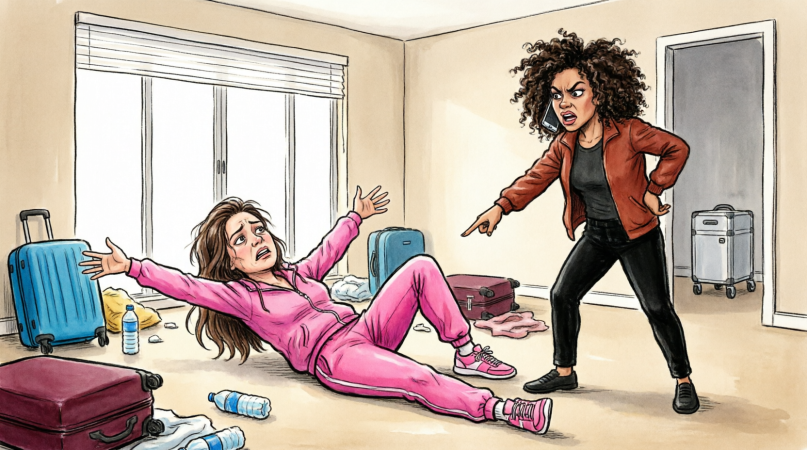
“Martha,” I said slowly. “You can have the couch. It pulls out into a bed. But we need to put it back during the day so I can work. I have meetings on Tuesdays and Thursdays from home.”
She barely looked up. “Actually, I was thinking I’d take the bedroom,” she said lightly, as if it were already decided. “The living room gets so much light in the morning and you know I’m not a morning person. Plus I have all these clothes that need to be hung up.”
I felt disbelief flare, hot and sudden. “Martha. This is my apartment. I’m not giving up my bedroom.”
She sat up a little, eyes narrowing. The hurt-and-wrath mask slid into place perfectly.
“Wow,” she said. “Ally—” she used my childhood nickname, the one I’d abandoned years ago—“I just lost my boyfriend and my job. I’m at my lowest point and you can’t even make a small sacrifice to help me?”
I inhaled slowly through my nose. I could hear my mother’s voice in my head: Family takes care of each other.
I could also hear another voice, quieter, older: Why is it always you?
“You can have the couch,” I repeated, steady. “That’s already a compromise.”
Martha’s lips pressed together. She looked like she might cry. If she cried, my phone would light up with messages from Mom. If she cried, I would become the villain by lunch.
My phone buzzed with a text from Mom right then, like she’d been watching.
Be kind to your sister. Remember how many times she was there for you.
I couldn’t recall these incidents. Not clearly. But I knew the script and what happened when I refused to play my part.
I felt something in me bend. Not break—bend. The way you bend when you’re tired and you tell yourself you’ll stand up later.
“Fine,” I said through gritted teeth. “You can use the living room. But we need to establish ground rules.”
Martha’s expression brightened instantly, like a switch flipped. “You’re the best sister ever,” she chirped. “This is going to be so fun—like when we were kids and shared a room!”
I didn’t have the heart to explain that those days were not fun for me. Those days were Martha borrowing my things without asking and crying to our parents whenever I tried to set boundaries. Those days were me being told to be the bigger sister when what they meant was: be the quieter one.
Martha resumed unpacking, humming to herself. My apartment—the place I’d built piece by piece—started looking like a suitcase had exploded in it.
I picked up my phone and texted Sophie.
Martha just moved in. No warning, no choice. Send wine and patience.
Sophie replied within seconds.
Oh no. Nightmare flashbacks. I’m coming over tonight with emergency supplies. Do not sign anything your parents give you.
My heart sank at her last sentence. I stared at it a moment, then at Martha, who was now draping a dress over the back of my reading chair as if it were a closet.
Sophie might have been joking about contracts.
But two weeks later, I realized she’d seen something I hadn’t named yet.
Before things went wrong, my life was a life I was proud of.
I worked as a social media marketer at Digital Pulse—a growing marketing agency downtown. Our office was modern and bright, all glass partitions and communal workstations and a break area that pretended caffeine was a personality. There was cappuccino, cold brew, and a rotating lineup of kombucha flavors that made the interns feel like they were in a wellness commercial.
My desk faced a wall of windows overlooking the city, and every morning I’d arrive with my laptop and my coffee and feel, for one small second, like I’d made it. Not because I was rich. Not because I had everything figured out. But because I’d built stability out of effort.
I’d been there four years and was recently given charge of our largest client—a national fitness chain that wanted to rebuild their entire web presence. It was a huge account, the kind that put your name in a manager’s mouth during promotion season. My supervisor, Clara, had hinted more than once that if I pulled it off, I’d be looking at a promotion and at least a fifteen percent bump.
I wasn’t glamorous, but I was on a path.
I saved twenty percent of my income every month. Religiously. No exceptions unless something catastrophic happened. I tracked expenses with spreadsheets that were color-coded and weirdly satisfying. I had a three-year plan for a down payment and a list of neighborhoods I’d begun watching—not shopping yet, but learning. Preparing.
My haven was the apartment I rented from my parents.
A one-bedroom in a quiet neighborhood, close enough to downtown for a tolerable commute, far enough away that I could breathe when I came home. When my parents bought the building as an investment property five years ago, they offered me one of the flats below market price. At the time, it felt like a blessing—family help without losing independence.
It took me years to understand that “help” in my family often came with invisible strings.
Still, I poured my heart into that apartment. Every object had a story.
The sectional sofa had been a splurge after my first big bonus—six months of payments that felt like proof I could treat myself without drowning. The coffee table came from an estate sale; I’d sanded it, stained it, and sealed it myself, proud of the way the worn wood became elegant under my hands.
My bookshelves were filled with psychology and marketing books, plus vinyl records I’d collected since college. My kitchen was small, but I’d upgraded what I could: a Vitamix blender after a milestone year, an espresso machine last birthday. My bedroom was my sanctuary—memory foam mattress, linens with ridiculous thread count, a reading nook by the window where rainy Sunday mornings felt like therapy.
It wasn’t just a space.
It was proof. Proof that I’d built something stable without needing my parents’ approval.
And then Martha showed up at 7:00 a.m. with suitcases, and within weeks, my sanctuary became a battleground disguised as “family support.”
The first week was exactly as awful as I’d expected.
Martha slept until noon most days. That wouldn’t have been a problem if she hadn’t turned my living room into a bedroom-fashion-boutique-makeup-studio combination. Clothes draped over chairs. Makeup scattered across my coffee table. Her toiletries lined up in my bathroom like they belonged there. Shoes kicked off in the hallway like she lived alone.
On Wednesday morning, I had a crucial video call with the fitness chain client. I had to angle my laptop camera so it wouldn’t capture Martha’s blanket on the sofa or the piles of clothing hanging from door knobs. When Clara commented that my background looked “different,” I lied and said I was redecorating.
My apartment had become something I had to hide.
Talking to Martha was like trying to negotiate with fog.
If I suggested she look for a job, she’d sigh and say she needed time to heal. If I asked her to clean up, she’d promise and forget. If I brought up groceries, she’d remind me she was going through heartbreak and needed comfort food.
By the end of the week, my refrigerator had been raided. Meal prep containers I’d made for work lunches were empty. My specialty coffee beans—my once-a-month treat—were nearly gone. Even my emergency stash of dark chocolate, hidden behind oatmeal, had been found and demolished.
One night, I came home and found Martha wrapped in my favorite throw blanket, watching reality TV at full volume.
“Martha,” I said carefully, “we need to talk about house rules.”
She didn’t look away from the screen. “Can it wait until the commercial break?”
“No,” I said. “It can’t.”
She finally glanced at me, annoyed. I sat across from her and pulled out a sheet of paper with three simple points written on it—quiet hours, shared expenses, personal space.
Martha stared at it. Then she laughed. Actually laughed.
“Are you seriously giving me a roommate contract?” she said, incredulous. “I’m your sister, not some random person off Craigslist.”
“That’s exactly why we need boundaries,” I said, keeping my voice calm even as my nerves vibrated. “Because we’re sisters. Things get complicated when we don’t communicate.”
Martha rolled her eyes and turned back to the show. “You’ve always been so uptight. Ally, relax. This isn’t forever.”
“How long is it, then?” I asked. “Have you started looking for jobs or apartments?”
She exhaled dramatically, as if I was torturing her. “Can you stop pressuring me? I told you I’m processing. Besides, Mom and Dad said I could stay here as long as I need to.”
Something cold clicked into place.
“Wait,” I said slowly. “What exactly did Mom and Dad tell you?”
Martha shrugged. “Just that you had plenty of space and could use the company. And since they own the building, it’s basically like staying with family anyway.”
My blood boiled so fast it made my vision blur.
I stepped onto my tiny balcony, shut the sliding door behind me, and called my parents.
My father answered on the fourth ring.
“Dad,” I said, voice tight, “did you and Mom tell Martha she could move in with me indefinitely without asking me?”
There was a pause—the kind of pause that isn’t confusion, but calculation.
“Emma,” he said carefully, “your sister is going through a difficult time. The apartment is plenty big enough for both of you temporarily. We thought you’d want to help family.”
“But it’s not temporary,” I said. “She has no plans. She’s not contributing. She’s not respecting my space.”
My father’s tone hardened. “Your mother and I give you a significant discount on rent. Many people would be grateful for such an arrangement.”
There it was again. The message I hated most.
The apartment wasn’t mine. It was a family asset I was allowed to use as long as I was compliant.
“I am grateful,” I said, trying not to shake. “But I also need to live my life. Martha is disrupting my work. She’s using my things. She’s—”
“You’ve always been the responsible one,” my father said, voice softening into manipulation. “Martha needs stability right now. Just give her some time. Be the big sister.”
By the time I hung up, my anger had shifted into resignation.
This was the same pattern that had haunted our entire upbringing. Martha’s wants came first; my boundaries came last.
And then the situation got worse.
Martha started bringing friends over without warning—often when I was on business calls. She borrowed my clothes and returned them stretched out. She used my expensive hair products like they were communal property. She took forty-minute showers twice a day. Utilities spiked. My electricity bill surged. My peaceful morning ritual vanished under piles of her belongings.
My work started slipping.
I missed a deadline for the first time in my professional life. Clara called me in for a check-in, her tone concerned but firm.
“Is everything okay at home?” she asked. “The Henderson account is too important.”
Family issues, I wanted to scream. My family is turning my life into a hostage negotiation.
Instead, I said quietly, “My sister is staying with me temporarily. It’s been an adjustment.”
Clara nodded. “Family can be complicated,” she said. “Just don’t let it affect your work for too long.”
That evening, I stayed late at the office, making excuses to avoid going home. I started cancelling plans with friends because I was embarrassed by the state of my apartment and too exhausted to explain.
One night, after finding Martha had used and emptied my pricey face cream, I locked myself in my bathroom and cried so hard I had to sit on the floor to breathe.
I called Sophie, shaking.
“I can’t do this anymore,” I sobbed. “It’s like I’m a guest in my own home. My parents won’t listen. Martha won’t change. I feel trapped.”
There was a quiet pause on the line, then Sophie said gently, “Have you considered finding another apartment?”
I laughed through tears. “On such short notice? At current market rates? My parents charge me thirty percent below market. I can’t afford something comparable.”
“Maybe not comparable,” Sophie said softly. “But something that’s yours. Where you make the rules.”
I stared at my bathroom tiles, my breath hiccuping.
“Is your sanity worth the price difference?” Sophie asked.
The question hung in the air like a light turning on.
I looked around my once-peaceful sanctuary now overrun with Martha’s chaos. I thought about my missed deadline, my slipping promotion prospects, my nights spent hiding.
Maybe Sophie was right.
But before I could fully consider that choice, my parents escalated.
Exactly one month after Martha moved in, my father called me at work.
His tone was serious, almost businesslike.
“Emma,” he said, “your mother and I want to have a family discussion this evening. It’s important you and Martha are present. We’ll come by around seven.”
Dread settled in my gut like lead.
“What is this about?” I asked.
“We’ll discuss everything tonight,” he said cryptically and hung up.
I spent the rest of the day distracted, cycling through possibilities. Maybe they’d found Martha an apartment. Maybe they were taking her back. Maybe this was finally the end of it.
When I got home, Martha had cleaned the apartment for the first time since arriving.
She was strangely quiet, checking her phone repeatedly. The living room was cleared of some clutter, as if she wanted to present a certain image.
“Do you know what this meeting is about?” I asked.
She shrugged without meeting my gaze. “Not really. Dad just said they wanted to talk to us.”
At precisely seven, my parents arrived.
Mom carried a casserole dish like peace offering and weapon all at once. Dad carried a folder.
The folder made my stomach drop.
We sat around my modest dining table—the one I’d bought at a flea market and refurbished with my own hands. Mom served casserole. Dad cleared his throat and opened the folder like he was about to read a verdict.
“Emma,” he began, “as you know, your sister has been staying with you for the past month. Given that the living arrangement appears to be working out, we need to make some adjustments to your rental agreement.”
My fork froze halfway to my mouth.
“What kind of adjustments?” I asked, already knowing.
Dad slid a document across the table.
“We need to increase your rent starting next month,” he said.
I stared at the paper. The number was printed in black ink that suddenly seemed too sharp.
“The new amount will be double what you’re currently paying.”
For a second, I genuinely thought I’d misread it.
“Double?” I repeated. “Why would you double my rent?”
Mom answered like it was obvious. “There are two people living there now. Twice the utilities. Twice the wear and tear.”
“But Martha isn’t paying anything,” I said, voice rising despite my effort to stay calm. “She doesn’t have a job.”
“Which is exactly why we need to adjust your rent,” Dad said patiently, as if I were slow. “We need to cover the additional expenses Martha incurs while she’s getting back on her feet.”
I looked at Martha.
She was staring intently at her dish, a faint smile flickering at the corner of her mouth.
She had known.
Of course she had known.
“So let me get this straight,” I said, forcing my voice to steady. “You want me to pay double rent to cover Martha living here, even though I didn’t invite her, even though there’s no space, even though I’m already paying more in groceries and utilities, and my work is suffering.”
Mom’s voice slid into the childhood tone I hated most—the tone that made me feel guilty for having needs.
“Martha is family,” she said. “Family supports each other.”
“Then why is the support always one-directional?” I asked quietly. “Why am I always the one expected to give while Martha only takes?”
Dad’s brow furrowed. “That’s unfair, Emma. Your sister has had some bad luck.”
“Bad luck,” I repeated, and something bitter rose in my throat. “Or bad choices?”
The table went silent.
Martha’s eyes filled with tears on cue, a skill she’d honed like an instrument.
“I can’t believe you would say something so cruel,” Mom snapped. “After everything we’ve done for you—giving you this beautiful apartment at below market rent for years.”
“I’ve paid rent faithfully every month,” I said, voice tight. “I’ve maintained the apartment. Improved it. I’ve been a good tenant.”
“And now the arrangement is changing,” Dad said firmly. “The new rent is effective the first of next month. That gives you two weeks to adjust your budget.”
Two weeks.
Two weeks to destroy my savings plan. Two weeks to watch my down payment timeline collapse. Two weeks to become the financial caretaker for a sister who wouldn’t even wash her own dishes.
I stared at the number again. It would eat seventy percent of my take-home pay.
“I can’t afford this,” I said plainly. “Not on my current salary.”
Dad shrugged. “Then perhaps you should look for a better-paying job. Or take on freelance work. You’re always talking about side hustles.”
Something snapped inside me. Not rage exactly—clarity.
Years of being the responsible one. Years of watching Martha get endless cushions while I got loans with interest. Years of being told to be grateful for scraps.
All of it converged into one steady, quiet thought:
They think I won’t leave.
I heard myself say it before I could talk myself out of it.
“Or,” I said, voice calm, “I could just move out.”
For a moment, the room held still.
Then my mother laughed.
A light, dismissive laugh that made my skin go cold.
“Move out to where?” she chuckled. “Do you have any idea what rental prices are like right now?”
Dad smiled confidently. “You won’t find anything close to what you have here, even at the increased rate.”
Martha leaned back and smirked. “Your whole life is here. Your stuff, your routine. You won’t really leave.”
Their laughter wasn’t just cruel—it was smug.
They honestly believed I was trapped.
They believed I lacked the spine to choose discomfort over disrespect.
I looked at the three of them—my parents and my sister—sitting at my table, eating my dinner, deciding my future like I was a line item.
“I’ll start looking for a new place tomorrow,” I said gently.
My father waved a hand. “Emma, don’t be dramatic. Just sign the new agreement and we can all enjoy this lovely dinner your mother made.”
He slid a pen toward me like it was inevitable.
I picked it up and held it over the paper for a long time.
I could feel my heart beating, steady and hard. I could hear Martha’s show playing faintly in the living room. I could smell casserole and the faint perfume my mother always wore, the scent that used to mean comfort when I was little.
Then I set the pen down without signing.
“I’ll let you know my decision by the end of the week,” I said.
My father’s eyes narrowed. My mother’s smile tightened. Martha’s tears dried instantly.
The rest of dinner was uncomfortable small talk—Mom and Dad discussing Martha’s “healing journey” and her desire to “find herself.” Martha nodded thoughtfully as if her unemployment were a spiritual practice.
I stayed quiet. Not because I had nothing to say, but because I was done wasting words on people who used them against me.
After my parents left, Martha flopped onto my sofa like nothing had happened.
“They’re right, you know,” she said casually, turning up the TV. “You won’t really move out. This place is too perfect and you hate change.”
I watched her lounge on my furniture, use my Netflix account, eat my food, and speak with absolute certainty.
Something solidified inside me.
It wasn’t just about the rent hike. It was about respect. It was about boundaries. It was about changing a family dynamic that had been broken for far too long.
I went to bed without reacting.
But I didn’t sleep.
I lay there staring at the ceiling, my mind racing. Not with panic—with planning.
By dawn, I knew exactly what I had to do.
The next day, I called in sick to work for the first time in over a year.
As soon as Martha left for her daily “networking” coffee shop visit—where she pretended to build connections but mostly scrolled social media—I sat down at my dining table with my laptop and a notebook.
First, I reviewed my finances.
I had been saving twenty percent of my paycheck for three years. It wasn’t enough for a down payment yet, but it was a solid emergency fund. Enough for first and last month’s rent, a deposit, moving expenses, and a cushion if something went wrong.
I calculated my maximum affordable rent using the thirty percent rule. The number was sobering. It meant compromise—smaller space, different neighborhood, fewer amenities.
But then I looked around my apartment—the chaos Martha had dragged into it—and I thought about Sophie’s question.
Is your sanity worth the price difference?
Yes, I realized. Yes it is.
I contacted three rental agents. Two sounded skeptical when I said I needed to move within two weeks. The third—Olivia—was brisk and upbeat.
“The market’s tight,” she said, “but not impossible. Especially if you’re flexible.”
While I waited for listings, I pulled my lease out of my filing cabinet and read it carefully, something I should’ve done years earlier.
And there it was: after the first year, the lease converted to month-to-month. Thirty days’ notice required.
No mention of furniture. No clause claiming any “fixtures” beyond built-ins.
My stomach lifted with a sudden rush of relief.
Everything I’d purchased—sofa, table, bed, appliances, shelves—was mine.
To be safe, I texted Sophie. Her brother was a real estate attorney.
Can you ask Derek a hypothetical question about tenant rights and furniture ownership?
Sophie called me twenty minutes later.
“Derek says unless the lease specifically states the furniture belongs to the landlord, anything you bought is legally yours,” she said. “And if your parents try to claim otherwise, they won’t have a case.”
I exhaled like I’d been holding my breath for months.
By the end of the day, Olivia emailed five listings.
All smaller than my current place. None as charming. But they were within my price range and available immediately.
The next day, I took another personal day and toured them.
The first smelled like mildew.
The second had a view of a dumpster.
The third was in a neighborhood that would turn my commute into a daily punishment.
The fourth had potential but stretched my budget to its limit.
The fifth was tiny—barely five hundred square feet—but clean, newly renovated, with new floors and appliances. Safe building. On-site laundry. Close to a direct bus route. The landlord was willing to work with my tight deadline and even offered to reduce the deposit if I moved in within ten days.
I signed the lease on the spot.
As I walked out of the building, lease folder tucked under my arm, I felt an odd combination of dread and exhilaration.
In forty-eight hours, I had committed to changing my life.
Back at my apartment, I started planning logistics like I was launching a campaign. Inventory everything. Categorize: must take, could sell, could donate. Research movers—too expensive on short notice. A truck with minimal help would cost around a thousand dollars.
So I did what I always did when something mattered:
I asked my community.
That evening, while Martha chatted loudly on the phone about an upcoming party, completely unaware, I texted friends. I made calls. I explained enough without oversharing.
Within hours, I had six volunteers, two pickup trucks, an SUV, and Sophie’s garage offered as emergency storage.
Sophie’s boyfriend Eric—who was a contractor—offered to help disassemble and reinstall furniture.
The last piece was timing.
I checked my parents’ social media and found what I expected: my mother had been posting about an upcoming family reunion at my aunt’s house three hours away. They’d been planning it for months. I’d declined because of work.
Martha, of course, had confirmed she was going.
They’d all be gone Friday evening to Sunday afternoon.
Perfect.
I booked the move for Saturday.
All day. Clear the apartment. Transfer everything. Leave nothing that wasn’t built in.
The night before my parents’ planned ultimatum meeting—the one they expected me to sign the new rental agreement—I texted my father.
I’ve decided on the apartment. I’ll talk about it when you return Sunday.
He replied immediately.
We need this resolved before the weekend. Emma, your mother and I expect you to be reasonable.
I didn’t respond.
For once, I wasn’t following their script.
The next forty-eight hours were a blur of quiet preparation.
I forwarded my mail. I scheduled utility transfers. I pulled cash for last-minute expenses. I packed important documents while Martha was out. I uploaded receipts—photos of purchase records for big items—into a folder on my cloud drive like I was building evidence for court.
By Friday evening, as Martha packed an overnight bag for the reunion, I felt strangely calm.
She had no idea that when she returned, the apartment—and our relationship—would be altered.
“Are you sure you won’t come?” she asked, swinging her bag over her shoulder. “Mom says Aunt Margaret really wants to see you.”
“I have too much work,” I said truthfully, just not for the reasons she imagined. “Have a good time.”
Martha kissed the air near my cheek and left, her rideshare pulling away into the night.
I stood in the doorway and looked around my apartment—my refuge, my proof, my sanctuary now invaded.
By this time tomorrow, it would be empty.
Saturday morning arrived clear and bright, as if the universe had decided to cooperate.
I’d barely slept. My stomach churned with adrenaline and fear and something that felt like grief. Not because I was losing the apartment—because I was losing the version of my family I kept hoping might exist.
By 6:00 a.m., I was dismantling my bed frame.
At 7:00, Sophie texted:
Independence Day is a go. Troops arrive 0800.
I laughed once, sharp and grateful. Sophie always knew when humor was the only thing that kept you from crying.
By 7:30, my dresser was emptied, my closet stripped, boxes stacked like towers. At 8:00, the first knock came.
Sophie arrived with coffee and bagels like a medic showing up to a battlefield with supplies. Eric followed with tools. Then more friends—some I hadn’t seen in months—arrived with trucks and willingness.
I stood in my living room, suddenly overwhelmed by the sight of people who came because I asked.
“Okay,” I said, voice shaking slightly. “Thank you for helping. The plan is to have everything out by four. Furniture first, then boxes, then small items.”
They moved with surprising efficiency. Eric and another friend disassembled heavy furniture. Sophie organized a box brigade. Someone labeled boxes with markers. Someone taped with the kind of speed that suggests pent-up competence.
By lunchtime, my bedroom was empty. The living room furniture was gone. The walls looked naked. The apartment echoed when we spoke.
We ate sandwiches sitting in a circle on the floor because there were no chairs left.
Sophie leaned close. “How are you feeling?” she asked quietly.
I thought about it honestly.
Sad. Angry. Relieved. Proud. Terrified. Free.
“All of it,” I admitted.
Sophie squeezed my hand. “You’re doing the right thing,” she said. “Long overdue.”
By mid-afternoon, we were doing the third trip to my new apartment, packing furniture into the small space like a puzzle. My landlord watched, amused.
“Most move-ins I see are chaos,” he said, holding a door open. “You folks have a system.”
“We’re motivated,” Sophie said cheerfully, and I heard the solidarity in her voice.
At 3:30, we returned to my old apartment for the final sweep.
It barely looked like the place I’d lived in for five years. The built-in appliances remained, the curtains still hung, but everything else was gone. Even the shower curtain, because I bought it and I was tired of leaving pieces of myself behind for other people to claim.
In the kitchen, I placed an envelope on the counter.
Inside: my keys, next month’s rent money to cover my thirty-day notice, and a short letter.
Factual. Unemotional.
I was exercising my right to terminate the rental arrangement with proper notice. I had taken only my belongings. If they had questions, they could contact me.
Sophie wrapped her arm around my shoulders as I stood in the empty living room one last time.
“Ready?” she asked.
I nodded, throat too tight to speak.
I locked the door behind me.
The click of the lock sounded like the first honest boundary I’d ever set.
The reaction came faster than I expected.
We were in my new apartment—pizza boxes on the counter, beers in hand, friends laughing softly around me—when my phone started exploding.
First, texts from Martha:
What the hell, Emma?? Where’s all the furniture?? Where am I supposed to sleep? Mom and dad are furious.
Then calls.
Mom.
Dad.
Mom again.
I let them go to voicemail. I needed a moment to breathe in a space that finally felt mine.
When I listened later, Mom’s voice was nearly hysterical.
“Emma Elizabeth, what have you done?” she cried. “We came home to find the apartment completely empty! Is this some kind of joke? Call me immediately!”
Dad’s message was colder, sharper.
“This is unacceptable behavior, Emma. That furniture belongs in that apartment. You have violated your lease. Call me back now before I take legal action.”
Legal action.
My father always reached for authority when he felt control slipping.
I waited until my friends left. I hugged Sophie tight, thanked everyone with a voice that trembled. Then I called my father back.
He answered immediately, voice tense with barely contained rage.
“Explain yourself,” he snapped.
I inhaled slowly. I centered myself the way I did before client presentations—calm, clear, prepared.
“I decided to move out,” I said. “I gave proper notice as required. I paid the final month’s rent. And I took my belongings.”
“My belongings?” he repeated incredulously. “That furniture belongs in the apartment.”
“Actually, no,” I said quietly. “Every piece of furniture in that apartment was purchased by me. I have receipts for everything. The lease makes no mention of furnished items provided by the landlord, which is you.”
There was a stunned silence on the line—the kind where you can hear someone recalculating.
He recovered quickly. “This isn’t about legalities, Emma,” he said, voice shifting into guilt. “This is about your sister having nowhere to sleep tonight. The apartment is empty.”
“There are air mattresses at Target for fifty dollars,” I said. “Or she can stay at your house. The guest room renovations must be finished by now, right?”
Another silence.
And suddenly, the thought hit me so hard it almost made me laugh.
There were probably never any renovations.
It had been an excuse. A story. A way to make Martha’s move-in seem inevitable.
“Where are you?” Dad asked finally, voice hard.
“I have a new apartment,” I said. I did not give the address. “It’s smaller, but it’s mine.”
“This isn’t over,” he warned. “Your mother is beside herself. Martha is crying. Is that what you wanted? To hurt your family?”
The guilt trip nearly worked. My chest tightened, the old conditioning flaring: You’re selfish. You’re dramatic. You’re ungrateful.
But I held steady.
“What I wanted,” I said calmly, “was to be treated with respect. What I wanted was for my boundaries to matter. What I wanted was to stop being punished for being responsible.”
“So this is revenge?” he snapped. “A childish tantrum because we asked you to help your sister?”
“No, Dad,” I said. “This is me making a choice about my life. I paid rent for the final thirty days. Martha can stay there. But she’ll need her own furniture.”
My mother’s voice rose in the background demanding the phone.
There was rustling. Then Mom came on, tear-filled and furious.
“How could you do this to your sister?” she cried. “To us? After everything we’ve done for you?”
“Mom,” I said quietly, “I’ve done nothing wrong. I moved out of an apartment that was no longer working. I took my things.”
“But where is Martha supposed to sleep?” she sobbed. “There is nothing left!”
“The same place she would have slept if I never lived there,” I said, and the blunt truth cut through her crying. “The apartment was unfurnished when I moved in.”
A long pause.
Then Mom’s voice changed. It wasn’t warm. It wasn’t soft. It was… startled.
“You really moved everything in one day,” she said.
“Yes.”
“And you already have a new place.”
“Yes.”
“You planned all this.”
“Yes,” I said again, steady.
Another pause, longer. And then, in a voice that held something I didn’t expect—something like awe—my mother said quietly, “I never thought you would actually leave.”
There it was.
The truth they never said out loud: they thought I was trapped by comfort and fear.
The call ended with vague threats and promises of “further discussions.” I hung up exhausted, but under the exhaustion was a strange calm.
For the first time in my adult life, I had drawn a line and held it.
Later that night, Dad sent a text that startled me.
The apartment looks… different. Empty. I forgot what it looked like before you moved in. We’ll talk tomorrow.
It wasn’t an apology.
But it was an acknowledgment.
And for that night, it was enough.
The weeks that followed were a reset.
My new apartment was significantly smaller. It forced creativity and hard choices. My king-sized bed dominated the bedroom. My sectional had to be reassembled in pieces to fit the living room. My dining table became a desk and a place to eat.
But the space had a lightness that had nothing to do with square footage.
For the first time in years—maybe ever—I felt completely in control of my surroundings.
Every object was where I wanted it. Every routine was mine. Every decision—laundry day, thermostat temperature, music volume—belonged to me alone.
The peace that came with that autonomy was worth far more than extra space.
I introduced myself to neighbors—something I’d never done in my old building because the apartment never felt truly mine. The woman across the hall was a graphic artist who worked remotely. She invited me for coffee on the rooftop terrace. An older man next door offered to water my plants when I traveled for work.
A tiny community formed around me—not family by blood, but by choice. Real connection. No manipulation.
Meanwhile, my family changed in ways I didn’t expect.
Martha, confronted with an empty apartment and no one to cater to her, had to adapt. My mother, in reluctant updates, admitted Martha had gotten a part-time job at a boutique. Not glamorous, but income. A step.
My father, surprisingly, began to question his own role.
Two weeks after my move, he called—not to yell, not to guilt, but to ask.
“Are you doing okay with the budget?” he said, voice neutral.
“Yes,” I answered honestly. “It’s tighter, but I’m making it work. The commute is actually better.”
“That’s good,” he said slowly, then hesitated. “Your mother and I have been talking about Martha. About… patterns we might have encouraged.”
It wasn’t a full apology. Not even close.
But it was the closest I’d ever heard to acknowledgment of the favoritism I’d swallowed for years.
My relationship with my mother remained tense. She still framed my move as betrayal rather than boundary. Our calls were short, hovering around safe topics like weather and work.
And then Martha did something unexpected.
A month after my move, she texted:
Can we get coffee? Just us.
I agreed, wary but curious.
We met at a café halfway between our homes. Martha looked different—less makeup, simpler clothes, her posture slightly less arrogant. She fidgeted with a napkin like she didn’t know what to do with her hands when she wasn’t performing.
“So,” she said after we ordered. “Your new place is good.”
“It is,” I said.
She nodded, staring at her coffee. “I didn’t think you’d really leave,” she admitted. Then she glanced up, a faint grin appearing. “None of us did.”
I waited.
Martha’s grin flickered into something more honest. “It was kind of… badass,” she said quietly. “The look on Dad’s face when we walked into that empty apartment. I wish I’d taken a picture.”
Despite myself, I laughed. It surprised me, the sound of it.
“It wasn’t about revenge,” I said. “It was about survival.”
“I know that now,” Martha murmured. She took a breath. “I’ve been thinking a lot. About how I’ve always expected people to take care of me. How I never really faced consequences because someone always bailed me out.”
I stayed quiet and let her keep going.
“When you left,” she said slowly, “it was like suddenly I had to figure things out. Mom and Dad brought an air mattress. I hated it. It was uncomfortable, and I felt… stupid. So I got a job to buy my own bed.”
My chest tightened in a strange way—relief mixed with grief. Because I wanted this growth for Martha, but I hated that it took me detonating my comfort to force it.
“And once I started working again,” Martha admitted, “I realized I actually like having my own money. Not asking. Not waiting.”
“That’s good,” I said, and I meant it.
“I’m still staying at the apartment,” she added quickly, “but I’m paying rent now. Not much, but something. And I’m looking for a roommate situation when the lease ends.”
We talked for nearly two hours—the longest we’d spoken in years. For the first time, it felt like conversation between equals, not the old dynamic of her taking and me absorbing.
When we stood to leave, Martha hugged me awkwardly.
“I’m sorry,” she whispered. “For being such a terrible sister.”
“You weren’t terrible,” I corrected softly. “We had unhealthy patterns. All of us.”
Martha nodded, eyes shiny. “Yeah,” she said. “We did.”
Over the next few months, healing came in slow waves.
There were setbacks—my mother still tried to guilt me sometimes. My father still slipped into his authoritative tone occasionally. Martha still had moments of entitlement she had to catch herself in.
But something fundamental had changed.
They could no longer take my compliance for granted.
Each interaction required mutual respect—or it didn’t happen.
I declined invitations that felt like obligations. I accepted those that felt sincere. I offered help when I could without resentment, and I said no without apology when I couldn’t.
Six months after the move, we had Thanksgiving at my parents’ house.
The atmosphere was tentative, but not hostile. Martha brought a dessert she’d baked herself. I brought a bottle of wine I could afford. My father carved the turkey with less pomp than usual. My mother asked about my neighbors with what sounded like real curiosity.
At the table, I looked around at the people who had shaped me—for better and worse.
I didn’t feel the raw anger that had driven me out. I didn’t feel the desperate need for approval that had kept me docile for years.
Instead, I felt something calmer.
Acceptance.
We were flawed people working with the emotional tools we had. Some of those tools had hurt each other. Some had protected us. Some had allowed damage to go unchecked.
But we were, slowly, learning different ways.
The biggest lesson I took from all of it wasn’t about furniture, housing, or even money.
It was about the difference between love and enabling.
Between generosity and being taken for granted.
I learned that sometimes the most loving thing you can do—for yourself and for others—is set a clear boundary and keep it, even when people call you selfish for it.
I also learned that independence isn’t just financial.
It’s emotional.
It’s the quiet confidence of knowing you can stand on your own. Make hard decisions. Handle consequences. Refuse manipulation. Leave if you need to.
That confidence seeped into everything.
My work recovered. I hit the deadline for the Henderson campaign, not just barely—cleanly. Clara noticed. The promotion conversation returned. I stopped staying late at work just to avoid going home, because home was finally mine again. My friendships deepened. My world expanded past the orbit of my family’s expectations.
A year after that moving day, I sit in my modest apartment surrounded by the same furniture that once filled a bigger space—but now feels perfectly proportioned to my life.
I’ve added a few new pieces chosen for this home. I’ve let go of others that no longer fit. In many ways, that’s what the whole experience taught me about people too.
We hold onto routines, relationships, and expectations that once made sense—but later become restrictive, suffocating, quietly damaging. We tell ourselves it’s easier to stay. Easier to endure. Easier to keep the peace.
Until one day, a folder slides across your dining table and someone laughs at the idea of you leaving.
And you realize the peace you’ve been keeping isn’t peace.
It’s compliance.
So you start planning.
You make spreadsheets. You call friends. You pack boxes. You move quietly and decisively.
You close a door.
And on the other side of it, you finally learn what respect feels like when it isn’t conditional.
Not because anyone suddenly changed into better people overnight.
But because you stopped offering your life as a place they could rearrange without asking.