The gravy spoon slipped from Marin Whitaker’s fingers the way a final warning sometimes slips through a person’s life—quietly, almost politely, until it strikes something hard and makes the whole room hear it.One second, she had been standing beside the stove in her parents’ beachside house in Sarasota, Florida, trying to pour the gravy into her grandmother’s silver serving boat without splashing the linen runner her mother had ironed twice that morning. The next, the spoon bounced against the ceramic floor with a sharp metallic clatter, sending a warm brown streak across the pale tile and splattering the hem of Marin’s apron.For a moment, she did not move.
The kitchen smelled like rosemary, garlic, turkey fat, browned butter, and the faint sweetness of pies cooling on the side counter. Steam clouded the windows over the sink, softening the view of the Gulf beyond the lawn. Outside, the late November light had turned the water into a sheet of hammered gold, the kind of view her father liked to mention whenever guests came over, as if the ocean itself were one more accomplishment he had personally arranged.From the dining room came laughter.It rose in a bright, careless wave, rolled through the doorway, and broke over Marin’s back while she stared at the mess on the floor.Someone clinked a glass. A fork scraped against china. Her father, William Whitaker, released one of his booming, satisfied laughs, the laugh he saved for stories in which he had the last word or the winning hand. Her mother, Patricia, followed with a softer laugh, the decorative kind she used when she wanted the room to feel harmonious. Aunt Sarah said something Marin could not make out. Then came Adrien’s voice, smooth and warm, the family’s favorite instrument.They had started without her.
The realization did not arrive with surprise. It settled into her body with the weight of something old. It felt less like an insult than a confirmation, as though a verdict had been read aloud after a trial she had been attending her entire life.
They had started without her, and somehow she had known they would.
She looked down at the gravy on her hands. Her fingers were red from washing dishes in hot water, her knuckles dry and cracked from three days of cooking, wiping, lifting, scrubbing, arranging. Her shoulders ached from bending over counters. Her lower back throbbed in a slow, steady pulse. A strand of brown hair had worked its way loose from the knot at the back of her head and stuck damply to her cheek.
In the dining room, Adrien was talking.
Marin could picture him without turning around. Her older brother would be leaning back in his chair at her father’s right hand, one ankle resting casually against the opposite knee, his white shirt perfectly pressed, his expensive watch catching candlelight. He had a way of sitting at a table as if he were being interviewed for a glossy magazine profile about men who had made excellent choices. He could make even ordinary sentences sound important, and their parents treated every word as evidence that their son had turned out exactly as promised.
Adrien Whitaker had arrived two hours earlier in his black Tesla, gliding into the driveway like a commercial for success. The house had changed the instant he stepped out.
Marin had been in the kitchen then, elbow-deep in a sink full of mixing bowls, when she heard her mother gasp from the foyer.
“He’s here!”
Patricia’s voice had carried through the house with a childlike excitement Marin had not heard when she herself arrived Tuesday night with six bags of groceries and a cooler full of thawing turkey parts. By the time Marin dried her hands and glanced through the side window, her mother was already on the front steps. Her father was walking faster than his knees usually allowed. Aunt Sarah had lifted her phone to take a photo.
Adrien got out of the car wearing a charcoal coat and sunglasses, his hair combed back in the effortless style Marin knew required effort. He pulled a rolling suitcase from the trunk and handed Patricia a bottle of wine wrapped in tissue paper.
“For you, Mom,” he said, kissing her cheek.
“Oh, Adrien,” Patricia breathed, as if he had brought diamonds from Paris instead of a bottle Marin recognized from the display near checkout at Tampa International Airport.
William slapped his son on the back. “There he is. Big man. New promotion treating you well?”
Adrien laughed. “Can’t complain.”
He could complain, of course. He complained plenty. He complained about mortgage rates, client dinners, airline delays, unreliable contractors, and the difficulty of finding a good dock company for the boat he had not yet purchased. But his complaints sounded impressive because they belonged to a life their parents admired.
Marin’s complaints, when she made the mistake of voicing them, sounded like weakness.
She had watched from the kitchen doorway while everyone gathered around Adrien. Her mother adjusted his collar. Her father took his luggage though Adrien was perfectly capable of carrying it. Aunt Sarah told him he looked thinner. Patricia asked if he had eaten. William asked whether the new title came with stock options. Adrien accepted every question, every touch, every beam of attention with the comfortable ease of a man who had never had to wonder whether he mattered.
Meanwhile, the turkey needed basting.
So Marin had turned back to the oven.
She had been in Sarasota since Tuesday afternoon. She had stopped at four different stores because Patricia said the cranberries at one market were too bitter, the bakery rolls at another were “never quite right,” and William could tell the difference between generic and name-brand butter in stuffing. Marin doubted he could. Her father had once praised boxed potatoes she had passed off as homemade during a summer barbecue, but he believed many things about himself, and the household usually cooperated.
On Wednesday, she chopped celery and onions until the sharp scent burned her eyes. She toasted bread cubes, brined the turkey, peeled potatoes, simmered stock, made pie crusts, trimmed green beans, and cleaned as she went because her mother disliked “kitchen chaos,” though Patricia had never objected to someone else absorbing the chaos for her.
On Thursday morning, Marin woke at five. The house was still dark. She moved quietly through the kitchen, tying her apron, lighting the oven, rinsing herbs, lifting the turkey into the roasting pan with a grunt she kept silent because no one else was awake to hear it anyway. By eight, the scent of roasting garlic had begun to fill the house. By ten, Patricia had come downstairs in a cream sweater and pearl earrings, looked around the gleaming kitchen, and said, “Oh good, you’re on schedule.”
Not thank you.
Not you must be exhausted.
Just: you’re on schedule.
Marin had nodded because nodding had always been easier than saying what lived underneath her ribs.
Now, hours later, kneeling on the cold kitchen floor with gravy cooling against her skin, she felt something inside her go very still.
It was not anger. Not yet.
It was clarity.
She reached for a towel and began wiping the floor. The gravy was thick and glossy because she had made it properly, reducing the turkey drippings with stock she had started the night before, whisking in flour at just the right moment, adding a splash of white wine when no one was looking because Patricia thought wine in gravy was “too fancy,” though she never complained when everyone praised the flavor. The towel smeared brown across the tile. Marin rinsed it, wrung it out, wiped again.
Through the doorway, she could see the dining room.
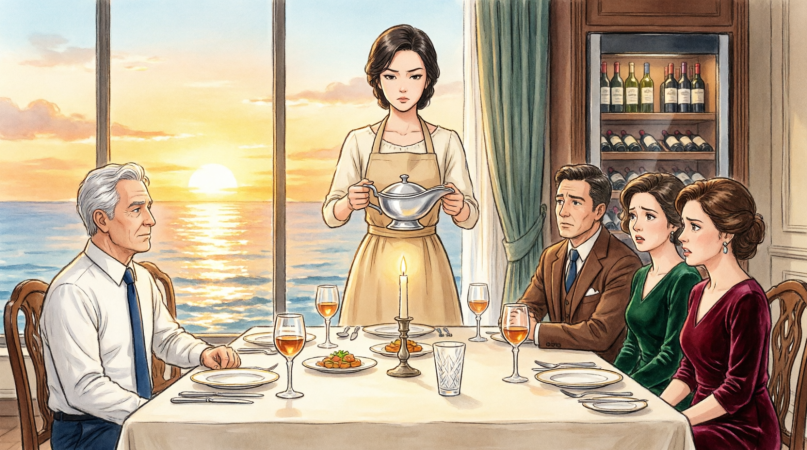
The table looked like a photograph from a lifestyle magazine: white linen cloth, folded napkins, hurricane candles, porcelain plates with blue edging, silver polished until it reflected the flames. The turkey sat carved at the center because William always liked to carve, though Marin had roasted it, rested it, and guided his knife with quiet instructions he pretended not to need.
Plates were already half full.
Adrien’s plate was piled high. Patricia leaned toward him, smiling. William poured him wine. Aunt Sarah watched him the way some people watched preachers.
No one looked toward the kitchen.
No one noticed Marin was missing.
Three weeks before Thanksgiving, Patricia had started the family group chat the way she always did when a holiday approached. It began with enthusiasm and ended with assignments.
Thanksgiving at our house this year!!! Can’t wait to have everyone together!!!
Then, immediately after:
We’ll plan the menu around what Adrien likes since he’s been so busy with his new position.
He’s been so busy.
Marin had read the message in her Orlando condo after a ten-hour workday at the marketing firm where she managed client presentations, deadlines, revisions, budgets, and the delicate personalities of men who called themselves visionaries. She had been standing barefoot in her own kitchen, eating cereal for dinner over the sink because she was too tired to cook.
She stared at the words.
He’s been so busy.
As if she had not been busy. As if the hours of her own life were made of cheaper material. Adrien’s work came with language the family admired: clients, deals, promotions, expansion, leadership. Marin’s work, though steady and demanding, did not translate into family pride. She was a project manager. She handled things. She met deadlines. She made other people’s chaos presentable. At work, that skill earned her a paycheck. At home, it earned her more tasks.
She had typed carefully:
Maybe this year we could go to that new restaurant on the bay? It might be nice for everyone to actually relax.
She stared at the message for five minutes before sending it.
Patricia responded in less than one.
Traditions matter, dear. Besides, you’re so good in the kitchen.
Marin could still feel the quiet collapse that message caused in her chest.
You’re so good in the kitchen.
It sounded like praise, but it worked like a chain.
Now, in that same kitchen, she wiped the last streak of gravy from the tile and stood. Her knees cracked. She rinsed her hands, then stared at herself in the dark reflection of the window above the sink.
At thirty-five, Marin did not look like the invisible woman she felt herself becoming. She had clear green eyes, a strong nose, and a mouth that had forgotten how often it pressed itself into politeness. Her hair, usually loose around her shoulders, was pulled back tightly. The lines between her brows were deeper than she remembered. She looked tired, but beneath the tiredness there was something else, something unfamiliar.
A pressure.
A gathering.
The gravy boat sat on the counter beside the stove, still half full. It had belonged to her grandmother, Eleanor Mae Whitaker, though everyone had called her Ellie. Marin had loved that serving piece as a child: heavy silver, tiny flowers engraved around the rim, the handle shaped like a curling vine. Grandma Ellie used to let Marin polish it with a cloth before Thanksgiving dinner. Marin could still remember her grandmother’s kitchen in Tallahassee, all yellow curtains and warm butter and women moving around each other with the practiced grace of servants who had convinced themselves they were hosts.
Men sat first in Grandma Ellie’s house. Children ran wild. Women carried dishes.
Marin had not understood the pattern then. She only knew the kitchen smelled safe, and her grandmother’s hands were soft when they guided hers over the silver.
“Pretty things last when someone takes care of them,” Grandma Ellie had told her once.
At ten, Marin thought she meant the gravy boat.
At thirty-five, Marin wondered if her grandmother had been trying to warn her.
She picked up the gravy boat and walked toward the dining room.
The conversation was midstream when she entered.
Adrien was telling a story about a golf game with a potential client from Naples, a man who apparently owned three restaurants and a fishing lodge. Adrien made the details sound strategic and masculine, though Marin suspected the story was mostly about hitting a ball badly and laughing at the right moments. William nodded as if hearing about a major diplomatic negotiation. Patricia smiled with maternal triumph. Aunt Sarah leaned in with her elbows near the edge of the table.
Marin placed the gravy boat down hard.
Thunk.
The sound was not loud enough to be rude. It was loud enough to be heard.
Five pairs of eyes flicked briefly toward her. Then most of them returned to Adrien.
Patricia looked at the gravy boat, then at Marin’s stained apron.
“Oh, honey,” she said, half distracted. “Could you grab some more ice for Adrien’s drink?”
Marin looked at her brother’s glass.
It was half full. Cubes floated near the rim, catching candlelight. He had not even asked. He did not have to. Their mother could anticipate his comfort with the accuracy of a weather radar.
Marin stood behind her empty chair. She could feel the heat of the kitchen still clinging to her skin. She could smell the gravy on her apron. She could see her place at the table, untouched, napkin folded like a prop no one expected her to use.
The old Marin would have said sure. She would have gone back to the kitchen, opened the freezer, scooped ice, returned with a smile, maybe even apologized for taking too long. She would have told herself it was easier. She would have told herself it was not worth making a scene. She would have told herself everyone was tired, everyone had expectations, holidays were stressful, family was family.
The old Marin had survived by shrinking.
But the word rose before she could bury it.
“No.”
It came out soft. Almost gentle.
The room stopped.
Adrien’s story broke in the middle. His mouth remained slightly open, a sentence abandoned behind his teeth. Aunt Sarah’s eyes widened. William’s fork paused halfway to his plate. Patricia blinked as if Marin had switched languages.
“I’m sorry,” Marin said automatically, then hated the apology the instant it left her mouth. Her hands tightened on the back of the chair. “No. I’m not getting ice.”
Patricia’s smile flickered. “Excuse me?”
“I said no.”
A silence fell over the table so complete that Marin could hear the candle flames faintly sputtering inside their glass holders.
William set his fork down with deliberate care.
“Marin,” he said.
It was the voice he used when she was twelve and had rolled her eyes in front of company. The voice that said remember your place without having to say it. The voice that still had access to the smallest frightened parts of her.
“Your brother drove all the way from Tampa,” he added.
“Two hours,” Marin said. “He drove two hours. I’ve been cooking for two days.”
The words landed in the room like something dropped from a great height.
Adrien shifted in his chair. “Marin, I didn’t—”
“This isn’t about you asking,” she said, looking at him, then at her mother. “That’s the point.”
Patricia gave a nervous laugh, the kind meant to gather loose threads before they tangled. “Marin’s just exhausted. She’s been working very hard on dinner.”
“Then maybe she should sit,” said a voice from the far end of the table.
Aunt Rachel had arrived late and quietly twenty minutes earlier, slipping into the room without demanding attention. Rachel was Patricia’s younger sister by seven years and had always seemed slightly misplaced in the Whitaker family drama. She wore linen when everyone else dressed up, laughed at inappropriate times, and brought store-bought dessert without shame. Marin had always loved her, though not enough to understand how much Rachel had seen.
Now Rachel’s gaze held Marin’s across the table.
“Dinner looks wonderful,” Rachel said. “She should eat while it’s hot.”
Patricia’s cheeks colored. “Of course she should. Marin, sit down.”
The invitation sounded like a correction, not an apology.
But Marin sat.
Not because she had been granted permission. Because she chose to.
She pulled out her chair, lowered herself into it, unfolded her napkin, and placed it on her lap. She poured herself wine before anyone could offer. The red rose nearly to the rim.
No one spoke for a few seconds. Then Patricia, desperate to restore the evening, turned to Adrien.
“The turkey is exceptional this year, don’t you think?”
Adrien looked at Marin, then at his plate. “Yeah,” he said. “It’s really good.”
His voice held something like discomfort, but not enough to become courage.
William cleared his throat. “Adrien, you were saying about the Naples client.”
And just like that, the machinery resumed.
Conversation flowed around Marin. Golf, promotions, potential deals, the new property Adrien had been looking at, the rising cost of waterfront real estate. Patricia added bright comments. William gave advice. Aunt Sarah praised. Adrien leaned back into the role built for him before he was born.
But the evening did not feel the same.
Marin’s no remained in the room.
It sat beside the candles. It hovered over the turkey. It touched the rim of her wine glass every time she lifted it.
She ate slowly. The food was good. It was better than good. The stuffing had held its texture. The turkey was moist. The cranberry relish was tart enough to cut through the richness. The mashed potatoes were smooth, the green beans still bright. She tasted everything as if eating food she had cooked for someone else.
Halfway through the meal, she looked up and found Rachel watching her again.
Rachel lifted her glass the smallest inch.
Marin lifted hers back.
It was not a toast anyone else noticed.
That, somehow, made it matter more.
After dinner, when the plates were smeared and the candles had burned low, Marin escaped to the kitchen under the pretense of checking dessert.
The kitchen was wrecked. The kind of wreck only a feast creates. Bowls in the sink. Foil crumpled near the stove. Pans cooling with browned bits stuck to the corners. A smear of cranberry on the counter near the cutting board. The floor clean where she had wiped the gravy, but sticky elsewhere from unknown drips.
Marin stood in the doorway and looked at it all.
Normally, the sight would trigger movement. She would begin scraping plates before dessert, loading the dishwasher while others lingered over pie, washing the roasting pan before anyone noticed there had been a pan at all. The cleaning was part of her role, as expected as the cooking. Invisible labor worked best when completed before gratitude had a chance to become necessary.
But she did not move.
On the granite island, Patricia’s iPad lay open, screen glowing. Marin would have ignored it any other day. She was not a snoop. She had spent years building an identity around respecting boundaries even while no one respected hers.
But the screen displayed Facebook.
And at the top of Patricia’s profile was a Thanksgiving post.
Marin’s eyes landed on the caption before she could look away.
Excited for Adrien’s special Thanksgiving menu! Can’t wait to taste what my talented son suggested for our family gathering!
For several seconds, Marin forgot to breathe.
Adrien’s special Thanksgiving menu.
Her talented son.
Suggested.
Marin’s hand hovered over the screen. She did not tap at first. She simply stared, waiting for the words to rearrange themselves into something less cruel. They did not.
She scrolled.
There was a photo of Adrien arriving with the wine bottle, Patricia’s arms around him, William smiling proudly. There was a picture of Adrien at the table, glass raised, candles glowing in front of him. There was one of the turkey after William carved it. The caption underneath said, Family traditions are everything.
Marin scrolled farther, through birthdays, holidays, beach weekends, Easter lunches, Christmas mornings.
Adrien front and center. Adrien with his arm around Patricia. Adrien laughing with William. Adrien in front of the Christmas tree. Adrien on the deck holding a beer. Adrien beside the boat rental from last summer.
Marin appeared in fragments.
Her shoulder at the edge of a Thanksgiving photo. Her hand reaching to clear a plate. The back of her head as she bent over a birthday cake. A blur of her body carrying a tray. Once, her face reflected faintly in a window behind the people being photographed.
Not one picture of her sitting.
Not one picture of her smiling at the table.
Not one picture where the caption praised her.
The evidence sat in her hands, bright and undeniable.
All these years, she had told herself she was being sensitive. She had told herself every family had patterns, every parent had blind spots, every sibling dynamic had an imbalance. She had softened the truth until she could live beside it.
But Patricia had curated the family story for the world, and Marin’s role was clear.
She was not absent.
She was background.
“Marin!” Patricia called from the dining room. “Where’s the pumpkin pie?”
Marin closed the iPad carefully, as if sudden movement might break something.
She took the pies from the cooling rack. Pumpkin. Chocolate pecan. Apple crumb because William liked options. She arranged them on serving plates, found the pie server, and carried everything into the dining room.
Everyone remained seated.
No one offered to help.
“Just set them on the sideboard, honey,” Patricia said. “You can serve from there.”
Serve from there.
Marin placed the pies on the sideboard and gripped the knife.
Adrien was talking about his new house.
“Closed last week,” he said, accepting another pour of wine from William. “Siesta Key. Needs some work, but it’s got potential. Great entertaining space.”
Patricia beamed. “It’s gorgeous. The windows alone.”
“You’ve seen it?” Marin asked.
The question came out sharper than intended.
A small pause.
Patricia looked at William. William looked at his wine. Adrien looked down.
“We drove down with Adrien after the closing,” Patricia said lightly. “Just to see it.”
“When?” Marin asked.
“Last Friday,” Adrien said. “It was quick.”
Last Friday, Marin had worked through lunch to finish a client deck, then stopped at two stores to find the cranberry brand Patricia demanded.
“No one mentioned it,” Marin said.
Patricia waved a hand. “Oh, honey, you were busy.”
Marin stared at her. The lie was casual. Polished by use.
Aunt Sarah, perhaps sensing tension but having no instinct except to redirect attention toward Adrien, brightened suddenly.
“Speaking of the new house,” she said, “Adrien, I’ve decided you should have Grandma’s china cabinet.”
Marin’s knife pressed into the pumpkin pie crust and stopped.
The china cabinet.
It had stood in Grandma Ellie’s dining room for as long as Marin could remember. Dark cherry wood, glass doors, little brass pulls, shelves lined with lace. As a girl, Marin had loved the way colored glass glowed inside it when the afternoon sun came through. Grandma Ellie kept wedding china there, but also little odd pieces: Depression glass plates in green and pink, a cobalt pitcher, tiny crystal bowls that caught light like water.
When Marin was sixteen, she had told Grandma Ellie she wanted a cabinet like that someday.
Grandma had smiled. “Maybe this one will be yours, then.”
No one else had heard. Or perhaps no one else had cared.
Over the years, Marin had collected pieces slowly from antique shops in Orlando, Winter Park, and Mount Dora. A pink glass bowl here. A green saucer there. She had imagined them inside Grandma Ellie’s cabinet, not because the cabinet was valuable, but because it meant someone in the family had remembered what mattered to her.
Adrien blinked. “Oh. Wow. Thanks, Aunt Sarah.”
“It would look perfect in your new dining room,” Sarah said.
Marin turned slowly. “I thought Grandma’s cabinet was staying in the family house.”
Sarah gave her a puzzled look. “Well, it is staying in the family.”
“As opposed to what?” Marin asked.
Sarah’s expression faltered.
William cut in, impatient. “Adrien needs it more than you do. He has the room. Besides, with that new mortgage, anything helps. Your mother and I already helped with the down payment, but waterfront property isn’t cheap.”
The sentence rearranged the room.
Marin looked at her father.
“You helped with his down payment?”
William’s face tightened, as if he realized he had revealed something not because it was wrong, but because it was inconvenient.
“It’s not a big deal,” Adrien said quickly.
Marin thought of her own condo in Orlando. She had bought it three years earlier after saving for a decade. When she told her parents, Patricia had asked whether she was sure she understood the responsibility. William had warned her not to get in over her head. Adrien had sent a thumbs-up emoji.
No one had offered money.
No one had offered furniture.
No one had offered to help paint, move boxes, assemble shelves, or hang curtains. Rachel had come for one weekend and helped her unpack the kitchen. Jessica from work had brought pizza. Marin had slept on a mattress on the floor for six weeks because the couch she wanted was back-ordered and she refused to use a credit card.
Now Adrien, with his Tesla and designer coat, had received parental help for a beach house.
And Grandma’s cabinet.
“More pie?” Marin heard herself say.
The room seemed relieved by the offer.
She served them.
Pumpkin for Patricia. Chocolate pecan for William. A narrow slice of apple for Aunt Sarah, who claimed she was full and then asked for whipped cream. A large slice of both for Adrien because Patricia insisted he deserved it after his drive.
When Marin finally cut a piece for herself, the pumpkin filling had slumped against the crust.
She ate standing by the sideboard.
No one told her to sit.
Later, she made coffee because Patricia asked. Then she brought more napkins because Adrien had spilled gravy. Then she wrapped leftovers, rinsed plates, packed containers for everyone to take home, and scrubbed the roasting pan while laughter continued in the other room.
At one point, Rachel came into the kitchen and stood beside her.
“You don’t have to do all this tonight,” Rachel said.
Marin’s hands remained in soapy water. “If I don’t, Mom will be stressed in the morning.”
Rachel was quiet for a long time.
“Marin,” she said softly, “your mother can be stressed.”
The words were almost absurd in their simplicity.
Marin looked at her aunt.
Rachel’s face held no judgment. Only sadness. And understanding.
“I don’t know how to stop,” Marin admitted.
Rachel reached out and squeezed her shoulder. “Start small.”
Marin looked toward the dining room, where Adrien was telling another story.
“I said no to ice,” Marin whispered.
Rachel smiled. “I saw.”
Something in Marin’s chest cracked then, not in pain exactly, but in recognition. She was so unaccustomed to being seen that the smallest witness felt like rescue.
She finished the dishes because she did not yet know how not to.
But that night, driving back to Orlando under a dark highway sky, leftovers sliding around in the cooler behind her seat, Marin replayed the day in pieces.
The spoon hitting the floor.
The Facebook post.
The china cabinet.
The down payment.
Her own voice saying no.
At a gas station outside Lakeland, she pulled into a space under fluorescent lights and turned off the car. Trucks hissed at nearby pumps. A family in matching holiday sweatshirts hurried into the store. Somewhere, someone laughed.
Marin took out her phone and opened Patricia’s Facebook again.
She found the Thanksgiving post.
The comments glowed beneath it.
Adrien is such a wonderful son!
Looks delicious! Great job, Adrien!
You must be so proud!
Marin read them until the words blurred.
Then she closed the app, placed the phone face down on the passenger seat, and sat in the silence.
For the first time, she did not cry.
She was too awake for tears.
Three weeks later, Patricia’s group text arrived at 7:12 on a Tuesday evening while Marin was sitting at her kitchen table with a laptop open and a bowl of soup going cold beside her.
Exciting news! Adrien is hosting Christmas at his new beach house. Everyone is thrilled!
Marin stared at the screen.
She was not thrilled. She was tired already.
The second message arrived before she could take a breath.
Marin, I’ve made a list of your dishes. The usual stuffing everyone loves, your cranberry relish, those puff pastry appetizers, the chocolate pecan pie, and maybe that green bean dish with almonds.
A third followed.
Could you come early to help set up? Around 9 would be best. Adrien has an important client breakfast that morning.
Marin let the phone drop onto the table.
The soup had formed a thin skin on top.
She looked around her condo. It was small but hers, with pale blue walls she had painted herself, shelves of thrifted books, a framed print from a local artist, and a line of potted herbs on the kitchen window ledge. The counters were clean. The sink was empty. No one was waiting in the next room for her to serve them. No one had assigned her dishes. No one had praised someone else for her labor.
Still, her body responded as if the command had already entered the room.
Her shoulders tightened. Her stomach clenched. Her mind began calculating without permission. Puff pastry needed thawing. Cranberries could be made two days ahead. Chocolate pecan pie would travel if packed carefully. Adrien’s beach house kitchen might not be stocked properly. She would need to bring knives. Maybe sheet pans. Maybe serving utensils.
She stood so abruptly her chair scraped against the floor.
“No,” she said aloud.
The empty room did not argue.
Her phone buzzed again.
Adrien: Mom says you’re handling the food. Let me know if you need my kitchen dimensions or whatever.
Kitchen dimensions or whatever.
Marin laughed once. It sounded sharp and humorless.
She did not respond.
The next morning, the resentment followed her to work.
Whitaker & Lowe Creative occupied the fourth floor of a glass building in downtown Orlando, with exposed ductwork, plants nobody watered consistently, and motivational words painted in oversized letters near the conference rooms. Marin usually liked the office before everyone arrived. It was quiet then. Neutral. No family roles waiting for her.
But that day, she sat in her cubicle with the Henderson pitch open on one screen and a recipe for travel-friendly holiday appetizers open on the other. She had not meant to search. She had told herself she was only checking one thing. Then one thing became another, and by the time Mark Ellison appeared at the edge of her desk, she had lost forty minutes to obligations she had not accepted.
“Marin,” Mark said.
She clicked away from the recipe so fast she nearly closed the wrong tab.
“Hi,” she said.
Mark was not an unkind boss. That made disappointing him worse. He was in his early forties, calm under pressure, with the rare managerial habit of saying what he meant without making people feel small.
“Did you send the Henderson pitch revisions?” he asked.
“I’m finishing them now.”
He looked at her for a moment. “They were due Friday.”
Marin’s face warmed.
“The client meeting is tomorrow morning,” he continued. “This isn’t like you.”
This isn’t like you.
The sentence echoed.
It was exactly like her, actually. Not the missed deadline, but the reason behind it. She had been spending pieces of herself everywhere, then wondering why the center would not hold.
“I know,” she said. “I’m sorry. I’ll have it to you by three.”
Mark studied her. “Are you okay?”
The question startled her.
No one in her family asked that question unless the answer inconvenienced no one.
“I’m fine,” she said automatically.
Mark did not look convinced, but he nodded. “Three, then.”
After he left, Marin closed every holiday tab. She finished the Henderson pitch in a focused blur and sent it at 2:41. Then she went to the restroom, locked herself in a stall, and sat with her hands pressed against her eyes until the urge to cry passed.
That night, she woke at 3:17 a.m. with acid burning in her throat.
She sat up, reached for the antacids in her nightstand, and chewed two chalky tablets while staring into the darkness of her room. Moonlight cut a pale line across the floor. Her phone lay facedown beside the lamp. She knew without checking that more messages waited.
Christmas was coming, and her body had begun resisting before her mind had consented.
After twenty minutes, she turned on the lamp and pulled a notebook from the drawer.
It was a blue spiral notebook she had bought months earlier because she liked the cover, then never used because she could not decide what deserved to be written in it. Now she opened to the first page and wrote:
Things I want.
She stared at the words.
The room hummed.
What did she want?
It seemed like such a simple question, the kind people answered casually in coffee shops, in office break rooms, in conversations about vacation days and dinner plans. But Marin had spent so many years filtering desire through other people’s needs that her own wants felt faint and far away, like radio signals from another country.
She wrote slowly.
I want to sleep.
She paused.
I want one holiday where I am not exhausted.
Then:
I want someone to take a picture of me sitting at the table.
The last sentence made her cry.
Not loudly. Not dramatically. Just tears sliding down her face while she sat upright in bed, notebook on her knees, the taste of antacid still on her tongue.
The next morning, Marin arrived at the office an hour early. She brought coffee from the shop downstairs and worked through everything due that week with a steady, almost fierce concentration. At ten, she sent Mark the final files for another client. At eleven-thirty, she updated three project timelines. At one, she declined a meeting she did not need to attend. At two, she walked to Mark’s office and stood in the doorway.
“I’ve finished the week’s priority items,” she said.
Mark looked up from his laptop. “Good.”
“I’m taking Friday off.”
He blinked, then checked his calendar. “Okay. You have the time.”
“I know,” Marin said.
He leaned back slightly, perhaps noticing the difference between a request and a statement. “Everything okay?”
Marin thought of her notebook. Her mother’s texts. Adrien’s kitchen dimensions. The photograph where she was only a blur.
“I’m taking care of myself,” she said.
The words felt foreign. Not false, exactly, but new. Like shoes she had not broken in.
Mark nodded. “Good. Do that.”
Back at her desk, Jessica Morales from accounting leaned over the cubicle wall holding two coffees.
“I overheard Mark not yelling,” Jessica said. “That seemed like a celebration moment.”
Marin laughed despite herself. Jessica was the kind of woman who wore red lipstick to staff meetings and spoke with the confidence of someone who had never apologized for taking up space. She and Marin had been friendly for years, though Marin rarely let work friendships cross into real life. Real life was too full of family obligations.
Jessica set one coffee on Marin’s desk.
“No expectations,” she said. “Just caffeine.”
Marin picked it up. “Thank you.”
Jessica tilted her head. “You look like someone who has been asked to make six pies against her will.”
“Only two pies,” Marin said. “And stuffing. And appetizers. And cranberry relish.”
Jessica’s eyebrows rose. “For who?”
“My brother’s Christmas.”
“Your brother’s Christmas,” Jessica repeated.
“At his new beach house.”
“Is he helpless?”
Marin laughed again, but it came out with an edge. “No.”
“Then why are you catering it?”
The question was so direct that Marin had no prepared answer. She opened her mouth, closed it, and looked at her coffee.
Jessica softened. “Sorry. Accountant brain. When numbers don’t add up, I point.”
“No,” Marin said slowly. “You’re right.”
Jessica studied her. “A bunch of us are doing a holiday thing Saturday night. No family drama allowed. Friends, food, and karaoke of questionable legality. You should come.”
“I don’t know. I have so much to prep before Christmas at Adrien’s—”
Jessica held up a hand. “Stop. One night for yourself won’t kill anyone. And if it does, they were medically fragile already.”
The absurdity broke something open. Marin laughed for real, loud enough that Dave from IT peeked around the corner.
“Was that joy?” Dave asked. “In this economy?”
Jessica pointed at him. “Saturday. Karaoke. Don’t forget.”
Dave placed a hand over his heart. “I have been rehearsing Total Eclipse of the Heart since birth.”
“Unfortunately,” Jessica told Marin, “he means that.”
Marin felt the first small loosening in her chest in weeks.
“Okay,” she said. “I’ll come.”
Saturday night, Marin almost backed out three times.
She stood in front of her closet wearing jeans and a sweater, phone in hand, thumb hovering over Jessica’s name. She could say she had a headache. That would not even be a lie. She could say she needed to prep. Also not a lie. She could remain home, make cranberry relish, and reassure herself that this was what responsible daughters did.
Instead, she looked at the notebook on her dresser.
I want one holiday where I am not exhausted.
She put on earrings.
The karaoke bar was in a strip mall near Winter Park, wedged between a nail salon and a Thai restaurant. Inside, colored lights moved over the walls, and a small stage stood under a neon sign shaped like a microphone. Jessica waved from a high-top table where Dave, Theo from marketing, and two other coworkers had already gathered around baskets of fries.
“You came!” Jessica said, hugging her.
Marin was surprised by the warmth of it.
“I came,” she said.
“No family drama allowed,” Jessica reminded her. “You may mention them only for comedic purposes or emotional breakthroughs.”
“I’ll try to keep it comedic.”
Dave performed Total Eclipse of the Heart with such theatrical intensity that a stranger filmed him. Theo, whom Marin had always considered too cool and quiet, stood on a chair and waved a phone flashlight during the chorus. Jessica sang a duet with a woman from HR and got nearly every word wrong with magnificent confidence.
At first, Marin clapped from the edge of the group. Then Jessica pulled her up for a group song. Marin protested. Jessica ignored her. The first verse was terrible. The second was worse. By the chorus, Marin was laughing too hard to sing.
For three hours, nobody asked her to refill anything.
Nobody handed her a plate to clear.
Nobody praised someone else for her effort.
When she drove home near midnight, windows cracked to the cool December air, holiday lights streaking past in red and gold and blue, Marin realized she had not thought about Adrien since arriving at the bar.
The realization felt like stepping outside after holding her breath underwater.
The next evening, Patricia called.
Marin looked at the name on the screen and felt her body tense. For years, she had treated her mother’s calls like summonses. Even when Patricia wanted nothing urgent, the expectation traveled through the phone before Marin answered.
This time, Marin let it ring twice more.
Then she picked up.
“Hi, Mom.”
“Marin,” Patricia said briskly. “I’m finalizing Christmas plans. Did you get my texts?”
“I did.”
“Good. Adrien is very excited, though of course he’s overwhelmed. The house still isn’t completely organized, and he has that client breakfast Christmas morning. I told him not to worry because you’d come early.”
Marin closed her eyes.
There it was. The assumption. The assignment. The invisible contract written without her signature.
“I’m busy too,” Marin said.
Silence.
“What?” Patricia asked, as if the sentence had arrived distorted.
“I said I’m busy too. I have my own life and career.”
Patricia gave a small laugh. “Of course you do, honey. But this is family.”
“Am I family when you need me at the table, or only when you need me in the kitchen?”
The words surprised them both.
Patricia inhaled sharply. “Where is this coming from?”
“Thanksgiving.”
“Oh, Marin.” Her mother’s voice shifted into wounded patience. “You’re still upset about the ice?”
“I’m upset that I cooked for two days and you all started eating without me.”
“That wasn’t intentional.”
“You posted that Adrien planned the menu.”
Another silence.
Marin gripped the edge of her kitchen counter.
“I saw it,” she said. “Your Facebook post. All the photos. All the comments praising him. Not one mention of me.”
Patricia’s voice tightened. “Social media isn’t real life.”
“It reflects what you want people to see.”
“That is unfair.”
“No,” Marin said. “Unfair is being expected to do all the work and then disappear.”
Patricia made a sound halfway between a sigh and a wounded gasp. “Adrien works very hard.”
“So do I.”
“I didn’t say you don’t.”
“You never say I do.”
The line went quiet again.
Marin had never spoken to her mother like this. Not because she had nothing to say, but because every truth in their family came with consequences. Patricia cried. William got angry. Adrien got uncomfortable. Marin apologized. The order restored itself.
But tonight, Marin stood in her own kitchen, where no one could send her back to the stove.
“I have deadlines,” she continued. “Responsibilities. Friends. A home. A life. I’m not sitting around waiting to be useful to Adrien.”
“This is Christmas,” Patricia said, voice sharpening. “Family comes first.”
“Does it?”
“Of course it does.”
“Then why has Adrien come first my whole life?”
Patricia’s breath caught.
Marin pressed on before fear could stop her. “His job, his house, his schedule, his preferences, his comfort. Every holiday is built around him. I cook. I clean. I serve. And everyone talks about how wonderful he is for showing up.”
“That’s not true.”
“It is true,” Marin said. “And I’m tired.”
The word broke differently than she expected.
Not angry. Bare.
“I’m tired, Mom.”
For a moment, there was only the faint hum of the refrigerator.
Then Patricia said, “I don’t understand why you’re doing this to us.”
Marin almost laughed. Not because it was funny, but because the sentence was so familiar in its structure. Her pain became an action against them. Her boundary became an attack. Her exhaustion became disloyalty.
“I’m not doing anything to you,” Marin said. “I’m telling you what this has done to me.”
Patricia did not answer.
“I’ll think about Christmas,” Marin said. “I’ll let you know what I decide.”
“Marin—”
She ended the call before her mother could pull her back into the old current.
Then she stood perfectly still, phone in hand, shaking from head to toe.
Not from regret.
From the shock of hearing her own voice survive.
On Monday, Jessica brought coffee again and set it beside Marin’s keyboard.
“You look like someone who told the truth and lived,” Jessica said.
Marin looked up. “How did you know?”
Jessica sat on the edge of her desk. “Because you look terrified and taller.”
Marin smiled.
At lunch, she told Jessica everything. Not all the childhood details, not yet, but enough: Thanksgiving, the Facebook post, the china cabinet, the Christmas assignment, the phone call. Jessica listened without interrupting, which somehow made the story sound worse than when it lived inside Marin’s head.
When Marin finished, Jessica leaned back.
“Your family has been running a restaurant where you’re the unpaid staff.”
Marin snorted. “That’s one way to put it.”
“No,” Jessica said. “That’s the way to put it.”
Dave joined them halfway through and, after hearing only the phrase unpaid staff, immediately invited Marin to what he called “Orphan Christmas.”
“Not actual orphans,” he clarified. “Just people refusing terrible holiday dynamics.”
Theo, carrying a salad he appeared to have bought and then regretted, nodded. “Everyone brings one thing they actually want to make. Or nothing. Last year I brought ice.”
Marin stared at them.
“What?” Dave asked.
“Nothing,” she said, though her eyes had begun to sting. “That sounds nice.”
“It is nice,” Jessica said. “Because no one’s mother is project-managing our emotional worth through casserole assignments.”
Marin laughed. Then she cried a little. Then she laughed again.
That evening, she opened her laptop and drafted an email.
Dear Mom, Dad, and Adrien,
I’ve thought carefully about Christmas this year. I’ve decided not to attend the gathering at Adrien’s house.
She stopped there for twenty minutes.
The sentence looked impossible on the screen.
Not attend.
A holiday without her family had once seemed unthinkable. But as she stared at the words, she realized the unthinkable part was not missing the holiday. It was choosing herself and allowing them to be disappointed.
She continued.
For years, I have taken on the work of our family gatherings—shopping, cooking, setting up, serving, and cleaning—while others enjoyed the holiday. I did this because I wanted to contribute and because I love this family. But over time, that contribution became expected rather than appreciated. Thanksgiving made that clear to me.
She paused and breathed.
I am not willing to continue participating in gatherings where I am treated as help instead of family. I need space this Christmas to rest, reflect, and create healthier traditions for myself.
She read it three times, removing anything that sounded like pleading.
Then she hit send.
The first response came from Adrien seventeen minutes later.
Seriously?
Then:
You’re making Mom cry.
Then:
Can we not do this right before Christmas?
Marin watched the bubbles appear and disappear.
Old Marin would have responded instantly, explaining, soothing, apologizing for everyone’s discomfort. New Marin placed the phone facedown.
An hour later, Rachel called.
“Your mother called me,” Rachel said without preamble.
Marin braced. “I’m sorry.”
“Don’t be. She wanted me to talk sense into you.”
Marin closed her eyes.
“So I told her you made perfect sense.”
A laugh escaped Marin, thin and disbelieving. “You did?”
“Of course I did. Honey, this has been long overdue.”
Marin walked to the window. Down below, the parking lot lights reflected on wet pavement from an earlier rain. “I keep wondering if I’m being cruel.”
“You are being inconvenient,” Rachel said. “People who benefited from your silence will call that cruelty.”
Marin pressed a hand to her mouth.
Rachel’s voice softened. “I saw Thanksgiving. I’ve seen a lot more than Thanksgiving.”
“Why didn’t anyone say anything?”
The question came out before Marin could stop it. It sounded younger than she wanted.
Rachel was quiet for a moment. “Because sometimes people mistake endurance for consent. And because I should have said something sooner.”
Marin wiped her cheek.
“I’m sorry,” Rachel said.
It was not a dramatic apology. It did not fix thirty-five years. But it entered Marin’s heart cleanly because it asked nothing from her in return.
“Thank you,” Marin whispered.
The next day, Patricia called six times before noon.
Marin did not answer until she was home.
“Hello, Mom.”
“Marin,” Patricia said, voice brittle. “We need to discuss this email.”
“There’s nothing to discuss.”
“Of course there is. You don’t just announce that you’re skipping Christmas.”
“I did.”
Patricia paused, unsettled by the simplicity.
“Adrien has planned a beautiful gathering,” she continued. “Your father has been telling people the whole family will be there.”
“I’m sorry he told people that without asking me.”
“That’s not the point.”
“It is one of the points.”
“Marin, don’t be difficult.”
The old phrase landed with an old sting.
Difficult meant not accommodating. Difficult meant visible at the wrong time. Difficult meant making people adjust to the reality of your needs.
“I’m not being difficult,” Marin said. “I’m being clear.”
Patricia’s voice wavered. “Your father is hurt.”
“Dad can call me if he wants to tell me that.”
“He doesn’t know what to say.”
“He always knows what to say when he’s correcting me.”
Silence.
Marin had surprised herself again.
Patricia recovered. “What about your brother? This is his first Christmas in the new house. He wants you there.”
“Adrien wants my food there.”
“That’s not fair.”
“Did he ask how I was after Thanksgiving?”
Patricia said nothing.
“Did he thank me for cooking?”
“He said the turkey was good.”
“To the room,” Marin said. “Not to me.”
Patricia’s breath shook. “I don’t know what you want from us.”
Marin looked at the notebook on her coffee table.
“I want to be treated like a daughter,” she said. “Not a servant.”
The word hung between them.
Servant.
 :
: