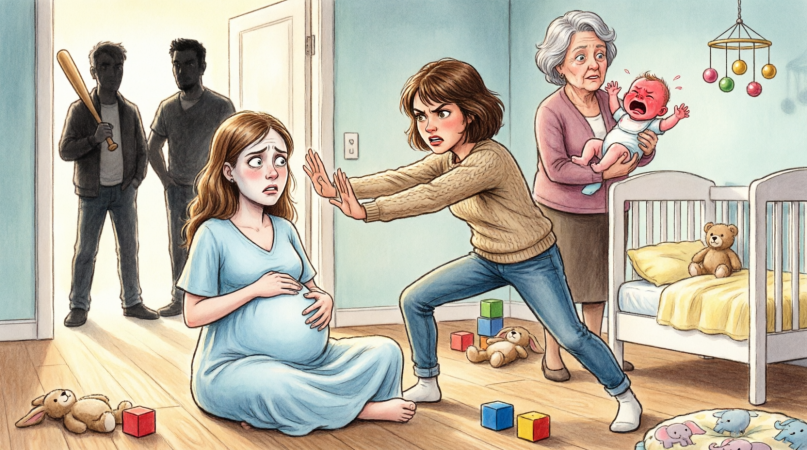
My parents broke through my gate with baseball bats. They destroyed my living room in a rage. Then they ripped my baby from my arms while I was six months pregnant.
For five years, I believed silence was the safest thing my family had ever given me.
It was not peace, exactly.
Peace has warmth in it.
What I had was absence.
No calls on birthdays.
No holiday invitations.
No texts from cousins who once slept on my bedroom floor during summer visits and whispered secrets until midnight.
My name had become a closed door in my parents’ house, and after a while, I stopped knocking.
I was 23 when everything broke.
I had just finished a brutal semester of nursing school, the kind where you learn to sleep in pieces and eat standing up between clinical shifts.
I was tired, but I was proud.
I had chosen a life that belonged to me.
That was the problem.
My sister Jessica was 26 then, and my parents still spoke about her like she was one good month away from becoming a legend.
She had started a candle company, a meal-prep subscription, and a boutique fitness idea that never actually opened its doors.
Three businesses.
Three failures.
$90,000 gone.
My father called it investing in her future.
My mother called it believing in your child.
When they asked me to quit nursing school for a year and work full-time to help fund Jessica’s ninth business attempt, I thought I had misunderstood.
I remember standing in their kitchen with my backpack still on my shoulder.
The room smelled like coffee left too long on the burner and the lemon cleaner my mother used when she was angry.
Jessica sat at the table with a glossy folder full of mock-ups and projections she had not earned.
My father did not ask.
He announced.
“Family helps family, Sarah.”
I said no.
It was the first time I had ever said it without apologizing afterward.
My mother stared at me like I had slapped her.
Jessica cried, not with grief, but with outrage.
My father told me I had become selfish, cold, and full of myself.
By the end of the week, I was blocked from every family group chat.
By the end of the month, relatives I had known since birth were repeating sentences my mother had clearly rehearsed.
Sarah thinks she is better than us.
Sarah abandoned Jessica.
Sarah chose a career over blood.
That is how some families keep score: one child bleeds, and the other is praised for needing the bandage.
I did not answer the rumors.
I studied.
I worked.
I passed exams with swollen eyes and cheap coffee in my veins.
I graduated.
David was there with flowers and a grin so wide that strangers smiled at him.
My parents were not.
Jessica was not.
There was one empty row of chairs behind me, and I pretended not to see it.
David never told me to forgive them before I was ready.
That was one of the reasons I married him.
He had the kind of steadiness that did not make a performance out of being good.
He showed up.
At my graduation.
At our courthouse wedding.
At every ultrasound.
When Emma was born, eighteen months before the attack, he held her like he had been handed the whole fragile universe wrapped in a hospital blanket.
She had his soft brown eyes and my stubborn chin.
She also had a laugh that could undo the worst day in under five seconds.
When I became pregnant again, we named the baby Michael before we even knew for sure he was a boy.
David said he just knew.
At six months, Michael already had a habit of kicking whenever I tried to sleep on my left side.
I complained, but secretly I loved it.
Every movement felt like a small private promise.
Our house was modest.
White gate.
Narrow front walkway.
Old oak floors with scratches we could not afford to refinish yet.
A living room with secondhand furniture and photos in mismatched frames.
But we had bought it ourselves.
David worked overtime.
I picked up night shifts.
We skipped vacations, packed lunches, and learned which repairs could wait and which ones had to be handled before rain found them.
The deed had both our names on it.
The mortgage payments came out on the first of every month.
The home inspection report still sat in a folder in David’s filing cabinet because he kept every important paper in labeled sleeves.
That house was not just shelter.
It was proof.
Proof that I could survive being erased.
Proof that I could build something without asking permission from people who thought love meant obedience.
Then, on a Tuesday in March, my mother called.
The number was unfamiliar.
I almost did not answer.
When I heard her voice, my entire body went cold before my mind caught up.
“Sarah,” she said.
Five years vanished in one syllable.
She sounded older.
Or maybe she sounded frightened, and I had never heard fear in her before.
She asked to meet at a coffee shop near the old mall, neutral ground, as if we were negotiating a business dispute instead of standing over the wreckage of a family.
I almost said no.
Then she said Jessica was in danger.
Not struggling.
Not embarrassed.
Danger.
I went because I am a nurse, and some part of me still responds when someone says there is blood somewhere.
My father was already seated when I arrived.
Jessica sat beside him, sunglasses on indoors, one knee bouncing under the table.
My mother had a folder in front of her.
Inside were printouts, wire receipts, handwritten dates, and a sheet of paper with numbers added and crossed out in my father’s cramped handwriting.
$150,000.
Jessica owed $150,000 to lenders my parents refused to name.
My mother said the word lenders the way someone says storm clouds while pretending it is still just weather.
They had drained their savings.
They had cashed out retirement money.
They were behind on the mortgage.
My father had borrowed against a truck he needed for work.
The family house, the one I had grown up in, was at risk.
I listened until my coffee went cold.
Then my mother reached across the table and touched my wrist.
It was the first time she had touched me in five years.
“Sell your house,” she whispered.
I stared at her hand.
She still wore the same gold bracelet my grandmother had given her.
For a second, all I could think about was being twelve years old and sick with fever while she sat beside my bed with a wet cloth.
Memory is cruel that way.
It offers you the mother you needed exactly when the mother in front of you is asking for something unforgivable.
“Just for now,” she said. “You and David can rent. You have good jobs. You can rebuild. Jessica can’t survive this.”
Jessica took off her sunglasses.
Her eyes were dry.
Not ashamed.
Not desperate.
Angry.
I asked, “Why is this my responsibility?”
My father slammed his palm on the table.
Several people turned.
“Because you have a house,” he said. “Because your sister is family. Because you owe us.”
There it was.
Not love.
Accounting.
I told them no.
The word felt smaller than it should have, considering everything it protected.
My mother began to cry.
My father stood so quickly his chair scraped the floor.
Jessica leaned across the table and said, very quietly, “You will regret this.”
I believed her.
I just did not understand how far she was willing to go.
Two weeks passed.
David suggested we change the gate code.
We did.
He installed a second camera above Emma’s nursery shelf because she had recently started trying to climb out of her crib.
It was not meant for protection.
It was meant to catch a toddler before she hurt herself.
The camera connected to a baby monitor app and stored short motion clips automatically.
David also told me to save screenshots of my mother’s calls and Jessica’s messages.
There were only three.
One from my mother that said, Please don’t do this to us.
One from my father that said, You have no idea what family means.
One from Jessica that said, Last chance.
I put them in a folder on my phone labeled March.
That detail would matter later.
The attack happened on a Thursday afternoon.
David was at work.
Emma was upstairs napping.
I was folding small blue onesies on our bed because Michael had been especially active that morning and I needed to do something quiet with my hands.
The house smelled like baby detergent and the lavender lotion I used on Emma after baths.
Outside, the day was bright and ordinary.
That was what made the first sound so wrong.
Metal shrieked.
Our front gate tore inward.
Then came glass.
A violent burst from downstairs, followed by the heavy thud of boots and my sister’s voice screaming, “Where is she?”
My body moved before fear found language.
I grabbed my phone.
I went to Emma’s room.
I locked the door.
My hand shook so badly I hit the wrong number once before dialing 911.
The dispatcher answered, and I whispered because every instinct in me believed loudness would bring them faster.
“My parents and my sister broke into my house,” I said. “They have baseball bats. My daughter is here. I’m six months pregnant. Please send police.”
The dispatcher asked for my address.
I gave it.
Downstairs, something shattered.
A lamp, I think.
Then another crash, lower and heavier.
The coffee table.
David had repaired one leg of it himself after Emma learned to pull up on furniture.
I heard my father’s voice.
“Sarah!”
Then my mother.
“Open the door!”
I backed toward Emma’s crib.
She was still sleeping, one hand tucked under her cheek.
For one insane second, I hoped she would sleep through all of it.
Then my mother started up the stairs.
Floorboards creaked under her steps.
“Sarah,” she called, softer now. “Open this door. We just want to talk.”
Jessica laughed behind her.
That laugh woke Emma.
She sat up in her crib, blinking, confused.
Then my father hit the nursery door with the bat.
The sound went through my bones.
Emma screamed.
I lifted her out of the crib and held her against my chest, one arm under her bottom, the other wrapped over my belly.
The dispatcher kept asking questions.
How many people?
Any weapons?
Are you injured?
I answered what I could.
The second blow cracked the doorframe.
Paint chips fell onto the carpet.
The third blow split the lock.
My father stood in the doorway with a baseball bat in his hand.
He did not look like the man who once taught me to ride a bike.
He looked like someone who had decided that fear was easier than shame.
My mother pushed past him.
Her arms went straight toward Emma.
“Give her to me,” she said. “You’ll see reason.”
I said, “Don’t touch my child.”
Jessica hit me from the side.
I do not remember falling as much as I remember the ceiling appearing above me.
My shoulder struck the carpet.
My hip burned.
Emma was ripped from my arms, and the sound she made was not a normal cry.
It was terror with no words big enough to hold it.
My mother clutched her and stepped back.
Jessica dropped her knee onto my forearm, pinning it hard enough that pain shot into my fingers.
Then she slapped me.
The taste of blood filled my mouth.
Copper.
Salt.
Shock.
“Tired of being the perfect, successful one?” she hissed.
My father stood in the hall.
My mother bounced Emma against her shoulder, whispering, “Shh, shh, Grandma has you,” as if she had not just helped rip a baby out of her mother’s arms.
The dispatcher was still on the phone near my hip.
I could hear her voice, tiny and urgent.
“Ma’am? Ma’am, are you there?”
Nobody moved.
That silence became its own crime.
My father looked at the wall.
My mother looked at Emma’s hair.
Jessica looked at my belly.
She leaned down until her face was close to mine.
Her breath smelled like mint gum and panic.
“No money?” she whispered. “Then you don’t get a second baby either.”
She stood.
Her foot lifted.
I curled around Michael as much as I could.
My hands went over my stomach.
My jaw locked so hard pain sparked near my ear.
I did not beg.
I was afraid that if I opened my mouth, all the terror would come out and there would be nothing left of me to shield him.
Then blue-red light flashed across the nursery wall.
Jessica froze.
Police were at the house.
At almost the same moment, David’s voice came from downstairs.
“Sarah?”
I have heard people say that rage is loud.
David’s was not.
His silence was worse.
He had come home early because a patient canceled and he wanted to surprise me with dinner.
He found the gate hanging crooked, glass across the living room, furniture destroyed, and our family photos broken on the floor.
He walked in behind the officers, saw my father with the bat, saw my mother holding Emma, saw Jessica over me, and stopped on the stairs.
My mother said, “David, this isn’t what it looks like.”
David did not look at her.
He looked at me.
Then at Emma.
Then at the small black camera above the nursery shelf.
“Tell me that camera wasn’t recording,” he said.
Jessica’s face changed.
Not fear exactly.
Recognition.
The kind that comes when a person realizes consequences have been in the room longer than they have.
The officers moved quickly after that.
One took Emma from my mother and handed her to David.
Another ordered my father to drop the bat.
He did, but only after being told twice.
Jessica started talking over everyone.
She said I had attacked her.
She said she was trying to protect Emma.
She said I was unstable from pregnancy hormones.
Then the dispatcher recording played from my phone speaker, still connected.
Jessica stopped talking.
An ambulance came.
I remember the paramedic asking if I had abdominal pain.
I remember saying yes because every part of me hurt and I could not tell what belonged to fear and what belonged to injury.
David held Emma while kneeling beside me.
She kept reaching for my face and crying, “Mama, Mama,” in a voice that cracked something inside me worse than the fall had.
At the hospital, they checked Michael first.
Those minutes were the longest of my life.
A nurse I knew from another unit held my hand while the monitor searched for his heartbeat.
When the steady rhythm filled the room, I started crying so hard I could not stop.
Michael was alive.
Emma had bruising on one arm from being grabbed too hard.
I had a split lip, bruised ribs, a sprained wrist, and abdominal tenderness that required monitoring.
The hospital intake form listed assault by family members.
The police report listed forced entry, property damage, assault, child endangerment, and threats against an unborn child.
David gave the officers the baby monitor footage before midnight.
He also gave them screenshots from the March folder, the coffee shop meeting date, and the names of the lenders my parents had mentioned once they were separated and questioned.
The footage was clear enough.
Not perfect.
Clear enough.
It showed the door breaking.
It captured my mother reaching for Emma.
It captured Jessica knocking me down.
It captured the slap.
It captured the threat.
Most importantly, it captured Jessica raising her foot over my belly before the police lights hit the wall.
My parents tried to say they had only come to talk.
The broken gate made that difficult.
The baseball bats made it harder.
The 911 call made it impossible.
In court, my mother cried.
Not for me.
Not for Emma.
Not for Michael.
She cried when the judge ordered her to have no contact with us.
My father stared at the floor.
Jessica looked furious until the prosecutor played the nursery clip.
Then she looked young for the first time in years.
Not innocent.
Just small.
There is a difference.
The case did not fix my family.
Nothing did.
My parents eventually lost the house they had tried to make me sell mine to save.
Jessica’s debts did not vanish because she hurt me.
That is the thing about destruction.
It feels powerful only while something is breaking.
Afterward, the bill still comes due.
David repaired the nursery door himself, but we replaced the living room window professionally because he said some things should not be patched by the people who had to survive them.
We sold the coffee table instead of fixing it.
I could not look at it without hearing the crash.
Emma slept in our room for six weeks.
Every time a truck passed outside, she woke crying.
I went to therapy because I kept replaying the moment Jessica lifted her foot.
My therapist told me trauma is the body remembering danger after the room is safe.
I did not feel safe for a long time.
Then Michael was born.
Healthy.
Loud.
Angry at the world in the way newborns are when air first touches them.
When the nurse placed him on my chest, I put one hand over his back and one over my mouth.
David cried openly.
Emma leaned over the hospital bed and whispered, “Baby.”
She touched his blanket with one finger like he was made of light.
We named him Michael because we had chosen that name before fear tried to take it from us.
The caption’s truth was simple, but the cost was not: my parents broke through my gate with baseball bats, destroyed my living room in a rage, and ripped my baby from my arms while I was six months pregnant.
For months, I thought that sentence would define me.
It does not.
What defines me is what happened after.
I protected my children.
I told the truth.
I let the documents speak when my voice shook.
I let the recordings answer the lies.
And when people asked whether I would ever forgive my parents and Jessica, I stopped giving the answer they wanted.
Forgiveness is not a door people get to kick in after they have shattered the house around it.
Sometimes the most loving thing a mother can do is lock that door, hold her children close, and never again confuse blood with safety.