I was sixty-five years old when I finally used the bank card Richard left me in the family court hallway.
By then, the card had been sitting in a shoebox for five years.
I had looked at it on nights when I had nothing in the fridge but a jar of mustard and one egg.
I had looked at it after cleaning houses until my knuckles cracked open from bleach.
I had looked at it the first winter the room above the garage grew so cold that my breath fogged near the window.
Every time, I put it back.
People might call that stubborn.
Maybe it was.
But some things are not money when they first touch your hand.
Some things are an insult with numbers embossed on the front.
Richard and I were married for thirty-seven years.
That is almost a whole adult life.
It is long enough to learn the sound of a man’s footsteps when he is angry, the exact amount of milk he wants in his coffee, the way his shoulder tightens before he says something cruel and then claims he was only being honest.
It is long enough to raise children together, bury parents together, buy appliances on payment plans, sit through school concerts, fight over bills, whisper in hospital waiting rooms, and build a life so repetitive it feels permanent.
Then one day, Richard decided he wanted a different ending.
He did not shout when he left.
That would have been easier to remember as cruelty.
He was calm.
He was neat.
He had filed the papers, divided the accounts, moved his better jackets out of the closet, and rehearsed his new voice before the hearing.
The family court hallway in Chicago smelled like burnt coffee, old paper, wet coats, and the lemon cleaner somebody had used too heavily near the bathrooms.
Fluorescent lights hummed above us.
A bailiff called names from a doorway.
A young couple argued quietly beside a vending machine.
I remember all of that because my mind grabbed small things to keep from grabbing his sleeve.
Richard stood beside me with his coat over one arm, looking less like a husband than a man waiting for his number to be called at the DMV.
The divorce decree was still warm from the printer.
I held it in both hands, even though the paper was only a few pages.
It felt heavier than a suitcase.
Before he left, he reached into his wallet and took out a bank card.
He put it in my palm.
“Here you go,” he said.
He had the softest voice when he was being the coldest.
“This should be enough for you to survive for a few months.”
I looked down at the card.
There was a sticky note wrapped around it with a four-digit PIN written in his square, impatient handwriting.
He did not say he was sorry.
He did not say he wished things had been different.
He did not even ask where I was going to sleep that night.
He just gave me a card and turned me into a loose end.
I wanted to throw it back at him.
I wanted to tell him that thirty-seven years of marriage deserved more than a plastic rectangle and a sentence.
I wanted to remind him of the fever he had at forty-two when I sat up for three nights counting his breaths.
I wanted to remind him of our daughter’s braces, our son’s broken arm, the winter his hours got cut and I stretched one chicken into four dinners.
I did not say any of it.
I had learned that some people do not hear your pain as pain.
They hear it as proof that they still matter.
So I closed my hand around the card and nodded once.
Richard walked toward the elevators.
His shoes made a clean tapping sound on the hallway floor.
He never looked back.
That was the first time I understood how a person could be abandoned in a public place and still feel invisible.
I found the room above the garage three days later.
It belonged to a woman from church whose nephew had moved out and left behind a twin mattress, a folding chair, and a little table with one bad leg.
The ceiling slanted low over the bed.
The radiator clanked like it had opinions.
When it rained, water came through near the window frame and collected in a mixing bowl I kept on the floor.
The first night, I sat on the mattress with my coat still on and opened my purse.
The divorce papers were folded in half.
My bus pass was tucked in the side pocket.
Richard’s card sat at the bottom like a dare.
I picked it up.
I turned it over.
I read the sticky note again.
Then I put it in a shoebox with my birth certificate, old photos of the kids, a spare key, and a Social Security card I had carried since before laminated cards were common.
I told myself I would use it only if I had no other choice.
That was the first lie.
Over the next five years, I had many other choices.
Bad ones.
Painful ones.
Humiliating ones.
But choices.
I cleaned homes where the refrigerators had entire drawers for cheese.
I scrubbed glass shower doors while women younger than my children complained about streaks I could not see without my reading glasses.
I watched an elderly man on Sundays so his daughter could go grocery shopping and sit in her car for ten minutes without anyone needing her.
I collected cans from alleys on mornings when the city was still gray and quiet.
I learned which grocery store marked down bread after 7 p.m.
I learned how to make instant noodles feel like a meal by adding a boiled egg when I had one.
I learned which laundromat had machines that gave two extra minutes if you hit the button twice.
I told my children I was fine.
Emily never believed me all the way.
She has my mother’s eyes and my old suspicion.
“Mom, do you need anything?” she would ask.
“No, sweetheart,” I would say.
“I’m good.”
Daniel asked less often, but when he did, he sounded like he had been carrying the question around all day.
“Seriously, Ma. Tell me.”
I never did.
Not because they would not help.
They had helped.
Emily sent grocery cards when she could.
Daniel paid my phone bill twice and pretended he had done it by accident.
But they had children, rent, car payments, dental bills, and the regular American math that keeps a family tired.
I was their mother.
I was supposed to be the person who said things were handled.
So I handled them.
I kept the card in the shoebox.
Sometimes, on nights when my stomach cramped from eating too little, I took it out and looked at it under the lamp.
I would tell myself it was three thousand dollars.
Not a fortune.
Not security.
Just a short bridge.
Then I would hear Richard’s voice.
Enough for you to survive for a few months.
And the bridge would turn back into a slap.
Maybe that sounds foolish.
Maybe hunger should have made me practical faster.
But a woman can survive poverty and still refuse to let the person who discarded her write the final receipt.
The card stayed untouched.
Then, a few days before everything changed, I fainted outside my door.
I had been carrying a small bag of groceries, mostly rice, bananas, canned soup, and a loaf of bread with a discount sticker on it.
The neighbor’s mailbox leaned at the edge of the driveway.
I remember seeing it twice, then not at all.
My keys hit the concrete first.
The soup cans rolled under the porch steps.
Somebody’s dog started barking.
When I opened my eyes, Mrs. Alvarez from the downstairs unit was kneeling beside me with one hand on my shoulder.
“Sarah,” she kept saying.
“Stay with me.”
I wanted to tell her I was fine.
That was my favorite sentence.
It had gotten so much use that it barely meant anything anymore.
But my mouth would not make the words.
At the hospital intake desk, a nurse wrapped a paper band around my wrist and asked questions while I stared at the scuffed floor.
Name.
Date of birth.
Emergency contact.
Insurance.
Current medications.
Pain level.
I had never liked rating pain.
Pain is not a number.
Pain is a room you have been living in so long you stop noticing the wallpaper.
The doctor came in after the blood work.
He was younger than my son.
That made me feel old in a new way.
He looked at the chart, then at me, and his face changed.
Not dramatically.
Doctors learn not to scare you with their faces.
But something in his eyes sharpened.
“If you don’t take care of this now,” he said, “things could get worse very quickly.”
I tried to ask how quickly.
He answered with instructions instead.
Follow up.
Medication.
Rest.
More testing.
Do not skip meals.
Do not ignore dizziness.
Do not wait if symptoms return.
He handed me a discharge packet and a prescription.
The paper felt official and useless at the same time.
Medicine costs money.
Follow-up visits cost money.
Rest costs money when the hours you lose are the hours that buy groceries.
That night, I sat on the edge of my bed in the room above the garage and listened to rain tap the window.
The radiator knocked.
The bowl under the leak filled drop by drop.
I took the shoebox from the closet.
Inside were old proofs of a life that had kept shrinking.
Birth certificate.
Divorce papers.
School photos.
A Mother’s Day card with Emily’s handwriting from third grade.
Daniel’s Little League picture with one missing front tooth.
Richard’s bank card.
The plastic had a dull look now, like it had aged in the dark.
I held it for a long time.
I thought about the doctor’s face.
I thought about my children getting a phone call they were not ready for.
I thought about every meal I had skipped to protect a pride no one could see.
Pride has its place.
It can keep you standing when shame wants you on the floor.
But pride cannot fill a prescription.
Pride cannot read a lab result and change it.
Pride cannot drive you to an appointment or pay for another night of monitoring.
I put the card in my purse.
The next morning, I wore my cleanest sweater.
It was navy blue, with one cuff stretched out and a tiny mended spot near the hem.
I pinned my hair back, although the gray pieces around my face refused to stay where I put them.
I checked the bus schedule twice.
The bank was not far, but the trip felt like walking into a room where Richard was still waiting to laugh at me.
The branch sat on a busy street with a glass front and a little American flag near the entrance.
Inside, the air was cold enough to make my hands stiff.
The floor smelled freshly mopped.
Somewhere behind the counter, coffee had burned in a pot.
There were three people in line ahead of me.
A man in work boots deposited a check.
A young mother bounced a baby on her hip while trying to find something in her wallet.
An older man argued softly about a fee.
Normal life was happening all around me.
That almost made it worse.
My emergency was just another Tuesday morning.
I stood there with the card in my purse and the prescription folded beside it.
A wall clock showed 10:42 a.m.
I remember the time because I stared at it whenever my courage started to leave.
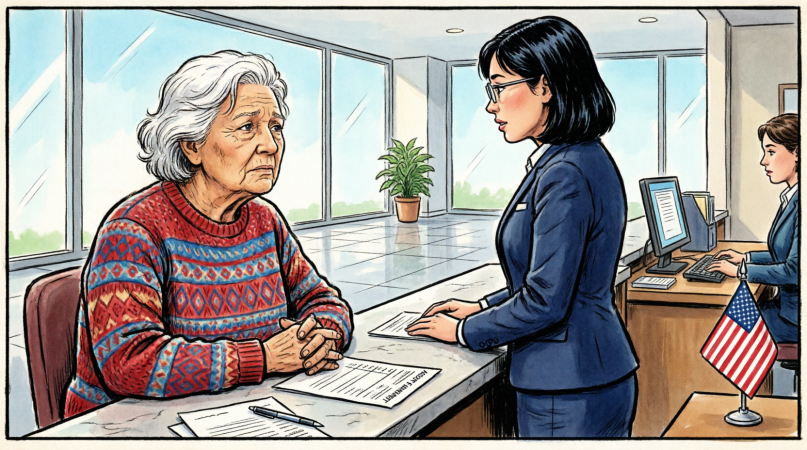
When the young teller called me forward, I almost turned around.
She could not have been more than twenty-four.
Her hair was pulled back neatly, and she wore a small necklace shaped like a star.
“Good morning,” she said.
“How can I help you?”
I took out the card.
My hand shook, so I placed it on the counter instead of handing it to her.
“I want to withdraw everything, please.”
She smiled and picked up the card.
“Of course.”
There are moments when you can feel the future pause.
This was one of them.
She typed the numbers.
She looked at the screen.
The automatic smile stayed on her face for one second too long.
Then it faded.
She typed again.
Her eyes moved from the screen to the card, from the card to my ID, and from my ID back to the screen.
“Can you confirm your full legal name for me?” she asked.
I did.
She asked for my date of birth.
I gave it.
She asked whether I had any other account information.
“No,” I said.
“My ex-husband gave me that card five years ago.”
The word ex-husband changed something in her expression.
She kept her voice careful.
“Ma’am,” she said, “there aren’t three thousand dollars here.”
I felt the counter under my palms.
Hard.
Cool.
Too clean.
For one second, I was back in the family court hallway with Richard’s voice in my ear.
This should be enough for you to survive for a few months.
Of course, I thought.
Of course he lied.
Of course the final cruelty would be small and stupid and perfectly timed.
I heard myself ask, “Then how much is there?”
The teller did not answer.
That was the first thing that truly frightened me.
If the account had been empty, she could have said so.
If the card had expired, she could have said so.
If there were ten dollars and twelve cents, she could have printed a receipt and avoided eye contact.
Instead, she swallowed.
Then she looked past me toward the glass office behind the counter.
“I need my manager,” she said.
Every person who has ever had too little money knows the humiliation of being passed to a manager.
It makes you feel like a problem with shoes.
I stepped back from the counter.
My purse strap slid down my arm.
The teller left her station and went to the office.
Through the glass, I saw her speaking to a woman in a dark blazer.
The woman looked toward me.
Then she looked down at whatever was on the screen.
Then she stopped moving.
I have seen people pause before bad news.
This was different.
This was recognition.
The manager came out slowly, carrying a sealed envelope.
It was cream-colored and thick, the kind people use when they want paper to feel important.
Across the front, in handwriting I knew even from several feet away, was my full name.
Sarah Carter.
Not Mrs. Richard Carter.
Not an account number.
Not a case file.
My name.
My legs felt unreliable.
The manager did not hand it to me immediately.
She set it on the counter beside the old bank card.
The young teller stood behind her, pale and silent, one hand pressed to the edge of the desk.
“Mrs. Carter,” the manager said, “before we go any further, I need you to understand something.”
The branch noise seemed to drop away.
The printer stopped.
The line behind me blurred.
Even the air-conditioning sounded far away.
I looked at the envelope.
Richard had written my name on it.
Five years earlier, I would have said I knew every version of his handwriting.
The fast grocery-list scribble.
The tight signature on tax forms.
The large block letters he used on boxes when we moved.
This was different.
The letters looked slower.
Careful.
Almost afraid.
“What is this?” I asked.
The manager glanced at the teller, then back at me.
“It was left with instructions,” she said.
My mouth went dry.
“What instructions?”
She took a breath.
“That it should only be given to you if you came in person with the original card.”
The original card.
The one I had hated.
The one I had refused.
The one I had kept anyway.
For five years, I had thought the card was the end of my marriage.
Now it sat beside a sealed envelope like it had only been the key.
I reached for the counter because the floor seemed to tilt.
The bank manager moved as if she might come around to help me, but I shook my head once.
Not yet.
I did not want anyone touching me while Richard’s handwriting stared up from the counter.
The teller whispered, “I’m so sorry.”
I do not know what she was sorry for.
The confusion.
The delay.
The numbers she had seen.
The fact that a stranger had accidentally witnessed the moment my past cracked open.
The manager slid a printed account history halfway toward me.
I saw dates.
I saw deposit lines.
I saw more than one.
I saw Richard’s name in a column where I had expected nothing but emptiness.
My breath caught so sharply it hurt.
Five years of refusing the card.
Five years of hunger, cold rooms, taped shoes, and lies told gently to my children.
Five years of believing I had been priced at three thousand dollars and dismissed.
The envelope waited beside my hand.
Inside it was the part Richard had not said in court.
Inside it was the sentence he had left behind when he walked to the elevators without turning back.
The manager touched the edge of the seal.
“Are you ready for me to open it?” she asked.
I looked at my name in Richard’s handwriting.
Then I looked at the bank card.
Then I realized the cruelest thing he had done might not have been leaving me.
It might have been letting me misunderstand why.
And when the envelope opened, the first line made my knees give out……………………

