Part 2
Rebecca looked at the photograph as if it were an open door to a room she had spent years keeping locked. She no longer had ready tears, nor the voice of a grieving daughter, nor arguments of “I’m entitled to half.” She only had fear. My brother-in-law, Arthur, took a step back, as if he had just realized he had accompanied his wife not to claim an inheritance, but to stand face-to-face with incriminating evidence. Daniela clutched her purse to her chest.
“Mom… what is that?”
Rebecca didn’t answer. I placed the photo on the table, right next to the will and my mother’s notebook.
“That’s exactly what I want to know. Because according to you, that day you were out of town dealing with wedding vendors. But here you are, walking out of a notary public’s office with Mom in a wheelchair.”
Rebecca swallowed hard. “It was just a legal formality. Mom wanted to help Daniela.”
“Mom couldn’t even read properly that month. She had a fever, was in pain, and was experiencing bouts of confusion from the infection.”
“But she signed.”
“No,” I said. “That’s what we are about to review.”
I called Mr. Ochoa, Mom’s attorney. It didn’t take him even twenty minutes to arrive because, as he confessed to me later, he expected Rebecca to show up the moment she caught wind of an inheritance. He brought another folder—thinner, but enough to change the expression on everyone’s faces.
“Mrs. Rebecca,” he said calmly, “before we discuss any distribution, you should know that your mother left a videotaped declaration.”
Rebecca let out a nervous laugh. “Videotaped?”
“Yes. A month before she passed, when she was completely lucid and accompanied by her physician. In that statement, she explains why she modified her will and why she requested an investigation into the notary visit you arranged without notifying Clara.”
Daniela looked at her mother as if she no longer wanted to be there. Arthur sat on the couch, pale. I didn’t know about that video. I felt my legs shaking beneath me, but I didn’t allow myself to fall.
The attorney placed his tablet on the table. My mom’s image appeared on the screen: thin, with dark circles under her eyes, wrapped in her gray shawl. Even so, her eyes were steady.
“Clara,” she said in the video, “if you are watching this, it’s because I could no longer tell you to your face. Rebecca took me to a notary by tricking me. She told me it was to update a medical assistance form, but on the way, she started talking about selling the house to pay off Daniela’s debts. I refused. She squeezed my hand so hard she left my finger bruised. She told me that you were already tired of taking care of me and that, if I didn’t sign, she was going to fight you for everything when I died.”
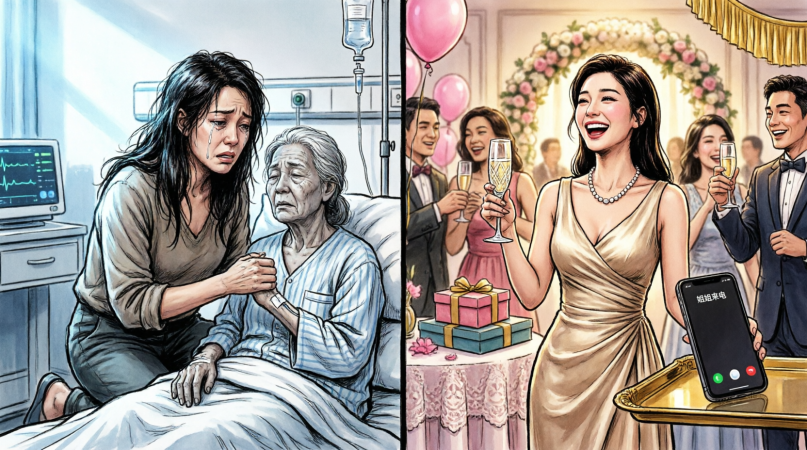
Rebecca abruptly turned off the screen. “Enough!”
My voice came out cold. “No. Now we are actually going to listen to Mom.”
The video continued. Mom explained that she didn’t end up signing the sale because the notary noticed she was confused and requested to reschedule with a medical certificate. Rebecca flew into a rage, dragged her out of there, and later denied ever going. Afterward, according to Mom, she began calling her only to ask about the safe, the deed, the jewelry, and “what was fair for Daniela.” I remembered all those afternoons when Mom would just stare at the phone and say she was tired. I thought her body was hurting. I didn’t know it was her daughter hurting her. In the video, Mom ended with a phrase that shattered me:
“I am leaving the house to Clara, not for taking care of me more, but because she was the only one who never asked me to die quickly just to solve her life financial problems.”
Daniela began to cry. “I didn’t know the house was meant for my wedding.”
Rebecca looked at her, furious. “Of course you knew we needed money!”
“I didn’t know you wanted to sell my sick grandmother’s house.”
Arthur stood up. “Rebecca, tell me this isn’t true.”
She completely lost control. “Everyone enjoyed it! Everyone wanted the venue, the dress, the decorations, the honeymoon! Where did you think the money was coming from? Clara always gets to play the saint, and I’m left with the bills!”
I took a step closer. “You chose those bills. And you chose not to come when Mom was dying.”
“Because if I came, she was going to ask for my forgiveness,” she snapped. “And I didn’t want to hear it.”
The silence that followed was so brutal that even she understood what she had just said.
Mr. Ochoa recorded a statement of everything that had occurred and asked me to lock away the notebook, the photo, the video, and the receipts. He also opened the safe completely. Inside was Mom’s small jewelry collection, which wasn’t much: a wedding band, some gold earrings, a small Miraculous Medal, and an envelope with my name on it. Inside were the receipts for every single debt I had paid off, noted in her own shaky handwriting with dates and short phrases: “Clara sold her car for my surgery,” “Clara paid off Rebecca’s loan,” “Clara did not leave me alone.” At the bottom, another envelope read: “For Daniela, if she ever wants to know the truth about her dress.”
Daniela took it with trembling hands. Inside were copies of bank transfers made by my mom to Rebecca for wedding expenses—money that I would give Mom for her medications, which she, under immense pressure, ended up handing over to my sister. Daniela sank to the floor.
“My dress came out of my grandmother’s medicine money…”
Rebecca tried to snatch the envelope away, but Arthur stopped her. “No more.”
That night, Rebecca left with nothing. Not a mug, not an earring, not a key. Before walking out, she looked at me with pure hatred: “I’ll see you in court.”
“Yes,” I replied. “But this time, Mom is going to testify too, even if it’s from a video.”
When I shut the door, the house fell completely silent. I sat in the chair where Mom used to drink tea and opened the very last page of her notebook. There was a note written with great difficulty:
“Clara, don’t let them turn my death into an inventory split. There is another key in the safe. It’s not for this house. It’s for the place where I hid what Rebecca fears most.”
I searched through the envelopes and found a small key marked with red tape. The label read: “Storage Unit 14, Downtown Commercial District.” I felt my grief mix with fear once again. Because if my mother had hidden something outside the house, it was because she knew my sister didn’t just want to inherit. She wanted to destroy evidence.
Part 3
I went to the storage facility the next day with Mr. Ochoa and my neighbor Teresa, because I no longer wanted to face any family secrets alone. Storage Unit 14 was small, damp, and smelled of old cardboard. Inside were two plastic crates, a brown suitcase, and a black binder wrapped in plastic garbage bags. In the first crate, I found photographs of my mother during her final years: at doctor appointments, with her oxygen tank, sitting in the backyard with her blanket. In almost every single one, I was by her side. Rebecca was in none of them. Not because Mom wanted to erase her daughter, but because Rebecca had already erased herself long before Mom passed away.
The black binder contained the most serious evidence: copies of promissory notes, printed text messages, rejected notary documents, and a formal complaint addressed to the District Attorney’s office that Mom never got the chance to submit. In that letter, she explained that Rebecca had attempted to pressure her multiple times into signing powers of attorney, selling the house, and draining her savings account. It also stated that Arthur, my brother-in-law, didn’t always know everything, but Daniela absolutely did receive gifts paid for with money Rebecca took from Mom under the guise of “urgent financial emergencies.” It pained me to read it. Not because I wanted to protect Daniela, but because I finally understood that my mother spent her final months not just fighting an illness, but silently defending the little she had left.
Rebecca went through with her threat and filed a lawsuit. She claimed that I had manipulated Mom, isolated her, forced her to change the will, and that the house should be split as a matter of “moral family estate.” Her attorney attempted to paint my years of caretaking as sheer greed. In response, we submitted everything: medical certificates proving her mental competency, the videos, the bank receipts, Mom’s written declaration, the photograph at the notary’s office, the letter from the storage unit, the loans I had settled, and the text messages where Rebecca asked about the safe before ever asking about Mom’s health. The judge was not moved by her black dress or her phrase “I’m her daughter too.” Being a daughter isn’t about showing up only when there are keys to inherit.
Daniela canceled her honeymoon. Not out of sudden nobility, but because the scandal spilled over into her wedding. She showed up at my house weeks later, alone, without her perfect nails or her spoiled-brat attitude. She asked me if she could see a photo of her grandmother. I gave her one where Mom was smiling, holding a sweet pastry in her hand. Daniela wept looking at the image.
“My mom told me Grandma didn’t want to come to my wedding because you were controlling her.”
I closed my eyes. “Your grandmother didn’t go because she could no longer walk without agonizing pain, and because your mother took the money meant for her medications to pay for your reception.”
Daniela didn’t know where to hide her shame. I didn’t hug her. But I didn’t kick her out, either. She, too, would have to live with the truth, even if she wasn’t the primary culprit.
Arthur separated from Rebecca during the legal proceedings. He testified under oath that he knew nothing about the notary visit or the storage unit, but he admitted he had allowed her to talk about “securing the inheritance” while my mother was still very much alive. That cowardice carried weight, too. Rebecca lost the lawsuit over the house and ended up under investigation for embezzlement, attempted fraud, and financial elder abuse against a sick adult. She didn’t go to prison immediately. Justice doesn’t always strike like a hammer. Sometimes it falls like a door slamming shut. For her, that door meant being banned from entering the house, unable to touch the account, unable to open the safe, and unable to turn our grief into an estate liquidation.
It took me months to sleep without waking up to the imagined sound of the hospital phone ringing. There were days when I felt angry at Mom for keeping so much quiet. Other days, I completely understood. Sometimes mothers stay silent because they cannot bear to accept that their own daughter has become a stranger. But she also left me proof, and that was her final way of looking out for me. With a portion of the savings account, I paid off the remaining medical bills. I used another portion to renovate the house: waterproofing the roof, replacing old pipes, and repainting the bedroom where Mom spent her final days. I didn’t turn it into a shrine. I turned it into a small library, complete with her favorite armchair, her plants, and a box where I kept her recipes, her glasses, and her notebook.
A year after her passing, I hosted a simple lunch at the house. Teresa came, as did Mr. Julian the baker, the lady from the pharmacy, Mr. Ochoa, and Daniela. Yes, Daniela. She arrived with a bouquet of daisies and a letter for her grandmother, which she left right next to a photograph. I didn’t read it. It wasn’t meant for me. Rebecca was not invited. My father had passed away years ago, so there was no one left pleading to “forgive for the sake of the family.” That phrase, I discovered, is almost always used by the people who want to avoid the consequences of their actions.
The last time I saw Rebecca was outside the courthouse. She told me: “Mom was mine too.”
I looked at her without hatred, but without opening the door. “Yes. And you could have actually been there for her.”
She didn’t respond. Because there was no inheritance to be found in that sentence. Only the truth. She walked away, clutching her purse tight against her body, as if she could still find a way to hide something inside it.
Today, the house in Garden Grove remains solely in my name. Not because I won a prize for taking care of my mother, but because she chose to ensure that the only roof she had left wouldn’t end up paying for someone else’s parties, debts, or guilt. I no longer keep jewelry in the safe; I keep papers, photographs, and a copy of the video where Mom, with a frail voice but unwavering eyes, gave me her permission to defend myself. Sometimes I miss her so much it hurts to breathe. Sometimes I get angry because she asked for Rebecca until her very last breath. But then I remember that loving someone doesn’t mean handing them the keys to your entire life, and that death does not magically make people good when they spent your final moments waiting to ask how much they were going to get. My sister arrived dressed in black saying, “I’m her daughter too.” Perhaps she was. But that day I learned that being a daughter isn’t proven by demanding half a house; it’s proven by being right there when a mother’s light fades away, and there is absolutely nothing left to collect except a hand to hold.