He came home from war and found his dog chained in a blizzard, and the first thing he noticed was the silence.
Not the broken door.
Not the snow.
Not even the lock hanging half-splintered from the cabin frame.
The silence.
David Miller had spent fifteen years learning what danger sounded like before it became visible.
A safety click in a dark hallway.
A foot shifting on gravel.
A radio going dead at the wrong second.
But his own cabin in the Colorado mountains had always sounded like Titan.
Claws on the hardwood.
A deep bark from the back room.
One heavy tail thumping against the wall as if the house itself had a heartbeat.
That night, there was nothing.
The rented Ford F-150 sat in the driveway with its headlights punching through the storm, the beams turning every snowflake into a white streak.
The old mailbox at the end of the drive was half-buried, the little flag frozen in place.
Wind shoved snow across the porch in hard sheets.
David stood with one hand inside his coat pocket, fingers around the Sig Sauer he had not meant to reach for yet.
“Whoever chained my dog outside in this storm better pray the cold gets to me before I do,” he said.
His voice disappeared into the trees.
The front door hung open two inches.
The deadbolt had been kicked through the frame.
Inside, the house was black.
David stepped onto the porch and felt the boards groan under his boots.
He had been home only twice in the last year, but he knew every sound that cabin made.
He knew which floorboard complained by the kitchen.
He knew the low hum of the refrigerator.
He knew the way Titan would usually huff from the hallway, deciding whether the man at the door was family or a problem.
No huff came.
David pushed the door wider with his shoulder.
The cold inside hit him wrong.
A cabin in a blizzard should hold some warmth, even if the fire had gone out.
This place felt abandoned by every living thing.
He clicked on his tactical flashlight.
The beam moved over destruction.
The couch had been flipped onto its back.
The coffee table had been smashed across the middle.
A framed photograph of his mother lay facedown in broken glass near the fireplace.
Another frame showed his old team overseas.
The third showed Titan in his service vest, sitting straight, ears up, looking more disciplined than most men David had known.
That glass had shattered too.
David did not move fast.
Fast got people killed when the room had already been touched by someone else.
He swept left.
Kitchen clear.
Drawers open.
Silverware scattered on the floor.
He swept right.
Living room torn apart.
Office door open.
Bedroom at the end of the hall standing in darkness.
“Greg!” he called.
His voice sounded too loud in the empty house.
No answer came back.
Greg Harrison should have been there.
Greg had promised.
That sentence was a small thing, but David had built too much on it.
Greg had been there when David was twelve and his father left without packing properly.
Greg had been there when David was seventeen and wrecked his first truck on black ice.
Greg had stood beside him at his mother’s funeral in the same plain black suit he wore to every funeral, wedding, and court date in Georgetown.
Greg owned Harrison’s Auto & Transmission, a shop that smelled like oil, coffee, and winter tires.
He had a laugh that started before the joke ended.
He had also been the only person David trusted enough to leave Titan with.
Three weeks earlier, David had been ordered to Washington for a final mandatory debriefing.
Sterile temporary housing.
A badge clipped to his jacket.
Men in quiet rooms asking careful questions about operations no one would ever admit happened.
No dogs allowed.
No exceptions.
Titan had stared at him from the truck seat the morning David dropped him at Greg’s shop, ears high and offended.
Greg had scratched him under the collar and said, “He’ll eat better than I do.”
Three days before the storm, Greg had called laughing.
“Titan stole half my turkey sandwich right off the counter,” he said.
David remembered smiling in that rented room outside D.C., looking at the government curtains and thinking there were still two creatures in the world he could trust without checking the exits.
Now the cabin told him that one of them might be dying and the other was missing.
He moved through the house room by room.
Guest room clear.
Closets torn open.
Office papers dumped from the desk.
Gun safe scratched but unopened.
This had not been a burglary.
Burglars took things.
Whoever had come here had searched.
David crouched near the safe and ran one gloved finger along the scratch marks.
Wrong tool.
Wrong pressure.
Someone had known the safe mattered but not enough to open it.
That meant Reed.
The name came before the evidence did.
Thomas Reed had once worn polished boots and a private contractor’s smile in a room full of men who thought money made them untouchable.
Five years earlier, Reed had been attached to an operation in Syria that David still did not speak about unless ordered.
Reed got greedy.
He diverted equipment.
He changed movement schedules.
Men died.
Civilians died.
David testified.
Reed lost contracts, influence, and almost his freedom.
At the tribunal table, Reed had leaned forward just enough for the recorder to catch his words.
“You’re going to regret being righteous, Miller.”
David had heard worse threats.
He had believed that one would rot with the man who made it.
Then the flashlight found a silver glint on the hearth.
A Zippo lighter.
Not David’s.
He picked it up with two fingers and turned it over.
Apex Solutions.
Reed’s company crest was stamped on the front, cold and clean in the beam.
David’s jaw tightened.
Not anger.
Worse than anger.
Focus.
He set the lighter on the mantel and kept moving.
At 8:53 p.m., he found Titan’s water bowl against the wall.
It had been dented in the middle, as though someone had thrown or kicked it.
Beside it, frozen into the floorboards, was a dark stain.
David pulled off one glove.
His fingertips touched the stain.
Blood.
The room narrowed.
The wind hammered the open door behind him, and the whole cabin seemed to breathe once.
He had seen blood in places no human being should have to see it.
He had washed it from his hands.
He had carried men through it.
But two fingers on that frozen stain did something no firefight had done.
It made him afraid to stand up.
“Titan,” he said.
The name came out quiet.
No bark answered.
He cleared the rest of the cabin anyway, because training does not care about grief.
Bedroom.
Bathroom.
Hall closet.
Laundry room.
Back door.
The office had been ransacked worst of all.
The drawers were empty on the floor.
Old deployment folders lay scattered under the desk.
One file cabinet had been tipped onto its side.
David saw no missing medals, no stolen cash, no missing firearms.
Only disruption.
Search patterns.
Pressure.
A message made out of damage.
Then he heard it.
Not a bark.
A whine.
Thin enough that the storm almost swallowed it.
David froze.
The sound came again.
Outside.
He hit the back door with his shoulder and went through it into the blizzard.
Snow swallowed him above the knees.
The cold stole the first breath from his chest.
His flashlight beam jerked over the shed, the stacked firewood, the old tractor axle he had never bothered to move.
“Titan!”
Another whine came from near the woodshed.
David pushed through the snow like it was surf.
The storm hit his face with ice.
His boots slipped on buried stones.
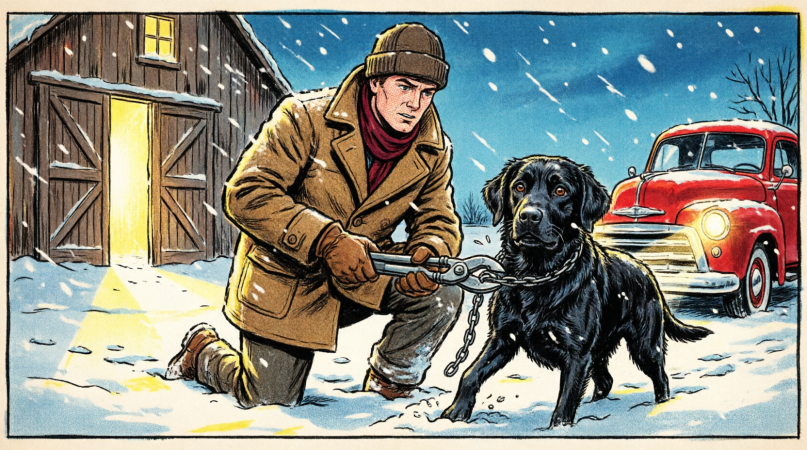
The flashlight found the iron axle first.
Then the chain.
Then the body at the end of it.
Titan lay curled in the snow, his dark coat silvered with ice.
His muzzle was white with frost.
His paws had torn at the frozen ground until the snow around them was marked dark.
A steel chain ran twice around his neck and back to the iron axle.
A brass padlock held it shut.
David dropped to his knees so hard the impact shot through his legs.
“No, no, no.”
Titan opened his eyes.
Only a little.
Enough.
His tail moved once.
It was the smallest movement David had ever seen break a man.
“I’m here,” David said, pressing his bare hand to Titan’s neck. “I’m here, buddy.”
Titan tried to lick him.
His tongue barely moved.
David felt along the chain, then the lock.
The metal had frozen slick.
He pulled once.
Nothing.
He pulled again until his shoulders screamed.
Nothing.
He took out his knife, wedged it into the lock, and twisted.
The blade snapped.
The little broken sound vanished into the storm.
David stared at the useless handle in his hand.
Then he looked at Titan.
The dog was not shivering.
That was what terrified him most.
In the field, David had learned that shivering meant the body was still fighting.
When the shaking stopped, the cold had already begun winning.
“Hold on,” he said.
He ran to the woodshed and kicked the door open.
Inside, the air smelled like old paint, cedar dust, and damp cardboard.
He tore through stacked wood and rusted cans.
A garden rake clattered down.
A coffee can full of screws spilled across the floor.
His flashlight shook over the wall until it found the old bolt cutters hanging on a nail.
He grabbed them and ran back.
The hinges protested when he opened them.
He set the jaws around one link.
The metal slipped out.
David reset.
“Hold still, T.”
He squeezed.
Nothing.
He changed the angle, braced one handle against his thigh, and put everything he had left into the cut.
His hands went numb.
His shoulder burned.
The chain groaned.
Then one link snapped.
David threw the cutters aside and unwound the chain from Titan’s neck with fingers that no longer felt like his.
The brass padlock hit the snow.
He scooped Titan into his arms.
The dog was too still.
Too heavy.
Too close to being a memory.
Inside the cabin, David kicked the door shut behind him and carried Titan to the living room.
He stripped off his coat and wrapped it around him.
Then he pulled every blanket from the hallway closet and piled them over the dog’s body.
The fireplace was cold.
The coffee table was already broken, so David finished the job.
He smashed the remaining legs loose, threw them into the hearth, and grabbed the whiskey bottle from the kitchen counter where he had left it three weeks earlier.
He poured it over the wood.
Then he took Reed’s silver Zippo from the mantel.
For one second, he stared at the Apex crest.
Then he struck the wheel.
The flame caught.
The fire rose fast, orange and hungry, throwing light over the ruined room.
David sat on the floor with Titan’s head in his lap and rubbed his ears, his legs, his chest.
“Stay with me,” he whispered.
The words were not a prayer, because David had never been good at praying.
They were an order.
“We didn’t survive Kandahar for you to die on my living room floor.”
The fire cracked.
The wind shook the windows.
Meltwater ran from Titan’s coat into David’s jeans.
Thirty minutes passed with no change.
David counted every breath he could feel.
He kept his hand under Titan’s ribs, waiting for the rise.
Some came shallow.
Some almost did not come at all.
His own phone had no service.
Greg’s phone had gone to voicemail for over an hour before David reached the logging road.
The county could not help if he could not call.
The vet could not help if he could not drive back through three feet of snow with a dying dog in his arms.
So he did the only thing left.
He kept the fire alive.
He kept rubbing.
He kept talking.
He talked about the first day Titan had ignored every handler and walked straight to him.
He talked about the convoy where Titan had pulled him by the vest through smoke.
He talked about the morning his mother died, when Titan had climbed onto the couch and put his head in David’s lap like grief was a command he could answer.
Care is not always soft.
Sometimes it is two frozen hands forcing warmth back into a body that has almost given up.
Then Titan inhaled.
One deep, jagged breath.
His back leg twitched.
A few seconds later, his body began to shiver.
David bent over him and pressed his forehead into the wet fur.
The sound that left his throat was half laugh, half broken thing.
Titan was alive.
For the first time since he had stepped onto the porch, David let himself close his eyes.
Only for a second.
When he opened them, the firelight caught something brass beside his boot.
The padlock.
He had carried it in with the chain without noticing.
It lay on the floor, wet and scratched, the little engraved bottom turned toward the light.
David picked it up.
At first, his mind refused the letters.
They were small.
Clean.
Too familiar.
G.
R.
H.
Greg Richard Harrison.
The room went very still around him.
Greg marked everything that mattered to him.
Shop locks.
Toolboxes.
Tow hooks.
Ammo cans.
David had teased him for it a hundred times.
Now those three letters sat in his palm like a verdict.
His childhood best friend’s initials were on the lock that had been around Titan’s neck.
David looked at the broken door.
He looked at Reed’s lighter.
He looked at Titan, shivering under the blankets, eyes barely open but fixed on him.
The easy answer was betrayal.
The harder answer was worse.
Because if Reed had left his own lighter and Greg’s marked lock in the same house, then maybe this had never been meant to be simple.
Maybe Greg had done it.
Maybe Greg had been forced.
Maybe Reed wanted David to choose wrong before he learned the truth.
At 9:31 p.m., David’s phone lit up near the shattered front window.
One bar.
One voicemail.
Greg Harrison.
The timestamp read 6:12 p.m.
David stared at the screen until the fire popped hard enough to make Titan flinch.
Then he pressed play.
Static filled the room.
Greg’s voice came through under it, breathless and terrified.
“Dave… listen to me. If you get home before I do, don’t touch the lock. Don’t trust what it says. Reed has—”
The message cut off.
Titan lifted his head at the sound.
David did not breathe.
Then something heavy struck the back porch once.
Not wind.
Not snow.
A knock.