When Rachel brought Sophie home from the ER, the porch light was already on.
That was the first warning.
It made the house look normal from the street, almost kind, with the small American flag in the porch planter bending in the damp May air and the family SUV cooling in the driveway.
Then Rachel saw the black garbage bag split open on the lawn.
Her work shoes were in the grass.
Sophie’s pink hoodie was half under the mailbox, one sleeve soaked from the rain.
Rachel slowed at the edge of the driveway, because her body understood the scene before her mind could.
“Mom?” Sophie whispered from the passenger seat.
Rachel turned off the engine and looked at her daughter.
Sophie was eleven, pale from fluorescent ER lights, with a hospital wristband still loose around her small wrist and a square bandage taped to the inside of her arm.
Hours earlier, the school office had called at 1:12 p.m.
Sophie had collapsed in the hallway between math and lunch.
By 2:04, Rachel was signing hospital intake forms with one hand while rubbing circles into Sophie’s back with the other.
Anemia, the nurse had said.
Follow-up labs, iron, more fluids, watch for dizziness.
Rachel heard the instructions, nodded, took the papers, and held herself together because mothers do not get to fall apart while their children are watching.
By the time they got home, Sophie had eaten half a carton of fries and fallen asleep against the car window.
Rachel had let herself believe the worst part of the day was over.
Then she saw her suitcase blocking the open front door.
Margaret was standing just inside the hallway.
Rachel’s mother was still wearing her good cardigan, the cream one she saved for church dinners and appointments where she wanted people to think she was softer than she was.
“Pay her rent or get out,” Margaret shouted before Rachel had even crossed the threshold.
Rachel stared at her.
Behind Margaret, Thomas stood with his arms crossed.
Brianna sat at the kitchen table in Rachel’s robe, eating soup from Rachel’s bowl.
For a moment, the whole scene looked so ridiculous that Rachel could not make herself answer.
Her daughter had come home from the hospital.
Their belongings were in the yard.
And her stepsister was eating dinner in her robe.
“What rent?” Rachel asked, though she already knew.
Margaret’s mouth tightened.
“Brianna is three months behind,” she said. “The total is $2,000 with the late fees, and you are going to help because family helps family.”
Rachel glanced at Brianna.
Brianna did not look up from the soup.
She had always been like that, able to make other people’s sacrifices feel like background noise.
When Rachel was sixteen, Margaret had said Brianna was sensitive because her parents’ divorce had hurt her.
When Rachel was twenty-four, Margaret said Brianna could not be expected to work full time because anxiety made her tired.
When Rachel was thirty-two, Margaret still said Brianna was fragile, even while Brianna borrowed Rachel’s car, wore Rachel’s clothes, and let Rachel pay bills that were never hers.
Rachel had believed too much of it for too long.
That was her first mistake.
Her second was giving Margaret access.
A house key.
The school pickup password.
A copy of her Social Security card during what Margaret called “family paperwork.”
The kind of things you hand over when you are exhausted, divorced, and trying to convince yourself that moving home does not mean you failed.
Rachel held up Sophie’s discharge folder.
“We just got back from the ER,” she said. “Move the suitcase.”
Margaret’s eyes flicked to Sophie, then back to Rachel.
“I’m tired of you using that child as an excuse.”
Sophie flinched.
Rachel felt that flinch like a hand closing around her throat.
“Don’t talk about her like that,” Rachel said.
Thomas stepped forward.
“This is our home,” he said.
No, Rachel thought.
No, it wasn’t.
But she did not say it yet.
There is a kind of anger that burns hot and gets you nowhere.
Then there is the kind that goes quiet, watches the room, and remembers where every exit is.
Rachel had lived in the second kind for six months.
Six months earlier, a River Point Apartments notice had arrived with her name on it.
Not Brianna’s.
Not Margaret’s.
Rachel’s.
It said the lease was behind and charges were accumulating.
Rachel had never toured River Point Apartments.
She had never filled out an application.
She had never signed a lease.
At first she thought it was an error.
Then the bank flagged two check images with her name on them.
The signature looked close enough to fool someone who only saw it once.
It was wrong enough to make Rachel’s stomach go cold.
The R was too tight.
The tail on the last letter was too short.
Then came the notice tied to Silver Ridge Holdings LLC.
A company Rachel had never formed.
A company connected to debt she did not recognize.
Margaret had cried when Rachel asked about it.
She cried so beautifully.
She said she was overwhelmed.
She said Brianna was in a bad place.
She said Rachel was being cruel by bringing up paperwork when the family was under stress.
Rachel almost apologized.
That was how deep the habit ran.
Instead, she began collecting.
Screenshots.
Bank alerts.
Copies of check images.
The River Point lease packet dated March 3.
Messages from Margaret demanding money in language that sounded like affection until you read it twice.
Every “please help your sister.”
Every “don’t embarrass this family.”
Every “you owe us after everything we did for you.”
Quiet people notice everything.
Rachel noticed which drawers Margaret opened when she thought no one was looking.
She noticed Brianna getting mail at the house under two different names.
She noticed Thomas taking calls in the garage and lowering his voice whenever Rachel walked past.
She noticed that the more questions she asked, the more urgently Margaret talked about loyalty.
So on the night Rachel brought Sophie home from the ER, she was not unprepared.
She was just tired.
That was different.
“Move the suitcase,” Rachel said again.
Thomas laughed.
“Or what?”
Rachel looked at the clothes on the lawn.
A pair of Sophie’s sneakers lay near the porch step.
Her own winter coat was draped over the railing.
A grocery bag had split, and the box of cereal inside was softening in the wet grass.
“Or I call the police,” Rachel said.
Margaret’s face sharpened.
“For what? For us putting your junk outside?”
“For the lease,” Rachel said. “For the checks. For my Social Security number. For tonight if you don’t let my daughter inside.”
Brianna’s spoon stopped.
It was the first time she looked afraid.
Thomas moved faster than Rachel expected.
The hit was not cinematic.
There was no slow motion.
There was only the clean crack of skin against skin and the hard shock of the floor rising up.
Rachel’s shoulder hit first.
Then her hip.
Then the side of her mouth.
Blood filled her mouth, metallic and hot.
Sophie screamed.
“Mom!”
Rachel tried to push up, but the hallway tilted.
For a second, she saw everything from floor level.
Thomas’s boots.
The suitcase wheel.
Margaret’s ankles by the stairs.
The wet porch beyond the open door.
And Sophie’s frightened face.
Thomas stood over her.
“Maybe now you’ll learn,” he said.
The words settled over the room.
Not because they were loud.
Because nobody argued with them.
Margaret folded her arms.
Brianna looked down at her soup.
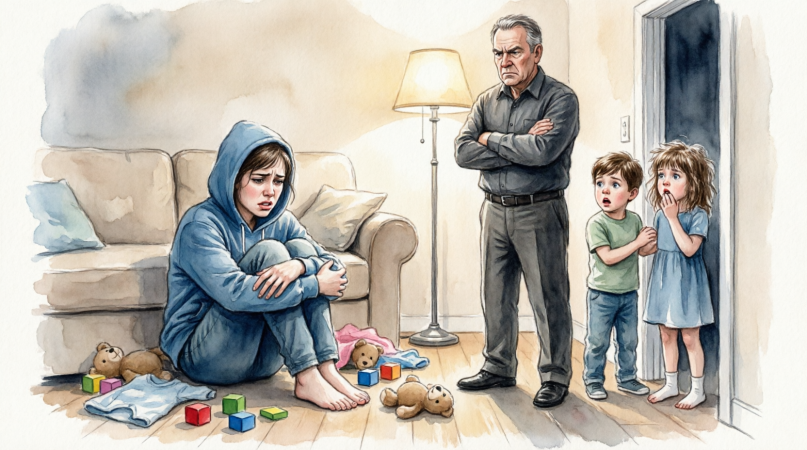
Sophie stood in the doorway, weak from the hospital, clutching the bandage on her arm like she could hold herself together if she pressed hard enough.
For one ugly heartbeat, Rachel wanted to make the room hurt back.
She saw the ceramic bowl on the table.
She saw the edge of the hallway mirror.
She saw Thomas close enough to reach.
Then Sophie whispered, “Mom, please.”
Rachel swallowed blood and stayed still.
That restraint saved everything.
Because the phone in Rachel’s pocket had been recording since Margaret shouted at them on the porch.
Rachel had started the recording before she opened the car door.
It was not dramatic.
It was practical.
For months, she had learned that people who lie well depend on everyone else being too embarrassed to keep proof.
She was done being embarrassed.
Thomas pointed toward the door.
“Get out.”
Rachel pushed herself to her knees.
It took longer than she wanted.
Her hand trembled against the hardwood floor, and the discharge papers slid under her palm.
The refrigerator hummed in the kitchen.
The porch light buzzed faintly.
Brianna’s spoon hit the bowl with a tiny sound that seemed to shame the whole room.
Rachel stood.
Thomas smirked.
He thought he had won because she was bleeding.
Some people mistake a bruise for surrender.
Rachel looked at him and smiled.
“Not tonight,” she said.
Margaret’s eyes narrowed.
Rachel reached into her pocket and pulled out her phone.
The recording had been running for twenty-three minutes and forty-one seconds.
“Tonight, you’re leaving,” Rachel said.
The first person to understand was not Thomas.
It was Brianna.
She went pale before Margaret even moved.
“What is that?” Brianna whispered.
“A record,” Rachel said.
Margaret lunged for the phone.
Rachel stepped back, and Sophie, still shaking, moved just enough to block the corner of the hall with her small body.
Rachel hated that.
She hated that Sophie thought she needed to protect her mother.
But Sophie’s eyes had changed.
There was fear in them, yes.
There was also something like recognition.
She was seeing the truth of the house at the same time Rachel was finally naming it.
“Touch me again,” Rachel said to Thomas, “and the next sound on this recording will be me calling 911.”
Thomas did not move.
Margaret did.
She turned on Brianna so fast it was almost graceful.
“Go upstairs,” she snapped.
Brianna stood halfway, still wearing Rachel’s robe.
“I didn’t sign anything,” she said.
The sentence was quiet, but it cracked something open.
Margaret froze.
Rachel looked at her stepsister.
“What did you say?”
Brianna’s eyes filled.
“I didn’t sign anything,” she repeated. “Mom said it was handled. She said you knew.”
Rachel opened her tote bag.
Inside, beneath Sophie’s medication instructions and a bottle of iron supplements, was a blue folder.
Rachel had kept it with her for three days.
She had planned to take it to the county clerk’s office on Monday morning, then to the police station if the clerk confirmed what the bank had already hinted at.
She had not planned to use it in the hallway with blood in her mouth.
But plans change.
Rachel placed the folder on the kitchen table.
Margaret whispered, “Rachel.”
It was the first time all night she sounded like a mother.
Rachel did not let that stop her.
The top page was the River Point Apartments lease.
The applicant name was Rachel’s.
The Social Security number was Rachel’s.
The emergency contact was Margaret, written in Margaret’s unmistakable handwriting.
Under the payment section was a copied check image.
The signature was the bad version of Rachel’s name.
The version with the tight R and the short tail.
Brianna sat down hard.
Her face looked empty.
“I thought it was just a co-sign,” she said.
Thomas turned on Margaret.
“You told me she agreed.”
Margaret’s mouth worked, but no answer came.
That was when Rachel understood the shape of it.
Margaret had used Rachel’s information to get Brianna into the apartment.
Thomas knew enough to be angry about the debt but not enough to understand the paper trail.
Brianna had benefited from it and chosen not to ask questions.
Everyone had used Rachel’s silence as a room they could store their guilt inside.
Rachel picked up the phone and called 911.
Her voice shook only once, when she said her daughter was present.
After that, she gave the facts.
Her name.
Her address.
Physical assault.
Fraudulent documents.
A child just discharged from the ER.
A recording in progress.
Margaret started crying.
Not the elegant crying she used when she wanted pity.
This was smaller.
Messier.
Angrier.
“You would do this to your own family?” she asked.
Rachel looked at Sophie.
Sophie had slid down the wall and was sitting on the floor now, exhausted, holding her bandaged arm.
“No,” Rachel said. “I’m doing it for mine.”
The officers arrived nine minutes later.
Rachel remembered that because the oven clock said 7:58 when she called and 8:07 when red-blue light washed across the front window.
The house changed when the lights appeared.
Thomas stepped back.
Margaret wiped her face.
Brianna pulled the robe tight around herself like clothes could make her innocent.
Rachel opened the door before anyone else could.
She gave the officers the recording.
She showed them the torn lip, non-graphic but obvious enough.
She showed them Sophie’s hospital bracelet and the discharge papers.
She showed them the suitcase, the clothes on the lawn, the lease packet, the check copies, and the messages on her phone.
The younger officer looked at Sophie and softened.
The older one looked at Thomas and did not.
Nobody was dragged out screaming.
Real consequences often look quieter than people expect.
Thomas was told to step outside.
Margaret was told to sit at the table and stop touching the paperwork.
Brianna cried so hard she hiccupped, then whispered that she did not know the Social Security number was stolen.
Rachel believed her halfway.
Halfway was all Brianna had earned.
Sophie slept on the couch that night with every lamp in the living room on.
Rachel sat beside her until dawn.
Her lip was swollen.
Her shoulder ached.
Her phone battery died and had to be plugged into the wall behind the couch.
At 6:19 a.m., Rachel emailed copies of the recording, the lease packet, the check images, and the screenshots to herself, then to a new account Margaret did not know existed.
At 8:30, she called the bank.
At 9:15, she called River Point Apartments.
At 10:40, she sat in a county office with her folder on her lap while Sophie leaned against her side and dozed.
Every person asked for another copy.
Rachel had copies.
For once, she had too many.
The following days were not clean or fast.
There were statements.
There were forms.
There was a police report.
There was a fraud packet from the bank.
There was an appointment to dispute the River Point lease.
There was a protective order hearing in a family court hallway where Margaret would not look at Rachel and Thomas stared at the floor.
Rachel did not feel powerful there.
She felt tired.
She felt embarrassed by the bruise on her mouth.
She felt angry that strangers had to help her say things her own family should have known without being told.
But when the clerk asked whether she wanted to continue, Rachel looked at Sophie sitting beside her in a clean hoodie with her hair brushed back and said yes.
That was the first full yes she had said for herself in years.
Margaret tried to call for two weeks.
Then she tried to text through Brianna.
Then she sent one message that said, “You are tearing this family apart.”
Rachel stared at it for a long time.
Then she took a screenshot and added it to the folder.
Family, she had learned, is not the word people get to use after they push your child past the doorway and throw her hoodie into the rain.
Family is the person who sits on the couch with you at 3:00 a.m. because you are scared to sleep.
Family is the school nurse who calls twice to check on your daughter.
Family is the neighbor who quietly brings your wet clothes back from the lawn and leaves them folded on the porch chair without asking questions.
Family is sometimes smaller than you hoped.
It is also safer.
Months later, Sophie asked Rachel if the house felt different.
Rachel was making grilled cheese at the stove.
The same kitchen.
The same table.
A new lock on the front door.
A new emergency contact listed at school.
A folder in a fireproof box in the closet.
Rachel looked at her daughter and thought about the night the whole house had gone still.
The refrigerator humming.
The porch light buzzing.
The little American flag outside, bending in the rain.
Thomas smirking because he thought standing over her meant he owned the ground beneath her.
Then she remembered Sophie’s voice.
Mom, please.
Rachel set the spatula down and answered honestly.
“Yes,” she said. “It feels like ours now.”
Sophie nodded, as if that made perfect sense.
Later, when Rachel found the old robe in the laundry basket, she did not throw it away in anger.
She washed it.
Folded it.
Placed it in a donation bag with the clothes Margaret had tossed into the yard.
Not because she was forgiving everyone.
Not because she had forgotten anything.
Because she no longer needed to keep evidence of every humiliation in her closet.
She had the real evidence where it belonged.
And she had her daughter safe in the next room.
That was enough.
For years, they had called Rachel weak.
The divorced daughter.
The burden.
The woman too quiet to fight back.
They were wrong about the quiet.
Quiet had been listening.
Quiet had been documenting.
Quiet had been waiting until the truth had enough paper behind it to stand on its own.
And when the night finally came, the moment they thought would destroy her became the first night she stopped apologizing for surviving.