I never admitted to my parents that the paycheck they kept trying to claim was only the smallest part of what I had built without them.
To Richard and Diane Carter, I was still the quiet son who worked too much, talked too little, and could be pushed into paying for whatever Madison wanted next.
They did not know about the company.
They did not know about the contracts.
They did not know about the bank account that no one in that house could touch.
They did not know I had learned to build my life in the dark because every dollar I ever showed them became a reason to reach deeper into my pockets.
Sunday dinner should have smelled like comfort.
Roast chicken.
Warm gravy.
Lemon cleaner on the counters.
Sweet tea sweating in glasses beside folded paper napkins.
Instead, the dining room smelled like old rules.
The kind nobody wrote down because everyone was supposed to know who got to ask, who got to receive, and who was expected to sacrifice quietly.
The ceiling fan clicked once every turn above us.
It had been doing that since I was in high school, and every time I heard it, I remembered sitting at that same table with homework spread under my elbows while Madison cried because Mom would not let her go to some weekend trip unless somebody “helped.”
Somebody usually meant me.
My parents called it family duty.
I learned early that family duty was a bill with my name on it.
When Madison wanted new shoes, I was told she needed confidence.
When Madison wanted a better phone, I was told she needed opportunity.
When Madison wanted money for another fresh start, another class, another trip, another version of herself she could photograph and abandon, I was told I had to stop being selfish.
If I asked to keep what I earned, I was cold.
If I stayed quiet, I was arrogant.
If I said no, I was cruel.
Love in that house always came with a receipt, and somehow I was always standing at the register.
Dad did not begin as a monster in public.
That was the trick of him.
At the hardware store, he shook hands.
At church dinners, he carried folding chairs.
At neighborhood cookouts, he laughed too loudly and slapped men on the back like he was everybody’s favorite uncle.
Inside the house, his voice changed.
It got lower.
Shorter.
It turned every room into a place where you measured your answer before you gave it.
Mom did not yell as much.
She did something worse.
She smiled.
Diane Carter could slice you open with a soft voice and then ask why you were bleeding on her floor.
Madison learned from both of them.
She did not have to demand loudly.
She only had to want something, and the whole house shifted to make space for it.
I was the middle son, the practical one, the worker.
The one who did not make a scene.
The one who could “figure it out.”
When I got my first real job after community college, I thought maybe my parents would be proud.
I had taken the bus when my car broke down.
I had worked closing shifts and morning shifts so close together that sometimes I slept in my uniform.
I had eaten gas station sandwiches in parking lots and told myself it was temporary.
The day I got hired full time, I walked into my parents’ kitchen with the offer letter folded in my pocket.
Dad did not ask about the work.
He did not ask if the supervisor seemed fair.
He did not ask whether the benefits were decent.
He asked, “What’s the salary?”
Mom’s eyes lifted from the counter.
She smiled the way people smile when a package arrives.
I told them less than the truth.
That was the first smart thing I ever did for myself.
Not enough of a lie to invite questions.
Just enough to leave a little room to breathe.
After that, I got careful.
I opened a separate account.
I took extra work they did not know about.
I learned software in the little hours of the night, staring at a secondhand laptop while the rest of my apartment building went quiet except for pipes clanking in the walls.
At 11:38 p.m. on a Tuesday, I registered my LLC from the laundry room downstairs because the Wi-Fi in my apartment kept cutting out.
The dryer shook so hard that the vending machine rattled.
Somebody had left a sock on top of the washer.
The fluorescent light buzzed overhead.
I remember all of it because that was the first night my name felt like it belonged to me.
I saved the confirmation email.
I saved the Articles of Organization.
I saved the first bank statement.
I made a folder on my laptop and named it “Records.”
Nothing dramatic.
Nothing emotional.
Just Records.
Over the next three years, that folder grew.
Contracts.
Invoices.
Receipts.
Wire confirmations.
Inspection reports.
Bank letters.
County recorder paperwork.
Every file was boring to look at.
Every file was freedom.
I was not planning revenge.
I was planning proof.
When you grow up around people who can rewrite a conversation before the dishes are done, proof becomes oxygen.
My younger sister, Lily, understood that better than anyone.
She was quieter than I had ever been.
She watched.
She noticed which version of our parents the world got and which version waited behind the front door.
She had a habit of pulling her hoodie sleeves over her hands when the room got tense.
That Sunday, she sat sideways on the couch near the front window, doing exactly that.
Her phone hovered in her hands, screen dark, thumb moving once in a while and then stopping.
Outside, a small American flag tapped against the porch bracket in the breeze.
It was one of those warm afternoons where the light looked pretty through the windows but the house still felt airless.
Madison arrived late.
She always arrived late enough that people noticed, but not late enough to apologize sincerely.
She came through the front door with sunglasses on top of her head, a small purse tucked under her arm, and that bright practiced smile that meant she was about to ask for something expensive.
Mom had already set the table.
The roast chicken sat in the center, glossy and perfect.
The gravy boat was full.
The sweet tea had lemon slices in the glasses.
Dad sat at the head of the table in his red flannel shirt even though the day was too warm for it.
He liked clothing that made him look like a man who knew how to work with his hands.
Sometimes he did.
Mostly, he liked the costume.
Madison kissed Mom’s cheek and told Dad the chicken smelled amazing.
Then she sat down like she was stepping onto a stage.
“I’ve been thinking,” she said.
That was how it always started.
Not with a request.
With a performance.
She said she was seriously considering moving to L.A.
She said she needed a change.
She said she could not keep shrinking herself to fit a town that did not understand her potential.
She said all of this while reaching for a roll and not once looking embarrassed.
Mom nodded like Madison had announced a medical diagnosis.
Dad leaned back in his chair.
I kept my eyes on my plate.
There are moments when you know the trap is already built and everyone is only waiting for you to step into it.
Madison said she would need help with the transition.
Rent money.
Deposits.
A little cushion until things started moving.
She did not say my name, because she did not have to.
The room did it for her.
Dad looked at me.
Mom looked at me.
Even Madison finally looked at me, her expression gentle in the fake way people get when they have already decided your money is theirs.
I took a slow drink of sweet tea.
The glass was cold in my hand.
I remember that because everything else in me was getting hot.
Dad slapped his palm on the table.
The forks jumped.
“You’re going to help your sister,” he said. “That’s what men do.”
I looked at Madison.
She did not look desperate.
She looked expectant.
There is a difference.
“I’m not funding her lifestyle,” I said.
The room tightened.
Mom laughed first.
It was sharp, delighted, almost relieved.
“Listen to the parasite talk like he has options,” she said.
Madison rolled her eyes.
She did not tell Mom to stop.
She never did.
That was the quiet arrangement in our family.
Madison made the request.
Mom made it cruel.
Dad made it an order.
Everyone else was supposed to call that love.
Lily’s head dipped near the couch.
Her phone was still in her hands.
I saw her thumb hover near the screen.
Dad’s chair scraped back.
“You think you’re better than us because you have a paycheck?”
“No,” I said. “I think it’s mine.”
That was the sentence that did it.
Not the refusal.
Not the money.
The ownership.
A family can turn hunger into virtue when somebody else is doing the starving.
The moment you stop handing over pieces of yourself, they call you selfish for bleeding less.
Dad’s face did not fully change.
It shifted just enough.
His jaw tightened.
His shoulders squared.
His right hand curled around the table edge as if the wood had insulted him too.
“Hand it over,” he said.
I looked at the chicken between us.
The paper napkins.
The sweating glass near Madison’s elbow.
The gravy boat Mom had bought for holidays and apologies.
For one ugly second, I pictured flipping the entire table.
I pictured the plates shattering, the chicken sliding, the sweet tea soaking Madison’s lap, the gravy running across the hardwood.
I pictured giving the room the chaos it deserved.
I did not move.
“No,” I said again.
The next second came in pieces.
Flannel close to my face.
Chair legs cracking against hardwood.
Dad’s hand bunching in my collar.
The table edge rushing up.
My mouth hit with a hard, bright pain that made the whole room flash white.
The taste of copper filled my mouth immediately.
I heard Lily inhale.
I heard Madison make a sound, but it was not fear.
It was irritation.
Like I had ruined the mood.
Like bleeding at dinner was rude.
Mom sat back and watched.
That was the part I could not stop noticing.
Not Dad’s hand.
Not the pain.
Mom’s calm.
She looked at me the way she looked at coupons on a Sunday morning, deciding what could be clipped, used, and thrown away.
The room froze.
A fork lay crooked beside my plate.
A drop of gravy slid down the side of the little white boat and landed on the tablecloth.
The ceiling fan clicked again.
Outside, the flag tapped softly against the porch bracket.
Lily stared at the carpet for half a second, because looking at me would have made the truth too loud.
Dad stood over me, breathing hard.
He looked satisfied.
That might have hurt worse than the table.
“You need to remember who raised you,” he said.
My lip felt split and hot.
My tooth throbbed.
Blood ran along my tongue.
I pressed one hand against the table, not because I needed help standing, but because I needed one still thing under my palm.
Mom tilted her head.
“Obedience,” she said, almost tenderly. “That’s all we ever wanted you to learn.”
For years, that word had lived under everything they said.
Respect.
Gratitude.
Family.
Duty.
It had always been obedience in a nicer shirt.
I wiped my mouth with the back of my hand.
Blood streaked my knuckles.
Madison looked away, not out of shame, but because she did not want the mess near her.
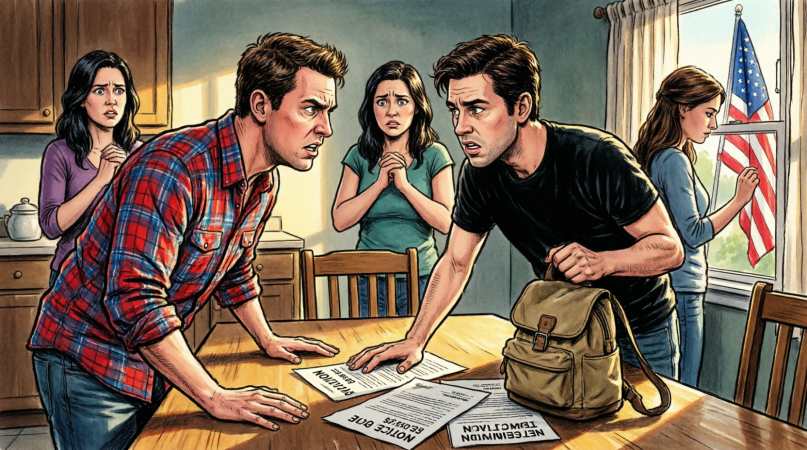
Dad sneered when he saw me reach for my bag.
“What is that?” he said. “Another excuse?”
My fingers found the folded paper.
I had picked it up three days earlier from the county recorder’s office.
The clerk had slid it across the counter like it was nothing special.
A stamped document.
A clean black mark at the top.
A property description.
A transfer date.
A signature block.
A line that mattered more than all the others.
I had put it in my bag because I knew Sunday dinner was coming.
I did not know Dad would put his hands on me.
Maybe that was a lie.
Maybe part of me had always known how far he would go if I finally said no with my whole chest.
My hands did not shake.
That surprised me.
Everything in my mouth hurt.
My pulse was loud in my ears.
But my hands stayed steady as I unfolded the document and laid it on the table between Madison’s sweet tea and the cooling chicken.
The black stamp faced up.
The company name was typed exactly the way I had filed it.
The paper looked ordinary.
That was the beautiful thing about it.
No shouting.
No begging.
No performance.
Just ink.
Dad stared at it.
Then he grabbed the page like he expected it to be a bill he could tear in half.
His fingers left small damp marks near the corner.
He held it too tightly.
Madison leaned forward.
Mom stopped smiling.
Lily stood from the couch so slowly that the cushion barely made a sound.
Dad’s eyes moved over the page.
Property description.
Transfer date.
Signature block.
Company name.
His mouth opened once, then closed.
He looked at the document again.
I watched him read the line a second time.
That was when I saw it happen.
The power did not explode out of him.
It drained.
First from his shoulders.
Then from his face.
Then from the hand that had been gripping the paper like he owned the room, the house, the air, and every person breathing it.
For the first time in my life, Richard Carter looked scared.
Not angry.
Not offended.
Scared.
Mom leaned toward him, impatient at first, then confused when he did not speak.
“What?” she asked.
Madison’s sunglasses slipped a little lower on her head.
“Dad?” she said.
He did not answer either of them.
His thumb froze over the bottom line.
The one line he could not bully.
The one line Mom could not laugh away.
The one line Madison could not turn into a need.
My blood was still on my hand.
The gravy was still cooling.
The ceiling fan was still clicking above us.
But the old house rules had stopped working.
Dad looked from the paper to me, and for the first time, he understood that the son he had called a paycheck had been keeping records while they were keeping score.
His thumb stayed on the word.
The room held its breath.
And under his shaking hand, the line read—