The first time I realized how easy it was for someone to cut a child with words, it happened over dinner, in my brother’s house, under warm pendant lights that made everything look softer than it really was. The table was set the way Chelsea always set it—linen napkins folded into neat triangles, water glasses lined up like soldiers, a centerpiece that smelled faintly like rosemary and something expensive she couldn’t pronounce. Aaron had grilled steaks on the back patio, thick and red in the middle the way he liked them, and he’d served them like he was hosting a celebration instead of a family meal held together by obligation and habit.
Eli sat to my right, shoulders tucked in, hands in his lap the way I’d taught him when he was younger because he used to talk with his whole body—hands waving, legs bouncing, energy spilling over. At fourteen, he’d learned to pull it all back. Not because he wanted to, but because he’d learned that some rooms punished you for being too much.
He looked older than fourteen sometimes. Not in the tall, broad-shouldered way boys on the varsity team looked older, but in the careful way he listened, in the way he waited an extra beat before he answered a question, as if he was checking whether the answer would make someone else uncomfortable. He’d been top of his class for two years running, the kind of kid teachers wrote glowing notes about. Polite. Soft-spoken. Brilliant. The kind of kid people claimed to want… until wanting became the same thing as accepting.
The conversation had started pleasantly enough. Chelsea had talked about a new yoga studio she wanted to try—she said “hot vinyasa” like she was announcing a brand of champagne—and Aaron had complained about the neighbor’s dog barking, and my mother had texted earlier that she couldn’t make it because she had a headache. Nothing unusual. Nothing dramatic. Just the normal hum of a family that shared bloodlines but not always warmth.
Eli ate slowly. He always did in unfamiliar spaces, even spaces he’d been in many times. It was his way of making sure he didn’t take too much. Too much food, too much attention, too much air. He’d cut his steak into small pieces and kept his eyes on his plate, answering when spoken to, smiling when Chelsea’s laugh got sharp and performative.
Aaron was across from us, leaning back in his chair as if his own home was a throne room. He had the kind of confidence that came from never having to fear consequences. His hair was a mess in the way men tried to make look effortless. His forearm rested on the table, tan and muscled from the gym membership I’d paid for in January, February, March, and April, because he’d said he needed it for his mental health and I’d believed him, or wanted to believe him, because guilt makes you generous.
Halfway through the meal, Chelsea asked Eli about school. Her tone was sweet but thin, as if she was doing him a favor by remembering he existed.
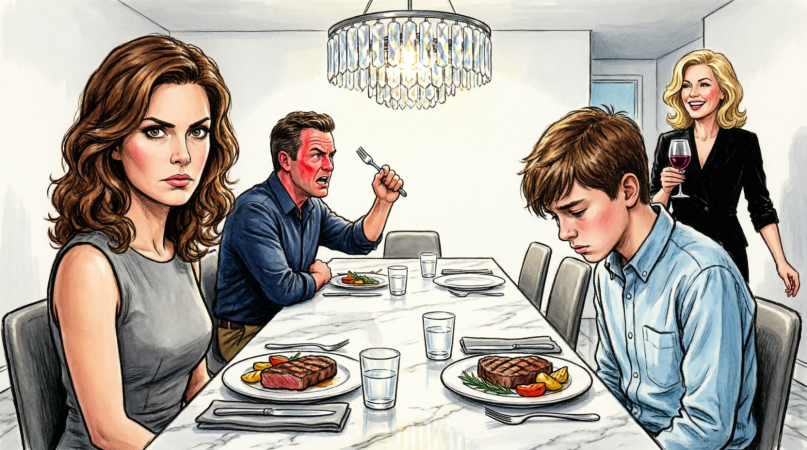
“How’s honors biology?” she asked, lifting her wine glass.
Eli nodded. “Good. We’re doing genetics right now.”
“Genetics,” Aaron repeated, like he was tasting the word. He stabbed his fork into a piece of steak—my steak, in a way, because the money for it came from my account—and chewed slowly, looking at Eli the way someone looks at a stranger who has walked into the wrong house.
And then he said it.
“Your son doesn’t belong here. He’s not one of us.”
It was so casual. No buildup, no warning, no pause to soften it. The words hit the table like a dropped knife. For a few seconds, the whole room went still. Even the air felt like it paused, like it didn’t know what to do with that kind of cruelty sitting openly between plates and glasses.
Eli’s hands stayed folded in his lap. He didn’t look up. His jaw tightened, and I saw his throat move as he swallowed something that wasn’t food.
I looked at Aaron. I kept my voice steady because raising my voice would have been a gift to him, a way to make me the problem instead of him.
“Do you want to repeat that?” I asked.
He met my eyes, dead calm. “He’s adopted. He’s not blood. You can pretend all you want, but he’s not family.”
Chelsea nodded, smug, like she’d been waiting for someone to say it out loud. She held her glass of white wine like a prop, her lips curling in the kind of smile women practice in mirrors when they want to look sympathetic without being sincere.
“Then maybe you both should leave,” she added.
There are moments in life where you can feel the timeline splitting. One path is the one you’ve been walking, the one built out of habits and compromises and a long list of swallowed words. The other path is the one you could choose if you finally stopped trying to keep everyone comfortable. In that moment, I felt the split like a crack in glass.
I could have argued. I could have cried. I could have demanded they apologize. I could have made a scene, thrown my napkin, slammed my hands on the table the way movies tell you a righteous person should. But I’d spent years learning that scenes only feed people like Aaron and Chelsea. They thrive on drama because drama lets them claim victimhood when the smoke clears.
So I did something else.
I stood up quietly.
No yelling. No scene. I picked up my purse. I looked from Aaron to Chelsea, and I said, “We will.”
Chelsea’s eyebrows rose, like she’d expected me to beg or negotiate. Aaron smirked, already tasting the satisfaction of winning.
“And my bank card, too,” I added.
Chelsea blinked. “What do you mean?”
I smiled—small, controlled, a smile I used in boardrooms when someone underestimated me. “I mean the dinners,” I said, “the monthly transfers, your credit cards, your lease, your utilities, the god-forsaken Peloton you’ve used twice, the loan I cosigned because your credit was garbage, the money I gave Mom to secretly pass on to you when you were broke again and too proud to ask.”
Aaron’s smirk slipped.
Chelsea’s mouth opened, then closed.
I paused just long enough for the words to settle. I wanted them to feel it. Not as a threat. As reality.
“All gone,” I said. “As of now.”
I didn’t look at Eli when I said it because I didn’t want him to see anger on my face. I didn’t want him to think he’d caused something terrible. I reached for his shoulder instead, a quiet signal. He stood immediately, chair scraping lightly against the floor.
We walked out before either of them could say another word.
Not a word to Eli. Not an apology. Not even a goodbye.
The front door shut behind us, and the cold night air hit my skin like a slap. Eli stepped onto the porch, and for a second he just stood there, frozen.
In the car, he stared out the window.
I waited until we were on the road before I spoke.
“You don’t have to say anything,” I told him. “But I want you to hear me say this clearly. What they said is wrong. It’s cruel. It’s not true.”
His voice came out quiet. “They’ve always thought it.”
“I know,” I admitted. The truth tasted bitter. “But thinking something and saying it out loud are two different things. And now we know who they are when they’re not pretending.”
He nodded once, still looking away. “Do you… do you regret adopting me?”
The question hurt so much it almost stole my breath. I gripped the steering wheel, forcing myself to keep the car steady, forcing myself to speak like a mother instead of a wounded person.
“No,” I said. “Never. Not for a single second. You were mine the moment I met you.”
He swallowed, and the streetlights flickered over his face, catching the sheen of tears he refused to let fall.
When we got home, he went to his room without taking off his shoes. I heard his door click shut, and then the house went quiet in that hollow way it does when a child decides to protect you by hiding their pain.
I sat at the kitchen table for a long time, staring at my phone. Messages were already coming in. Chelsea, of course. She loved to control the narrative. Aaron too, texting as if he’d done nothing wrong.
Chelsea: “I can’t believe you’d walk out like that. This is family.”
Aaron: “You’re overreacting. You always do this. You think you’re better than us.”
I read the words and felt something strange: not anger, not heartbreak, but a calm, sharp clarity.
Because here was the truth I’d been avoiding for years: I had been funding their lives.
Not metaphorically. Literally.
And it wasn’t because I was rich and they were poor. It was because I felt guilty.
Our father died when we were young. He was the one who’d built the family business from nothing, the one who’d worked until his hands cracked, the one who’d promised Aaron and me that we’d inherit something solid, something that would hold us up when he was gone. When he died, the business was a mess—debts, outdated equipment, contracts slipping away. Mom tried for a while, but grief swallowed her, and she retreated into herself like a house closing its shutters.
I was the one who stepped in.
I was barely out of college. I should have been figuring out who I was, going on trips, making mistakes in cheap apartments with roommates. Instead, I was sitting in meetings with men twice my age, fighting for contracts, learning how to read financial statements like they were survival manuals. I took the business over because someone had to, and because I’d promised my father, and because Aaron was off doing what Aaron always did—chasing the next fun thing, the next escape, the next version of a life where responsibility never caught him.
The will had been clear: I was named sole owner because I was already working there full-time, because Dad trusted me to keep it alive. Aaron never forgave him for that. He told anyone who would listen that I’d “stolen” it, that I’d manipulated our father. And because I didn’t want to be seen as the sister who took everything, I spent years trying to make it feel shared.
I paid for Aaron’s mistakes. Again and again.
When he quit his first job after three months because his boss “didn’t respect him,” I covered his rent. When he started a “business” selling fitness supplements and it collapsed, I paid off the credit card debt. When he married Chelsea—who had the kind of entitlement that comes from believing you deserve comfort just for existing—I bought them wedding gifts that were basically checks in disguise.
And then, when Eli came into my life, I did it even more.
Because adopting Eli was the best thing I’d ever done—and also the most terrifying. I was thirty-two, single, running a company, and I wanted a child with a certainty that felt like hunger. I’d started volunteering at a youth center years earlier, thinking I could help in small ways. Eli was there, a quiet kid with bright eyes and bruises he didn’t talk about. He’d been bounced through foster placements. He’d learned not to expect permanence. The first time he smiled at me—really smiled, like sunlight breaking through clouds—I felt something in me shift.
The adoption process was long, complicated, full of paperwork and interviews and moments where I wondered if the universe was going to deny me this one thing I wanted more than anything. Aaron pretended to support me. Chelsea smiled and said all the right things, but her eyes always had that calculating edge, like she was measuring what Eli’s presence would mean for her place in the family.
When the adoption finalized, Aaron hugged me and said, “Congrats.” Chelsea kissed my cheek and said, “You’re so brave.” But later, when they thought I couldn’t hear, I caught Chelsea whispering to Aaron, “Well, it’s not like he’s really yours.”
I should have cut them off then.
But guilt is a powerful leash. And I’d been trained to believe that holding the family together was my job.
That dinner—those words—snapped the leash.
By Monday morning, their cards were frozen.
It wasn’t dramatic. I didn’t send a long email. I didn’t call and announce it like a villain. I simply called the bank and revoked the authorized user access I’d given Aaron years ago “temporarily.” I canceled the credit line tied to Chelsea’s name. I shut down the monthly transfers I’d been sending to cover their utilities. I canceled the autopay on their lease.
Then I revoked Aaron’s access to the company systems. That was a step I’d avoided for too long because a part of me still clung to the idea that he was family, that he wouldn’t hurt me in a way that mattered. But the thing about entitlement is that it grows when you feed it, and Aaron had been feeding for years.
My head of IT, a man named Rob who had been with me since the early days when we were still patching together old computers to keep things running, didn’t ask questions. He just nodded and said, “About time.”
We changed passwords. We updated security protocols. We removed old admin profiles that hadn’t been used in years.
By Wednesday, Chelsea was posting cryptic things on Facebook.
Some meme about snakes in the grass. Some quote about betrayal. Some dramatic line about how people show their true colors when you need them most. The comments section filled with sympathetic friends who didn’t know the story, who didn’t care to know, who just liked the performance.
My mother texted me a long paragraph about family.
“You shouldn’t overreact,” she wrote. “Family isn’t just about money. Aaron is your brother.”
I stared at the message for a long time. My mother had spent years trying to keep peace by asking me to shrink. She’d never asked Aaron to grow. She’d never asked Chelsea to be kind. Peace, in her world, always meant my silence.
I didn’t reply.
Because this wasn’t just about cutting them off.
This was about finally making them face the reality I’d been shielding them from for years.
And I had receipts.
On Friday, Chelsea showed up outside my office.
Unannounced, of course. She never respected boundaries. She wore oversized sunglasses like they could hide the fact that her mascara had smudged, that she’d been crying, that desperation was already seeping through her polished exterior.
I didn’t invite her in. I stood in the doorway, blocking the entrance like a bouncer in a suit.
“What kind of person abandons their own family?” she demanded, voice trembling with outrage she wanted to turn into righteousness.
I tilted my head. “What kind of person tells a kid he’s not family because he was adopted?”
Chelsea’s jaw tightened. “Emotions were high. Aaron didn’t mean it.”
“He meant it enough to say it twice,” I replied.
She crossed her arms, shifting tactics. “We need to talk like adults.”
That was always her line when she wanted to manipulate someone quietly. Talk like adults. As if cruelty was childish but control was mature.
I reached behind me and pulled out a folder.
She stared at it like it might explode.
When she finally took it and opened it, I watched her face change. At first, confusion—pages of numbers, bank statements, wire transfers. Then realization. Then fear.
Every cent I’d ever paid on their behalf. Three years of financial dependency printed and stapled. Dates. Account numbers. Memo lines. A trail so clear you could follow it like a map.
Chelsea looked up. “Why are you showing me this?”
“Because I’m done being painted as the villain,” I said. “And because you need to understand something.”
I pulled out a single page and held it out. It was a simple agreement. They would walk away from any claim to the business. They would stop telling people they had ownership. They would stop saying the company was “family inheritance” split equally. In return, I wouldn’t drag every embarrassing detail into court or make it part of public record.
“Sign this,” I said calmly, “or I take it all public.”
Chelsea’s hand shook slightly. “You can’t do that.”
I smiled again, that boardroom smile. “I can do whatever the law allows. And I’ve made sure the law is on my side.”
She didn’t sign.
She stormed off, sunglasses back on, chin high like pride could keep her afloat.
That weekend, Aaron sent me a furious voice message. He called me cold. Fake. He said I had no right to weaponize money against family.
Funny, considering they’d never called it weaponizing when they used it.
On Sunday, I got a notification from one of the business accounts: attempted login from an old admin profile. An account Aaron hadn’t used in two years. He was trying to access payroll.
It was such a specific kind of betrayal. Not emotional. Not petty. Practical. He wasn’t just angry. He was calculating how to get his hands on resources.
I called Rob. We locked everything down tighter. We flagged the login attempt, saved the logs, handed everything to legal.
Monday morning, a local reporter reached out.
They said they’d received an anonymous tip claiming I was stealing money from the business and funneling it into personal projects. Luxury vacations. Private school tuition. Fake charities.
All provably false.
But I knew exactly who sent it.
What Aaron and Chelsea didn’t understand—because they’d never built anything themselves—was that people who run businesses learn to document everything. If you don’t, the world eats you. Every email. Every contract. Every transfer. Every permission change. Everything leaves a trail.
If they wanted a war, they’d picked the wrong person to provoke.
That afternoon, my lawyer filed an official cease and desist. It went to both of their emails. It gave them forty-eight hours to retract the anonymous tips or I would sue for defamation.
Chelsea responded with a single line.
“You’re going to regret this.”
It didn’t sound like a warning.
It sounded like a promise.
Tuesday night, I stayed late at the office. I’d been working with my lawyer to finalize new ownership filings. Paperwork that made it official in every possible way: I was the sole owner, exactly as my father had intended. No more informal sharing. No more “family legacy” language. No more ambiguity for Aaron to twist.
I left a little after ten. The parking lot was empty except for my car and the night janitors. The air was cold, and the streetlights made the asphalt shine like wet stone.
I drove home, parked in the garage, locked everything up like I always did. Eli’s bike was in the way, angled awkwardly, and I decided to move my car out onto the street for the night so I could deal with the bike in the morning when I wasn’t tired.
At 2:43 a.m., sirens woke me.
At first, my brain couldn’t place the sound. Then I heard shouting. Then I saw the orange flicker through the curtains.
I ran to the window and froze.
My car was on fire.
Not smoking. Not damaged. Fully engulfed.
Flames licked up the sides, reflected in the windows of neighboring houses. The heat made the air shimmer. The smell of burning rubber and metal filled the night, sharp and nauseating.
Eli came running into my room half-dressed, eyes wide. “Mom—what’s happening?”
We stood at the front door, staring through the glass until the fire department arrived, lights flashing, boots pounding, hoses unfurling. The water hit the flames with a hiss like anger.
The police asked the question they always ask.
“Do you have any enemies?”
I didn’t even have to think.
Two days later, it was confirmed: arson. Accelerant traces on the grass. It wasn’t electrical. It wasn’t a mechanical failure. Someone had set it deliberately.
I knew exactly who.
The problem was proving it.
Aaron had an alibi. He was logged into an online game with friends at the time. Chelsea had posted a selfie from their backyard at midnight, holding a wine glass, timestamped.
But I didn’t believe either of them. Alibis are easy when you plan ahead. And Aaron and Chelsea had always been good at planning just enough to get away with things.
They were getting desperate. Their finances were drying up. They had no safety net. They hated that I’d pulled away completely, that I was fine without them, that my world didn’t collapse when they stopped being part of it.
I didn’t respond publicly. I didn’t post dramatic updates or accuse anyone online. Instead, I installed cameras around my house and my office. I hired a security company to do a sweep of both properties. I changed my routine, made sure Eli was never alone walking home from school. I wasn’t scared exactly—but I wasn’t going to be caught off guard again.
Late Thursday night, I got a message from a number I didn’t recognize.
Just a single photo.
It was my office, taken from outside. The lights were off, windows dark. But near the back door, in the shadowy corner where the camera angle didn’t reach, there was a figure.
You couldn’t see a face. Just a silhouette.
I replied immediately: “Who is this?”
No answer.
I called the number. Disconnected.
When I showed the photo to the security team the next morning, they checked the cameras. There had been motion at 2:17 a.m. Someone had been there. They hadn’t gotten inside, but they’d been close enough to send a message.
It wasn’t over. Not even close.
The fire was a warning.
The photo was a threat.
And the next thing they did crossed a line I hadn’t known existed until they stepped over it.
It came through Eli.
Friday afternoon, he came home from school quiet. Too quiet. The kind of quiet that sits heavy, like a storm cloud waiting to break.
I asked him how his day was.
He shrugged.
I asked if something happened.
He didn’t answer. He walked into the kitchen, dropped his backpack on the floor, and pulled out a folded sheet of paper like it weighed too much to hold.
“It was in my locker,” he said.
I unfolded it.
It was a printed screenshot—a conversation thread designed to look like a group chat. Anonymous usernames, but the topic was unmistakable: me.
Accusations of fraud. Abuse of power. Stealing the business from my struggling brother. Cutting my family off over a petty disagreement. Using adoption to manipulate sympathy.
The phrasing was familiar. Chelsea’s buzzwords. Her dramatic cadence. Even the way she used ellipses.
It was fake.
But fake doesn’t matter when people want to believe something ugly.
At the bottom of the page, someone had scribbled in red pen:
“Ask your mom who she really is. She’s not the hero she pretends to be.”
Eli stood there, eyes on my face, waiting.
I forced my voice to stay steady. “This is fake,” I said. “It’s designed to hurt us. It doesn’t matter.”
But I could see the question in him, the crack in trust that happens when someone tries to wedge doubt into a child’s mind.
That night, after Eli went to bed, I sat at my desk and started digging through old messages, emails, group chats. Looking for patterns. Looking for anything I’d missed.
And then I remembered something.
Aaron still had access to one place I’d forgotten to lock down.
Our father’s old storage unit.
We kept it open mostly out of sentiment. A dusty little place on the edge of town filled with things we never used—boxes of photos, furniture, old desktops, files we couldn’t bring ourselves to throw away.
I hadn’t been there in over a year.
Saturday morning, I drove out there alone.
My key still worked. The lock clicked. The metal door creaked as I lifted it, and stale air spilled out, smelling like dust and cardboard and forgotten grief.
At first glance, everything looked the same.
But then I noticed one of the boxes was open—torn, actually, like someone had yanked it apart in a hurry. The edges were jagged, flaps ripped.
Inside were old tax documents, letters, my father’s original will.
My stomach tightened.
I pulled out an envelope labeled “Business Records, 1998–2003.”
It was empty.
 :
: