I came home from my mother-in-law’s funeral still wearing black, my coat carrying the smell of wet earth and cemetery grass.
My husband wouldn’t even let me sit down.
Ryan looked straight at me from the couch and said, his voice cold enough to make the room feel smaller, “Mom left everything to me. You have two days to pack.”
I had cared for Margaret for ten years.
Ten years of doctor appointments, pill schedules, midnight fevers, lifting, bathing, cleaning, feeding, and swallowing my own exhaustion so she wouldn’t see it. Ten years of sleeping with one ear open, listening for the smallest change in her breathing.
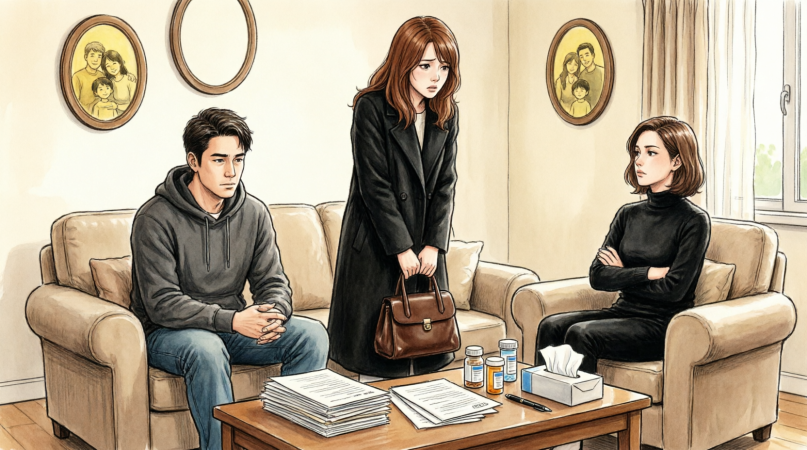
And yet that day—after the service, after the pastor’s soft words about peace and rest, after the last clods of wet soil had struck her casket—I walked into my own living room and found Ryan, his sister Lisa, and a man in a gray suit already waiting for me.
On the coffee table sat a neat stack of papers, arranged so perfectly it looked rehearsed.
No one stood.
No one said, “I’m sorry.”
No one asked if I was okay.
Ryan sat with his legs crossed like he owned the house already. Lisa sat beside him with her purse in her lap, posture straight, eyes sharp, almost pleased. The man in the suit occupied the armchair near the window—the same chair where Margaret used to sit with her tea and blanket.
For half a second, I thought maybe they were there to talk about funeral paperwork.
Something normal.
Something human.
Then the man opened his folder.
He introduced himself, but his name slid past me. All I could see was the thick legal folder resting on his knee like a verdict.
He began to read.
“The house goes to Ryan.”
I felt the floor tilt beneath me.
“The savings also go to Ryan.”
He flipped a page.
“Elena receives five thousand dollars for her service.”
For her service.
The words arrived slowly, like glass breaking piece by piece.
Five thousand dollars.
For ten years of my life.
For chemo appointments taped to the fridge, blood and vomit cleaned from sheets, nights spent upright at three in the morning with my hand on Margaret’s chest, counting every breath as if counting could keep her alive.
Five thousand dollars.
Lisa let out a small sound—half laugh, half scoff.
The lawyer continued. I had forty-eight hours to vacate the premises.
“Forty-eight hours?” I repeated, the words sounding like they belonged to someone else.
Ryan finally stood. He walked toward me but stopped at a safe distance, his expression hard and finished.
“You heard him,” he said. “This is how it is.”
I looked at his face—the same face I had defended for years when people asked why he was never around—and searched for something familiar.
There was nothing.
“You’re not family,” he added. “You were just the caregiver.”
Lisa smiled openly then, quick and sharp, unable to stop herself.
The lawyer used the word eviction carefully, as if saying it gently could make it less brutal.
I stopped listening.
Eviction.
The word echoed louder than the door closing behind me had.
I looked around the room—at the furniture Margaret and I had chosen together, at the faded photo on the wall of her standing there years ago, healthy and smiling before sickness changed everything.
And in that moment, I understood.
This was no longer my home.
It had been taken from me while I was standing at a grave.
I could have screamed. I could have reminded Ryan where he had been all those years while I was here day after day. I could have listed every missed holiday, every broken promise, every hospice nurse who had asked where the rest of the family was.
But ten years of caregiving teaches you something most people never learn.
You don’t waste energy on noise.
You save it for survival.
So I nodded.
I said nothing.
I walked upstairs and packed a small bag.
Only what I could carry without shaking.
When I came back down, they were still there, watching me as if I might change my mind.
I didn’t look at them.
I walked out of the house I had built my life around and into the cold evening air.
I didn’t scream.
I didn’t cry.
I didn’t argue.
I just walked away carrying something they didn’t know existed.
An envelope Margaret had pressed into my hand days before she died.
“Don’t open it until I’m gone,” she had whispered.
I had kept that promise through the funeral, through the drive home, through the moment they tried to erase me.
Now it was the only thing I had left.
The motel sign flickered when I pulled into the parking lot, one letter dimmer than the rest. It was cheap, close to the highway, and had a vacancy sign glowing red in the cold air.
That was enough.
The lobby smelled like old coffee and industrial cleaner. The man behind the desk barely looked up as he handed me a key.
Inside, the room was small and dim. The carpet was worn thin. The heater rattled in the corner, coughing out uneven bursts of warm air.
I sat on the edge of the bed still wearing my funeral clothes, waiting for my body to react.
Crying, maybe.
Panic.
Something.
Nothing came.
Everything I owned fit inside one bag.
A change of clothes. Toiletries. A few papers I hadn’t had the heart to throw away.
And at the bottom, still sealed, was Margaret’s envelope.
I didn’t open it that first night.
I pushed the bag under the bed, turned off the light, and lay there fully dressed while cars rushed past on the highway.
Sleep never came.
Every time I closed my eyes, I saw the living room.
Ryan’s face.
Lisa’s smile.
The word eviction.
In the morning, I counted the money.
Five thousand dollars.
The transfer had already gone through—efficient, impersonal, insulting.
I calculated motel rates, food, gas. It would last a few weeks if I was careful. Maybe less.
The days blurred together. I bought bread, peanut butter, and soup from a grocery store wedged between a dollar store and a nail salon. I sat on the motel bed and stared at the television without turning it on.
I thought about calling Ryan.
There was nothing left to say.
I thought about calling old friends.
But I didn’t know how to explain what had happened without sounding like I was asking for something.
I had spent too long being the person who handled things.
Asking felt foreign.
On the second night, I dreamed Margaret was calling for me.
I woke gasping, my body already moving before my mind remembered where I was.
The motel.
The bed.
The rattling heater.
No baby monitor.
No footsteps down the hall.
No one needed me.
That realization hurt more than I expected.
For ten years, my purpose had been defined by someone else’s survival.
Now she was gone.
And I didn’t know who I was supposed to be without her.
By the third day, the walls felt closer.
I pulled the bag from under the bed.
The envelope was still there.
The paper was thick, its edges slightly worn where Margaret’s fingers had held it. I could see her handwriting pressed faintly into the surface.
I remembered the afternoon she gave it to me.
She had been propped against the pillows, breathing shallowly, the morphine giving her one of those rare clear windows near the end. I had been changing her sheets when she reached for my wrist with surprising strength.
“Elena,” she said.
I stopped immediately.
She asked me to open her nightstand drawer. Under the medications and old receipts, taped to the bottom, was an envelope.
She watched as I peeled it loose.
Then she pressed it into my hand.
“Don’t open this,” she said, her eyes fixed on mine. “Not until I’m gone.”
I tried to protest.
She tightened her grip.
“Promise me.”
So I promised.
Now, alone in the motel room, I finally slid my finger under the seal.
Inside was not money.
Not an apology.
There was a small metal key taped to a folded piece of paper.
A white tag hung from the key.
First National Bank — safe deposit box.
I unfolded the note.
Elena, it began.
If you’re reading this, then I’m gone, and I need you to listen to me now the way you always have.
My throat tightened.
I know my children, she wrote. I have made excuses for them for too long—the same way you have. But I see clearly now.
My hands began to tremble.
I know what they will try to do.
The will they show you is not the real one.
The real will is in the box.
There is also a video.
I did this to protect you.
It’s already set in motion.
A chill moved through me.
Not fear.
Recognition.
Margaret hadn’t been guessing.
She had been preparing.
Call Mr. Harris, the note continued, followed by a phone number.
He helped me with everything.
He knows.
He has been waiting for you.
At the bottom, in smaller letters, she had added:
Please forgive me for not being braver sooner.
I love you.
I sat there for a long time with the key in my palm and the paper resting on my knees.
There was no rush of triumph.
Only a deep, quiet sadness mixed with something steadier.
Margaret had seen me.
Not as the daughter-in-law who stayed.
Not as the caregiver who made her life possible.
As a person worth protecting.
She had known I wouldn’t fight loudly. She knew I would walk away rather than make a scene.
So she had fought for me in advance.
The motel room felt less airless then, as if the walls had moved back an inch.
I folded the note carefully, wrapped the key inside it, and slipped the envelope back into my bag.
Tomorrow, I would call Mr. Harris.
Tomorrow, I would step into whatever Margaret had prepared.
But that night, one thought settled quietly inside me.
She hadn’t left me empty-handed.
She had left me a way forward.
The next morning, pale light filled the motel room.
I washed my face in the tiny bathroom and stared at the woman in the mirror. She looked older than she had a week ago. Sharper. Quieter.
I took out the envelope, checked the number, and sat on the edge of the bed for a long time before dialing.
The line rang twice.
A calm voice answered.
I said my name.
There was a pause.
“Yes,” the man said. “I was wondering when you’d call.”
He gave me an address downtown and told me to come that afternoon.
No questions.
No surprise.
Just certainty.
The office sat above a bakery on a quiet street. The smell of warm bread followed me up the stairs. Inside, the furniture was simple, the certificates on the wall yellowed at the edges.
Mr. Harris was older than I expected, with white hair and kind eyes that felt earned rather than practiced.
“Elena,” he said, standing. “I’m glad you came.”
He didn’t ask how I was.
He didn’t offer empty condolences.
He simply waited until I sat down.
I placed Margaret’s envelope on his desk.
He nodded as if he had expected it.
“Your mother-in-law came to see me eight months ago,” he said. “She was very clear. Very determined.”
I told him what had happened.
The funeral.
The living room.
Ryan.
Lisa.
The lawyer.
The will.
The forty-eight hours.
He listened without interrupting. When I finished, he let out a slow breath.
“They showed you a will,” he said carefully, “but it wasn’t the one she executed with me.”
Then he asked for the key.
“That belongs to a safe deposit box Margaret opened in her own name,” he explained. “She asked me to keep certain documents here until the right moment.”
He looked at me steadily.
“What you’re about to see won’t erase what they did to you,” he said. “But it will change who has the power.”
He unlocked a metal cabinet and brought back several folders and a USB drive.
“This,” he said, tapping the first folder, “is Margaret’s last will and testament. Properly executed, notarized, and filed.”
He slid it toward me.
“The will they showed you has no legal standing—if it exists at all. It was created without my involvement and without proper execution. What Margaret prepared here is valid. Enforceable.”
Then he added, “She anticipated resistance. That’s why she kept records. And that’s why she recorded a video.”
The word landed like quiet thunder.
He opened the official will first.
The language was formal, precise, nothing like Margaret’s voice.
But the meaning was unmistakable.
The house—the one I had just been told to leave—was mine.
Not shared.
Not conditional.
Mine.
A portion of her savings was left to me, specified down to the dollar.
Ryan and Lisa were named later, receiving much smaller amounts, and even those came with conditions.
Everything they had told me in that living room had been a lie.
Then Mr. Harris inserted the USB drive into his laptop.
The screen went dark.
And then Margaret’s face appeared.
She sat in the blue cardigan I had given her two Christmases earlier. Her hair was thinner. Her skin paler. But her eyes were clear.
“My name is Margaret,” she began. “I am of sound mind.”
A faint smile touched her lips.
“My body is failing me, but my mind is not.”
She folded her hands in her lap.
“I am making this video because I know what happens in families like mine when someone dies.”
She did not sound angry.
She sounded tired.
Resolved.
“My son Ryan and my daughter Lisa have not been present in my care,” she said. “They visit when convenient. They call when they remember. They have chosen not to be here.”
My breath caught.
Margaret had protected them for years.
She was not protecting them anymore.
“My daughter-in-law Elena has been my caregiver for ten years,” she continued. “She has bathed me, fed me, lifted me, taken me to appointments, and sat with me through pain and fear and nights when I did not think I would see morning.”
Her voice wavered.
Then steadied.
“She has done this without complaint, without expectation, and without help.”
My hands curled into fists in my lap.
“The house belongs to Elena,” Margaret said plainly.
“The money belongs to Elena.”
No flourish.
No drama.
Just fact.
“She has earned it, though nothing could ever truly repay what she has given.”
Then she leaned closer to the camera.
“If anyone tries to take this from her, if anyone presents a different will, know that it is not mine. I am saying this now so there can be no confusion.”
She straightened with effort.
“This is my final decision.”
The video ended.
The screen went black.
I realized I had been holding my breath.
Mr. Harris poured me water and gave me a moment before opening another folder.
Inside were Margaret’s journals.
Dates.
Times.
Observations.
Who visited.
Who called.
Who didn’t.
My name appeared again and again.
Elena stayed.
Elena handled it.
There were medical records, hospice notes, and statements from nurses confirming I had been the only consistent caregiver.
One line caught my eye:
Daughter-in-law provided all care. No other relatives present during night hours.
I stared at the documents, and grief hit me harder than victory.
Margaret had turned my life into evidence because she knew no one else would believe it.
“She was worried you wouldn’t fight,” Mr. Harris said quietly. “She said you were the kind of person who would walk away rather than make a scene.”
He looked at me over his glasses.
“So she made sure you wouldn’t have to.”
I wiped my face with the back of my hand.
“What happens now?” I asked.
Mr. Harris closed the folders carefully.
“Now,” he said, “you decide what to do with the truth.”
For ten years, every decision I made had belonged to someone else’s needs.
Now, for the first time in a long time, this one belonged to me.
“I need a copy of everything,” I said.
Mr. Harris nodded.
When I left his office, the folder rested on the passenger seat like something alive.
I thought about Ryan saying eviction.
Lisa smiling.
The forged will.
The deliberate choice to steal what wasn’t theirs.
This wasn’t a misunderstanding.
It wasn’t a family disagreement.
It was fraud.
So I drove to the police station.
The officer at the desk asked what kind of report I wanted to file.
I took a breath.
“Forgery,” I said. “Fraud. Elder abuse.”
The words felt heavy.
But correct.
A detective listened to everything in a small interview room. I told her about the funeral, the living room, the false will, the safe deposit box, the real will, the video.
When I slid the folder across the table, her posture changed.
After reading, she looked up.
“I want to be clear,” she said. “This is not a civil family dispute. Presenting a forged will, attempting to transfer property based on it, and using it to force someone out of a home is serious criminal behavior.”
My stomach tightened.
Not with fear.
With relief.
Naming something correctly has power.
“I don’t want revenge,” I said quietly. “I just don’t want them to get away with it.”
The detective nodded.
“That’s usually how these cases start,” she said. “With someone finally deciding not to protect the people who harmed them.”
She told me not to contact Ryan or Lisa.
“We’ll handle that.”
That night, back in the motel, the walls didn’t feel as close.
Somewhere across town, Ryan and Lisa were probably settling into the house, confident in the story they had built.
They had no idea the ground beneath them had already shifted.
Three days later, the detective called.
“We’re going to the house today,” she said. “I wanted you to know.”
She did not ask me to come.
But I did.
I parked across the street and watched.
The house looked exactly the same from outside. Sunlight on the windows. Neatly trimmed yard. Ryan’s car in the driveway. Lisa’s behind it.
Through the open front door, I could see boxes stacked in the hallway.
They had already begun claiming what was never theirs.
Two police cars pulled up with their lights off.
Ryan appeared in the doorway, confident at first.
Then confused.
Then irritated.
Lisa came up behind him, speaking quickly, hands moving.
One officer held up a hand.
Another asked them both to step outside.
Ryan hesitated.
Then he stepped onto the porch, still talking, still trying to control the room as if the porch were his courtroom.
That was when the handcuffs came out.
The moment was quieter than I imagined.
No screaming.
No struggle.
Just the soft click of metal closing around wrists that had been so certain days before.
Ryan’s mouth opened.
No words came.
Lisa went pale, looking around wildly for someone to save her from the consequences she had helped create.
There was no one.
The officers read them their rights.
Lisa began to cry—loud, shocked, disbelieving sobs that sounded nothing like remorse.
I watched from across the street, unseen.
The house behind them stood silent.
It wasn’t his house.
It never had been.
For the first time, that truth was being recognized in action.
Neighbors began to gather. Curtains shifted. A woman two houses down stepped onto her porch with a hand over her mouth.
I wondered what stories they would tell later.
Then I realized I didn’t care.
I didn’t feel triumph.
I didn’t feel satisfaction.
Only a quiet sense that something deeply wrong had finally begun to correct itself.
Eventually, I drove away without going inside.
I didn’t need to.
The sight of the handcuffs, the half-packed boxes, the open door—it was enough.
Silence had been my strength when they thought they could erase me.
Silence remained my strength now.
I didn’t say a word.
I didn’t have to.
The court process moved slowly, the way serious things do.
Weeks turned into months. Filings. Motions. Hearings set and postponed. Envelopes arrived at the motel. Phone calls were scheduled days in advance.
Through it all, the facts stayed the same.
The forged will.
The recorded video.
The journals.
The hospice statements.
The signatures that didn’t match.
Evidence doesn’t argue.
It waits.
When plea negotiations began, Mr. Harris called me.
“They’ve seen what we have,” he said. “They’re prepared to plead guilty to forgery and fraud.”
Guilty.
Not misunderstood.
Not mistaken.
Guilty.
The day they entered their pleas, I sat in the back of the courtroom.
Ryan looked smaller than I remembered. Lisa sat beside him, hands clasped so tightly her knuckles were white.
When the judge asked how they pleaded, their voices were barely audible.
“Guilty.”
Sentencing came weeks later.
The judge spoke plainly about the harm they had caused—not only financial, but moral. The manipulation of a vulnerable person. The attempt to force a caregiver from her home using false authority. The destruction of trust.
Ryan received jail time, with a portion suspended for good behavior, plus fines and restitution.
Lisa received a shorter term and probation.
The gavel fell once.
Clean.
Final.
No one clapped.
Justice, I learned, rarely announces itself with fireworks.
The real will was executed without delay. The house transferred into my name. The funds were released exactly as Margaret had instructed.
I signed the final documents with a steady hand.
Mr. Harris slid the last paper across his desk.
“It’s done,” he said.
Ryan and Lisa asked to speak to me once through their attorneys.
I agreed to a brief meeting in a neutral office with the door open.
They sat across from me, drawn and careful.
Ryan apologized first.
Pressure, he said.
Fear.
Mistakes.
Lisa added her own apology, quieter, eyes fixed on the table.
I listened.
When they finished, the room went still.
“I hear you,” I said. “But I’m not ready to forgive.”
I didn’t raise my voice.
I didn’t list every wound.
I simply told the truth.
Forgiveness isn’t an obligation.
It is a choice that requires time and safety.
The meeting ended without resolution.
And that was okay.
I moved back into the house on a quiet morning.
Alone.
The rooms felt empty of other people’s claims. I opened the windows and let light spill across the floors that had once been treated like inventory.
Boxes were still half-packed. Margaret’s belongings had been set aside to be sold.
I unpacked them slowly.
I returned photographs to shelves.
I placed her favorite mug back in the kitchen cabinet.
That night, I slept in my old room and woke to a silence that finally felt earned.
I didn’t sell the house.
People assumed I would. Real estate agents left cards in the mailbox. Distant relatives talked about fresh starts and clean slates.
I listened.
I thanked them.
And I did nothing.
The house was not a burden.
It was a record.
Every hallway held the shape of years that mattered, even when no one else had been looking.
Selling it would have felt like erasing proof.
I cleaned room by room, not to make it perfect, but to make it mine again. Each morning, I opened the windows and let fresh air move through spaces that had once been sealed tight against illness.
In the living room, I hung a photograph of Margaret in the backyard, sunlight on her face, laughing at something outside the frame.
Not Margaret in pain.
Not Margaret at the end.
Margaret alive.
The idea came quietly.
At the pharmacy. At the grocery store. In lowered conversations with people who heard what had happened and began sharing their own stories.
Years spent caring for parents, spouses, siblings.
Jobs abandoned.
Lives paused.
Gratitude rarely spoken.
When I said, “I understand,” their shoulders dropped.
Recognition, I learned, can be its own kind of rescue.
So I used part of what Margaret left me to start something small.
Not a foundation with a grand name.
A network.
A place where caregivers could come once a week, sit in a circle, and speak without explaining themselves.
We met in my living room at first, on folding chairs borrowed from the community center.
I called it At Margaret’s House.
The first meeting had four people.
By the third month, there were fifteen.
We shared resources, legal information, hospice contacts, doctors who listened, tips for insurance forms. But more than that, we shared the nights no one saw.
The guilt.
The resentment.
The exhaustion.
The loneliness.
I did not lead as an expert.
I sat with them as someone who had been there and survived.
In the backyard, I planted roses because Margaret had loved them. I dug the soil myself, letting my arms ache from work I had chosen.
On warm afternoons, I sat outside and let the sun touch my face.
No alarms.
No one waiting for me to move faster.
The house grew quiet in a new way.
Not the tense quiet of illness.
The calm that comes after a storm has finally passed.
People still ask if I will ever forgive Ryan.
I tell them the truth.
“I don’t know.”
Forgiveness is not a finish line. It unfolds, or it doesn’t, depending on what comes after.
What I do know is this:
I no longer confuse forgiveness with access.
Boundaries are not punishment.
They are protection.
Loving someone does not mean surrendering your life to their expectations.
The door that closed behind me on the day of the funeral was not the end of my story.
It was the beginning of the one I finally chose for myself.
And when I stood on the right side of it, I understood what Margaret had known all along.
Sometimes the greatest act of love is refusing to disappear.