Part 2
Two days later, karma arrived wearing a gray wool coat and no expression.
His name was Mr. Dorian Hale.
He stepped into my hospital room at precisely nine in the morning, carrying a leather briefcase in one hand and a paper cup of coffee in the other. Behind him came two women in black suits, both silent, both sharp-eyed, both looking like they knew where every body was buried.
My mother stood from the chair beside my bed.
“Dorian,” she said.
He bowed his head slightly. “Mrs. Whitmore.”
Not Mom.
Mrs. Whitmore.
That was the first time in five years I heard that name spoken in front of anyone outside my family.
I lay against the pillows, one baby asleep against my chest, the other two dozing in their bassinets. My body still ached. My milk had come in overnight, heavy and painful, and I had cried twice before breakfast from exhaustion alone.
But when Dorian Hale placed that briefcase on the table, something inside me went still.
My father entered a moment later.
He did not look like a dangerous man.
That was what made him dangerous.
Thomas Whitmore had silver hair, kind eyes, and the patient manners of a retired professor. He wore cardigans. He remembered nurses’ names. He held newborns as if the world might crack if he breathed too loudly.
But before he became “Grandpa,” before he sold most of his companies and vanished from every magazine list by choice, my father had built Whitmore Global from a single failing logistics firm into an empire that quietly owned pieces of ports, banks, medical chains, media networks, real estate funds, and law firms in thirteen countries.
He was not famous anymore.
He preferred it that way.
Adrian had met him only as “my father, Thomas,” the gentle widower-looking man who liked old jazz and chess. My parents had never shown him the family estate. Never invited him into the inner circle. Never corrected him when he assumed they were comfortably retired.
Adrian thought I came from money.
He had no idea I came from power.
My father leaned over and kissed my forehead. “How are my grandsons?”
“Hungry,” I whispered.
“Good,” he said. “That means they intend to survive.”
My mother brushed hair from my cheek. “So do you.”
Dorian opened the briefcase. Inside were folders, clipped documents, flash drives, notarized copies, and a tablet already glowing with prepared files.
He looked at me, not with pity, but with respect.
“Mrs. Vale,” he said. “Or would you prefer Ms. Whitmore?”
The name landed like a hand offered over dark water.
I looked down at my son sleeping against me. His tiny mouth twitched. His fist rested on my hospital gown like he was holding me in place.
“Whitmore,” I said.
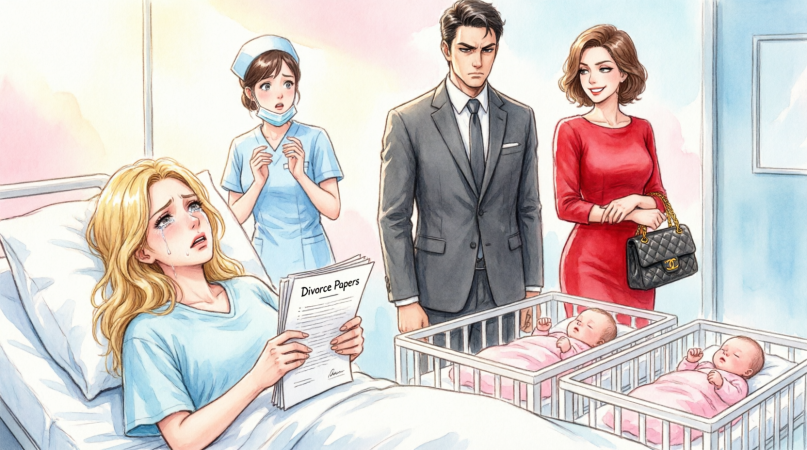
Dorian nodded once. “Then we begin.”
My mother moved one bassinet closer, my father took the baby from my arms, and I watched as the room transformed from a place of humiliation into a war chamber.
Dorian tapped the tablet.
“Adrian Vale filed for divorce yesterday afternoon. He is requesting primary control of marital assets, limited custody for you due to alleged instability, and exclusive occupancy of the marital residence.”
I gave a hollow laugh. “Instability?”
“He claims postpartum emotional distress.”
My mother’s mouth became a thin line.
“He brought his mistress to my hospital room after I delivered triplets.”
Dorian looked at one of the women beside him. “Add that to the record.”
She typed without blinking.
“He also had the house transferred to Celeste Monroe,” I said. “I found out when I called the property manager.”
Dorian’s eyes sharpened. “Transferred how?”
“Adrian said it was not our house anymore.”
My father, who had been rocking my son gently, stopped moving for one second.
Only one.
But the room felt colder afterward.
Dorian opened another folder. “That property was originally purchased through a marital trust. However, the initial down payment came from your personal inheritance account. Adrian had no unilateral authority to transfer title.”
“He forged something?” I asked.
“We will know within the hour.”
My father resumed rocking the baby.
“Not within the hour,” he said softly. “Now.”
Dorian slid one folder toward me. “Your father asked us to review all major transactions involving Adrian Vale over the past three years. We began last night.”
I stared at him. “Last night?”
My mother gave me a small, tired smile. “Your father does not sleep when his children are threatened.”
Dorian continued. “Adrian has been moving money for eighteen months. Shell vendors. Inflated consulting fees. False invoices. Several routed through companies connected to Celeste Monroe.”
The room blurred at the edges.
I thought betrayal was one wound.
I had not understood it could have layers.
“He was stealing from me?” I whispered.
“From you,” Dorian said. “From the marital estate. And from a Whitmore subsidiary he believed was an unrelated investor in his firm.”
Adrian’s company.
ValeArc Development.
The pride of his life. The thing he had built, bragged about, used to justify late nights, locked phones, sudden trips, and the smell of another woman’s perfume on his shirts.
My father cleared his throat.
“Three years ago,” he said, “Adrian’s firm needed capital. You asked me not to interfere in your marriage, so I did not approach him directly. But one of our private investment arms purchased a minority stake through a third party.”
My breath caught. “You invested in him?”
“I invested in you,” he said. “At the time, I believed supporting his business would support your household.”
I closed my eyes.
How many times had Adrian mocked my family?
Your parents live like librarians.
Your father probably keeps cash under the mattress.
You’re lucky I’m ambitious enough for both of us.
Dorian turned the tablet toward me. A web of names and transactions filled the screen.
“Adrian did not know Whitmore Capital was behind that investment. He has been defrauding his own shareholder.”
My father smiled faintly.
It was not a warm smile.
“He should have read the fine print.”
A knock came at the door.
A nurse entered with a vase of white roses. “Delivery for Mrs. Vale.”
My mother intercepted it before it reached the bed. There was no card on the outside. She pulled the small envelope free and opened it.
Her expression did not change, but she handed the card to my father.
He read it aloud.
“Sign before this gets ugly. Think of the boys.”
My pulse began to pound.
Adrian.
Even now.
Even after everything.
My father held the card between two fingers as if it were contaminated.
Dorian took a photo of it. “Useful.”
I laughed then. A strange, shaky sound.
“Useful?”
“Yes,” he said. “Threats often are.”
One of the babies woke and began to cry. Then another. Then the third, as if they had formed a union and issued demands.
For the next twenty minutes, there was no empire, no strategy, no revenge. There was only feeding, burping, diapers, pain, milk, and three tiny mouths searching desperately for comfort.
My father held the smallest, Noah, against his shoulder and whispered nonsense in French.
My mother swaddled Leo with the firm confidence of a woman who had raised four children and buried every enemy who underestimated her.
I held Oliver, the firstborn, and watched his eyelashes flutter against his cheeks.
I had thought losing Adrian would destroy my family.
But looking at my sons, I realized Adrian had never been the center of it.
He had only stood in the doorway and called himself the house.
By noon, I was discharged.
Not because I was ready.
Because staying in that room made me feel like prey.
My parents arranged everything. A private nurse. A security team that looked like hotel staff. Two black SUVs waiting beneath the covered hospital entrance.
I left through a side exit wrapped in a long camel coat my mother had brought from home, my triplets secured in three identical carriers.
For one second, as the doors opened, I expected Adrian to appear.
He did not.
Cowards prefer rooms where women are alone.
The ride home was silent except for the soft newborn noises from the back seat.
When we turned onto our street, my stomach twisted.
The house stood at the end of the drive, pale stone and glass, the one I had chosen paint colors for, hosted Christmas in, decorated the nursery in, believed I would grow old in.
But there was a red convertible in the driveway.
Celeste’s.
My father looked at it through the windshield.
“Bold,” he murmured.
The security car behind us stopped. Two men stepped out.
Dorian, who had followed in the second SUV, came to my window.
“Ms. Whitmore,” he said, “you do not have to go inside.”
“Yes,” I said. “I do.”
My mother studied my face.
Then she nodded. “Then we go together.”
The front door opened before we reached it.
Celeste stood there barefoot, wearing my silk robe.
My robe.
Champagne-colored. Monogrammed. A gift from my mother after my wedding.
For a moment, everything inside me went white.
Celeste smiled slowly. “Oh. You’re back.”
Behind her, I saw boxes stacked in the hall.
My books.
My framed photos.
My grandmother’s porcelain lamp wrapped in newspaper.
Adrian appeared from the living room, phone in hand. His smile vanished when he saw my parents, Dorian, and the two suited women behind me.
“Evelyn,” he said tightly. “This is not a good time.”
I looked past him.
The nursery door was open.
Celeste had placed shopping bags inside it.
Designer shopping bags.
On the changing table where I had folded tiny blue onesies two weeks ago, there was a cosmetics case and a glass of wine.
Something inside me snapped into perfect alignment.
“No,” I said. “It is the perfect time.”
Adrian’s eyes flicked to my father. “Thomas, I’m sorry you had to get involved. Evelyn is emotional. We’re trying to handle this like adults.”
My father looked at him.
No anger. No raised voice.
Just that calm, ancient patience.
“Mr. Vale,” he said, “you are standing in a house you may have fraudulently attempted to transfer, beside a woman wearing my daughter’s property, after sending written threats to her hospital bed.”
Adrian blinked.
Celeste’s smile faded slightly.
“Who the hell are you?” she asked.
My mother stepped forward.
“The wrong family,” she said.
Dorian handed Adrian a packet.
“You are being served with notice of emergency injunctive relief regarding the residence, marital assets, and custody matters. You are also ordered to preserve all financial records, electronic devices, communications, and business documents.”
Adrian stared at the papers, then gave a sharp laugh.
“Ordered? By who?”
“By the court,” Dorian said. “Filed this morning.”
“That’s impossible.”
“It was expedited.”
Adrian’s face reddened. “Do you know who my attorney is?”
Dorian looked almost bored. “Yes. He called us twenty minutes ago to withdraw from representing you in matters involving Whitmore Capital.”
Silence.
Adrian looked at my father.
Something shifted in his eyes then.
Not understanding.
Fear.
“Whitmore,” he repeated slowly.
My father smiled politely. “Yes.”
Celeste glanced between them. “What is happening?”
No one answered her.
Dorian continued. “Furthermore, ValeArc Development is under internal audit by its minority shareholder. Several transactions involving Monroe Lifestyle Holdings and related vendors have been flagged for review.”
Celeste went pale beneath her makeup.
Adrian’s hand tightened around the packet. “You have no right.”
“I have every right,” my father said. “You spent eighteen months stealing from a company whose investor you never bothered to identify.”
Adrian opened his mouth.
Closed it.
Then turned on me.
“You did this?”
I shifted Noah’s carrier slightly, because he had begun fussing.
“No,” I said. “You did.”
He stepped toward me.
One of the security men moved first.
Not dramatically. Not violently. He simply appeared between us.
Adrian stopped.
His face twisted. “You think you can take my sons from me?”
My mother’s voice cut through the air. “You brought your mistress to their mother’s hospital room hours after they were born.”
“They’re my blood,” he snapped.
“And she is ours,” my father said.
That quiet sentence did what shouting could not.
It ended the performance.
Celeste suddenly seemed aware she was wearing my robe. She pulled it tighter around herself, then remembered that made it worse.
“I didn’t know she was coming home today,” she said.
I looked at her for the first time without rage.
Really looked.
She was beautiful in the way expensive things are beautiful: polished, maintained, hollow in certain lights. Her confidence had depended on my collapse. Now that I was standing, she looked smaller.
“You put shopping bags in my sons’ nursery,” I said.
She swallowed. “Adrian said you were moving out.”
“Adrian says many things.”
Dorian gestured to the two women. “We will document the condition of the property.”
They moved through the house with phones and clipboards, photographing everything. The boxes. The wineglass. The nursery. The robe. Celeste’s Birkin sitting on my kitchen island like a crown.
Adrian noticed and lunged toward the bag.
One security man cleared his throat.
Adrian froze again.
Dorian looked at the Birkin. “Is that yours, Ms. Monroe?”
Celeste lifted her chin. “Yes.”
“Purchased when?”
“None of your business.”
Dorian gave her a thin smile. “It may become our business if it was purchased with misappropriated funds.”
Her eyes shot to Adrian.
There it was.
The first crack.
Adrian saw it too. “Don’t look at me like that.”
“You said everything was clean,” she whispered.
“It is.”
My father laughed softly.
It was the most frightening sound in the room.
Dorian’s phone buzzed. He checked it, then looked at my father.
“We have confirmation from the county recorder. The deed transfer used a notarized spousal consent.”
“I never signed one,” I said.
“I know,” Dorian replied. “The signature is not yours.”
My mother inhaled once.
My father’s face became very still.
Adrian’s voice went hoarse. “Evelyn signs things without reading. She probably forgot.”
“No,” I said.
He pointed at me. “You were always careless.”
“Not with my name.”
Dorian slid another page from his folder. “The notary listed on the document has been dead for seven months.”
Celeste took one step away from Adrian.
The room seemed to tilt.
Adrian stared at Dorian like he had just watched a locked door open from the wrong side.
“That’s a clerical issue,” he said.
“No,” Dorian answered. “That is fraud.”
The smallest baby began to cry then, sharp and sudden.
I bent to lift him from the carrier, and pain shot through my body so fiercely I almost gasped. My mother reached for him first, but I shook my head.
“I have him.”
Noah quieted against me, his warm cheek pressed beneath my collarbone.
I looked at Adrian over my son’s head.
“You told me no one would want me now,” I said.
His eyes flickered.
For a moment, I saw the man I had married. Not because he returned, but because I finally understood he had always been a costume. Charm over hunger. Devotion over vanity. Love over appetite.
“I was wrong,” he said quickly.
The words came too fast.
Everyone heard the calculation in them.
He stepped closer, palms open. “Evelyn, listen. Things got out of hand. I was scared. Triplets, the pressure, the business—”
Celeste made a sound. “Adrian.”
He ignored her.
“We can fix this,” he said. “You’re tired. I’m tired. We shouldn’t make decisions in anger.”
I almost smiled.
There it was.
The second mask.
When cruelty failed, tenderness.
When tenderness failed, fear.
When fear failed, lies.
“You brought her here,” I said. “Into our home.”
“She means nothing.”
Celeste’s face hardened.
“Oh?” she said.
Adrian shot her a warning look.
But she was already unraveling.
“You said she was unstable,” Celeste snapped. “You said the marriage was over. You said the house was yours. You said—”
“Stop talking,” Adrian hissed.
My father turned slightly toward her. “No, Ms. Monroe. Please continue.”
Celeste looked at him, and some instinct told her she was standing at the edge of a cliff.
She shut her mouth.
Dorian handed her a card. “You should retain independent counsel.”
Her hand trembled as she took it.
Adrian threw the packet onto the console table. “This is harassment. I’m calling the police.”
“Please do,” Dorian said.
Adrian did not move.
For the first time that day, I smiled.
Not because I was happy.
Because I understood.
He had expected tears, pleas, chaos. He had expected me to beg for the house, for money, for his attention. He had prepared for a broken woman.
He had not prepared for witnesses.
He had not prepared for records.
He had not prepared for my father.
My mother stepped beside me. “Evelyn and the children will be staying elsewhere until the court rules on occupancy.”
Adrian seized on that. “So she’s abandoning the house.”
“No,” Dorian said. “She is leaving a hostile environment created by you. Temporarily.”
My father looked around the foyer. “I never liked this house.”
I turned to him, startled.
He shrugged lightly. “Too much glass.”
Despite everything, a laugh escaped me.
It cracked through the room like light.
Adrian hated it.
His face darkened. “You think this is funny?”
“No,” I said. “I think you are finished.”
We left with the things that mattered.
The babies.
My documents.
My grandmother’s lamp.
The robe, which my mother removed from Celeste’s body with one raised eyebrow and a sentence so soft I could not hear it, though Celeste went crimson and disappeared upstairs to change.
As we stepped outside, Adrian followed us onto the porch.
“Evelyn,” he called.
I turned.
He stood there in the doorway of the house he had tried to steal, with his mistress behind him and court papers at his feet.
For the first time since I had known him, he looked ordinary.
Not handsome.
Not powerful.
Just ordinary.
“You’ll regret this,” he said.
My father answered before I could.
“No,” he said. “That is your role now.”
That evening, my parents took me to a place I had not visited in years.
Whitmore House stood behind iron gates at the end of a long private road lined with winter trees. It was not a mansion in the vulgar sense. It was older than that. Stone, ivy, tall windows, warm light, and silence so complete it felt guarded.
Adrian had never been invited there.
He had once joked that my parents probably lived in a “cute little retirement condo.”
I had let him believe it.
I had wanted a marriage separate from the weight of my name. I had wanted to be loved as Evelyn, not as the daughter of Thomas and Helena Whitmore.
I had been loved as neither.
The staff had prepared the east wing. Three bassinets stood in a sunlit room beside mine. A postpartum nurse named Mara greeted me with gentle hands and no questions. Dinner waited under silver covers. My mother’s old rocking chair had been placed by the window.
When the babies were asleep, I sat in bed with a bowl of soup untouched on my lap.
My father knocked once and entered.
He carried a small velvet box.
“I was going to wait,” he said.
“For what?”
“For you to ask who you are now.”
He sat beside the bed and opened the box.
Inside was a ring.
Not a wedding ring.
A signet.
Gold, heavy, marked with the Whitmore crest. A hawk holding a key.
“It belonged to your grandmother,” he said. “She wore it when men walked into boardrooms and assumed she was someone’s secretary.”
I touched the crest.
“She won?”
My father’s smile warmed. “Usually before they realized they were playing.”
He took my hand and slid the ring onto my finger.
It fit.
Something about that nearly undid me.
“I’m scared,” I admitted.
“I know.”
“I don’t know how to raise three sons alone.”
“You are not alone.”
“I don’t know how to fight him.”
My father looked toward the nursery door, where three tiny breaths rose and fell in the next room.
“You do not need to become cruel to defeat a cruel man,” he said. “You need patience, memory, and better records.”
I laughed weakly.
Then I cried.
Not the panicked crying from the hospital. Not the desperate sobs from the phone call. This was older. Deeper. Grief for five years of swallowing little insults, excusing absences, shrinking my questions, mistaking endurance for devotion.
My father held my hand until it passed.
At midnight, Dorian called.
My mother put him on speaker in the sitting room while I sat wrapped in a blanket, one baby tucked against me.
“We have movement,” Dorian said.
Adrian had attempted to access three business accounts. Frozen.
He had called two board members. Neither answered.
He had sent seventeen messages to his former lawyer. No response.
Celeste had left the house at 10:42 p.m. carrying two suitcases and the Birkin.
My mother arched a brow. “The bag survived.”
“For now,” Dorian said. “But Ms. Monroe also placed a call to a criminal defense attorney.”
My father stirred his tea.
“Good,” he said.
I stared at the fire. “What about Adrian?”
“He is still at the house,” Dorian replied. “Drinking, according to the investigator outside.”
An ugly satisfaction curled in me, and I was too tired to pretend otherwise.
Then Dorian’s voice changed.
“There is something else.”
My father looked up.
“Tell us.”
“We found recurring payments from one of Adrian’s shell entities to a private clinic.”
My heart gave a hard kick.
“A clinic?” I asked.
“Yes. The payments began four years ago.”
My mother looked at me sharply.
Four years ago, Adrian and I had started trying for a baby.
Four years ago, the doctors had found nothing wrong but told us stress could be a factor.
Four years ago, Adrian began saying maybe motherhood was not meant for everyone.
“What kind of clinic?” my father asked.
“Fertility and genetic services,” Dorian said.
The room went silent.
My hand tightened around the blanket.
The baby stirred.
Dorian continued carefully. “We do not know what the payments were for yet. The clinic is refusing informal requests, as expected. We can subpoena records through the divorce and custody proceedings if relevant.”
A coldness spread through me.
“What did he do?” I whispered.
No one answered.
Because none of us knew.
And because all of us understood, suddenly, that the betrayal might not have begun with Celeste.
It might have begun before my sons were even conceived.
My mother sat beside me. “Evelyn.”
I shook my head.
“No. I want to know.”
My father’s gaze moved to the nursery.
For the first time since the hospital, I saw real anger in his face.
Not loud.
Not hot.
Something carved from ice.
“We will,” he said.
By morning, the first headline appeared.
Not in a major paper.
Not yet.
Just a business column.
VALEARC DEVELOPMENT FACES SHAREHOLDER AUDIT AMID EXECUTIVE MISCONDUCT QUESTIONS.
No names beyond Adrian’s.
No mention of me.
My father’s influence worked like weather. You did not see the hand that moved the clouds. You only noticed when the sun vanished.
By noon, ValeArc’s largest lender suspended its credit facility pending review.
By three, two clients requested clarification.
By five, Adrian called me thirty-one times.
I did not answer.
He sent messages instead.
Evelyn, this is insane.
Call me.
Your father is manipulating you.
Think about the boys.
I made mistakes, but you are destroying our family.
Then, at 6:17 p.m.:
You don’t know everything.
I stared at that message for a long time.
My mother found me in the nursery, sitting between the three bassinets.
“Do not answer him,” she said.
“I wasn’t going to.”
But my voice sounded far away.
She took the phone gently and read the message.
Her face changed.
Not much.
Enough.
“What does that mean?” I asked.
She did not lie.
“I don’t know.”
At 7:03 p.m., a second message arrived.
Ask your father why he really invested in ValeArc.
I stopped breathing.
My mother read it.
Then turned toward the doorway.
My father stood there.
He had seen her face.
“What is it?” he asked.
She handed him the phone.
He read the message once.
Only once.
Then he closed his eyes.
That frightened me more than Adrian’s threats.
“Dad,” I said.
He opened his eyes.
There was something in them I had never seen before.
Regret.
“I need to tell you something,” he said.
The nursery seemed to grow quiet around us.
Even the babies slept without stirring.
My mother whispered, “Thomas, not here.”
But my father shook his head.
“She deserves the truth.”
My mouth went dry.
“What truth?”
Before he could answer, Dorian appeared at the end of the hall, phone pressed to his ear, his composed face finally cracked.
“Thomas,” he said. “The clinic records were just leaked.”
My father went very still.
Dorian looked at me.
And in that look, I understood that whatever Adrian had done, whatever my father had hidden, whatever truth was buried under my marriage, my babies, and that clinic, it was no longer waiting politely behind locked doors.
It was already coming for us.
Then my phone rang again.
Unknown number.
I answered before anyone could stop me.
A woman’s voice whispered, trembling and breathless.
“Evelyn Whitmore? My name is Dr. Mara Voss. I worked at the clinic. Your husband lied to you. But your father lied first.”
The line went dead.
…If you want to know what happened next, please type “YES” and like for more