PART 3 — The Man at the Door Was Not My Father Anymore
The doorbell rang a third time.
Not impatiently.
Not angrily.
Just once, clean and deliberate, like my father still believed the world opened when he pressed hard enough.
Evelyn Parker stood in my kitchen with the flash drive in her hand, her face pale under the pendant lights.
“Dominic,” she whispered, “do not open that door.”
But my father’s voice came through the wood again.
“Son. We need to talk.”
I almost laughed.
Twelve years of silence, one dead man, one hidden video, and now Richard Reed wanted to talk.
The rain pressed against the windows. The house around me felt hollow without Callie in it. Her absence was everywhere: in the missing mug by the sink, in the empty hook near the door, in the nursery upstairs where a letter had destroyed whatever remained of my excuses.
My father knocked this time.
Three slow taps.
Evelyn moved closer. “Does he know I’m here?”
I stared at the security monitor near the hallway. My father stood beneath the porch light in a dark wool coat, silver hair damp from the rain, one gloved hand resting on the brass railing.
He looked composed.
He always looked composed.
That was the thing about monsters in expensive coats. They didn’t snarl. They adjusted their cuffs and asked to be let in.
“I don’t know,” I said.
My phone buzzed again.
Unknown sender.
Do not give him the drive.
Evelyn saw the message over my shoulder.
“Who is that?”
“I don’t know.”
Her eyes narrowed. “That’s becoming a theme.”
My father knocked again.
“Dominic. Open the door before this becomes embarrassing.”
Embarrassing.
Not dangerous.
Not tragic.
Embarrassing.
I walked toward the foyer.
Evelyn hissed my name, but I ignored her. My hand closed around the lock. For one second, I saw myself at twenty-nine again, standing on that wet lake house deck, watching Peter Lang crumple after my father struck him.
I remembered my father turning to me.
Now you learn what control costs.
I opened the door.
Richard Reed stepped inside like he was entering a boardroom. His eyes flicked once over my wet shirt, my cut palm, my bare feet, and landed on my face.
“You look terrible.”
“Good evening to you too.”
He removed his gloves slowly. “Where is it?”
No greeting. No denial. No hesitation.
I closed the door behind him.
“Where is what?”
His gaze hardened.
“Don’t insult me. I know someone sent you a file.”
My stomach tightened. “How?”
He smiled faintly.
That old smile.
The one that taught me arrogance before I had money of my own.
“Because people talk when they’re frightened.”
Evelyn stepped into the hallway behind me.
My father’s expression shifted by a fraction.
Not surprise.
Annoyance.
“Evelyn.”
“Richard.”
“You’re far from home.”
“So are your morals.”
He chuckled softly. “Still theatrical.”
Evelyn lifted the plastic evidence pouch.
My father looked at it.
For the first time that night, the confidence in his face cracked.
Only slightly.
But I saw it.
“You watched it,” he said.
I stepped closer. “You hit him.”
His eyes returned to mine. Calm. Patient. Almost bored.
“Yes.”
The word entered the room and changed its temperature.
No denial.
No story.
No mistake.
Just yes.
Evelyn’s face went still.
“You killed Peter Lang,” she said.
My father sighed. “Peter Lang killed himself by thinking principles were stronger than pressure.”
“You killed him,” I repeated.
“No,” he said sharply. “I solved a problem. Arthur panicked afterward. You froze. I made sure the police saw what they needed to see.”
My mouth went dry.
The man standing in my foyer was not a memory anymore.
He was a confession.
“You let me believe it was an accident.”
“I let you grow up.”
Something in me snapped.
“I was twenty-nine.”
“You were soft.”
“I watched a man die.”
“You watched a business survive.”
Evelyn moved toward the front table where her phone lay beside her purse.
My father noticed.
“Don’t,” he said quietly.
She stopped.
That was when I saw the gun.
Not raised. Not aimed. Just tucked inside his coat, his hand resting near it like an old habit.
My breath caught.
“Dad.”
He looked almost disappointed.
“Don’t make that sound. I’m not here to hurt you.”
“Then why bring a gun?”
“Because I don’t know who else has seen that drive.”
Evelyn’s voice was cold. “The police will.”
“No, they won’t.”
He turned to me.
“Give it to me, Dominic. Tonight. Right now. Then you go back to doing what you do best.”
“What is that?”
“Surviving.”
I stared at him, and suddenly I understood something terrible.
Every lie I had ever told Callie had been rehearsed first in my father’s house.
Every polished half-truth. Every controlled expression. Every cruel calculation disguised as practicality. He had not simply raised me. He had trained me.
And I had mistaken corruption for inheritance.
My phone buzzed again.
Unknown sender.
Ask him about the second car.
I read the message twice.
“The second car,” I said.
My father’s eyelid twitched.
Evelyn looked between us. “What second car?”
I stepped forward. “Peter’s car went over an embankment. But he didn’t drive it there, did he?”
My father’s silence was answer enough.
“Arthur?” I asked.
He laughed once. “Arthur could barely stand.”
“Then who?”
My father glanced at the flash drive again.
“Give me that file.”
“Who drove Peter’s car?”
His face changed.
Coldness slid into it.
“Your mother.”
The room disappeared.
For a second, there was no rain, no foyer, no scandal, no Evelyn.
Only my mother.
Margaret Reed.
Elegant. Soft-spoken. Dead for six years.
The woman who had kept fresh flowers in every room and cried during old movies. The woman who sent Callie a handwritten note after our engagement saying, He is better when loved well.
“My mother?” I whispered.
“She understood what family required.”
“No.”
“Yes.”
“She would never—”
“She did what you could not.”
The words struck like a physical blow.
Evelyn looked genuinely shaken.
My father stepped closer.
“Your mother drove Peter’s car away from the lake house. I followed. We staged the wreck. By sunrise, it was over.”
I could not breathe.
All these years, I had built my life on my father’s brutality and my mother’s tenderness.
Now the ground beneath both was gone.
“Why tell me?” I asked.
“Because the person who sent that message knows pieces. Not all. They’re trying to make you emotional.” His eyes narrowed. “And emotional men make stupid choices.”
A sound came from outside.
A car door.
Then another.
My father looked toward the window.
Blue and red light flashed faintly against the wet glass.
Police.
Evelyn exhaled.
My father’s hand moved under his coat.
I stepped between him and the door.
“Don’t.”
He smiled sadly.
“You think this is redemption?”
“No.”
“Then what is it?”
I looked at him, at the man who had taught me to dominate rooms, ruin rivals, ignore pain, and call it strength.
Then I thought of Callie reading medical files alone.
I thought of our unborn son, his small heart already under threat before he had even taken a breath.
And I said the first honest sentence I had spoken all day.
“I don’t know what kind of man I am without your voice in my head.”
My father’s smile vanished.
The door burst open.
Two officers entered with weapons drawn. Behind them came Martin Greer, soaked and frantic, shouting that everyone needed to remain calm.
My father lifted both hands.
He did not resist.
He did not panic.
He simply looked at me as officers removed the gun from his coat and turned him toward the wall.
“You’ll regret this,” he said.
I shook my head.
“No. I think I already regret enough.”
As they led him out, he paused at the door.
“Callie did this to you,” he said.
That old instinct rose in me.
Blame her.
Fear her.
Destroy her first.
But it died before it reached my mouth.
“No,” I said quietly. “She showed me what was already here.”
His eyes hardened.
Then he was gone.
Evelyn stood beside me in the wreckage of my foyer.
For a long time, neither of us moved.
Then she whispered, “Dominic.”
I turned.
Her face was pale.
“The police didn’t come because I called them.”
My stomach dropped.
“What?”
She held up her phone.
“No signal. Someone jammed it. I never made the call.”
Outside, officers were putting my father into a black SUV.
Not a squad car.
A black SUV.
The flashing lights vanished.
Martin Greer stood in the doorway, rain running down his face, eyes wide with terror.
“That wasn’t Chicago PD,” he said.
The street was suddenly empty.
My father was gone.
The flash drive was still in Evelyn’s hand.
And my phone buzzed one more time.
Unknown sender.
Now your father knows you watched it. Run.
PART 4 — Callie Was Missing, and I Finally Learned Fear
The first thing Evelyn did was slap me.
Hard.
The sound cracked through the foyer like a gunshot.
I staggered back, stunned more by the precision than the pain.
“What the hell was that for?”
“For opening the door.”
She grabbed her purse and coat with shaking hands. “And for being exactly stupid enough to have survived this long by accident.”
Martin Greer locked the door behind him, panting.
“I followed Richard here,” he said. “Then those men arrived.”
“What men?” I demanded.
“The men pretending to be police.”
Evelyn’s voice was sharp. “Did you recognize them?”
“No. But one of them wore an earpiece, and another called Richard ‘sir.’”
My throat tightened.
Not arrested.
Extracted.
My father had not been taken into custody.
He had been removed from danger.
“Private security,” Evelyn said. “Or former law enforcement.”
Martin looked at me. “Dominic, what is on that drive?”
I laughed once, humorless.
“My childhood.”
Evelyn ignored that. She opened her phone, then cursed. “Signal’s back.”
Immediately, all three of our phones exploded.
Messages. Calls. Alerts.
And then one number flashed across mine.
Callie’s attorney.
Marissa Vale.
I answered so fast I nearly dropped the phone.
“Where is Callie?”
Marissa’s voice came through rigid and controlled.
“Mr. Reed, you are not to contact my client directly.”
“Is she safe?”
A pause.
Too long.
“Why are you asking?”
My body went cold.
“Because my father just came to my house for a video connected to Peter Lang. Then men pretending to be police took him away. If Callie has anything—”
Marissa inhaled sharply.
“What video?”
Evelyn grabbed my wrist. “Speaker.”
I put the call on speaker.
Marissa’s voice changed. “Dominic, listen carefully. Callie did not send you any video.”
“I know.”
“She received a package three days ago. No return address. It contained documents, photos, and a note telling her which attorney to contact. She gave me copies. We filed what we needed to file. But I told her not to touch anything connected to Lang.”
My heartbeat hammered.
“Where is she?”
“I can’t tell you.”
“Marissa, my father may be looking for her.”
“She’s at a private medical residence.”
“Where?”
“I cannot disclose—”
“Her baby may need heart surgery,” I shouted. “My father has men taking people in fake police cars, and whoever gave her those files is still moving pieces around us. This is not about divorce anymore.”
Silence.
Then Marissa said softly, “You knew about the baby’s heart?”
The shame hit like nausea.
“Yes.”
“And you didn’t tell her?”
I closed my eyes.
“No.”
Evelyn looked away.
Martin whispered, “Jesus.”
Marissa’s voice hardened again. “Then understand this clearly, Mr. Reed. You are not the reason I’m considering telling you where she is. The child is.”
“I understand.”
“No, you don’t. But you might before morning.”
She gave us an address.
Not a hospital.
A restored stone estate outside Evanston used for high-risk maternal care and private recovery.
Callie had been there for two days.
Or she was supposed to be.
Because when we arrived forty minutes later, the night receptionist was crying.
The lobby smelled of antiseptic, lavender, and panic.
A nurse stood near the desk with one hand pressed over her mouth. Two security guards argued beside a side entrance.
Marissa Vale was already there in a camel coat, her dark hair pulled back, eyes blazing.
She looked at me like she wanted to carve my name into a legal complaint with a steak knife.
“She’s gone,” she said.
I felt the words pass through me without meaning.
“What?”
“Callie is gone.”
“No.”
“She left her room at 10:46 p.m. with a woman from the facility staff. The staff member was not scheduled tonight. The cameras went dark for eight minutes.”
My hearing dimmed.
Eight minutes.
That was all it took.
A life could collapse in an envelope, and a person could vanish in eight minutes.
“Was she taken?” I asked.
Marissa’s jaw tightened.
“We don’t know.”
I moved toward the hallway.
A guard stepped in front of me.
“Sir—”
I shoved him so hard he hit the wall.
“Get out of my way.”
Evelyn caught my arm. “Dominic!”
But I was already moving.
Callie’s room was at the end of a quiet corridor. Pale blue walls. Soft lamps. A folded blanket at the foot of the bed.
Her suitcase was still open.
A maternity sweater lay over a chair.
On the nightstand sat a glass of water, prenatal vitamins, and a paperback novel with a bookmark halfway through.
She had not packed.
She had not planned to leave.
Then I saw it.
On the pillow.
A small white card.
I picked it up.
Six words.
Your son deserves a cleaner name.
My knees nearly buckled.
Behind me, Marissa whispered, “Who wrote that?”
I couldn’t answer.
Because I knew the shape of the cruelty.
Not my father’s.
His threats were direct.
This was theatrical.
Personal.
Designed to wound.
Vanessa.
The thought arrived like a knife.
I turned toward Evelyn.
“Where is Vanessa?”
Evelyn blinked. “Your mistress?”
“She knows enough to panic. She knows about the shell company, the apartment, the accounts. She knew my wife was pregnant. She was already thinking about saving herself.”
Marissa stared at me with open disgust. “You think your mistress kidnapped your pregnant wife?”
“I think people do impossible things when they believe they’re about to lose everything.”
My phone rang.
Unknown caller.
The room went silent.
I answered.
For three seconds, there was only breathing.
Then Callie’s voice came through.
“Dominic?”
The sound of her broke something in me.
“Callie. Where are you?”
“I don’t know.”
Her voice was thin. Frightened. Trying not to be.
I gripped the phone with both hands.
“Are you hurt?”
“No. I don’t think so. They gave me something. I’m in a car.”
Marissa moved closer, mouthing, Keep her talking.
“Who’s with you?”
“A woman. She said she was a nurse. But she’s not. Dominic, she has my phone. She let me call because she said you needed to hear this.”
“Hear what?”
Callie began to cry then.
Not loudly.
Not dramatically.
Just one broken breath.
“She said your father wants the original drive.”
I looked at Evelyn.
Her hand tightened around the evidence pouch.
“I don’t have the original,” I said.
Callie repeated it to someone nearby.
Then another voice came on the line.
Female.
Smooth.
Almost amused.
“Dominic Reed.”
My blood iced.
“Vanessa.”
Marissa’s eyes widened.
Vanessa laughed softly. “You always were good at recognizing trouble.”
“If you hurt her—”
“Oh, please. Spare me the husband act. It’s embarrassing this late in the play.”
“Where are you?”
“Negotiating.”
“For what?”
“My future.”
Behind her, I heard Callie whisper, “Please.”
Vanessa’s voice sharpened. “Quiet.”
Rage rose so quickly I nearly choked on it.
“You listen to me,” I said. “Whatever you think you can trade, my father will bury you the moment he has it.”
“You think I’m trading with your father?”
The room froze.
Vanessa lowered her voice.
“I’m trading with the person who gave Callie everything.”
Evelyn mouthed, Who?
Vanessa continued.
“You thought your wife became a mastermind overnight? Sweet, stupid Dominic. Callie was just the doorway.”
“Who are you working with?”
A pause.
Then Vanessa said, “Ask your mother.”
The line went dead.
For several seconds, no one spoke.
Then Martin, pale as paper, said, “Your mother is dead.”
I stared at the phone.
Yes.
My mother had died six years ago.
Cancer.
Private funeral.
Closed casket because my father said she looked unlike herself.
A terrible thought moved through me.
Slowly at first.
Then all at once.
I remembered my mother’s funeral.
The speed of it.
My father controlling the arrangements.
No hospital goodbyes because he said she was too weak.
No final conversation because he said sedation made her unaware.
No open casket.
No autopsy.
No questions.
I sat down hard on the edge of Callie’s empty bed.
Evelyn whispered, “Dominic, what are you thinking?”
I looked up.
For the first time that night, I felt something sharper than fear.
Hope.
Impossible.
Insane.
Devastating hope.
“I’m thinking,” I said, “that my mother may not be dead.”
PART 5 — The Dead Woman Who Called Herself Margaret
We found Vanessa’s car two hours later.
Abandoned.
Not hidden.
Displayed.
A black Mercedes parked beneath the orange glow of an underpass on Lower Wacker Drive, doors unlocked, headlights still on, windshield glittering with rain.
Callie was not inside.
Neither was Vanessa.
But there was blood on the backseat.
Not a lot.
Enough.
Marissa turned away, one hand pressed over her mouth. Evelyn stood frozen under the dripping concrete, her face drawn tight.
I could not move.
I stared at the blood and thought of Callie’s hand on her stomach. Of the child inside her whose heartbeat I had ignored because meetings mattered more.
Martin spoke to someone on the phone, giving clipped instructions to private investigators, retired police contacts, anyone who still owed him favors.
But every voice blurred.
Only one thought remained.
I had spent years afraid of losing control. Now I would have given anything just to know Callie was breathing.
My phone buzzed.
A video call.
Unknown number.
I answered.
The screen showed darkness.
Then a lamp switched on.
A woman sat in a chair.
Older than I remembered. Thinner. Her hair completely white now, pulled neatly at the nape of her neck. Her cheekbones sharper. Her eyes exactly the same.
My mother.
Margaret Reed.
The dead woman.
My dead woman.
I dropped the phone.
Evelyn caught it before it hit the pavement.
“Dominic,” she whispered.
The woman on the screen smiled sadly.
“Hello, my darling.”
My legs weakened.
“No.”
“I know.”
“You’re dead.”
“I was supposed to be.”
My mouth opened, but no sound came.
For six years, I had carried grief like a sealed box. I had not opened it often because grief made men like me uncomfortable. But it had been there. Heavy. Real.
Now the box broke open and something impossible stepped out.
“Where is Callie?” I demanded.
My mother’s expression tightened.
“She is safe for the moment.”
“For the moment?”
“Vanessa made a mistake.”
A sound left me that barely counted as language.
“Where is my wife?”
“She is with me.”
Evelyn leaned into frame. “Margaret, if that’s truly you, you need to tell us where you are.”
My mother’s eyes flicked to her. “Evelyn Parker. Still looking for the room’s sharpest edge.”
“Still finding it,” Evelyn said. “Where is Callie?”
My mother looked back at me.
“There are things you need to understand first.”
“No. There aren’t.”
“Yes, Dominic. There are. Because the people hunting your wife are not hunting her because of the affair, or the divorce, or even the money. They are hunting her because she carries the last legitimate Reed heir.”
The words made my skin crawl.
“Don’t call him that.”
“I’m not the one who sees him that way.”
“My father.”
“Yes.”
Martin stepped closer. “Margaret, Richard was taken tonight by men we believe work for him.”
“No,” she said. “They work for the family office.”
I frowned. “What family office?”
Her smile was bitter.
“The one you were never allowed to see.”
For the next twenty minutes, my mother dismantled my life with the precision of a surgeon.
Reed money did not begin with development.
It began with influence.
Land deals. Judges. zoning boards. shell nonprofits. campaign donations. private security. Quiet ownership in companies that never had Reed on the letterhead.
My father was not merely powerful.
He was protected.
And the family office, run by men who had served my grandfather before him, existed to ensure Reed scandals never became Reed consequences.
“Peter Lang was not the first,” my mother said.
Evelyn closed her eyes.
“And I was not helping your father that night because I believed in him,” my mother continued. “I was helping because he told me he would destroy you if I didn’t.”
“Me?”
She nodded.
“You had signed documents you didn’t read. Your father placed you inside the deal deliberately. If Peter exposed it, you would have gone down first.”
I shook my head. “You staged the crash.”
“Yes.”
“How can you say that so calmly?”
“Because I have spent twelve years saying it every night in my own head.”
I looked away.
Rainwater ran along the gutter near my shoes.
“Why fake your death?”
My mother’s face crumpled slightly.
“Because I tried to leave him. Because I had started collecting evidence. Because Richard found out. And because the only person who could smuggle me out alive was the man everyone thought had died drunk at the bottom of an embankment.”
The underpass seemed to tilt.
“Peter Lang is alive?” Evelyn whispered.
My mother nodded once.
“Barely, at first. Richard’s men dumped the car, but they didn’t know Peter regained consciousness before it went over. He escaped downstream. A local mechanic found him. Peter knew if he surfaced, Richard would finish the job.”
My head pounded.
“So he stayed dead.”
“He stayed hidden,” she corrected. “There is a difference.”
“And you?”
“Peter helped me disappear six years ago.”
I laughed, but it came out broken.
“My mother ran away with a dead man.”
“No,” she said softly. “Your mother ran away from one.”
The words cut cleanly.
Behind my mother, I heard a faint sound.
Callie.
“Let me speak to her,” I said.
My mother hesitated.
Then the camera shifted.
Callie appeared on screen.
She sat propped against pillows, face pale, hair loose around her shoulders. A bandage covered the inside of one arm where an IV had been removed. Her eyes were red, but alive.
My knees nearly gave out.
“Callie.”
She looked at me through the screen with an expression I deserved: guarded, exhausted, hurt beyond language.
“Dominic.”
“Are you hurt?”
“No.”
“The blood?”
“Vanessa’s,” she said.
I went still.
“What happened?”
Callie swallowed.
“She panicked. She was taking me somewhere else. Your mother’s people intercepted us. Vanessa tried to run. There was a struggle.”
“Is Vanessa alive?”
Callie looked away.
My mother answered from off-screen.
“Yes. But injured. And angry.”
Of course.
Vanessa wounded would be more dangerous than Vanessa afraid.
Callie’s hand rested on her stomach.
“Our son?”
Her face changed.
Pain moved through it.
“We need the specialist. Soon.”
The word soon hit harder than any accusation.
“I’ll bring one.”
“No,” she said immediately. “You won’t bring anyone to me. Not until we know who can be trusted.”
I nodded too fast. “Anything. Whatever you need.”
She studied me.
For one moment, I saw the woman who used to stand barefoot in our kitchen making tea. Then she was gone again, replaced by someone war had sharpened.
“Dominic,” she said, “your mother says there’s a trust.”
“What trust?”
“One created by your grandfather. It activates when a Reed child is born. Control transfers through guardianship if the father is incapacitated or discredited.”
Evelyn cursed under her breath.
Callie continued.
“Your father doesn’t just want the baby as an heir. He wants control of the trust through him.”
I felt sick.
“My father would use my son?”
My mother’s voice came from off-screen.
“Your father has used every child he has ever been given.”
Callie’s eyes filled, but she did not cry.
“He cannot find us, Dominic.”
“He won’t.”
“You said that before.”
I flinched.
She was right.
I had promised safety while building danger around her.
“You don’t have to believe me,” I said. “Just tell me what to do.”
That surprised her.
It surprised me too.
Callie stared at me for a long moment.
Then she said, “Tell the truth.”
“About what?”
“All of it.”
My stomach tightened.
“The affair. The accounts. The lake house. Your father. Your mother. Arthur. Everything.”
“If I do that, I go to prison.”
Her voice softened.
“Maybe.”
I looked down at the wet pavement.
There it was.
The price.
Not money.
Not reputation.
Not divorce.
Truth.
For years, I had believed truth was a thing controlled by whoever had the most power. Now Callie was asking me to surrender the only weapon I had ever trusted.
I looked back at the screen.
“Will it save you?”
“It might save our son.”
Our son.
Not your son.
Not my baby.
Our son.
A small mercy I had not earned.
I nodded.
“Then I’ll do it.”
My mother watched me closely.
“Dominic, once you start, Richard will not stop.”
I thought of my father’s eyes as fake officers took him away.
I thought of the nursery letter.
I thought of Callie’s pale face on the screen.
Then I said, “Neither will I.”
For the first time, Callie looked almost afraid of hope.
The call ended with one final instruction from my mother.
“Go to the old Michigan Theater. Midnight tomorrow. Bring Evelyn. Bring no one else. Peter will meet you there.”
Then the screen went black.
Martin stared at me.
Evelyn folded the flash drive into her coat.
“What now?” Martin asked.
I looked at the blood in Vanessa’s abandoned car.
Then at my reflection in the wet pavement.
The man looking back did not look powerful.
He looked ruined.
But for the first time, ruined felt like a beginning.
“Now,” I said, “we burn my father’s kingdom down.”
PART 6 — The Dead Man in the Theater
The old Michigan Theater had once been a palace.
Now it was bones.
Rain dripped through gaps in the ceiling. Mold crawled along the gilded walls. Rows of broken seats disappeared into darkness beneath a balcony cracked like a rotten crown.
At 11:58 p.m., Evelyn and I stepped inside.
She carried the flash drive in a lead-lined evidence case. I carried nothing but a wire Martin insisted I wear and a fear so large it made my ribs ache.
“You sure this isn’t a trap?” Evelyn whispered.
“No.”
“Refreshing honesty.”
We moved down the aisle.
At midnight exactly, a projector flickered to life.
White light spilled across the torn screen.
A man’s voice echoed from the back row.
“Dominic Reed.”
I turned.
Peter Lang stepped into the light.
Alive.
Older. Scarred along one side of his face. Limping slightly. His left hand curled stiffly at his side.
But alive.
I had seen him dead in my memory for twelve years. Seeing him breathe felt obscene.
“I should apologize,” I said.
Peter smiled without warmth.
“You should do many things.”
Evelyn lifted her chin. “Where is Margaret?”
“Safe.”
“Callie?”
“Safer than she was.”
I stepped closer. “Thank you.”
Peter’s eyes hardened.
“Do not thank me. I did not save them for you.”
Fair.
He walked slowly toward the stage, each step measured.
“I watched you become your father’s son from a distance,” he said. “It was almost impressive. The arrogance. The charm. The appetite. Same machine, prettier casing.”
I accepted the hit because it was true.
“Why come out now?”
Peter looked at the ruined theater around us.
“Because your father found my son.”
Evelyn froze.
“You have a son?”
Peter nodded.
“Twenty-three. He grew up under another name. Richard discovered him six months ago and sent men to ask questions. Then I learned Margaret’s grandson would be born into the same bloodline trap.”
My chest tightened.
“So you sent Callie the files.”
“Yes.”
“How did you get them?”
Peter’s smile turned grim.
“Your mother stole them. Thomas copied what she missed. Arthur sold what he thought would protect himself. Vanessa tried to sell what she didn’t understand. Everyone around you had pieces because you taught them all where the bodies were buried.”
Evelyn glanced at me.
I said nothing.
Peter gestured to the projector.
“Tonight you get the full map.”
The screen changed.
Documents appeared. Trust papers. Land transfers. Offshore entities. Names of judges, shell charities, political consultants, private security contractors.
Then the trust.
The Reed Continuity Trust.
Created by my grandfather, amended by my father, buried behind layers of legal camouflage.
When a direct Reed heir was born, control of certain assets moved into a dynastic structure. If the child’s parent was compromised, control could transfer to a designated family protector.
Richard Reed.
My father had designed a machine that profited from my destruction.
If I went down, he became protector of my son’s fortune.
If Callie was declared unstable, he gained influence over the child.
If both of us were discredited, he won everything.
My affair had not merely given Callie grounds for divorce. It had given my father leverage.
I gripped the back of a broken seat.
Evelyn looked horrified.
“He expected this scandal,” she said.
Peter nodded. “He cultivated it.”
I turned sharply.
“What?”
“Vanessa did not meet you by accident.”
The theater seemed to expand around me.
“No.”
Peter pressed a key.
Photos appeared.
Vanessa leaving a private club with my father four months before I met her.
Vanessa at a charity event speaking with Arthur.
Vanessa’s gallery receiving anonymous donations from a Reed family entity.
My mouth went dry.
“She was placed near you?” Evelyn asked.
“At first,” Peter said. “Then she enjoyed the position too much. Richard likes people who can be bought, but he underestimates how often greed develops its own imagination.”
I thought of Vanessa smiling over champagne.
Can you disappear Thursday night or not?
Your poor wife.
My hands curled.
Every betrayal I had committed remained mine. No one forced me into hotel rooms or lies. But my father had laid the road and watched me drive.
“Why?” I asked.
Peter studied me.
“Because a clean son is difficult to control. A compromised son is useful.”
Something broke open inside me.
Not grief.
Not rage.
Recognition.
My father had never needed me strong.
He needed me dirty.
Because dirty men obey.
Evelyn turned to Peter. “What do you want?”
“Public exposure. Immunity for Margaret. Protection for Callie, the baby, and my son. Criminal referral for Richard and the family office.”
“And Dominic?”
Peter looked at me.
“He confesses.”
I nodded before Evelyn could speak.
“I will.”
She grabbed my arm. “Dominic, do not agree to prison in an abandoned theater without counsel.”
“I’m done negotiating with truth.”
Peter stared at me for a long moment.
Then he handed me a sealed envelope.
“For Callie.”
I took it.
“What is it?”
“The specialist report your father intercepted this morning.”
My blood stopped.
“This morning?”
Peter’s face darkened.
“Richard has a doctor inside the network. Callie’s condition is more urgent than she knows.”
I felt the floor drop away.
“How urgent?”
“She needs to be moved to a hospital with fetal cardiac surgery capability within twenty-four hours.”
Evelyn whispered, “Oh my God.”
I tore open the envelope.
Medical language blurred across the page, but one line stabbed through everything.
Recommended immediate transfer for monitored delivery planning due to fetal cardiac complication and maternal stress indicators.
Maternal stress.
Because of me.
Because of all of us.
“Where is she?” I demanded.
Peter’s jaw tightened.
“I won’t tell you.”
“You just said she needs a hospital.”
“She does.”
“Then tell me where she is.”
“No.”
I moved toward him.
Evelyn stepped between us. “Dominic.”
Peter did not flinch.
“You are still thinking like a man entitled to enter every room,” he said.
“My wife and son are in danger.”
“Yes. And for once, your presence may make that worse.”
The words stopped me.
Peter’s voice softened slightly.
“Confess publicly. Force Richard into defense mode. Make yourself too visible to erase. Then we can move Callie without his men focusing on her.”
I looked at the medical report.
Then at the ruined theater.
“What kind of confession?”
Peter pointed at the projection booth.
“Live.”
Evelyn blinked. “You’re insane.”
“Probably,” Peter said.
He turned on an old camera connected to a streaming setup hidden behind the front row.
“We have reporters waiting. Not friendly ones. Real ones. Once you start talking, there’s no controlling where it goes.”
My pulse pounded.
I saw my life as it had been forty-eight hours earlier.
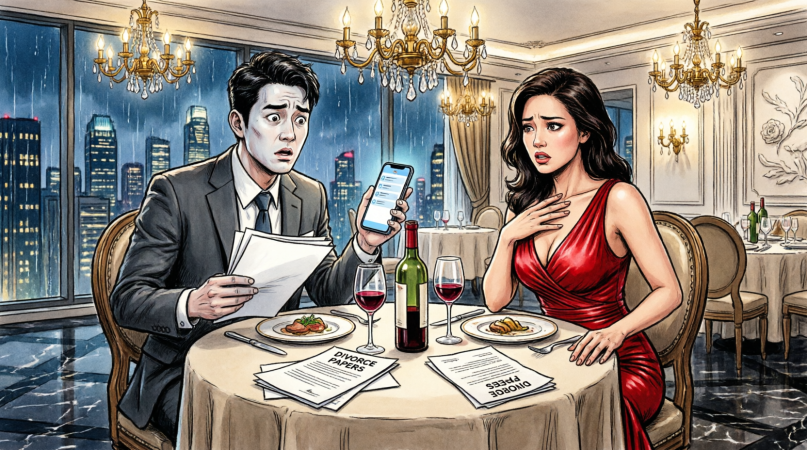
Luxury restaurant.
Mistress.
Wine.
Rain.
Lies arranged like polished silver.
Then I saw Callie alone in a medical residence, kidnapped, hunted, carrying our son while I learned too late what love had required.
I stepped onto the stage.
Evelyn whispered, “Dominic.”
I turned.
She looked almost sad.
“If you do this, Reed & Parker may not survive.”
I nodded.
“Maybe it shouldn’t.”
The red camera light came on.
Peter counted down silently.
Three.
Two.
One.
I looked directly into the lens.
“My name is Dominic Reed,” I said, my voice rough but steady. “I have lied to my wife, my partners, my clients, and the public. Tonight, I am going to tell the truth about my affair, my company, my father, and a man named Peter Lang who was supposed to have died twelve years ago.”
Somewhere beyond that ruined theater, servers picked up the feed.
Phones buzzed.
Newsrooms lit up.
My father’s kingdom heard the first crack of thunder.
And I kept talking.
PART 7 — The Birth of a Son and the Death of a Dynasty
By dawn, I was the most hated man in Chicago.
That was not an exaggeration.
My confession spread faster than any legal team could contain. Clips played on news channels before sunrise. My face appeared beside words like fraud, cover-up, mistress, shell companies, fake death, and Reed dynasty.
Reed & Parker’s board suspended me before breakfast.
The state attorney general announced an investigation by noon.
Federal prosecutors contacted Martin by two.
My father issued one statement.
My son is unwell and being manipulated by unstable individuals.
Classic Richard Reed.
When truth failed, question sanity.
But this time, the world had seen documents. Video. Peter Lang alive. Margaret Reed alive. Evelyn Parker standing beside me, grim and credible, verifying enough to make denial impossible.
By evening, my father disappeared again.
Callie was moved at 6:10 p.m.
I did not know from where.
I only knew the hospital after she arrived, because Marissa called me from a private hallway and said, “She agreed to let you come.”
For three seconds, I forgot how to speak.
“She did?”
“Do not mistake this for forgiveness.”
“I won’t.”
“She wants you there because decisions may need to be made for the baby.”
The baby.
Our son.
The drive to the hospital was the longest journey of my life.
Reporters followed. Martin’s security team boxed them out. Evelyn rode in the passenger seat, silent except for one sentence.
“Do not make this about you.”
“I won’t.”
She looked at me.
“For once, I believe you’re trying.”
That was probably the kindest thing she had ever said to me.
The hospital room was dim when I entered.
Machines hummed softly. Rain tapped against the window. Callie lay propped against pillows, one hand resting protectively over her stomach.
She looked exhausted.
Beautiful.
Frightened.
Stronger than anyone I had ever known.
I stopped at the doorway.
“May I come in?”
Her eyes flicked to mine.
That tiny question mattered.
Because for years I had entered every space as if permission were decorative.
She nodded.
I stepped inside slowly.
“I saw your confession,” she said.
My throat tightened. “I’m sorry you had to.”
“I’m not.”
That surprised me.
She looked toward the window. “It was ugly. But it was true.”
I stood beside the chair, not sitting until she gestured.
“I should have told you about the specialist,” I said.
“Yes.”
“There is no excuse.”
“No.”
“I was cowardly.”
Her eyes returned to mine.
“Yes.”
Each answer landed cleanly.
No shouting.
No performance.
Just truth.
I deserved every syllable.
“I thought I was protecting you,” I said.
Her expression hardened.
“You were protecting yourself from my fear.”
I closed my eyes.
“Yes.”
A long silence passed.
Then she whispered, “I was scared alone.”
The sentence broke me more completely than any headline.
I bent forward, elbows on knees, and covered my face.
“I know.”
“No,” she said. “You don’t. But maybe one day you will understand a piece of it.”
Before I could answer, the fetal monitor changed.
A nurse entered quickly.
Then another.
Callie’s hand tightened on the blanket.
“What’s happening?”
The nurse kept her voice calm, which terrified me.
“We need the doctor.”
Within minutes, the room filled.
Words flew through the air.
Decelerations.
Fetal distress.
Emergency delivery.
Callie’s face drained of color.
I stood useless near the wall while doctors moved around her with terrifying efficiency.
Then she reached for me.
Not lovingly.
Not forgivingly.
Humanly.
I took her hand.
It was cold and shaking.
“Dominic,” she whispered.
“I’m here.”
Her eyes filled with tears.
“If he doesn’t make it—”
“Don’t.”
“If he doesn’t—”
I gripped her hand gently.
“Then he will still have been loved by you every second.”
She stared at me.
Something passed between us.
Not reconciliation.
Not romance.
A bridge made of grief and fear.
They wheeled her toward surgery.
I walked beside her until the doors stopped me.
Before they pushed her through, she squeezed my fingers once.
“His name,” she said.
“What?”
“If I can’t—”
“You will.”
“If I can’t,” she insisted, “his name is Jonah.”
Jonah.
Not Richard.
Not Dominic.
Not Reed.
Jonah.
A prophet swallowed by darkness who came out alive.
I nodded, tears blurring everything.
“Jonah.”
The doors closed.
For three hours, I learned the shape of helplessness.
No boardroom. No money. No charm. No threat. No attorney. Nothing could negotiate with a surgical door.
Evelyn arrived with coffee I didn’t drink.
Marissa sat across from me, arms crossed, watching as if waiting for me to prove I was still a fool.
Thomas came too.
I looked up when he appeared.
He stood uncertainly near the vending machines.
“I heard,” he said.
I nodded.
For a long moment, neither of us spoke.
Then I said, “Thank you for helping her.”
His face shifted.
“You would have fired me for it.”
“Yes.”
“And ruined me.”
“Yes.”
He swallowed.
“Are you going to now?”
“No.”
He nodded once, but his eyes stayed guarded.
“I’m cooperating with investigators,” he said.
“Good.”
He seemed surprised.
“I implicated you.”
“I implicated myself last night.”
A faint, tired smile touched his face.
“About time.”
At 3:41 a.m., a surgeon came through the doors.
Everyone stood.
The doctor removed her cap.
“Mrs. Reed is stable.”
The world tilted.
“And the baby?” I asked.
The doctor looked at me.
“Your son is alive.”
I sat down because my legs stopped working.
Alive.
Not fine.
Not safe forever.
But alive.
Jonah Reed entered the world weighing four pounds, seven ounces, with a heart that needed repair and lungs that refused to quit.
When they let me see him through the NICU glass, I stopped breathing.
He was impossibly small.
A tiny red face under tubes and wires. One fist curled near his cheek like he was ready to fight the entire Reed family himself.
Callie was wheeled in beside me later, pale and weak, but awake.
We looked at him together.
Neither of us spoke.
Finally, she whispered, “Jonah.”
I pressed one hand against the glass.
“Jonah.”
She looked at me then.
Tears slid down her face.
“I don’t know how to forgive you.”
I nodded.
“I know.”
“I don’t know if I want to.”
“I know.”
“But I don’t want him born into hate.”
My chest tightened.
“Neither do I.”
She turned back to our son.
“Then we start there.”
Behind us, a television mounted in the waiting area played muted breaking news.
My father’s face appeared.
Then Vanessa’s.
A headline scrolled beneath them.
VANESSA HALE FOUND IN FEDERAL CUSTODY; REED FAMILY OFFICE UNDER INVESTIGATION.
Evelyn read the captions aloud.
“Vanessa flipped.”
Of course she had.
Vanessa always chose the winning side, even if she had to invent it at the last second.
But the next headline stunned us all.
RICHARD REED SEEKS EMERGENCY GUARDIANSHIP HEARING FOR NEWBORN GRANDSON.
Callie’s hand tightened on the wheelchair arm.
“No.”
My blood turned to ice.
Even now.
Even after everything.
My father was reaching for Jonah.
Marissa was already dialing.
Evelyn’s face went sharp as a blade.
Thomas whispered, “Can he do that?”
Callie looked at me.
For the first time since the divorce papers, she did not look away.
“Dominic,” she said.
I understood.
This was not about saving my reputation.
It never had been.
This was about standing between my son and the machine that made me.
I looked through the glass at Jonah’s tiny fighting fist.
Then I turned to Marissa.
“What do we file?”
PART 8 — The Last Lie Became the First Truth
The guardian hearing took place in a private courtroom three days after Jonah’s birth.
Private, supposedly, because a newborn’s medical condition was involved.
But nothing stays private when a dynasty is bleeding.
Reporters crowded the courthouse steps. Cameras flashed against gray morning light. Every network wanted the same image: the ruined son walking in to fight the monstrous father for the child who had inherited both their names and none of their sins.
Callie arrived in a wheelchair, against medical advice.
No one could stop her.
She wore a soft cream coat over hospital clothes, her hair pulled back, her face pale but unbroken. Marissa pushed the chair. Evelyn walked on one side. Thomas on the other.
I walked behind them.
Not beside Callie.
Behind.
Where I belonged until invited otherwise.
Inside the courtroom, my father sat at the petitioner’s table in a navy suit, perfectly tailored, silver hair combed back, expression grave with manufactured concern.
He looked like a grieving patriarch.
He looked like every lie money can buy.
When he saw Callie, his eyes moved to her stomach first.
Empty now.
Then to me.
He smiled.
Not warmly.
Victoriously.
His attorney argued that I was under criminal investigation, emotionally unstable, publicly disgraced, financially compromised, and therefore unfit to influence decisions regarding Jonah’s trust or medical care.
It was an elegant assassination.
Worse, much of it was true.
Then he turned to Callie.
He called her overwhelmed.
Traumatized.
Medically fragile.
Potentially manipulated by outside actors.
I felt Callie flinch beside me.
My father’s attorney never raised his voice. Men like him didn’t need to. Cruelty sounds cleaner when billed hourly.
Then Marissa stood.
She did not begin with my confession.
She did not begin with Richard.
She began with Callie.
“Mrs. Reed,” she asked gently, “why did you file for divorce?”
Callie’s voice was weak, but steady.
“Because my husband betrayed me.”
My father’s attorney looked satisfied.
Marissa continued.
“Why did you expose financial documents?”
“Because the accounts used to hide his affair revealed larger wrongdoing.”
“Did anyone force you?”
“No.”
“Did you understand what you were doing?”
“Yes.”
“And why are you opposing Mr. Richard Reed’s petition today?”
Callie turned slowly toward my father.
“Because my son is not an asset.”
The courtroom went silent.
She continued.
“He is not an heir to be managed, a trust trigger, a family instrument, or leverage. He is a baby. He is sick. He is loved. And the people who speak about him as property should never be allowed near him.”
My father’s face remained still.
But his hand tightened around a pen.
Then Marissa called me.
Walking to the stand felt like walking toward an execution I had scheduled myself.
I swore to tell the truth.
For once, the words mattered.
Marissa asked about Vanessa.
I answered.
She asked about the shell company.
I answered.
She asked about Callie’s medical appointment.
My voice cracked, but I answered.
Then she asked the question that changed everything.
“Mr. Reed, do you believe you should have custody or control over Jonah Reed’s trust at this time?”
My father’s attorney stiffened.
Callie looked at me.
This was the opening.
The old Dominic would have reached for it. He would have performed remorse beautifully, argued partial rights, preserved leverage, negotiated fatherhood into a favorable structure.
But Jonah was in an intensive care unit with wires taped to his tiny chest.
And Callie had been scared alone.
“No,” I said.
A murmur moved through the courtroom.
Marissa held my gaze.
“Why not?”
“Because I spent years becoming the kind of man who thought control was love. I am under investigation. I have lied repeatedly. I endangered my wife emotionally and medically. I helped create the conditions that put my son at risk.”
My father stared at me.
Furious now.
I continued.
“I want to be his father. But wanting something does not make me entitled to it. Callie should have medical authority. Independent trustees should control any financial structures. My father should have nothing.”
The courtroom went utterly still.
My father’s attorney rose. “Your Honor—”
But my father stood first.
“Dominic.”
One word.
A command disguised as a name.
For forty-two years, that voice had shaped me.
Sit.
Stand.
Smile.
Win.
Deny.
Destroy.
I looked at him and felt the final thread snap.
“No,” I said.
His face changed.
Not much.
Enough.
The judge warned him to sit.
He did.
But his eyes promised war.
Then the doors opened.
Everyone turned.
An elderly woman entered with a cane.
My mother.
Margaret Reed walked into court like a ghost tired of haunting.
Behind her came Peter Lang.
Alive in front of cameras, lawyers, and my father.
For the first time in my life, I saw Richard Reed afraid.
Not startled.
Afraid.
My mother took the stand.
Her testimony lasted ninety-four minutes.
She spoke of Peter Lang. The lake house. The staged crash. The family office. The trust. Her false death. The doctors. The private security network. The way my father had built a kingdom where wives disappeared, sons were compromised, and babies became signatures on legal instruments.
Then Peter testified.
Then Vanessa.
They brought her in under federal protection, one arm in a sling, face bruised, glamour stripped down to bone.
She looked at me once.
No apology.
No love.
Just survival.
She gave them accounts, names, transfers, messages from my father’s people. She admitted she had been placed near me. She admitted she later acted for herself. She admitted she helped take Callie from the medical residence because she thought trading Callie’s location would buy immunity from both sides.
Callie listened without expression.
I could barely look at her.
By sunset, the judge denied my father’s emergency petition.
He also issued protective orders preventing Richard Reed or any associated representative from contacting Callie, Jonah, my mother, Peter Lang, or me.
My father was arrested outside the courthouse before he reached his car.
This time, by real police.
He did not struggle.
He looked back once.
At my mother.
At me.
At Callie.
Then he smiled.
“You think this ends me?” he called.
My mother stepped forward.
“No, Richard,” she said calmly. “You ended yourself years ago. We only stopped carrying the body.”
The cameras caught every word.
That was the line the newspapers printed the next morning.
Not mine.
Hers.
Six months later, Jonah survived his second surgery.
By then, Reed & Parker no longer existed under that name. Evelyn led a restructuring and handed entire divisions over to investigators. Arthur Bell was arrested in Lisbon. Martin Greer retired, then unretired when he realized half the city still needed legal help untangling the damage.
Thomas became a whistleblower.
Then, unexpectedly, a partner in a compliance firm.
He sent Callie flowers after Jonah’s surgery and signed the card: For the bravest mother I know.
Vanessa testified for eighteen days.
Then disappeared into witness protection under a name no one told me.
My father went to trial the following spring.
He was convicted on financial crimes first. The Lang case reopened afterward. My mother testified again. Peter testified again. I testified too.
When the prosecutor asked why I had stayed silent for twelve years, I told the truth.
“Because silence benefited me.”
No one liked that answer.
But it was true.
Truth does not always make you noble.
Sometimes it only makes you finished lying.
Callie finalized the divorce on a bright morning in June.
We signed in separate rooms.
Afterward, I found her outside the courthouse beneath a maple tree, Jonah asleep against her chest in a blue blanket.
For a moment, I could not speak.
He had grown rounder, stronger. A scar curved faintly beneath his tiny shirt, proof that survival can leave beautiful evidence.
“He looks good,” I said.
“He is good.”
I nodded.
Callie studied me.
Prison remained possible for me then. Charges were pending. Cooperation helped, but did not erase everything. I had given up the penthouse, the club memberships, the accounts tied to the investigation. I lived in a small apartment near the river with rented furniture and silence.
“I’m going to ask the court for supervised visits,” she said.
My throat tightened.
“You are?”
“Yes.”
I looked at Jonah.
“Why?”
Callie’s eyes softened, but only a little.
“Because he deserves the chance to know who you become after losing everything.”
That sentence stayed with me longer than any punishment.
Two years passed.
My sentence came down as cooperation, restitution, probation, and community service tied to financial crime education. Some people said I escaped lightly. Maybe I did. Some said I had been brave. I knew better.
I had been late.
Late to honesty.
Late to fatherhood.
Late to love.
But not too late to be different.
Jonah grew.
His laugh sounded like bells dropped into sunlight. He loved trucks, bananas, and throwing socks into impossible places. He called Thomas “Tee.” He called Evelyn “Scary Nana,” which secretly delighted her.
He called me Dad for the first time in a hospital parking lot after a routine cardiac checkup.
I had just buckled him into his car seat when he touched my face with one sticky hand and said, “Dad, home?”
I turned away so he would not see me cry.
Callie saw anyway.
She always did.
We did not remarry.
That is what people expected when they heard this story from far away. They wanted a neat ending, a repaired marriage, a kiss in the rain.
Life was less theatrical.
And better.
Callie built a foundation for women navigating medical neglect, financial abuse, and high-risk pregnancies. My mother helped fund it with money recovered from assets my father had hidden in her name.
Peter Lang became Jonah’s godfather.
That surprised everyone, including me.
But Callie said Jonah deserved protectors who understood survival.
As for me, I became useful in quieter ways.
School pickups.
Doctor visits.
Truthful answers.
No secret phones.
No locked accounts.
No lies made beautiful.
Then, on Jonah’s fifth birthday, Callie invited me to dinner at her house.
Not our old brownstone.
She sold that.
This was a smaller place near the lake, full of light, books, mismatched mugs, and drawings taped to the refrigerator.
Jonah fell asleep before cake.
My mother and Peter left early.
Thomas and Evelyn argued in the kitchen about whether birthday clowns were emotionally necessary.
Callie and I stood on the back porch while summer rain fell softly over the garden.
For a while, we said nothing.
Then she handed me an envelope.
My body went cold from old memory.
“The last envelope you gave me ruined my life,” I said.
She smiled faintly.
“No. It revealed it.”
Inside was a photograph.
Jonah as a newborn in the NICU, one fist curled near his cheek.
On the back, Callie had written:
The first day we both told the truth.
I looked at her.
“I don’t know what this means.”
“It means,” she said softly, “I’m happy.”
The words startled me.
Not because I wanted her unhappy.
Because for years I had thought happiness meant returning to what was lost.
But Callie’s happiness did not include being my wife.
It included freedom. Jonah. Work that mattered. A life without pretending.
And somehow, standing there in the rain, I realized that was the happiest ending I could have been allowed to witness.
“I’m glad,” I said.
She looked at me for a long moment.
“I know.”
Inside, Jonah called sleepily for water.
We both turned at the same time.
Then stopped.
Then laughed.
A small laugh.
Quiet.
Human.
Callie opened the door.
“You get him,” she said.
I stepped inside.
Jonah’s room glowed with a nightlight shaped like a moon. He lay tangled in dinosaur sheets, hair messy, cheeks warm from sleep.
“Dad,” he murmured.
“I’m here.”
“Storm?”
“Just rain.”
“Stay?”
I sat beside him and brushed hair from his forehead.
“For a while.”
His eyes closed.
I listened to him breathe.
Steady.
Alive.
Unowned by any dynasty.
Unburdened by any name except the one Callie chose.
Behind me, in the doorway, Callie watched quietly.
For once, I did not ask for more than the moment gave.
Outside, rain touched the windows gently.
Not like the storm at L’Orangerie.
Not like the night my father came for the drive.
This rain sounded clean.
And for the first time in my life, I understood something my old self would have mocked.
A happy ending is not always getting back what you lost.
Sometimes it is watching the people you hurt become safe enough to smile again.
Jonah sighed in his sleep.
Callie switched off the hall light.
And the last lie of my life finally became the first truth I knew how to keep.
THE END.