My daughter knocked on my apartment door at exactly 3:00 in the morning wearing her wedding dress and covered in blood.
Even now, months later, I still hear those knocks in my sleep.
Three sharp sounds against wood.
Controlled.
Weak.
Like she was trying not to wake the neighbors while her entire life collapsed around her.
The hallway outside my apartment in Dallas smelled like rain and wet concrete when I opened the door.
Sofia stood there barefoot.
One heel missing.
Mascara streaked beneath swollen eyes.
Blood staining the lace along the back of her wedding gown.
For one second, my brain refused to understand what I was seeing.
That morning I had zipped that same dress closed with my own hands.
That night I was holding my daughter upright while blood dripped onto my hardwood floor.
“Mom,” she whispered.
Then she collapsed into my arms.
People talk about maternal instinct like it feels noble.
It doesn’t.
It feels animal.
Hot.
Terrified.
I dragged Sofia inside and locked the deadbolt before she could even finish speaking.
The apartment suddenly felt too small for breathing.
Too quiet.
The only sound was the wet scrape of her dress dragging across the floor.
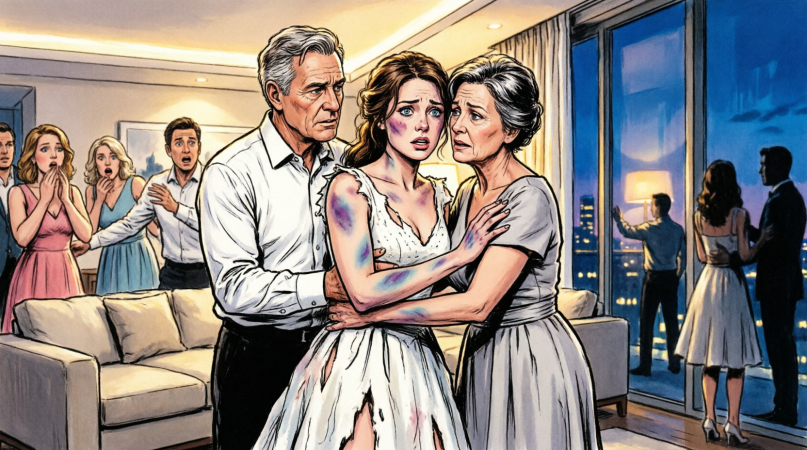
When I turned on the lamp beside the couch, I saw the bruises clearly for the first time.
Purple marks around both arms.
Finger-shaped.
One cheek swollen.
Split lip.
And deep red welts crossing her upper back beneath torn lace.
My daughter looked like someone had punished her.
Not attacked.
Punished.
There is a difference.
One comes from rage.
The other comes from entitlement.
I knelt beside her with shaking hands.
“Sofia,” I whispered. “Who did this?”
Her lower lip trembled.
“My mother-in-law.”
Even now, that sentence still sounds unreal to me.
Not because Carmen Robles seemed kind.
She never did.
But because some people radiate danger so quietly you spend months convincing yourself you imagined it.
I had met Carmen three months earlier during brunch at my apartment.
She arrived wearing enough gold jewelry to announce herself before she spoke.
Cream silk blouse.
Diamond bracelet.
Heavy perfume.
Everything about her felt deliberate.
Her son Javier looked easier to trust.
Thirty-one.
Attorney.
Tailored suits.
Polite smile.
Calm voice.
The kind of man who said exactly the right thing at exactly the right moment.
Sofia adored him almost immediately.
After years of dating emotionally unavailable men, she thought Javier represented stability.
Structure.
Ambition.
I wanted to support her happiness.
God help me, I tried.
But the first time Carmen walked through my apartment, her eyes landed on objects before people.
Furniture.
Art.
Kitchen finishes.
Views from the balcony.
She appraised rooms instead of entering them.
Then she asked about Sofia’s condo.
Casually.
Too casually.
“I heard she owns property in Uptown Dallas,” Carmen said while stirring coffee. “That’s impressive for someone her age.”
I answered carefully.
“It belongs to Sofia.”
Carmen smiled.
“But marriage changes ownership structures.”
No.
Marriage changes access.
And some people mistake access for permission.
That condo mattered because of how Sofia received it.
My ex-husband Alexander transferred it into her name after our divorce finalized in 2021.
A clean protected transfer.
No shared claims.
No joint ownership clauses.
Worth nearly $1.8 million.
Alexander called it Sofia’s “safety net.”
Maybe somewhere deep inside himself, he already understood how vulnerable women become when money enters marriage.
My marriage to Alexander had lasted eleven years.
Not violent.
Never violent.
But exhausting in ways harder to explain.
Alexander’s mother controlled everything.
Vacations.
Holidays.
Parenting decisions.
Furniture.
Guest lists.
The entire emotional climate of our home.
And I stayed quiet far too often because survival inside certain families depends on strategic silence.
By the time I finally left, I barely recognized myself.
Sofia knew some of that history.
Not all of it.
Children never fully understand the marriages that raise them.
Still, she believed Javier was different.
I wanted to believe it too.
The problems started after the engagement dinner.
Carmen suddenly became obsessed with “family integration.”
That was her phrase.
Not marriage.
Integration.
She asked invasive questions about wills, insurance, and asset protections disguised as concern for Sofia’s future.
Then came the requests.
Cash contributions toward the wedding.
Luxury gifts for Javier’s relatives.
“Security guarantees.”
The exact phrase still makes my skin crawl.
Like my daughter was entering organized business negotiations instead of marriage.
I refused repeatedly.
Sofia cried repeatedly.
“Mom, you’re looking for problems,” she kept saying.
Maybe I was.
But women learn pattern recognition long before men believe us.
Still, I compromised because Sofia begged me to.
The wedding took place at the Crescent Court Hotel downtown on a humid Saturday evening in June.
Everything looked beautiful.
White orchids.
Crystal chandeliers.
Soft jazz.
Sofia looked radiant walking down the aisle.
I remember thinking she finally seemed peaceful.
That thought haunts me now.
Because sometimes peace is simply the last moment before betrayal arrives.
During the reception, Carmen moved through the ballroom like a queen inspecting servants.
She corrected waiters.
Directed photographers.
Interrupted conversations.
At one point, I caught her cornering Alexander near the bar.
Their conversation looked tense.
Alexander later admitted Carmen directly asked whether Sofia planned to combine marital assets after the honeymoon.
“Your daughter is marrying into an influential family,” Carmen reportedly told him.
Alexander answered only one sentence.
“My daughter already belongs to herself.”
I wish now we had both listened harder to our instincts.
The reception ended shortly after midnight.
Sofia kissed me goodbye outside the hotel elevators.
She looked tired.
Happy too.
Or maybe relieved.
“You survived,” I joked.
She laughed weakly.
“Barely.”
That was the last normal moment.
Around 2:40 a.m., according to the timestamp later recovered from hotel surveillance, Javier escorted Sofia into the bridal suite.
At 2:58 a.m., he exited alone.
At 3:04 a.m., Carmen arrived with six women from Javier’s extended family.
One carried a designer handbag large enough to hide documents.
Another carried wine.
The hallway footage later became critical evidence.
At the time, Sofia thought none of it mattered.
She thought Javier would return.
Instead Carmen locked the suite door behind them.
When Sofia finally described the attack, she spoke in fragments.
Not because she forgot.
Because memory itself resisted replaying it.
Carmen demanded Sofia sign preliminary transfer paperwork for the condo into a future Robles family trust.
Sofia refused.
Carmen slapped her.
Once.
Then again.
Then harder.
Forty times total, according to Sofia’s own count.
The other women laughed.
One reportedly filmed parts of the assault.
Another held Sofia’s wrists.
Someone called it “training.”
That word nearly made me vomit when Sofia repeated it.
Training.
As though marriage transformed a woman into livestock needing discipline.
The worst part was Javier.
Not because he participated directly.
Because he didn’t stop it.
Sofia heard him outside the suite door.
“Don’t hit her too much in the face,” he reportedly told his mother.
“People will notice tomorrow.”
Not horror.
Management.
Not protection.
Damage control.
That distinction changed everything for me.
Some men commit violence themselves.
Others simply create environments where violence flourishes safely around them.
Sofia escaped only because one hotel employee accidentally interrupted the suite floor by delivering room service to the wrong door.
The distraction gave her enough time to run barefoot through a service elevator and into the parking garage.
At 3:17 a.m., she called a rideshare from the hotel loading dock.
At 3:42 a.m., she arrived at my apartment.
Those timestamps later appeared in police records.
I documented everything before sunrise.
Bruises.
Torn fabric.
Voice recordings.
Photographs.
I emailed copies to myself and uploaded duplicates to cloud storage.
Years earlier, during my divorce, one attorney gave me advice I never forgot.
“Evidence disappears faster than truth.”
So I preserved every detail.
Sofia begged me not to contact authorities.
“She said they’ll kill me,” Sofia whispered repeatedly.
Carmen apparently spent much of the assault boasting about connections inside Dallas social circles.
Judges.
Business owners.
Attorneys.
Rich people love pretending influence makes them untouchable.
Sometimes it does.
Until somebody wealthier gets involved.
At 3:26 a.m., I called Alexander.
We had barely spoken in years outside occasional logistical conversations about Sofia.
Divorce creates strange distances.
You stop knowing who someone became after your shared life ended.
Alexander answered sounding half asleep.
“Elena?”
I took one breath.
Then I said, “Your daughter was almost killed tonight.”
Silence.
Complete silence.
Then his voice changed instantly.
Not louder.
Colder.
“What happened?”
I explained everything in under thirty seconds.
By the end, Alexander sounded fully awake.
“Send me the address.”
He arrived thirty minutes later.
Wrinkled shirt.
Untucked collar.
Rainwater soaking his shoulders.
The second he saw Sofia, he dropped to his knees beside the couch.
“Baby girl…”
I watched my daughter’s face soften for the first time since she arrived.
“Dad.”
There are moments when divorced people remember why they once loved each other.
Watching Alexander touch our daughter’s bruised arm with trembling hands was one of them.
Not romance.
Recognition.
We had built this human together.
And somebody hurt her.
Alexander examined every injury carefully.
Then he asked me for my phone.
I showed him the photographs and timestamps.
He nodded once.
Good.
Methodical.
Controlled.
That frightened me more than rage would have.
At 4:11 a.m., Alexander reached into his jacket pocket and removed court documents.
Dallas County civil filings.
Javier Robles was already tied to a pending financial misconduct investigation involving hidden marital asset disclosures through his law practice.
Alexander had received copies two weeks earlier from a former business partner connected to Hartwell & Price Legal Consulting.
He had not told Sofia because he lacked proof Javier himself was involved.
Now he had proof.
At least enough for suspicion to become strategy.
Then Alexander showed us something else.
A screenshot.
Timestamped 11:43 p.m.
Carmen texting Javier.
“Get her signature tonight. One way or another.”
I felt sick reading it.
Because suddenly this was no longer family dysfunction.
It was premeditated coercion.
Potentially criminal.
At 4:19 a.m., a security manager from the Crescent Court called Alexander directly.
Someone had attempted to request deletion of hallway surveillance footage from the bridal suite floor.
Alexander immediately instructed them to preserve every recording pending emergency legal action.
That was the moment I realized something important.
Carmen assumed fear would isolate Sofia.
Instead fear reunited the two people most capable of protecting her.
Her parents.
At 4:31 a.m., another knock sounded at my apartment door.
Slow.
Heavy.
Deliberate.
Sofia froze beside me.
Alexander stood immediately.
Then Javier spoke through the door.
“Sofia,” he said quietly. “Please open this.”
No apology.
No panic.
Just control.
Alexander opened the door instead.
What happened next eventually became part of Dallas County case files, police interviews, and civil testimony.
Javier tried to claim misunderstanding.
Cultural tradition.
Family pressure.
None of it mattered after Alexander handed him printed screenshots of Carmen’s text messages.
For the first time that night, Javier lost composure.
The criminal investigation unfolded quickly afterward.
Hotel staff cooperated.
Surveillance footage survived.
One of the women present during the assault eventually turned state witness after learning portions of the incident were being investigated as felony coercion and aggravated assault.
Carmen Robles was arrested three weeks later.
Javier lost his position at his law firm within days.
Civil lawsuits followed.
Protective orders too.
The condo remained solely in Sofia’s name.
Exactly where it always belonged.
Recovery took longer.
Bruises fade faster than humiliation.
For months Sofia struggled sleeping through the night.
She avoided mirrors.
Wedding music.
Hotels.
Anything white.
Anything formal.
But healing arrived slowly through ordinary things.
Therapy.
Morning coffee together.
Walks around Uptown.
Laughter returning unexpectedly in small moments.
And Alexander stayed present through all of it.
More present than he had been in years.
One afternoon nearly six months later, Sofia asked me something while we folded laundry in my apartment.
“Mom,” she said quietly, “how did you know something was wrong with Carmen so early?”
I looked at her for a long moment before answering.
“Because women like that don’t see love,” I told her.
“They see leverage.”
Sofia nodded slowly.
Then she touched the scar near her lip.
Not shamefully.
Thoughtfully.
As though finally understanding something larger than her own pain.
An entire family had tried teaching her that survival required surrender.
But they failed.
Because the one thing Carmen Robles never understood was this:
A woman who escapes violence once learns how to recognize it forever.
And a daughter raised by that woman eventually learns too.
FULL STORY – My Billionaire Boss Showed Up Drunk at My Apartment Whispering “I Need You”—Then His Secret Fiancée Revealed the Truth
“Why do I feel safer here with you than anywhere else?”
For one full second, I forgot how to breathe.
Cameron Reed stood too close, his arm wrapped around my waist, his forehead nearly touching my hair. His voice was low, broken, and warm against my skin in a way that sent every sensible thought in my brain sprinting for the emergency exit.
This was my boss.
My terrifying, impossible, billionaire CEO boss.
And he was drunk in my living room, holding me like I was the only solid thing left in his world.
“Mr. Reed,” I whispered, because formality was the last fragile wall standing between me and complete emotional disaster, “you need to sit down.”
His grip tightened slightly.
“Cameron,” he murmured.
“What?”
“My name is Cameron.”
“I know your name.”
“You never use it.”
“You sign my paychecks.”
His mouth curved faintly, but the smile vanished almost immediately.
Then his eyes closed.
For one terrifying moment, I thought he might kiss me.
For one even more terrifying moment, I realized I might let him.
Instead, his entire body sagged.
“Whoa—okay.” I grabbed his arm and guided him back to the couch. “Sit before you turn my living room into a workplace injury report.”
He collapsed onto the cushions again, one hand covering his face.
I stood there in kitten pajamas, barefoot, heart pounding like a traitor.
The apartment suddenly felt too small.
My tiny coffee table, my thrift-store lamp, the stack of romance novels Lily kept threatening to organize by spice level, the chipped mug with three pens in it—it all looked painfully ordinary around him.
Cameron Reed did not belong here.
He belonged in glass towers, private jets, whispered boardroom power games, and newspaper headlines about acquisitions worth more than entire countries.
Not on my secondhand couch under a crocheted blanket my grandmother made.
Definitely not staring at me like I was something he had been searching for.
I moved to the kitchen because I needed distance.
And water.
Mostly distance.
“You need to hydrate,” I said, grabbing a glass.
“I need to forget.”
“That is above my pay grade.”
“You’re my executive assistant. Nothing is above your pay grade.”
“False. This is exactly the kind of emotional crisis that requires either a therapist or a very expensive divorce lawyer.”
He gave a humorless laugh.
“There won’t be a divorce. We never made it that far.”
I turned back toward him.
The word fiancée still hung in the air like broken glass.
I knew he was engaged, of course. Everyone at Reed Global knew.
Vanessa Ellington was impossible not to know.
Fashion heiress. Charity board darling. Golden hair. Diamond smile. The kind of woman who looked as if she had been designed by an algorithm trained entirely on luxury perfume ads.
She visited the office sometimes.
Every time she entered, people straightened.
Not because she was kind.
Because she inspected rooms the way other people inspected produce.
The first time she met me, she had looked me up and down, paused at my sensible flats, and asked Cameron, “This is the assistant?”
Not your assistant.
The assistant.
As if I were office equipment.
Cameron had only said, “Emma keeps the company functioning.”
At the time, I had thought it was the closest thing to a compliment I would ever get from him.
Now he was on my couch because that same perfect woman had left him.
I handed him the water.
“Drink.”
He accepted it, looked at the glass suspiciously, then drank half.
“Do you always give orders at home?”
“Only to drunk billionaires who break into my apartment.”
“I didn’t break in.”
“You used HR files to find my home address.”
“That sounds worse when you say it.”
“It sounded bad when you said it.”
He lowered the glass and stared at the floor.
The humor faded again.
“She didn’t just leave,” he said quietly. “She announced it.”
I frowned. “Announced it?”
“At dinner. In front of twelve people.”
My stomach twisted.
“Oh.”
“At my father’s club.”
The way he said father made the air change.
I knew fragments about the Reed family because everyone knew fragments about the Reed family.
Old money. Real estate. Tech. Shipping. Media. A dynasty built on wealth and silence.
Cameron’s father, Malcolm Reed, was chairman of the board, though technically retired. His name still appeared in business magazines beside words like titan, strategist, kingmaker.
In the office, Cameron never mentioned him.
Ever.
“What happened?” I asked softly.
Cameron’s jaw flexed.
“She stood up before dessert and said she couldn’t marry a man incapable of love.”
I winced.
He laughed under his breath, but there was no amusement in it.
“Then she gave back the ring.”
“In front of everyone?”
“In front of my father. My board chair. Two investors. A senator. Her mother. A man who owns half of Midtown.”
“That is…” I searched for the right word. “Theatrical.”
“That’s one word.”
“What did you do?”
He looked up at me.
“I said thank you for being honest.”
I stared at him.
Of course he did.
Of course Cameron Reed got publicly humiliated and responded like someone had corrected a spreadsheet.
“That’s it?”
“What should I have done?”
“Reacted?”
“I did react.”
“Mr. Reed—”
“Cameron.”
“Cameron,” I corrected, and his eyes softened in a way that made me immediately regret it. “That is not reacting. That is politely accepting an emotional stabbing.”
His mouth twitched.
“You’re surprisingly violent in cat pajamas.”
“You have no idea.”
For a moment, something easy passed between us.
Something almost normal.
Then his expression darkened.
“She said I chose Reed Global over her. That I loved control more than people. That I wouldn’t recognize intimacy if it was handed to me in a signed contract.”
I sat slowly in the armchair across from him.
“Was she right?”
The question slipped out before I could stop it.
Cameron looked at me.
In the office, asking him something that direct would have been career suicide.
Here, barefoot and exhausted, I couldn’t pretend I wasn’t curious.
He leaned back, eyes fixed on mine.
“Probably.”
The honesty startled me.
Then he added, “But she didn’t leave because I couldn’t love her.”
Something in his voice changed.
Sharper.
Colder.
More like the CEO I knew.
“She left because she lost patience.”
“Patience for what?”
He looked at the glass in his hand.
“For me to give her what she really wanted.”
“Which was?”
“Access.”
The word landed heavily.
I frowned. “Access to what?”
Cameron didn’t answer immediately.
Outside, a siren wailed somewhere down the avenue, fading into the restless hum of Manhattan at midnight.
Inside, my apartment felt suspended in a strange, dangerous intimacy.
He dragged a hand through his hair.
“My father built Reed Global like a fortress. Layers of holding companies. Private divisions. Partnerships no one outside a closed circle understands.”
I knew that much.
Reed Global wasn’t just one company. It was an empire wearing a corporate logo.
“When I became CEO,” he continued, “I inherited the public structure. Real estate, logistics, communications, infrastructure. The clean version.”
“The clean version?” I repeated.
His eyes lifted.
“That’s already more than I should have said.”
A chill moved through me.
“Cameron.”
He smiled faintly.
“There it is again.”
“This isn’t funny.”
“No,” he said. “It isn’t.”
He set the glass on the coffee table with careful precision, as if controlling the movement was the only thing keeping him from falling apart.
“Vanessa’s family wanted a merger through marriage. Old money married to old machinery. Her mother practically planned the wedding before our first date.”
“That sounds romantic.”
“It was efficient.”
“Dear God.”
His gaze lowered, almost ashamed.
“I thought efficiency was enough.”
The sadness in that sentence caught me off guard.
Not because I pitied him.
Because for the first time, I understood something fundamental about Cameron Reed.
He wasn’t cold because he felt nothing.
He was cold because feeling things had never been safe.
I should have made him sleep on the couch right then.
I should have handed him a blanket, called a car for the morning, and locked myself in my bedroom with every bad decision I had nearly made.
Instead, I asked, “Why did you come here?”
He looked at me for a long time.
Too long.
“Because when everything went quiet after she left,” he said, “I realized I didn’t want to call anyone who knew me socially. I didn’t want pity from people waiting to use it. I didn’t want my father’s silence. I didn’t want Vanessa’s apology.”
His voice dropped.
“I wanted the person who notices when I haven’t eaten.”
My throat tightened.
I hated that I knew exactly what he meant.
Because I did notice.
I noticed everything.
The untouched coffee going cold beside contracts.
The way he rubbed his left temple before board meetings with his father.
The days he skipped lunch and snapped at no one, which was somehow worse than snapping.
The way his signature grew sharper when he was angry.
The way he paused outside conference room seven every Thursday before the finance call, as if bracing for impact.
I noticed because that was my job.
At least, that was what I told myself.
“You pay me to notice,” I said.
“No.” His eyes held mine. “I pay you to manage my calendar. You notice because you care.”
My heart made a stupid, dangerous little movement.
I stood too quickly.
“You are very drunk.”
“Not drunk enough to be wrong.”
“Yes, actually, that is exactly how drunk works.”
He leaned forward, elbows on knees.
“Emma.”
My name sounded different in his mouth tonight.
At work, it was clipped and efficient.
Emma, move the Tokyo call.
Emma, get me Stanton’s report.
Emma, cancel lunch.
Now it sounded like a confession.
I wrapped my arms around myself.
“You shouldn’t say things like this to me.”
“Why?”
“Because tomorrow you’ll regret them.”
His expression changed.
“And you?”
I looked away.
That was answer enough.
For several seconds, neither of us spoke.
Then a soft meow came from behind the kitchen counter.
Cameron blinked.
A tiny gray head appeared, followed by cautious paws and enormous green eyes.
“No,” I whispered. “Muffin, don’t.”
My cat ignored me, because Muffin respected no hierarchy known to man or capitalism.
She padded across the rug and leapt onto the couch beside Cameron.
He stared at her.
She stared back.
“This is a cat,” he said.
“That is usually what kitten pajamas imply.”
“She’s very small.”
“She’s judgmental about size comments.”
Muffin sniffed his sleeve, then climbed directly into his lap as if conquering a hostile nation.
Cameron froze completely.
I bit my lip to keep from laughing.
“Have you never met a cat before?”
“I’ve met cats.”
“Then why do you look like she’s negotiating a hostile takeover?”
“She’s touching me.”
“She does that.”
Muffin curled into a fluffy ball on his expensive trousers and began purring.
Something in Cameron’s face shifted.
Softened.
Almost helplessly.
He lowered one hand, hesitant, and brushed two fingers over her head.
Muffin purred louder.
The sight nearly destroyed me.
This impossible man, who could buy buildings without blinking, looked utterly undone by a seven-pound rescue cat.
“She likes you,” I said.
“She has poor instincts.”
“No. She has excellent instincts. She hates my landlord.”
“Smart cat.”
He stroked Muffin again, slower this time.
The room settled around us.
For a moment, it felt almost peaceful.
Then Cameron’s phone buzzed on the coffee table.
Once.
Twice.
Again and again.
He closed his eyes.
“Don’t answer it,” he said.
I glanced at the screen.
Vanessa Ellington.
Her name flashed in elegant white letters.
My stomach tightened.
“It’s her.”
“I know.”
The phone stopped.
Then started again.
Cameron reached for it, but I picked it up first.
His eyes snapped to mine.
I didn’t know what possessed me.
Maybe exhaustion.
Maybe curiosity.
Maybe the fact that a woman had publicly humiliated him and then decided midnight was a perfect time to keep cutting.
“Emma,” he warned softly.
I held the phone out.
“You should answer.”
“No.”
“Then I will.”
His brows lifted.
“That’s a terrible idea.”
“I specialize in those after midnight.”
Before he could stop me, I accepted the call.
“Cameron?” Vanessa’s voice came through immediately, smooth and icy. “Where are you?”
I paused.
Cameron stared at me as if I had just detonated a grenade.
“This is Emma Carter,” I said. “Mr. Reed is unavailable.”
Silence.
Then Vanessa laughed softly.
“Oh. The assistant.”
Muffin lifted her head, offended on my behalf.
Cameron’s expression went black.
I straightened.
“Yes. The assistant.”
“How quaint. Put him on.”
“No.”
Another silence.
This one sharper.
“Excuse me?”
“He is not in a condition to have a productive conversation.”
Vanessa’s voice lowered. “Listen carefully, Emma. Whatever little fantasy you’re constructing in your head, destroy it now. Cameron belongs to a world you serve. You don’t enter it.”
Heat rose in my face.
Across from me, Cameron started to stand.
I held up a hand.
To my astonishment, he stopped.
“Thank you for the sociological update,” I said. “Was there a message?”
Her laugh vanished.
“Tell him he has until eight tomorrow morning.”
“For what?”
“He knows.”
“No,” I said. “I don’t think he does.”
“Then tell him I know about Meridian.”
Cameron went perfectly still.
Every ounce of drunken softness disappeared from his face.
Vanessa continued, “Tell him his father chose the wrong son to protect it. And tell him if he doesn’t come home tonight, everyone finds out.”
The call ended.
I slowly lowered the phone.
My hand felt cold.
“Cameron,” I whispered, “what is Meridian?”
He took the phone from me, but his eyes weren’t on the screen.
They were on the floor.
Or maybe somewhere far beneath it.
“Something my father should have buried twenty years ago.”
I sat down without meaning to.
“Is it illegal?”
He laughed once.
That told me enough.
Muffin, sensing disaster, jumped off his lap and disappeared beneath the table.
Cameron stood and swayed slightly, catching himself on the couch arm.
“I need to go.”
“No. Absolutely not. You can barely stand.”
“I have to.”
“Vanessa just threatened you.”
“She threatened more than me.”
The words were flat.
Controlled.
He was turning back into the man from the office, but now I could see the cracks under the marble.
“Tell me what Meridian is.”
His jaw tightened.
“No.”
“You came to my apartment drunk and said you needed me. You let me answer your phone. A woman just threatened you through me. You do not get to shut the door now.”
Something flashed in his eyes.
Pride.
Fear.
Maybe admiration.
“You don’t understand what you’re asking.”
“Then explain it.”
“I can’t.”
“Because it’s confidential?”
“Because the less you know, the safer you are.”
I laughed.
It came out bitter and thin.
“Men like you always say that right before ruining women’s lives.”
He flinched as if I had slapped him.
Good.
I was tired, scared, and still wearing kitten pajamas. I had earned one clean hit.
“I won’t ruin your life,” he said quietly.
“You already came to my home.”
“I know.”
“You already dragged me into whatever this is.”
“I know.”
“You already made me care.”
The last sentence escaped before I could stop it.
The room went still again.
Cameron looked at me.
Not like a boss.
Not like a billionaire.
Like a man who had been drowning all night and had just seen shore.
“Emma,” he said softly.
“No.” I stepped back. “Don’t.”
“Don’t what?”
“Don’t look relieved. I’m angry.”
“I know.”
“I should report you to HR.”
“I own HR.”
“That is not helping your case.”
He moved closer, but carefully this time. No stumbling. No careless touch.
“I came here because you are the only person in my life who has never asked me for anything.”
“That’s not true. I asked for a printer replacement six times.”
His mouth twitched.
“Seven. I approved it this morning.”
“I take back one percent of my anger.”
He reached into his jacket pocket and pulled out a small black key card.
It looked ordinary except for the silver symbol printed across the front.
A simple letter M.
Meridian.
He placed it on my coffee table.
“Tomorrow morning,” he said, “Vanessa will walk into a board emergency session and claim I am mentally unstable, professionally compromised, and unfit to remain CEO.”
My mouth went dry.
“What?”
“She will say our engagement ended because she discovered I was hiding corporate fraud.”
“Are you?”
“No.”
I believed him immediately.
That was inconvenient.
“Then why would anyone believe her?”
“Because she has documents.”
“Forged?”
“Some.”
“Some?”
His face hardened.
“My father did things when he built this company. Things I have spent five years trying to dismantle without destroying thousands of employees in the process.”
I stared at the little black card.
“And Meridian?”
“A private archive. Deals, payments, shell structures, political favors, offshore accounts. My father kept records because powerful men always think evidence is protection if they control it.”
“And Vanessa knows?”
“Vanessa knows enough.”
“Why?”
His silence answered before he did.
“Because I told her too much.”
There was no self-pity in the words.
Only shame.
I looked at him properly then.
Past the money. Past the arrogance. Past the cold precision that had terrified me for two years.
“You trusted her,” I said.
He nodded once.
“And she used it.”
Another nod.
The anger in my chest shifted.
Not vanished.
Shifted into something sharper.
“What happens at eight?”
“If I don’t sign over control of Meridian access to a trust controlled by Vanessa’s family and two members of my board, she leaks enough to trigger investigations, panic investors, and force me out.”
“Can she do that?”
“She can start it.”
“And your father?”
Cameron’s expression turned unreadable.
“My father would rather burn Reed Global down than admit what he built beneath it.”
A knock struck my door.
Three hard hits.
I jumped.
Cameron turned instantly, stepping in front of me.
The movement was so fast, so protective, it made my heart stumble again.
“Are you expecting someone?” he asked.
“At midnight? In these pajamas? No.”
The knock came again.
Then a woman’s voice.
“Emma? It’s Lily. Open up before I assume you’re dead or doing something deeply regrettable.”
I exhaled.
Cameron glanced at me.
“Friend?”
“Best friend. Unfortunately psychic.”
I opened the door only a crack.
Lily stood in the hall wearing a trench coat over gym clothes, holding pepper spray in one hand and my spare key in the other.
Her curls were piled messily on her head, and her eyes narrowed the second she saw my face.
“You didn’t answer twelve texts,” she said. “Then I saw a black town car outside your building and thought either you were murdered or finally dating someone rich.”
“Neither.”
She pushed the door open.
Then saw Cameron Reed standing in my living room.
Lily froze.
Cameron stared back.
Muffin meowed from beneath the coffee table.
Lily slowly looked at me.
Then down at my kitten pajamas.
Then back at Cameron.
“Oh,” she said. “So deeply regrettable, then.”
“It’s not what it looks like.”
“It looks like your terrifying billionaire boss is drunk in your apartment at midnight.”
Cameron said, “That is unfortunately accurate.”
Lily pointed at him. “Why is he funny? I hate that.”
“Lily,” I said, “this is complicated.”
“No, complicated is assembling Swedish furniture without instructions. This is a lawsuit wearing Italian shoes.”
Cameron straightened. “You’re not wrong.”
Lily narrowed her eyes further.
“You hurt her, I don’t care how many companies you own. I will ruin you with one TikTok and a burner account.”
“Noted,” Cameron said.
I rubbed my forehead.
This was officially the worst night of my life.
Possibly the strangest.
Lily’s gaze landed on the black key card on the table.
“What’s that?”
“No,” Cameron and I said at the same time.
Her brows lifted.
“Oh, so definitely evidence.”
Before anyone could respond, Cameron’s phone buzzed again.
This time, it wasn’t Vanessa.
It was an unknown number.
A message appeared on the screen.
Cameron read it.
Every trace of color left his face.
He handed it to me.
The text contained one sentence.
She already knows more than you think.
Below it was a photo.
My apartment building.
Taken from across the street.
Tonight.
Through my window, the picture clearly showed Cameron standing in my living room beside me.
Lily whispered, “Okay. That’s creepy.”
Another message arrived.
Ask Emma what happened to her father at Reed Tower in 2006.
The room tilted.
I heard my own breath leave me.
Cameron turned toward me slowly.
“Emma?”
I stared at the message.
At the date.
At the words Reed Tower.
A memory I had spent years locking away rose like smoke.
My mother crying in a hospital corridor.
A lawyer with a polished smile.
A settlement check we never cashed.
My father’s watch, cracked down the glass.
The official report: accident.
Mechanical failure.
Wrong place, wrong time.
My voice came out barely audible.
“My father died at Reed Tower.”
Cameron looked as if someone had cut him open.
“What?”
I swallowed hard.
“He was an electrician. Contract work. There was a fire during a private renovation. Three men died.”
Lily’s hand covered her mouth.
She knew this story.
She had held me through anniversaries and nightmares and the strange guilt of grief that never found a target.
But Cameron looked destroyed.
Not surprised.
Destroyed.
“Emma,” he whispered, “what was your father’s name?”
“Thomas Carter.”
He closed his eyes.
And that was when I understood something worse than fear.
Recognition.
He knew the name.
“Cameron,” I said slowly, “why do you know my father’s name?”
He didn’t answer.
The silence was the answer.
My skin went cold.
I stepped back from him.
“No.”
“Emma—”
“No. Tell me you don’t know.”
He opened his eyes.
They were full of something I had never seen there before.
Guilt.
Real guilt.
“I was sixteen,” he said.
My stomach twisted.
“What does that mean?”
“My father brought me to Reed Tower that night. He said I needed to learn what legacy required.”
I shook my head.
“No.”
“I didn’t know there were workers still inside.”
“Stop.”
“I heard alarms. I heard men shouting. I tried to go back, but my father’s security—”
“Stop talking.”
He did.
The room had become too bright, too small, too impossible.
For months after my father died, I had imagined the people responsible.
Faceless executives.
Careless contractors.
Men in suits who signed papers and slept well.
I had never imagined one of them would someday sit drunk on my couch and tell me he needed me.
Lily moved beside me. “Emma.”
I couldn’t look at her.
I couldn’t look away from Cameron either.
“You knew?” I asked.
“I found the file three years ago.”
Three years.
He had known for three years.
I laughed once.
The sound was ugly.
“You hired me two years ago.”
Cameron’s face tightened with pain.
“Yes.”
The word broke something.
“You hired me because of my father?”
“At first,” he said. “Yes.”
Lily said, “Oh, I’m going to kill him.”
I held up a hand.
Not to protect him.
To keep myself from shattering.
“At first?” I repeated.
Cameron took one step toward me.
I stepped back.
He stopped.
“I wanted to know if the settlement reached your family. It hadn’t. I wanted to know if you were okay. You weren’t. You were working three jobs and drowning in debt from your mother’s care.”
“You investigated me?”
“Yes.”
The honesty was brutal.
“And then what?” I asked. “You gave me a job to ease your guilt?”
“Yes.”
The second yes hurt worse than any lie.
My eyes burned.
I hated myself for it.
I hated him more for seeing it.
“But then,” he said, voice rougher, “you became the only person in that building who told me the truth. You challenged me when everyone else performed loyalty. You remembered things I forgot saying. You made my life function when I didn’t deserve the kindness.”
“Don’t make this romantic.”
“I’m not.”
“Yes, you are. You’re making my father’s death into your emotional origin story.”
He flinched again.
Good.
Let him bleed somewhere visible for once.
The phone buzzed one final time.
This message had no unknown number.
It came from Vanessa.
Eight o’clock, Cameron. Bring Meridian. Bring the girl too. After all, she is part of the file.
I stared at the screen until the words blurred.
Part of the file.
The apartment was silent except for Muffin’s tiny bell as she crept from beneath the table.
Cameron reached for the key card, but I picked it up first.
His eyes snapped to mine.
“Emma, don’t.”
I closed my fingers around the black card.
For years, I had built a life around not knowing why my father died.
For two years, I had worked for a man who knew more than he ever said.
For one night, I had almost believed his brokenness had brought him to me by accident.
Now I understood.
Nothing about Cameron Reed was accidental.
Not even me.
I looked at him, and whatever he saw in my face made him go still.
“You said you needed me,” I said.
“I do.”
“No.” My voice hardened. “You needed forgiveness.”
His jaw trembled once.
Only once.
But I saw it.
“I can’t give you that,” I said.
“I know.”
“But I can help destroy Vanessa.”
Lily made a strangled sound. “Emma?”
Cameron stared at me.
I lifted the Meridian card between two fingers.
“At eight o’clock,” I said, “we’re walking into that boardroom together.”
“Absolutely not.”
“You no longer get to decide what keeps me safe.”
His eyes darkened.
“She’ll use you.”
“Then we’ll use her first.”
For the first time all night, Cameron Reed looked afraid of someone other than his father.
He looked afraid of me.
That should not have satisfied me.
It did.
Then my phone rang.
Not Cameron’s.
Mine.
Unknown number.
Slowly, I answered.
A man’s voice came through.
Older.
Calm.
Dangerously familiar, though I could not place it.
“Miss Carter,” he said. “My name is Malcolm Reed.”
Cameron stopped breathing.
The voice continued.
“My son has lied to you. Vanessa has lied to you. But your father told the truth before he died.”
My grip tightened around the phone.
“What truth?”
Malcolm Reed said softly, “Thomas Carter didn’t die in that fire.”
The room disappeared beneath me.
Then he added, “He started it.”
PART 3 — The Dead Man’s Daughter
“He started it.”
Those three words did not enter my ears.
They detonated behind my ribs.
For several seconds, nobody moved. Not Lily. Not Cameron. Not even Muffin, who sat frozen in the middle of the rug as if she too understood that my entire life had just tilted off its axis.
I gripped my phone so tightly my fingers hurt.
“My father was not a criminal,” I said.
Malcolm Reed’s voice remained smooth, almost bored. “No. He was much more inconvenient than that.”
Cameron lunged for the phone.
I stepped back.
“Emma,” he said, his voice low and urgent, “hang up.”
I stared at him.
The man who had lied to me for two years.
The man whose family name was written across my grief like a watermark.
“No.”
On the other end, Malcolm gave a quiet sigh. “My son has always had poor timing. He should have told you everything before Vanessa did.”
Cameron’s face went pale.
Everything.
The room seemed to shrink around that word.
“What do you want?” I asked Malcolm.
“Simple. I want my son to stop behaving like a martyr. I want Meridian back where it belongs. And I want you, Miss Carter, to understand what your father actually died protecting.”
“My father died in a fire.”
“No,” Malcolm said softly. “Your father disappeared in one.”
My knees weakened.
Lily grabbed my arm. “Emma, sit down.”
I didn’t.
Because if I sat down, I might never stand again.
Cameron took a step toward me, then stopped like approaching me required permission he knew he no longer had.
“Emma,” he whispered, “please don’t listen to him alone.”
I laughed, but it came out cracked. “Alone? You mean like I was for the last thirteen years?”
Pain crossed his face.
Good.
I wanted him hurt.
I wanted everyone hurt.
“My father wore a watch,” I said into the phone. “They gave it to my mother. It was cracked from the heat.”
“A planted effect,” Malcolm replied.
Something cold crawled up my spine.
“You’re lying.”
“Possibly. But would a liar know that Thomas Carter carved the initials E.C. into the underside of that watch before your seventh birthday?”
My breath left me.
No one knew that.
Not even Lily.
My father had shown me secretly, pressing a finger to his lips as I squealed with delight at the tiny hidden letters.
For my brave girl, he had said.
My brave girl.
The room blurred.
Cameron’s voice sounded far away. “What did you do with him?”
Malcolm chuckled.
“With him? My son, you still think this story is about what I did. That has always been your weakness. You imagine yourself the only man in the room capable of sin.”
“Where is Thomas Carter?” Cameron demanded.
A pause.
Then Malcolm said, “Alive, the last time I checked.”
I made a sound I didn’t recognize.
Lily’s hand flew to her mouth.
Cameron went absolutely still.
Alive.
The word was impossible.
Cruel.
Beautiful.
Horrifying.
“Where?” I whispered.
“At eight o’clock,” Malcolm said, “come to Reed Tower. Boardroom thirty-nine. Bring Meridian. Bring Cameron. Bring courage if you can locate any.”
The line went dead.
I stood with the phone pressed to my ear long after the call ended.
My father was alive.
Or Malcolm wanted me to believe he was.
Either option was torture.
Lily turned on Cameron like a loaded weapon. “Start talking.”
He looked at me, not her.
“I don’t know if he’s telling the truth.”
“But you know something,” I said.
His silence gave him away.
Of course it did.
Cameron Reed’s silence had always been his sharpest language.
I walked to the coffee table and picked up the black Meridian card again.
It felt heavier now.
Like grief had a physical weight.
“Tell me what’s on this.”
Cameron exhaled slowly. “Records.”
“What records?”
“Payments. Bribes. covert acquisitions. Blackmail material. Death settlements. Political favors.”
“And my father?”
His throat moved. “A file marked Carter.”
The floor swayed beneath me.
“You saw it?”
“Yes.”
“What was in it?”
“I didn’t have full access. Only fragments. Your father worked contract electrical on the private renovation in Reed Tower, but he wasn’t just an electrician.”
Lily frowned. “What does that mean?”
Cameron looked at her, then back at me.
“He was helping someone copy Meridian.”
The apartment went so quiet I heard a taxi horn eleven stories below.
“My father?” I whispered.
“He discovered something inside the tower. Something my father was hiding beneath the renovation budget. Your father tried to expose it.”
“No.” I shook my head. “My dad fixed wiring. He packed my lunch in brown paper bags and sang badly in the kitchen. He wasn’t some corporate spy.”
“People become extraordinary when they’re cornered,” Cameron said gently.
I hated the tenderness in his voice.
I hated that I wanted to believe it.
“And the fire?” Lily asked.
Cameron’s expression hardened. “My father’s version says Thomas Carter set it to erase evidence and escape.”
“And your version?” I asked.
“My version says my father trapped three men in that building and blamed the only one who couldn’t defend himself.”
My chest tightened.
“You think Malcolm killed him.”
“I thought Malcolm killed him.” Cameron glanced at my phone. “Now I don’t know.”
I turned away, pressing my fists against my eyes.
I saw my father’s hands.
Scarred knuckles.
Warm palms.
The way he lifted me onto his shoulders so I could touch the kitchen ceiling.
The way he smelled of metal, soap, and winter air.
Thirteen years of mourning cracked open, and something impossible shone through.
Hope.
I hated hope most of all.
Because hope could ruin you faster than grief.
“What are we doing?” Lily asked.
“We’re going to Reed Tower,” I said.
“No,” Cameron said instantly.
I spun on him. “You don’t get that word anymore.”
His jaw clenched. “Malcolm is baiting you.”
“Obviously.”
“He wants Meridian.”
“Obviously.”
“He will destroy you to get it.”
“He already destroyed me once. Apparently it didn’t stick.”
A flicker of something dark crossed Cameron’s face.
Admiration.
Fear.
Maybe both.
Lily raised the pepper spray. “Fine. We go. But I’m driving the emotional support pepper spray.”
Cameron looked at her. “No offense, but this is bigger than pepper spray.”
“Rich men always think that right before getting pepper sprayed.”
For one insane second, I almost laughed.
Almost.
Then Cameron swayed.
The night caught up with him all at once. Whiskey, betrayal, adrenaline, guilt. He pressed a hand to the wall.
I forgot to be angry for half a second.
That was all it took.
“Sit,” I ordered.
He gave me a faint, humorless smile. “There she is.”
“Do not make me feel fond of you. I’m busy hating you.”
He sat.
I went to the kitchen and returned with black coffee, aspirin, and a slice of toast because apparently trauma had not killed my practical instincts.
He accepted them without argument.
That scared me more than anything.
Cameron Reed arguing meant he was functional.
Cameron Reed obeying meant he was afraid.
At 1:16 a.m., Lily locked my apartment door and announced that no one was sleeping until everyone had stopped lying.
By 2:00, Cameron had sobered enough to explain the boardroom trap.
Vanessa had spent months charming two directors who hated Cameron’s reforms. Malcolm had quietly fed her fragments from Meridian, enough to make her believe she could seize leverage. The emergency meeting at eight was not about a broken engagement.
It was a coup.
Vanessa would claim Cameron had concealed historic crimes for personal control. Malcolm would appear reluctantly, playing grieving father and responsible patriarch. The board would suspend Cameron pending investigation.
Then Meridian would vanish.
Along with the truth about my father.
“So we stop them,” I said.
Cameron rubbed his temples. “With what? Half a key card, one executive assistant, and a cat-themed sleepwear-based vendetta?”
“Careful,” Lily said. “That vendetta has range.”
I looked at the Meridian card.
“What does full access require?”
Cameron hesitated.
“Cameron.”
His eyes met mine.
“A biometric match.”
“To you?”
“To a Reed board-level custodian.”
“Meaning Malcolm.”
“Or me.”
I frowned. “Then why doesn’t Vanessa just force you?”
“Because Meridian has two locks. Reed blood and witness authorization.”
“What witness?”
Cameron’s gaze lowered.
“The Carter file.”
My pulse slowed.
No.
No.
“What does that mean?”
He looked sick.
“When Thomas Carter copied part of Meridian, he embedded a failsafe. A living witness tied to the archive. Someone whose identity could verify whether the Carter file had been opened under coercion.”
Lily whispered, “Emma.”
Cameron nodded once.
“You.”
I stared at him.
The room slid sideways again.
“I was seven.”
“Yes.”
“My father used me as a password?”
“As protection.”
The difference did not comfort me.
I walked to the window, staring down at the glittering city that had swallowed my father and offered me a paycheck years later as compensation.
Behind me, Cameron said quietly, “That’s why Malcolm called you part of the file.”
The glass reflected my face back at me.
Messy ponytail.
Tired eyes.
Kitten pajamas.
A woman who had been living inside a lie so large it had become the skyline.
At 4:30 a.m., the first gray light crept over Manhattan.
By then, the plan was ugly, fragile, and probably suicidal.
We would go to Reed Tower.
Cameron would walk into the boardroom as if Vanessa’s ambush had worked.
I would go with him, not as his assistant, not as his almost-mistake, not as the daughter of a dead man.
As the key they didn’t know had teeth.
At 7:42 a.m., I stood outside Reed Tower in Lily’s borrowed black dress, my hair pinned back, my hands cold around a folder Cameron had given me.
Inside it were printed fragments from Meridian.
My father’s name appeared on one page.
Thomas Carter — witness vector active.
I had stared at it until the words became meaningless.
Cameron stood beside me, sober now, immaculate in a fresh suit brought by a terrified private driver. Only his eyes betrayed the night.
He looked at me before we entered.
“Emma.”
“No apologies right now.”
“I wasn’t going to apologize.”
That made me look at him.
His voice lowered.
“I was going to say, when we walk in there, don’t look at Vanessa. Don’t look at Malcolm. Look at me if you need to steady yourself.”
The tenderness almost broke me.
So I sharpened myself instead.
“And what do you look at?”
His mouth tightened.
“You.”
Then we walked into Reed Tower.
And every camera in the lobby turned toward us.
PART 4 — The Boardroom Trap
The elevator ride to the thirty-ninth floor felt like ascending into a storm.
Cameron stood beside me, still as stone. His reflection in the mirrored doors looked flawless: black suit, controlled posture, hard jaw, billionaire armor restored piece by piece.
But I knew better now.
I knew about the man who had trembled in my living room.
I knew about the boy who had heard alarms at sixteen.
I knew about the son who had spent years dismantling his father’s sins with tweezers instead of fire because thousands of employees depended on the empire not collapsing.
And I hated that knowing him made hating him harder.
Lily stood behind us, wearing sunglasses indoors because she claimed it made her look “legally intimidating.”
“You two are very quiet,” she said.
“This is an ambush,” Cameron replied.
“Yes, but socially. You’re allowed to make small talk.”
I looked at him. “Do you have a favorite color?”
He blinked.
Lily muttered, “Not that small.”
Cameron’s mouth twitched.
Then the elevator dinged.
The doors opened.
Boardroom thirty-nine waited at the end of a marble hallway lined with black-and-white photographs of Reed Tower through the decades. Men in suits shaking hands. Groundbreaking ceremonies. Ribbon cuttings. Smiles polished into history.
I wondered how many lies were framed on those walls.
Two security guards stood outside the boardroom.
They moved to block Lily.
“She’s with me,” I said.
One guard looked at Cameron.
Cameron didn’t glance at him. “Ms. Reyes enters.”
The guard stepped aside.
That tiny moment should not have thrilled me.
It did anyway.
Inside, the boardroom was enormous.
Floor-to-ceiling windows revealed Manhattan glittering under pale morning sun. A long obsidian table stretched across the room like a blade. At one end stood Vanessa Ellington in a white suit, golden hair smooth, lips curved in victory.
At the other sat Malcolm Reed.
He was older than Cameron by thirty years but carved from the same dangerous material. Silver hair. Cold eyes. Elegant hands folded over a cane with a black onyx handle.
He looked at me first.
Not Cameron.
Me.
“Miss Carter,” he said. “You have your father’s eyes.”
My blood turned to ice.
Cameron stepped slightly in front of me.
Malcolm noticed.
His mouth curved.
“Still collecting strays, Cameron?”
Vanessa laughed softly. “Careful, Malcolm. She bites. I learned that last night.”
I looked at her.
Her beauty was worse in daylight.
Not softer.
Sharper.
She smiled like diamonds cutting glass.
“Emma,” she said. “I’m surprised he brought you. I assumed he’d lock you somewhere safe and call it nobility.”
“He tried.”
“And yet here you are. How romantic. Or tragic. It’s difficult to tell with assistants.”
Lily leaned toward me. “I can pepper spray her emotionally and physically.”
“Later,” I whispered.
Cameron placed the Meridian card on the table.
The atmosphere shifted immediately.
Every board member leaned forward.
Vanessa’s eyes brightened.
Malcolm did not move.
“Let’s end the performance,” Cameron said.
His voice had become the one I knew from conference rooms. Cool. Surgical. Terrifying.
“Vanessa, you’re going to accuse me of hiding historic misconduct. Malcolm, you’re going to pretend you discovered it recently and are heartbroken. Directors Vale and Mercer will call for emergency suspension. Then a transition committee will request temporary control over protected archives, including Meridian.”
Director Vale, a narrow man with nervous fingers, went pale.
Vanessa’s smile faded slightly.
Cameron continued, “Did I miss anything?”
Malcolm tapped one finger against his cane. “Only humility.”
“No, I lost that around the time my father weaponized a dead electrician’s daughter.”
My lungs tightened.
Malcolm’s eyes flicked to me.
“Dead is a flexible word.”
I stepped forward. “Where is he?”
The room froze.
Vanessa’s gaze sharpened.
So she hadn’t known everything.
Good.
Malcolm leaned back. “Your father was given a choice. Prison as an arsonist, death as a victim, or disappearance as a witness.”
“My father would never leave us.”
“Wouldn’t he?” Malcolm asked gently. “If staying meant your mother went to prison for receiving stolen funds? If refusing meant seven-year-old Emma Carter became leverage for men worse than me?”
The words struck with precision.
I didn’t want to believe him.
But Malcolm Reed was not improvising.
He was opening wounds using a map.
“What stolen funds?” I whispered.
Cameron looked sharply at Malcolm. “Don’t.”
Malcolm smiled. “Ah. You didn’t tell her that either.”
I turned to Cameron.
His face was grim.
“The settlement,” he said quietly. “The one your mother never cashed.”
“We didn’t cash it because she said it was blood money.”
“It wasn’t only a settlement. It included a hidden transfer from an account your father created using copied Meridian funds.”
The room spun.
“No.”
“He stole from us,” Malcolm said.
Cameron snapped, “He copied evidence from you.”
“Evidence financed through theft is still theft.”
“My father was not a thief!” My voice cracked across the room.
For the first time, Malcolm’s expression changed.
Not guilt.
Not remorse.
Interest.
“Your father was a brave man,” he said. “Brave men are often thieves when the locked door hides something worth stealing.”
I hated him.
I hated how calm he was.
I hated how every answer created another question.
Vanessa stepped forward. “This is fascinating, but we’re not here for family therapy. Cameron is unfit to lead. He has concealed Meridian, misled the board, involved an employee in private corporate matters, and is emotionally compromised.”
Her eyes slid to me.
“Painfully compromised.”
Something hot moved under my skin.
Cameron’s hand twitched beside him, but he said nothing.
Vanessa lifted a folder.
“I have documentation showing Cameron accessed protected archives repeatedly while blocking board oversight. I also have evidence that he hired Ms. Carter due to her connection to a covered-up fatal incident, creating massive liability.”
She laid photographs on the table.
My employment file.
My father’s accident report.
A photo of Cameron outside my apartment.
Murmurs filled the room.
Cameron remained still.
But I saw the tiny muscle jumping in his jaw.
Director Mercer cleared his throat. “Cameron, is this true?”
Before he could answer, I did.
“Yes.”
Every face turned toward me.
Vanessa blinked.
Cameron looked at me.
“It’s true he hired me because of my father,” I said. My voice shook, but it did not break. “It’s true he lied. It’s true he should have told me.”
Cameron closed his eyes briefly.
Vanessa smiled, sensing blood.
Then I continued.
“But it’s also true that Vanessa Ellington threatened to use me as leverage last night. It’s true Malcolm Reed contacted me afterward to manipulate the same file. And it’s true that everyone in this room seems more concerned with who controls the evidence than with what the evidence proves.”
Silence.
Lily whispered, “That’s my girl.”
Vanessa’s smile vanished.
I took the printed Meridian fragments from my folder and scattered them across the table.
“Thomas Carter. Reed Tower. 2006. Witness vector active. Three fatalities. Archive restrictions. Someone in this room knows why my father’s name is still attached to a private system thirteen years after his supposed death.”
Malcolm’s gaze sharpened.
Cameron looked startled.
Good.
He hadn’t known I’d printed copies.
I was done being protected by men who confused silence with care.
Vanessa recovered first. “This is irrelevant to Cameron’s fitness.”
“No,” I said. “It’s central to yours.”
Her eyes narrowed.
I lifted Cameron’s phone, which he had handed me before we entered.
“Last night you told Cameron to bring Meridian and bring the girl. That’s coercion.”
Vanessa laughed. “A desperate interpretation.”
“Maybe.”
I tapped the phone.
Lily had recorded the call.
Vanessa’s own voice filled the boardroom.
“Tell him if he doesn’t come home tonight, everyone finds out.”
Then:
“Bring the girl too. After all, she is part of the file.”
The silence afterward was delicious.
Director Vale looked like he might faint.
Vanessa’s face hardened.
Cameron stared at me with an expression that might have undone me under different circumstances.
Pride.
Astonishment.
Something warmer.
Malcolm chuckled.
“There she is,” he said softly.
I turned on him. “What does that mean?”
“It means Thomas Carter chose well.”
“Stop talking like you knew him.”
“I did know him.”
I swallowed.
“Then where is he?”
Malcolm’s fingers tightened around his cane.
For the first time, I saw it.
A crack.
Tiny.
But real.
“I don’t know.”
The words landed strangely.
Too plain to be theatrical.
Cameron’s head turned. “What?”
Malcolm looked at his son. “I lost him.”
The boardroom seemed to tilt toward him.
Malcolm Reed, empire-maker, kingmaker, monster in a thousand-dollar suit, looked suddenly older.
“He vanished from the safe house in 2009,” Malcolm said. “Took copied files with him. Left only one message.”
My heart pounded.
“What message?”
Malcolm reached into his jacket and withdrew a small envelope, yellowed at the edges.
He placed it on the table.
My name was written across it.
Emma.
The handwriting hit me like a physical blow.
I knew that E.
That slanted M.
I knew them from birthday cards, grocery lists, notes tucked into lunchboxes.
My father’s handwriting.
My hands trembled as I picked up the envelope.
Cameron moved closer, then stopped himself.
This time, I didn’t tell him to stay away.
Inside was a single photograph.
Me at seven, missing one front tooth, sitting on my father’s shoulders.
On the back, written in faded ink:
For my brave girl. When the tower opens, don’t trust the man who says he owns the truth. Trust the son who hates the fire. —Dad
My eyes filled so fast the room disappeared.
Trust the son.
Cameron.
A sob broke from my throat before I could swallow it.
Cameron whispered my name.
Vanessa moved suddenly.
Too fast.
She snatched the Meridian card from the table and lunged toward Malcolm.
“Enough,” she hissed. “Open it.”
Malcolm looked almost amused. “You foolish girl.”
Then the boardroom doors burst open.
Security entered.
Not Reed security.
Federal agents.
Vanessa froze.
Cameron went still.
Malcolm smiled faintly at me.
And I understood, with horror and awe, that the ambush had never belonged to Vanessa.
It had belonged to my father.
PART 5 — The Ghost in Reed Tower
Chaos has a sound.
It is not screaming.
Not always.
Sometimes chaos sounds like leather chairs scraping too quickly against marble floors. Like expensive pens dropping from startled hands. Like Vanessa Ellington inhaling once, sharply, as her perfect future collapses in public.
The lead federal agent entered first, a woman with iron-gray hair and eyes that missed nothing.
“Cameron Reed?” she asked.
Cameron stepped forward. “Yes.”
“Malcolm Reed?”
Malcolm inclined his head.
“Vanessa Ellington?”
Vanessa recovered with astonishing speed. “This is a private board meeting.”
The agent looked at her. “Not anymore.”
Two agents moved to secure the doors.
Lily whispered, “Okay, this is above pepper spray.”
The lead agent turned to me.
“Emma Carter?”
My name in her mouth felt official.
Terrifyingly so.
“Yes.”
“I’m Special Agent Mara Voss. Your father asked us to come if Meridian was activated with your biometric presence.”
The room disappeared for a second.
My father asked us.
Not had asked years ago.
Asked.
Present enough to plan.
Present enough to protect.
“Where is he?” I whispered.
Agent Voss’s expression changed.
Not soft exactly.
Human.
“We hoped you knew.”
Hope died in such small ways.
A flicker.
A blink.
A breath not taken.
Cameron moved beside me, close enough that his sleeve brushed mine.
I didn’t pull away.
Vanessa laughed suddenly.
It was ugly beneath the polish.
“You’re all insane. Thomas Carter is dead.”
Agent Voss looked at her. “Then how did he send our office updated Meridian coordinates six weeks ago?”
Six weeks.
My father had been alive six weeks ago.
My hand flew to my mouth.
Cameron turned to Malcolm. “You knew?”
Malcolm’s eyes remained on Agent Voss. “I suspected.”
“You suspected and said nothing?”
“I said many things. You were too busy hating me to listen.”
Cameron took one step toward him. “You let Emma grieve for thirteen years.”
Malcolm’s gaze cut to him. “And you hired her, watched her every day, and told her nothing. Shall we compare cruelties in front of witnesses?”
Cameron flinched.
I should have felt satisfied.
I didn’t.
Because the worst part about truth is that it does not pick sides.
Agent Voss opened a black case on the boardroom table.
Inside was a compact biometric scanner and a secure tablet.
“We have a court order authorizing immediate review of the Carter-linked Meridian partition.”
Vanessa’s face drained of color.
Director Vale stood. “I demand legal counsel.”
Agent Voss didn’t look at him. “Sit down.”
He sat.
I almost admired her.
Agent Voss turned the scanner toward Cameron. “Mr. Reed.”
He placed his thumb on the glass.
A blue light swept beneath it.
The tablet chimed.
Then Agent Voss looked at me.
“Ms. Carter.”
My stomach clenched.
Cameron’s voice lowered. “You don’t have to.”
“Yes,” I said. “I do.”
I placed my thumb on the scanner.
The glass was cold.
For one heartbeat, nothing happened.
Then the tablet screen turned black.
White text appeared.
WITNESS VECTOR CONFIRMED.
CARTER PARTITION UNSEALED.
A sound moved through the boardroom.
Shock.
Fear.
Hunger.
The kind powerful people make when a locked door opens and they are no longer sure which side of it they stand on.
Agent Voss tapped the screen.
Files began to populate.
Dates.
Names.
Transfers.
Images.
Blueprints.
Audio logs.
Then one file enlarged automatically.
CARTER_THOMAS_FINAL.
My heart stopped.
Agent Voss looked at me. “This may be difficult.”
I laughed through sudden tears. “That seems to be the theme.”
She pressed play.
The screen filled with my father’s face.
Older than I remembered from that last morning, but not by much. Smoke marked one side of his forehead. His shirt was torn. Behind him, emergency lights flashed red.
My knees buckled.
Cameron caught me.
I let him.
Not because I forgave him.
Because my father’s ghost was looking at me from a screen, and I needed something solid.
“Emma,” my father said in the video.
His voice.
God, his voice.
I covered my mouth to hold in the sound trying to tear out of me.
“If you’re seeing this, then my brave girl found the tower door.”
He smiled weakly.
“I’m sorry, sweetheart. I am so sorry.”
The boardroom blurred.
“I didn’t leave because I wanted to. I left because Meridian had names that would get you and your mother killed. Malcolm Reed wanted to bury it. Others wanted to sell it. I thought I could copy enough to expose them, but I was caught.”
The video crackled.
“I set the fire alarm. Not the fire. Remember that. The alarm. I needed workers out. I needed people moving. But someone locked the east stairwell. Three men died because of that. I have carried their names every day.”
Cameron’s hand tightened around my arm.
My father looked off-camera.
Then back.
“Cameron tried to go back.”
A sharp breath left Cameron.
“He was a kid. Don’t let them make him into his father for what happened that night.”
Cameron closed his eyes.
I turned to look at him.
He was barely breathing.
On the screen, my father continued.
“Malcolm made me an offer. Disappear and let them call me dead, or watch them frame your mother as an accomplice. I chose wrong. Or maybe I chose the only wrong that kept you alive.”
Tears slid down my face.
“I kept working. Kept copying. Kept waiting for the day you’d be old enough to decide what to do with the truth. And if Cameron is with you, listen to him, but don’t let him choose for you. Reed men are trained to mistake control for love.”
Lily made a broken little sound.
The video flickered again.
“Vanessa Ellington’s family isn’t trying to expose Meridian. They’re trying to own it. They’ve been buying the old debts. Follow the charity accounts. Follow the children’s hospitals. That’s where they washed the favors.”
Vanessa went white.
Agent Voss looked sharply at her.
My father leaned closer to the camera.
“And Emma… sweetheart…”
His voice cracked.
Mine shattered.
“I saw you once. Years later. You were nineteen, outside the hospital with your mother. You were wearing a yellow scarf. I wanted to run to you so badly I almost did.”
I remembered that scarf.
I remembered wind.
I remembered looking over my shoulder because I felt watched.
I had told myself grief made ghosts out of strangers.
“I stayed away because men were watching me. Because I had not finished making the truth safe. I thought I had more time.”
He swallowed.
“If I don’t come back, it doesn’t mean I stopped trying.”
The video paused as he coughed.
Then he smiled one last time.
“You are not part of the file, Emma. You are the reason for it.”
The recording ended.
No one spoke.
Not even Malcolm.
I stood in a room full of billionaires, board members, federal agents, and enemies, and I cried like a seven-year-old girl waiting at the window for a father who never came home.
Cameron’s hand remained on my arm.
Careful.
Light.
Ready to let go the second I asked.
I didn’t.
Agent Voss began issuing orders.
Files were copied. Devices seized. Directors separated. Vanessa’s phone was taken from her clenched hand as she protested about attorneys, reputations, diplomatic connections.
Then an agent read one line from the newly opened archive.
“Ellington Foundation pediatric grant accounts. Shell transfer ledgers. Co-signed by Vanessa Ellington.”
Vanessa stopped talking.
Cameron turned to her slowly.
The look on his face was not anger.
It was worse.
Recognition.
“You used sick children’s charities,” he said.
Vanessa’s chin lifted. “Everyone uses something.”
The room chilled.
There it was.
Not a denial.
A confession dressed as boredom.
“You never loved me,” Cameron said.
She looked genuinely confused. “I was going to marry you.”
“That wasn’t the question.”
Vanessa smiled faintly. “Love is what poor people call dependency.”
Lily said, “Wow. I’m going to need a bigger pepper spray.”
Agent Voss signaled two agents.
Vanessa’s smile finally cracked.
“You can’t arrest me based on archive theatrics.”
“No,” Agent Voss said. “But I can arrest you for extortion, obstruction, conspiracy, and wire fraud while my team enjoys the theatrics.”
As they cuffed Vanessa, she looked at me.
The hatred in her eyes was pure enough to cut.
“You think this makes you special?” she hissed. “You’re still just the dead man’s daughter.”
I stepped toward her.
Cameron’s hand fell away, letting me choose.
“My father isn’t dead,” I said. “And neither am I.”
For the first time all morning, Vanessa had no answer.
As agents led her out, Malcolm stood slowly.
Cameron faced him.
“You’re next.”
Malcolm looked at his son for a long moment.
Then, unexpectedly, he smiled.
“I should hope so.”
Cameron frowned.
Malcolm reached into his jacket.
Every agent moved.
He withdrew a small silver flash drive and placed it on the table.
“The rest of Meridian,” he said.
Agent Voss stared at him. “Why now?”
Malcolm looked at me.
“Because Thomas Carter was better at haunting than I was at hiding.”
Then he turned to Cameron.
“And because my son finally brought the right woman into the room.”
I wanted to hate the sentence.
Instead, it lodged somewhere dangerous in my chest.
Agent Voss took the drive.
“Malcolm Reed, you’re coming with us.”
Malcolm nodded as if being arrested were a calendar item.
As agents escorted him toward the door, he paused beside me.
His voice lowered.
“Your father left one more thing.”
My heart slammed.
“What?”
“A location.”
Cameron stepped closer. “Where?”
Malcolm looked at him, then at me.
“Not where,” he said. “When.”
He leaned in just enough for only me to hear.
“Tonight. Midnight. The clock above Grand Central.”
Then he walked away in handcuffs.
And for the first time in thirteen years, I knew where to wait for my father.
PART 6 — Midnight at Grand Central
The day became a blur of statements, lawyers, federal questions, and emotional devastation wearing fluorescent office lighting.
By noon, the news had broken.
Not all of it.
Not Meridian.
Not yet.
But enough.
Reed Global CEO survives emergency board challenge. Ellington heiress questioned in federal investigation. Reed chairman cooperating with authorities.
The headlines were sterile compared to the blood underneath them.
No headline said:
A woman found out her father may be alive.
No alert said:
A billionaire’s empire was built over a locked stairwell and thirteen years of silence.
No breaking-news banner said:
Emma Carter had cried in a federal conference room while the man she hated brought her coffee exactly the way she liked it.
But that happened too.
Cameron placed the paper cup beside me at 3:17 p.m.
Two sugars.
A splash of oat milk.
I stared at it.
“You know my coffee order.”
“I know most things about you.”
“That sounded less creepy before I knew you investigated me.”
He winced. “Fair.”
I picked up the cup anyway.
We sat in a private waiting room at the federal building while Lily slept across three chairs with her sunglasses still on and Muffin’s emergency photo open on her phone because she claimed it regulated her nervous system.
Cameron sat opposite me.
Not too close.
Not too far.
The distance of a man trying not to want more than he deserved.
For a long while, neither of us spoke.
Then I said, “When did you stop hiring me out of guilt?”
His eyes lifted.
He answered carefully.
“I didn’t.”
Pain moved through me.
He continued before I could look away.
“The guilt never stopped. But somewhere along the way, it stopped being the reason I wanted you near me.”
My throat tightened.
“That’s not enough.”
“I know.”
“You lied every day.”
“Yes.”
“You let me smile at you in elevators. You let me worry about whether you ate lunch. You let me think the worst thing between us was your ego.”
His mouth twitched sadly. “My ego is still a major concern.”
“Cameron.”
“I know.” His face sobered. “I should have told you. I told myself I was protecting you. Then I told myself I needed proof. Then I told myself I’d lose you if you knew.”
His voice grew quieter.
“The last one was the truth.”
I looked down at the coffee.
“You didn’t have me.”
“No,” he said. “But I wanted to.”
There it was.
Simple.
Unguarded.
No whiskey to blame.
No midnight collapse.
Just Cameron Reed in daylight, saying the thing both of us had been circling like fire.
My heart betrayed me again.
I hated its timing.
“I can’t deal with that right now.”
“I’m not asking you to.”
“Good.”
“I’m just done lying.”
That sentence sat between us, fragile and enormous.
At 6:40 p.m., Agent Voss returned.
“We analyzed the coordinate packet Malcolm gave us.”
I stood so quickly my chair skidded.
“And?”
“It contained old surveillance routes, dead drops, and a time marker. Grand Central at midnight appears legitimate.”
“Appears?”
She hesitated.
“It could be a trap.”
Cameron stood. “Then she’s not going alone.”
“I wasn’t planning to,” I said.
Both of them looked at me.
I lifted my chin.
“I’m going with federal agents, my best friend, and the emotionally damaged billionaire who owes me answers.”
Lily raised one hand without opening her eyes. “Present.”
Agent Voss’s mouth twitched. “We’ll have teams inside and outside the terminal.”
Cameron said, “My security will coordinate.”
“No private security,” Voss said.
Cameron looked offended.
I almost smiled.
Almost.
By 11:38 p.m., Grand Central Terminal glowed like a cathedral built for departures.
The celestial ceiling arched high above us, painted stars watching from blue-green heavens. People moved through the main concourse in streams: tourists taking photos, commuters rushing home, lovers meeting beneath the clock as if the city had arranged them there.
I stood near the information booth with Lily on one side and Cameron on the other.
Federal agents blended into the crowd.
Every face looked like it could become my father’s.
Every older man in a coat.
Every gray-haired stranger.
Every shadow near a pillar.
My hands shook.
Cameron noticed but did not touch me.
“Emma,” he said softly.
“I’m fine.”
“You’re not.”
“Obviously, but I’m committed to the lie.”
He looked up at the clock.
Five minutes to midnight.
Lily leaned close. “Whatever happens, you are not doing dramatic running unless I approve the footwear.”
I looked down at the black heels she had forced me into after declaring kitten pajamas “not suitable for confronting resurrection-level family secrets.”
“I hate these shoes.”
“They make your calves look vengeful.”
Despite everything, I laughed.
It broke something loose in my chest.
Then the clock began to strike midnight.
One chime.
Two.
Three.
The crowd shifted.
Four.
Cameron’s posture changed.
Five.
An agent near the west balcony touched her earpiece.
Six.
My pulse roared.
Seven.
Lily grabbed my hand.
Eight.
A man in a gray coat stepped into view beneath the clock.
Nine.
He was thin.
Older.
His hair more silver than brown.
Ten.
He held a yellow scarf.
Eleven.
My yellow scarf.
Twelve.
The world stopped.
My father looked at me.
Not a video.
Not a photograph.
Not a memory.
Him.
Alive.
“Emma,” he said.
I broke.
I ran before Lily could approve the footwear.
My heels slipped on the marble, but I didn’t care. I crashed into him so hard he stumbled, and then his arms closed around me.
Real arms.
Warm.
Shaking.
My father smelled different now—rain, wool, train smoke, something medicinal—but beneath it, impossibly, there was still soap and metal and winter air.
“Dad,” I sobbed.
“My brave girl,” he whispered.
That destroyed me completely.
I clung to him with thirteen years of birthdays, hospital visits, unpaid bills, lonely holidays, and unanswered prayers tearing out of me at once.
He cried too.
Quietly.
Like he had forgotten how and his body was remembering under protest.
“I’m sorry,” he kept saying. “I’m sorry, Emma. I’m so sorry.”
I wanted to say I forgave him.
I wanted to say I hated him.
I wanted to say how dare you and please don’t disappear and Mom needed you and I needed you and where were you when the rent was late and why didn’t you come back when she died?
Instead, I held him tighter.
Because he was there.
Because sometimes the first miracle is not clean enough for words.
Cameron stood several feet away, watching with an expression so raw it hurt to see.
My father noticed him over my shoulder.
His face changed.
“Cameron.”
“Mr. Carter.”
My father released me slowly, keeping one hand on my shoulder as if afraid I might vanish.
“You grew up,” he said.
Cameron’s mouth tightened. “Not enough.”
My father studied him.
Then nodded once.
“No. But you tried.”
Cameron looked away.
Lily appeared beside me, crying openly and pretending not to.
“Hi, Mr. Carter. I’m Lily. I’ve been emotionally raising your daughter part-time. We’ll discuss compensation later.”
My father blinked.
Then laughed.
It was rusty and beautiful.
“I owe you everything, then.”
“Yes,” Lily said. “But I accept pastries.”
Agent Voss approached carefully.
“Thomas.”
My father’s smile faded.
“Mara.”
“We need to move.”
He nodded.
Then his gaze shifted past us.
His entire body went rigid.
Cameron noticed instantly.
“What is it?”
My father whispered, “She shouldn’t be here.”
I turned.
Across the concourse, escorted by two agents, Vanessa Ellington stood near the east archway.
Only she wasn’t cuffed anymore.
One agent spoke into his radio.
The other smiled at her.
Cameron cursed.
Agent Voss reached for her weapon.
Too late.
The lights went out.
Grand Central plunged into darkness.
Screams erupted.
And my father shoved me into Cameron’s arms just as the first gunshot cracked through the terminal.
PART 7 — The Woman Who Owned the Dark
Cameron caught me so hard the breath left my lungs.
“Down!” he shouted.
The terminal exploded into panic.
People screamed. Feet thundered across marble. Phones lit the darkness in frantic blue-white bursts. Somewhere above us, emergency systems stuttered and failed.
Another gunshot cracked.
Then another.
Cameron dragged me behind the information booth, covering my body with his.
“Lily!” I screamed.
“I’m here!” Lily yelled from the other side. “I’m alive and extremely opposed to this!”
Relief hit so hard I nearly collapsed.
“My father,” I gasped.
Cameron’s face hardened. “Stay here.”
“No!”
But he was already moving.
Not away from me.
Toward the gunfire.
For half a second, I saw the sixteen-year-old boy from my father’s video.
The boy who tried to go back.
The man who had spent half his life still trying.
Then darkness swallowed him.
Agent Voss shouted orders. Red emergency lights finally flickered on, bathing the terminal in nightmare color.
I saw Vanessa near the east archway.
White suit.
Golden hair.
A gun in one hand.
A flash drive in the other.
Her perfect face twisted with fury.
“You think I was the villain?” she shouted across the chaos. “You still don’t understand. I was the only one honest enough to admit what everyone wanted.”
My father stood near a pillar, one hand pressed to his side.
Blood darkened his coat.
“No,” I whispered.
I moved before thinking.
Lily grabbed me. “Emma!”
“My dad!”
We ran low across the concourse as agents exchanged fire with the corrupted security men who had brought Vanessa in.
Cameron reached my father first.
I saw him drop to his knees, pressing his hand against the wound.
My father looked up at him.
I couldn’t hear what they said over the chaos.
Then Vanessa saw me.
Her eyes lit with hatred.
“There you are,” she called. “The sentimental password.”
Cameron turned.
“Emma, run!”
But Vanessa lifted the gun.
And I understood something with sudden, icy clarity.
She wasn’t aiming at me.
She was aiming at Cameron.
My body moved faster than fear.
I grabbed a fallen metal crowd-control post and swung it with every ounce of grief in me. It struck Vanessa’s wrist as the gun fired.
The shot shattered the clock above the information booth.
Glass rained down like broken stars.
Vanessa screamed and dropped the gun.
I lunged for it.
She hit me first.
We crashed to the floor, sliding across marble. She was stronger than she looked, all sharp elbows and manic fury. Her fingers clawed for my throat.
“You little nothing,” she hissed. “Do you know what I gave up for this?”
I shoved her back. “A conscience?”
She slapped me so hard light burst behind my eyes.
Then Lily appeared like divine vengeance in a trench coat.
“Hey, charity fraud Barbie!”
Vanessa turned.
Lily pepper sprayed her directly in the face.
Vanessa’s scream may have healed something in me.
Cameron kicked the gun away. Agent Voss tackled the corrupt security man nearest us. Federal agents swarmed.
The darkness began to lift as backup power surged.
Vanessa writhed on the floor, coughing, mascara streaking down her face for the first time all day.
Not a diamond.
Not a queen.
Just a woman who had mistaken cruelty for intelligence.
Agent Voss cuffed her herself.
Vanessa, half-blind and shaking, laughed through tears.
“You think this ends with me? Meridian is everywhere. Men like Malcolm built the world. Men like Cameron inherit it. Men like Thomas hide from it. And women like Emma—”
I stepped close.
She looked up at me.
I bent down.
“Women like Emma survive it.”
Her mouth twisted.
Then Agent Voss dragged her away.
I turned and ran to my father.
He was sitting against the pillar, pale but conscious. Cameron knelt beside him, his hands covered in blood.
My father smiled weakly when he saw me.
“Still running toward danger.”
I dropped beside him. “You taught me.”
“I taught you to check both ways before crossing.”
“You faked your death. Your parenting credibility is under review.”
He laughed, then winced.
Paramedics rushed in.
I grabbed his hand.
“Don’t you dare leave again.”
His eyes filled.
“I’m tired of leaving.”
Cameron sat back as medics took over, his face ashen.
Blood stained his shirt cuffs.
Not his blood.
My father’s.
Mine, from a cut on my cheek.
The city’s.
I looked at him.
He looked destroyed.
“He’ll live,” a paramedic said. “Through and through. We need to move him.”
The relief nearly knocked me flat.
As they lifted my father onto the stretcher, he grabbed Cameron’s wrist.
“Tell her,” he said.
Cameron went still.
“Thomas—”
“Tell her everything.”
My father’s eyes moved to me.
“Especially the part he doesn’t know.”
My blood chilled.
Cameron frowned. “What part?”
My father looked between us, pain and urgency in his face.
“The Carter witness vector wasn’t just biometric.”
Agent Voss, overhearing, stepped closer. “Thomas?”
My father’s voice weakened.
“Meridian needed a bloodline key and a Reed custodian. But the final release needed consent from both family lines.”
Cameron’s eyes narrowed. “Both?”
My father looked at me.
Then at Cameron.
“Carter,” he whispered. “And Reed.”
The paramedics began wheeling him away.
I ran beside the stretcher. “What does that mean?”
My father gripped my hand.
His next words changed everything.
“Emma… your mother didn’t tell you because I asked her not to.”
My chest tightened.
“Tell me what?”
His eyes filled with apology.
“Malcolm Reed is not Cameron’s only father.”
Cameron stopped dead.
So did I.
The stretcher kept moving.
My father’s voice faded behind the rush of paramedics.
“Cameron is my son too.”
The terminal roared around us.
But I heard nothing.
Nothing except Cameron’s breath leaving his body behind me.
Nothing except the impossible rearrangement of every feeling I had spent the last two days trying to name.
Cameron.
My boss.
My almost-kiss.
My enemy.
My anchor.
My father’s son.
Not by blood—my mind screamed for clarification, for sanity, for anything.
Agent Voss caught up to us, face grim.
“Thomas is delirious from blood loss.”
But Cameron was staring at my father like the floor had opened beneath him.
Malcolm’s old words echoed suddenly.
My father chose the wrong son to protect it.
Not Malcolm’s son.
The wrong son.
Cameron whispered, “No.”
I turned toward him.
“Cameron—”
He stepped back.
The look on his face broke something in me.
Not horror at me.
Horror at himself.
At wanting me.
At holding me.
At every almost moment now poisoned by a sentence that might or might not be true.
“No,” he said again, and then he walked away into the flashing lights before I could stop him.
PART 8 — The Ending No One Saw Coming
Hospitals make time cruel.
It stretches minutes into punishments and compresses life-changing news into sentences delivered under fluorescent lights.
My father survived surgery.
That was the first miracle.
The second was that when he woke thirteen hours later, he remembered exactly what he had said.
And the third was that it was not what we thought.
Cameron did not come to the hospital.
Of course he didn’t.
He sent security.
He sent lawyers.
He sent flowers with no card because apparently emotional avoidance could be arranged through a florist.
But he did not come.
Lily wanted to hunt him.
“He is spiraling in a penthouse somewhere,” she announced in the ICU waiting room. “I can feel rich-person self-loathing in the air.”
“I don’t care,” I lied.
“You care so loudly it’s bothering the vending machine.”
I did care.
I cared in a way that made me furious.
Because somewhere between betrayal and gunfire, Cameron Reed had become a person to me. Not a symbol. Not a monster. Not a paycheck.
A person.
And now that person believed he might be my brother.
Which was, frankly, the most aggressive plot twist my life had ever attempted.
When my father finally woke, his face was pale, his voice rough, and his eyes filled with tears the moment he saw me.
I held his hand.
“You have five minutes before I start yelling,” I said.
He smiled weakly. “You look like your mother when you threaten people.”
“Good. She was terrifying.”
“She was magnificent.”
The grief softened between us for one breath.
Then I said, “Cameron.”
My father closed his eyes.
“He misunderstood.”
“So did every person with ears.”
“I said he was my son too.” He opened his eyes. “Not by blood.”
My lungs unlocked.
“What?”
“By choice. By debt. By the night of the fire.”
I stared at him.
My father swallowed.
“Cameron was sixteen. Malcolm brought him to Reed Tower to teach him how power worked. When alarms went off, Cameron heard men trapped near the east stairwell. He fought security to go back. He bit one guard hard enough to scar him.”
Despite everything, I almost smiled.
“Of course he did.”
“He couldn’t save them. But he found me.”
My breath caught.
“In the service corridor. Smoke everywhere. I was half-conscious. He dragged me behind a utility wall before Malcolm’s men reached us. Hid me. Lied to his father.”
“Cameron saved you?”
My father nodded.
“He thought I died later. Malcolm made sure he believed it. But I remembered that boy’s face. Covered in soot, terrified, furious, refusing to become what his father wanted.”
Tears burned my eyes.
“I called him my son because that night he became part of what I was protecting. Meridian required a Reed custodian who would choose truth over blood. Thomas Carter’s daughter and Cameron Reed’s conscience. That was the lock.”
Relief hit first.
Then anger.
Then something dangerously close to joy.
“You could have worded that better while bleeding.”
“I’ve had thirteen years to make mistakes. Apparently I’m still talented.”
I laughed and cried at the same time.
Then I stood.
My father’s smile faded knowingly.
“Go find him.”
“I’m still mad at him.”
“You can be mad at someone while refusing to let them drown.”
That was unfairly wise for a man who had faked his death.
So I went.
Cameron was not at his penthouse.
Not at Reed Global.
Not at his club.
I found him where I should have looked first.
Reed Tower.
The thirty-ninth floor boardroom was dark except for the city lights spilling through the windows. The obsidian table had been cleared. The cameras removed. The empire wounded but standing.
Cameron stood by the glass, jacket off, sleeves rolled up, staring at Manhattan like it had personally disappointed him.
He didn’t turn when I entered.
“You shouldn’t be here,” he said.
“I’m getting tired of men saying that to me in dramatic rooms.”
His shoulders tensed.
“How is he?”
“Alive. Annoying. Improving.”
A breath left him.
Relief.
He hid it badly.
Good.
I walked closer.
“He clarified something.”
Cameron went still.
“He is not your biological father.”
His head bowed.
For several seconds, he didn’t speak.
Then he laughed once, broken and sharp.
“I spent fourteen hours thinking—”
“I know.”
He turned, and the look on his face nearly undid me.
Exhaustion.
Shame.
Longing.
Fear.
“I thought I had become my father’s cruelest joke.”
“You’re not Malcolm’s joke.”
“No?” His voice roughened. “I lied to you. Investigated you. Hired you because of a debt I had no right trying to pay. Wanted you anyway.”
“Yes,” I said.
He flinched.
I stepped closer.
“You did all of that.”
“I know.”
“And I am furious.”
“I know.”
“And hurt.”
His face tightened. “I know.”
“And I don’t forgive you yet.”
He nodded once, swallowing hard. “You shouldn’t.”
“But I understand more than I did.”
His eyes lifted.
I held his gaze.
“My father says you saved him.”
Cameron looked away instantly.
“He saved himself.”
“He says you dragged him through smoke.”
“I was sixteen.”
“You were brave.”
“I was too late.”
“You were sixteen,” I said again, sharper this time. “You were a child in a burning tower fighting grown men trained to obey a monster. Stop punishing that boy because Malcolm survived inside your last name.”
His expression cracked.
For one second, all his control vanished.
“I don’t know how,” he whispered.
That was the truth.
The deepest one.
Not Meridian.
Not Vanessa.
Not Malcolm.
Cameron Reed did not know how to stop paying for being born inside the wrong empire.
I crossed the remaining distance.
Slowly.
Giving him every chance to step back.
He didn’t.
I touched his hand.
His fingers trembled under mine.
“This doesn’t fix us,” I said.
His voice was barely audible. “There is an us?”
I hated how my heart answered before I did.
“There is something.”
He closed his eyes.
The city glittered behind him.
“I’ll resign,” he said. “From Reed Global. From being your boss. From anything that gives me power over your life.”
I stared at him.
That was not what I expected.
“You’d give up the company?”
“I should have done it before wanting you became another conflict.”
“Cameron.”
“I’m serious. Reed Global can survive without me.”
“Can you survive without punishing yourself?”
That silenced him.
I stepped closer.
“Don’t resign to make yourself feel noble. Resign if it’s right. Stay if you can fix what Malcolm built. But don’t turn my pain into another altar you bleed on.”
His mouth parted slightly.
Then, to my shock, he smiled.
Small.
Real.
Devastating.
“You’re terrifying.”
“I learned from my boss.”
“Former boss,” he said.
My eyebrows lifted.
He reached into his pocket and handed me an envelope.
My resignation letter.
Already signed.
“I wrote it before you came.”
My chest tightened.
“You dramatic idiot.”
“That’s fair.”
“What are you going to do now?”
“Cooperate with Voss. Break up Reed Global’s shadow structures. Create a restitution fund for every family connected to Meridian. Ask Thomas Carter to advise it if he can stand the sight of me.”
“He likes you.”
“He has poor instincts.”
I smiled despite myself.
“Muffin liked you too.”
“That cat saw through me.”
“She sat on you.”
“Exactly. Dominance.”
A laugh escaped me.
It changed the room.
Not fixed it.
Changed it.
Cameron looked at me like the sound was something fragile he wanted to keep but didn’t dare touch.
Then he said, “I love you.”
Everything stopped.
He didn’t move closer.
Didn’t reach for me.
Didn’t make the words a demand.
He simply stood there, wounded and honest, and let them exist.
“I know that’s selfish,” he said. “I know it’s badly timed. I know you may never want to hear it. But I am done letting fear decide which truths you deserve.”
My eyes burned.
“Cameron.”
“I don’t need you to say it back.”
“Good.”
Pain flickered across his face, but he nodded.
I stepped closer until only inches separated us.
“Because I’m not saying it back tonight.”
His breath caught.
“But someday,” I whispered, “after therapy, indictments, probably twelve difficult conversations, and at least one sincere apology to my cat for judging her pajamas—”
His laugh broke softly.
“—I might.”
Hope entered his face like sunrise touching glass.
Careful.
Unbelieving.
Beautiful.
“I can wait,” he said.
“You’re a billionaire. You’re used to fast results.”
“I’ll learn.”
“You’ll suffer.”
“Likely.”
I looked at him for a long time.
Then I rose on my toes and kissed his cheek.
Not his mouth.
Not yet.
His cheek.
A promise with boundaries.
A beginning with teeth.
When I pulled back, his eyes were closed, and his expression looked almost peaceful.
Three months later, Vanessa Ellington pleaded guilty after Agent Voss uncovered the Ellington Foundation’s laundering network. Malcolm Reed gave testimony that destroyed half his own legacy and entered federal custody with the same cold dignity he had once brought to board meetings.
Reed Global did not collapse.
It changed.
Messily.
Publicly.
Painfully.
Cameron stayed long enough to dismantle the worst of it, then stepped down and converted a controlling block of shares into the Carter-Reed Restitution Trust.
My father became its most stubborn advisor.
Lily became its loudest unofficial critic and somehow ended up dating Agent Voss’s younger brother, which she claimed was “for national security reasons.”
Muffin received a custom heated bed from Cameron and ignored it for the box.
As for me?
I quit Reed Global before Cameron could dramatically refuse to be my boss anymore.
Then I started a nonprofit legal support office for families buried under corporate settlements and sealed records.
Our first donation arrived anonymously.
I returned it.
The second arrived with a note.
Not charity. Reparations. Also, Muffin’s box was expensive. —C
I kept that one.
Cameron and I did not become easy.
We became honest.
Slowly.
Awkwardly.
With therapy appointments and arguments and long walks where we learned each other without contracts, secrets, or job titles between us.
One year after the night he showed up drunk at my apartment, he came to my door again.
This time, sober.
This time, invited.
This time, holding takeout, daisies, and a tiny blue sweater for Muffin that said CEO.
I opened the door wearing the same kitten pajamas.
His eyes dropped to them.
His mouth twitched.
“You’re wearing cats.”
I crossed my arms. “Still personally offended?”
“No.” His gaze softened. “I’m grateful.”
“For the pajamas?”
“For the night they opened the door.”
My heart did that dangerous little movement again.
Only this time, I let it.
He stepped inside, and Muffin immediately climbed onto his shoe like a tiny gray queen claiming territory.
Cameron looked down.
Then back at me.
“I need you,” he said softly.
The words were the same.
But everything else had changed.
I smiled.
“No, Cameron. You don’t.”
His face stilled.
I reached for his hand.
“You choose me.”
His fingers closed around mine.
And for once, the most powerful man I knew had no clever answer.
Only the truth.
“Every day,” he whispered.
Then he kissed me beneath the warm light of my tiny apartment, while Manhattan roared outside, Muffin attacked the takeout bag, and the ghosts of old towers finally learned how to rest.
And somehow, impossibly, the story that began with a drunk billionaire at my door ended with a family rebuilt from ashes, a love chosen in daylight, and a future no one had managed to steal.
END!