After my own daughter called me WALANG KUWENTA (USELESS), I sold everything and disappeared. She thought she was going to inherit, but she didn’t expect me to leave with ALL THE MONEY ….
My name is Margarita Ellington , and at seventy years old, I never imagined that the most hurtful words I would hear would come from the very daughter I raised alone. Six months ago, my daughter Lily knocked on my door: recently separated from her husband, desperate, with her two children.
I’d been living alone in a large, five-bedroom house in a quiet Quezon City neighborhood since my husband died. When Lily tearfully told me that her ex-husband had left her for a younger woman, I opened the door immediately, without a second thought.
“Mom, I have nowhere else to go,” she cried. “It’ll only be for a while… until I can get back on my feet again.”
The first few days were like a miracle. After years of silence, my life was filled with color again thanks to the children’s laughter. I cooked for them, helped them with their homework, and read them stories before bed. Lily even thanked me.
“Mom, you saved me,” he told me, and for a moment I believed that we were finally a family again.
But two weeks later the comments started.
—Mom, could you cut your nails more often? You look… old.
—Mom, could you bathe more often? Sometimes there’s a strange smell.
—Mom, those clothes… you look sloppy.
I tried to change. I bought new clothes. I showered twice a day. I even avoided eating near her because she’d say, “Mom, you chew too loudly.” But the more I tried to adjust, the worse things got.
One afternoon, while tending to the roses my late husband had planted in the yard, I overheard Lily talking on the phone with her sister Emma .
“I can’t stand living with her anymore, Emma. She’s disgusting. Disgusting as an old woman. The way she eats, coughs, walks… everything makes me nauseous. But I need somewhere to stay until I find a job, so I’m going to put up with it.”
I froze. The pruning shears slipped from my hand. My own daughter, my only daughter, talking about me as if I were disgusting. That night I faced her calmly. She downplayed it.
“I was just working up the courage,” he insisted. “You know I love you.”
But nothing changed. She separated my food because she said the children were disgusted by the sight of me eating. She wouldn’t let me sit on the living room sofa because “I smelled like an old woman.” She always had an excuse to keep my grandchildren away from me.
One morning, in the kitchen, while preparing tea, Lily finally said the words that broke everything.
—Mom… I don’t know how to say this anymore. Your presence disgusts me. The way you breathe, eat, walk… I can’t stand it anymore. Old people are… disgusting.
Something broke inside me, but my voice remained calm.
—Lily… do I really disgust you?
She hesitated, but finally nodded.
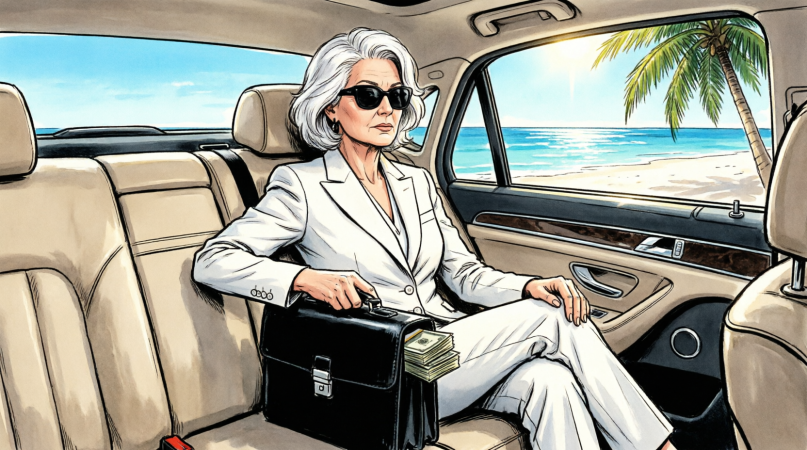
That night I made the bravest decision of my life: to disappear. And to take with me all the money I had left…
I didn’t cry. I didn’t scream. I just went up to my room, closed the door, and sat on the edge of the bed where my husband and I used to sit together to talk about our daughter’s future. “Take care of Lily,” were the last things he asked of me before he died. I did it my whole life. But that night I understood that there was someone I never took care of: myself.
I took the small box out from under the bed. Inside were the documents: the house title, the papers for a plot of land in Batangas that my husband had inherited, and the bank books I had been silently filling out for many years. Lily didn’t know that, in addition to this house, I owned two rental apartments in Marikina . She didn’t know that I hadn’t spent the money her father left me; I had made it grow. She thought her mother was just an old woman living off her pension.
I barely smiled. Not out of revenge, but because I finally had a clear decision.
The next day, while Lily was taking the children to school, I called the family lawyer. Just a week earlier, he had asked me if I wanted to amend my will. At the time, I hesitated. Now, my mind was completely clear.
“Sir,” I told him over the phone, “I’m going to sell the house. Everything. And I want us to resolve this immediately.”
She didn’t ask many questions. She knew me as a woman who doesn’t make decisions lightly.
In a month, I sold the house for even more than I expected. Then I sold the apartments. The land in Batangas was bought by a businessman who had wanted it for some time: I accepted his offer. I did it all quietly. In front of Lily, I remained calm, as if nothing had changed.
One night, while they were having dinner in the dining room and I was eating separately at a small table in the kitchen, I spoke.
—Lily —I said calmly—, I already sold the house.
She froze.
—What? Mom, how come you sold the house?
—There’s a new owner now. We have two weeks before we move out permanently.
His face lit up with rage.
—Mom, you can’t decide something like that without telling me! Where are we going to go?
“Shall we go?” I repeated slowly. “You and the children will find a place to rent. You have plenty of time.”
“And my inheritance?” she blurted out the truth. “That was all we had left!”
I looked directly at her. For the first time, I didn’t avoid her gaze.
—Did you really think, Lily, that I let you in here so you could wait for me to die?
He was unable to answer.
“That money,” I continued, “your father and I worked for. It’s not a prize for someone who doesn’t know how to respect.”
His hands were trembling.
—You can’t do this to me.
I smiled, not with anger, but with deep sadness.
—You already did something worse to me.
Two weeks later, I left before they woke up. I only took a small suitcase. All the money—now in a new account solely in my name—was ready. I had a ticket to Palawan . There, on a quiet beach, I had bought a small house without her knowing.
I didn’t leave any drama. Just one card on the table.
“Lily, I love you. But I didn’t live seventy years to feel disgusting in my own home. It’s time to choose me. I hope that one day you learn to respect the hands that once cared for you.”
In Palawan, the air was different: salty, free. In the mornings, I walked along the seashore. In the afternoons, I read in the shade of the coconut palms. There were neighbors my age, widows too, who had learned to start over. They didn’t know me as “a disgusting old woman.” They knew me as Margarita: a woman who knows how to plant roses and cook a delicious adobo.
Three months passed before Lily called.
“Mom…” her voice was soft on the other end of the line. “We have nowhere to live anymore. The owner of the place we were renting kicked us out. I don’t know what to do.”
I listened to her in silence. I didn’t rush.
—Lily —I finally said—, do you have a job yet?
—Yes… I have a part-time one.
—Good. That means you can get through this.
She cried.
—Mom, forgive me.
I closed my eyes for a moment. I remembered little Lily, the one who was afraid of the dark and clung to my clothes. I still loved that little girl.
“I forgive you,” I replied. “But respect is learned. It’s not demanded.”
I didn’t let her come back. I didn’t give her any money either. Instead, I helped her find a cheap apartment through a friend who works as an agent. That was the help I could give her: not like a bank, but like a mother with limits.
For the first time in a long time, my nights were peaceful. I didn’t disappear to seek revenge. I disappeared to live.
And if one day my daughter’s heart truly changes, she will know where to find me: not as an inheritance to be collected, but as a mother who decided not to allow her dignity to be trampled on.
At seventy, I finally learned something: loving doesn’t mean forgetting yourself. And the money? That wasn’t the only thing she lost.
Part 3
That wasn’t the only thing she lost.
Six months after I moved to Palawan, life had settled into a rhythm that felt almost unfamiliar. Peace had become normal.
I woke with the sunrise.
I drank coffee on my porch overlooking the sea.
I tended to a small garden behind my house.
And for the first time in decades, I lived a day without someone demanding something from me.
Then one afternoon, while I was trimming a hibiscus bush, my phone rang.
The screen showed a number I didn’t recognize.
Normally, I would have ignored it.
Something told me not to.
“Hello?”
The voice on the other end was shaky.
“Mrs. Ellington?”
“Yes?”
“My name is Anna. I work at Saint Gabriel Learning Center.”
I frowned.
“That’s where my grandchildren go to school.”
There was a pause.
“Yes, ma’am. I’m calling because I think there’s something you should know.”
A strange feeling crawled into my stomach.
“What happened?”
The woman hesitated.
“I’m sorry if this isn’t my place, but your grandson Ethan has been asking for you almost every day.”
My hand tightened around the phone.
“He has?”
“Yes. He keeps bringing an old photograph of you to school.”
For a moment, I couldn’t speak.
The photograph.
I already knew which one.
A faded picture taken twelve years earlier.
Ethan sitting on my lap while feeding ducks at Luneta Park.
“I thought you should know,” the teacher continued softly. “He misses you very much.”
When the call ended, I sat alone on the porch for a long time.
Because for months, I had convinced myself that the children were better off without me.
That maybe they had forgotten.
Apparently, they hadn’t.
Two weeks later, another call came.
This time it was Lily.
Her voice sounded different.
Not softer.
Exhausted.
“Mom.”
“Yes?”
“I got served with papers today.”
“What papers?”
Silence.
Then she whispered:
“Emma is suing me.”
I closed my eyes.
Of course she was.
My sister Emma had always been good at smelling money.
The moment she learned I had sold everything, she became obsessed.
Apparently, Lily had borrowed money from her during the months after I left.
A lot of money.
Money she couldn’t repay.
“How much?” I asked.
“Almost two million pesos.”
I nearly dropped the phone.
“Lily… what did you do?”
She started crying.
For several minutes she could barely form a sentence.
Eventually the truth came out.
After I left, she had continued living exactly as before.
Private schools.
Designer handbags.
Restaurant meals.
Credit cards.
Online shopping.
For months she convinced herself she would somehow gain access to my money eventually.
That I would soften.
That I would rescue her.
That I would die.
And when none of those things happened, the debt buried her.
“I thought you’d come back,” she admitted through tears.
The words struck me harder than any insult she had ever thrown at me.
Not because they were cruel.
Because they were honest.
She had never expected me to choose myself.
She had spent her whole life believing her mother would always sacrifice everything.
Even dignity.
Even peace.
Even happiness.
For her.
“I can’t help you financially,” I said quietly.
“Mom—”
“No.”
The word came out firmer than I expected.
For years I had been afraid of disappointing my daughter.
Now I was finally learning that disappointment doesn’t kill people.
Enabling them sometimes does.
She cried harder.
Then she hung up.
Three days later, Ethan called.
Not Lily.
My grandson.
“Grandma?”
The moment I heard his voice, my eyes filled with tears.
“Hello, sweetheart.”
“Mom doesn’t know I’m calling.”
I laughed softly.
“That sounds serious.”
“It is.”
“What is it?”
There was a pause.
Then he asked the question that shattered me.
“Did we lose you forever?”
I covered my mouth.
Because children don’t know how to hide behind pride.
They only know how to tell the truth.
“No,” I whispered.
“You didn’t?”
“No, sweetheart.”
“Then why did you leave?”
I looked out toward the ocean.
The waves rolled quietly against the shore.
How do you explain betrayal to a child?
How do you explain dignity?
How do you explain that sometimes the people we love hurt us the most?
Finally I answered.
“Because Grandma was very sad.”
Another silence.
Then he said:
“Mom is sad now too.”
The words hung between us.
I knew they would.
Pain travels through families.
One generation passes it to the next unless someone chooses to stop it.
That night I didn’t sleep.
I kept thinking about Ethan.
About Lily.
About the little girl who once held my hand crossing busy streets.
The little girl who had become a woman I barely recognized.
The next morning I called my lawyer.
“Mr. Santos,” I said.
“Yes, Mrs. Ellington?”
“I want to create a trust.”
“A trust?”
“Yes.”
“For whom?”
I smiled.
“For my grandchildren.”
He was quiet for several seconds.
Then he understood.
The money would never become a reward for greed.
But neither would it become a weapon.
My grandchildren would receive help for education, medical care, and their future.
Protected.
Secure.
Beyond anyone’s reach.
Including Lily’s.
When the paperwork was finished, I felt lighter than I had in years.
For the first time, my wealth finally had a purpose.
Not inheritance.
Not punishment.
Protection.
A month later, there was a knock on my door.
I opened it.
And froze.
Lily stood there.
Thinner.
Older.
The arrogance was gone.
Behind her stood Ethan and Sophie.
Neither child waited.
They ran straight into my arms.
I nearly fell backward.
“Grandma!”
I held them tightly.
So tightly.
As if I could make up for every missed birthday, every missed hug, every lost month.
When I finally looked up, Lily was crying.
Not dramatic tears.
Not manipulative tears.
The quiet kind.
The kind that come when a person has finally run out of excuses.
“I was wrong, Mom.”
I didn’t answer.
“I was cruel.”
Still I remained silent.
“I treated you like you were already gone.”
Her voice broke.
“And then you left… and I realized I had become the kind of person I would never want my own children to become.”
For a long moment neither of us moved.
Then I asked the only question that mattered.
“Why did you really come here?”
She lowered her eyes.
“Not for money.”
I waited.
“Because Ethan wouldn’t stop asking for his grandmother.”
The truth.
Simple.
Uncomfortable.
Real.
And somehow that meant more than any perfect apology.
I stepped aside.
“Come in.”
The children rushed inside.
Lily hesitated.
“Does this mean everything is forgiven?”
I looked at her carefully.
Then I shook my head.
“No.”
The pain in her eyes was immediate.
But I continued.
“Forgiveness happened months ago.”
A tear slid down her cheek.
“What hasn’t happened yet,” I said softly, “is rebuilding trust.”
She nodded.
Because for the first time in her life, she understood the difference.
And as the sun set over the Palawan shoreline, my family sat together on the porch.
Not healed.
Not fixed.
But finally honest.
Sometimes that is where real families begin.
Not when everything is perfect.
But when the lies finally end.

