PART 2
Blake Harrington had built his entire life on control.
Control of boardrooms.
Control of markets.
Control of headlines.
Control of people.
But in that moment outside O’Hare International Airport, with exhaust drifting through the cold Chicago air and three little boys clinging to me like I was the center of their universe, he looked like a man watching the ground disappear beneath his feet.
The oldest boy, Noah, noticed him first.
He was five, sharp-eyed, serious, and far too observant for his age.
“Mom,” he whispered, tightening his grip around my hand. “Who is that man?”
I swallowed.
The question landed like a stone in my chest.
Blake heard it.
His eyes flicked from Noah to Liam, then to Oliver, the youngest, who had buried his face against my coat. Blake’s face changed with every second he looked at them. Shock gave way to disbelief. Disbelief gave way to recognition. And recognition slowly turned into horror.
Not fear for himself.
Not yet.
Fear of the truth.
I crouched, smoothing Oliver’s hair away from his forehead.
“Boys,” I said softly, “this is someone I used to know.”
Blake flinched.
Someone I used to know.
The phrase was small.
Cruel, maybe.
But after everything he had said on that flight, after years of silence and suspicion and the way he had looked at me like I was a chapter he had already judged and closed, I could not bring myself to be kinder.
Liam, the middle one, squinted up at him.
“He looks like us.”
The curb seemed to fall silent.
Even the driver standing beside the Bentley lowered his gaze.
Blake took another step forward.
“Emma,” he said again.
There was something broken in his voice now.
I stood.
“Not here.”
His jaw tightened. “Are they mine?”
The question came out harshly, but not because he was angry. Because if he asked gently, he might fall apart.
Noah looked up at me.
“Mom?”
I placed a hand over his shoulder.
“Get in the car, sweetheart.”
“But—”
“Now, please.”
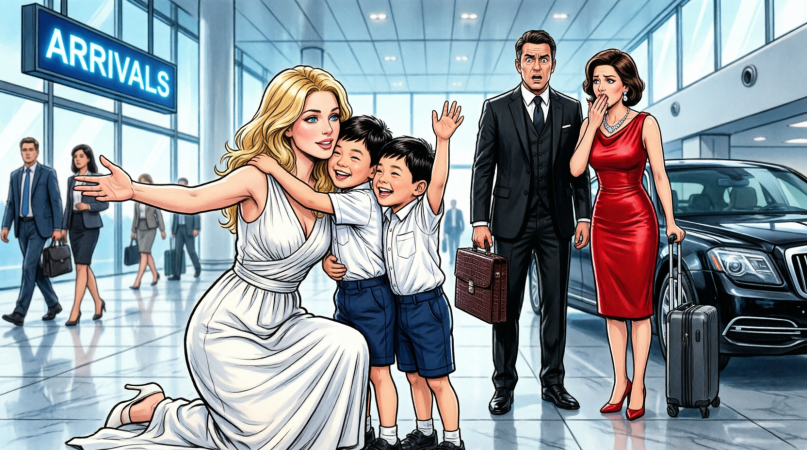
My boys knew that voice. Not angry. Not impatient. The voice that meant the world had become complicated and I needed them safe.
One by one, they obeyed.
Noah helped Oliver climb in. Liam paused at the door and looked back at Blake again.
“You have our hair,” he said.
Then he climbed into the Bentley.
The door closed softly.
Blake stared at the tinted window.
“Emma,” he said, barely above a whisper. “Tell me.”
I looked at him then. Really looked at him.
The man I had married had once known how to laugh without calculating who was watching. He had once kissed me in laboratories at two in the morning, when we were exhausted and covered in dust from prototype casings. He had once promised that no matter how big the company became, no matter how loud the world got, he would always listen to me first.
That man had vanished long before the divorce papers were signed.
Or maybe he had been standing in front of me all along, buried beneath pride and inherited arrogance and the Harrington family’s talent for turning every wound into a weapon.
“Yes,” I said.
The word struck him harder than any slap could have.
His mouth parted. Nothing came out.
“They’re yours,” I continued. “All three.”
He looked back at the car, then at me.
“Triplets?”
“Yes.”
He blinked slowly, as if his mind could not hold the truth all at once.
“Five years,” he said.
I said nothing.
“You had my sons for five years?”
“Our sons.”
His eyes flashed.
“You never told me.”
That almost made me laugh.
Not because anything was funny.
Because pain, when pressed too hard, sometimes came out sounding like madness.
“I tried.”
His expression hardened, instinctively defensive.
“No, you didn’t.”
“Yes, Blake. I did.”
“No.” He shook his head. “I would have known.”
“You didn’t want to know.”
His gaze cut into me. “Don’t do that. Don’t rewrite history.”
Something inside me snapped quietly.
“Rewrite history?” I repeated. “You sat beside me on that plane for two hours and accused me without once asking the right question. Five years ago, you did the same thing. You found messages, decided I betrayed you, and turned our life into a courtroom before I could even breathe.”
“Those messages were from a man saying he couldn’t wait to see you. That he missed you. That you needed to tell me.”
I closed my eyes briefly.
Dr. Elias Monroe.
The name still carried the echo of hospital corridors, antiseptic, fear, and hope.
“He was my doctor, Blake.”
Blake went still.
I watched the color drain from his face again.
“My fertility specialist,” I said. “The messages were about the pregnancy.”
For a moment, he looked genuinely confused.
Then his brows drew together.
“But we weren’t—”
“No,” I said. “We weren’t trying anymore. You decided we were too busy. You said a baby would come when the timing was right. But after the second miscarriage, I kept going to appointments alone because every time I mentioned it, you looked like you were checking your calendar in your head.”
His lips parted.
I knew he remembered.
The first miscarriage had broken us quietly.
The second had broken something deeper.
After that, Blake stopped talking about children. He buried himself in Harrington Energy’s expansion. I buried myself in research, treatments, and grief I had no language for.
“When I found out I was pregnant again,” I said, “I was terrified. I wanted to be sure before I told you. Elias was helping monitor everything. That’s what the messages were.”
Blake stared at me as if every word rearranged the world.
“You should have told me.”
“I was going to.” My voice lowered. “That night.”
The night.
Our penthouse.
His rage.
My phone in his hand.
The accusation in his eyes.
The words he never took back.
“You called me a liar,” I said. “You called me unfaithful. You told me anything that came from me was poisoned.”
His face tightened.
“I was angry.”
“I was pregnant.”
His throat moved.
“Why didn’t you tell me then?”
“I tried.” My voice trembled despite myself. “You walked out before I could. Then your lawyer called me the next morning.”
He looked away.
Cars moved past us. A horn blared somewhere behind the line of waiting vehicles. Life kept going, indifferent to the ruin opening between us.
“I sent a letter,” I said.
His eyes returned to mine.
“What letter?”
“To your office. To your penthouse. To your attorney. I sent medical records. Ultrasound confirmation. Everything.”
“No,” he said. “I never got anything.”
“I know.”
His eyes narrowed. “What does that mean?”
Before I could answer, the Bentley’s rear window lowered.
Noah’s small face appeared.
“Mom, Oliver’s crying.”
Every instinct in me shifted.
The past could wait.
My children could not.
I turned away from Blake.
“We’re leaving.”
“No.” Blake reached for my arm but stopped himself before touching me. “Emma, wait. We need to talk.”
“We do. But not on an airport curb.”
“Where are you staying?”
I hesitated.
That hesitation was enough. Blake noticed.
His expression sharpened, the businessman returning because panic needed somewhere to hide.
“You live here.”
“I have a house outside the city.”
“With them.”
“Yes.”
His jaw clenched.
“I’m coming with you.”
“No, you’re not.”
“They’re my sons.”
“They are five years old,” I said. “And two minutes ago, they didn’t know you existed.”
His face twisted.
That hurt him.
Good, some cold part of me thought.
Then I hated myself for thinking it.
“They should have known,” he said.
“Yes,” I replied. “They should have.”
The words ended the argument, at least for that moment.
I opened the Bentley door and climbed inside. Oliver immediately crawled into my lap, his little body trembling.
“Who is he?” he whispered.
I kissed his forehead.
“A man from before you were born.”
“Is he bad?”
I glanced through the window.
Blake stood by the curb alone, surrounded by his luggage, his wealth, his waiting black SUV, and the first consequence he could not buy his way out of.
“I don’t know anymore,” I said.
The driver pulled away.
For several seconds, none of the boys spoke.
Then Liam leaned forward.
“He looked sad.”
Noah crossed his arms. “He looked guilty.”
Oliver sniffed. “Does he know Spider-Man?”
Despite everything, I laughed.
That was how motherhood saved me over and over. It dragged me out of old pain and back into small, urgent things. Snacks. Seat belts. Superheroes. Wet mittens. Lost socks. Bedtime stories told in three different voices.
Blake had thought I was alone.
He had no idea I had spent five years surrounded by life.
Messy, loud, beautiful life.
The house sat in Winnetka, tucked behind iron gates and old trees that shielded it from the road. It wasn’t Harrington money that bought it. That mattered to me more than I ever admitted.
After the divorce, I had left New York with nothing but my research notes, my medical files, and the kind of heartbreak that made breathing feel like labor. I moved to Illinois because a former colleague offered me a position at a private research institute. What began as consulting became patents. Patents became partnerships. Partnerships became a company.
Winters Biotech was not as famous as Harrington Energy.
Not yet.
But it was mine.
No boardroom had been handed to me by a father. No legacy carried my name before I earned it. Every brick, every lab, every contract had been built while pregnant with triplets, then nursing three newborns, then answering investor calls with a baby monitor blinking beside my laptop.
I had not survived Blake.
I had become someone he no longer knew how to measure.
Inside the house, my mother was waiting.
Margaret Winters took one look at my face and knew.
“What happened?”
The boys rushed past her toward the kitchen, already demanding pancakes despite having eaten on the plane.
I removed my coat slowly.
“Blake was on the flight.”
Her expression froze.
“Oh, Emma.”
“He saw them.”
Her hand rose to her mouth.
For five years, my mother had carried my secret with me. Not because she thought Blake deserved ignorance. She had wanted me to fight him. To hire louder lawyers. To walk into Harrington Tower with three birth certificates and a judge’s order.
But then the letters disappeared.
Then the phone calls were blocked.
Then a private investigator I hired found evidence that someone inside Blake’s circle had intercepted my attempts to reach him.
And by then, I was seven months pregnant and nearly hospitalized twice.
So I chose peace.
Or maybe I chose survival and called it peace.
“He asked if they were his,” I said.
“What did you say?”
“The truth.”
My mother closed her eyes.
“Then it begins.”
I looked toward the kitchen, where Liam was telling Oliver that pancakes tasted better when shaped like dinosaurs.
“Yes,” I whispered. “It begins.”
Blake called seventeen times that afternoon.
I didn’t answer.
He texted once.
We need to talk. Please.
That please did more to unsettle me than any threat could have.
Blake Harrington did not say please unless something inside him had cracked.
At 6:12 p.m., my security system chimed.
A black SUV had stopped outside the gate.
I watched the camera feed from the study.
Blake stood in the cold wearing the same coat from the airport. No entourage. No assistant. No lawyer visible. Just him.
My mother stood behind me.
“You don’t have to let him in.”
“I know.”
“But you will.”
I looked at the screen.
His shoulders were hunched against the wind. Snow had begun to fall lightly, catching in his dark hair. He looked up toward the camera as if he knew I was watching.
“I need answers too,” I said.
I opened the gate.
He did not enter the house immediately.
When the front door opened, he stood on the porch and looked past me into the warm hallway. Family photographs lined the wall. The boys at the beach. The boys covered in finger paint. The boys asleep in a pile on the sofa. Three lives documented in frames.
Blake saw them.
His face shifted again.
Pain.
A quiet, devastating kind.
“Come in,” I said.
He stepped inside like a stranger entering a church.
From the living room came the boys’ voices.
“Grandma, Oliver took my red car!”
“I didn’t take it, I borrowed it forever!”
Blake’s mouth trembled.
He looked at me, and for the first time since I had known him, the billionaire mask was completely gone.
“What are their names?”
“Noah James. Liam Alexander. Oliver Blake.”
His eyes closed at the last name.
I hated that I had given our youngest his name.
I hated more that I had never regretted it.
“You named one after me,” he said.
“He was the smallest,” I replied. “He almost didn’t make it. I needed something to believe he would be strong.”
Blake gripped the edge of the entry table.
“You went through that alone?”
“No,” I said. “I had my mother. Doctors. Friends.”
“You know what I mean.”
“Yes.”
Silence stretched between us.
Then he said, “Show me the letters.”
I led him to the study.
The room had always been my refuge. Dark shelves. A wide desk. Files arranged with the precision of someone whose life once depended on documentation.
I opened a locked drawer and removed a folder.
Blake stared at it.
“You kept everything.”
“I learned to.”
I handed him the first copy.
Certified mail receipt.
Delivered to Harrington Tower.
Five years earlier.
His eyes moved across the page.
Then the next.
A letter addressed to his attorney.
A copy of my ultrasound.
A medical statement confirming pregnancy.
Three embryos. High-risk.
Request for immediate contact.
Blake sat down slowly.
He read in silence.
With each page, something in him seemed to collapse.
“I never saw these,” he said.
“I believe you.”
He looked up sharply.
That surprised him.
I folded my arms.
“I didn’t, at first. For years, I thought you ignored them. Then I learned someone made sure you never received them.”
“Who?”
“I don’t know.”
His eyes darkened.
There he was again. The man who could tear apart companies with a phone call. But this time the fury was not aimed at me.
“My lawyer,” he said.
“Maybe.”
“Richard Vale handled the divorce.”
“I know.”
Blake’s jaw flexed.
“He told me you wanted nothing from me. That you disappeared with some man from the lab.”
“Convenient.”
His eyes lifted.
“I believed him.”
“I know.”
“I wanted to believe him.”
That honesty cut deeper than denial.
He looked down at the ultrasound image.
The first picture of our sons.
Tiny. Fragile. Unformed.
“They were real,” he whispered.
“They were always real.”
Before he could respond, a small knock came at the study door.
It opened before I answered.
Noah stood there in dinosaur pajamas, solemn as a judge.
“Mom, Grandma says not to bother you, but Oliver put syrup in his hair.”
I sighed. “Of course he did.”
Noah’s gaze shifted to Blake.
For a moment, father and son stared at each other.
Noah was the most like him. Not just in looks. In stillness. In the way he watched before speaking.
“Are you the man from the airport?” Noah asked.
Blake stood carefully, as if sudden movement might scare him away.
“Yes.”
“Why are you here?”
Blake glanced at me.
I gave him nothing.
He crouched to Noah’s level.
“Because I knew your mom a long time ago.”
Noah considered that.
“Did you make her sad?”
The question pierced the room.
Blake inhaled slowly.
“Yes,” he said. “I did.”
Noah’s eyes narrowed.
“Don’t do it again.”
Then he turned to me.
“Oliver’s hair is really sticky.”
I followed him out, leaving Blake alone with the folder.
By the time the syrup crisis was resolved, the boys were too curious to stay away.
They peeked around corners.
They whispered.
They argued over whether Blake was famous.
Liam claimed he had seen him on a magazine at the dentist. Noah said that didn’t count because Liam also thought a toothpaste ad was a movie poster.
Oliver, freshly bathed and smelling like lavender shampoo, wandered into the living room carrying a stuffed elephant.
He stopped in front of Blake.
“Are you rich?”
Blake blinked.
I pressed my lips together.
“Yes,” Blake said carefully.
Oliver nodded. “Do you have a rocket?”
“No.”
“A dragon?”
“No.”
“Then not that rich.”
For the first time all day, Blake laughed.
It was small and stunned, but real.
Oliver climbed onto the sofa beside him without permission, because Oliver belonged to every room he entered.
“I’m Oliver,” he announced.
“I know,” Blake said softly.
“You know me?”
“I know your name.”
Oliver studied him.
“You look like my brothers.”
Blake’s eyes shimmered.
“I’ve been told that.”
Liam came next, carrying two toy cars.
“You can play, but Noah makes rules and gets mad if you don’t follow them.”
“I do not,” Noah said from the doorway.
“You do.”
“Rules matter.”
Blake looked at Noah, and something like recognition moved across his face.
“Yes,” he said quietly. “They do.”
I watched from near the fireplace, my arms wrapped around myself.
This was the part I had feared.
Not Blake’s anger.
Not lawyers.
Not headlines.
This.
The impossible tenderness of seeing him with them.
The boys did not know enough to hate him. They did not know abandonment. They did not know intercepted letters, broken vows, pride, suspicion, or the nights I had cried silently over three cribs because I could not understand how love had turned so completely into absence.
To them, he was new.
A tall stranger with their face.
And children, unlike adults, are willing to wonder before they judge.
An hour passed.
Then another.
Blake sat on the rug in his designer suit while three boys explained a complicated race involving toy cars, a wooden train track, and a stuffed elephant named Captain Muffin.
He listened like a man starving.
At bedtime, Oliver asked if the “airport man” could hear the dragon story too.
I almost said no.
Then I saw Blake’s face.
So I read.
The boys curled beneath their blankets while Blake stood near the door, hands in his pockets, silent. When I reached the part where the dragon guarded a mountain of stars, Liam interrupted to ask whether dragons could be allergic to peanut butter.
Blake answered before I could.
“Only if they’re very unlucky.”
The boys giggled.
I continued reading, but my voice wavered.
Because once, long ago, I had imagined this.
Not exactly this room. Not this house. Not this broken path.
But Blake leaning in a doorway while our children drifted toward sleep.
A dream delayed can sometimes hurt more than a dream destroyed.
When the boys finally slept, I closed their door halfway and turned.
Blake stood in the hallway.
Tears had fallen silently down his face.
He did not wipe them away.
“I missed everything,” he said.
I wanted to be cruel.
I wanted to say yes.
First steps.
First fevers.
First words.
First day of preschool.
Three birthdays.
Three favorite colors changing every month.
Loose teeth.
Nightmares.
The way Oliver needed two kisses, never one.
The way Liam sang when he was nervous.
The way Noah pretended not to need comfort but leaned against me whenever the world felt too big.
Blake had missed all of it.
But the truth was already standing between us, fully armed.
So I said nothing.
Downstairs, my mother had left tea on the counter and vanished discreetly to her room.
Blake and I sat across from each other in the kitchen.
The same kitchen where I had built a life out of exhaustion and determination.
He looked too large for it somehow. Not physically. Historically. Like a piece of my old world had been dragged into my new one and did not know where to stand.
“I want a paternity test,” he said.
The words were careful.
I smiled faintly.
“There he is.”
His face tightened. “Emma—”
“No, it’s fine. You’re entitled to certainty.”
“I didn’t mean it as an insult.”
“You rarely do.”
He looked down.
“I deserve that.”
“You deserve worse.”
“Yes.”
That stopped me.
Blake Harrington agreeing with me was unfamiliar enough to feel suspicious.
He leaned forward.
“I need to know who kept this from me.”
“So do I.”
“Did you investigate?”
“Yes.”
“And?”
I hesitated.
The answer had lived in the back of my mind for years, half-formed and dangerous.
“I found patterns,” I said. “Not proof.”
“What patterns?”
“Your lawyer intercepted the letters. But he may not have acted alone. Someone paid a courier service to redirect documents. Someone accessed my old medical portal after the divorce filing. Someone requested copies of my records using forged authorization.”
His face hardened with every sentence.
“Who had access?”
“You tell me.”
He looked away.
I knew the names running through his mind.
Richard Vale, his attorney.
Grant Harrington, his father.
Vivian Harrington, his mother.
Celeste Ward, the family’s public relations strategist, who had always smiled like she was choosing where to place the knife.
And then there was Claire.
Claire Ashford.
Blake’s childhood friend. Later his chief operating officer. Always elegant. Always patient. Always nearby after our marriage began to crumble.
I had never accused him of having an affair with her.
I had refused to become what he had made of me.
But I had eyes.
“Claire knew about the messages,” Blake said suddenly.
My heart slowed.
I kept my face still.
“How?”
“She was there the night after I left the penthouse. I showed her screenshots.”
Of course he had.
The humiliation found a new place to burn.
“You showed another woman private messages from my doctor?”
“I thought—”
“You thought I was cheating.”
His mouth closed.
“And she encouraged that?”
He did not answer quickly enough.
I laughed once, without humor.
“Of course.”
“She told me I needed to protect myself.”
“From your pregnant wife.”
“I didn’t know.”
“You didn’t ask.”
His eyes lifted to mine, raw with anger and grief.
“I know.”
The kitchen fell silent.
Snow tapped lightly against the windows.
Then Blake’s phone rang.
He looked at the screen and went still.
I knew before he turned it around.
Claire Ashford.
Her name glowed between us like an old accusation.
“Answer it,” I said.
Blake hesitated.
“Answer it.”
He accepted the call and placed it on speaker.
“Blake?” Claire’s voice filled the kitchen, smooth and intimate. “Where are you? The Chicago investors are waiting. Your driver said you dismissed him at the airport.”
Blake looked at me.
“I had something personal come up.”
A soft pause.
“Personal?”
“Yes.”
“Is everything all right?”
“No.”
Another pause.
Then her voice changed, just slightly.
“Did you see Emma?”
There it was.
Not surprise.
Not curiosity.
Calculation.
My fingers tightened around my mug.
Blake’s eyes sharpened.
“Why would you ask that?”
Claire laughed lightly. “You were on the same flight manifest. Richard mentioned it this morning. I assumed it might be awkward.”
Richard mentioned it.
Blake mouthed the name silently.
I felt cold move through me.
“Richard knew?” Blake asked.
“Of course. He handles travel coordination when legal overlaps with investor meetings.”
Blake’s voice became dangerously calm.
“Claire, did you know Emma had children?”
Silence.
It lasted one second too long.
Then Claire said, “What?”
Not convincing.
Not to either of us.
“Answer me,” Blake said.
“I don’t understand the question.”
“Did you know?”
“Blake, where are you?”
His hand curled into a fist on the table.
“At Emma’s house.”
This time, Claire did not speak.
When she did, her voice had lost its softness.
“That is a mistake.”
My pulse quickened.
Blake leaned closer to the phone.
“Why?”
“Because she has always known how to manipulate you.”
I almost smiled.
Five years, and the script had not changed.
Blake’s eyes flicked to me, then away.
“She sent letters,” he said. “Medical documents. Ultrasounds.”
“That’s what she told you?”
“I’m holding them.”
Claire inhaled softly.
“Blake, listen to me carefully. Do not make decisions while you’re emotional. You know what she did to you.”
“What did she do, Claire?”
“She lied.”
“About what?”
“She vanished. She refused settlement. She made herself look noble so you would look cruel.”
Blake’s voice dropped.
“Did you intercept the letters?”
The silence that followed was different.
It was not confusion.
It was assessment.
“Blake,” Claire said slowly, “you need to come back to the hotel.”
“Answer the question.”
“Some things were handled to protect you.”
The room went utterly still.
My breath caught.
Blake looked as if he had been struck.
“What does that mean?”
“It means your father was right,” Claire said, her voice suddenly sharper. “You were vulnerable. She had influence over you. Too much influence. The company was preparing for international expansion. A scandal over a disputed pregnancy would have destroyed everything.”
A sound escaped me.
Not a sob.
Not a laugh.
Something in between.
Blake stood so abruptly the chair scraped against the floor.
“A disputed pregnancy?” he repeated.
“You had no proof they were yours.”
“They are my sons.”
Another silence.
Then Claire said, “So she got to you.”
Blake’s face changed.
It was terrible to watch.
He had spent five years believing I had betrayed him. In one day, that belief had begun to die. But something worse was being born in its place.
The knowledge that people he trusted had chosen his life for him.
“Who else knew?” he asked.
Claire did not answer.
“Was it Richard?”
“Come back to the hotel.”
“Was it my father?”
“Blake—”
“Was it my father?”
The line clicked.
She had hung up.
For a long moment, neither of us moved.
Then Blake picked up the phone and hurled it against the wall.
It shattered near the pantry.
I startled despite myself.
Upstairs, one of the boys stirred.
Blake froze.
The rage drained from him instantly, replaced by shame.
“I’m sorry,” he said.
I stood.
“Keep your voice down.”
He pressed both hands to the counter and lowered his head.
“I’m sorry,” he repeated, quieter. “Emma, I didn’t know.”
I looked at the broken phone on the floor.
“No,” I said. “But part of you chose not to.”
He closed his eyes.
That was the truth neither of us could escape.
No conspiracy could erase his cruelty.
No intercepted letter could erase the fact that when our marriage stood at the edge, he pushed.
“I can’t fix five years,” he said.
“No.”
“But I want to know them.”
My heart gave a painful twist.
“You don’t get to walk in and become their father overnight.”
“I know.”
“You don’t get to confuse them because guilt is eating you alive.”
“I know.”
“You don’t get to punish me through them.”
His head lifted.
“I won’t.”
I wanted to believe him.
That was the dangerous part.
Because once, believing Blake had been as natural as breathing.
“You’ll have to earn everything,” I said.
“I will.”
“And if you bring lawyers to my door before you bring patience, I will fight you with every resource I have.”
A faint shadow crossed his face.
“You think I’d take them from you?”
“I think I once believed you would never destroy me either.”
He absorbed that.
Then nodded.
“Fair.”
It was nearly midnight when he left.
At the door, he paused.
“Can I see them again?”
I hesitated.
The easy answer was no.
The safe answer was no.
But motherhood had taught me that love was not about what made me feel safe. It was about what my children deserved.
“They have soccer practice Saturday,” I said. “You can watch from the sidelines. No promises beyond that.”
His face softened with gratitude so intense it almost hurt to look at.
“Thank you.”
“Blake.”
He stopped.
“Don’t make me regret this.”
His expression became solemn.
“I already regret everything.”
Then he stepped into the snow and disappeared into the waiting dark.
I locked the door behind him.
For a while, I stood there, listening to the house breathe.
Then I went upstairs.
Noah was awake.
I found him sitting in bed, knees pulled to his chest.
“You heard?”
He nodded.
I sat beside him.
“Was that man yelling?”
“A little.”
“Because of us?”
“No, sweetheart.”
“Because of you?”
I brushed his hair back.
“Because grown-ups sometimes make very big mistakes and then get angry when they finally understand them.”
Noah looked toward the hallway.
“Is he our dad?”
There it was.
The question I had prepared for and dreaded for five years.
I could have delayed.
I could have softened.
But Noah hated half-truths. He sensed them like storms.
“Yes,” I said.
His eyes widened, not with joy, not with fear, but with the solemn weight of a door opening.
“Why didn’t he come before?”
My throat tightened.
“Because he didn’t know about you.”
“Why?”
“Because people kept the truth from him. And because he made mistakes too.”
Noah thought about that.
“Do we have to love him?”
Tears burned my eyes.
“No. You don’t have to feel anything before you’re ready.”
He leaned against me.
“Do you love him?”
The room seemed to tilt.
I looked at the moonlight on the floor, at the toy dinosaur near the dresser, at the life I had built from the ashes of that very question.
“I loved him once,” I said.
Noah was quiet.
Then he whispered, “That’s not what I asked.”
I closed my eyes.
Children could be merciless without meaning to.
“I don’t know,” I admitted.
Noah slipped his hand into mine.
“That’s okay. I don’t know either.”
The next morning, the world found out.
Not the whole truth.
Not yet.
But enough.
A photograph appeared online just after eight.
Blake Harrington standing outside my house in the snow.
The headline was immediate.
BILLIONAIRE BLAKE HARRINGTON REUNITES WITH EX-WIFE IN CHICAGO AFTER FIVE YEARS.
By noon, the story had multiplied.
Speculation.
Old divorce details.
Photos from our marriage.
Photos from the airport.
One blurry image showed me bending toward the boys near the Bentley. Their faces were mostly hidden, but not enough.
My blood turned cold.
I called my security team.
Then my attorney.
Then the boys’ school.
My mother watched the news in grim silence.
“They waited,” she said.
“What?”
She pointed at the screen.
The photo of Blake at my house.
“Someone knew he came here last night. They waited to release it until morning.”
Blake called from a new number.
This time, I answered.
“Tell me you didn’t leak this,” I said.
“I didn’t.”
“Can you prove that?”
“Yes.”
His voice was clipped, controlled, furious.
“I’ve already traced the first outlet. The tip came from a burner email routed through one of Richard Vale’s shell consulting accounts.”
Richard.
Again.
“Why expose it?” I asked. “If they wanted this hidden, why leak it now?”
Blake was silent for half a breath.
“Because the paternity test will come next. They’re trying to frame you before I can confirm anything.”
“As what?”
“A gold digger. A liar. A woman who hid children from a billionaire for leverage.”
I closed my eyes.
Of course.
A familiar story, polished for public consumption.
“Blake,” I said quietly, “my sons’ faces are almost online.”
“I know.”
“If this gets worse—”
“It won’t.”
“You don’t control everything.”
“I’m starting to understand that.”
Something in his voice made me pause.
He sounded different.
Not weaker.
Clearer.
“I’m holding a press conference,” he said.
“No.”
“Emma—”
“No. You will not turn my children into a media event.”
“I won’t mention them.”
“Then what will you say?”
“The truth I can say.”
“And what truth is that?”
His answer came slowly.
“That I wronged you.”
I had no reply.
He continued, “That public speculation about you is false. That any harassment toward you or your family will be met legally. That our divorce was private and should have remained private.”
“That won’t stop them.”
“No. But it will redirect them.”
“Toward you.”
“Yes.”
I looked through the window at the backyard, where the boys were building a snow fort with my mother.
“Why?”
His voice softened.
“Because five years ago, when everyone looked at you, I let them think the worst. I won’t do it again.”
It was not enough.
It could never be enough.
But it was something.
That afternoon, Blake Harrington stood before a wall of cameras in Chicago.
I watched from my study, arms wrapped tightly around myself.
He wore a dark suit and no expression.
The Harrington mask had returned, but this time it did not feel aimed at me.
“I will make one statement,” he said. “My former wife, Dr. Emma Winters, has been the subject of renewed speculation today. Let me be clear. Any suggestion that she acted dishonorably during or after our marriage is false.”
Reporters shouted.
He ignored them.
“Five years ago, I allowed private pain and misinformation to shape my judgment. Dr. Winters owes the public nothing. She owes me nothing. She is a brilliant scientist, a respected founder, and someone I failed to protect from narratives I should have corrected long ago.”
My mother turned slowly toward me.
I could not move.
Blake continued.
“Any outlet publishing images or identifying details of minors connected to this matter will hear from my legal team and hers. That is all.”
He stepped away as reporters erupted.
For several minutes, I simply stared at the blank screen after the broadcast ended.
Then my phone buzzed.
A message from Blake.
I meant every word.
Another message appeared before I could respond.
And I found something.
Attached was a scanned document.
At first, I did not understand what I was seeing.
It was a trust amendment.
Harrington Family Holdings.
Dated five years earlier.
Three weeks after our divorce filing.
My eyes moved down the page.
Clause 17.
In the event Blake Harrington produces biological heirs outside an approved marital agreement, voting control protections shall be enacted to prevent dilution of Harrington family authority.
My heart began to pound.
Below it was a signature.
Grant Harrington.
Blake’s father.
Then a handwritten note, photographed separately.
Richard,
Ensure no claim of pregnancy survives discovery. If she has proof, bury it. Blake cannot be distracted before the merger vote.
G.H.
I read it once.
Then again.
Then a third time.
My hands went numb.
Blake called.
I answered but could not speak.
“Emma,” he said, voice low and shaken. “My father knew.”
I looked through the glass at my sons in the snow.
Noah was laughing now, his serious little face transformed. Liam threw himself dramatically into a snowbank. Oliver stood in the middle of the yard with his arms raised, declaring victory over everyone.
For five years, I had believed Blake’s pride destroyed us.
But pride had only opened the door.
Someone else had walked through it.
“Emma,” Blake said again. “There’s more.”
I gripped the phone.
“What more?”
His breathing was uneven.
“The merger vote wasn’t the only reason. My father transferred something the same week your letters disappeared. A private account. Ten million dollars.”
“To Richard?”
“No.”
A coldness spread through me before he said the name.
“To Dr. Elias Monroe.”
The room tilted.
Elias.
My doctor.
The man whose messages had ended my marriage.
The man who had held my hand after the first ultrasound showed three heartbeats.
The man who disappeared from the clinic two months before my delivery.
Blake’s voice came through the phone, distant and urgent.
“Emma, did Monroe ever tell you why he left Chicago?”
I stared at the boys outside.
At Oliver Blake Harrington, alive because Elias had once sworn he would do everything possible to save him.
“No,” I whispered.
A black sedan rolled slowly past the front gate.
Too slowly.
My security lights flickered on.
Then my phone buzzed with a message from an unknown number.
No text.
Just a photo.
It showed my boys in the backyard.
Taken seconds ago.
Underneath it were seven words.
Blake was never the only one lied to.
My blood turned to ice.
Outside, Noah stopped laughing.
He turned toward the trees beyond the fence, as if he had heard something none of us could.
Then the house alarm began to scream.
…If you want to know what happened next, please type “YES” and like for more.