My appendix ruptured at 2 a.m., and I called my parents seventeen times before the world began to blur.
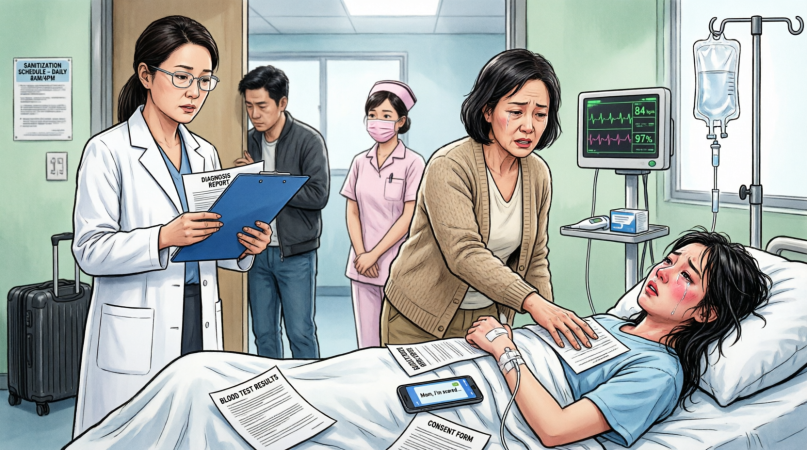
My mother finally texted back, “Your sister’s baby shower is tomorrow. We can’t leave now.”
My name is Holly Crawford.
I was twenty-six when I learned that betrayal does not always slam a door.
Sometimes it lets the phone ring.
Sometimes it arrives in a short gray text bubble, clean and practical, as if your pain is a scheduling problem.
At 2:14 a.m., I was lying on the kitchen floor of my apartment with my cheek pressed against cold tile and my phone glowing inches from my face.
The apartment smelled like lemon cleaner because I had mopped after work, too tired to do a good job but too anxious to leave the floor sticky.
The refrigerator hummed.
Somewhere outside, a pickup rolled over a speed bump and rattled like loose change.
I had been trying to convince myself the pain was food poisoning.
Then it sharpened.
It did not rise and fall anymore.
It stayed.
I called my mother first because that is what I had done my entire life, even when I already knew she might not answer.
Her phone rang until voicemail.
I called again.
Then I called my father.
His message played in the same steady voice he used for clients and delivery drivers.
“I’m either away from my desk or on the other line…”
I remember hating how normal he sounded.
I remember wanting to scream at that recorded version of him because the real one was probably asleep two towns over, in the same house where my mother had arranged pink napkins for my sister Ashley’s baby shower.
I called Mom again.
Then Dad again.
By the seventh call, I had started sweating through my T-shirt.
By the tenth, I was curled so tightly that my knees pressed against my stomach and made everything worse.
By the seventeenth, I could not sit up without black sparks crowding the edges of my vision.
The text came at 2:31 a.m.
“Your sister’s baby shower is tomorrow. We can’t leave now.”
I stared at it until the letters blurred.
I had helped pay for those cupcakes.
That was the ridiculous thing my brain chose to hold onto.
Three days earlier, Mom had called me from the grocery store parking lot, voice tight with embarrassment, saying the bakery wanted the balance before pickup.
Ashley could not know.
Dad would be irritated.
Could I cover it just until Friday?
I had transferred the money while standing in my laundry room with a basket against my hip.
I had even told Mom not to worry.
That was the kind of daughter I had been trained to be.
Useful.
Quiet.
Available.
I typed, “I think something is really wrong.”
The little dots appeared.
Then disappeared.
No answer came.
Pain has a way of stripping life down to simple truths.
At that moment, the truth was that my mother had seen my message, measured it against a brunch party, and chosen the party.
I called 911.
The dispatcher’s voice was calm enough to hold onto.
She asked me if I was alone.
I said yes.
She asked me to unlock the door.
I crawled across the living room carpet because standing was no longer possible.
The fibers scraped my elbows, and my breathing sounded like someone else crying through a wall.
The deadbolt clicked.
That click was the first kindness of the night because it meant somebody could get in.
The paramedics arrived with radios, rubber soles, and cold air from the hallway.
One of them knelt beside me and said my name as if he had known me longer than five seconds.
“Holly, stay with us.”
I wanted to tell him I was trying.
Instead, I threw up into a plastic bag and heard someone say my blood pressure was dropping.
The ambulance ceiling was bright and narrow.
A monitor beeped near my ear.
A paramedic asked about allergies, medications, last meal, emergency contact.
I said my mother’s name.
Then I said my father’s.
Even then.
Even after seventeen unanswered calls.
Even after the text.
Hope can be embarrassing when you see it from the outside, but from the inside it just feels like survival.
At the ER intake desk, someone cut the side of my sweatshirt because I could not lift my arms.
A nurse with tired eyes put a plastic band around my wrist and asked if there was anyone they should call.
“My parents,” I whispered.
She glanced at the phone on the tray beside me.
The screen was cracked from where I had dropped it on the tile.
No new calls.
No new messages.
There was a photo notification from Ashley’s account.
In the tiny preview, my mother was standing at the dining room table, arranging pastel napkins into little fans.
The caption said, “Almost ready for our girl.”
Our girl.
I was wheeled under fluorescent lights that made every ceiling tile look exactly the same.
Someone said “rupture.”
Someone else said “OR.”
A form appeared near my face.
A pen was put into my hand.
I could not feel the pen, but I made a mark because a nurse told me she needed consent.
The last thing I remember before the operating room was the smell of antiseptic and the pressure of a mask settling over my nose.
They told me later my heart stopped.
Not for long, they said.
Doctors say things like that gently, as if time is the part that matters.
But I know what I felt.
There was no movie of my life.
No bright tunnel.
No voices from beyond.
There was only silence so complete it felt like being swallowed.
Then something hit me hard and electric, dragging me back into a body full of pain.
A body that was not finished.
A body that had been left on a kitchen floor while pink napkins waited on a dining room table.
When I woke, I did not know where I was.
The room was washed in thin morning light, and the air was so dry it hurt to breathe.
My throat felt scraped raw.
My hands were puffy around the IV tape.
There was a heart monitor to my left, bed rails on both sides, and a folded stack of papers clipped to the end of the bed.
For a moment, I thought I was a child again.
I thought my mother would be sitting in the chair with her purse on her lap, looking worried but relieved, the way mothers look in hospital rooms on television.
The chair was empty.
“My parents?” I tried to ask.
The word came out broken.
A surgeon stood near the foot of the bed.
He looked like he had been awake longer than I had been unconscious.
His surgical cap was gone, and his hair had a crease in it.
He checked the monitor, then looked toward the hallway.
That pause told me more than I wanted to know.
“Holly,” he said, “you came through surgery.”
I tried to nod.
“You were very sick.”
The way he said very made my skin go cold.
He explained the rupture.
He explained infection.
He explained that I would need observation, antibiotics, and rest.
He used careful words, the kind people use when they are building a bridge over something ugly.
I waited for him to tell me my parents had just stepped out.
I waited for the excuse.
Traffic.
Parking.
The wrong floor.
Anything.
Instead, he said, “There was an issue while you were still recovering.”
I blinked at him.
“A woman claiming to be your mother came to the nurses’ station.”
My mouth went dry.
“She said she needed to take you home.”
For a few seconds, I could not understand the sentence.
Home sounded safe.
Home sounded like soup, clean sheets, someone checking your temperature with the back of a hand.
But the surgeon’s face did not say safe.
“She told staff you were being dramatic,” he continued.
The monitor beside me kept beeping.
“She said there was a family event today and asked whether we could release you before noon.”
Before noon.
Before the baby shower.
My mother had not come because she was sorry.
She had come because my emergency was inconvenient and needed to be put away before guests arrived.
There are moments when your life divides itself.
Before the sentence.
After the sentence.
I lay there staring at the ceiling tiles, feeling the adhesive pull at the skin on my hand every time my fingers trembled.
A family does not always break in one dramatic explosion.
Sometimes it breaks in a hospital hallway, one clipboard at a time.
I asked, “Did you call my dad?”
The surgeon’s expression changed again.
Not softer.
More cautious.
“Your father arrived later,” he said.
Later.
That word floated between us.
“And my mom?”
“She is still here.”
I turned my head toward the door too fast and pain tore through my side.
I gasped.
The surgeon reached for the bed rail.
“Careful.”
I wanted to be careful.
I also wanted to rip every tube from my arm and ask my mother what kind of person tried to discharge her daughter hours after emergency surgery.
I did neither.
I held the rail so tightly my knuckles went white.
That was the first time in my life I remember choosing not to spend my last bit of strength making her comfortable.
The hallway outside my room was busy in the ordinary hospital way.
Rubber soles.
A cart wheel squeaking.
A nurse laughing softly at something down the hall and then going quiet as she passed my door.
My cracked phone lay on the blanket near my thigh.
When I touched the screen, it lit up.
No missed calls from Mom.
No missed calls from Dad.
One message from Ashley.
“Mom said you’re doing this today? Seriously?”
I laughed once, but it came out like a cough.
The surgeon did not ask what was funny.
Maybe he had seen enough families to know that sometimes the worst thing in the room is not the illness.
“Someone intervened,” he said.
I looked up.
“There was a man here.”
“A man?”
“He paid the outstanding portion of your bill and asked that no discharge proceed unless it was medically appropriate.”
My first thought was that he had the wrong patient.
I did not have some wealthy uncle or secret boyfriend or kindly neighbor who handled hospital bills in the middle of the night.
I had rent due in six days.
I had a savings account that looked brave only until anything serious happened.
I had parents who knew exactly how much I made and still asked me to cover cupcakes.
“What man?” I whispered.
The surgeon looked toward the doorway.
Before he could answer, my mother appeared.
She stepped into view wearing the cream sweater from Ashley’s shower photos.
Her hair was sprayed smooth.
Her makeup was done.
On the bottom of her purse, a small pink ribbon clung like proof.
She looked at me, and for one tiny, foolish second, I searched her face for fear.
I wanted her to rush to the bed.
I wanted her to cry.
I wanted her to say she had been wrong, that she had panicked, that she had not understood.
Instead, her mouth tightened.
“Holly,” she said, too brightly, “you scared everybody.”
Everybody.
The word felt crowded with people who had not answered.
She stepped closer, but the surgeon moved slightly, not blocking her completely, just enough to remind everyone he was there.
“We just need to get this handled quickly,” she said.
The hospital room became very still.
My mother glanced at the clipboard in the surgeon’s hand.
It was such a small movement, but I saw it.
So did he.
“This patient is not being discharged,” the surgeon said.
My mother’s smile twitched.
“I’m her mother.”
“She is an adult patient,” he said.
“She has responsibilities,” Mom replied, and her voice sharpened around the edges. “Her sister has been worried sick.”
Ashley had been posting balloon photos.
I said, “Stop.”
It was barely louder than breath.
My mother turned toward me with the expression she used when I embarrassed her in front of strangers.
“Holly, don’t start.”
Don’t start.
As if I had scheduled a ruptured appendix to ruin brunch.
As if I had trained my heart to stop because I wanted attention.
As if my body on an operating table was another inconvenient habit of mine.
Behind her, my father appeared in the doorway.
He looked older than he had the last time I saw him.
His jacket was zipped wrong, and his hair was flattened on one side.
In his right hand, he held my overnight bag.
It was the blue canvas one from my closet.
The zipper was open.
Inside, I could see folded leggings, a phone charger, my wallet, and the small envelope where I kept emergency cash.
The envelope was not hidden anymore.
It sat on top.
My father looked at it at the same time I did.
Then he looked at my mother.
“Linda,” he said quietly.
She turned her head.
“What did you do?”
For the first time that morning, my mother lost control of her face.
Only for a second.
But I saw it.
The surgeon saw it.
The nurse in the doorway saw it.
And the man standing behind my father saw it too.
He was not family.
That was obvious before he said a word.
He wore a gray work jacket with frayed cuffs and held a paper coffee cup in one hand.
He looked uncomfortable, like a person who had walked into a private disaster because someone had asked him to do the right thing.
His eyes met mine.
I did not know him.
But he looked at me with more concern than my mother had managed in twenty-six years.
The surgeon said, “Holly, this is the gentleman I mentioned.”
My mother’s hand tightened on the strap of her purse.
The man stepped into the room and placed a folded receipt on the blanket near my cracked phone.
Not too close.
Not in a way that touched me.
Just close enough for me to see the hospital logo and the amount printed underneath.
“I’m sorry,” he said.
His voice was low and rough, like he had not slept either.
“I didn’t know they hadn’t told you.”
My father frowned.
“Told her what?”
The man looked at my mother, then back at me.
In the hallway, someone’s phone rang.
No one moved.
I could hear my own monitor keeping time.
I thought about all the years I had made myself smaller to keep peace in that family.
I thought about birthday dinners where Ashley’s problems became emergencies and mine became bad timing.
I thought about the way my mother could make neglect sound like practicality.
I thought about my father leaving every hard conversation to her and then acting surprised when the damage had his fingerprints too.
The man reached into his jacket pocket.
My mother said, “Don’t.”
That single word changed the room.
It was not pleading.
It was a warning.
My father’s face went pale.
The nurse straightened.
The surgeon’s shoulders squared.
The man pulled out a folded piece of paper, worn soft at the creases.
It was not a legal form.
Not a bill.
It was a note.
He held it between two fingers, like it might burn him.
“Holly,” he said, “your mother called me before she came here.”
I looked at Mom.
Her lips parted, but nothing came out.
“She told me you were trying to embarrass the family,” he said.
My chest felt too tight for the room.
“She said if I still felt guilty about what happened years ago, I could make myself useful and pay enough to keep the hospital quiet.”
My father whispered, “Years ago?”
The man’s eyes did not leave mine.
“She said you never needed to know who I was.”
My mother closed her eyes.
That was when I understood that the stranger beside my hospital bed was not a stranger to everyone.
He was a secret with a receipt.
And whatever my mother had buried, she had dragged it into the light herself while trying to get me out before noon.