The backyard smelled like lighter fluid, cheap beer, and burgers left too long over a hot grill.
Elena noticed that before she noticed anything else.
It was a habit from work, that way of registering ordinary details before people started lying about extraordinary things.
The grill smoke drifted over her mother’s patio in soft gray waves.
Paper cups sweated on folding tables.
A small American flag clipped near the porch light tapped against the siding every few seconds when the wind moved through the yard.
It should have been an ordinary birthday party.
It should have been burgers, cake, bad jokes, and people leaving before dark because it was Sunday and work came early.
But in Elena’s family, ordinary events had a way of becoming stages.
And Mark always needed a stage.
He was turning thirty-four, though he had been treated like a hero since he was twelve.
First touchdown.
First badge.
First framed commendation Sylvia hung in the hallway with a little spotlight from the lamp beneath it, as if guests needed help knowing which child mattered.
Elena’s framed degrees had never gone on that wall.
Her certificates stayed in a box in her home office, stacked beside complaint packets, sworn statements, closed case reviews, and the kind of paperwork her brother liked to call “desk dust.”
Mark did not ask many questions about her job.
He knew she worked in accountability.
He knew she reviewed files.
He knew she was good with deadlines, records, signatures, and the language people used when they wanted bad behavior to sound procedural.
That was all he cared to know.
To Mark, Elena had always been the boring sister.
The careful one.
The one who did not drink too much, laugh too loud, or perform loyalty on command.
Their mother called her cold.
Mark called her sensitive.
Elena called it survival, though she had stopped saying that out loud years ago.
Silence had been the one thing she kept giving them.
She gave it at Christmas when Mark mocked her work in front of cousins.
She gave it at Thanksgiving when Sylvia introduced him as “my officer” and Elena as “my daughter who does paperwork.”
She gave it every time her mother let Mark’s cruelty pass as personality.
Some families do not ask you to forgive them.
They ask you to keep pretending the harm is small enough to fit inside a joke.
Elena arrived late because she had debated not coming at all.
She parked in the driveway behind a family SUV she did not recognize and sat with both hands on the steering wheel for a full minute.
Through the open backyard gate, she could hear men laughing.
Not just family.
Mark’s people.
Off-duty cops in department hoodies and baseball caps, men who stood with their thumbs hooked in their belts even when they were not working, men who filled a backyard like they were claiming it.
There were about thirty of them.
Elena counted automatically.
Thirty witnesses.
Thirty possible statements.
Thirty people who might later say they did not see what everyone saw.
She stepped out of the car anyway.
Sylvia spotted her from the patio and gave a tight smile that did not reach her eyes.
“You made it,” her mother said.
“I said I would.”
Sylvia looked at Elena’s sundress, then at her shoes, then at the purse on her shoulder.
“You could try to look happy for your brother.”
Elena breathed in the grill smoke and let that comment pass.
She had learned long ago that Sylvia did not want answers.
She wanted obedience with a pleasant face.
Mark was near the cooler, loud already.
He had one hand wrapped around a paper cup and the other resting near the badge clipped to his belt, even though he was off duty and wearing jeans.
That badge did not need to be there.
That was the point.
It was not a tool that afternoon.
It was jewelry.
He saw Elena and grinned with all his teeth.
“There she is,” he called. “The fun police.”
A few men laughed.
Elena set her purse on the patio chair closest to her and picked up a can of soda from the cooler.
“Happy birthday, Mark.”
He stepped close enough for her to smell beer under the barbecue sauce on his breath.
“That all I get?”
“You got a card from me last week.”
Sylvia appeared beside him, proud and sharp-eyed.
“She sent a gift card,” Sylvia said, as if presenting evidence of a moral failure.
Mark lifted his cup.
“Classic Elena. Practical. Cold. No imagination.”
Again, laughter.
Elena opened her soda and let the fizz burn her nose.
There were moments in life when reacting gave people exactly what they wanted.
This was one of them.
She stayed quiet.
For a while, the party moved around her.
Someone brought out a sheet cake.
Someone’s wife rearranged paper plates.
Two men argued about a football game near the fence.
A child ran through the grass with a balloon until his mother pulled him back from the grill.
Elena checked the time on her phone.
5:41 p.m.
She remembers that because five minutes later, Mark decided a birthday party was not enough attention.
At 5:46 p.m., he raised his cup and looked straight at her.
“You know, Elena,” he said, loud enough that people turned before he even got to the accusation, “my new Seiko watch just went missing.”
A few men made low sounds of interest.
Mark smiled wider.
“And someone matching your exact description was seen lingering near the kitchen.”
Elena did not move.
The kitchen had been empty when she stepped inside to throw away her soda tab.
She had not touched his watch.
She did not even know he owned a new one.
But the accusation was not really about a watch.
It was about making her defend herself.
It was about seeing whether the boring sister would finally break in front of his audience.
“Mark,” she said quietly, “don’t.”
That word should have mattered.
It did not.
He lunged before she could step back.
His fingers closed around her wrist with bruising force.
Elena twisted on instinct, not to fight, but to keep her balance.
He took that as permission to escalate.
He grabbed her other arm and forced both wrists behind her back.
Pain shot through her shoulder so fast that the breath left her chest.
There was a pop deep in the joint.
Not loud.
Not dramatic.
Just enough for her body to understand that something had been pushed too far.
Click-click.
Click-click.
Cold steel closed around her wrists.
The sound cut through the yard with a clean finality that made several people stop laughing.
The cuffs were real.
The pressure was real.
Her brother’s hand on her upper arm was real.
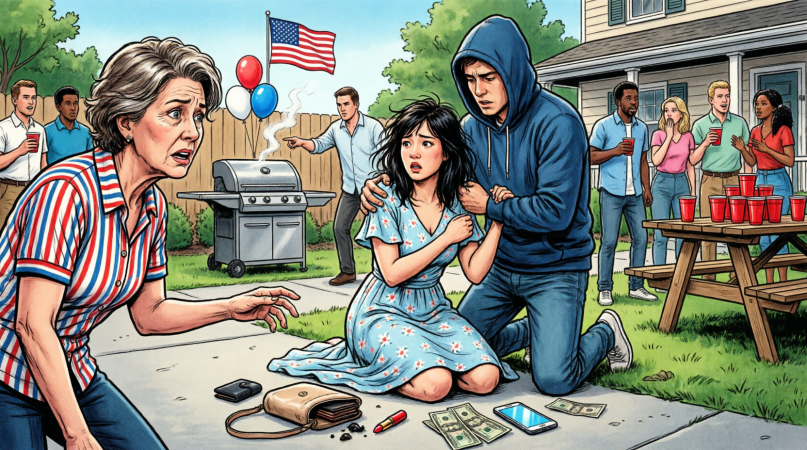
So was the shove that forced her down near the edge of the patio, one knee in dirt, one knee scraping concrete.
Her sundress pulled tight across her thighs.
Gravel pressed into her skin.
The cuffs bit hard enough that the metal edges pinched the nerves near her thumbs.
“You’re under arrest for theft!” Mark bellowed.
Some of his friends laughed, but the laughter came unevenly now.
A few men shifted their weight.
One looked down into his cup.
Elena’s aunt Linda gasped from near the folding table.
“Mark, stop it.”
Her voice was thin.
Sylvia’s was not.
Elena heard her mother’s sandals slap the concrete before she saw her.
For one impossible second, Elena thought Sylvia might pull Mark back.
Then Sylvia kicked her purse.
The purse skidded across the patio, hit the leg of a lawn chair, and spilled open.
Her wallet slid out first.
Then her keys.
Then a tube of lipstick.
Then tampons rolled over the concrete in front of thirty staring men.
The humiliation was not accidental.
Sylvia looked down at the scattered contents like she had been waiting years to see Elena emptied out in public.
“If you didn’t steal it, prove it,” she said.
Elena looked up from the ground.
Her mother’s face was tight with satisfaction.
“You always were a jealous, sneaky little girl.”
That sentence landed harder than the cuffs.
Not because Elena believed it.
Because Sylvia did.
Or worse, because Sylvia knew it was false and wanted it to hurt anyway.
The backyard froze in pieces.
A man near the cooler stopped with a beer halfway to his mouth.
A paper plate tilted in a woman’s hand until a pickle slid onto the grass.
The little American flag by the porch kept tapping the siding like nothing human had happened.
Linda’s hand covered her mouth.
Two officers looked away at the grill.
One laughed once, too late, then seemed to regret it.
Nobody moved fast enough to help.
Elena felt the cuffs grind against her skin.
Her left thumb had begun to tingle.
Mark’s boot stepped near her purse.
He nudged the wallet open with the toe like he was searching a suspect on a sidewalk instead of humiliating his sister at a birthday party.
“Let’s see what we’ve got,” he said.
He wanted her to cry.
Elena understood that with a clarity that steadied her.
He wanted tears.
He wanted pleading.
He wanted her to twist and beg and make him look powerful in front of the men who mattered to him.
For one ugly second, Elena imagined standing up fast enough to drive her elbow into his ribs.
She imagined his cup hitting the concrete.
She imagined telling every man there exactly what kind of officer laughed while a drunk colleague cuffed a woman in a backyard.
Then she let the thought pass.
Anger is sometimes evidence that has not yet learned discipline.
Elena had built a career on discipline.
So she went still.
That was the first thing that unsettled Mark.
He kept digging through her purse with his boot, but his laugh grew louder and less natural.
There was no watch.
Of course there was no watch.
There was only a wallet, keys, lipstick, tampons, a folded grocery receipt, and an old hair tie.
At 5:49 p.m., he ran out of performance.
He bent down, unlocked the cuffs, and hauled her up by the arm.
The sudden blood flow into her hands felt like needles.
“Relax, everybody,” he shouted. “It’s a joke.”
Nobody answered quickly enough, so he pushed harder.
“Testing the tension on the rookie cuffs.”
A few men forced a laugh because men like Mark train rooms to rescue them from silence.
He leaned close to Elena.
“Can’t take a joke?”
His breath was hot with beer.
“You’re too damn sensitive.”
Elena looked at him.
She did not slap him.
She did not scream.
She did not say what she knew, because what she knew belonged in a file, not in a backyard argument.
Mark smirked and turned away for another drink.
That was his mistake.
He thought humiliation ended when he got bored.
He thought silence meant defeat.
He thought his badge made every room his courtroom.
He had never bothered to learn what Elena did for a living.
He knew her title in the vague way families know things they do not respect.
Senior Auditor.
Office of Professional Accountability.
Paperwork, in his words.
But paperwork had teeth when it was built correctly.
Complaint logs had dates.
Sworn narratives had signatures.
Incident packets had chain-of-custody notes, timestamps, witness lists, equipment details, and disciplinary consequences.
Elena had spent eleven years learning how bad officers hid behind jokes, misunderstandings, and the words “no harm intended.”
She knew what an unofficial restraint looked like when it became an official violation.
She knew what it meant to use department equipment while intoxicated at a private event.
She knew how quickly thirty witnesses became thirty liabilities when a complaint number existed.
And she knew better than to warn Mark before the record was secure.
At 5:53 p.m., Elena bent down and gathered her things.
One by one.
Wallet.
Keys.
Lipstick.
Tampons.
Receipt.
Hair tie.
Her hands shook only once, when the metal swelling around her wrists brushed the concrete.
She steadied them.
Sylvia stood above her with folded arms.
“Don’t start drama,” her mother said.
Elena put the last tampon into her purse and looked up.
“I’m documenting it.”
Sylvia blinked.
She did not understand the difference.
Elena walked to her car without hurrying.
She passed the grill smoke.
She passed Mark’s friends pretending not to watch.
She passed Linda, whose eyes were wet and wide.
She opened the driver’s door, slid inside, and locked it.
Only then did her breath come hard.
Her wrists were already swelling.
The cuff marks had turned red and angry, with narrow broken lines where the metal teeth had dragged.
Her left thumb tingled when she tried to flex it.
There was dirt on her knee.
There was blood under the thin bracelet she wore every day.
She took photos before she let herself feel anything else.
Right wrist.
Left wrist.
Both wrists together.
Knee.
Purse contents after recovery.
Mark visible through the windshield, still laughing near the patio.
Each photo saved with a timestamp.
5:56 p.m.
Then she dialed the unlisted number Mark had once mocked as “paper-pusher nonsense.”
It was answered on the second ring.
“Elena?”
The man on the line was calm.
That calm nearly broke her.
“Are you injured?” he asked.
“My wrists are marked,” she said. “Left thumb numb. Department restraints used at a private event. Officer intoxicated. Approximately thirty witnesses, many off duty. Accusation of theft made publicly. Search of personal property conducted by force and humiliation. No probable cause. No recovered item. Mother kicked the purse open.”
There was a pause.
Not doubt.
Recording.
“Location?” he asked.
She gave the address.
“Is the officer still on scene?”
“Yes.”
“Is he armed?”
Elena looked through the windshield.
Mark’s badge was still clipped to his belt.
His duty weapon was not visible, but she knew better than to assume.
“I can’t confirm from the car.”
“Stay locked inside.”
Mark noticed her then.
His smile changed.
At first, he looked annoyed.
Then he saw the phone against her ear, the stillness in her face, and the way she was not crying.
He stepped away from the cooler.
Sylvia followed his gaze.
Elena could see her mother’s lips form one word.
Who?
That was when Linda moved.
Elena’s aunt stepped from beside the folding table with her phone clutched against her chest.
She looked older than she had ten minutes earlier.
Her mouth trembled.
Her hand did too.
Linda walked toward the driveway but stopped before reaching the car, as if she was afraid that choosing a side too visibly might split the ground beneath her.
Then Elena’s phone buzzed.
A video file appeared.
From Linda.
Elena opened it just long enough to see the first frame.
Mark’s hand on her wrist.
Sylvia’s sandal near the purse.
The backyard full of witnesses.
The audio was clear.
“You’re under arrest for theft!”
Elena closed the video and forwarded it to the man on the line.
“I have video,” she said.
Mark saw Linda’s phone then.
His body went still in a way Elena had never seen before.
Not sober.
Still.
Sylvia reached toward Linda.
Linda pulled back so fast that her cup fell, spilling sweet tea across the concrete.
“Don’t,” Linda whispered.
Sylvia’s face hardened.
“Give me that phone.”
“I sent it to Elena.”
Those six words changed the yard.
A few men stepped away from Mark as if distance could rewrite the last ten minutes.
One officer took his cap off and rubbed his forehead.
Another looked toward the gate.
Mark’s mouth opened, but no joke came out.
The man on Elena’s call said, “Put me on speaker.”
Elena did.
His voice filled the locked car and carried through the half-open window crack.
“Officer Mark,” he said, flat and official, “before you touch another person or another phone, listen very carefully.”
Mark’s face drained.
There are moments when power shifts so quietly that only the guilty hear the sound.
This one sounded like a phone speaker in a locked car.
“Identify yourself,” Mark snapped, but his voice had lost its party volume.
“You are being notified that a formal incident review is being initiated regarding misuse of restraints, potential unlawful detention, conduct unbecoming, and witness interference,” the man said.
The backyard went silent.
Even the child with the balloon stopped moving.
Mark looked at Elena, then at Linda, then at the men around him.
“This is family,” he said.
Elena almost laughed.
Not because it was funny.
Because cruelty always reached for family when consequences arrived.
The man on the phone did not react.
“Do not approach the complainant. Do not attempt to delete recordings. Do not attempt to influence witnesses. Preserve the restraints used. A supervisor will make contact.”
Mark’s hand twitched toward his belt.
Three men saw it.
One of them said, very quietly, “Mark.”
That single warning did what Elena’s pain had not.
It stopped him.
Sylvia looked from face to face, trying to find the room she understood.
A room where Mark was always right.
A room where Elena was always difficult.
A room where witnesses laughed because it was safer than disagreeing.
But that room had vanished.
In its place was a backyard full of men realizing they were not just guests anymore.
They were witnesses.
Elena stayed in the car until the first supervisor arrived.
Not sirens.
Not a spectacle.
A plain vehicle pulled up to the curb at 6:18 p.m., followed by another a few minutes later.
The men who stepped out were not there to celebrate Mark.
They asked Elena if she needed medical care.
They photographed her wrists again, this time with an evidence card beside the marks.
They took Linda’s statement first because she was shaking too hard to keep standing.
They separated the off-duty officers and told them not to discuss the incident.
That instruction alone made several faces change.
People who had been loud all afternoon became suddenly careful.
Mark tried one more time to laugh it away.
“It was a joke,” he said.
The supervisor looked at Elena’s wrists.
Then he looked at the cuffs lying on the patio table where Mark had placed them like they were harmless.
“Jokes don’t leave restraint marks,” he said.
Sylvia burst in then.
“She’s always been dramatic.”
The supervisor turned to her.
“Ma’am, were you the person who kicked the purse?”
Sylvia’s mouth opened.
Closed.
Opened again.
Linda began to cry.
Not loud sobbing.
Just tears slipping down her face while she kept both hands around her phone.
“I should have stopped it,” she whispered.
Elena wanted to tell her that Mark had built the whole moment on people not stopping it.
Instead, she said, “You recorded it.”
Linda looked at her.
“That counts?”
Elena nodded.
“It counts.”
By 7:04 p.m., the party was over.
The cake still sat uncut under its plastic cover.
The burgers were cold.
The little flag by the porch tapped the siding in the same rhythm it had kept all afternoon.
Mark was told to surrender the restraints and badge pending administrative review.
He stared at the supervisor as if the words were in another language.
“Pending review?” he repeated.
“Yes.”
“My badge?”
“Yes.”
He looked at Elena then.
For the first time in her life, he looked at her not as a little sister, not as a joke, not as the family disappointment who did paperwork.
He looked at her like someone who had finally realized paperwork could end a career.
Sylvia stepped toward him, but he did not look at her.
He kept staring at Elena.
“What did you do?” he asked.
Elena held up her wrists.
“I documented what you did.”
That was all.
No speech.
No revenge monologue.
No dramatic promise.
The record would do what the record did.
In the days that followed, people tried to soften it.
One cousin texted that Mark had been drinking.
Another said birthdays got rowdy.
Sylvia left three voicemails, each one starting angry and ending tearful, saying Elena had gone too far, saying family handled things privately, saying Mark could lose everything.
Elena saved the voicemails.
She did not answer them.
On Monday at 8:12 a.m., she filed her formal statement with the incident packet already organized.
Photos.
Video.
Timestamp log.
Witness list.
Medical note documenting nerve irritation in her left thumb.
Description of equipment used.
Audio transcript of the accusation and the phrase “under arrest for theft.”
A separate note about Sylvia’s interference with personal property.
Not anger.
Not drama.
A record.
That was what they had never respected about Elena.
She did not need to be louder than Mark.
She only needed to be accurate.
The review did not end in a single day, because real consequences rarely move at the speed humiliation does.
There were interviews.
There were written statements.
There was an equipment audit.
There was a review of Mark’s prior complaints, including two closed cases Elena had already been scheduled to examine before the party ever happened.
Those cases reopened questions that Mark could not joke away.
One involved a man who said cuffs were tightened after he complained of numbness.
Another involved a public accusation that had turned out to be unsupported.
Patterns matter.
Mark had built his life believing each incident could stand alone, explained away by mood, misunderstanding, or the weakness of whoever complained.
But patterns are what auditors are trained to see.
Three weeks later, Elena received a copy of the administrative finding she was permitted to see as complainant.
Sustained.
Misuse of department equipment.
Conduct unbecoming.
Failure to preserve professional standards while off duty.
Retaliatory humiliation.
The language was dry.
That made it stronger.
No one could accuse a dry sentence of being emotional.
Mark was suspended first.
Then stripped of field duty.
Then his badge was removed pending final separation.
Sylvia called the night she found out.
Elena did not answer.
Then Linda called.
Elena did answer that one.
For a while, neither of them spoke.
Finally Linda said, “Your mother says you destroyed him.”
Elena looked down at the faint marks still healing around her wrists.
“No,” she said. “I stopped protecting him from himself.”
Linda exhaled slowly.
“I keep hearing the cuffs.”
“So do I.”
“I should have yelled louder.”
“You sent the video.”
“It didn’t feel like enough.”
“It was enough to make the truth harder to bury.”
Linda cried then.
Elena let her.
There was no neat ending with family apologies around a kitchen table.
Sylvia never admitted she had enjoyed kicking the purse.
Mark never apologized in a way that did not include the word but.
Some relatives decided Elena had embarrassed the family.
Others quietly stopped inviting Mark to things.
A few sent messages saying they had always known he went too far, which was its own kind of confession.
Elena kept working.
She kept reviewing files.
She kept noticing the difference between mistakes and habits.
On her desk, she kept no trophy from that day.
No copy of the finding framed on a wall.
No photograph of Mark handing over his badge.
Only the incident packet existed, stored where it belonged, part of a record that would outlast every backyard excuse.
Months later, when the red marks on her wrists had faded to nothing, Elena found the thin bracelet she had been wearing that day in a drawer.
There was still a tiny scratch in the metal from where the cuffs had caught it.
She held it under the lamp for a long time.
Then she put it back on.
Not as a reminder of what Mark did.
As a reminder of what silence had cost her.
The backyard had taught her what her family wanted from her.
They wanted quiet pain, private shame, and public obedience.
They wanted her to laugh after being dragged to her knees.
They wanted her to call abuse a joke because the man holding the cuffs had a badge.
She did not give them that anymore.
The next time someone at work tried to call a complaint “just a misunderstanding,” Elena opened the file, checked the timestamps, and read every witness statement twice.
She knew exactly how jokes sounded when they were used as weapons.
She knew exactly how silence looked when a room full of people chose comfort over courage.
And she knew exactly why records mattered.
Because one afternoon in her mother’s backyard, her brother twisted her arms behind her back, snapped cold steel cuffs onto her wrists, and called it funny.
Elena said nothing then.
But silence was not surrender.
It was documentation waiting for a number.
And once the number existed, Mark’s badge was no longer a crown.
It was evidence.