The living room still smelled like funeral lilies when my brother tried to turn me into a signature.
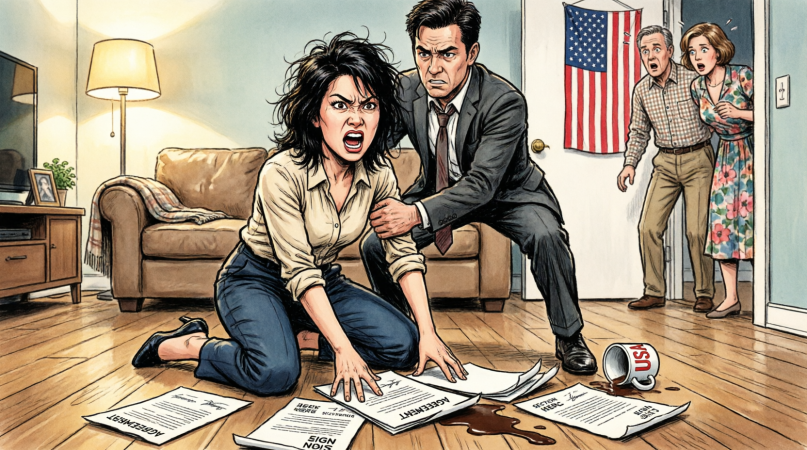
My name is Captain Linda Morse, and I was thirty-three years old when Damian Morse put his knee into my ribs on the oak floor our father had installed with his own hands.
Dad had been buried three days earlier.
Arthur Morse was not a rich man. He had a two-story house on Washington Avenue, a narrow driveway, a sagging porch, and a small American flag clipped by the rail because he believed a home should look like somebody inside still cared.
That house was where my mother taught me to fold towels.
It was where I did homework at the kitchen table while Dad fixed leaky faucets after dinner.
It was where I moved back when chemo made him too weak to live alone.
Damian did not move back. He visited, called, posted old photos, and wrote things online about family being everything.
But he did not learn the medication schedule.
He did not sit through hospital intake forms.
He did not know Dad hated grape nutritional shakes but would drink vanilla if I chilled them until the bottle was almost icy.
Those are the details inheritance papers never show. They show parcels, signatures, values, dates. They do not show who got up at 2:13 a.m. because a cough sounded wrong.
On the afternoon of the will reading, rain tapped the front windows in a steady rhythm.
The kitchen was crowded with foil casserole trays and paper plates from neighbors who had brought food because grief in our neighborhood usually arrived wrapped in aluminum.
Damian sat in Dad’s brown recliner like he had already claimed it.
His wife, Sarah, stood by the sideboard with her phone pressed to her ear.
“No, I said sell it,” she said, not lowering her voice. “I’m not waiting six months because his daughter is emotional.”
His daughter.
Not Linda. Not Damian’s sister. Not the person who had held Dad’s hand when the nurse explained the next treatment.
I looked at Damian and said, “This is my home.”
Before he could answer, the doorbell rang.
Mr. Finch stood on the porch in a worn brown coat with his leather briefcase tucked under one arm.
He had been Dad’s lawyer for years. Not fancy. Not loud. Just steady in the way some people become steady after seeing too much foolishness to be impressed by it.
We sat at the dining room table under the white embroidered cloth my mother had made before cancer took her when I was fifteen.
Mr. Finch opened the probate packet carefully.
He read the file numbers. He reviewed the deed transfer file. He confirmed the Franklin County appraisal schedule. He showed the signed witness affidavit, stamped and dated.
At 4:11 p.m., he read the line that made Damian stop tapping his fingers.
The house on Washington Avenue belonged to me.
I did not smile.
Dad had not cut Damian out. The will required me to pay my brother half the appraised value within five years.
It was fair in the painful way Dad had always been fair. He knew Damian would be angry, and he knew I would need time.
At 4:18 p.m., Sarah lifted her phone and photographed the final page when she thought no one noticed.
I noticed.
At 4:22, while Mr. Finch clicked his briefcase shut, she leaned close to Damian and whispered, “Don’t let her walk away with it.”
I heard her.
Captain is not just a title you leave at work. Some habits stay in your bones. You notice hands, exits, whispers, and the moment a room turns dangerous.
Mr. Finch left a little after five.
On the porch, he squeezed my shoulder and said, “Your father wanted you safe here, Linda.”
When I came back inside, Damian was already holding another stack of papers.
A quitclaim deed.
A waiver of inheritance rights.
A private sale agreement typed so badly my name was misspelled once, though the signature line had been circled in red.
“Sign these,” he said.
I asked where they came from.
“Don’t make this ugly,” he said.
Sarah stood behind him, calm as ice in a glass.
There was no surprise on her face.
Not anger. Not grief. Planning.
A family betrayal always feels sudden to the person being betrayed, but it rarely begins in the moment it shows its teeth.
I said, “No.”
Damian laughed once.
It was a short sound, almost embarrassed for me.
“Linda, you can’t afford this place.”
“I have five years.”
“You have a job that moves you around, a dead father’s medical bills, and no idea what property tax looks like now.”
I could have told him I had already photographed every invoice, requested every statement, and put copies of the probate documents in a folder on my laptop.
I could have told him competence is quieter than entitlement.
Instead, I said, “I am not signing.”
His smile disappeared.
He stepped close enough for me to smell his cologne.
“Sign the papers.”
“No.”
The first punch knocked the room sideways.
My shoulder hit Dad’s recliner. My cheek struck the oak floor. A white flash broke across my vision before I understood he had hit me.
The second punch took the air out of me.
My coffee mug shattered behind my wrist, and cold coffee spilled across the floor, bleeding into the edges of the quitclaim deed.
Damian dropped his knee into my side.
Something in my ribs gave with a hot, sharp snap that made the room shrink down to one point of pain.
“Sign it,” he snarled. “Sign it or die here.”
Sarah did not call 911.
She did not scream.
She stood beside the sideboard with her phone in her hand and watched me like the problem was that I was taking too long.
“Finish it, Damian,” she said. “Put her down.”
For one ugly heartbeat, I thought about every way I could hurt him if I could move cleanly.
Then Dad’s voice came back to me from a thousand ordinary mornings.
Steady, Lindy.
So I slowed down.
I kept my breathing shallow. I curled my fingers against the floorboards. I watched the pen roll under the sofa.
Damian grabbed my wrist and dragged my hand toward the red-circled line.
That was when the front door burst open.
“Damian, take your hands off her.”
It was Mr. Finch.
His brown coat was dark with rain, his glasses had slid down his nose, and in his left hand he held Dad’s old porch camera, the little black one clipped near the door after chemo deliveries had started disappearing.
A red light blinked on the side.
Damian froze.
Sarah went white.
Before Mr. Finch walked in, the room had been violence, breath, rain, and paper scraping over wood. After he spoke, the room filled with consequences.
“She fell,” Damian said.
It was almost impressive how fast he found the lie.
“She attacked me.”
Mr. Finch did not blink.
“Move away from her.”
Damian did not.
Then headlights swept across the front windows.
Blue-white light washed over the lilies, the papers, the broken mug, Damian’s raised fist, and Sarah’s face.
One responding officer came through the door first. Then another.
I remember the sound of rain on their jackets. I remember the radio clipped to one shoulder. I remember the officer’s eyes moving from my face to Damian’s hand to the papers soaked with coffee.
“Sir,” she said, “stand up and step back.”
Damian tried to explain. People like Damian always try to explain.
He said it was a misunderstanding. He said grief had everyone emotional. He said I had been unstable since Dad died. He said Sarah could explain.
Sarah said nothing.
Cruelty is brave when it controls the room. It gets very small when someone else starts writing things down.
Mr. Finch handed the porch camera to the officer and said, “I heard shouting when I came back for my reading glasses. I saw him holding her down. I called from the porch before I opened the door.”
Then he pointed to the papers.
“Those documents are not from my office.”
One officer crouched beside me and asked if I could breathe.
I wanted to say yes.
I wanted to stand up because standing up felt like proving Damian had not won.
But when I tried, the room tilted and the pain in my ribs caught hard enough that my vision went gray at the edges.
“I think something broke,” I said.
At 5:31 p.m., the ambulance arrived.
I know the time because later it was written on the incident report, and I read that report so many times I could have recited it.
Hospital intake wrote blunt trauma to ribs on the first page.
The imaging order came next.
Two ribs were cracked. My cheek was bruised. My wrist was sprained.
Nothing life-threatening, the doctor said.
People say that like it should comfort you.
Nothing life-threatening.
As if betrayal has to kill you before it counts.
Mr. Finch came to the hospital waiting room before midnight with coffee in one hand and a folder in the other.
He waited until the nurse left before he spoke.
“Your father’s will stands. The deed stands. Damian cannot force a transfer through a document signed under duress. And now there is a record.”
A record.
That word steadied me.
Police report. Hospital intake notes. Photographs of the floor. The porch camera timestamp. The original probate packet. The fake quitclaim deed with coffee dried into one corner.
Not feelings. Proof.
By 9:00 a.m. the next morning, Mr. Finch filed notice with the county clerk to flag any attempted transfer involving the Washington Avenue property.
He sent copies of Dad’s will, the deed transfer file, and the witness affidavit.
He photographed the fake documents and logged them by page number.
Damian called from an unknown number two days later.
I did not answer.
Then Sarah texted.
Linda, this has gone too far.
That sentence sat on my phone while I stood in Dad’s kitchen with a hospital band still around my wrist.
Too far.
Not the punch. Not the knee. Not “Sign it or die here.”
The consequence.
I took a screenshot, saved it to the case folder, and blocked the number.
For the first week, I slept on the couch because climbing the stairs hurt too much.
Neighbors left soup on the porch. One woman from down the block brought paper plates and trash bags because she said grief creates dishes, and she was right.
I did not feel brave.
I felt sore, embarrassed, furious, and strangely hollow.
People imagine survival feels powerful right away. Sometimes it feels like sitting very still in the room where you were hurt, listening to the refrigerator hum, trying to convince your body the danger is gone.
A week later, I collected every paper Damian had thrown across the floor.
The quitclaim deed. The waiver. The private sale agreement.
All of it had dried stiff at the corners from the coffee.
I placed each page in a plastic sleeve.
Then I sat on Dad’s oak floor, carefully because of my ribs, and cried without trying to stop it.
Not because I was scared.
Because the floor was stained. Because Dad’s recliner still held the shape of his last months. Because the house he wanted me safe in had become the place where my brother decided I was worth less than an appraisal number.
A home is not just what someone leaves you. It is what you refuse to surrender when the people who should protect you become the threat.
I thought that the night Damian attacked me.
I believed it later, when the paperwork started to pile up in my favor.
The porch camera file showed enough of Damian over me, enough of Sarah standing by, enough of the papers on the floor, and enough of Mr. Finch entering and telling him to let go.
The police report recorded Mr. Finch as the witness.
The hospital file recorded the injuries.
The probate file recorded the house.
The fake documents recorded intent.
Damian tried once, through an attorney, to frame it as a grief-fueled argument.
Mr. Finch answered with dates.
4:11 p.m., will read.
4:18 p.m., Sarah photographed the page.
4:22 p.m., Sarah whispered.
5:09 p.m., porch camera recording active.
5:31 p.m., ambulance arrival.
There are moments when a timeline becomes more powerful than any speech. A speech can be argued with. A timeline just stands there.
The final time I saw Damian face-to-face for a while was not dramatic.
It happened in a county courthouse hallway with beige walls, vending machines, and an American flag standing near a bulletin board of public notices.
He looked smaller than he had in Dad’s living room.
Not sorry.
Just smaller.
Sarah stood beside him without the gold hoops and would not look at me.
The legal process moved slowly, with too many forms and too much waiting, but the house stayed mine.
The attempted transfer went nowhere.
The fake documents became part of the record.
People asked later if keeping the house was worth it.
They meant well.
They saw the brace, the bruises, the exhaustion, and me limping across the porch to pick up mail from the box Dad had repainted the year before he got sick.
They did not see what I saw.
I saw Mom’s embroidered cloth folded in the dining room drawer.
I saw the pencil marks on the pantry door where Dad had measured our heights.
I saw the recliner where I held his hand the night he admitted he was tired.
Worth it is the wrong question.
Some things are not kept because they are easy. They are kept because letting them be stolen would finish a harm someone else started.
Months later, I repaired the stain on the oak floor as best I could.
It never disappeared entirely.
In the right afternoon light, I can still see where the coffee spread near the sofa.
I do not cover it with a rug.
For a long time, I wanted that mark gone.
Then one morning, I stood there with a cup of coffee in my hand and realized the stain was not only proof of what happened to me.
It was proof of what did not happen.
I did not sign.
I did not hand over my father’s house.
I did not let Damian turn grief into a closing document.
Mr. Finch came by that spring with final stamped copies from the county clerk.
He set the folder on the dining room table while the porch flag moved in the breeze outside.
The house was quiet.
Not empty quiet.
Safe quiet.
He tapped the folder once and said, “Your father would be relieved.”
That word nearly undid me.
Relieved.
That was Dad.
He never needed a parade. He just needed to know I had a door that locked, a roof that held, and a place to sit down when the world got hard.
I kept the house.
I kept the probate packet in a fireproof box.
I kept the porch camera too.
Some evenings, when rain ticks against the front windows and the old floors creak the way they always have, I think about how close my brother came to turning me into a signature.
Then I think about Dad’s hands sanding that oak smooth.
I think about my own hand refusing to move.
And I remember that a home is not just what someone leaves you.
It is what you refuse to surrender.