Ryan Mercer came home at 6:17 in the morning, smiling like he had survived the night instead of destroyed something that had taken seven years to build.
The sky outside our townhouse near Portland, Oregon, was still the color of wet ash, and rain tapped lightly against the kitchen window.
I had been awake for hours.
Not the kind of awake where you scroll on your phone and tell yourself you are fine.
The kind of awake where your body is sitting still, but your life is rearranging itself piece by piece in front of you.
My coffee had gone cold before dawn.
I kept the mug on the table anyway, because I needed something to hold that was not my own anger.
The kitchen smelled like lemon cleaner, stainless steel polish, and burned toast from the slice I made at 4:12 a.m. and never ate.
When I was scared, I cleaned.
When I was heartbroken, I made countertops shine.
Ryan used to joke about that in the beginning of our marriage.
He would come into the kitchen, kiss the back of my neck, and say, “Bad day?”
I would say, “Not anymore.”
That was before I learned that some people only love your softness because they believe it will never become evidence.
We met at a charity fundraiser downtown, the kind of event where everyone pretended to care about auction baskets while checking who else had arrived.
Ryan was funny then.
He made me laugh so hard I spilled white wine on my dress.
He helped me blot it with napkins from the bar and told me the stain looked “expensive, like abstract art.”
I thought that was charm.
Maybe it was.
Charm is not always fake at first.
Sometimes it begins as a real gift, then becomes a tool.
For the first three years, he was attentive in a way that felt almost embarrassing to describe.
He learned how I took my coffee.
He remembered that I hated cilantro.
He kept a spare phone charger in his car because I always forgot mine.
When my father had surgery, Ryan drove me to the hospital before sunrise and sat beside me for nine hours in a vinyl chair that made his back ache.
That was the version of him I kept defending later.
Every betrayal has a ghost version of the person standing beside it.
That is what makes leaving hard.
You are not only walking away from what they did.
You are walking away from who you thought they were.
Lauren Whitfield had been there for most of it.
She held my bouquet at our wedding.
She gave the toast about how Ryan and I made love look “safe.”
She stayed in my hotel room the night before the ceremony, eating room-service fries with me on the floor and telling me I had chosen well.
“Ryan adores you,” she said that night.
I believed her because I trusted her more than almost anyone.
Lauren knew the alarm code to our house.
She knew where I kept the spare key.
She knew I had a habit of blaming myself first and asking questions later.
I gave her access to my life because friendship, when it is real, should not require locked doors.
She used every open door I gave her.
The first signs were small enough to explain away.
Ryan started working later.
Then he began sleeping with his phone facedown.
Then Lauren started arriving at brunch with little pieces of advice that sounded caring until I heard the pattern underneath.
“You’re exhausted, Em,” she would say, pushing a mimosa toward me. “Don’t read too much into things.”
Or, “Marriage gets boring sometimes. That doesn’t mean anything is wrong.”
Or, “You always panic when you feel ignored. Maybe talk to someone about that.”
Those sentences did not sound cruel when she said them.
They sounded mature.
They sounded reasonable.
They sounded like friendship wearing perfume.
Ryan had explanations too.
Late nights were client dinners.
Secretive calls were work stress.
Missed dinners were traffic.
A new gym membership was for his health.
A hotel charge on the joint account was a reimbursable business expense.
He always said just enough truth to make the lie feel lazy to challenge.
That is what trained me.
Not one huge deception.
A hundred little moments where asking for honesty made me feel unreasonable.
By the seventh year of our marriage, I had become an expert at swallowing humiliation neatly.
I could smile through dinner.
I could excuse a forgotten anniversary.
I could pretend not to notice when Ryan stepped into the garage to take a call.
I told myself that marriage required generosity.
It does.
But generosity without truth becomes a leash.
The night everything changed was ordinary until 11:43 p.m.
Ryan had told me he was going to poker night with Derek.
He kissed my cheek before leaving and said he would not be late.
Derek had moved to Arizona six months earlier.
Ryan knew that.
I knew that.
But I still stood in the hallway after he left, holding the laundry basket, feeling foolish for how badly I wanted to believe him.
Around 9:30, Lauren texted me a photo of a glass of wine beside a candle.
Long day, she wrote.
I replied with a heart.
That still hurts to remember.
At 11:43 p.m., my phone lit up.
The message was from Lauren.
You left your watch on my nightstand. Come back before your wife wakes up.
I stared at it so long that the letters stopped looking like words.
Then the message disappeared.
Deleted.
Gone.
As if betrayal could be recalled like a typo.
My hands were shaking, but only for the first minute.
Then something colder moved in.
I took a screenshot before the deletion registered in the thread fully.
It was not perfect, but it was enough.
Her name was at the top.
The words were visible.
The timestamp was visible.
11:43 p.m.
That was the first artifact.
The second came at 12:31 a.m., when I opened our joint banking app and searched the last ninety days.
I did not know exactly what I was looking for.
That is the strange thing about suspicion.
Your heart knows before your eyes have instructions.
I found the hotel charge first.
Then a series of transfers labeled “consulting reimbursement.”
Then a rent payment to an apartment complex near Lauren’s office.
The payment had not been made once.
It had been made three times.
Three months.
Three neat withdrawals buried among groceries, utilities, and ordinary married life.
At 2:14 a.m., I printed the records from the small office upstairs.
The printer sounded impossibly loud in the sleeping house.
Each page slid out warm and accusing.
I stacked them carefully.
I highlighted the dates.
I circled the account name.
I did not cry then.
Crying would have made it feel like a collapse.
What I needed was architecture.
I needed the truth to have corners.
The third artifact was the key.
Two weeks earlier, Ryan had asked me to pick up his dry cleaning because he was “slammed.”
When I emptied his suit pockets before taking it in, a small brass key fell onto the dresser.
It was not ours.
It was not for his office.
I asked him about it, and he said it belonged to a storage unit for some files.
I almost believed him.
Almost.
But that night, after Lauren’s text, I remembered the key.
I found it in the back of his desk drawer, taped inside an old envelope.
There was a number written on the envelope in Ryan’s handwriting.
I searched the number with the apartment complex from the bank statement.
Building C.
Unit 214.
There it was.
A marriage does not always end with screaming.
Sometimes it ends with a printer, a bank login, and the sound of rain against glass.
At 3:06 a.m., I called Ryan’s mother.
Not because I wanted her sympathy.
Patricia Mercer did not hand out sympathy easily.
She was practical, sharp, and more loyal to the family’s financial stability than to anyone’s feelings.
But she had one quality Ryan underestimated.
She hated being made a fool.
When she answered, her voice was rough with sleep.
“Emma? Is someone hurt?”
I looked at the screenshot on my phone.
“Yes,” I said.
There was a pause.
Then she was awake.
“What did he do?”
I did not tell her everything.
I told her enough.
I told her about the transfers.
I told her about the apartment.
I told her I needed Marlene, the family accountant, to look at the records before breakfast.
Patricia was quiet for a long time.
Then she said, “I will be there at eight.”
I said, “Bring Marlene.”
Another pause.
Then, colder, “I already know what she is going to find.”
That sentence stayed with me.
I cleaned after that.
The counters.
The sink.
The stovetop.
The little splash of coffee near the machine.
I wiped the same spotless surface three times because my hands needed work and my mind needed distance.
At 5:38 a.m., I put the screenshot, bank records, and key into the drawer beside my chair.
At 6:02, I reheated my coffee and forgot to drink it.
At 6:17, Ryan came home smiling.
He opened the door with the relaxed confidence of a man walking back into a house where the woman inside had been trained to doubt herself.
His shirt was wrinkled.
His hair was damp from the rain.
He smelled like his cologne, wet pavement, and a floral perfume Lauren had worn since college.
For one second, he froze.
Then he smiled wider.
“Morning, babe,” he said. “You’re up early.”
I looked at the lipstick smudge near his collar.
I looked at the scratch on his neck.
I looked at the man I had loved and felt my grief sit down beside my anger like they had become allies.
“So are you,” I said.
He dropped his keys into the ceramic bowl by the door.
The sound was bright and ordinary.
That almost made me laugh.
Ordinary things keep going while your life changes.
Refrigerators hum.
Clocks tick.
Keys land in bowls.
The world does not dim the lights just because your marriage has become a crime scene.
“I crashed at Derek’s after poker night,” he said.
He delivered it smoothly.
Too smoothly.
Derek was in Arizona.
Derek had posted a sunset from Scottsdale the night before.
Derek had not hosted poker night in Oregon since winter.
I said nothing.
Ryan walked past me to the refrigerator and pulled out the orange juice.
He drank straight from the bottle.
I used to hate that.
I used to ask him not to.
This time, I watched him do it and felt nothing but a distant curiosity about how many tiny acts of disrespect I had mistaken for personality.
“Big day?” he asked.
“Yes,” I said.
He lowered the bottle.
“What’s happening?”
I folded my hands on the table.
My knuckles looked white, but my voice stayed steady.
“Your mother is coming over at eight.”
His smile slipped.
“My mom? Why?”
“And Lauren.”
That was when his face changed.
Not much.
Not enough for a stranger to notice.
But I knew him.
I had watched him pretend through late bills, bad sales quarters, awkward dinners, and one Christmas when he forgot to buy me anything and blamed shipping delays.
His eyes flicked once to the window.
Then to my phone.
Then back to me.
“What is this, an intervention?” he said, forcing a laugh.
“No,” I said. “A breakfast.”
He leaned against the counter like he was trying to put his body back into the shape of confidence.
“Emma, if you’re upset about something, just say it.”
I looked at the clock.
6:22.
In ninety-eight minutes, Patricia was supposed to arrive with Marlene.
In one hundred and two minutes, Lauren was supposed to come through my front door with whatever face she wore for betrayal before brunch.
Ryan did not know any of that.
He also did not know Marlene had texted me at 6:05.
Running early. Found something else. Do not let him leave.
That message sat unread on the table until Ryan turned away.
I had opened it while he pretended to search for a glass.
Found something else.
Those three words were worse than the screenshot.
They meant the affair was not the whole story.
It was a doorway.
At 6:28, a car door shut outside.
Ryan turned toward the front window.
Headlights swept across the glass.
For the first time since he walked in, his smile disappeared.
Because the person getting out of the car was early.
And she was carrying the black folder Ryan thought he had hidden forever.
Marlene Mercer stepped onto the porch wearing a dark raincoat, her gray hair tucked under a hood, her glasses dotted with water.
She was not Ryan’s mother by blood.
She was Patricia’s younger cousin and had handled Mercer family books for twenty-two years.
Birthdays, divorces, business filings, tax extensions, emergency loans, she had seen it all.
Marlene did not scare easily.
That morning, she looked scared.
I opened the door before she knocked.
“Emma,” she said softly.
“Come in.”
Ryan stood frozen by the counter.
“Marlene?” he said. “What are you doing here?”
She took off her hood slowly.
Rainwater dripped onto the entry mat.
“I think you know.”
His laugh came back, but this time it had cracks in it.
“Okay, this is ridiculous. Mom sent you over because Emma got emotional about something?”
Marlene looked at me.
Then she looked at him.
“Your mother asked me to review the family-linked accounts after she noticed the withdrawal pattern.”
Ryan’s jaw tightened.
There it was.
Not guilt.
Calculation.
He was not wondering what he had done.
He was wondering how much we had found.
Marlene placed the black folder on the kitchen table.
The sound was soft, but it changed the room.
Ryan said, “Emma, don’t do this.”
I almost smiled.
That is the sentence guilty people offer when consequences enter the room.
Not “I did not do it.”
Not “You are mistaken.”
Just “don’t.”
Marlene opened the folder.
The first page was a transfer ledger.
The second was a printout from the apartment complex.
The third was a signed lease addendum.
Lauren Whitfield’s name sat on the top line.
Ryan’s initials were at the bottom.
The move-in date was circled in blue ink.
Three months ago.
I stared at it for longer than I expected.
Not because I was surprised.
Because part of me still wanted one piece of the betrayal to be smaller.
One night would have been ugly.
Three months was construction.
Three months meant planning, payments, passwords, keys, routines.
Three months meant my husband had not stumbled.
He had rented a place to fall.
Ryan reached for the paper.
Marlene pulled it back.
“No,” she said.
It was the first hard word anyone else had spoken in that kitchen.
Ryan’s face flushed.
“You have no right to bring private documents into my house.”
“My house,” I said.
He blinked.
The silence after that was small, but sharp.
The townhouse had been purchased before our marriage with the inheritance my grandmother left me.
Ryan had lived there for seven years.
He had chosen paint colors, complained about the water pressure, mounted a television crooked in the den, and hosted friends on the patio.
But the deed had never had his name on it.
He knew that.
He just forgot it whenever ownership became inconvenient.
Marlene turned another page.
“This is not only about the apartment,” she said.
Ryan’s eyes snapped to her.
That was the first time I saw fear without vanity in him.
“What does that mean?” I asked.
Marlene hesitated.
She was loyal to Patricia.
She was loyal to rules.
But in that moment, she looked at me like she was deciding whether truth could be delayed without becoming another betrayal.
“Some of the transfers came out of accounts tied to your joint savings,” she said. “Some did not.”
Ryan said, “Stop.”
Marlene did not stop.
“There are withdrawals connected to Patricia’s reserve account.”
My stomach tightened.
Ryan’s mother had money of her own, old family money from a property sale before I ever entered the picture.
She was careful with it.
She was suspicious of everyone around it.
Including Ryan.
Especially Ryan.
“What reserve account?” I asked.
Ryan put both hands on the counter behind him.
His knuckles whitened.
Marlene said, “That is Patricia’s question to answer.”
As if summoned by her own name, another car pulled up outside.
Patricia Mercer arrived at 7:04, nearly an hour before Ryan expected her.
She came in without an umbrella, rain clinging to her silver hair and navy coat.
She looked at Ryan once.
Then she looked at the open folder.
Then she removed her gloves finger by finger.
That woman had never needed to raise her voice to make a room behave.
“Mother,” Ryan said.
“No,” Patricia said. “You do not get to start with that.”
He swallowed.
I had seen Ryan talk his way out of angry clients, traffic tickets, family arguments, and once even a restaurant bill he claimed had been doubled by mistake.
I had never seen him speechless in front of his mother.
Patricia walked to the table and placed her purse on the chair beside me.
“Emma,” she said. “I am sorry.”
Those three words hit harder than I expected.
Not because they fixed anything.
Because she did not decorate them.
She did not excuse him.
She did not ask me what I had done to make him wander.
She simply looked at the wreckage and named it.
Ryan found his voice.
“You don’t even know what this is.”
Patricia laughed once.
It was a dry, humorless sound.
“I know exactly what this is.”
At 7:12, Lauren texted me.
On my way! Bringing croissants. Hope you’re hungry.
I looked at the message.
Then I looked at Ryan.
He saw it on my face before he saw the screen.
“No,” he said.
The word came out low.
Almost pleading.
I tilted the phone so he could read it.
Patricia inhaled through her nose.
Marlene closed the folder halfway, then opened it again, as if even she could not decide whether the next few minutes required mercy or precision.
Ryan stepped toward me.
“Emma, listen to me.”
I stood.
Not fast.
Not dramatically.
Just enough for him to stop moving.
For one ugly second, I wanted to slap him.
I wanted to take every quiet breakfast, every lonely dinner, every time Lauren told me I was overthinking, and put it into my hand.
I did not.
That restraint felt like the first clean thing I had owned all morning.
“You can sit down,” I said.
Ryan stared at me.
“You are enjoying this.”
“No,” I said. “I am documenting it.”
Marlene’s eyes flicked to me.
Patricia’s mouth tightened, almost approvingly.
Ryan looked around the kitchen, suddenly understanding the trap he had walked into.
The printed bank records.
The screenshot.
The key.
The accountant.
His mother.
And soon, Lauren.
There was no shouting.
That was the part Ryan could not handle.
He knew how to manage tears.
He knew how to soothe anger.
He knew how to turn accusations into conversations about tone.
But evidence does not care about tone.
Evidence sits quietly and waits to be read.
At 7:26, Lauren’s car pulled into the driveway.
Through the rain-streaked window, I saw her pause at the mirror, fix her hair, and lift a pastry box from the passenger seat.
She looked beautiful.
She always did.
Cream coat.
Black umbrella.
Rose-colored nails.
The same nails that had squeezed my hand while she told me not to ruin a good marriage by overthinking.
Ryan whispered, “Please.”
I did not know which of us he was asking.
Me.
His mother.
God.
The doorbell rang.
Nobody moved at first.
The refrigerator hummed.
Rainwater dripped from Patricia’s coat onto the floor.
Marlene’s fingers rested on the black folder.
Ryan stared at the door as if it had become a judge.
Then the bell rang again.
I walked to the entry and opened it.
Lauren stood there smiling.
“Surprise,” she said, lifting the pastry box. “I brought almond croissants.”
Then she saw Ryan.
Then Patricia.
Then Marlene.
Then the table.
Her smile did not fall all at once.
It cracked in stages.
That almost made it worse.
“Lauren,” I said. “Come in.”
She glanced at Ryan.
He looked away.
That was the first honest thing he did all morning.
Lauren stepped into the house, closing her umbrella slowly.
“What’s going on?” she asked.
Patricia answered before I could.
“Breakfast.”
Marlene slid the lease addendum to the center of the table.
Lauren saw her name.
The pastry box dipped in her hands.
“Emma,” she said.
I hated how small my name sounded in her mouth.
Like she still expected friendship to soften what she had done.
I said, “You left your text in the wrong marriage.”
Her eyes filled instantly.
That was Lauren’s gift.
Tears on command.
Softness as a shield.
“I can explain,” she whispered.
Ryan seized on it.
“Yes. Let us explain.”
I looked at him.
Us.
Even then, he chose the team correctly.
Patricia sat down.
Marlene remained standing.
Lauren placed the pastry box on the counter with trembling hands.
The box left a wet mark where rain had soaked the cardboard.
“I didn’t mean for this to happen,” Lauren said.
That sentence is popular because it asks to be judged by intention instead of impact.
But nobody accidentally rents an apartment.
Nobody accidentally signs a lease addendum.
Nobody accidentally texts a married man to come back before his wife wakes up.
Marlene turned the folder toward Lauren.
“Is this your signature?”
Lauren looked at Ryan.
He did not save her.
So she did what people do when the person they betrayed you with starts protecting himself.
She told the truth in fragments.
“Yes,” she said. “But Ryan said the money was his.”
Patricia’s face hardened.
Ryan closed his eyes.
There it was.
The crack widened.
“What money?” Patricia asked.
Lauren blinked.
“You said she knew about the apartment,” she whispered to Ryan.
I felt something in my chest twist.
Not because I believed she was innocent.
Because even betrayal has hierarchies, and Ryan had clearly lied to everyone at a different depth.
He had told me one story.
He had told Lauren another.
He had told his mother nothing.
And beneath all of it, the money moved quietly.
Marlene pulled one final page from the back of the folder.
“This is why I came early,” she said.
The page was not from the apartment complex.
It was a transfer authorization.
Patricia reached for it first.
Her hands did not shake until she read the account name.
Then the color left her face.
Ryan said, “Mom, I can fix it.”
Patricia looked up slowly.
“You already tried to fix it with my money.”
Lauren covered her mouth.
Marlene looked down.
I stood beside the table, feeling the strange calm that arrives when pain becomes information.
The affair had been the bright, ugly thing.
The money was the deeper rot.
Ryan had used transfers from our joint savings to maintain the apartment.
Then, when that was not enough, he had moved funds from Patricia’s reserve account through a reimbursement channel he had access to from an old family business filing.
Marlene explained it in plain language.
No theatrics.
No moral speech.
Just dates, amounts, routing paths, and authorizations.
The first withdrawal had been three months earlier.
The second came after a weekend Ryan told me he was visiting a client in Seattle.
The third matched the hotel charge.
The fourth was pending.
Pending.
That word made Patricia stand.
“How much?” she asked.
Marlene gave the number.
It was not enough to ruin Patricia.
It was enough to reveal him.
Ryan started talking then.
Fast.
Too fast.
He said it was temporary.
He said he had meant to pay it back.
He said Lauren did not know.
He said I had been distant.
He said his mother had always controlled him.
He said stress made people do things.
He said marriage was complicated.
He said everything except the one sentence that mattered.
I did this.
Lauren was crying openly now.
“I thought you were separated,” she said to me.
I looked at her.
“You were in my kitchen last month helping me plan his birthday dinner.”
She flinched.
Good.
Some truths should land physically.
“You told me I was lucky,” I said.
She closed her eyes.
“You told me not to be paranoid.”
“I know,” she whispered.
“You knew the alarm code to my house.”
Her tears fell harder.
“You knew where I kept my spare key.”
“I’m sorry.”
“You knew me.”
That was the one that broke something in her face.
Ryan reached toward her.
Patricia snapped, “Do not.”
He stopped.
It would have been satisfying if I had felt triumphant.
I did not.
Triumph is too clean a word for a room where everyone is bleeding from a wound they helped make.
At 8:03, Patricia called her attorney.
At 8:17, I called mine.
At 8:28, Marlene emailed the records to both, with a note that said: Preliminary ledger attached, full reconciliation pending.
I remember the exact phrase because it sounded so calm.
Full reconciliation pending.
That is what my life had become.
A reconciliation of what I thought was true against what the documents could prove.
Ryan tried to leave at 8:41.
I did not block the door.
I did not need to.
Patricia did.
She stood in front of him with her purse over one arm and said, “You will give Emma your house key.”
He laughed bitterly.
“This is my home.”
“No,” I said again. “It isn’t.”
This time he heard it.
He placed the key on the entry table.
Then, after Marlene reminded him there was another one, he removed the apartment key from his pocket.
The same key I already had a match for.
He looked at me when he set it down.
I do not know what he expected to see.
Rage, maybe.
Devastation.
A wife who could still be negotiated with.
What he saw was the woman who had spent the night turning heartbreak into a file.
That is the part people misunderstand about betrayal.
They think the strongest moment is the confrontation.
It is not.
The strongest moment is when you stop begging reality to be different.
Ryan left in Patricia’s car because she refused to let him take his own until the attorney advised her.
Lauren stayed behind for seven minutes.
She said sorry six times.
Each one got smaller.
I did not forgive her.
I did not curse her either.
I opened the door and let the rain speak for me.
She walked out without the pastry box.
It sat on my counter until noon.
Eventually I threw it away unopened.
In the weeks that followed, the story became less cinematic and more exhausting.
That is how real endings work.
There were attorneys.
There were account reviews.
There were calls from people who wanted details disguised as concern.
There were nights when I slept three hours and mornings when I reached for my phone expecting an apology that would never be clean enough to matter.
Ryan sent messages at first.
Long ones.
Then shorter ones.
Then angry ones.
Then messages through counsel.
He wanted to frame the affair as a private marital issue.
Marlene’s ledger made that impossible.
The money changed everything.
It made the betrayal measurable.
It brought Patricia fully onto the side of consequence, even if not always onto mine emotionally.
She never became warm.
But she became useful.
Sometimes useful is enough.
Lauren disappeared from my everyday life faster than I expected.
Her number stayed in my phone for a month because I could not bring myself to delete it.
Not because I wanted her back.
Because deleting someone who had stood beside you for years feels strange, even when keeping them feels worse.
One night, I scrolled up through old messages.
Vacation photos.
Birthday plans.
Voice notes.
Her checking on me after my father’s surgery.
Her calling Ryan “one of the good ones.”
I deleted the thread at 1:19 a.m.
Then I sat on the bathroom floor and cried for both betrayals separately.
That mattered.
Ryan had broken my marriage.
Lauren had broken my memory of friendship.
The divorce moved slowly, as divorces do when one person has spent years confusing charm with ownership.
My attorney asked for records.
Marlene provided them.
Patricia protected her own accounts, which indirectly protected my case.
The apartment lease became evidence.
The screenshot became evidence.
The transfer ledger became evidence.
The key became evidence too, not legally dramatic, but emotionally perfect.
A small brass object that opened the door to the life my husband swore he was not living.
By the time Ryan finally admitted the affair in a mediated session, he delivered it like a man granting a concession.
“I made mistakes,” he said.
My attorney glanced at me.
I looked at Ryan and said, “No. You made arrangements.”
He hated that.
Good.
Mistakes are dropped glasses.
Arrangements have signatures.
In the end, the townhouse stayed mine.
The joint accounts were separated.
The improper transfers were repaid through funds Ryan had to liquidate under legal pressure from his mother and the family attorney.
Lauren’s lease ended early.
I do not know where she moved.
I stopped asking questions that kept me tied to people who had already shown me the answer.
Months later, on a Saturday morning, I made coffee in the same kitchen.
The counters were clean, but not because I was afraid.
Rain tapped the window again.
The ceramic key bowl by the door held only my keys.
For a while, I stood there listening to the house.
No secret phone calls in the garage.
No late-night explanations.
No friend telling me to ignore the instincts that were trying to save me.
Just quiet.
Real quiet.
Not the silence of a woman trained to doubt herself.
The silence of a woman who finally believed what she saw.
My husband came home smiling after spending a steamy night with my best friend, thinking I knew nothing.
He walked through the door relaxed, proud, and happier than ever.
But he had no idea karma was already waiting for him.
It was not loud.
It did not kick down the door.
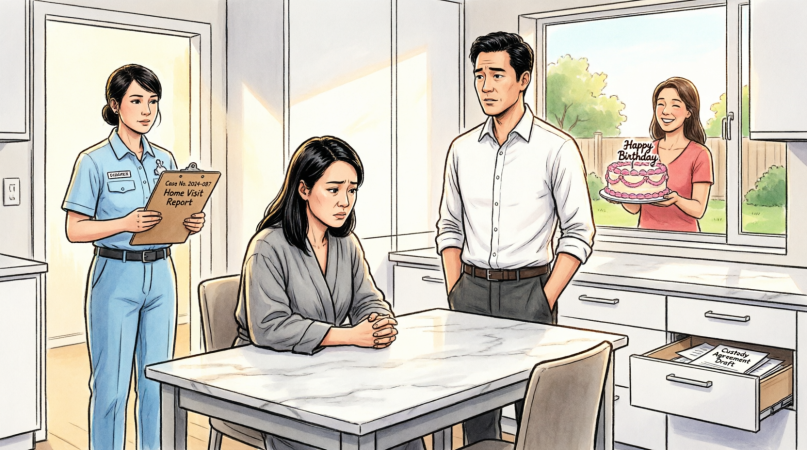
It sat at my kitchen table in a gray robe, beside cold coffee, printed bank records, a screenshot, and a key.
And when the time came, it opened the drawer………………..