At the picnic, the air smelled like charcoal and sugar—cheap ketchup turning warm in the sun, sticky soda sweating through plastic cups, my father’s grill hissing every time he pressed a spatula down like he was taming the flames by force of habit. The yard had that late-summer look, patchy green and stubborn brown, a few tired flowers leaning toward the fence like they were trying to eavesdrop. Kids shrieked and ran in loops that made no sense, and the adults sat around a long folding table that bowed in the middle under bowls of potato salad and baked beans. Paper plates fluttered whenever the breeze picked up, and someone—my mother—kept patting napkins down like she could iron the day into behaving.
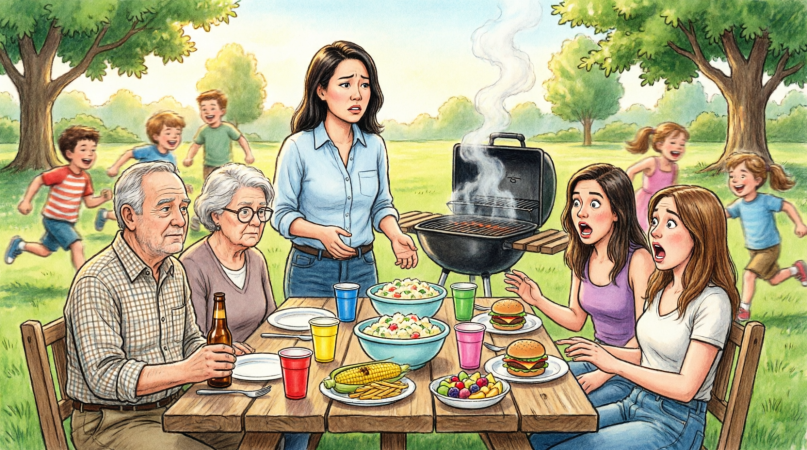
It was one of those Saturdays my parents insisted on, the kind that had become tradition because traditions are easier than honest conversations. Every year, the same speeches: “Isn’t it nice to have everyone together?” and “We should do this more often,” and “Family is everything.” The words were always said with the expectation that hearing them would make them true.
My sister Rachel sat across from me, sunglasses perched on her head, phone in her hand. She wore the expression she always wore at these things—half amused, half bored, as if she’d been invited to an event she was too cool to attend but couldn’t resist showing up anyway. Her son Tyler was tearing across the yard with a bright green squirt gun, shrieking as he chased my daughter Lily. Lily’s laughter sounded like bells, pure and uncomplicated, the kind of sound that made my chest tighten in a way that felt both good and fragile.
My mother moved around the table like a woman trying to keep a ship from taking on water. She placed things, shifted things, asked if anyone wanted seconds before anyone had finished firsts. My father drank his beer and stared at the grill with the solemn focus of a man who didn’t know what to do when a moment got quiet.
Everyone had a drink in hand. Everyone had sun on their shoulders. Everyone looked relaxed in that performative way families do when they’re pretending the past didn’t happen and the present isn’t fragile. And beneath all that normal, beneath the laughter and the clink of plastic cups, there was the soft, familiar pressure in my ribs—an awareness of what I’d paid for. Not just the groceries, not just the propane tank refilled two days ago, not just the electric bill I’d quietly covered last week when my mother had “misplaced” the notice on the kitchen counter. I’d paid for the ease sitting at this table. I’d paid for the illusion that my parents’ house could host this kind of afternoon without strain.
My job at the logistics company had taken off last year. I’d been promoted twice, a blessing that came with longer hours and more responsibility, but also with money that showed up reliably, without drama. The kind of money that families notice. The kind of money that, once noticed, gets treated like it belongs to the group.
At first, it started small. My dad’s construction hours got cut, and he didn’t say anything until the mortgage was two weeks from being late. My mom’s insurance started “reviewing” her prescriptions, which meant she’d stand at the pharmacy counter blinking back tears as if shame could negotiate with a pharmacist. Rachel’s rent was due and she’d had a “weird month.” Car repairs. Phone bills. Groceries. “Just until we get through this.” “Just this once.” “You know we’d do it for you.” People said those things when they wanted help without having to feel like they were asking.
And I did help. I told myself what everyone told me: family helps family. That phrase is simple enough to sound like morality. It’s also vague enough to hide exploitation.
Rachel was the one who repeated it most. She loved the line the way people love a slogan that excuses them. Family helps family. She’d say it when she needed money, when she needed childcare, when she needed someone to pick Tyler up from school because her shift ran late. She’d say it with a smile like it was proof of her good heart, when really it was a key she used to unlock my wallet.
That afternoon, she lifted her cup as if she was making a toast. She raised her voice just enough for the table—and the neighbor leaning over the fence—to hear.
“Here’s to the relative who thinks paying bills makes them important.”
My parents burst out laughing. My mother’s laugh came too quickly, too brightly, like she was relieved to have something to laugh at. My father slapped the table once, delighted. Someone else chuckled. Even my aunt—who had arrived late and always looked like she’d rather be anywhere else—smiled.
Rachel’s eyes flicked toward me, checking for reaction, already prepared to roll them if I looked offended.
Something in me went very still. Not the stillness of shock, exactly. More like the moment you realize you’ve been holding a weight so long you forgot it was heavy, and then someone jokingly presses down on it and you suddenly feel every pound.
I smiled because my face knew the choreography. I lifted my drink because it was easier than dropping it and making the table flinch. I took a slow sip, bought myself a second, and then I said, calmly, with the same brightness everyone else had used to laugh:
“Then tonight you’ll all see how unimportant I really am.”
My father’s hand froze halfway to his mouth. His fingers stopped around the beer bottle like someone had pressed pause. The laughter died in little awkward coughs. My mother looked down at the potato salad as if she’d suddenly remembered she needed to count the noodles.
Rachel rolled her eyes, the way she always did when reality interrupted her fun. “Oh, relax, Stacy. I was joking.”
“Of course you were,” I said.
It wasn’t anger that made my voice steady. It was observation. I’d spent months learning to watch my family the way you watch weather—anticipating storms, bracing for shifts. I’d learned to read the quick exchange of looks between my parents when money came up. I’d learned Rachel’s tone changes: playful when she wanted something, irritated when she was challenged, wounded when she was held accountable.
My mother waved a hand like she was brushing away smoke. “Rachel didn’t mean anything by it.”
Rachel shrugged, already bored. “Yeah, don’t be dramatic.”
Dramatic. That word landed like it always did. Funny how the person carrying the weight is always the one accused of making a scene when they finally clear their throat.
Across the yard, Lily ran past the table with Tyler at her heels, her ponytail bouncing, her cheeks flushed. For a moment I let my eyes rest on her, because kids still believed the world was fair. They still believed adults were safe. They still believed that if you did your best, things worked out.
Rachel leaned back in her chair, plastic creaking under her. “You act like you run the family or something.”
I looked at her. “You want honesty?”
She shrugged. “Sure.”
“You’d all be in serious trouble if I actually stopped.”
Rachel snorted. “Please. We survived before you started playing hero.”
My father cleared his throat—his favorite method of trying to erase tension. “Let’s not turn this into something stupid.”
I could have pushed then. I could have listed every payment, every late-night transfer, every anxious phone call. But I didn’t. Not yet. The strange thing was, I wasn’t even furious. I felt…awake. Like someone had turned up the brightness on a screen I’d been staring at for months.
Rachel grabbed a burger and started eating as if the conversation had ended because she was done with it. “Anyway,” she said around a bite, “I’m meeting some friends later.”
“That’s good,” my mother said, eager to pivot.
Rachel glanced at me. “You still covering the internet bill this month?”
The assumption slid out casually, like it was the weather. Not a request. Not even a question, really. A reminder. A fact she expected me to maintain.
I set my cup down. “I don’t know.”
Rachel laughed. “What do you mean you don’t know?”
“I mean,” I said, “I haven’t decided.”
My mother’s forehead pinched. “Stacy…”
Rachel shook her head like I’d insulted her. “God, you’re acting like I asked for a car.”
“No,” I said softly. “Just your lifestyle.”
My father sighed deeply. “Enough.”
Rachel leaned forward, eyes sharp now, voice lowering. “You know what your problem is?”
I waited.
“You think money makes you the responsible one.”
I nodded once. “No.” Then I met her gaze and didn’t blink. “I think responsibility makes me the responsible one.”
She rolled her eyes again and stood up. “I’m getting another drink.”
She walked toward the cooler, hips swaying, hair catching the sun, and the table fell quiet behind her. My mother started rearranging plates that didn’t need rearranging. My father stared out toward the yard like he could find answers in the way the grass moved.
I sat there thinking about what Rachel had said—We survived before you started playing hero—and how easy it was for her to believe that. When you’ve been cushioned by someone else’s effort, you start to think the cushion is the natural shape of life.
A sharp cry cut through the air.
Tyler had shoved Lily hard enough that she went down in the grass, palms scraping dirt, lemonade tipping and spilling. Lily’s face crumpled in surprise before the tears came. Tyler stood over her for a second, chest heaving, then bolted off like he’d dropped something hot.
Rachel didn’t even turn around. She was laughing at something my mother said, hand on the cooler lid, completely unbothered.
Something inside me shifted. Not anger. Something colder. The kind of clarity that comes when you stop explaining away patterns.
I stood up, walked across the yard, and knelt beside Lily. “Hey,” I said gently, brushing grass off her knees. “You okay?”
She sniffed and nodded, trying to be brave. “He pushed me.”
“Did he say why?”
She rubbed her eyes with the back of her hand. “He said the yard is his.”
My throat tightened. I looked toward the patio. Tyler was already back to playing, crouched behind a lawn chair like he was in a war movie.
I helped Lily up, handed her a fresh cup of lemonade, and guided her to the swing set. “Sit here for a minute,” I told her. “I’ll be right back.”
When I returned to the table, Rachel was opening another drink. I didn’t sit down right away. I stood behind my chair, hands resting on the back.
“Your son pushed Lily.”
Rachel barely flicked her eyes up. “Kids push each other.”
“She fell.”
Rachel shrugged. “Tell her to push back.”
My father cleared his throat again. “They’re just playing.”
I looked at him. “She’s six.”
Rachel leaned against the cooler. “Tyler’s eight. It’s not a crime.”
No apology. No correction. Just excuses. Rachel was a professional at that. She could excuse anything as long as it benefited her.
Rachel snapped her fingers lightly in front of my face. “You doing that thing again?”
“What thing?”
“You stare like you’re calculating something.”
I smiled. “Maybe I am.”
My mother tried to soften it. “Stacy’s always been the organized one.”
Rachel laughed. “Oh yeah. Miss Spreadsheet.”
That nickname had started as a joke in high school when I’d color-coded my homework planner. Now she used it like a slur, as if tracking reality was an insult. As if numbers were petty. As if my awareness was the problem, not what the numbers revealed.
I watched Rachel’s mouth move while she talked, watched the ease with which she took space, took attention, took support. I thought about the rows I’d added over the past year: mortgage assistance, electric bills, groceries, car repairs, Rachel’s rent, Rachel’s phone bill, my mom’s medication, my dad’s insurance deductible, the “emergency” that always landed right before the first of the month.
The picnic wound down slowly, the way these gatherings always did—like a show that had lost momentum but didn’t want to end. My dad went inside to watch baseball. My mom started stacking plates into a trash bag. Rachel sat on the patio scrolling her phone again, thumb moving like it was the only thing she did with urgency.
Lily came over and stood close to my side. “Can we go home soon?”
“Yeah,” I said. “Why?”
She lowered her voice. “Tyler keeps saying I can’t play here.”
That did it. Not a dramatic explosion. Not shouting. Just a steady decision settling into place.
I walked over to Rachel. “You need to talk to your son.”
She didn’t look up. “About what?”
“He’s bullying Lily.”
Rachel finally glanced at me, annoyance flashing. “He’s a kid and she’s a kid.”
“So you need to parent him.”
Rachel sighed like I’d asked her to solve global hunger. “Tyler!” she called.
He jogged over, cheeks flushed. “What?”
Rachel pointed vaguely toward Lily without even turning fully. “Don’t be mean to your cousin.”
Tyler nodded once. “Okay.” Then he ran off again, already forgetting.
Rachel looked at me like the issue was resolved. “Happy?”
“No.”
She shrugged. “Well, that’s all I’m doing.” She grabbed her bag. “I’m heading out.”
My mom looked surprised. “You’re leaving already?”
“I’ve got plans,” Rachel said, already walking toward her car.
Before she got in, she turned back. “Oh, and Stacy?”
I waited.
“Don’t forget the internet bill is due Monday.”
Then she got in and drove away, gravel crunching under her tires like punctuation.
My mother watched her go and sighed. “She’s just stressed.”
“From what?” I asked before I could stop myself.
My mom’s eyes narrowed in that familiar way, warning me not to be cruel. “Being a single mom isn’t easy.”
Neither was being the person everyone treated like an ATM with feelings. But I didn’t say that. I just helped my mother clean up, because I knew how this went: if I didn’t help, she’d interpret it as proof that I was “changing” in a way that threatened her comfort.
That night, after Lily went to bed, I sat at my kitchen table with my laptop open. The house was quiet in the way it only gets when you’re alone and the day’s noise has drained out. The refrigerator hummed. The clock over the stove ticked steadily, indifferent.
I opened the spreadsheet.
The rows filled the screen like a confession. Each line was a date, a recipient, a reason. Some reasons were vague because the truth had been too embarrassing to type: “Mom—pharmacy,” “Dad—mortgage,” “Rachel—help.” I scrolled and scrolled, my fingers moving on the trackpad, my eyes tracing patterns. The numbers were larger than I remembered. Not because I’d forgotten what I’d paid, but because part of me had been trained to minimize it.
I highlighted all the amounts and let the sum calculate at the bottom.
The number sat there like a weight.
Then I opened my bank app and went to scheduled payments. There they were—little digital promises I’d set up to keep the peace: internet bill, electric bill, auto insurance, rent transfer to Rachel.
For the first time in almost a year, I hovered over them not as obligations, but as choices.
One by one, I clicked cancel.
It took less than thirty seconds to remove what had taken months to build. That’s the thing about enabling: it accumulates slowly, like dust, until you can’t remember the furniture without it. But it can be wiped away in a moment if you finally decide you’re tired of breathing it in.
When I closed the laptop, the stillness in the house wasn’t guilt. It wasn’t relief, exactly. It was a kind of quiet I hadn’t heard in a long time—a quiet that came from not anticipating the next request, the next crisis, the next “just this once.”
Rachel thought my comment at the picnic had been drama. She thought it was a performance.
It wasn’t.
It was a warning.
Monday morning started quietly. I dropped Lily off at school, kissed her forehead, watched her skip toward the building with her backpack bouncing. I sat in the parking lot for a minute because I wasn’t ready to go back into my day yet. The sun hit my windshield. Somewhere nearby, a teacher’s whistle blew.
My phone buzzed.
I watched it ring. I let it go to voicemail.
It rang again. Then again. Finally, on the fourth call, I answered.
“What?” Rachel’s voice snapped through the speaker like a rubber band.
“Hello to you too,” I said, calm.
“Did you cancel the internet?”
“No small talk. Straight to the problem. Not even a hint of embarrassment at how quickly she’d noticed.
“Yes,” I said.
Silence for two seconds. Then, “Why?”
“I told you at the picnic,” I said. “I’m done paying for things.”
Rachel laughed like I’d told her a ridiculous joke. “Very funny. Turn it back on.”
“I can’t.”
“What do you mean you can’t?”
“I canceled the payment.”
“You can just send it again.”
“I could,” I agreed. “I’m not going to.”
Another pause. Then her voice shifted—less sharp, more pleading, like she’d opened a new folder of tactics. “Stacy, I need the internet. Tyler has school stuff.”
“You have a job.”
“It’s part-time.”
“You have rent money.”
“That’s different.”
I almost asked her what she meant, because I genuinely wanted to understand the math she used where her money was sacred and mine was communal. Instead I said, “You’ll figure it out.”
She hung up.
The second call came from my mom around noon. Her voice was careful. “Rachel says the internet shut off.”
“It did.”
“Did something happen?”
“No.”
“So why?”
“I’m not paying it anymore.”
Her silence was full of confusion, like I’d spoken a language she didn’t know. “But you always have.”
“Not anymore.”
My mom inhaled slowly. “Well, maybe just this month. It’s already off, and Tyler—”
“No, Mom.”
She sighed, frustration slipping in. “You know Rachel struggles.”
“So does everyone,” I said, looking at the stack of paperwork on my desk at work. “That’s not the same.”
“Why?” my mom asked, as if she truly didn’t understand. “She has a child.”
“So do I.”
That ended the conversation. Not with shouting. With my mother’s soft, wounded, “Fine,” and the click of her hanging up first.
By that evening, the family group chat—which had been silent for months except for holiday GIFs—lit up like a flare.
Rachel: Internet is off because Miss Important decided to make a point.
Mom: Girls, please.
Dad: We can talk tonight.
Rachel: Yeah, we will.
I didn’t answer. I didn’t jump in to defend myself. I’d defended myself for years. It never worked. The story they told was always the story that made them comfortable. If I argued, I’d be “dramatic.” If I explained, I’d be “keeping score.” If I stayed quiet, I’d be “cold.” There was no version of my behavior that would make them happy except the version where I kept paying.
So instead of typing into the group chat, I picked Lily up from school and took her for ice cream.
We sat outside the little shop near the park. The metal table was warm from the sun. Lily held her cone with both hands like it was precious, chocolate melting down the side and onto her fingers.
She licked and giggled. “Mom, look! It’s dripping.”
I handed her a napkin. “That’s what ice cream does.”
She wiped her hands and looked up at me with sudden seriousness. “Are we still going to Grandma’s this weekend?”
“I’m not sure yet,” I said.
Her brows knit. “Tyler says we can’t come anymore.”
Something inside me tightened. “Did he say that today?”
She nodded. “He said his mom thinks we act like we’re better than them.”
I looked down at the table, at the tiny smear of chocolate Lily had missed. Rachel was already telling her version of the story at home, and Tyler was absorbing it the way kids absorb everything—unfiltered, unquestioned.
“Did he push you again?” I asked.
“No,” Lily said quickly. “He just…he keeps saying stuff.”
She licked her cone again, then asked in a small voice, “Why are adults always mad about money?”
I blinked. It wasn’t a question kids are supposed to ask. Not at six. It hit me like a reminder that my choices weren’t just affecting me. Lily was watching. Lily was learning what it looked like when someone used you, and what it looked like when you let them.
“Because,” I said slowly, choosing my words, “some people think money fixes their problems.”
“Does it?”
“It can help,” I admitted. “But it doesn’t fix things like…being responsible. Or being kind.”
Lily frowned. “Tyler says money makes people bossy.”
I smiled a little, though it felt sad. “Money makes some people think they can do whatever they want. But that’s not true.”
“What makes people good?” Lily asked.
I reached across the table and wiped a little chocolate off her chin. “Choices,” I said. “Responsibility. How they treat other people.”
That night, my dad called. He waited until after dinner, after he’d likely paced the kitchen and listened to my mother sigh. He always called when he felt like he had to do something but didn’t want to.
His voice came out tired. “Rachel’s upset.”
“I know.”
“She thinks you’re punishing her.”
“I’m not punishing anyone,” I said, leaning against my kitchen counter. “I’m just stopping.”
“Stopping what?”
“Everything.”
There was a pause where I could hear the TV in the background at his house. A baseball announcer droned softly. “Stacy,” my dad said, “you know this is going to cause tension.”
“It’s already tense,” I said. “It’s just been quiet because I’ve been paying to keep it quiet.”
He exhaled. “Rachel says you’re doing this to make everyone feel bad.”
I laughed once, short. “Rachel said paying bills doesn’t make someone important,” I reminded him. “I’m just proving her right.”
He didn’t answer for a moment. Then he said, softer, “Your mother’s worried.”
“I’m sure she is.”
“Can you at least cover your mom’s medication?” he asked, and there it was—the first crack. He didn’t go straight to the mortgage. He didn’t mention the electric. He went for the thing that would make me feel cruel if I refused.
I closed my eyes. “I’m not cutting off medication,” I said. “But I’m not paying everything else just because no one wants to face what’s happening.”
“So what,” he said slowly, “you’re just…done?”
“Yes,” I said. “I’m done being laughed at for it. I’m done being treated like I’m important only when my bank account is.”
After we hung up, I sat at the table in the quiet again and wondered if I was making a mistake. Not because I doubted the fairness of my decision, but because I knew how families can punish you for changing roles. When you’re the fixer, you’re loved as long as you keep fixing. The moment you stop, people act like you broke something.
Over the next few days, the calls kept coming.
Rachel called to complain about the internet. Then to complain about her phone bill. Then to “just ask” if I could float her rent “until she got paid.” Every time, her tone shifted through stages—angry, mocking, pleading, accusing. She told me I was selfish. She told me I was trying to control everyone. She told me I’d changed.
Each time, I said some version of the same sentence: “I’m not paying.”
By Thursday, my mother called and asked if I could cover the electric bill “just this once” because it was going to be hot and your father needs his fan at night. By Friday, my dad said the mortgage was due and he’d “figure something out,” a phrase that sounded like a threat and a plea all at once.
And through all of it, I kept going to work, kept packing Lily’s lunches, kept driving her to school, kept answering emails and scheduling shipments and watching numbers move across my screen in a way that felt oddly comforting. At work, the money had rules. It had structure. It wasn’t emotional. It didn’t guilt-trip me.
At home, the money was always tangled with love and obligation and fear.
On Saturday morning, Lily climbed into my bed early and curled up beside me like she used to when she was younger. Her hair smelled like strawberry shampoo.
“Mom,” she whispered, like she didn’t want to wake the whole house even though it was just us. “Are you mad at Aunt Rachel?”
I stared at the ceiling. “I’m…disappointed,” I said, because that was the truth. Anger would’ve been easier. Anger burns and then fades. Disappointment is heavy and slow.
“Is she mad at you?”
“Yes,” I admitted.
“Why?”
I turned my head and looked at Lily’s face, serious in the pale morning light. “Because,” I said, “sometimes when people get used to you doing something for them, they think they deserve it.”
Lily frowned. “Like when Tyler takes my crayons and says they’re his.”
A surprising laugh bubbled out of me. “Yes,” I said. “Like that.”
“What do you do when someone takes your crayons?” Lily asked.
“You tell them no,” I said. “And if they don’t listen, you stop letting them use your stuff.”
Lily nodded slowly, absorbing it. Then she said, “Tyler doesn’t like no.”
“Neither does his mom,” I murmured before I could stop myself.
That afternoon, I drove to my parents’ house because I knew avoidance wouldn’t fix anything. If I didn’t show up, the story would be that I was sulking, punishing, abandoning. If I showed up, at least I could look them in the eye while the story got told.
Rachel’s car was already in the driveway when I arrived. My stomach tightened, but I kept my face neutral. Lily held my hand as we walked up the steps. The porch smelled like old wood and sun.
Inside, my mother was in the kitchen, wiping counters that were already clean. My father sat in his chair, remote in hand but the TV muted. Rachel sat at the table with her arms crossed, Tyler beside her, kicking the chair legs like he was bored.
Rachel looked up and smirked. “Well, look who decided to grace us with her presence.”
Lily squeezed my hand.
My mother said quickly, “Hi, honey,” too bright. “Do you want some coffee?”
“No,” I said. “I’m fine.”
Rachel leaned back. “So are you done with your little tantrum?”
I didn’t react to the word tantrum, though it made my jaw clench. “It’s not a tantrum,” I said evenly. “It’s a boundary.”
Rachel laughed. “Boundary. Listen to you. Like you’re in therapy.”
“Maybe I should be,” I said. “Maybe all of us should.”
My father’s eyes flicked up briefly, then back down. He hated confrontation. He hated it so much he’d rather let resentment grow moldy in the walls than open a window.
Rachel gestured toward the living room. “Dad had to go to the bank,” she said, voice rising. “Because you decided to stop paying the mortgage.”
I looked at my father. “Is that true?”
My father’s mouth tightened. “We’re…working on it.”
“Working on it,” Rachel echoed, mocking. “Do you know what that means? It means we’re scrambling.”
My mother’s voice was pleading. “Stacy, honey, can’t you just—”
“No,” I said, and the firmness in my tone surprised even me. “I’m not doing it anymore.”
Rachel slapped her hand on the table. “Why? Because I made a joke?”
“It wasn’t just the joke,” I said quietly. “It was everything behind it.”
Rachel scoffed. “Oh my God. Here we go.”
I pulled out my phone.
Rachel’s eyes narrowed. “What are you doing?”
“I’m showing you something,” I said, and I opened the spreadsheet.
The kitchen felt suddenly too small. The air thickened. My mother stopped wiping. Tyler stopped kicking. Even my father sat up straighter, as if his body recognized that something real was happening.
I turned the phone so they could see.
Rows of dates. Amounts. Notes.
Mortgage—$1,420. Electric—$260. Medication—$184. Groceries—$310. Rachel rent—$900. Rachel phone—$120. Car repair—$680. School clothes—$145. “Emergency”—$300.
It went on and on.
My mother’s face changed as she read. Her brows lifted, then pulled together. Her mouth parted slightly as if she wanted to speak but couldn’t find the words.
My father leaned forward, squinting, as if he didn’t fully believe it until his eyes confirmed it.
Rachel’s smirk faltered for the first time. “What is that?”
“It’s what I’ve paid,” I said. “For the last eight months.”
Rachel’s voice sharpened. “Why are you keeping track? That’s so…gross.”
“It’s not gross,” I said. “It’s reality.”
My mother whispered, “Stacy…”
My father swallowed hard. “This is…this is all?”
“Yes,” I said. “And this is why I’m done.”
Rachel snatched the phone from my hand before I could stop her and scrolled violently, like she could erase it with speed. “This is ridiculous,” she snapped. “You’re acting like we forced you.”
“You didn’t have to force me,” I said. “You just had to ask, and then act like it was normal.”
Rachel threw the phone back onto the table. “You’re making us look bad,” she hissed.
I laughed once, humorless. “You did that yourself.”
My mother’s voice trembled. “I…Stacy, I didn’t realize…”
“You didn’t want to,” I said, and my voice cracked slightly on the last word, because that was the hardest truth. My parents didn’t see because seeing would mean admitting they’d let it happen.
My father rubbed his face with both hands. “We never meant for you to carry all that.”
“But I have,” I said.
Rachel stood up, pacing like a trapped animal. “Okay, so what, you’re just going to let us drown?”
“You’re not drowning,” I said. “You’re uncomfortable. There’s a difference.”
Rachel whirled on me. “You don’t understand how hard it is—”
“I understand plenty,” I cut in. “I work full time. I raise Lily. I pay my bills. I plan. I sacrifice. You don’t get to act like your chaos is my responsibility.”
Rachel’s eyes flashed. “You think you’re better than me.”
“I think I’m tired,” I said, voice low. “And I think you’re used to getting whatever you want as long as you complain loudly enough.”
Tyler watched us, eyes wide. Lily stood quietly near the doorway, clutching her backpack straps.
My mother put a hand to her chest. “Girls, please…”
My father finally spoke, voice heavy. “Rachel,” he said, and she looked at him, surprised. “We…we’ve been making you comfortable.”
Rachel stared. “What?”
My father swallowed. “We have. We’ve been letting Stacy cover things because it was easier than telling you no.”
Rachel’s mouth opened, then closed. “So now you’re taking her side?”
“It’s not sides,” my father said, sounding exhausted. “It’s truth.”
Rachel’s eyes filled with sudden fury, as if the entire world was conspiring against her. “Unbelievable,” she spat. “This is unbelievable.”
She grabbed her purse. “Come on, Tyler.”
Tyler stood. “But I wanna play—”
“Now,” Rachel snapped, and Tyler flinched.
As she stormed toward the door, she turned back. “You’ll regret this,” she said to me. “When we lose the house, when Mom can’t get her meds—this will be on you.”
My stomach twisted, but I held her gaze. “No,” I said. “It won’t.”
Then she was gone, the door slamming hard enough to rattle the picture frames in the hallway.
The silence after felt unreal, like the air didn’t know what to do without her noise.
My mother sank into a chair. “I don’t want to lose my family,” she whispered.
“You’re not losing it,” I said, though my voice was softer now. “We’re just changing.”
My father stared at the table. “I should’ve handled this,” he said quietly.
I looked at him. “Yes,” I said. “You should have.”
That weekend, my parents didn’t ask me to pay anything. Not because they suddenly didn’t need help, but because the spreadsheet had shocked them into a kind of shame they didn’t know what to do with. Shame can be useful when it leads to change. It can also be dangerous when it leads to denial. I didn’t know yet which path they’d choose.
Over the next few weeks, the consequences rolled in like slow waves.
Rachel’s internet stayed off until she paid it. She called me twice the first week, voice sharp with panic, then stopped calling as much and started sending texts instead. Texts were easier to weaponize because you could screenshot them, show them to people, twist them.
Her messages shifted from angry to pleading to manipulative.
Tyler needs this.
You’re really going to do this to him?
Mom is crying.
Dad looks sick.
You’re tearing the family apart.
Each time, I responded with short sentences, sometimes only one word. No. Not this time. I’m not paying. I won’t discuss it.
At work, I found myself strangely focused. My mind, freed from constantly calculating how much I could give without collapsing, seemed sharper. I finished projects early. I took lunch breaks. I stopped checking my phone every ten minutes to see if someone had another crisis.
At home, I noticed things I’d ignored. Lily’s drawings taped to the fridge. The way she hummed when she colored. The way she watched me carefully when I got a text, as if she’d learned that my phone was a doorway to stress.
One evening, while I cooked dinner, Lily sat at the counter and asked, “Are we still going to Grandma’s?”
“Yes,” I said, because we were, but not every weekend like before.
“Will Tyler be there?”
“Maybe.”
She hesitated. “If he’s mean, can we leave?”
My heart squeezed. “Yes,” I promised. “We can always leave.”
She nodded, satisfied, like she’d just learned a rule that would keep her safe.
The first time we saw Rachel again was at a school event. Tyler and Lily went to the same elementary school, different grades, but the building funneled everyone through the same hallways. It was a Thursday evening, a “Family Night” where kids displayed projects and teachers smiled too brightly because they were tired.
I walked in holding Lily’s hand, scanning the room for her teacher. I smelled glue sticks and cafeteria pizza. The fluorescent lights made everyone look slightly sick.
I spotted Rachel near Tyler’s display, arms crossed, jaw clenched. Tyler stood beside her, shifting from foot to foot, his eyes darting. When Rachel saw me, her face hardened. She didn’t wave. She didn’t approach. She just watched me like I was something she didn’t trust.
I didn’t go to her. I focused on Lily, on her project. Lily’s face lit up when she saw her teacher, and she ran to show her display, tugging me along.
For a while, I almost forgot Rachel was there.
Then Tyler wandered over, drawn by Lily’s laughter. He hovered behind her, silent.
Lily noticed him and stiffened slightly. “Hi,” she said, cautious.
Tyler kicked at the floor. “Hi.”
Lily glanced at me, and I nodded encouragingly.
Tyler’s eyes flicked to my face. “My mom says you’re mean now.”
The sentence landed bluntly. Kids don’t cushion words.
I crouched slightly so I was closer to his level. “I’m not mean,” I said gently. “I’m just…making sure my family is taken care of.”
Tyler frowned, confused. “But you are family.”
“Yes,” I said. “And Lily is my family. And I have to take care of her first.”
He looked down. “Mom says you think you’re better.”
I exhaled slowly. “Tyler,” I said, “sometimes grown-ups get upset and say things that aren’t fair. It’s not your job to fix it.”
He stared at me, as if he’d never been told something wasn’t his job before.
From across the room, Rachel’s voice snapped: “Tyler!”
Tyler flinched and turned toward her.
Rachel marched over, smile tight and fake for the teachers around us. “What are you doing?” she hissed at him.
He shrugged. “Talking.”
Rachel’s eyes cut to me. “Don’t talk to my kid like you’re his parent.”
“I wasn’t,” I said, standing. “I was answering him.”
Rachel’s lips curled. “Answering him with your little therapy talk?”
I kept my voice low. “Not here.”
Rachel laughed sharply. “Oh, so you can embarrass us at a picnic and show spreadsheets, but you can’t talk at school?”
Lily tugged my sleeve. “Mom,” she whispered, afraid.
That was my line. “We’re leaving,” I said, not to Rachel but to Lily.
Rachel scoffed. “Of course. Run away.”
I looked at her, and I didn’t see just anger anymore. I saw fear. Her control had been slipping for weeks. And people like Rachel—people who survive by leaning on others—feel terror when the support moves. They call it betrayal. They call it cruelty. But it’s just gravity returning.
“We’re not running,” I said quietly. “We’re choosing peace.”
Then I took Lily’s hand and walked away, ignoring Rachel’s muttered insults behind me. Lily’s fingers were small and warm in mine.
In the car, Lily was silent for a few minutes. Then she asked, “Why is Aunt Rachel always mad?”
I stared at the road. “Because she’s scared,” I said honestly. “And she doesn’t know how to handle it.”
“Is she scared of you?”
“No,” I said. “She’s scared of having to do things on her own.”
Lily thought about that. “I get scared when I have to do hard math.”
I smiled slightly. “Me too.”
“What do you do?”
“I take it one step at a time,” I said. “And I ask for help in a fair way. Not by yelling at people.”
Lily nodded, as if filing away the lesson for later.
By the end of the first month, Rachel had started doing things she’d resisted for years. Not because she’d matured overnight, but because discomfort forces action when excuses stop working.
She got a second job at a diner. I heard about it through my mother, who told me in a careful voice like she wasn’t sure whether to praise Rachel or blame me.
“She’s working nights,” my mom said on the phone. “She’s exhausted.”
“Good,” I said before I could soften it. Then I sighed. “I mean…good that she’s working.”
My mom’s voice was conflicted. “She says it’s because of you.”
“She can say whatever she wants,” I replied. “The result is still the same.”
Rachel sold her TV. She moved to a cheaper phone plan. She stopped ordering takeout every other night. She complained loudly about all of it, of course, because sacrifice feels like injustice when you’re not used to it.
Meanwhile, my parents started facing their own choices. My dad picked up extra weekend work wherever he could. My mom clipped coupons the way she used to when we were kids. They didn’t like it. They were embarrassed. They were resentful sometimes. But they did it.
And slowly, the atmosphere shifted.
My mother stopped calling me daily. My father stopped sighing into the phone as if I was responsible for his stress. The crisis mode dulled. Not because everything was fixed, but because everyone was finally doing the work they’d avoided.
One evening, about six weeks after the picnic, there was a knock at my door.
It was late enough that the sky had turned that deep blue that feels like velvet. Lily was in her pajamas, brushing her teeth. I opened the door and froze.
Rachel stood on my porch with Tyler beside her. Tyler held a backpack and looked tired. Rachel’s makeup was smudged. Her hair was pulled back in a messy knot. Her shoulders sagged as if she’d carried something heavy and couldn’t put it down.
“What are you doing here?” I asked.
Rachel swallowed. Her eyes flicked behind me into my warm living room, where Lily’s small shoes sat by the couch and a cartoon played softly on the TV.
“I need to talk,” she said, voice hoarse.
Tyler shifted. “Hi, Aunt Stacy,” he murmured.
“Hi, Tyler,” I said, still wary.
Rachel exhaled. “Can Tyler stay here for an hour? I—I have to go to my second job and the sitter canceled.”
The old pattern rose up immediately. The assumption. The crisis. The expectation that I would fix it.
I stared at her. “Rachel,” I said, “this is exactly—”
“Please,” she cut in, and the word came out raw, not dramatic. “Just this once. I’m not asking for money. I’m asking for…an hour.”
Tyler’s eyes darted to mine, anxious. Behind him, the night air was cool, carrying faint sounds of crickets.
I felt Lily’s presence behind me in the hallway, watching.
I breathed in slowly. “Come in,” I said.
Rachel blinked, surprised. Tyler stepped inside quickly, relief visible in his shoulders. Rachel hesitated, then followed, standing awkwardly in my living room like she didn’t know where to put her hands.
Lily padded out, toothbrush in hand. She froze when she saw them. Tyler’s eyes lit up and he smiled shyly.
Lily glanced at me. I nodded gently.
“Hi,” Lily said to Tyler.
“Hi,” Tyler replied. “Sorry I was mean.”
The words were quiet, almost embarrassed. Lily blinked, taken aback. “Okay,” she said, not sure what to do with that.
Rachel cleared her throat. “Tyler,” she said softly, “go sit with Lily. Watch TV. Be nice.”
Tyler nodded and moved toward the couch, sitting at a careful distance from Lily like he didn’t trust himself not to mess up.
Rachel looked at me, her jaw tight. “I’ll be back in an hour,” she said.
I didn’t move. “Rachel,” I said, “if you’re going to ask me for something, you don’t get to act like you’re doing me a favor by being here.”
Her shoulders flinched as if I’d slapped her. Then her eyes flashed with that familiar defensive anger. “I knew you’d—”
“Stop,” I said, voice firm. “Just stop. You asked. I said yes. Don’t turn this into something else.”
Rachel’s lips pressed together. For a moment she looked like she might scream. Then she didn’t. She just nodded once, stiffly. “Fine,” she muttered. “Thank you.”
Then she left, the door clicking softly behind her. No slam this time.
While she was gone, Tyler sat on my couch and watched cartoons with Lily. At first he was quiet, tense. Then slowly, as Lily started laughing at something silly on screen, he relaxed. He leaned closer. He offered her the bowl of popcorn I’d made without being asked. Lily took a piece cautiously, then smiled.
I watched them from the kitchen doorway and felt something complicated in my chest. Tyler wasn’t the villain. He was a kid soaked in his mother’s resentment, acting it out because it was all he knew.
When Rachel returned, she looked even more tired. She stepped inside, eyes flicking to Tyler, to Lily, to me. Tyler stood up quickly. “Mom,” he said.
Rachel’s face softened for a second as she saw him safe. Then she looked back at me, and something in her expression shifted—not gratitude exactly, but recognition. Like she’d glimpsed the normal kindness she’d taken for granted.
“Thanks,” she said again, quieter.
I nodded. “Tyler was fine,” I said. “He and Lily watched TV.”
Tyler looked up at Rachel. “Can Lily come over sometime?”
Rachel’s mouth twitched, uncertain. She glanced at me, waiting for me to say no.
I didn’t.
Rachel cleared her throat. “We’ll see,” she told Tyler. Then she looked at me again. “We should…talk,” she said.
“Not tonight,” I said. “You look exhausted.”
Rachel huffed a humorless laugh. “Yeah,” she admitted. “I am.”
“Go home,” I said. “Get some sleep.”
Rachel’s eyes narrowed slightly, suspicious of kindness. “Are you happy now?” she asked suddenly, bitterness resurfacing. “That I’m working two jobs? That I sold my TV?”
“No,” I said honestly. “I’m not happy. I’m not trying to punish you.”
Rachel’s voice rose. “Then what do you want?”
The question hung in the air, heavy.
I looked at her. “I wanted respect,” I said. “I wanted you to stop treating me like I was only useful when I paid.”
Rachel’s face went still. For a moment, she looked like she might deny it again, might twist it. But something about her exhaustion seemed to strip her defenses thin.
She didn’t answer. She just nodded once, stiff, and guided Tyler out the door.
After they left, Lily climbed onto the couch and curled up, sleepy. “Tyler was nicer,” she murmured.
“Yeah,” I said, brushing her hair back. “He was.”
“Is Aunt Rachel going to be nicer too?”
I stared at the dark window, thinking of my sister’s eyes on my porch, the tiredness in them, the fear beneath the anger.
“I hope so,” I said quietly. “But even if she isn’t, we’ll be okay.”
Over the next few weeks, Rachel didn’t ask me for money. Not once. She asked for favors sometimes—could I pick Tyler up from school if she was stuck at work, could Lily come over to keep Tyler company while she ran errands. Each time she asked, there was a pause before the request, as if she was forcing herself to say it the right way. As if she’d realized asking wasn’t automatically getting.
I helped when I could. Not out of guilt, but out of choice. The difference mattered. It mattered to me. And slowly, I could tell it was starting to matter to her too.
My parents changed, too, in quieter ways. My mother stopped making little comments about how I “used to be so generous.” My father stopped calling me when the bank account dipped. Instead, he called to tell me about work he’d picked up. He sounded proud when he said it, like he’d remembered what it felt like to provide.
One Sunday afternoon, we all ended up at my parents’ house again. Not for a big picnic this time, just a normal visit. My mother had made soup. My father watched sports in the background, volume low.
Rachel arrived late, wearing her diner uniform, hair still smelling faintly of grease. She looked thinner. Tired. But there was something else too—something steadier. Tyler clung to her side at first, then ran off to play when Lily arrived.
Rachel sat on the couch and rubbed her temples. My mother asked if she wanted tea. Rachel shook her head. “I just want to sit,” she muttered.
My father glanced over. “How’s work?”
Rachel sighed. “Hard.”
He nodded. “Yeah.”
There was a long pause.
Rachel’s eyes flicked to me. “You still keeping…your spreadsheet?” she asked, voice half mocking, half curious.
I smiled. “Yes.”
Rachel let out a breath. “Good,” she said, surprising me. Then she looked down at her hands. “I should’ve listened earlier,” she admitted, so softly I almost missed it.
My mother looked startled. My father went still. The room seemed to lean in.
Rachel swallowed. “I didn’t realize how much you were doing,” she said, voice shaky. “I mean… I knew, but… I didn’t feel it.” She let out a short laugh that sounded like it hurt. “Turns out bills don’t care if you’re tired.”
I didn’t speak. I waited. This was her moment to either grow or retreat.
Rachel’s shoulders slumped. “I’m not asking you to pay again,” she said quickly, as if afraid I’d accuse her. “I’m not. I just…” She hesitated, and for the first time in my adult life, my sister looked genuinely unsure. “I don’t want us to be enemies.”
The words landed harder than any insult she’d thrown. Because they were honest.
I held her gaze. “I didn’t want enemies either,” I said. “I wanted a sister.”
Rachel’s eyes filled, and she blinked rapidly, annoyed at herself. “I’m sorry,” she said. “For the joke. For…everything.”
My throat tightened. I didn’t rush to comfort her. I didn’t say it was fine. Because it hadn’t been. But I also didn’t punish her for apologizing.
“Thank you,” I said quietly. “That matters.”
Rachel nodded, staring at the floor like she didn’t know where to put her shame.
My mother let out a breath she’d been holding for months. “Oh,” she whispered, and her voice cracked. “Oh, thank God.”
Rachel glanced up, irritated. “Don’t,” she muttered. “Don’t make it dramatic.”
My mother laughed through tears, and even my father’s mouth twitched.
The kids ran through the living room, Tyler and Lily chasing each other with stuffed animals, shrieking with laughter. Tyler didn’t push. Lily didn’t flinch. It wasn’t perfect. It wasn’t healed completely. But it was different.
After that, things didn’t magically become easy. Rachel still struggled. There were weeks she was behind, weeks she was exhausted, weeks she wanted to complain and blame. But now, when she complained, she didn’t aim it at me like a weapon. She aimed it at the world like a normal person.
She moved to a smaller apartment she could afford. She stopped making jokes about me paying bills. She started paying her own. Sometimes she’d text me a photo of a receipt like it was proof she’d climbed a mountain.
Paid the internet. Alive.
Paid rent. Still breathing.
Bought groceries. No one died.
I’d respond with something simple. Proud of you. Or Good job. Or a thumbs-up emoji when I was too busy to type.
My parents adjusted too. They took responsibility for their own finances in ways they hadn’t in years. It wasn’t because they became saints. It was because they had to. And in that “had to,” they found parts of themselves they’d let go.
Months later, another barbecue happened at my parents’ house—not the same big summer picnic, just a smaller gathering. The air was cooler. The light softer. My father stood at the grill, flipping burgers, and my mother set out plates with a calmer kind of confidence. Rachel arrived with a homemade dessert she’d baked after a night shift, eyes droopy but smile real. Tyler and Lily ran around the yard, chasing each other without cruelty. When Tyler bumped Lily by accident, he stopped and said, “Sorry,” and Lily shrugged and kept running, safe in the assumption that apology was normal.
At one point, my dad handed me a drink. He leaned close so only I could hear, his voice quiet and rough.
“You remember what you said at the picnic?” he asked.
I looked at him. “About everyone learning how unimportant I am?”
He chuckled softly, shaking his head. “Turns out you were the most important one the whole time.”
I stared at the yard, at the kids, at my mother laughing gently with Rachel, at the way the evening held itself without strain. “I wasn’t important because of money,” I said.
My dad nodded. “No,” he agreed. “You were important because you cared.”
I took a slow sip and felt something loosen inside me. Not because I’d been praised. Praise is nice, but it’s not what I’d needed. What I’d needed was for the world to stop demanding pieces of me as proof of love.
The real change wasn’t that they appreciated me more.
The real change was that they finally stopped needing me to carry everyone.
And if I’m honest, the biggest shift wasn’t in them—it was in me. I’d spent so long believing my worth was tied to what I could provide. I’d let the role become my identity: the reliable one, the fixer, the one who handled things so no one else had to.
When I stopped, I expected collapse. I expected guilt to swallow me. I expected to miss the feeling of being needed.
What I found instead was space. Space to breathe. Space to be a mother without resentment humming in the background. Space to be a sister without being a bank. Space to be a daughter without being a substitute parent.
I still helped my family sometimes. Because I wanted to. Because I chose to. Because love isn’t a spreadsheet, even if spreadsheets can reveal where love has been exploited.
But now, when I helped, it came with a clear understanding: my kindness was not a contract. My generosity was not a leash. And my boundaries were not cruelty.
Rachel learned that too, in her own stumbling way. Sometimes she’d still slip into old patterns—an eye roll here, a sarcastic comment there—but she’d catch herself. She’d sigh. She’d correct. Growth isn’t pretty. It’s awkward. It’s humbling. It’s a person realizing the world won’t cushion them forever and deciding, reluctantly, to stand.
One night, long after the dust had settled, Rachel called me. Not to ask for money. Not to complain.
“I had a weird thought today,” she said.
“Uh oh,” I teased lightly, and she laughed.
“I was paying bills,” she said, and I could hear her smile in her voice. “And I remembered that stupid toast.”
My stomach tightened slightly, old reflex.
Rachel sighed. “I hate that I said it.”
“I know,” I said.
She was quiet for a moment. Then she said, “You know what’s funny?”
“What?”
“I used to think you paid bills to feel important.” Her voice softened. “Now I think you paid bills because you didn’t want to watch people you loved struggle.”
I swallowed. “Yeah,” I admitted.
Rachel’s voice cracked slightly. “That was…a lot of love. And we treated it like it was nothing.”
I closed my eyes. “I let you,” I said, because I had to own my part too. “I didn’t say no early enough.”
Rachel sniffed. “Well,” she said, trying to lighten it, “I’m saying it now. Thank you. For what you did. And…for stopping.”
I laughed softly, surprised. “For stopping?”
“Yeah,” Rachel said, voice sincere. “Because if you hadn’t, I’d still be…me.” She paused. “And Tyler would still be learning the wrong stuff.”
My throat tightened again, but this time it felt like something warm rather than painful.
“Goodnight, Stacy,” Rachel said.
“Goodnight,” I replied.
After the call ended, I sat in my quiet living room and listened to the hum of the refrigerator and the steady tick of the clock. Lily was asleep in her room, safe. The house felt peaceful, not because nothing was wrong in the world, but because I wasn’t sacrificing myself to keep everyone else comfortable.
Outside, the night was still. Somewhere down the street, a dog barked once and then quieted.
And I thought about that moment at the picnic—Rachel’s raised cup, my parents’ laughter, my own calm voice saying, Then tonight you’ll all see how unimportant I really am.
I’d meant it as a warning.
But in the end, it became something else. A turning point. A door closing on an old version of myself—one that believed love had to be proven through exhaustion.
I didn’t become unimportant when I stopped paying.
I became visible.
And once I was visible, once the truth was on the table in black-and-white rows, the family couldn’t pretend anymore. Not forever.
We were still messy. Still human. Still capable of slipping into old habits when stressed.
But now, the jokes landed differently. The laughter didn’t come at the cost of my dignity. The toasts, if anyone made them, were gentler.
And when Lily asked me later, months down the line, “Mom, do you have to give people money to make them love you?” I looked her straight in the eye and said, “No, baby. Anyone who needs your money to love you doesn’t love you the way you deserve.”
She nodded, satisfied, and went back to coloring.
Sometimes, I still thought about the spreadsheet. Not with bitterness, but with gratitude for what it taught me. Numbers don’t lie, but they also don’t explain everything. They don’t capture the feeling of swallowing resentment. They don’t capture the late-night anxiety, the whispered guilt, the way my mother’s voice sounded when she asked for help as if she was ashamed but also entitled.
But the numbers did one important thing: they made it impossible to deny what was happening.
And denial is where dysfunction lives.
Once the denial cracked, everything else could shift—even if slowly, even if painfully, even if imperfectly.
Because the truth is, families don’t break because someone stops paying.
They break because they confuse love with obligation. They break because they laugh at the person holding them up until that person finally lets go.
And sometimes, letting go isn’t abandonment.
Sometimes, it’s the first honest act of love anyone has done in a long time.
THE END.