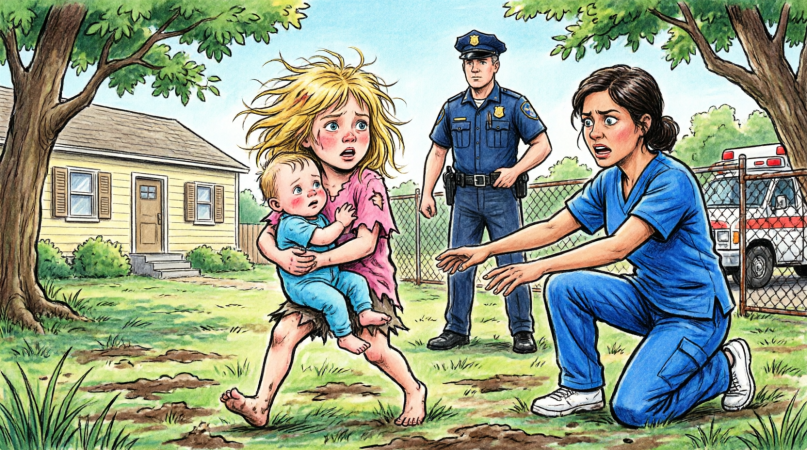
The second I got home from work, I saw my seven-year-old daughter stumbling out of the woods behind our house with her baby brother in her arms.
For a moment, my brain refused to understand what my eyes were seeing.
Maisy was too small to be carrying Theo that far.
Theo was too quiet.
The woods behind our fence were too still.
Her arms were wrapped around him so tightly that his little body seemed pressed into hers, one sweaty cheek mashed against her torn shirt.
She was limping.
One shoe was missing.
The other foot was bare too, streaked with dirt and blood from the roots and rocks that cut through the narrow creek path behind our house.
Her pink shirt was ripped at the shoulder.
There were scratches across both forearms, thin red lines where thorns had grabbed her skin.
Her blonde hair, usually soft and wild around her face, was damp and tangled with leaves.
Theo’s curls were wet with sweat.
His cheeks were red in a way that looked wrong on a baby.
Not rosy.
Hot.
Dangerously hot.
I had left both of my children with my parents that morning because I thought there was no safer place in the world.
That sentence has lived inside me ever since.
It comes back in grocery store aisles.
It comes back when I buckle Theo into his car seat.
It comes back when Maisy asks if she can sleep with the hallway light on.
I thought there was no safer place in the world.
The drive home that evening had already felt strange, though at the time I would not have called it fear.
I was coming off a twelve-hour hospital shift that had stretched closer to thirteen because two nurses called out and nobody wanted to leave the floor short.
My scrubs smelled like antiseptic, baby formula, and stale coffee from the paper cup I had abandoned at the nurses’ station sometime after lunch.
My feet ached inside my work shoes.
My head was pounding behind my eyes.
Outside, the sky had turned that heavy orange color it gets before a summer storm breaks.
The air was thick enough to make everything feel slower.
Every traffic light stayed red.
Every car in front of me seemed to hesitate one beat too long.
I remember thinking that all I wanted was a shower and five quiet minutes with my children.
I wanted to kiss Theo’s curls.
I wanted to hear Maisy tell me some long, serious story about a cloud shaped like a dragon or a worm she had rescued from the sidewalk.
Maisy had turned seven three weeks earlier.
She was the kind of little girl who made the world softer without trying.
She gave names to the neighborhood squirrels.
She left notes under my pillow that said, I love you more than stars, written in crooked purple marker.
She still believed bandages worked better if you kissed them first.
Theo was fifteen months old, all dimples and sticky hands, still in that stage where every new word felt like a miracle.
He called blueberries “boos.”
He laughed so hard at sneezes that he sometimes fell backward onto the carpet.
He followed Maisy around like she personally hung the moon over our roof every night.
On Tuesdays, my parents watched them.
My mother, Joanne, had started insisting on it after I returned to full-time shifts.
She said the kids needed family.
She said daycare was too expensive.
She said I was wearing myself down and refusing help because I had always been stubborn.
My father, Curtis, was retired.
He had spent years driving a delivery truck, the kind of man who woke up before dawn even when there was nowhere to be.
When I was little, he fixed loose cabinet handles without being asked and warmed up the car for my mother in winter.
He was not a soft man, but he had always seemed steady.
That was the word I would have used.
Steady.
My mother and father still lived four houses down from me on the same street where I grew up.
There was comfort in that, or at least I thought there was.
My kids knew their porch.
They knew the old recliner by the front window.
They knew the little ceramic dish where my mother kept butterscotch candies even though she pretended they were only for adults.
I gave my parents a key to my house.
I gave them the car seat instructions.
I gave them the emergency contact sheet with the pediatrician’s number taped to the side of their refrigerator.
I gave them my children.
That was the trust signal.
Love is not always a speech.
Sometimes it is a key on a ring, a booster seat in someone else’s back seat, and the belief that the people who raised you will know how to keep your babies alive.
At 6:18 p.m., I turned onto Maple Grove Lane.
The first thing I noticed was the driveway.
My mother’s silver Honda was not there.
My father’s truck was not there either.
That should not have been possible.
They knew I would be home around six.
They knew I always picked the kids up before I even changed out of my scrubs.
I slowed in front of their house, glanced toward the porch, and saw nothing.
No stroller.
No sippy cup on the steps.
No movement behind the curtain.
I told myself maybe my mother had taken them for ice cream.
I told myself maybe my father had gone along.
I told myself all the stupid little things a parent tells herself because the alternative is too awful to look at straight on.
Then I pulled into my own driveway.
The engine ticked after I turned the key off.
The air conditioner stopped blowing.
For one second, the silence had weight.
My yard looked wrong.
No toys in the grass.
No tiny plastic truck tipped over by the porch.
No Theo banging his palm against the front window because he had heard my car.
Then I saw movement by the woods behind the fence.
At first, I thought it was a deer.
Something small moved between the tree trunks, wavering in the orange light.
Then the shape stepped forward.
Blonde hair.
A child.
My child.
I dropped my hospital bag in the driveway and ran.
I do not remember opening the gate.
I do not remember crossing the yard.
I remember the grass whipping against my ankles and my own breath tearing in my chest.
The closer I got, the more impossible it looked.
Maisy was carrying Theo.
Not dragging him.
Not holding his hand.
Carrying him with both arms locked around his body, her small back bowed under his weight.
Theo was not unconscious, but he was frighteningly limp.
His mouth opened and closed like he wanted to cry but did not have the strength left.
His little cheeks were hot and red.
His skin felt feverish from several feet away, as if the heat around him had its own presence.
Maisy saw me and tried to take another step.
Her knees bent.
Her whole body swayed.
I reached her before she fell.
I dropped to my knees in the grass and said her name.
She looked at me like she was trying to place me.
That look hurt more than the scratches.
It was the look of a child who had been afraid for so long that safety no longer arrived all at once.
I told her to give Theo to me.
I told her Mommy was here.
I told her she could let go.
She shook her head.
Her lips were cracked white at the edges.
Her voice was so small I almost missed it.
“Not yet,” she whispered.
Then she tightened her arms around Theo.
“I have to keep him safe.”
I have heard people say their hearts broke.
That is not what it felt like.
It felt like something in me split into two versions of myself.
One version wanted to scream until the windows on our street rattled.
The other version knew my daughter was watching my face and needed me to stay human.
I chose the second one because she had already done too much choosing for one day.
“You did keep him safe,” I told her.
My voice did not sound like mine.
“You did it, baby. I have him now.”
I pried Theo gently from her arms.
The moment his weight left her, Maisy’s body folded.
I caught her before she hit the ground.
She was burning up and shivering at the same time.
I pressed my hand to her forehead, then Theo’s.
Theo was hotter.
My fingers started shaking.
I pulled out my phone and nearly dropped it twice before I managed to call 911.
The dispatcher answered at 6:21 p.m.
I know because that time appears in the police report, on the emergency dispatch record, and in the hospital intake notes that I later read so many times the words blurred together.
Seven-year-old female.
Fifteen-month-old male.
Possible heat exposure.
Dehydration.
Scratches.
Bleeding feet.
Unknown location of grandparents.
Those words looked clinical on paper.
They did not capture Maisy’s fingers clutching my sleeve.
They did not capture Theo’s tiny broken sounds.
They did not capture the smell of hot grass, storm air, and the sour fear of a mother realizing the danger had worn a familiar face.
While we waited for the ambulance, I cupped Maisy’s cheek and asked what happened.
I asked where Grandma was.
I asked where Grandpa was.
Her mouth trembled.
Tears slid through dirt already streaked across her face.
“Grandma left us in the car,” she said.
I thought I had heard wrong.
There are sentences the mind rejects before the heart can take them in.
I asked her to say it again.
She swallowed like it hurt.
She said Grandma told them she was only going inside for one minute.
She said the car got hotter and hotter.
She said Theo started crying and would not stop.
She tried the door handle.
She tried to unbuckle him.
She tried to fan his face with her shirt.
She called for Grandma until her throat hurt.
Then Grandpa came outside.
Everything about her changed when she said that.
Her eyes moved to the woods.
Her shoulders curled inward.
She whispered that Grandpa was acting scary.
He was saying things that did not make sense.
His face looked strange.
His eyes looked wrong.
“Like he didn’t know me,” she said.
He opened the car door.
He grabbed her arm.
He tried to take Theo.
Maybe he thought he was helping.
Maybe there was some confusion in him that none of us had understood.
Maybe his mind had been slipping in ways my mother had hidden from me because pride can look a lot like protection until someone gets hurt.
But Maisy was seven.
She was trapped in a boiling car with a screaming baby.
To her, the adult reaching for Theo was not confused.
He was danger.
So she ran.
She got Theo loose from his seat.
She dragged him across the back seat.
She climbed out with him pressed against her chest.
She ran through my parents’ backyard, past the chain-link fence, and into the woods between their property and mine.
The route is not long for an adult.
For a seven-year-old carrying a toddler in summer heat, it was a nightmare.
There were roots exposed from last spring’s rain.
There were thorn bushes near the creek bank.
There were broken branches and mud pockets where the ground dipped under the leaves.
She lost one shoe in the mud.
She lost the other somewhere near the creek.
She could not remember exactly where.
She said she heard Grandpa crashing behind them for a while.
Branches snapped.
Leaves shook.
Then everything went quiet.
That frightened her worse.
She thought he might be hiding.
She thought he might be pretending.
She thought if Theo cried, he would find them.
So she hid behind brush and wrapped her body around him.
Every time he whimpered, she whispered for him to please be quiet because Mommy was coming.
A child should never have to become a wall between her baby brother and the adults who were supposed to love them.
The first deputy arrived before the ambulance.
He came through my side gate with one hand near his radio and the other lifted gently when he saw the kids.
His face changed.
I have seen that look on hospital staff when they enter a room expecting one thing and find something worse.
The ambulance pulled up behind him.
Two paramedics moved fast but spoke softly.
One opened a medical kit in the grass.
Another took Theo from me for less than a minute to check him, and I had to force myself not to grab him back.
They started cooling him.
They checked Maisy’s pulse.
They examined her feet.
One asked if there had been a fall.
One asked how long they had been outside.
Maisy could not answer times.
She only knew that the car was hot, the woods were scary, and she waited until I came home.
A deputy took photos of the torn shoulder seam of her shirt.
He photographed her forearms.
He photographed the muddy trail near the fence.
The second deputy walked toward the woods.
Maisy grabbed the front of my scrub top with both fists.
“Don’t let him come back,” she whispered.
I put my hand over hers and promised, even though I did not yet understand what I was promising against.
Then the radio crackled.
The deputy deeper in the trees said they had found my father near the creek bed.
The words moved through the yard like cold water.
The paramedic looking over Theo lifted his head.
The second deputy turned sharply.
Maisy’s grip tightened.
“Mommy,” she whispered, “he fell down by the water.”
That was the part she had been too scared to say first.
She had seen him go down.
She had heard the strange sound he made.
She had thought it was a trick to make her come closer.
So she had stayed hidden.
She had stayed hidden with her brother in her arms while my father lay near the creek.
At 6:37 p.m., my mother’s Honda pulled into my driveway.
I will never forget the sound of her brakes.
Soft.
Ordinary.
Insultingly normal.
She stepped out with a white paper pharmacy bag in one hand and her phone in the other.
Her sunglasses were pushed up on her head.
She looked annoyed before she looked afraid.
“What is going on?” she called.
Then she saw Maisy.
The pharmacy bag slipped from her hand and hit the driveway.
A prescription bottle rolled under the ambulance step.
My mother’s face emptied.
All the color left her at once.
She looked from Maisy to Theo, then to the deputies, then toward the woods.
“Joanne,” the deputy said, “where were the children supposed to be?”
My mother opened her mouth.
Nothing came out.
Maisy pressed closer to me.
Her voice was barely there.
“Grandma locked us in because Grandpa was having one of his bad days.”
My mother covered her mouth with both hands.
That was the second sentence that changed everything.
Not one bad decision.
Not one forgotten errand.
A pattern.
A secret.
A risk my mother had carried into the same house as my babies and then pretended was manageable.
The deputy’s voice became very quiet.
“How long have you known about his bad days?”
My mother shook her head, but she did not answer.
That silence answered enough.
At the hospital, the story began turning into documents.
Hospital intake form.
Pediatric evaluation.
Emergency department notes.
Incident report.
Deputy statement.
Photographs logged as evidence.
Maisy’s scratches were cleaned and dressed.
Theo was treated for heat exposure and dehydration.
They monitored him carefully, and every beep from the machine beside his bed felt like a judgment against every adult who had failed him.
Maisy sat on the bed beside me wrapped in a warm blanket even though the room was not cold.
She would not let Theo out of her sight.
When a nurse tried to wheel him briefly for another check, Maisy panicked so badly the nurse stopped and explained every step first.
“She saved him,” the nurse told me later in the hallway.
Her voice was gentle.
But I hated the sentence.
I hated it because it was true.
I hated it because my seven-year-old should have been drawing clouds, not making life-or-death decisions in the woods.
My mother arrived at the hospital about forty minutes after us.
A deputy stayed near the door.
She had been told to wait before approaching the children.
She looked smaller in that hallway than I had ever seen her.
Her hands shook around a bottle of water she had not opened.
“I only went inside for a minute,” she said when I stepped out.
“No,” I said.
The word was flat.
She flinched as if I had shouted.
She tried again.
“Your father was agitated.
I had to get his medication. I thought the car would be fine with the windows cracked.
I thought I would be right back.”
I stared at her.
“How long?”
She looked down.
“How long, Mom?”
She whispered that it had been twenty-six minutes.
Twenty-six minutes in a hot car with a seven-year-old and a fifteen-month-old.
Twenty-six minutes while my mother stood in a pharmacy line because she did not want to ask anyone for help.
Twenty-six minutes because she had convinced herself that managing my father’s decline in secret was better than admitting the truth.
Then came the worse part.
She had known he was confused in the afternoons.
She had known he sometimes forgot names.
She had known he got angry when routines changed.
She had known he had once left a burner on and once wandered two blocks away before a neighbor brought him back.
She had not told me.
Not because she meant harm, she said.
Because she was embarrassed.
Because she did not want me to stop bringing the children.
Because she wanted things to stay normal.
Normal is not a place you can keep by lying about danger.
It becomes a stage set, and sooner or later somebody leans on the painted wall and falls straight through.
My father survived.
He had collapsed near the creek from a medical event that the doctors later said may have explained some of his confusion that day, though not all of what had been happening before it.
He was taken to the same hospital and admitted on another floor.
I did not go see him that night.
I could not.
Maybe that makes some people uncomfortable.
It made my mother furious later, when she found enough strength to be angry again.
But I had two children in pediatric beds, one of whom had carried the other through the woods because the adults had broken the world around her.
My place was with them.
The investigation did not become some dramatic courtroom scene overnight.
Real life is slower and uglier than that.
There were interviews.
There were follow-up statements.
There were phone calls from people using careful voices.
There was a child safety review.
There were medical records and recommendations.
There were questions about supervision, known impairment, heat exposure, and whether my mother’s choices had created a foreseeable risk.
I cooperated with every process verb they gave me.
I documented.
I requested copies.
I wrote down dates.
I saved voicemail messages.
I photographed Maisy’s shoes when one was finally found near the creek bank days later, half sunk in mud like evidence from a life that no longer belonged to us.
My mother called me cruel.
She said I was punishing her during the worst week of her life.
She said she had almost lost her husband too.
I told her she had almost lost my children.
There is no softer way to say that.
For a while, relatives tried to make it a family misunderstanding.
They said Grandma made a mistake.
They said Grandpa was sick.
They said Maisy was brave, as if bravery erased the reason she had needed to be.
One aunt told me children are resilient.
I remember looking at her across my kitchen table, at the mug of coffee going cold between us, and saying, “Children are not supposed to be tested for resilience by the people trusted to protect them.”
She did not come back after that.
Maisy had nightmares for months.
She woke up crying because she heard Theo crying in the car.
She refused to wear the color pink for a while because of the torn shirt.
She kept snacks hidden in her dresser for emergencies.
At school, her teacher called me after Maisy tried to carry a crying kindergartner to the nurse by herself and would not let go until an adult promised three separate times that the little girl was safe.
Theo recovered physically faster.
Toddlers can look fine before everyone else feels fine.
He went back to throwing cereal on the floor and laughing at sneezes.
But for a long time, he screamed when car doors shut too firmly.
He screamed when I stepped away at gas stations.
He screamed when anyone other than me tried to buckle him in.
My parents did not watch them again.
Not once.
Not for five minutes.
Not while I ran into a store.
Not after apologies.
Not after tears.
That boundary cost me a relationship with my mother for a long time.
Maybe permanently.
She wanted forgiveness to mean access.
I told her forgiveness, if it ever came, would not come with a car seat.
My father was eventually moved into care where people trained for his condition could monitor him safely.
That should have happened earlier.
My mother admitted that once, but only once.
She said it late one night on the phone, when her voice sounded scraped hollow.
“I thought if I kept handling it, we would still be us,” she said.
I was sitting on the hallway floor outside Maisy’s room, listening to my daughter breathe in her sleep.
“You used my children to prove something wasn’t broken,” I said.
She cried then.
I did not.
Not because I felt nothing.
Because some grief comes so deep it does not know how to come out yet.
Months later, Maisy asked me if she had done the right thing by running.
We were folding laundry in the living room.
Theo was asleep on the couch with one sock missing, because some things about toddlers remain beautifully ordinary no matter what happens.
Maisy held one of his tiny shirts and would not look at me.
“What if Grandpa needed help?” she asked.
I sat on the floor in front of her.
I told her that adults are responsible for adult emergencies.
I told her children are responsible for being children.
I told her she had listened to the strongest, smartest part of herself.
I told her she saved Theo because she loved him, but she should never have been put in a place where saving him was her job.
She nodded.
Then she asked if Grandma still loved her.
That question hurt in a different way.
I told her yes, because I believe my mother does love her.
But then I told her something I wish more people understood.
Love is not the same as safety.
Someone can love you and still be too proud, too careless, too ashamed, or too afraid to protect you the way they should.
That is why parents have to choose safety, even when family calls it betrayal.
Maisy wears sneakers in the backyard now.
She still checks on Theo more than she should.
Sometimes I catch her watching the tree line through the kitchen window, her face serious in a way no seven-year-old’s face should be.
But she laughs again.
She names clouds again.
She leaves notes under my pillow again, though now some of them say things like, Theo is okay, I checked.
I keep every one.
The police report is in a folder in my closet.
The hospital papers are there too.
The torn pink shirt is sealed in a bag because I could not throw it away and could not bear to see it loose in a drawer.
One muddy shoe sits beside it.
The other was never found.
Sometimes people ask how I can live so close to the place where it happened.
The answer is that the woods did not betray us.
The creek did not betray us.
The house did not betray us.
The betrayal came from adults who confused secrecy with love and routine with safety.
I had left both of my children with my parents that morning because I thought there was no safer place in the world.
Now I know safety is not a place.
It is a pattern.
It is the truth told early.
It is help asked for before pride turns dangerous.
It is a mother believing a child’s fear the first time.
And it is a seven-year-old girl walking out of the woods with her baby brother in her arms, refusing to put him down until she knows, with her whole exhausted heart, that someone safe has finally come.