My daughter called me in tears and whispered, “Mom, come get me. They hurt me.”
For three seconds, I heard only her breathing.
Not crying.
Not anger.
Breathing, thin and hidden, like she had pressed herself into a corner and was afraid the walls could hear.
I was still at Fort Liberty, still in my Army dress uniform, still holding a paper coffee cup that had gone cold beside my desk.
The late light caught my ribbons through the office window, and the starch in my jacket suddenly felt too tight across my shoulders.
“Emily?” I said.
Her answer came in pieces.
“Mom. Please. Come get me.”
My daughter was twenty-six years old, old enough to have a marriage, an apartment, a life she insisted I needed to respect.
She had survived my deployments, my missed birthdays, and the years when I had to love her through phone calls from places I could not name.
When she married Jason Bennett, I told myself she was grown.
I told myself not every polished family was dangerous.
I told myself Evelyn Bennett’s corrections, Derek’s smug jokes, and Jason’s quiet habit of answering for Emily were only things I noticed because I was a soldier and a mother.
Mothers of adult daughters learn a hard discipline.
You keep the porch light on, but you do not drag them home.
You make sure they know the door is unlocked.
Then you pray they remember before the house they chose becomes a cage.
“Where are you?”
I asked.
“Mercy General,” she whispered.
“In Charlotte?”
“Yes.”
“Are you alone?”
The pause told me the answer before she did.
“I don’t know.”
I stood so fast my chair hit the wall.
“Listen to me. Stay where nurses can see you. Tell them you want everything documented. Do you understand?”
“They took my phone,” she whispered. “I got it back for one minute.”
“Who took it?”
“Jason.”
There are names that do not surprise you.
They only punish you for having suspected them too long.
“I’m coming,” I said.
At 6:18 p.m., I left Fort Liberty.
At 6:41 p.m., stopped at a red light, I made a voice-note timeline: daughter called in distress, reported injury, reported phone taken, husband involved.
At 7:03 p.m., I called a military family liaison I trusted because people who understand violence understand documentation.
At 7:26 p.m., I called Mercy General and asked the intake desk to preserve every nurse observation, medical note, and patient property entry connected to Emily Hart.
At 8:11 p.m., I made one more call and gave a room number.
Observation room seven.
The emergency room smelled like disinfectant, old coffee, and rain-soaked coats when I walked in.
A small American flag was mounted near the nurses’ station, quiet on the wall while real battles happened behind curtains.
A nurse lifted a clipboard.
“Ma’am, you can’t go back there.”
“My daughter,” I said. “Emily Hart. Observation room seven.”
She looked at my uniform, then at my face.
“Straight down. Second left.”
The hallway seemed longer than it was.
Every fluorescent light hummed.
Every step sounded too loud.
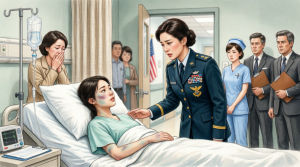
When I pushed open the curtain, the first thing I saw was the white dress.
Emily had worn it that morning because Jason’s family had invited her to what they called a private reconciliation lunch.
Now it was torn at the shoulder and stained near the hem.
One eye was swollen nearly shut.
Her lower lip was split.
Dark bruises marked both arms where fingers had held too hard.
A hospital wristband hung loose around her wrist.
For a second, I did not see the adult woman who had built a life away from me.
I saw the little girl who used to mail crayon drawings to deployed soldiers because she thought lonely people deserved color.
“Mom,” she whispered.
I crossed the room and gathered her carefully.
Her body shook against me, not from cold and not from pain.
From terror.
That kind of fear is not born in one bad minute.
It is trained into a person until she apologizes for bleeding on the floor.
“They locked me in the guest house,” she whispered into my uniform. “They took my phone. They said if I left Jason, they’d ruin me.”
Before I could answer, laughter came from the doorway.
Jason Bennett stood there in a dark suit, one hand in his pocket, looking inconvenienced.
His mother, Evelyn Bennett, wore pearls and a cream coat.
His older brother, Derek, leaned against the frame with the lazy confidence of a man who had never been told no by someone he feared.
They were immaculate.
My daughter was bruised.
That told me everything.
Evelyn tilted her head.
“She’s always been dramatic,” she said.
Emily clutched my sleeve.
“No, Mom. They locked me in the guest house. They took my phone. They said if I left Jason, they’d ruin my reputation.”
Jason rolled his eyes.
“She’s exaggerating.”
Derek laughed softly.
“Some women marry into families they’re not equipped to handle.”
The room froze.
A monitor beeped.
A paper cup sat untouched on the tray.
The privacy curtain breathed from the vent, and a nurse in the hallway slowed just enough to become a witness.
I stood, still holding Emily’s hand.
For one ugly heartbeat, I pictured crossing the room and making Jason understand what fear felt like.
Then Emily’s fingers trembled against mine, and I remembered the mission.
My daughter did not need my rage.
She needed my control.
Control is not weakness.
Sometimes control is the last wall between your child and the people waiting for you to make one mistake.
“Let’s not make this unpleasant, Colonel Hart,” Evelyn said.
She made my rank sound like a cheap accessory.
“Our family has friends everywhere. Courts. Media. State government. You do understand that, don’t you?”
Derek smirked.
“Take your daughter home and be grateful we’re not filing a lawsuit against her.”
Jason folded his arms.
“You should think about what this could do to your career.”
Emily looked down when he spoke.
That almost broke me more than the bruises.
Her body had memorized consequences.
I looked at Jason, then Derek, then Evelyn.
They mistook silence for surrender because people like that always do.
They think money is proof.
They think volume is power.
They think a frightened woman in a hospital bed is the end of a story.
They were wrong.
Evelyn stepped closer.
“You should understand something, Colonel. The Bennett family always wins.”
I reached into my uniform pocket.
Their eyes followed my hand.
I pulled out my phone and placed it face down on the bedside table beside Emily’s medical forms.
Jason frowned.
Derek’s smirk thinned.
Evelyn’s smile faltered.
“What are you doing?” Derek asked.
“My daughter called me three hours ago,” I said. “She wasn’t the first person I contacted.”
The room went quiet enough for the monitor to sound too loud.
Jason glanced toward the hallway.
“What calls?”
At that exact moment, several dark-suited people appeared outside observation room seven.
One stood near the nurses’ station.
One carried a folder.
The last stepped into the doorway and nodded to me.
“Colonel Hart.”
He said it without mockery.
Then he turned to the Bennetts.
“Nobody here is discussing reputations anymore.”
The folder opened.
Inside was the first hospital intake note, time-stamped 6:52 p.m.
Emily’s statement was clipped beneath it.
A patient property form sat behind that, and one line made Jason stop breathing through his mouth.
Cell phone missing on arrival.
The nurse drew in a breath.
Emily made a tiny sound beside me, not relief yet, but the first crack in the room built around her fear.
Jason recovered first.
“This is ridiculous. My wife is emotional. We were trying to help her.”
The man with the folder did not blink.
“Then you can explain why she arrived injured, without her phone, and afraid to identify who brought her here.”
Derek pushed off the doorframe.
“Who exactly are you?”
“Someone asked to make sure this did not get buried.”
That answer did more damage than a title would have.
Evelyn lifted her chin.
“My attorney will be here in twenty minutes.”
“Good,” I said. “Tell him to bring a pen.”
Her eyes narrowed.
“Excuse me?”
“Because every person in this room who threatened my daughter is going to choose tonight. Speak truthfully now, or explain the inconsistencies later.”
Jason laughed once.
It sounded thin.
“You don’t have anything.”
I picked up my phone but did not unlock it.
“You took her phone. You did not take mine. You did not take the hospital notes, the intake log, the nurse’s observations, or the timeline I made before I ever walked through those doors.”
Derek looked at Jason.
It was the first crack between the brothers.
Jason saw it too.
“Don’t look at me like that,” he snapped.
“Jason,” Evelyn warned.
He shut his mouth.
A mother’s control can be tender or poisonous.
Evelyn’s was the second kind.
The man with the folder asked Emily if she wanted Jason and his family removed from the room.
Her hand tightened around mine.
Everyone watched her.
That was the cruelest part of it, the way abuse makes a simple sentence feel like a cliff.
Jason softened his voice.
“Em. Think about this.”
Emily flinched.
I did not answer for her.
I wanted to, but there are doors a mother cannot walk through on her child’s behalf.
Emily had to reach for the handle herself.
She swallowed.
“I want them out.”
Jason’s face hardened.
“Emily.”
She said it louder.
“I want them out.”
The nurse stepped fully into the doorway.
The man with the folder turned to the people behind him.
“Please clear the room.”
Derek started, “You can’t just—”
Then he saw the nurse pick up the phone at the nurses’ station, and he stopped.
The Bennett family always wins, Evelyn had said.
But in that room, winning suddenly required them to leave.
Jason backed out first.
Derek followed.
Evelyn stayed long enough to stare at me.
“You have no idea what you’ve done,” she whispered.
I looked at my daughter’s swollen face.
“I know exactly what I’ve done.”
When the door closed, Emily broke.
Not loudly.
She folded inward, hands over her mouth, shoulders shaking with sobs that seemed to come from somewhere below language.
I sat on the edge of the bed and held her while the nurse drew the curtain.
“I’m sorry,” Emily whispered.
That was the first full sentence she gave me after they were gone.
Not thank you.
Not I’m scared.
I’m sorry.
There are apologies that should never exist, and a daughter apologizing to her mother for surviving is one of them.
“You do not apologize for being hurt,” I said.
“But I went back.”
“I know.”
“I thought if I tried harder, marriage would get easier.”
I looked at her.
“Hard is bills. Hard is grief. Hard is two tired people trying to be kind after a long day. Hard is not being locked in a guest house.”
Her face crumpled.
The next hour became paperwork.
Hospital intake form.
Patient property statement.
Injury documentation.
Written timeline.
Restricted visitor request.
Emily answered what she could.
When her voice failed, she pointed.
When her hand shook too badly to sign, the nurse let her pause.
Nothing was rushed.
Every fact became part of a wall the Bennetts could not walk through.
At 10:38 p.m., Jason tried to come back.
He did not get past the nurses’ station.
I heard his voice rise, then Evelyn’s, then Derek’s.
A security supervisor said something low.
The hallway quieted.
Emily stared at the curtain.
“He sounds so normal when other people are around,” she whispered.
“That’s the part that makes you feel crazy.”
“I know.”
She turned toward me.
“Did you know?”
“I knew something was wrong,” I said. “I did not know how bad.”
Her eyes filled.
“I kept trying to make it look okay because you’re you.”
That hurt because I understood it.
Because I wore a uniform.
Because I survived hard things.
Because I had taught her to stand straight and keep receipts and know her worth.
She thought admitting fear meant failing me.
I took her hand.
“Strength is not staying where you are being destroyed.”
She looked away, and I let the sentence sit.
Some truths need room to land.
After midnight, the man with the folder returned and explained the next steps in plain language.
No promises.
No dramatic speech.
Just process.
Statements would be taken.
The medical record would be preserved.
The missing phone would be included in the report.
If Emily wanted protection, the path could begin tonight.
For the first time all evening, someone spoke to her like she owned her own choices.
That changed her breathing.
At 12:17 a.m., Emily asked for the first call to be made to a locksmith.
Not a lawyer.
Not a reporter.
A locksmith.
“I don’t want him getting into my apartment,” she said.
Jason had a key.
Of course he did.
He had a key, a garage code, her passwords once, her calendar, and a whole family trained to make control sound like concern.
That is how cages get built in ordinary life.
Not always with chains.
Sometimes with access.
Sometimes with shared accounts, spare keys, family dinners, and the word dramatic placed over a woman’s mouth until she stops trusting her own pain.
By morning, Emily’s phone had not been returned.
Jason claimed he never had it.
Derek claimed she must have lost it.
Evelyn called the whole thing a misunderstanding.
But the patient property form existed.
The intake notes existed.
The nurse’s observations existed.
My timeline existed.
And Emily finally existed in the record as more than someone else’s difficult wife.
That was the beginning, not the ending.
People like the Bennetts do not collapse because one room stops obeying them.
They test doors.
They make calls.
They send messages through relatives.
They wrap threats in concern and say things like, “We just want what’s best for her,” while trying to reach the woman they cornered.
But Emily had said the first real sentence.
I want them out.
Everything else grew from that.
By the second day, she gave a full statement.
By the third, the visitor restrictions were expanded.
By the end of the week, she had changed her locks, moved her important papers, and opened a new phone account Jason could not touch.
A local attorney helped her file the first protective paperwork.
I stood in the hallway while she signed it.
I did not sign for her.
I did not tell her what to say.
I watched my daughter write her name like she was taking it back one letter at a time.
There is a kind of victory that does not look like triumph.
It looks like a woman sleeping four uninterrupted hours.
It looks like a nurse saying, “You’re safe here,” and the body almost believing it.
It looks like a daughter asking for scrambled eggs after two days of nausea.
The Bennetts did not laugh in front of me again.
Evelyn tried once to stare me down in a hallway.
I let her.
There is no need to perform power for people who only recognize it when it is loud.
Jason sent one message through someone else.
Tell Emily we can fix this privately.
Emily read it, stared at the screen, and handed it to her attorney.
“Add it to the file,” she said.
I will remember that sentence for the rest of my life.
Not because it was dramatic.
Because it was calm.
Weeks later, when Emily came to stay with me for a while, she stood on my front porch at sunset.
There was a small flag by the railing and grocery bags near the door because I had stopped on the way home and bought everything she liked as a child.
Chicken noodle soup.
Peaches.
The cheap cinnamon cereal she pretended she had outgrown.
She looked at the driveway, the mailbox, the quiet street, and then at me.
“I kept thinking I had to win,” she said.
I set the bags down.
“You survived.”
She nodded slowly.
“Is that enough?”
I thought about observation room seven.
I thought about the white dress.
I thought about Evelyn saying the Bennett family always wins.
Then I thought about Emily saying, “I want them out.”
“Yes,” I said. “For tonight, that is enough.”
She cried then, but not like she had in the hospital.
This time she stood upright and let the tears come.
That was when I understood the lesson I wish every mother could learn without fear.
You cannot fight your child’s whole battle for her.
You can answer the phone.
You can drive through the dark.
You can stand in the room.
You can place the evidence on the table.
You can make sure the people who hurt her are not the only ones with power.
But the sentence that opens the door has to come from her.
Emily said it.
I want them out.
And when she did, the family that thought money could buy silence discovered something they should have understood before they ever touched my daughter.
A mother who has spent her whole life fighting impossible battles does not need to shout to become dangerous.
She only needs the truth.
A timeline.
A witness.
And one phone call answered at exactly the right time.