You open the door with one hand still resting on the knob, and for a second the hallway light frames Nicole like she has stepped into a scene she has rehearsed in her head too many times. She is prettier in the way certain women become prettier when they know they are being watched, all polished hair, white coat, expensive lipstick, and a bottle of wine held delicately by the neck as if even glass should understand its place around her. She looks over your shoulder before she looks at your face, already smiling at the room behind you, already assuming she belongs somewhere inside it. Then her eyes finally land on you, and the smile flickers.
You smile first.
“Nicole,” you say warmly, as if you are greeting a book club friend and not the woman your husband smuggled into your marriage under the label of maturity. “I’m so glad you made it.”
She blinks once, thrown off by your tone. “Hi,” she says, and there is just enough hesitation in it to show that she had expected resistance, maybe even drama. “I brought a cabernet. I hope that’s okay.”
“Perfect,” you say. “Come in. Everyone’s waiting.”
Behind you, the apartment has gone quiet in that eerie, social way people go quiet when they can smell a story developing but do not yet know whether they are supposed to pretend not to notice it. Your husband is standing a few feet back, relief already beginning to loosen his posture because he thinks he has won. In his mind, the dangerous part was your reaction. He has not yet imagined that calm can be a knife too.
You step aside and let Nicole in.
Your husband reaches for her with the relaxed ease of someone greeting an old favorite. Not romantic on the surface. That would be too easy to accuse. No, he goes for the subtler cruelty, the kind that hides behind deniability. He touches her elbow. He takes the wine. He smiles a little too long. And then he glances at you with the smug, private satisfaction of a man who believes he has just proven something about your character.
“See?” he says softly, almost like praise. “This is great.”
You nod. “It is.”
He studies you for one beat longer, probably searching for a crack he can label irrational later. When he finds none, he turns back toward the party, buoyant again, while Nicole begins floating into the apartment like she has been invited to a gallery opening in her honor. Conversations restart, but not fully. Thirty people try to act normal while their curiosity crowds the walls.
Ava, standing near the charcuterie board with a paper cup in her hand, watches you closely.
You give her the smallest nod.
That is all she needs.
Your apartment is not large, which is part of what makes his choice so obscene. There is nowhere to hide awkwardness in a small space. Every laugh spills into every other room. Every glance catches on another. You had spent a month making this place feel like a beginning. You patched drywall yourself. You refinished the little entry bench you found on marketplace and painted it the warm green he said made the apartment feel alive. You hung floating shelves in the kitchen. You assembled the media console alone because he was “buried at work.” Every square foot holds your fingerprints, and now he has invited his past to drift through it like a guest of honor.
Nicole makes a slow turn through the living room, taking everything in.
“This place is gorgeous,” she says brightly. “You did such a good job with it.”
She is speaking to both of you, but she is looking at him.
He grins. “Thanks. We really wanted it to feel grown-up.”
You nearly laugh at that. Grown-up. As if adulthood is measured in throw pillows and imported wine rather than the ability to maintain basic respect inside a marriage.
“Can I take your coat?” you ask Nicole.
Your husband looks at you quickly, surprised again by your grace. Nicole hesitates, then slides the coat off her shoulders and hands it to you. It is heavier than it looks. Soft wool. Expensive. It smells faintly of perfume and cold air.
“Thank you,” she says.
“Of course.”
As you carry it to the bedroom, you feel your pulse for the first time that evening. It is steady. Not because you are unhurt. You are hurt in that deep, ugly way that wants to set dishes on fire. But beneath the hurt is something cleaner. A decision, made piece by piece over the last forty-eight hours while he was planning cocktail playlists and congratulating himself for having such a reasonable wife. Rage would have tied you to him. Calm is untying every knot.
In the bedroom, your half-packed duffel bag sits in the closet behind his winter coats. You touch it for just a second, the way a traveler checks for a passport before boarding.
Still there.
Still real.
When you return to the living room, your husband is telling a story about the first day you moved in, specifically the part where he had to “talk you down” because the couch wouldn’t fit through the stairwell. Several people laugh. You remember that day differently. You remember solving the angle problem yourself while he FaceTimed his brother and made commentary from the landing. But he has always had a talent for narrating your competence as if it were a charming extension of his patience.
Nicole laughs too. She laughs like she already knows his rhythm.
A small circle has formed around them. Not huge, just enough to shift the room’s center of gravity. He is standing taller. More animated. Performing. You have seen this version of him at work events and birthday dinners, the polished, witty version that feeds off attention the way certain electronics feed off a wall socket. He is never cruel in those moments, not openly. He is simply expansive, and everyone else is expected to become furniture around him.
Ava appears at your side without warning.
“You okay?” she asks under her breath.
“Yes,” you say.
“That sounded like a lie.”
“It’s not,” you tell her. “Not anymore.”
She studies your face. Ava has known you since community college, since the years when you worked mornings at the hardware store and nights waiting tables, since the tiny rental with the slanted floor and the window that wouldn’t close in winter. She knows the difference between your brave face and your done face. After a second, she exhales quietly.
“You already decided.”
You nod.
“Tonight?”
“Yes.”
She glances toward your husband, then back to you. “Do you need me to hit someone with a folding chair?”
You almost smile. “Not unless things go off script.”
“What’s the script?”
“You’ll know.”
She sips her drink. “That is both reassuring and terrifying.”
Across the room, Nicole has migrated to the kitchen island. Your husband is beside her pouring wine. Not for the room. For her specifically. He tilts the bottle, says something low, and she smiles in a way that would look innocent to anyone who had never had their instincts insulted before. But instincts are not jealous. Instincts are pattern recognition with scar tissue.
Someone from his office, a guy named Derek who always speaks as if he expects his own podcast to launch any minute, drifts over to you.
“You’re handling this super well,” he says. “Honestly, it’s refreshing.”
You turn to him. “Refreshing?”
“Yeah, you know. A lot of women would make it a whole thing.”
You hold his gaze for a beat. “That would be exhausting.”
He laughs, missing the ice entirely. “Exactly.”
You leave him standing there with his little plastic cup and his little plastic worldview.
At six fifteen, the apartment is full enough that people have stopped pretending Nicole is incidental. Some are whispering in corners. Some keep glancing at you to see if the mask will slip. Some are suddenly overcompensating with loud praise about the apartment, the snacks, the playlist, as if enthusiasm itself can smother discomfort. Your husband, meanwhile, is gliding between groups with the bloated self-satisfaction of a man who thinks he has staged a social experiment and proven himself enlightened.
Then Nicole says the first truly unforgivable thing.
She is standing near the bookshelf in the living room, holding her wine, looking at the framed black-and-white photo of your grandparents that you restored and enlarged as a surprise when you moved in. You had told him once, late at night, that your grandfather taught you to use a socket wrench before he taught you how to drive. That photo matters to you more than half the furniture combined.
Nicole points to it lightly. “This is adorable. Very… you.”
You look at her. “It’s my grandparents.”
She smiles. “I know. It’s sweet. The whole place has that handmade charm.”
Handmade charm.
You hear the phrase for what it is instantly. Not a compliment. A soft little downgrade wrapped in a ribbon. This apartment is curated, hers suggests without saying. Yours looks assembled. Homemade. Practical. A life built with tools instead of taste.
Your husband says nothing.
He actually smiles.
And because he smiles, several other people do too, not because they agree exactly, but because the room always takes its moral temperature from whoever speaks with the most confidence.
You set your drink down on the coffee table. “I like handmade,” you say.
Nicole lifts her brows. “It shows.”
The room tenses. Ava mutters, “Wow,” into her cup.
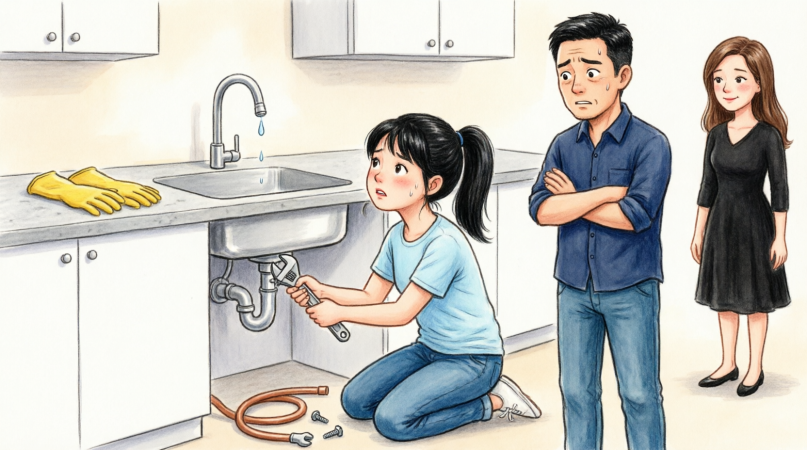
Still, you smile. “You should see the sink. I fixed it myself.”
Your husband chuckles, as if you have added a cute domestic detail to the evening. “She can fix anything.”
Except you think, quietly, except this.
An hour later, you realize something almost funny. Nobody is actually having a good time.
Not really.
People are entertained, yes. Alert. Hungry for the next social tremor. But the air is too tight for ease. Your husband wanted admiration and control in the same package, but public humiliation has a smell, and even guests who would never interrupt it still don’t like breathing it in for too long. The apartment feels overlit. The music sounds too bright. The laughter keeps tripping over itself.
Nicole is sitting on the arm of a chair now, telling a story from “years ago” that includes your husband in its punchline. She doesn’t mention they dated for three years, but she doesn’t have to. The intimacy is in the shorthand. The references. The old names for old neighborhoods. The memory of his dumb college haircut. She is not merely attending your housewarming. She is helping him remember a version of himself that existed before you, and he is letting her do it in the middle of the home you built together.
That is when you stop hurting enough to be embarrassed.
A strange peace settles over you. Cold, clear, almost elegant.
This, you think, is not a marriage in danger. This is already a marriage in disguise.
Ava catches your eye from across the room and walks over.
“Tell me where we are on the chaos meter,” she says.
“We’re close.”
“Do I need to corral witnesses?”
“Yes.”
Her eyebrows go up.
“Witnesses?” she repeats.
You nod. “Not all of them. Just the ones with functioning consciences.”
She takes that in, then gives a brisk little nod. “Copy that.”
Fifteen minutes later, she has casually steered a cluster of people toward the living room under the pretense of a group toast. She is good at social maneuvering in the way only someone with three younger brothers and years of restaurant management can be. By the time she catches your eye again, enough of the guests are gathered in one place that whatever happens next will not get rewritten easily by your husband later.
He is in the kitchen opening another bottle of wine with Nicole beside him, both of them laughing. He looks over when Ava clinks her cup with a spoon.
“Toast!” she calls brightly.
Heads turn. Conversations pause. People begin drifting closer with the relieved curiosity of an audience sensing that the intermission is over.
Your husband raises his glass. “Nice,” he says. “You want me to do it?”
“No,” Ava says smoothly. “I think the hostess should.”
The word lands.
Hostess.
Not couple. Not homeowners. Not him.
You step into the center of the living room holding a glass you have barely touched all night. The apartment goes quiet with surprising speed. Nicole straightens slightly. Your husband smiles, clearly expecting a gracious little speech about new beginnings and friendship and how lucky you both are.
He is still smiling when you begin.
“Thanks, everyone, for coming,” you say. “Seriously. It means a lot that you’re here.”
There are murmurs of approval. A few cups lift.
You keep your voice calm, even warm. “When we moved into this apartment, I thought tonight was going to celebrate building something solid together. I spent the last month making this place feel like home. Some of you know that, because you helped carry boxes, or answered my paint-texts, or listened to me complain about the plumbing.”
A few people laugh softly.
Your husband is still relaxed. He has no idea.
“But sometimes,” you continue, “the best thing a housewarming can do is reveal what kind of home you’re actually standing in.”
The room stills.
That sentence lands differently. You can feel people adjusting internally, looking for edges now, not jokes.
Your husband gives a faint laugh. “Babe…”
You lift one hand gently without looking at him. “I’m almost done.”
The smile on his face tightens.
You turn slightly so you are speaking to the whole room, but the truth of it points exactly where it needs to. “Two nights ago, my husband told me he had invited his ex-girlfriend to our housewarming. When I asked why, he said it was important to him, and if I couldn’t handle it, I could leave. He told me to be mature.”
No one moves. Somewhere near the hallway, a guest whispers “Jesus” before remembering volume.
Nicole’s posture has gone rigid. Your husband’s face begins to change in layers, first annoyance, then disbelief, then warning.
You go on.
“So I took him seriously. I stayed calm. I didn’t yell. I didn’t beg. I didn’t turn this into a scene. I cleaned, decorated, smiled, welcomed everyone in, and made sure the drinks were cold.” You take a breath. “And I also made arrangements.”
Now the room is so quiet you can hear the refrigerator hum from the kitchen.
Your husband sets his glass down too fast. “Okay,” he says with a strained little chuckle. “What are you doing?”
You finally look at him.
“What you asked,” you say. “I’m leaving.”
The sentence drops into the room like a piano through thin ice.
Several people actually gasp. Nicole’s mouth parts. Derek, podcast soul still trapped in a finance bro body, mutters, “No way,” as if he has purchased tickets to a show more expensive than expected.
Your husband laughs again, but the sound comes out wrong. “What?”
“I said I’m leaving.” You reach into your pocket, pull out your ring, and place it carefully on the coffee table beside your untouched drink. “Not because your ex came over. Because you wanted to use my acceptance of that as proof that you could disrespect me in my own home and call it maturity.”
“Are you serious right now?” he snaps, dropping the performance entirely.
“Yes,” you say. “For the first time in a while.”
He glances around the room, realizing too late that the audience he cultivated has turned dangerous. Public control only works while the public stays on script. Now every face around him is a witness, and witnesses make narcissists sweat.
“This is insane,” he says. “You’re blindsiding me in front of everyone over one guest?”
You shake your head. “No. I’m refusing to protect you from the meaning of your choices.”
Ava looks down to hide her expression. Someone near the bookshelf gives up entirely and whispers, “Damn.”
Your husband steps toward you, voice lowering into the tone he uses when he wants to sound calm while actually trying to corner a conversation. “We are not doing this here.”
You hold his gaze. “You did this here.”
Nicole sets her wine down with both hands as if she suddenly isn’t sure her fingers work. “I didn’t know,” she says, almost reflexively, but not to you exactly. To the room. To herself. To history. “I didn’t know it was like this.”
You turn to her, and for the first time all evening your smile disappears.
“You knew enough.”
She flinches.
Because she did. She may not have known every detail, but nobody with a functioning moral spine hears “my ex invited me to his housewarming with his wife” and thinks, What a healthy, neutral social situation. She came because some part of her liked being chosen for the discomfort her presence would create. Maybe not as an affair. Maybe not even as a plan. But as proof. Of what, exactly, probably depends on which mirror she stands in front of.
Your husband’s face hardens. “So that’s it? You’re running away because you’re insecure?”
There it is again. The old trick. Name the wound in a way that flatters the weapon.
You almost pity him for how predictable he is.
“I’m leaving because I’m secure enough not to negotiate with humiliation,” you say. “That’s different.”
He opens his mouth, but you keep going, not louder, just clearer.
“I fixed the leaks in this apartment. I assembled the furniture. I paid my half. I made this place livable while you floated above it giving opinions. And then you decided the first party we hosted here would double as a test of how much disrespect I’d swallow to keep you comfortable.” You take one slow breath. “I passed my own test.”
No one interrupts. No one can.
His face has gone red around the ears now, which always happens when his self-image and reality collide in public. “You’re being dramatic.”
“No,” Ava says from the side before she can stop herself. “She’s really not.”
Every head turns.
Your husband stares at her. “Stay out of this.”
Ava folds her arms. “You invited your ex to your housewarming and told your wife she could leave if she didn’t like it. I think the ship on tasteful boundaries sailed an hour ago.”
A few people shift uncomfortably. A couple nod, almost involuntarily. Derek stares into his cup as if hoping it contains an exit strategy.
You bend, pick up the folded envelope you tucked beneath a coaster on the side table earlier, and hold it out to him.
“What’s that?” he demands.
“An itemized list of what I already took and what I’ll be picking up later with a witness present.”
His expression flickers. He was not expecting logistics. Men like him never expect the administrative efficiency of a woman who has already grieved them in private.
“You packed?” he says.
“Yesterday.”
He laughs once, harsh and incredulous. “So you planned this.”
“Yes,” you say. “Maturely.”
A ripple goes through the room. Tiny, cruel, almost comic. Not laughter exactly. Recognition.
Nicole looks at your husband then, really looks at him, maybe for the first time that night without nostalgia blurring the edges. She sees the anger, the entitlement, the panic that his charm cannot keep up with. And maybe she also sees herself, standing in another woman’s apartment with a bottle of wine like a prop in somebody else’s power play.
“I should go,” she says quietly.
He turns on her so fast that half the room recoils. “Don’t be ridiculous.”
She stiffens. “No. I think I should.”
For one bright second, you see the entire structure collapsing in real time. He thought he was orchestrating women. Instead he has put both of you in the same room long enough to compare notes without saying a word.
You step back toward the hallway. “Ava, would you grab my overnight bag from the bedroom?”
“Already on it.”
Of course she is.
Your husband’s control is fraying now. “You don’t get to make me look like the bad guy and walk out.”
You pause and turn back. “I’m not making you look like anything. I’m declining to keep editing.”
That one hits harder than you expect. His face changes, some part of him recognizing the precision of it. You have always translated him for the room. Softened him. Explained him. Cleaned up the emotional broken glass after his need for dominance tore through a conversation. Tonight you are leaving the shards where they fell.
A guest from your side, Lauren from work, sets her drink down and says carefully, “I think maybe everyone should head out.”
The spell breaks. People begin moving, not all at once, but in a rustling wave of coats and awkward murmurs and eye contact no one wants to hold too long. Some approach you briefly with hugs or squeezed shoulders. Some avoid both of you and flee. A few give your husband that look men give each other when they are trying to signal disapproval without risking fraternity. It is not much, but it is more than he deserves.
Nicole retrieves her coat from the bed where you placed it earlier. When she comes back into the hallway, she stops in front of you. Up close, without the room to play to, she looks less polished. Younger, somehow. Or maybe just smaller.
“I really didn’t think…” she begins.
You save her from finishing.
“I know,” you say. “That’s part of the problem.”
She swallows. “I’m sorry.”
It is not enough. But it is not nothing.
“Goodnight, Nicole.”
She leaves without taking the wine.
By the time Ava returns with your bag and your tool case, the apartment has thinned out to the stubborn, fascinated few who always linger after impact. Your husband is pacing now, furious in circles, running one hand through his hair. He wants the privacy of a fight. He wants you cornered in the kitchen where he can move from anger to injured confusion to seductive reconciliation in whatever order best serves him. Public exposure terrifies men who thrive on private revision.
“You are humiliating me,” he says.
You slide the strap of the bag over your shoulder. “You were fine humiliating me. You just expected me to do it silently.”
He steps closer. “So what, that’s it? You throw away your marriage because I invited one person you don’t like?”
You look at him. Really look. At the handsome face that once made you feel chosen. At the mouth that could be tender in the morning and dismissive by dinner. At the body you have curled beside, argued beside, carried groceries beside, planned a future beside. There is grief in this moment, real grief, because love does not vanish simply because respect finally does. But grief and clarity can live in the same room.
“This marriage was not thrown away tonight,” you say. “It was spent. Slowly.”
That silences him for the first time.
He tries one more angle. His voice drops. “You’re overreacting because you’re embarrassed.”
You shake your head. “I was embarrassed yesterday. Tonight I’m informed.”
Ava, standing at the door with your bag, raises an eyebrow like she is genuinely considering putting that on a T-shirt.
You move toward the entryway and slip your boots on. Your hands do not shake. That surprises you a little. The body knows when a decision has matured past fear.
He follows you to the door.
“If you walk out,” he says, “don’t expect me to beg.”
You almost smile. “I wasn’t counting on growth spurts.”
Ava makes a strangled noise that might be a cough and might be joy.
You open the door, cold Seattle air slipping in around your ankles. The hallway smells like rain and someone else’s takeout. Familiar, ordinary, blessedly neutral.
Then you turn back one last time.
“For the record,” you say, “maturity isn’t sitting still while someone tests how badly they can treat you. It’s knowing when the answer is no.”
And then you leave.
The elevator ride down feels surreal in the way certain thresholds do. Not cinematic. More bodily than that. Your shoulders hurt. Your scalp hurts from having been tense too long. Your palms are marked with little half-moons from where your nails pressed into them during the speech. Ava stands beside you holding your tool bag like a loyal mercenary and saying nothing because she knows silence is sometimes the first mercy after noise…..