My sister called saying she was babysitting my 8-month-old for the day while I worked. When I came to pick her up hours later, my sister opened the door covered in blood and said casually, “There was an accident.” I pushed past her, screaming for my daughter in panic…
My sister’s voice had sounded perfectly normal on the phone that morning, light and almost cheerful as she told me she’d be happy to babysit my eight-month-old daughter while I worked. She even laughed a little, as if the request was an honor instead of an inconvenience. I remember standing in my kitchen with Emma balanced on my hip, her soft breath warm against my neck, feeling that familiar tug of hesitation I always felt when it came to Vanessa. Responsibility had never been her strong suit. Still, my regular babysitter had canceled at the last minute, and Vanessa assured me our mother would be there too. Two adults in the house. Family. What could really go wrong in a single day?
I kissed Emma’s forehead before handing her over, breathing in that clean baby scent that always grounded me. She babbled and reached for my hair, completely trusting, completely unaware of how fragile that trust truly was. I told myself I was being dramatic, that nothing bad ever actually happened in daylight, in familiar homes, surrounded by people who shared your blood. Then I went to work.
The morning passed in a blur of deadlines and conference rooms. My design firm was pitching a major client, the kind of account that could define an entire year, and every detail had to be flawless. Company policy meant phones stayed tucked away during meetings, and I barely noticed the hours slipping by as I refined slides and adjusted layouts. For a while, I almost forgot the quiet unease sitting at the back of my mind.
It wasn’t until just after three in the afternoon, when I finally pulled my phone from my desk drawer, that my stomach dropped so hard it felt like I might be sick right there on the office carpet. Seventeen missed calls. All from unknown numbers. No voicemail. No messages from Vanessa. Nothing from my mother. The silence was louder than any alarm.
I didn’t even explain properly to my supervisor. I just said “family emergency” and grabbed my bag, already moving before the words were finished. The drive to my mother’s house usually took twenty minutes. I made it in twelve. Every red light felt personal, like the world itself was conspiring to slow me down. My hands shook so badly on the steering wheel I had to clench my jaw to keep my teeth from chattering.
By the time I pulled into the driveway, my heart was pounding so hard it hurt. The house looked normal from the outside. Curtains drawn halfway. Porch light off. No signs of chaos or urgency. That almost made it worse.
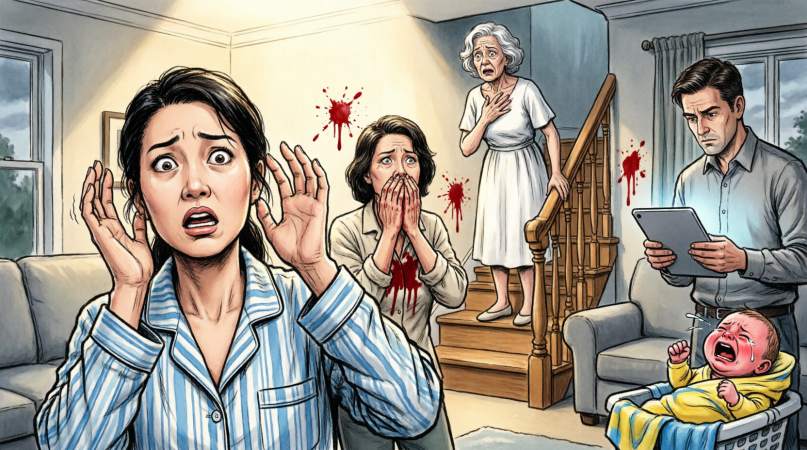
Vanessa opened the door before I could knock. She was wearing a thin tank top, and her arms and chest were smeared with blood, dark and uneven, some of it still glossy and fresh. She didn’t look frightened. She didn’t look rushed. She looked almost bored.
“There was an accident,” she said casually, as if she were commenting on the weather.
I screamed Emma’s name and shoved past her, my shoulder knocking into the doorframe as I stumbled inside. My voice cracked immediately, the sound raw and animal, echoing through the hallway. “Where is she? Where’s my daughter?”
The smell hit me next. Bleach. Something metallic underneath it. My throat tightened, and my eyes burned as panic surged higher, sharper, leaving no room for rational thought.
My mother stood in the kitchen, her back to me, washing dishes with slow, deliberate movements. Soap bubbles slid over her hands as water ran steadily into the sink. A pot roast sat on the counter, seasoned and ready for the oven, like this was just another ordinary afternoon. She glanced over her shoulder at me, irritation flickering across her face.
“Must you shout?” she said coolly.
I felt like I was losing my mind. “Where is Emma?” I demanded, my voice breaking completely now. “Where is my baby?”
Vanessa leaned against the wall behind me, arms crossed, watching my reaction with something that looked disturbingly like amusement. “She wouldn’t stop crying,” she said. “I had to teach her a lesson about respect.”
The words didn’t make sense. They slid past my ears without meaning, too wrong to process. I ran down the hallway, opening doors at random, calling Emma’s name again and again. Empty bedroom. Bathroom. Linen closet. Each space colder than the last.
My brother Tyler stepped out near the end of the hall, his face pale, his eyes darting behind him. He positioned himself squarely in front of the basement door, hands lifting in a gesture that might have been meant to calm me.
“Don’t go down there,” he said quickly. “You don’t want to see.”
That was the moment something inside me snapped completely. I shoved him with every ounce of strength I had, a force born entirely of terror. He stumbled back into the wall as I yanked the basement door open.
The light was off.
The stairs disappeared into darkness, the air below thick and cold. I didn’t slow down. I took the steps two at a time, my feet barely touching each one, Emma’s name tearing out of my throat between sobs I couldn’t control.
At the bottom, my eyes struggled to adjust. Shapes emerged slowly, shadows resolving into something horribly real. A laundry basket sat on the concrete floor, surrounded by towels thrown down haphazardly. The basement was cold, the kind of damp chill that seeped straight into your bones.
Emma was inside the basket.
Her tiny body was curled awkwardly, her face red and swollen from crying, her cheeks streaked with dried tears. Her diaper was soaked through, her little hands clenched tight against her chest. She was trembling, exhausted, silent now in that terrifying way babies get when they’ve cried for too long.
Blood stained the towels around her.
For a split second, my mind shattered completely. The scream that ripped out of me felt like it came from somewhere deeper than my lungs, somewhere primal and broken. It echoed off the concrete walls, so loud and desperate that neighbors would later tell police it chilled them through their closed windows.
I dropped to my knees beside the basket, my hands hovering, shaking so badly I was afraid to touch her and make it worse. The scene burned itself into my memory in perfect, merciless detail. The dark basement. The smell of damp concrete. The red stains against white towels. My baby alone in the dark for hours.
What I didn’t know yet was …
Continue in C0mment 
SAY “YES” — WHEN WE REACH 30 COMMENTS, THE FULL STORY WILL BE REVEALED.
PART 2
I scooped Emma into my arms, her small body trembling violently against my chest, her cries weak and hoarse like her voice had been worn raw from screaming for someone who never came.
Her skin was cold, too cold, and the fear that surged through me was so sharp it made my vision blur as I pressed my cheek to her hair and whispered her name over and over, trying to anchor her to me, to this moment, to life.
Behind me, footsteps echoed on the basement stairs, slow and unhurried, and when I turned my head I saw Vanessa watching from the doorway, her expression flat, almost annoyed, like I had interrupted something inconvenient.
“She needed discipline,” she said calmly. “Babies manipulate people with crying. Mom said so.”
My mother appeared beside her, arms folded, her mouth set in that familiar line of disapproval she’d worn my entire childhood. She didn’t look at Emma, didn’t react to the blood, didn’t acknowledge the terror shaking my hands.
“You’ve always been dramatic,” she said. “If you’d raised her properly, this wouldn’t have happened.”
Something inside me went terrifyingly still.
I didn’t argue. I didn’t scream. I turned and ran up the stairs with my daughter pressed to my chest, dialing 911 with fingers that barely obeyed me, my voice breaking as I told the dispatcher my baby needed help now, not later, not after excuses.
Sirens arrived faster than I expected, red and blue lights washing over the house as neighbors gathered on their porches, faces pale with shock as paramedics rushed inside.
Vanessa tried to laugh it off when the police arrived, telling them it was a misunderstanding, that Emma was “just fussy,” that I was overreacting like always.
Then the paramedic lifted Emma’s sleeve, and the room changed.
My mother stopped talking.
Vanessa stopped smiling.
The officer’s voice hardened as he asked who had been responsible for my daughter that day, and for the first time, no one answered immediately.
As they led Vanessa away in handcuffs, she turned back toward me, her eyes cold and burning, and said quietly, “You think this is over?”
I held Emma tighter, knowing with terrifying certainty that this was only the beginning, because families like mine never stop trying to control the story.
And I had finally decided I wasn’t going to let them.
C0ntinue below
My mother was in the kitchen calmly washing dishes like nothing was wrong.
When I asked frantically, “Where is she? Where’s my daughter?” My sister smirked and said she wouldn’t stop crying, so I had to teach her a lesson about respect. I ran through the house opening every door and calling her name. My brother suddenly blocked the basement door. Don’t go down there.
You don’t want to see. I shoved him aside with all my strength and ran down the dark steps two at a time. What I found at the bottom made me scream so loud the neighbors called 911. My daughter was the basement was cold. My Emma lay in a laundry basket surrounded by towels. Her tiny face red from crying. Her diaper soaked through.
She had been left alone in the dark for hours. Blood stained the towels around her, though the paramedics would later determine it came from Vanessa’s own self-inflicted cuts made to create a dramatic scene. The manipulation was calculated, designed to traumatize me before I even found my daughter. That morning had started normally.
Vanessa called around 7, asking if she could watch Emma while I worked my shift at the design firm. She sounded cheerful, enthusiastic even. I had hesitated because Vanessa’s track record with responsibility was questionable, but my regular babysitter had canled due to illness. My mother, Patricia, would be there, too, which provided an extra layer of supervision.
Against my better instincts, I agreed. Work had been demanding that day. Our firm was pitching a major client, and I spent hours perfecting presentation materials. My phone stayed in my desk drawer per company policy during important meetings. When I finally checked it around 3:00 in the afternoon, 17 m calls from unknown numbers made my stomach drop.
No messages from Vanessa or Patricia, which seems strange given the call volume. I left work immediately, telling my supervisor there was a family emergency. The drive to my mother’s house normally took 20 minutes, but I made it in 12. My hands shook on the steering wheel as worst case scenarios flooded my mind. Traffic lights felt deliberately slow, every red signal and unbearable delay.
Other drivers seemed to move in slow motion while my urgency screamed through every nerve. Vanessa answered the door wearing a tank top with blood smeared across her arms and chest. Her expression held no panic, no concern, just detached observation of my reaction. The blood appeared fresh, still slightly wet in places. She stepped aside casually as I pushed past her, my voice already from screaming Emma’s name.
The house smelled wrong, a mixture of bleach and something metallic that made my throat tighten. Patricia stood at the kitchen sink methodically washing dishes, her movements precise and unhurried. Soap bubbles covered her hands while water ran steadily. She glanced at me with mild annoyance, as though my frantic entrance was an inconvenience rather than a mother searching for her missing child.
A pot rose sat on the counter, prepared for dinner as if this were any ordinary evening. Tyler emerged from the hallway leading to the bedrooms. His face showed more distress than either of the women, but he positioned himself between me and the basement door. His hands came up in a placating gesture that only heightened my terror.
The way he blocked my path suggested something horrible waited below, something he desperately wanted to prevent me from seeing. Shoving him required using strength I didn’t know I possessed. Adrenaline turned my body into something primal and unstoppable. Tyler stumbled backward into the wall as I wrenched the basement door open.
The stairs descended into darkness because someone had turned off the light. My feet barely touched the steps as I flew downward. Emma’s name tearing from my throat and ragged sobs. The scene at the bottom would haunt me forever. Emma lay in that laundry basket surrounded by towel soaked not just with urine but with blood from Vanessa’s staged injuries.
My daughter’s face was blotchy and swollen from crying for hours. Her tiny fists were clenched, her body rigid with distress. The basement was freezing. The thermostat clearly adjusted to make her suffer more. Empty bottles sat nearby, evidence that Vanessa had been down here at some point, but chose to leave Emma in misery.
I scooped her up, feeling how cold her skin had become. Her diaper was so saturated it had leaked through her clothes. She was making a weak mewing sound, her cries reduced to exhausted whimpers. Holding her against my chest, I ran back upstairs while dialing emergency services. My voice sounded foreign in my own ears as I reported what I’d found, begging them to hurry.
Vanessa stood in the living room, examining her nails when I emerged. She had the audacity to roll her eyes at my distress, muttering something about overreacting. Patricia finally turned from the sink, her face showing irritation rather than concern. She began a sentence about how babies needed to learn crying wouldn’t always get them attention.
A parenting philosophy so twisted it made me want to physically attack her. The first police car arrived within 4 minutes, followed quickly by an ambulance. Officers immediately separated everyone into different rooms for questioning. I stayed with Emma while paramedics assessed her condition, their professional expressions tightening as they documented each issue.
One paramedic, a woman named Lauren, kept her hand on my shoulder while explaining what they were seeing. her touch the only thing keeping me from completely falling apart. Detective Harold Mason arrived shortly after the first responders. He was a veteran investigator with grown children of his own, and his jaw clenched visibly when he saw Emma’s condition.
He asked me to walk him through the day, his pen moving steadily across his notepad. When I mentioned Vanessa’s bloodcovered appearance and casual demeanor, his expression darkened further. He requested officers photograph Vanessa before she could wash away evidence. The hospital admitted Emma immediately upon arrival.
Nurses worked efficiently, removing her soiled clothing and cleaning her gently while maintaining her for a pediatric specialist named Dr. Karen Mills conducted a thorough examination, documenting every mark, every rash, every sign of neglect. She pulled me aside afterward to explain that Emma’s condition suggested intentional deprivation rather than accidental oversight.
The coldness of the basement, the prolonged isolation, the lack of basic care despite Vanessa’s presence in the house, all pointed to deliberate cruelty. Detective Mason visited my hospital room that evening with updates. Vanessa’s blood came entirely from superficial cuts on her own forearms made with a kitchen knife found in her purse.
She had created the bloody appearance deliberately, seemingly to shock me or perhaps to garner sympathy. Patricia had witnessed this, but made no attempt to intervene or clean up, instead continuing her dinner preparations. Tyler admitted he knew Emma was in the basement, but was told not to interfere with Vanessa’s discipline methods.
Forensic specialists collected Vanessa’s phone from the scene. The text messages they uncovered painted a disturbing picture of premeditated abuse. She had texted her boyfriend Kevin around noon, complaining that Emma wouldn’t stop fussing. His response suggested putting the baby somewhere she couldn’t hear her. Vanessa replied with laughing emojis and a photo of the basement door.
Later, messages showed her upstairs watching television, periodically commenting to Kevin about how quiet the house had become. More messages emerged showing Vanessa had researched online how long babies could safely be left alone. She had visited forums where she posed hypothetical questions about infant discipline and unresponsiveness.
These searches demonstrated awareness that her actions could cause harm, eliminating any defense of ignorance or accidental neglect. The digital trail would become prosecution’s strongest evidence. My employer called while I sat beside Emma’s hospital bed. My supervisor, Janet, expressed horror at what happened and insisted I take whatever time needed.
She mentioned the company had discussed the situation and decided to maintain my full salary during my absence. The relief I felt at not having to worry about immediate finances brought fresh tears. Janet’s kindness stood in sharp contrast to my own family’s cruelty. Emma remained hospitalized for 3 days. Nurses grew attached to her, frequently stopping by, even when off duty to check her progress.
One nurse named Bethany brought in a handmade blanket for Emma, explaining her own daughter was the same age. These gestures of compassion from strangers highlighted how profoundly my own blood relatives had failed their most basic obligation to protect an innocent child. District Attorney Rebecca Thornton personally handled Vanessa’s case.
She had built her career prosecuting child abuse and took special interest in cases involving family perpetrators. During our first meeting, she explained how the evidence overwhelmingly supported multiple felony charges. Rebecca’s confidence provided comfort, though she warned that Patricia would likely hire expensive attorneys who would attack my character and parenting throughout the process.
Vanessa’s arraignment occurred while Emma was still hospitalized. She appeared in court wearing jail scrubs, her usual styled hair now pulled back plainly. The judge set bail at $500,000 based on the severity of charges and risk to children. Patricia immediately contacted bail bondsmen, liquidating savings to secure Vanessa’s release.
This decision would later haunt her when Vanessa violated bail conditions. Child protective services assigned a caseworker named Monica Hayes to our situation. She conducted home visits to my apartment, reviewed Emma’s medical records, and interviewed everyone involved. Monica’s assessment concluded that I had acted appropriately by immediately seeking help and that Emma would be safe in my sole custody.
However, she recommended supervised visitation only if I chose to maintain any family contact, which I had no intention of doing. The preliminary hearing revealed additional disturbing facts. Tyler testified reluctantly, admitting Patricia had instructed both him and Vanessa that crying babies needed to be ignored to prevent spoiling them.
This philosophy had guided Vanessa’s decision-making throughout the day. Tyler’s testimony also exposed that Vanessa had discussed wanting to prove she could handle child care better than me, viewing Emma’s care as some kind of competition she intended to win through harsh discipline. Neighbors provided statements to investigators. Mrs.
Dorothy Chen, who lived next door to Patricia, reported hearing a baby crying for extended periods that afternoon. She had considered calling the police, but assumed it was typical infant fussiness. Another neighbor, Mr. Frank Rodriguez, mentioned seeing Vanessa arrived that morning carrying what appeared to be a bag of supplies.
suggesting premeditation rather than spontaneous babysitting. My apartment became my sanctuary during those initial weeks. I installed additional locks and a security camera system, paranoid that Patricia or Vanessa might attempt to contact Emma. Sleep came in brief stretches interrupted by nightmares of finding Emma too late of those basement stairs leading somewhere darker.
Emma’s pediatrician recommended therapy for both of us, recognizing trauma extended beyond physical injuries. Financial strain began almost immediately. Legal fees mounted despite Rebecca Thornton’s office handling the criminal prosecution. I needed my own attorney, Maxwell Hunt, to file restraining orders and prepare for potential custody challenges.
Maxwell worked on a payment plan, understanding my circumstances, but costs still accumulated faster than I could manage. My savings dwindled while I remained on unpaid leave, caring for Emma. Patricia’s campaign against me intensified through social media and family group chats. She posted long messages claiming I had abandoned Emma with family, then fabricated abuse allegations when things went wrong.
She shared edited versions of events, painting Vanessa as a victim of my vindictiveness. Several relatives believed her narrative initially, sending me angry messages about destroying the family over an accident. These betrayals cut deeply, revealing who valued truth versus who valued comfort.
Vanessa violated her bail conditions within 2 weeks of release. Police found her at a shopping mall food court attempting to approach a mother with young children. Witnesses reported she had made comments about parenting techniques before mall security intervened. This violation resulted in immediate arrest and bail revocation. Rebecca Thornton used the incident to demonstrate Vanessa’s continuing danger to children, strengthening the prosecution’s case significantly.
Emma’s 8-month checkup, rescheduled after the incident, showed she had lost weight rather than gaining it. Dr. Mills expressed concern about developmental delays potentially caused by the trauma. Emma had become hypervigilant, startling easily at sudden sounds. She refused to be put down for naps, screaming if I left her sight.
The changes in her personality broke my heart repeatedly, knowing my sister had stolen her sense of security. My workplace eventually needed to fill my position permanently. Jana called apologetically, explaining business realities required staffing consistency. She offered freelance contracts when I felt ready to work again, emphasizing they valued my skills despite circumstances……….