In front of fifty journalists, she laughed and declared, “He belongs to me now.” Wine soaked through my clothes, but I didn’t scream, cry, or sla:p her. I simply texted my husband, “Get here now. She just made this public.”…My husband’s girlfriend threw wine on me, then announced to fifty journalists that he belonged to her.It happened during the Harrington Media Awards in Manhattan, inside a ballroom crowded with cameras, donors, editors, and people who smiled while quietly destroying careers. I wore an ivory silk dress I had saved six months to afford, standing near the press wall with sparkling water in my hand.My husband, Julian West, was upstairs preparing for his keynote speech.At least, that was what he told me.Then a young woman in a red satin gown walked toward me carrying a glass of merlot and a smile too sharp to be accidental.“Oh,” she said as the wine splashed across my dress. “I’m so sorry.”The stain spread like blood across the silk.Conversations stopped around us.Before I could answer, she leaned closer and spoke loudly enough for nearby reporters to hear. “You must be Evelyn. Julian said you handled being replaced very gracefully.”A camera clicked.
Then another.
I looked at her carefully and realized I had seen her before. Not face-to-face. In reflections. In late-night notifications lighting Julian’s phone. In the background of a hotel lobby picture he insisted was “strictly business.”
Her name was Tessa Lane, a political lifestyle reporter the city treated like a rising media star.
She lifted her chin, enjoying every second of it.
“Julian and I never wanted things to happen like this,” she continued smoothly. “But honestly, hiding becomes exhausting. He belongs with someone who understands his future.”
Fifty journalists heard her say it.
That was her mistake.
I didn’t throw wine back at her. I didn’t slap her. I didn’t cry.
I took a linen napkin from a passing waiter, pressed it gently against the stain, and smiled.
Then I texted my husband.
Get down here. Your girlfriend just introduced herself to the entire room.
Three dots appeared.
Disappeared.
Appeared again.
Finally:
Evelyn, don’t make a scene.
I almost laughed.
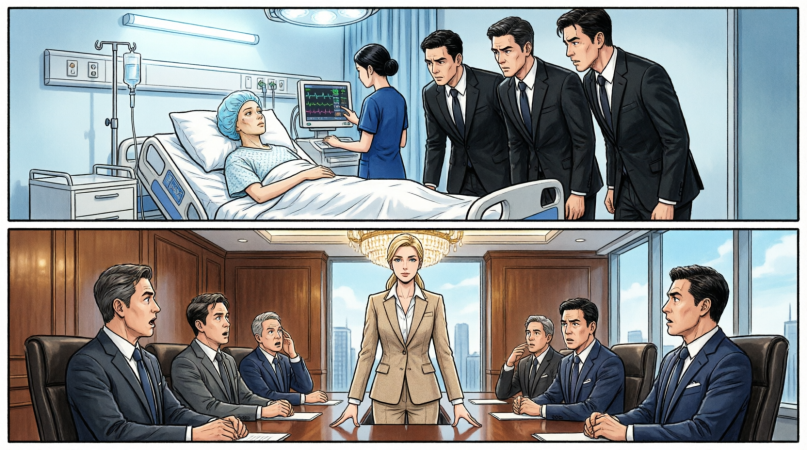
Across from me, Tessa’s smile widened confidently. She believed silence meant weakness. Women like her always did.
My phone buzzed again.
I can explain after the speech.
I typed back immediately:
No. You’ll explain before it. On camera.
Tessa’s expression flickered when she noticed cameras beginning to turn toward the staircase.
Julian appeared five minutes later wearing a black tuxedo, pale and furious beneath the polished smile that had carried him through interviews, fundraisers, and ten years of marriage.
He looked first at my ruined dress.
Then at Tessa.
Then at the reporters already recording everything.
For the first time that evening, the man who always controlled the narrative had absolutely no script….
Julian approached us with the cautious walk of a man heading toward an explosion.
“Evelyn,” he said quietly, “let’s discuss this somewhere private.”
Tessa stepped closer to him, suddenly bold again now that he had arrived. “Julian, tell her. I’m tired of being treated like a secret.”
The silence surrounding us sharpened.
A journalist from the Herald lifted her phone higher.
I looked directly at Julian. “Go ahead.”
His jaw tightened. “This isn’t the place.”
“Interesting,” I replied. “Because it became the place the moment she threw wine on me and announced she owned my husband.”
Tessa flushed. “I didn’t say owned.”
“No,” I corrected calmly. “You said belonged. It sounded more poetic.”
A few people murmured softly.
Julian reached toward my elbow. I stepped back immediately.
“Don’t touch me.”
That was when his public smile cracked.
“Evelyn, enough.”
I removed my phone from my clutch and opened the folder I hoped I would never need. For two months, I collected everything Julian carelessly left behind: hotel receipts, late-night messages, deleted calendar appointments synced through our shared tablet, credit card charges from restaurants where he claimed he was meeting donors.
But the real evidence arrived that morning.
An anonymous email from someone inside Tessa’s network.
Screenshots. Voice recordings. A draft article.
Tessa had not simply fallen in love with my husband. She planned to launch their relationship publicly as a media story after Julian’s keynote speech, using my humiliation as proof their marriage was “already dead.” Worse, Julian promised her confidential donor files from the nonprofit media foundation he chaired.
I turned the screen toward him.
His face drained gray.
Tessa whispered, “Where did you get that?”
“From someone who understands journalism better than you do.”
The Herald reporter stepped closer. “Mrs. West, are you accusing your husband of misusing donor information?”
Julian snapped immediately, “No comment.”
I looked at him calmly. “That’s the first honest thing you’ve said all night.”
The event organizer, Malcolm Reed, rushed over sweating through his tuxedo jacket. “Julian, your speech starts in eight minutes.”
“Cancel it,” I said.
Malcolm blinked in confusion.
I raised my voice just enough for the room to hear. “Julian West should not be delivering a keynote speech about ethical journalism while his girlfriend carries draft copy about their affair and he shares confidential donor data.”
The ballroom erupted instantly.
Tessa grabbed Julian’s arm tightly. “Say something.”
He looked at her.
Then at me.
Then at the reporters.
“I made a personal mistake,” he finally said.
I smiled without warmth.
“No, Julian. You made a documented one.”
And every camera captured the moment.
The keynote speech never happened.
By midnight, three separate outlets published the story. Not the glamorous rebranding Tessa imagined. Not the dignified separation Julian carefully planned. The headline spreading fastest across the internet was brutally simple:
Ethics Speaker Accused of Donor Data Leak After Mistress Confronts Wife at Media Awards
Tessa’s network suspended her within twenty-four hours pending investigation. Her editor released a public statement regarding conflicts of interest, undisclosed personal relationships, and misuse of professional access. Tessa tried presenting herself as a woman in love destroyed by a bitter wife, but the draft article, messages, and donor-file evidence made that impossible to sell.
Julian resigned from the foundation board before they could remove him publicly.
At home, he attempted one final performance.
He claimed he had been lonely. He said Tessa manipulated him. He insisted our marriage had been “quietly over,” despite kissing me that very morning and asking me to proofread his speech.
I listened until he finally said, “You didn’t need to destroy me publicly.”
Then I answered him at last.
“You chose the audience.”
My attorney filed divorce papers the following week.
Because our assets were carefully documented, Julian couldn’t hide much. Because the donor scandal triggered outside review, he couldn’t pretend the affair was merely personal. Investigators discovered he forwarded restricted contact lists and internal strategy notes to Tessa under the excuse of “press preparation.” It wasn’t criminal enough for prison, but it was serious enough to destroy his board memberships and consulting contracts.
Tessa lost her column.
Julian lost his reputation as a moral authority.
I lost the version of my marriage that existed mostly because I kept protecting it.
Six months later, I sold the apartment and moved into a smaller place in Brooklyn Heights with wide windows, worn hardwood floors, and no memories of Julian practicing speeches in hallway mirrors.
The ivory dress couldn’t be saved. The dry cleaner tried, but the wine soaked too deeply into the fabric.
I kept the dress anyway.
Not because I wanted to relive the humiliation, but because it reminded me of the exact moment I stopped cleaning up messes I didn’t create.
One year later, I attended another media event alone. A young reporter asked how I remained so calm that night.
I told her the truth.
“I had already cried in private. Public was for evidence.”
She laughed softly, then wrote it down.
Julian eventually married nobody. Tessa moved to Los Angeles and started a podcast about “cancel culture,” where she never once mentioned the woman whose dress she ruined.
As for me, I founded a crisis communications firm.
My first rule for every client was simple:
Never confuse silence with surrender.
Sometimes silence is simply the sound a woman makes while opening the folder.
I kept the ivory dress in a climate-controlled garment bag, hung in the back of a closet that no longer belonged to a marriage. It was a relic, not a trophy. The stain had set permanently, a bruise of merlot woven into silk, and I refused to let it be cleaned away. Some things are meant to remain visible. Not as a wound. As a calibration.
My first rule for every client was simple: Never confuse silence with surrender. Sometimes silence is simply the sound a woman makes while opening the folder.
The folder, in my case, was now a business.
Whitmore Strategic Communications occupied the seventh floor of a converted warehouse in DUMBO. Exposed brick, floor-to-ceiling windows overlooking the East River, a conference table carved from a single slab of reclaimed oak. No gold plaques. No receptionist who judged you by your shoes. Just a secure server room, a legal review suite, and a soundproof recording booth where clients learned how to speak when the microphones were already live.
I built it slowly. Methodically. The way I’d built the Whitmore Foundation decades earlier, before I knew how easily philanthropy could be hollowed out by people who loved the spotlight more than the cause. I hired two former investigative journalists, a forensic accountant who had spent seven years at the SEC, and a litigation PR specialist who knew how to read a subpoena like a weather report. My overhead was low. My intake was strict. I only took cases where the truth could be documented, and the truth mattered.
For the first four months, we handled quiet crises. A nonprofit executive caught in a fabricated embezzlement narrative. A tech founder whose co-founder leaked internal Slack messages to a rival outlet. A museum director accused of ethical violations after refusing to return looted artifacts. In each case, we did the same thing: we stopped the bleeding, mapped the attack vector, secured the evidence, and then chose the battlefield. Sometimes the battlefield was a court filing. Sometimes it was a timed press release. Sometimes it was a single, unedited interview dropped at 2:00 AM when the algorithm was starving and the journalists were awake.
I didn’t sleep much. I didn’t need to. Sleep is for people who believe the world will wait for them to catch up. I had learned, at fifty-eight years old, that the world only waits for those who control the timing.
Then the past stopped knocking and started breaking the door.
It arrived on a Tuesday, disguised as a routine foundation audit notice. The Whitmore Medical Research Initiative, the very entity Vanessa had tried to strip bare while I lay paralyzed on an operating table, had triggered a compliance review. Standard procedure, the email said. Annual donor transparency check. Routine.
But the attachment wasn’t routine. It was a draft motion from a law firm I recognized: Vance & Crowe. Boutique. Expensive. Known for representing disgraced executives who wanted to rebrand as misunderstood visionaries. The motion wasn’t about the foundation. It was about me. It requested a psychiatric evaluation, citing “documented inconsistencies in medical capacity during and following emergency surgery,” and argued that the trust amendments signed six months prior were executed under “compromised cognitive and emotional states.”
They weren’t trying to steal the money anymore. They were trying to erase the woman who had protected it.
I printed the document. Placed it on the oak table. Poured black coffee. Called Malcolm.
He answered on the second ring. “You saw it.”
“I saw the motion. I also saw who filed it. Vance & Crowe doesn’t touch estate disputes unless the payout is seven figures or the client is media-adjacent.”
“Vanessa hired them.” Malcolm’s voice was flat, tired. “She’s been liquidating personal assets. Sold the townhouse in Georgetown. Moved into a leased penthouse in Silver Lake. She’s funding this through a shell LLC registered in Delaware.”
“Daniel?”
“Daniel signed a separate affidavit claiming he felt ‘pressured’ during the trust meeting. He’s trying to position himself as a victim of his wife’s influence while preserving his annuity. It’s cowardly. It’s also legally useless.”
I traced the edge of the paper with my index finger. “They’re using the anesthesia incident. They want to paint me as unstable. Impaired. Easily manipulated.”
“They’re using whatever sticks. Vanessa’s learned one thing: if she can’t win in court, she wins in the press. And the press loves a fallen matriarch.”
I closed my eyes. Not in fear. In calculation. “The recorder. The hospital board meeting. The notarized trust documents. The physician witnesses. All of it still stands.”
“On paper, yes. But Vance & Crowe is filing for a discovery injunction. They want the raw audio. They want your medical records from the past five years. They want to depose Malcolm. They want to depose the surgeon. They want to depose the anesthesiologist. They’re going to drown us in procedure until you’re too exhausted to testify.”
I opened my eyes. “Let them.”
“Evelyn—”
“Let them file. Let them request. Let them schedule. They think this is a war of attrition. It isn’t. It’s a war of architecture. They’re building a scaffold of doubt. I’m going to remove the ground beneath it.”
I hung up. Walked to the window. Watched a ferry cut through the gray water. I thought of Daniel’s shoes shifting on the hospital floor. I thought of Vanessa’s perfume masking the sharp little blade. I thought of Julian’s pale face in the ballroom when I turned the phone toward him. I thought of Tessa’s smile, wide and certain, right before it collapsed.
They all made the same mistake. They believed power was something you took. I knew better. Power is something you allow to reveal itself, then you document it, then you let it hang itself.
I called my forensic accountant. “Pull every wire transfer, LLC filing, and property deed linked to Vanessa’s Delaware shell. Cross-reference it with Tessa’s podcast production company. Look for shared vendors, overlapping IP addresses, contractor payments. I want a map.”
Then I called the investigative journalist on my team. “We’re going to need a timeline. Not of the surgery. Of the campaign. Who hired Vance & Crowe? Who funded the LLC? Who leaked the psychiatric motion to three mid-tier outlets before it was even filed? Find the pattern. Patterns have fingerprints.”
I sat back down. Opened a new folder on my desktop. Labeled it: WHITMORE v. GHOSTS.
The silence wasn’t empty. It was loading.
Three days later, the pattern emerged.
Vanessa hadn’t just hired Vance & Crowe. She had partnered with a reputation management firm called Aegis Narrative Group. Aegis specialized in “counter-story deployment.” They didn’t defend clients. They attacked the accusers. Their signature move was to flood the zone with competing narratives until the original truth became unrecognizable. They had successfully rehabilitated a crypto founder who stole user funds, a politician who accepted dark money, and a celebrity chef who ran a kitchen built on harassment.
They were also quietly funding Tessa’s podcast.
Not directly. Aegis operated through a network of media LLCs, sponsorships, and “independent production grants.” But the money trail was clean enough for a subpoena. Tessa’s show, The Widow’s Game, wasn’t just gossip. It was a carefully engineered character assassination. Each episode featured anonymous “insiders,” redacted documents, and psychological framing designed to paint me as a wealthy, emotionally volatile woman who weaponized wealth to control her son, destroy her daughter-in-law, and abandon her husband the moment he needed her.
Episode three had already aired. Title: The Architecture of Control. It ran forty-two minutes. I listened to it while eating takeout at my desk. The host’s voice was calm, measured, almost sympathetic. “When a woman builds her entire identity around institutions—foundations, trusts, board seats—what happens when those institutions begin to fail? Does she adapt? Or does she double down, using legal instruments as emotional leverage?”
They were using my own language against me. My precision. My documentation. My silence. They were framing it as pathology.
I paused the audio. Took a sip of water. Then I called Malcolm.
“They’re not trying to invalidate the trust. They’re trying to invalidate me. If the court believes I’m unstable, the trust amendments become suspect. If the trust becomes suspect, the foundation’s governance collapses. If the governance collapses, Vanessa’s shell company can petition for emergency receivership. She doesn’t need to win the case. She just needs to win the narrative long enough to trigger a freeze.”
Malcolm exhaled slowly. “She’s weaponizing doubt. It’s older than law. Older than money. It’s the oldest trick in the book.”
“I know. That’s why we’re not fighting doubt. We’re replacing it.”
“How?”
“With architecture.”
I spent the next seventy-two hours mapping the counter-strategy. It wasn’t about going on television. It wasn’t about issuing angry statements. It was about building a structure so solid that when they pushed, they’d break their hands.
Step one: Secure the medical record. I requested my complete surgical file, anesthesiology logs, and post-op cognitive assessments through independent channels. Not through the hospital’s compliance office. Through a third-party medical audit firm I’d retained years ago for foundation grant reviews. The file arrived sealed, timestamped, notarized. It showed a standard anesthesia complication. A brief period of delayed emergence. No cognitive impairment. Full neurological clearance within forty-eight hours. I had a signed statement from the lead anesthesiologist confirming I was oriented, responsive, and legally competent before any trust documents were finalized.
Step two: Isolate the attack vector. Vance & Crowe’s motion relied on a single premise: that the trust amendments were signed while I was “under the influence of post-surgical medication and emotional distress.” But the signing had occurred three weeks after discharge. In my study. With three witnesses. Video recorded. I hadn’t included the video in the initial filing because I believed the notarized documents were sufficient. I was wrong. Sufficiency is a luxury. Redundancy is a strategy.
Step three: Flip the narrative. Aegis was using psychological framing. I would use procedural transparency. I wouldn’t defend my character. I would display my process.
I scheduled a press briefing. Not for me. For the foundation’s independent board of trustees. I drafted a public letter, not as Evelyn Whitmore, but as Founder and Chair. I outlined the audit notice, the psychiatric motion, the shell LLC, the Aegis connection. I didn’t accuse. I stated. I attached the medical clearance. I attached the witness affidavits. I attached the video timestamp. I attached the forensic accounting map showing the flow of funds from Vanessa’s LLC to Tessa’s production company to Aegis’s vendor network.
Then I did the one thing they didn’t expect.
I released it all. Not to one outlet. To every outlet. Simultaneously. With a single subject line: WHITMORE FOUNDATION: TRANSPARENCY PACKET.
I didn’t hold a press conference. I didn’t give interviews. I let the documents speak. Because documents don’t blink. They don’t hesitate. They don’t perform grief.
Within six hours, the narrative fractured.
Three financial journalists published breakdowns of the shell LLC structure. A medical ethics columnist wrote a piece titled When Doubt Becomes a Weapon: The Danger of Psychiatric Motions in Estate Disputes. The hospital issued a statement confirming the anesthesiology logs aligned with standard protocols. The foundation’s trustees held an emergency virtual meeting and voted unanimously to retain independent legal counsel, freezing all pending motions.
Vanessa’s response was immediate. Predictable. Desperate.
She filed an emergency injunction, claiming the document dump violated patient privacy, medical confidentiality, and “harassed a grieving family member.” She went on a morning news show. She wore a soft cream sweater. She spoke slowly. She said all the right words. “I only wanted to protect Daniel. Evelyn has always been controlling. The money was meant for the family, not a legacy project. I never wanted this to become public.”
The anchor nodded sympathetically. The segment cut to a photo of me at a gala, smiling in pearls. The caption read: The Woman Behind the Empire.
I watched it from my desk. I didn’t feel anger. I felt clarity.
They were still playing the old game. The game of emotion. The game of sympathy. The game of who looked more broken.
I picked up my phone. Called Malcolm.
“They’re going to request a sealed hearing. They’ll argue the documents were obtained improperly. They’ll try to bury it in procedure.”
“Let them,” Malcolm said. “We have the video. We have the medical logs. We have the money trail. They’re fighting a fire with a teacup.”
“No,” I said. “They’re fighting a mirror. And mirrors don’t break. They reflect.”
I hung up. Opened a new file. Labeled it: DEPOSITION PREP.
The legal battle was entering its next phase. The public narrative was shifting. But the real test wasn’t in the press. It was in the room. The room where they would have to speak under oath. The room where silence would no longer be an option.
I began preparing for deposition. Not just mine. Daniel’s. Vanessa’s. The surgeon’s. The anesthesiologist’s. The Aegis contractors. The shell LLC managers. Every thread. Every name. Every signature.
I didn’t sleep. I didn’t need to. Sleep is for people who believe the truth will wait. I knew better. The truth only waits for those who know how to ask it questions.
The deposition was scheduled for a federal courthouse in Manhattan. Room 412. Fluorescent lights. Wood-paneled walls. A court reporter’s machine humming in the corner like a mechanical insect.
Vanessa arrived first. She wore a tailored navy suit. Hair pinned back. Minimal makeup. The uniform of a woman preparing to perform sincerity. She sat across from me. Didn’t look at me. Looked at her lawyer. Her lawyer looked at the ceiling.
Daniel arrived ten minutes later. He looked thinner. His eyes were hollow. He wore a gray blazer that fit poorly, as if he’d borrowed it from a man who no longer existed. He sat beside Vanessa. Didn’t touch her hand. Didn’t look at me.
Malcolm sat at my side. He placed a single manila folder on the table. Opened it. Slid a document toward me. It was the video transcript. Timestamped. Notarized. Ready.
The court reporter cleared her throat. “State your name for the record.”
“Evelyn Margaret Whitmore.”
The lawyer across from me stood. He was young. Sharp. Carefully rehearsed. “Mrs. Whitmore, you filed this trust amendment six months prior to your surgery. Is that correct?”
“Yes.”
“Can you describe your mental state at the time?”
“I was lucid. I was deliberate. I was surrounded by witnesses who confirmed it.”
“Did you experience any cognitive impairment following the surgery?”
“No.”
“Are you aware that your daughter-in-law filed a motion suggesting otherwise?”
“I’m aware she filed a motion. I’m also aware it was funded by a Delaware shell company, routed through a reputation management firm, and designed to trigger a narrative, not a legal outcome.”
The lawyer blinked. “Are you alleging a conspiracy?”
“I’m alleging a paper trail. Conspiracy requires secrecy. This required invoices.”
A murmur from the gallery. The court reporter’s fingers paused.
Malcolm leaned forward. “Objection. Speculation.”
“Sustained,” the arbitrator said. “Stick to facts, Mrs. Whitmore.”
“I am.” I opened the folder. Slid the video transcript forward. “This is the recording of the trust signing. Date: October 14. Time: 3:12 PM. Witnesses: Dr. Aris Thorne, neurologist; Margaret Lin, notary public; David Reyes, estate auditor. All present. All sworn. The document was signed, sealed, and filed with the county clerk before I entered the hospital for any procedure. The surgery occurred November 8. The motion Vanessa filed references ‘post-surgical impairment.’ There is no temporal overlap. There is only narrative convenience.”
The lawyer’s pen stopped moving.
Vanessa finally looked at me. Her eyes were cold. Calculating. Not afraid. Annoyed.
“Mrs. Whitmore,” the lawyer said carefully, “you’ve built a reputation for control. For documentation. For strategic silence. Do you ever consider that your methods alienate the people who love you?”
I didn’t answer immediately. I let the question hang. I let the room feel its weight.
Then I said: “Love doesn’t file motions. Love doesn’t hire reputation firms. Love doesn’t use psychiatric evaluations as leverage. What you’re describing isn’t love. It’s ownership. And I stopped being property a long time ago.”
The court reporter’s machine clicked. The arbitrator adjusted his glasses. Malcolm didn’t smile. He didn’t need to.
The lawyer switched tactics. “Let’s discuss your son. Daniel. You’ve reduced his inheritance to a contingent annuity. You’ve excluded his wife entirely. You’ve locked the foundation assets for fifty years. Do you acknowledge that this could be seen as punitive?”
“I acknowledge that it could be seen as protective.”
“Protective of what?”
“Of the people who rely on the foundation. Of the researchers funded by it. Of the patients who will benefit from it. And of the legal integrity of an estate that was built on transparency, not sentiment.”
Daniel finally spoke. His voice was thin. Frayed. “Mom. I didn’t know what she was doing. I just signed where she pointed. I thought… I thought it was standard.”
I looked at him. Not with anger. With recognition. “You thought it was standard because you stopped reading the documents. You thought it was standard because you wanted to believe the narrative she sold you. You thought it was standard because it’s easier to sign than to question. That’s not cruelty, Daniel. That’s negligence. And negligence has consequences.”
He flinched. Vanessa’s jaw tightened.
The lawyer pressed on. “Mrs. Whitmore, you’ve accused your daughter-in-law of orchestrating a media campaign. Do you have evidence beyond financial routing?”
“I have episode timestamps. I have vendor contracts. I have email chains between Aegis narrative strategists and Tessa Lane’s production LLC. I have drafts of podcast scripts that reference ‘the controlling matriarch’ before any public filings existed. I have proof that the campaign was designed, funded, and deployed before a single legal motion was filed. That’s not evidence. That’s architecture. And architecture leaves blueprints.”
The lawyer closed his notebook. “No further questions.”
The arbitrator nodded. “Mrs. Whitmore, you’re excused. We’ll reconvene tomorrow for cross-examination of the opposing parties.”
I stood. Gathered the folder. Closed it. Walked out.
In the hallway, Malcolm fell into step beside me. “You didn’t break. You didn’t raise your voice. You didn’t defend your character. You just displayed the structure.”
“Structure doesn’t need defense. It just needs to hold.”
He exhaled. “Vanessa’s going to panic. She’ll try to settle. She’ll try to leak something else. She’ll try to make you look cold.”
“Let her. Cold is just the temperature of clarity.”
I walked to the elevator. Pressed the button. Watched the numbers descend.
The deposition wasn’t the end. It was the calibration. The public narrative was shifting. The legal foundation was holding. But the real test was still coming. Because when people lose control, they don’t surrender. They escalate.
And escalation leaves footprints.
Three weeks later, the footprints appeared.
Aegis Narrative Group dropped a client. Tessa’s podcast was suspended indefinitely. Vance & Crowe filed a motion to withdraw from Vanessa’s case, citing “irreconcilable strategic differences.” The shell LLC was dissolved. The Delaware registration was flagged for compliance review.
Vanessa was alone. Not legally. Not financially. Narratively.
She called me. Not through a lawyer. Not through a message. Directly. My personal line. I let it ring four times. Then I answered.
“Evelyn.” Her voice was stripped of performance. Flat. Tired. “We need to talk.”
“We’re talking.”
“I didn’t plan the podcast. I didn’t know about Aegis until it was too late. Daniel hired a consultant. The consultant brought them in. I just… I just wanted the foundation to survive. I wanted Daniel to have something. You built it, but you locked it away. You made it a monument instead of a home.”
I didn’t interrupt. I let her speak. Not because I owed her mercy. Because I needed to hear the exact shape of her justification.
“I’m not asking for the money,” she continued. “I’m asking for a conversation. Daniel is broken. I’m exhausted. The lawyers are bleeding us dry. The press is tearing us apart. You won. I know you won. But winning isn’t the same as healing. And I don’t want to hate you for the rest of my life.”
Silence. Not hers. Mine.
I measured it. I didn’t rush to fill it. I let it stretch until it revealed its purpose.
“Vanessa,” I said finally, “you didn’t want the foundation to survive. You wanted it to be yours. You didn’t want Daniel to have something. You wanted him to have control. You didn’t want to talk. You wanted to negotiate. And negotiation requires leverage. You have none.”
She exhaled sharply. “You’re going to leave us with nothing.”
“I’m leaving you with exactly what you earned. Daniel receives his annuity. It’s modest. It’s secure. It’s contingent on him never filing legal action against the estate. You receive nothing. Not out of cruelty. Out of consequence. You tried to weaponize my vulnerability. You tried to manufacture incapacity. You tried to replace governance with narrative. That’s not a mistake. That’s a choice. And choices have endings.”
“You’re a cold woman.”
“I’m a precise woman. Precision looks like coldness to people who operate on temperature.”
She hung up.
I placed the phone on the desk. Looked out the window. The river was moving. The sky was gray. The world was continuing.
I didn’t feel triumph. I felt alignment.
The trust was secure. The foundation was intact. The narrative was documented. The legal battle was winding down. But I knew better than to mistake quiet for closure. Closure is a luxury for people who believe the past stops knocking. I knew it never did. It just changed frequency.
I turned back to my desk. Opened a new folder. Labeled it: NEXT CLIENT.
The work didn’t end. It evolved.
Six months later, Whitmore Strategic handled its first international case. A European pharmaceutical executive facing a coordinated smear campaign across three continents. The attack vector was familiar: leaked emails, anonymous sources, narrative framing designed to paint him as unethical, reckless, emotionally compromised. The defense was unfamiliar: jurisdictional complexity, cross-border media laws, a network of shell entities spanning five countries.
I didn’t panic. I mapped.
I hired a local legal team in Geneva. I retained a data forensic firm in London. I partnered with a crisis PR specialist in Singapore. I didn’t try to control the narrative globally. I controlled the anchor points. I secured the original documents. I verified the timelines. I identified the funding source. I released the evidence in waves, not floods. I let each jurisdiction absorb the truth at its own pace.
It took eleven months. It cost a fortune. It worked.
The executive retained his license. The smear campaign collapsed under its own contradictions. The funding source was exposed as a rival conglomerate using media manipulation to delay a patent approval. The case was written up in three major business journals. Not as a victory. As a blueprint.
I didn’t take credit. I let the work speak.
Because work is the only thing that outlives narrative.

I returned to New York on a rainy Thursday. The city smelled like wet concrete and exhaust. My office was quiet. The team was out. I sat at my desk. Opened a drawer. Pulled out the ivory dress. Placed it on the table.
I didn’t look at the stain. I looked at the fabric. The weave. The weight. The way it had held its shape despite everything.
I thought of Daniel. He had taken the annuity. He had moved to Portland. He had started teaching architecture at a community college. He sent a letter once. Short. Careful. “I’m learning to build things that last. I’m sorry it took so long to understand the difference between shelter and monument.” I didn’t reply. I didn’t need to. Some apologies aren’t meant to be answered. They’re meant to be witnessed.
I thought of Vanessa. She had left the country. Not in disgrace. In retreat. She bought a small villa outside Florence. She painted. Badly. She posted nothing. She spoke to no one. She existed. That was enough.
I thought of Julian. He had married no one. He taught media ethics at a small university. He wrote a book. It was mediocre. It sold poorly. He gave one interview. He said he had learned the difference between narrative and truth. He didn’t mention me. He didn’t need to. Some lessons aren’t meant to be shared. They’re meant to be carried.
I thought of Tessa. Her podcast had resurrected itself under a new name. She talked about “resilience” and “second acts.” She never mentioned the dress. She never mentioned the room. She never mentioned the moment the cameras turned toward the staircase. She didn’t need to. Some failures aren’t meant to be remembered. They’re meant to be repeated.
I folded the dress. Placed it back in the garment bag. Hung it in the closet.
I didn’t keep it as a reminder of humiliation. I kept it as a reminder of calibration.
The world will always try to frame you. To paint you. To reduce you to a narrative that fits someone else’s pocket. They will use love. They will use grief. They will use loyalty. They will use silence. They will use noise. They will use every tool in the box.
Your job isn’t to fight the frame. Your job is to change the lighting.
I closed the closet. Walked to the window. Watched the rain streak the glass. Watched the city move beneath it. Watched the world continue.
I sat back down. Opened a new file. Began typing.
My first rule for every client remained unchanged: Never confuse silence with surrender.
Sometimes silence is simply the sound a woman makes while opening the folder.
And sometimes, the folder contains everything you need to rebuild the room.