Margarita Ellington had lived in the five-bedroom house outside Sacramento long enough to know every sound it made. The hallway floor sighed near the linen closet.
The refrigerator hummed louder before rain. The back door clicked twice before it sealed.
Her husband used to tease her for noticing things like that.
He said a house only spoke to the person who loved it enough to listen. After he died, Margarita listened because there was no one else.
At seventy years old, she believed grief had already taught her the hardest lesson.
She knew how to cook for one after decades of cooking for two. She knew how to sleep with a pillow against her back where his hand used to rest.
What she did not know was how much a living child could wound her more deeply than the absence of a dead husband.
Silence was heavy. Cruelty had teeth, especially when it came from the person she had raised.
Six months before everything changed, Lily arrived at the door after her marriage collapsed.
She had two exhausted children, swollen eyes, and a voice that had lost all its polish. Margarita opened the door before Lily finished asking.
“Mom, please,” Lily cried.
“Just until I get back on my feet.” The porch smelled of rain and car exhaust. One child leaned against Lily’s leg.
The other stared at Margarita’s cardigan like it was a lifeline.
Margarita said yes because mothers often answer before wisdom has time to intervene. Lily was her daughter.
The children were her grandchildren. The house had five bedrooms and too many closed doors.
At first, the arrangement felt like mercy returning in a form Margarita could understand.
Mornings filled with cereal bowls, school shoes, missing crayons, and small voices calling for Grandma. The house sounded alive again.
She cooked breakfast, folded laundry, supervised homework, and tucked the children into bed.
Lily hugged her once in the hallway and whispered, “You saved me, Mom.” Margarita carried that sentence carefully, like a candle in wind.
There had been a time when Lily came to Margarita for everything. Bad dreams.
Fever. First heartbreak.
A college application she almost did not send. Margarita had always been the open door, the spare key, the person who made room.
That was the trust signal Lily later weaponized.
Margarita had taught her that home meant no questions before shelter. Lily accepted the shelter and slowly began treating the woman who gave it as part of the furniture.
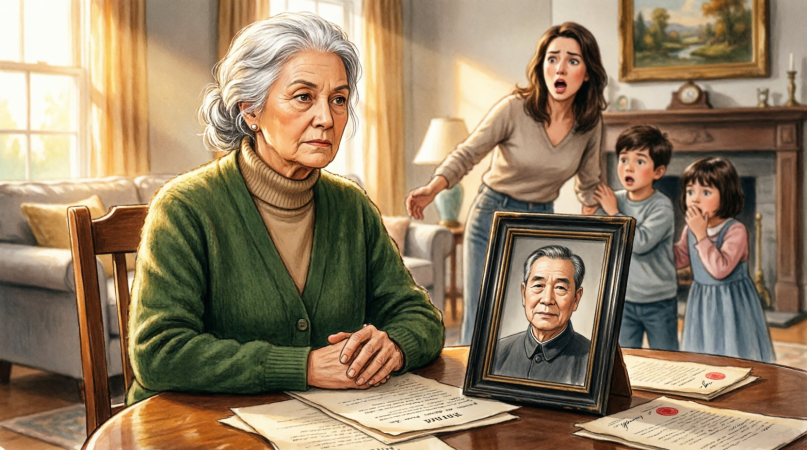
The first comments were small enough to excuse.
“Mom, you should clip your nails more. They make you look very old.” Margarita looked down at hands that had cooked, cleaned, soothed, planted roses, and signed school forms.
Then came, “Mom, maybe shower again.
Sometimes you smell stale.” Margarita changed soaps. She washed her cardigan twice in one week.
She stood in the bathroom afterward smelling her sleeves, ashamed without knowing what crime she had committed.
“Mom, don’t wear that sweater around the kids. You look neglected,” Lily said another day.
Margarita folded the sweater away, though it was warm and blue and her husband had once told her it matched her eyes.
The cruelty worked because it asked Margarita to edit herself in pieces. First the nails.
Then the sweater. Then the chewing.
Then the way she moved slowly while helping the children put on jackets.
Margarita told herself Lily was grieving her marriage. Fear can make people sharp.
Divorce can turn ordinary needs into panic. She made excuses because excuses were easier than admitting her daughter had begun to look at her with disgust.
One afternoon, Margarita stood in the backyard trimming the rose bushes her husband had planted.
The soil smelled damp. The stems scratched through her gloves.
Inside the house, Lily was on the phone with Emma.
Margarita did not mean to listen. Then she heard her own name, and her body reacted before her mind could stop it.
She stood still, one gloved hand holding a branch, the other gripping the pruning shears.
“I can’t stand living with her, Emma,” Lily said. “She disgusts me.
Everything about old people is gross. The way she eats, coughs, walks around in those slippers… it turns my stomach.”
The words came clearly through the open kitchen window.
Margarita could hear a drawer shut behind Lily, then the softer sound of Lily lowering her voice, as if discretion mattered more than decency.
“But I need the house, so I’m dealing with it until I find work,” Lily continued. “Honestly, once she’s gone, I can sell this place and finally breathe.”
The pruning shears slipped from Margarita’s hand.
They hit the patio stone with a hard metallic snap. She remembered thinking, strangely, that her husband would have heard that sound from the garage and asked if she was hurt.
That evening, Margarita asked the question directly.
“Lily, did you say I disgust you?” Her voice stayed calm because age had taught her that trembling in front of cruel people only gives them another weapon.
Lily barely lifted her eyes from her phone. “I was venting, Mom.
Don’t be dramatic. You know I love you.” Then she went back to scrolling as if love could be announced and disproved in the same breath.
But love does not sound like disgust.
It does not plan your death as a financial event. It does not stand in your kitchen and describe your breathing like an offense.
After that, Lily stopped pretending.
She separated Margarita’s food because the children supposedly felt sick watching her eat. She sprayed the couch after Margarita sat on it.
She told the children not to climb into Grandma’s lap because Grandma was fragile.
One child began pausing before hugging her. The pause hurt more than the insults.
Children learn where affection is permitted. They watch faces.
They measure danger through adult silence.
At 6:18 a.m. on a gray Tuesday, the kettle shook on the stove while rain tapped the kitchen window.
The children sat at the table with cereal softening in their bowls. Margarita waited for water to boil.
Lily stood near the counter, arms folded, her expression sharpened by sleeplessness and resentment.
“Mom, I don’t know how else to say this,” she began, and Margarita knew something in the room was about to break.
“Your presence disgusts me,” Lily said. “The way you breathe, clear your throat, walk around at night… everything.
Old people are revolting.”
The room froze around the words. One spoon stopped halfway to a child’s mouth.
A crayon rolled off a placemat and clicked against the tile. The kettle screamed until Margarita turned the burner off.
“Do I truly disgust you that much?” Margarita asked.
She did not raise her voice. She did not cry.
The softness of the question seemed to unsettle Lily more than anger would have.
Lily hesitated. Then she nodded.
That was the moment I stopped begging, inside my own heart, to be loved by someone who only valued me as long as I was useful. Margarita would later understand that sentence as the hinge between two lives.
She wanted to throw the teacup.
She wanted to list every sacrifice, every fever, every bill, every night she stayed awake for Lily. Instead, she set the cup down so gently the saucer barely made a sound.
That night, while Lily slept under Margarita’s roof, Margarita sat at her desk with three lamps burning.
She gathered bank statements, the house deed, property tax folders, insurance policies, her late husband’s records, and every account document she owned.
The paper smelled faintly of dust and ink. Her hands shook, but not from weakness.
They shook because she was not used to choosing herself without first asking whether someone else would be inconvenienced.
At 11:47 p.m., Margarita wrote three lists. What belonged to her.
What could be sold. What needed signatures.
Then she wrote a fourth list, shorter than the others: what she refused to explain anymore.
By Wednesday morning, she had called the Sacramento County Recorder’s Office for certified deed copies. She scheduled an appointment with the attorney who had handled her husband’s estate.
By Friday, she opened a new bank account with no family access.
She did not move like a woman seeking revenge. She moved like a woman taking inventory after discovering a thief had been living inside her grief.
Every drawer was photographed. Every heirloom was wrapped and labeled.
She kept one photograph of her husband in his garden hat, one quilt her mother had stitched, and her wedding ring.
Grief had never humiliated her. Grief had only asked to be carried.
Lily had asked Margarita to disappear while still serving.
When the real estate agent visited, she walked through the front room admiring the light. She praised the rose bushes, the storage, the bedroom count, and the care that had kept the home warm instead of merely maintained.
“This place will move quickly,” the agent said.
Margarita looked at the walls where Lily had already begun imagining inheritance and answered, “Good.” The word surprised even her. It sounded clean.
Final. Earned.
The sign went up while Lily was taking the children to school.
Margarita stood near the curb in the morning chill as the post was driven into the lawn. Each strike sounded like a boundary being hammered into place.
The sale process moved faster than Lily expected because Lily did not know it was happening.
Margarita signed what needed signing. She redirected mail.
She transferred her accounts. She packed only what belonged to her and left the rest cataloged.
The day Lily came home and found the key would not turn, the sky had cleared into a sharp afternoon brightness.
She was laughing into her phone when she reached the door. Then metal met metal and stopped.
She tried again.
The lock refused her. The children stood behind her, confused, their backpacks sliding down their shoulders.
Inside the glass, an envelope waited with Lily’s name written in Margarita’s careful handwriting.
The envelope contained the listing agreement, the attorney’s card, and a sentence that ended Lily’s private fantasy. This house is no longer part of your future.
Behind it was a copy of the deed documentation.
Lily called Margarita seven times. Then twelve.
Then Emma. By the time the attorney’s office returned Lily’s call, her voice had changed from outrage to panic.
People sound different when entitlement stops working.
The attorney did not argue with her. He explained that Margarita owned the house, Margarita controlled the accounts, and Margarita had the legal right to sell, relocate, and restrict contact.
No inheritance had vested. No promise had been made.
Lily insisted that her children lived there.
The attorney reminded her that Margarita had given temporary shelter, not ownership. He gave her the date by which remaining belongings could be collected and the instructions for arranging supervised access.
Emma arrived before sunset.
She found Lily on the porch with mascara under her eyes and anger trembling in her hands. For once, Emma did not rescue the lie.
She had heard enough from that phone call to know what had happened.
“She opened her door to you,” Emma said quietly. “You talked about waiting for her to die.” Lily tried to deny it, but the words came out thin, because some truths do not need recordings to sound recorded.
Margarita did not come back that night.
She did not sit in the driveway watching Lily cry. She had already learned that witnessing someone’s regret is not the same as receiving their love.
She spent the first evening in her new place with one lamp, one suitcase, one quilt, and the photograph of her husband.
The rooms were smaller, but the silence was different. It did not accuse her.
It rested.
Lily sent messages for weeks. Some angry.
Some apologetic. Some practical.
Margarita answered only through the attorney until the sale closed. She refused to debate the value of her own dignity with the person who had priced it against a house.
After my own daughter called me useless, I sold everything and disappeared.
That sentence sounded cruel when strangers repeated it, but Margarita knew the truth beneath it. She had not abandoned love.
She had abandoned being used.
The house sold. The accounts moved.
The remaining furniture was collected under supervision. Lily found another place to stay, smaller and less convenient, and for the first time she had to explain to her children why Grandma was not opening the door.
Margarita did not celebrate Lily’s struggle.
She prayed the children would grow kinder than what they had witnessed. But she no longer mistook suffering for proof that she should return to the role of unpaid servant.
In the months that followed, Margarita took morning walks, learned the names of neighbors, and bought herself a blue cardigan almost like the one Lily had mocked.
The first time she wore it outside, she did not check anyone’s face for approval.
She still missed the grandchildren. She still cried some nights.
Freedom did not erase grief. It simply made room for grief to exist without insult sitting beside it at breakfast.
When asked whether she regretted leaving first, Margarita would touch her wedding ring and shake her head.
She had given Lily shelter, history, trust, and time. Lily had looked at all of it and seen an asset waiting to transfer.
The hardest part of aging was not learning how to live with silence.
It was learning that some people call you useless the moment you stop being available for use. Margarita learned late, but not too late.
She left before Lily could count her among her possessions.
And for the first time in years, the life Margarita built belonged completely to her.