For 3 years, Ethan had known Megan as disciplined, private, and impossible to pressure into explaining what she was not allowed to discuss. He knew she worked for the Navy. He did not know what that really meant.
Megan had never hidden her service from him. She had simply refused to turn her rank into a dating credential. In her world, titles changed rooms before truth ever entered them, and she had seen that happen too many times.
At secure gates, people straightened. In conference rooms, voices softened. On calls with restricted agendas, questions became careful. She had learned that respect given only after recognition was not respect at all.
So with Ethan, she stayed Megan first. She answered what she could answer. She said “operational logistics” when people asked. She closed laptops when she had to. She carried what she carried quietly.
For a while, she thought Ethan understood that privacy was not distance. It was responsibility. He had seen the late nights, the missed birthdays, the midnight texts, and the way her face changed when her phone lit up.
What he had not done was defend the life that created those absences. That became clear the night he took her to his parents’ house outside San Diego for a dinner Diane kept calling “simple.”
It was not simple. It was staged.
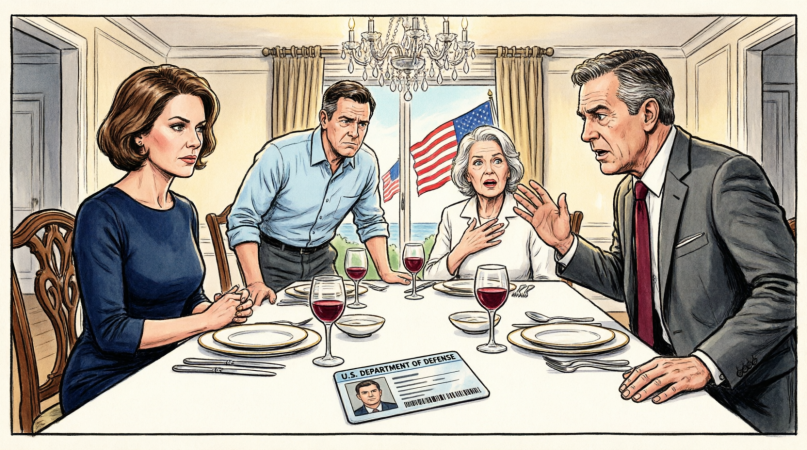
The house was polished enough to feel expensive before anyone mentioned money. The dining room held a long wooden table, silverware laid in perfect lines, and candlelight reflected in crystal glasses.
Outside, a Navy flag moved beneath the American flag. The wind tapped the flagpole with a small metallic sound, steady and patient, as if the house itself had a clock running toward exposure.
Megan arrived in a dark blue dress with a bottle of cabernet and a measured hope. She wanted the evening to be awkward, maybe even chilly, but survivable. She wanted Ethan to choose her in small ways.
Diane hugged her first. The smile was careful, not warm. “How beautiful you are, my dear,” she said. “Ethan didn’t tell us you were so… simple.”
Richard shook Megan’s hand while looking at her shoes first. Then her shoulders. Then her face. It was not an introduction. It was an inspection dressed up as manners.
“Discipline always helps girls like you,” he said.
Ethan gave a little laugh. It was not agreement exactly, and that made it worse. It was the laugh of someone who heard the insult and chose comfort over courage.
Dinner began with salad and small questions sharpened at the edges. Richard asked what Megan did. She answered the way she always answered strangers who had not earned more.
“Operational logistics,” she said.
Richard turned his cup between his fingers. “Paperwork.”
“Operations,” Megan corrected.
“Same thing,” Richard said, “if you’re not at the front.”
Diane used the first course to establish the hierarchy. She set plates down, paused beside Megan, and left the serving dish in her hands as if the role had already been assigned.
“Would you mind serving, Megan?” Diane asked. “You look practical.”
The spoon was cold. The dish was heavier than it looked. Megan’s fingers curled around the handle, and for one second, she imagined placing it back in Diane’s hands without a word.
She served instead. Not because Diane deserved obedience, but because Megan knew the difference between restraint and surrender. At that table, she was still collecting evidence.
By 8:06 p.m., the pattern was no longer subtle. Richard praised a neighbor’s daughter who had made partner at a Phoenix firm. Diane mentioned a cousin who bought a second home before 30.
They spoke of “real careers” with the casual cruelty of people who had never been asked to protect anything larger than their own comfort.
Diane cut her meat into a piece so small it looked like punctuation. “After the wedding,” she said, “I suppose you’ll leave that job. A husband needs an available wife.”
Megan looked at Ethan. He looked at his plate.
That was the moment the evening changed inside her, though nobody else noticed. A person can survive insults from strangers. What breaks colder is watching someone you love leave you alone with them.
Megan said, “I have always handled my responsibilities.”
Diane smiled as if Megan had misused a household word.
The dinner receipt, later, would show $240. The price mattered to Richard. It was the kind of number men like him used as proof that they were generous, even while every sentence they offered was a bill.
Megan noticed everything. The time. The comments. The way Ethan’s hand stayed near his glass instead of reaching for hers. The way Richard’s confidence grew each time silence protected him.
That morning, at 6:40 a.m., Megan had already been inside a Pacific Fleet administrative review. Her military I.D. had passed through secure checkpoints. Her name had been attached to decisions Richard would never have been cleared to read.
At that dinner, the same card sat in her purse behind her keys and wallet.
She did not bring it to perform. She carried it because she always carried it. But as dessert arrived, she became aware of it the way a person becomes aware of a locked door during a fire.
Lemon cake came out under warm light. Coffee filled the room with a bitter smell that cut through the sweetness. Ice cracked in Richard’s glass, sharp and sudden.
He leaned back in his chair. “So tell me the truth,” he said. “What is your real position?”
Megan answered carefully. “Pacific Fleet logistics supervision.”
Richard laughed softly. “That sounds important if you like forms.”
Diane tilted her head. “Richard is only asking because Ethan deserves to know what kind of life he’s about to marry.”
Ethan whispered, “Megan…”
For the first time all night, he looked at her differently. Not with understanding. With alarm. As if he had finally noticed there was a locked door inside her and realized he had been joking in front of it.
Megan’s purse rested against the chair leg. She slid two fingers inside, past the keys, past the wallet, and touched the hard edge of her military I.D.
For one ugly heartbeat, she imagined leaving without giving them the satisfaction of discovery. She imagined standing, smoothing her dress, and walking into the San Diego night with every answer still locked behind her teeth.
But some silences protect dignity, and some silences protect cowards. That night, Ethan had let his parents confuse the two.
Megan took the card out slowly.
Plastic hit the table with a dry, precise sound.
The freeze that followed was almost physical. Richard’s glass remained halfway raised. Diane’s knife hovered above her lemon cake. Ethan’s fork touched the china and stayed there.
The candles kept burning. The Navy flag outside kept moving. Everyone inside the room stopped.
Richard’s eyes went first to the photograph. Then to Megan’s full name. Then to the line that made his face change. It did not change all at once. Pride rarely dies cleanly.
It left in pieces.
His phone lit up beside his plate. His brother, a retired captain, was calling back. The timing was so sharp that even Diane noticed it before Richard could hide the screen.
Richard answered too quickly. “I’m at dinner,” he said.
Megan watched his face as the voice on the other end spoke. She did not need to hear every word. She knew the rhythm of military recognition. She had seen it before.
Richard’s brother did not ask if Megan was exaggerating. He did not ask if the card was real. He asked Richard, very quietly, whether he understood who was sitting at his table.
Richard lowered the phone.
Megan looked him straight in the eyes and said the word he had spent the evening proving he was unworthy to use casually.
“Admiral.”
The room did not explode. That would have been easier. Instead, it collapsed inward. Diane’s lips parted, but no apology came. Ethan looked ashamed in the way people look ashamed when they are sorry for consequences first.
Richard swallowed. The cup came down at last, touching the table with a faint click. No one reached for dessert. No one joked about paperwork again.
Megan placed her hand over the I.D. She did not gloat. She did not explain her clearance, her schedule, or the years of work Richard had reduced to forms.
She simply said, “Now you know what kind of life he was about to marry.”
That sentence did what anger could not have done. It returned every insult to its owner.
Ethan finally turned toward her. “Megan, I didn’t know.”
She looked at him for a long moment. “You didn’t ask,” she said. “And tonight, when they decided who I was for you, you let them.”
Diane tried to recover with manners. “I think this has become a misunderstanding.”
Megan looked at the serving dish, the folded napkin, the untouched lemon cake, and the $240 receipt near Richard’s plate. “No,” she said. “It became clear.”
Richard’s brother remained on the line, silent now, but present. That mattered. Not because Megan needed backup, but because Richard needed a witness he respected before he could recognize shame.
Megan put the I.D. back into her purse. She stood. Ethan stood too, too late and too quickly, knocking his chair back an inch against the floor.
“I’ll take you home,” he said.
“No,” Megan replied. “I’ll take myself.”
Outside, the air smelled like salt, cut grass, and cooling pavement. The Navy flag moved under the American flag again, still tapping the pole in the wind.
Behind her, the house remained bright. Through the window, she could see Diane seated stiffly, Richard holding the phone with both hands, and Ethan standing between the table and the door.
For 3 years, Megan had wanted to be loved before she was ranked. That was the simple hope she had carried into the room, wrapped in a dark blue dress and good manners.
Instead, an entire table taught her the difference between being unknown and being underestimated.
In the days that followed, Ethan called. He apologized. He said he should have defended her. He said he had frozen. Megan believed that part. Freezing was easy. Courage was what came after.
She did not make a public scene. She did not use her rank to punish anyone. She documented what mattered, returned the engagement plans to silence, and made the decision in the same calm way she had survived the dinner.
She chose not to marry into a family that needed a military I.D. before it could locate basic respect.
Richard sent one message through Ethan: an apology that sounded like it had been assembled by committee. Diane sent none.
Megan kept the cabernet receipt, the dinner receipt, and the memory of that plastic card striking wood. Not because she wanted revenge, but because evidence has a way of steadying the heart when people later try to rewrite what happened.
Years in service had taught her many things. How to read a room. How to absorb pressure. How to wait until the exact moment when one quiet fact could do more damage than a raised voice.
That night outside San Diego, the fact was simple.
She had never been “just a Navy girl.”
She had been Megan all along. And that should have been enough before anyone learned to say “Admiral.”