By the time Daniel Mercer realized his marriage had turned into a system built to drain him, five years had already disappeared.
He would later think that was the cruelest part.
Not the slap.
Not the shouting.
Not even the legal mess that came after.
It was how long exploitation could hide inside the language of family, obligation, patience, and keeping the peace.
At first, none of it had looked dangerous.
Daniel met Michelle at a church barbecue in late summer, when the heat sat heavy over the picnic tables and the men running the grills kept wiping their foreheads with paper towels.
She had a quick smile, soft brown eyes, and a calm way of speaking that made him feel less tired just standing near her.
Daniel was never the loudest man in a room.
He liked people who felt steady.
Michelle felt steady.
He was thirty-four then, already established in his trade, already living in the three-bedroom house he had bought after years of working double shifts and side jobs.
It was not a fancy house, but it was solid.
He had fixed the roof himself, replaced the cabinets, refinished the hardwoods, and turned a neglected place into a home.
He was proud of it in the quiet way working men are proud of things they build with their own hands.
Michelle admired that.
At least she seemed to.
She told him she loved that he was dependable.
He told her he liked that she seemed warm without being loud.
They dated for a year.
Then another.
The wedding that followed should have warned him more than it did.
Michelle’s mother, Lorraine, inserted herself into every decision as if the ceremony were really about her own taste.
She pushed for a bigger venue, more guests, more flowers, more opinions, more visibility.
Michelle would roll her eyes privately and tell Daniel, That’s just how she is, then turn around and let Lorraine take over anyway.
Daniel noticed the pattern, but only as irritation, not danger.
Every family had its difficult people.
He believed marriage meant making room for each other’s relatives.
The first request came two years after the wedding.
Michelle’s father, Richard, had a business go under.
He and Lorraine needed a place to stay for a little while.
Just a few months, Michelle said.
Just until they got back on their feet.
Daniel hesitated.
He had worked too hard for his peace to invite chaos into it.
But Michelle cried, then softened, then said she would never forget it if he helped her parents through a hard season.
So he agreed.
The first month was inconvenient.
By the third month, it was intrusive.
By the sixth, Daniel began to notice that nobody was talking about leaving anymore.
Richard criticized the thermostat, the lawn, the garage layout, and the quality of Daniel’s coffee.
Lorraine rearranged kitchen drawers and declared certain rooms better suited for other uses.
She treated Daniel’s home like an inherited property she was restoring to proper order.
Michelle would smooth things over with a tired smile and tell him they were under stress.
Then Michelle’s younger brother, Evan, needed the basement for a while after losing a warehouse job.
Then Michelle’s sister, Kara, arrived after a breakup and said she just needed time to reset.
Then the older brother, Neil, started sleeping on the couch often enough that eventually nobody pretended he lived anywhere else.
Daniel never remembered a single family meeting where they all decided his house would become a boarding house for Michelle’s relatives.
That was part of how it happened.
Not by one giant invasion, but by a hundred small permissions granted under pressure, guilt, and fatigue.
He worked more to cover the extra groceries, the extra utility bills, the repairs, the wear and tear.
The more he worked, the less control he had over what happened inside the house.
The less control he had, the more the others behaved as if the place existed for their use.
Michelle changed too, though slowly enough that Daniel kept excusing it.
Three years into the marriage, she quit her receptionist job.
Her mother, she explained, needed help during the day.
Daniel asked what kind of help.
Michelle said Lorraine was overwhelmed.
Daniel asked whether there was a diagnosis, a treatment plan, a doctor’s recommendation.
Michelle got offended and accused him of being cold.
So he dropped it.
He dropped a lot of things.
He dropped complaints about the noise.
He dropped arguments about dishes.
He dropped objections when Richard parked behind him and made him late for work.
He dropped anger when Evan borrowed tools and returned them broken.
He dropped resentment when Neil spent whole afternoons in the recliner with the television on while Daniel paid the internet bill, the streaming services, the electric, the food, the mortgage, the repairs, the property taxes.
He kept telling himself there would be gratitude eventually.
There never was.
Instead there were comments.
A man should do more.
A husband should make his wife comfortable.
A provider should not complain.
If money felt tight, he must not be planning well enough.
It was remarkable, Daniel would later think, how comfortably people judged labor they had never done.
The longer the arrangement lasted, the more entitled the family became.
Lorraine spoke as if Daniel’s paycheck belonged first to the household she defined.
Richard referred to the property as the family home.
Kara developed a habit of filming little snippets at dinner or during arguments, then claiming she was making memories or collecting content for private family chats.
Daniel disliked that, but Michelle always told him he was too sensitive.
Then came the questions.
In the year before everything collapsed, Michelle grew oddly interested in paperwork.
She asked about the deed, about what would happen to the house if Daniel died first, about whether he had updated his life insurance, about how separate property worked after years of marriage, about wills, estate planning, and survivorship.
When he asked why she suddenly cared, she said she was just trying to be a responsible spouse.
Daniel wanted to believe that.
But some part of him filed the questions away.
The night of the slap started like countless other nights.
Daniel got home tired, shoulders burning from a long day on a framing crew.
The house was loud before he even opened the door.
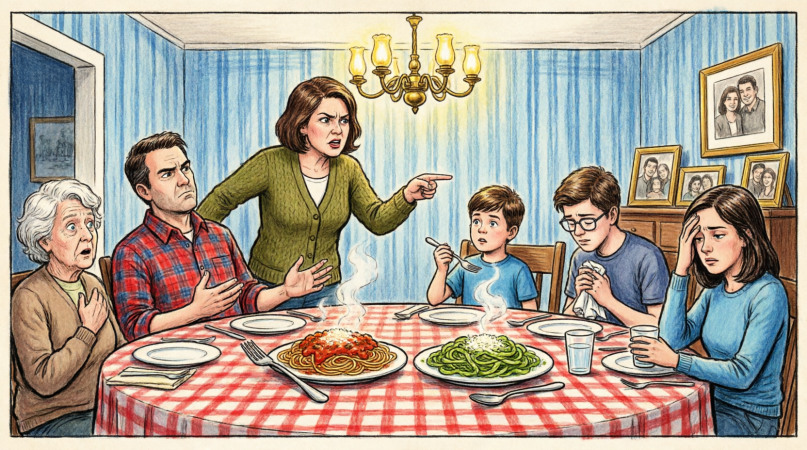
Inside, the dining room was crowded, the table full, the air warm with food he had bought and a faint edge of tension he had learned to ignore.
Lorraine started in on him before he’d finished half his
meal.
“A man who plans ahead doesn’t keep his wife worrying,” she said in that silky, poisonous tone she used when she wanted plausible deniability.
“If Daniel pushed himself a little more, maybe things wouldn’t always feel so tight.”
Michelle nodded while cutting her chicken.
That nod broke something.
Daniel set down his fork and said the sentence that would divide his life into before and after.
“Maybe we’d have more money if I wasn’t supporting six extra adults.”
It was calm.
Precise.
True.
Michelle rose so fast her chair legs shrieked across the floor.
“What did you just say?”
“You heard me,” he said.
She slapped him hard enough that his head snapped sideways.
The room froze.
He touched his cheek.
It burned.
But the deeper shock came from what did not happen.
Nobody condemned her.
Nobody asked whether he was all right.
Nobody said she had crossed a line.
Richard stood and demanded Daniel apologize.
Daniel looked around at six adults living on his labor and understood, with humiliating clarity, that he had spent years financing his own disrespect.
He refused.
When Richard took a step toward him and Lorraine said, “How dare you,” Daniel said the only thing left worth saying.
“It’s my table.
In my house.”
Then he went upstairs, packed a bag, took his paperwork, and left.
He drove straight to Steve Patterson.
Steve was a local attorney Daniel had met on a remodeling job.
He was dry, sharp, and not given to emotional decoration.
When Daniel arrived at the office that night with a red mark spreading across his cheek, Steve unlocked the side door, poured burnt coffee, and said, “Tell me everything.”
Daniel did.
He explained the house.
The marriage.
The relatives.
The years of support.
The slap.
Steve took notes, then asked the practical questions.
House purchased before marriage? Yes.
Deed solely in Daniel’s name? Yes.
Children? No.
Major shared assets? No.
“The divorce is simple,” Steve said.
“The occupancy is not.”
Daniel’s phone lit up over and over.
Michelle.
Richard.
Lorraine.
He ignored them.
Then Steve asked the question that changed the temperature in the room.
“Did she hit you?”
Daniel met his eyes.
“Yes.”
Steve’s expression hardened.
He pulled out a recorder and had Daniel state, in detail, what had happened and who had witnessed it.
Then he told Daniel to photograph his face immediately, email the photos to a new folder, and back up every document in his possession.
Michelle texted while they sat there.
Come home now.
You embarrassed my family enough.
Then another.
If you try to punish my parents over one mistake, I swear you’ll regret it.
Steve read both messages and asked, very carefully, whether anyone in the house had ever talked about getting Daniel out of it.
Daniel started to say no.
Then he remembered Thanksgiving.
Richard joking that old houses changed hands all the time.
Lorraine asking about life insurance with strange intensity.
Michelle smiling too quickly.
Neil muttering that the place wouldn’t stay Daniel’s forever.
Before he could speak, a new message came from an unknown number.
It was a photograph.
His own dining room.
His own empty chair.
And on the corner of the table, near Michelle’s plate, was a kitchen knife placed beside a shattered drinking glass.
Daniel stared at
the image.
“That wasn’t there when I left,” he said.
Steve leaned in, eyes narrowing.
“Good,” he said quietly.
“Now we know what game they’re thinking about playing.”
Daniel looked at him.
“What does that mean?”
“It means,” Steve said, “you are not going back there tonight.
And first thing in the morning, we’re getting ahead of whatever story they’re building.”
They started before sunrise.
Steve sent Daniel to urgent care to document the facial injury.
The physician noted redness, swelling, and tenderness consistent with a recent strike.
From there they went to the police station.
Daniel filed a report describing the assault and the threatening messages.
He gave the officer screenshots of Michelle’s texts and the suspicious photograph from the unknown number.
Steve made sure everything was logged.
Then they petitioned for a temporary protective order and exclusive use of the home pending divorce and occupancy proceedings.
Steve’s argument was brutally simple: Daniel was the sole legal owner of the property, had been assaulted there, had left to avoid escalation, and now faced credible concern that the occupants might manufacture claims against him if he returned alone.
The judge granted an emergency order for no contact and authorized a civil standby so Daniel could reenter the property with police present.
At noon, Daniel rode back to his own house in silence behind a patrol car.
Michelle opened the door before he reached it.
Her expression was all outrage until she saw the officers.
Then it became alarm.
“What is this?” she demanded.
Steve handed over the order.
Richard came barreling into the foyer behind her, red-faced and loud, until one of the officers told him sharply to stop advancing.
Lorraine clutched the banister and gasped as if she were the injured party.
Kara stood halfway down the hall with her phone up, filming.
“Put the phone down,” the officer said.
She did, but slowly.
Daniel stepped past them and felt something inside him settle.
He was done being frightened in his own house.
The officers walked room to room while Daniel and Steve documented everything.
In the guest room, drawers Daniel had never opened were full of Michelle’s family’s mail, bills, and paperwork addressed to the house.
In the basement, Evan had stored broken furniture, gym equipment, and boxes of junk as if the space belonged to him permanently.
In the kitchen, Daniel found the same knife from the photograph, washed and back in the block.
The broken glass was gone.
Steve noticed a small ring light and phone tripod on the sideboard.
“Who uses that?” he asked.
Kara crossed her arms.
“I do.”
He looked at the unknown number’s message on Daniel’s phone, then at Kara.
“Interesting.”
Nobody answered.
Daniel gathered more clothes, tools, personal documents, and his checkbook.
Before he left, Steve served Michelle with divorce papers and separate notices to vacate for the adult occupants, tied to the court’s forthcoming occupancy hearing.
The explosion that followed shook the house.
Michelle cried first, then shouted.
Richard called Daniel a coward.
Lorraine said no decent man would throw family into the street.
Neil accused him of planning this for months.
Evan demanded to know where they were supposed to go.
Daniel heard his own voice answer, calm and unfamiliar.
“The same way I was supposed to keep paying
forever.
Figure it out.”
The next three weeks were uglier than the five years before them.
The family tried everything Steve predicted.
Michelle filed a response claiming Daniel had emotionally abused her and that the slap was an isolated reaction to provocation.
Richard submitted a statement describing Daniel as unstable and financially controlling.
Lorraine painted herself as a fragile elder dependent on Michelle’s care.
Kara hinted that Daniel had made the household feel unsafe.
Neil and Evan suddenly described their long stay as contributions of labor and maintenance, though neither could produce receipts, contracts, or anything resembling rent.
But evidence has a way of humiliating people who are used to winning by volume.
Daniel had years of bank records showing he paid the mortgage, utilities, repairs, groceries, and insurance.
He had tax records proving sole ownership before marriage.
He had text messages in which Michelle referred to the house as Daniel’s when asking him to approve another family member’s stay.
He had timestamps showing he left immediately after the slap.
He had a medical report and police report.
He had threatening messages from Michelle.
And most damaging of all, Steve subpoenaed the contents of the family group chat after the unknown number photograph was traced back to Kara’s phone.
Kara had not expected that.
Neither had Michelle.
The messages were devastating.
There were months of jokes about Daniel being “the mule.” Complaints that he needed to be pressured harder whenever he mentioned money.
Lorraine coaching Michelle on how to respond when Daniel talked about boundaries.
Richard insisting that after enough time in the house, a judge would never remove them all.
Neil urging Michelle to get Daniel to put her on the deed.
Evan laughing that if Daniel ever snapped, they would “make sure the story favors us.”
And from the night of the slap, there it was.
Kara: Get a pic with the knife on the table just in case.
Michelle: He already left.
Richard: Then say he scared you before he ran.
Lorraine: Don’t say too much in writing.
Michelle: He deserves to suffer for humiliating Mother.
Daniel read those lines twice in Steve’s office and felt the last of his doubt leave him.
It had never just been dependence.
It was strategy.
At the temporary hearing, Michelle’s attorney looked increasingly miserable as Steve walked the court through the timeline.
Daniel testified plainly.
No drama.
No performance.
Just facts.
He bought the house before marriage.
He had supported the household alone.
He had been struck by his wife in front of six adult witnesses.
He left rather than escalate.
He sought counsel immediately.
He documented everything.
The occupants then discussed shaping a false narrative.
When Steve introduced the group chat messages, the courtroom changed.
Michelle stared at the table.
Richard muttered under his breath.
Lorraine wept without tears.
Kara looked like someone had finally discovered the camera was pointed both ways.
The judge granted Daniel exclusive possession of the home pending final disposition, barred Michelle’s family from returning after removal, and ordered the non-owner occupants out within ten days under supervised conditions.
Michelle was permitted one scheduled retrieval of personal belongings with counsel present.
Her request for continued residence was denied.
Outside the courthouse, Richard tried one last time.
“You’re destroying this family,” he said.
Daniel looked at
him for a long moment.
“No,” Daniel replied.
“I’m just the first person who stopped financing the lie.”
The move-out day felt less like a victory than a stripping away.
Police were present.
A locksmith waited in the driveway.
Michelle’s family carried out bags, boxes, cheap furniture, small appliances, piles of laundry, and years of accumulated entitlement.
Lorraine complained about her back while directing other people.
Neil cursed under his breath.
Evan argued over tools that were never his.
Kara kept glancing at Daniel as if hoping he would soften in front of everyone’s misery.
He didn’t.
Michelle came last.
She carried two suitcases and a framed wedding photograph.
She paused in the foyer beneath the light fixture Daniel had installed years before and looked around the house as if she were only now seeing what it had cost him to keep it standing.
“You really mean to do this,” she said.
Daniel almost laughed at the wording.
As if she were still the one being acted upon.
“You hit me,” he said.
Her jaw tightened.
“I was angry.”
“You built a life where everybody used me, and when I said one true sentence, you hit me.
Then your family tried to build a false story to trap me in my own house.
So yes.
I mean to do this.”
For the first time since he’d known her, Michelle had no immediate defense.
No pivot.
No explanation ready.
Only the raw humiliation of hearing the truth said where it couldn’t be edited.
“I didn’t think it would go this far,” she said.
Daniel believed her.
Not because she was innocent, but because people like Michelle and her family never imagined consequences going farther than other people’s breaking points.
“That’s the problem,” he said.
She left without another word.
The divorce finalized four months later.
Because the house was premarital separate property and because Michelle’s conduct and the documented false-narrative messages destroyed her credibility, the final settlement was straightforward.
Daniel kept the house.
There was no spousal support.
Shared accounts were untangled.
The protective provisions remained in place for a period after judgment.
Steve called it one of the cleaner endings available after such a messy situation.
Daniel did not think of it as clean.
He thought of it as necessary.
The house felt strange after everyone was gone.
Not peaceful at first.
Too open.
Too quiet.
He would walk past the dining room and remember the slap.
He would stand in the kitchen and hear Lorraine’s voice where there was only the refrigerator humming.
He would unlock his own front door and still brace, for a second, for confrontation.
Healing, he learned, was not the same as relief.
But relief came too.
The utility bills dropped.
The groceries lasted.
The floors stayed clean.
His tools stayed where he left them.
He slept through the night more often.
He ate at his own table without dread.
On Saturdays he began repairing the small damage the years had left behind: patched scuffs in the hallway, replaced cracked trim in the basement, repainted the guest room, cleared out the junk, opened windows, let light back into spaces that had been crowded by other people’s permanent emergencies.
One evening, months later, he found the old wedding picture Michelle had taken but forgotten in a
closet during move-out.
He looked at it a long time before throwing it away.
The man in the photo was smiling.
He looked hopeful, steady, strong.
He also looked like someone who believed love and gratitude were natural partners.
Daniel knew better now.
Some people confuse access with ownership.
Some people mistake patience for weakness.
Some people call exploitation family because it sounds holier than control.
He never saw Michelle’s parents again.
He heard, through a mutual acquaintance, that Richard and Lorraine moved into a cramped rental with two of the siblings, and that the arrangement started cracking within months once there was no single man underwriting everyone’s comfort.
Neil took temporary construction work and quit after three weeks.
Evan bounced between friends.
Kara kept posting polished little fragments of her life online, but Daniel no longer cared what image she was trying to build.
Michelle sent one email nearly a year later.
It was brief.
No apology worthy of the name.
Mostly regret dressed up as reflection.
Daniel deleted it.
He had spent too many years listening to people explain why he should tolerate what they would never endure themselves.
The strange thing was this: the slap that humiliated him in the moment may have saved him in the long run.
Without it, he might have kept swallowing smaller insults forever.
Without that sharp public crossing of the line, he might never have admitted how many quieter lines had already been erased.
Sometimes he still sat at the dining room table after work with a plate of food and the house finally silent around him.
He would look at the walls he had painted, the floor he had laid, the light hanging over the table, and feel the deep, hard-earned peace of a man who nearly lost his home by trying too long to be decent.
And every now and then, he would think about the question that lingered after everything was over.
What was the biggest red flag?
The slap itself?
Michelle’s nod when her mother insulted him?
The years of freeloading dressed as family need?
Or the simple fact that six adults could sit at a table bought by one man, eat food paid for by one man, live under a roof maintained by one man, and still believe he was the one who owed them more?
Daniel never settled on a single answer.
Maybe that was because the truth was harder than one moment.
The slap was only the loudest proof of something that had been happening all along.