The first thing Sarah Mitchell remembered afterward was not the crack in her arm.
It was the sound of the bathroom light.
That thin, electrical hum above the mirror stayed in her memory longer than Derrick’s shouting, longer than the pain, longer than the moment she realized the number she had texted was not her mother’s.
The light hummed while she crouched on the cold tile floor at 2247 Riverside Apartments, Unit 15.
It hummed while her right eye swelled.
It hummed while blood from her split lip dried against her chin.
It hummed while the man who claimed to love her paced on the other side of the door and told her, in the soft voice he saved for threats, that she should open up so they could talk.
Sarah had once thought Derrick was charming.
That was the part she hated admitting later, because people like simple stories where the warning signs arrive wearing neon.
Derrick did not arrive like that.
He arrived two years earlier with coffee when her moving truck was late, with a toolbox when her bookshelf leaned sideways, with jokes that made the new apartment feel less empty.
He helped carry boxes up the narrow staircase at Riverside Apartments and remembered that Sarah took her tea with honey.
He met her mother, Linda, on a Saturday afternoon and called her ma’am with such careful respect that Linda teased Sarah for blushing in the kitchen.
By the end of that first month, Derrick knew the building code, the grocery store she preferred, and the way Sarah tucked the spare key behind the loose brick near the mailboxes.
Sarah had handed him small pieces of access because access did not look dangerous when it came with flowers.
The first shove came six months later.
He had apologized before she finished crying.
The second time, he cried harder than she did.
By the third time, he had started explaining what she had done to make him lose control.
That was how the apartment changed without moving an inch.
The couch was still blue.
The kitchen still had the chipped white mugs her mother bought her at a flea market.
The lease still had Sarah Mitchell’s name printed above the signature line.
But Derrick’s moods became the weather inside Unit 15, and Sarah became a person who checked the air before speaking.
At work, she became quieter.
At dinner with her mother, she kept her sleeves pulled down.
When Linda asked why she seemed tired, Sarah blamed overtime, headaches, bad sleep, anything easier than saying the truth while Derrick’s truck sat outside the restaurant window.
Derrick liked to talk about connections.
He said he knew men who could make problems vanish.
He said a woman could call the police and still end up alone before morning.
Sometimes he left his phone on speaker, letting Sarah hear rough male voices laughing on the other end, as if fear needed witnesses to become real.
Later, the prosecutor would call those conversations intimidation.
At the time, Sarah called them nights she survived.
The fight on May 14 began over a locked screen.
Derrick saw her phone light up while she was washing a glass in the kitchen.
It was her mother asking, You coming Sunday?
That was all.
Three words.
Derrick read them as betrayal.
He asked why Linda needed to know where Sarah was going.
He asked whether Sarah had been telling stories.
He asked whether she thought her mother could save her.
Sarah said, very carefully, that it was just dinner.
Derrick laughed once.
Then he threw the glass against the sink hard enough for a shard to cut the inside of Sarah’s wrist.
The argument moved from the kitchen to the bedroom in fragments Sarah later had to piece together for the police report.
The overturned laundry basket.
The lamp knocked sideways.
The bedroom door half-closed.
The pressure of Derrick’s hand around her upper arm.
The sound her bone made when he shoved her and she struck the bathroom doorframe.
It was not loud.
It was worse.
It was small and final, the kind of sound that tells the body a thing has happened before the mind can allow it.
Sarah fell to her knees and saw her right arm hanging wrong.
Derrick stared at it too.
For one second, his face looked almost sober.
Then he said, “Look what you made me do.”
Sarah ran because something colder than fear took over.
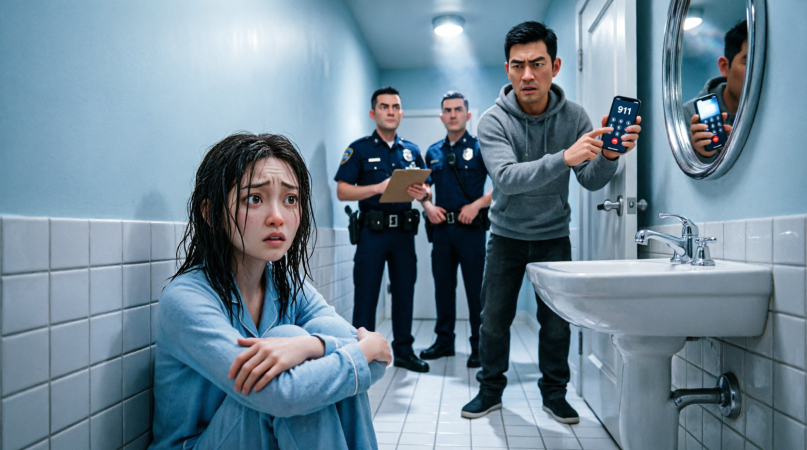
She locked herself in the bathroom with her left hand, nearly dropping the phone twice before she got it open.
The tile was freezing beneath her knees.
The split in her lip filled her mouth with the taste of copper.
Through the door, Derrick’s footsteps made short, hard turns between the bed and the dresser.
“Sarah,” he called. “Come on, baby. Open the door. I said I’m sorry. You know I didn’t mean it.”
That apology had history.
It belonged to the hole in the hallway drywall, to the bruise below her collarbone, to the night he stood between her and the front door with a smile too calm to be human.
But pain had stripped something clean inside Sarah.
For the first time, Sarah understood with perfect, freezing clarity that if she stayed here much longer, she might not walk out at all.
She opened her mother’s contact.
Or she thought she did.
Her thumb shook so badly that every letter looked wrong.
Mom, please help.
Derrick broke my arm.
I’m scared. He won’t let me leave.
She hit send at 10:46 p.m., then pressed herself into the narrow space beside the tub.
The message did not go to Linda Mitchell.
It went to a number Sarah had never seen before, one digit away from her mother’s old contact.
The reply came quickly.
Who is this? You have the wrong number.
Sarah stared at the words until the bathroom seemed to tilt.
Outside the door, Derrick’s voice hardened.
“Don’t make this worse. Open the door so we can talk.”
Sarah almost dropped the phone into the towel at her knees.
Then another message appeared.
Where are you? Are you safe right now?
There are moments when a stranger can sound more like rescue than anyone you know.
Sarah typed because the alternative was waiting for Derrick to decide how angry he still was.
Locked in bathroom.
2247 Riverside Apartments, Unit 15.
Please don’t call police. He’ll kill me if cops show up. He has connections.
She regretted the address the moment she sent it.
Derrick had taught her suspicion until even help looked like a trap.
But the reply came back at 10:48 p.m.
I’m sending someone. Do not open that door. Hold on.
The message was short.
It sounded like a person who knew what to do.
Sarah did not know then that the number belonged to Caleb Hart, a former domestic violence liaison who still volunteered with a small crisis network after his sister’s death.
She did not know that Caleb had been sitting in his truck outside a pharmacy less than twelve blocks away.
She did not know that his sister, Emily, had once texted him from a bathroom with almost the same words and had not survived the hour.
Sarah only knew that Derrick was counting.
“One.”
Her right arm burned so fiercely she bit the inside of her cheek to keep from crying out.
“Two.”
The bathroom door shook.
Wood dust fell from the old strike plate where Derrick had cracked it two months before.
“Three.”
The door burst inward.
The cheap lock tore loose, and the door slammed against the wall.
Derrick filled the doorway.
He was breathing hard.
His eyes were wild.
For one second, Sarah thought he would look at her arm and remember she was a person.
Instead, he looked at the phone.
“Who did you text?” he demanded.
She tried to crawl backward, but the tub stopped her.
“Nobody,” she whispered.
He took the phone from her hand.
He read the screen.
At first, his expression sharpened with the satisfaction of catching her.
Then his eyes landed on the number.
The change in him was immediate.
His color drained.
His mouth opened slightly.
The hand holding the phone lowered as if the device had suddenly become heavier.
“How do you have this number?” he hissed.
Sarah could barely understand the question.
“I don’t know. I meant to text my mom.”
The pounding came from the front door before Derrick could answer.
Once.
Twice.
A third time, harder.
The whole apartment seemed to hold its breath.
Derrick backed away from the bathroom, Sarah’s phone still in his hand.
“Stay here,” he snapped.
It was such a ridiculous command that Sarah almost laughed.
She could not stand.
She could barely breathe.
She heard him cross the apartment.
She heard the deadbolt move halfway and stop.
Then a man’s voice came from the hall, low and controlled.
“Open the door, Derrick.”
Sarah did not know the voice, but Derrick did.
That was the first real crack in the world he had built around her.
Derrick said, “You have the wrong place.”
The man answered, “No. I have the exact address. Unit 15. And I have her message time-stamped at 10:48.”
Derrick went quiet.
Then paper slid under the door.
Sarah could not see it from the bathroom, but she heard it scrape across the entryway floor.
She heard Derrick bend.
She heard the small, strangled sound he made when he saw whatever was printed there.
“That’s from April 17,” the man said. “You remember April 17, don’t you?”
The name came later in the police report.
Caleb Hart.
The date came with it.
April 17 was the night another woman, Marissa Lane, had filed a statement against Derrick after he cornered her in a parking garage outside a bar where he worked security.
The case had stalled when Marissa became too frightened to testify.
Caleb had been the civilian advocate who tried to keep her from disappearing into silence.
Derrick had never forgotten him.
And Caleb had never forgotten Derrick.
A second voice spoke from the hallway.
“Riverside security. Hallway cameras are recording.”
The security guard, Anthony Brooks, had arrived because Caleb called the building emergency line on the way over and said there was a woman injured in Unit 15.
He did not call it a domestic dispute.
He called it an active assault.
Words matter in emergencies.
They decide how slowly people move.
Derrick tried to close the door.
Caleb blocked it with one hand against the frame.
He did not shove.
He did not shout.
He simply stood where Derrick did not want him to stand and said, “Move away from the door.”
Derrick said, “She fell.”
From the bathroom, Sarah heard herself make a sound.
It was not a word.
It was the sound of a body refusing to let a lie become the record.
Caleb heard it.
“Sarah,” he called, louder now. “Can you hear me?”
Derrick snapped, “Don’t talk to her.”
Caleb’s voice did not change.
“Sarah, if you can hear me, say anything.”
Sarah tried.
At first, only air came out.
Then she forced the word through the pain.
“Here.”
The hallway went still.
Anthony Brooks reached for his radio.
Derrick lunged toward the bathroom.
That was when Caleb moved.
No one who saw the hallway footage later called it dramatic.
It was fast and plain.
Caleb stepped inside the threshold, caught Derrick’s wrist before he reached the bathroom door, and turned him into the wall with enough force to stop him but not enough to give him anything useful to claim.
Anthony was already on the radio.
“We need police and medical at 2247 Riverside, Unit 15. Female injured. Suspect restrained. Cameras active.”
Derrick cursed.
He threatened.
He said names Sarah had heard before, the names he used like weapons in the dark.
None of them made Caleb step back.
Sarah remembered seeing Caleb’s shoes first.
Brown boots at the broken bathroom threshold.
Then his hand, open and low, not reaching for her until she could decide whether she wanted to take it.
“My name is Caleb,” he said. “I’m not going to touch you without permission. Help is coming.”
That sentence broke her more than Derrick’s shouting had.
Permission had become such a foreign thing that kindness sounded like another language.
Sarah nodded once.
Then she cried.
By 11:07 p.m., paramedics were in the apartment.
At 11:19 p.m., Officer Nina Patel photographed the broken bathroom lock, the blood on the towel, the damaged doorframe, and the swelling around Sarah’s eye.
At 11:24 p.m., Anthony Brooks downloaded hallway camera footage to preserve the time stamp.
At 11:31 p.m., Sarah’s mother finally saw the missed call from an unknown number and called back screaming Sarah’s name before anyone could explain that her daughter was alive.
The emergency room at Mercy General smelled like antiseptic and burnt coffee.
Sarah sat under fluorescent lights while a nurse cut the sleeve from her sweatshirt.
Her right forearm was fractured in two places.
Two ribs were bruised.
Her lip needed three small stitches.
The hospital intake form asked whether she felt safe at home, and Sarah stared at the box for so long the nurse gently placed a pen in her left hand.
Sarah checked no.
It was the first honest answer she had put on paper in years.
Derrick was arrested that night for aggravated assault, unlawful restraint, and witness intimidation after officers reviewed the messages on Sarah’s phone.
He told them she had exaggerated.
He told them she was unstable.
He told them the stranger at the door had attacked him for no reason.
But the evidence did not care how smoothly Derrick could speak.
Evidence is cold in the best way.
It does not flinch when a charming man smiles.
The prosecutor had the 10:46 p.m. message, the 10:48 p.m. reply, the hallway video, the photographs from Unit 15, the hospital records from Mercy General, and the prior April 17 statement from Marissa Lane.
Caleb gave a statement too.
So did Anthony Brooks.
So did the neighbor in Unit 14, who admitted she had heard screaming before but had convinced herself it was not her business.
That part hurt Sarah in a complicated way.
For months, she had thought nobody knew.
Then she learned people often know just enough to look away.
At the protective-order hearing, Derrick arrived in a gray suit with his hair combed back and his voice polished flat.
He looked smaller in daylight.
Not harmless.
Never harmless.
Just smaller than the monster the apartment had made him seem when the doors were locked.
His attorney suggested Sarah had been confused.
He suggested Caleb’s arrival had escalated a private argument.
He suggested Derrick had only broken the bathroom door because he was worried Sarah might hurt herself.
Sarah sat with her left hand wrapped around her mother’s and listened.
Her arm was in a cast.
Her eye had faded from purple to yellow at the edge.
When the judge asked whether she wanted to speak, Sarah stood.
Her voice shook at first.
Then it steadied.
“I texted my mother because I thought I was going to die,” she said. “I sent it to the wrong number. That mistake is the reason I’m here.”
Derrick looked down.
Linda Mitchell began to cry silently beside her.
Sarah kept going.
“He spent two years telling me no one would come. He was wrong.”
The judge granted the protective order.
The criminal case took longer.
Derrick’s connections turned out to be smaller than his threats.
One man he had claimed was a detective was a cousin who worked dispatch in another county and denied ever helping him.
Another was a bar owner who admitted Derrick liked to exaggerate when he drank.
The dangerous network that had filled Sarah’s nights with dread collapsed into smoke, debt, and men who suddenly had no interest in protecting him under oath.
Marissa Lane testified.
She did it by video, hands folded tightly in her lap, voice trembling but clear.
She said Caleb had helped her once too.
She said Derrick had called her a liar until she almost believed him.
When the prosecutor played the hallway audio, the courtroom went silent.
Open the door, Derrick.
Sarah stared at the table in front of her and felt the sentence move through her bones.
Not because it belonged to Caleb anymore.
Because it had become the sound of a locked world opening.
Derrick pleaded guilty before the second day of testimony ended.
The sentence was not a perfect ending because real life rarely offers those.
There were court dates, medical bills, nightmares, and mornings when Sarah woke with her heart racing because an upstairs neighbor dropped something heavy on the floor.
There were forms to file and locks to change.
There was the slow humiliation of realizing how much of her own life she had surrendered one apology at a time.
But there was also her mother sleeping on an air mattress beside her for three weeks after she came home.
There was Anthony Brooks walking her to her door until the building installed new cameras.
There was Caleb leaving a list of victim services on her kitchen counter and never once asking for gratitude.
There was Marissa Lane sending a card with only five words inside.
I believe you. Keep going.
Sarah kept it in the drawer where she used to hide cash.
Six months later, Sarah moved out of Riverside Apartments.
She chose a smaller place with morning light in the kitchen and a deadbolt she picked herself.
Her mother helped hang curtains.
Caleb carried no boxes because Sarah told him she wanted to do some things with her own hands, and he respected that without making it a speech.
On the first night in the new apartment, Sarah sat on the floor eating takeout from a paper carton.
Her arm had healed crooked only in the smallest way, a faint ache when rain was coming.
Her phone buzzed.
It was her mother.
You safe?
Sarah looked around at the room.
The door was locked.
The window was open.
No one was pacing outside the bathroom.
She typed back, Yes.
Then she paused and added, I am.
Later, when people asked why she trusted a stranger, Sarah always corrected them.
She did not trust a stranger.
She trusted the part of herself that still reached for help even after Derrick spent two years trying to train that instinct out of her.
The wrong number did not save her by magic.
It saved her because she sent the message.
It saved her because someone answered.
It saved her because enough people finally refused to look away.
For the first time, Sarah understood with perfect, freezing clarity that if she stayed there much longer, she might not have walked out at all.
And for the rest of her life, she would remember the truth that followed.
Sometimes survival begins as a mistake.
Sometimes the digit you miss becomes the door that opens.
Sometimes the wrong number is the first right thing to happen in years.