The front door opened at exactly 4:30 a.m., and somehow the sound was quieter than it should have been.
That made it worse.
Claire had been standing barefoot in the kitchen for so long that the cold tile had gone from uncomfortable to numb.
Her two-month-old son was asleep against her chest, one tiny fist tucked under his cheek, his breath warming the collar of her T-shirt.
On the stove, the last pan of food gave off a tired smell of onions, oil, and overcooked patience.
The dining table was already set for Ryan’s parents.
Six plates.
Six folded napkins.
Serving spoons lined up as if the night had ever been normal.
Claire had cooked because Ryan told her his family was coming early.
She had cooked because his mother noticed everything.
She had cooked because, after two years of marriage into the Calloway family, she had learned that a woman could be criticized for the temperature of mashed potatoes while holding a crying newborn and still be told she was lucky.
Ryan stepped inside with his tie loosened and his phone glowing in his hand.
He did not look at the baby first.
He did not look at Claire first.
His eyes moved to the table.
That told her almost everything she needed to know.
“You’re late,” she said, not because she cared anymore, but because the old version of herself still knew how to begin a conversation gently.
Ryan exhaled through his nose.
His shirt was wrinkled, his jaw unshaven, his expression empty in a way that did not look like exhaustion.
It looked like rehearsal.
Then he said it.
“Divorce.”
Claire did not move.
For one second, the refrigerator hummed and the baby breathed and the kitchen light buzzed over their heads.
It was strange what the body notices when a marriage is being broken in half.
The little grease spot on Ryan’s cuff.
The spoon slipping slightly in the serving bowl.
The pressure of her son’s cheek against her skin.
Claire looked at the man she had married and felt something inside her go very still.
“You’re late,” she said, not because she cared anymore, but because the old version of herself still knew how to begin a conversation gently.
Ryan exhaled through his nose.
His shirt was wrinkled, his jaw unshaven, his expression empty in a way that did not look like exhaustion.
It looked like rehearsal.
Then he said it.
“Divorce.”
Claire did not move.
For one second, the refrigerator hummed and the baby breathed and the kitchen light buzzed over their heads.
It was strange what the body notices when a marriage is being broken in half.
The little grease spot on Ryan’s cuff.
The spoon slipping slightly in the serving bowl.
The pressure of her son’s cheek against her skin.
Claire looked at the man she had married and felt something inside her go very still.
Not dead.
Still.
There was a difference.
Ryan seemed ready for tears.
He seemed ready for questions.
He seemed ready for the kind of scene his family could retell later as proof that Claire had always been too emotional, too fragile, too grateful for the Calloway name to understand how grown-up people handled business.
So she gave him nothing.
She shifted their son higher on her shoulder, turned off the stove, and listened to the burner click into silence.
Ryan blinked.
That was the first sign he had miscalculated.
“Claire,” he said.
She walked past him.
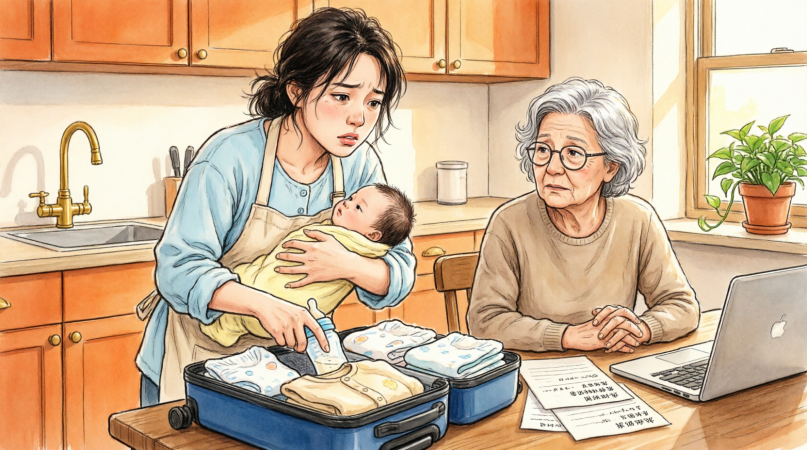
In the bedroom, she opened the closet and pulled out the battered suitcase she had not used since before the baby was born.
The handle was cracked from years of work trips, back when she still flew out on Monday mornings with audit folders in her carry-on and came home on Fridays smelling like airport coffee and printer toner.
Before Ryan’s family slowly made her smaller.
Before Calloway House became a place where she apologized for needing rest, apologized for asking questions, apologized for not knowing a family rule nobody had explained until she broke it.
She placed the suitcase on the bed and packed without shaking.
Diapers.
Formula.
Onesies.
A clean blouse.
Flat shoes.
The baby blanket from the hospital.
The envelope with their son’s birth certificate.
Ryan appeared in the bedroom doorway at 4:42 a.m.
His phone was still in his hand.
“Where are you going?”
“Out.”
He gave a short laugh.
It was not amusement.
It was disbelief that a woman he had just dismissed had found a door.
“You’re being dramatic.”
Claire zipped the suitcase.
That tiny metal sound cut through the room better than shouting would have.
“I’m taking the baby somewhere quiet.”
“You can’t just leave.”
She looked at him then.
For the first time all night, she let him see her eyes.
“I can.”
Ryan’s mouth tightened.
Claire had seen that expression before.
It came out whenever his control did not land on the first try.
His father used the same face at dinner when servers took too long.
His mother used the same face when Claire said she was too tired to host Sunday lunch.
In that family, disappointment was not a feeling.
It was a weapon.
Ryan stepped sideways, not enough to block the door, but enough to remind her that he could.
Claire held the baby closer.
“You said divorce,” she said.
“I did.”
“Then move.”
He stared at her, and for a second she thought he might argue.
Then he looked at the baby.
Maybe he remembered that the hallway camera by the nursery still recorded motion.
Maybe he remembered that Claire had spent her career noticing details other people forgot.
Maybe he simply did not expect her to call his bluff.
Whatever the reason, he moved.
Claire rolled the suitcase past him and down the hall.
In the kitchen, the food still sat waiting for a family that had always expected her labor without her voice.
A tray of rolls had gone hard under a towel.
Coffee had burned down in the pot.
The table looked like a stage after the audience had left.
She picked up the diaper bag from the chair, checked the baby’s car seat straps twice, and walked into the dark driveway.
Behind her, Ryan stood on the porch in his socks.
He looked ridiculous there.
Expensive shirt.
Bare feet.
No script.
By 5:16 a.m., Claire was backing out with one hand on the wheel and her son asleep behind her.
The house glowed in the rearview mirror.
Warm.
Large.
Empty.
She did not drive to a hotel.
She did not drive aimlessly.
She drove to Mrs. Parker’s house.
Mrs. Parker had been her mentor before marriage made Claire hard to reach.
She was the woman who taught Claire that numbers had tempers, that ledgers had body language, and that a good auditor did not accuse until the paper was ready to speak.
When Claire had first joined the audit team years earlier, Mrs. Parker had looked at her first review notes and said, “You don’t miss much.”
Claire had carried that sentence around like a passport.
Then she married Ryan, and little by little, the passport stayed in a drawer.
Mrs. Parker opened the door before the second knock.
She wore a robe over pajamas, silver hair clipped back, eyes sharp despite the hour.
Her gaze moved from Claire’s face to the baby to the suitcase.
She did not ask a gentle question.
Gentle questions were for people who had slept.
“He did it?” Mrs. Parker asked.
Claire nodded.
“At four-thirty.”
Mrs. Parker stepped aside.
“Come in.”
Claire sat at the kitchen table while dawn slowly turned the window pale.
Mrs. Parker warmed a bottle for the baby and set a paper coffee cup beside Claire’s hand, even though neither of them had gone anywhere to buy coffee.
It was from the sleeve of cups she kept near the machine, the kind she used when she knew someone might need to hold something without thinking.
“What exactly did he say?” Mrs. Parker asked.
“Divorce.”
“That’s all?”
“That’s all.”
Mrs. Parker took out a yellow legal pad.
Claire watched her write.
4:30 A.M.
DEMAND MADE WITH CHILD PRESENT.
LEFT WITH PERSONAL ITEMS.
Then she wrote Ryan Calloway and underlined it twice.
The old rhythm came back so quickly that Claire almost laughed.
Not grief.
Not panic.
A ledger.
A timeline.
A woman who remembered her own name.
Mrs. Parker looked up.
“Do you still have access to Silverline’s audit archive?”
Claire’s fingers tightened around the cup.
“Yes,” she said.
“Legal access?”
“Read-only. Old project permissions. They never removed me from the archive after I rotated off.”
Mrs. Parker nodded once.
“Good. Then we do this clean.”
The word clean mattered.
Claire did not hack anything.
She did not steal anything.
She did not break into her husband’s life the way he had broken into hers.
She used access that should have been removed and never was, to view records she had once been responsible for reviewing.
At 6:03 a.m., Mrs. Parker turned the laptop toward her.
Claire entered her credentials.
For a breathless moment, the screen loaded.
Then the Silverline Holdings archive opened.
Claire did not cry then either.
She had expected to feel triumph.
Instead, she felt the calm dread of a doctor finding the shadow exactly where she feared it would be.
The first folder was an accounts payable archive.
The second was a vendor reimbursement batch.
The third was flagged for review hold.
Mrs. Parker leaned closer.
“Start there.”
Claire opened the transfer ledger.
The page filled with dates, account codes, vendor numbers, authorization initials, and amounts.
Most people saw rows.
Claire saw movement.
A false vendor reimbursement has a rhythm when you know what to watch for.
Too clean.
Too round.
Too often approved after hours.
She clicked into the attached authorization packet.
Ryan’s name appeared on the approval line.
Not as a bystander.
Not as a spouse repeating family dinner gossip.
As a signer.
Claire sat back.
Mrs. Parker said nothing.
Silence was professional courtesy when the first proof landed.
Claire opened the next file.
This one tied a reimbursement request to renovations at Calloway House.
The language was dressed up as consulting expenses.
The supporting invoice was thin.
The mailing address attached to the payment looked familiar.
Claire had seen that address on Christmas cards in Ryan’s mother’s hallway drawer.
Her stomach turned, but her hands remained steady.
Ryan had not just humiliated her at 4:30 a.m.
He had done it while standing on a floor that may have been paid for by money that did not belong where it ended up.
Mrs. Parker’s mouth tightened.
“Print to PDF. Save nothing locally. We document the file path, the timestamp, and the access trail.”
Claire obeyed.
At 6:29 a.m., Ryan called.
She watched his name pulse on her phone.
She did not answer.
At 6:31 a.m., his mother called.
Claire did not answer that either.
At 6:34 a.m., a text arrived.
Where are you?
Then another.
Do not make this ugly.
Claire looked at the transfer ledger.
“It’s a little late for that,” Mrs. Parker said.
Claire had not realized she had spoken aloud.
They worked for forty-seven minutes.
They documented every file path.
They saved screenshots of metadata.
They created a timeline that started before the marriage and continued through the baby’s birth, the renovations, the missing invoices, the after-hours approvals, and Ryan’s sudden decision to demand divorce before sunrise.
By 7:18 a.m., Mrs. Parker had stopped calling it messy.
By 7:32 a.m., she called it exposure risk.
By 7:45 a.m., she called a former colleague who still handled corporate compliance reviews and said only, “I need to route a preservation concern through the proper channel.”
Claire fed the baby while listening.
Her son drank quietly, one tiny hand resting against her wrist.
It struck her then that she had been cooking for people who would have watched her lose everything and still complained about the rolls.
The thought did not make her cry.
It made her clear.
Ryan called eleven times before 8:10 a.m.
His messages changed tone.
First irritation.
Then warning.
Then the kind of false worry men use when anger has not worked.
Claire, come home.
Your son needs stability.
My parents are worried.
You’re making yourself look bad.
At 8:22 a.m., Mrs. Parker’s former colleague responded with instructions for a preservation packet.
No accusations.
No drama.
Just documents routed to people whose job was to make sure nobody quietly deleted a problem.
That was when Ryan finally sent the message that told Claire he had realized what she was doing.
Do not touch Silverline.
Mrs. Parker looked at the phone and gave a humorless laugh.
“There he is.”
The next hour moved fast.
Claire sent the preservation packet through the official channel.
She included the file paths, timestamps, approval names, and a written statement that she was reporting a concern based on records available under her archived read-only access.
She did not mention revenge.
She did not mention divorce.
She did not mention the kitchen at 4:30 a.m.
The documents did not need her heartbreak to be useful.
By late morning, Silverline’s compliance office acknowledged receipt.
By noon, Ryan’s tone had collapsed.
He stopped demanding that she come home.
He started asking what she had seen.
Then he asked who she had told.
Then he asked if she understood what she was doing to his family.
Claire read that one twice.
His family.
Not their son.
Not their marriage.
Not the woman he had ordered out of his life with one word while she held his baby.
His family.
Mrs. Parker made soup.
Claire ate because her body needed it, not because she was hungry.
The baby slept in a portable bassinet Mrs. Parker borrowed from a neighbor, and every time he moved, Claire looked over.
The day felt unreal in the way disasters feel unreal after the first hour.
You keep expecting the world to change color.
Instead, the microwave beeps.
A truck passes outside.
Someone’s dog barks two houses down.
At 2:17 p.m., Ryan arrived.
Claire saw his car through the front window before he knocked.
Mrs. Parker stood up.
“No.”
Claire shook her head.
“I want him to know I’m not hiding.”
Ryan knocked hard enough to rattle the glass.
Mrs. Parker opened the door but did not step aside.
He looked past her and found Claire at the table.
For the first time since 4:30 a.m., he looked afraid.
Not sad.
Not guilty.
Afraid.
“Claire,” he said. “We need to talk.”
Mrs. Parker folded her arms.
“You can talk from there.”
Ryan’s eyes darted toward the laptop.
Claire closed it slowly.
That small movement did more damage than shouting would have.
“What did you send?” he asked.
“The truth,” Claire said.
“You don’t understand what you’re involved in.”
She almost smiled.
That had always been the Calloway family’s favorite lie.
Claire wouldn’t understand business.
Claire wouldn’t understand pressure.
Claire wouldn’t understand how things were handled.
But Claire understood plenty.
She understood invoice trails.
She understood approval chains.
She understood how panic sounded when it wore her husband’s voice.
Ryan stepped forward, and Mrs. Parker did not move.
“I said divorce,” he snapped, the old cruelty trying to return because fear embarrassed him.
“Yes,” Claire said. “You did.”
“You think this helps you?”
“No,” she said. “I think it helps the people whose money moved through accounts you thought nobody would check.”
His face changed.
That was the moment the marriage truly ended.
Not at 4:30 a.m.
Not with the suitcase.
Not with the word divorce.
It ended when Ryan realized Claire had stopped trying to be understood by him.
A person begging to be understood still gives you power.
Claire had taken hers back.
Mrs. Parker’s phone rang.
She answered, listened, and looked directly at Ryan.
“Thank you,” she said into the phone. “Yes. We’ll preserve everything.”
Ryan swallowed.
“What was that?”
Mrs. Parker did not answer him.
Claire did.
“That was the compliance acknowledgment being escalated.”
Ryan’s mouth opened, then closed.
For once, he had no casual word to drop.
By the end of that week, Silverline had frozen Ryan’s access.
An external forensic review began.
Claire was interviewed twice, both times with counsel present, both times calmly.
She repeated only what she could prove.
Dates.
Files.
Names.
Approvals.
She did not speculate about motive.
The records handled that on their own.
Ryan’s father tried to call her once.
Claire did not answer.
Ryan’s mother sent a message that said she had destroyed the family.
Claire deleted it after saving a screenshot.
Old habits die slowly.
Good habits save you.
The divorce became much simpler than Ryan had expected because he had made one error that arrogant people often make.
He believed humiliation would make Claire small.
Instead, it made her precise.
Through her attorney, Claire requested temporary custody arrangements that protected the baby’s routine and limited conflict.
She did not ask for drama.
She asked for documented exchanges, written communication, and financial disclosures.
Ryan’s lawyer tried to paint her as vindictive.
Then the preservation packet became part of the larger review, and the word vindictive began to sound ridiculous next to transfer logs and archived approvals.
No single day solved everything.
That is not how real freedom works.
Real freedom is paperwork, childcare, sleep, rent, a checking account, a safe place to put the crib, and a morning when nobody criticizes the way you hold a spoon.
Claire moved into a small apartment with pale walls and a kitchen barely big enough for two people to stand in.
She loved it immediately.
There was no dining room table set for people who hated her.
No porch where Ryan stood waiting to perform authority.
No hallway where his mother’s voice could float in and make Claire feel like a guest in her own life.
The first night, she warmed soup on the stove and fed her son in an old rocking chair Mrs. Parker found through a friend.
Her suitcase sat by the bedroom door, still not fully unpacked.
The cracked handle looked less pathetic now.
It looked like proof.
Weeks later, the corporate review confirmed that improper transfers had been routed through vendor reimbursements connected to entities tied to the Calloway family.
Claire was not told every consequence.
She did not need to be.
She knew enough.
Ryan lost his position.
His father’s role came under review.
The family house, the polished dinners, the expensive certainty, all of it became quieter after that.
The Calloways did not apologize.
People like that rarely do.
They prefer to call accountability cruelty because it lets them stay the victim in their own story.
But Ryan did sign the custody agreement.
He signed the support order.
He signed the property disclosures after being reminded that Claire had always been very good at reading documents.
The last time Claire saw him in a family court hallway, he looked smaller than he had in the kitchen.
Not ruined.
Just ordinary.
That was almost more satisfying.
He had built himself into a storm in her mind, but outside Calloway House, under fluorescent lights with a folder in his hand, he was just a man who thought one word could erase a woman.
“Divorce,” he had said.
And maybe he thought that was the end of the story.
But sometimes the word meant to discard you becomes the door you walk through.
Claire walked through it at 4:30 a.m. with a baby, a suitcase, and no plan except not to stay.
By dawn, the plan had found her.
Not grief.
Not panic.
A ledger.
A timeline.
A woman who remembered her own name.
Months later, when her son was old enough to laugh at the mobile above his crib, Claire cooked dinner in her little apartment while rain tapped softly at the window.
The food was simple.
The table was small.
No one inspected the napkins.
No one asked why the potatoes were not warmer.
Her phone buzzed once with a message from Mrs. Parker.
Proud of you.
Claire looked at her son, then at the suitcase finally tucked away in the closet.
For the first time in years, the house around her felt quiet in a way that did not scare her.
It felt like peace.