I arrived home late that Tuesday with rainwater on my shoes and the tired, ordinary ache of a woman who had spent the whole day holding herself together.
The porch light on our small rental in Tampa flickered when I climbed the steps.
The mailbox at the curb was still hanging open from the afternoon, and a plastic grocery bag had blown against the fence, snapping softly in the storm wind.
I remember those details because the mind grabs the smallest things right before the world changes.
Inside, the living room smelled like stale popcorn, wet carpet, and that damp-metal smell that comes in when rain pushes under an old door.
Cartoons were still playing on the television, loud and bright, with silly voices bouncing off the walls like nothing in the room was wrong.
Mason was on the sofa under the yellow lamp.
My seven-year-old son sat with his knees close together and his hands folded too neatly in his lap.
He was wearing pajama shorts and the blue hoodie I had washed two nights before, the one with the little zipper he always forgot to pull all the way up.
At first, my brain tried to make sense of him in pieces.
His cheek looked swollen.
His arms were marked.
His collar was twisted.
Then the pieces became one picture, and I stopped breathing.
The bruises were not the kind a child gets from a playground tumble or a clumsy run into the coffee table.
They were placed.
They had shape.
They made my son look smaller than he was.
I dropped my tote bag, and my keys cracked against the tile.
Mason flinched so hard his shoulders rose toward his ears.
That flinch told me there had been more than pain in that house.
There had been warning.
For three years, I had built our home around one promise.
Mason would not be afraid of the place where he slept.
After his father and I separated, I moved us into the small Tampa rental because it was what I could afford without begging anyone.
The kitchen cabinets stuck in the humidity.
The hallway floor had a loose board outside the linen closet.
The air conditioner made a whining sound every time it kicked on.
But I knew every sound, every lock, every bad corner of that house, and I treated that knowledge like protection.
I worked double shifts when I had to.
I kept cereal in the pantry and gas in the car.
I answered school emails at midnight and folded laundry at the edge of my bed.
None of it felt heroic.
It just felt like motherhood.
A safe home is not built out of walls.
It is built out of a child’s belief that when he calls your name, somebody comes.
That night, Mason looked at me like he was not sure calling my name would be enough.
I crossed the room slowly.
“Mason, baby,” I said, keeping my voice low, “what happened to you?”
He looked toward the hallway.
Then toward the kitchen.
Then toward the sliding glass door, where our reflection floated dark against the rain.
His lips trembled.
“Mommy,” he whispered, “I can’t tell you here.”
I felt something inside me go cold.
Not angry yet.
Colder than angry.
A mother knows the difference between a child hiding trouble and a child hiding from danger.
I wanted to run through the house.
I wanted to open every door.
I wanted to shout until whoever had done that to him came out and showed their face.
Instead, I looked at my son’s hands.
They were clenched in his lap so tightly his little knuckles were pale.
He was waiting to see what I would do.
So I did not explode.
I did not ask him again in that room.
I did not turn his fear into a scene he had to survive.
I grabbed his sneakers from beside the sofa, wrapped him in the blue hoodie, and carried him out through the rain.
He was too old for me to carry easily, but he did not fight me.
That scared me too.
At 9:47 p.m., I backed out of our driveway with both hands locked around the steering wheel.
The dashboard light made my fingers look bloodless.
Mason sat in the back seat and watched the streetlights slide over the windows.
Every time we passed one, he took a small hitching breath.
I kept my voice steady because it was the only thing I could give him.
“We’re going somewhere safe,” I told him.
He did not ask where.
He just nodded once.
By 10:06 p.m., Tampa General Hospital had our names on an intake form.
The emergency room doors opened with a cold hiss, and the air hit us all at once.
Disinfectant.
Coffee.
Wet clothes.
A television in the corner was playing local news with the sound turned low, and somebody’s baby was crying behind a curtain.
The nurse at intake started to ask for my ID.
Then she looked at Mason.
Her fingers stopped over the keyboard.
Her eyes moved from his cheek to his arms to the marks near his shoulder.
She did not ask us to sit in the waiting area.
She did not tell me to fill out one more page first.
She stood up and said, “Come with me.”
That was when I understood other people could see it too.
Not a worried mother’s exaggeration.
Not a rough night.
Not clumsiness.
Something had happened to my child, and the room knew it before anybody said the word.
They brought us into a pediatric bay with pale curtains and a monitor mounted on the wall.
A nurse wrote 10:06 p.m. across the top of the intake form.
Another nurse clipped a hospital band around Mason’s wrist.
A third one came in with a camera for the injury chart, and she spoke to him in the gentlest voice I had ever heard.
“I’m going to take pictures of the places that hurt,” she said.
Mason looked at me.
I put my hand on his sneaker.
“I’m right here,” I told him.
He nodded again.
He did not cry during the pictures.
That was almost worse.
He sat still and turned his arm when they asked.
He lifted his chin when they needed to see his cheek.
He let them do their work like a child who had already learned that stillness was safer than protest.
Proof has its own language.
Timestamps.
Forms.
Photographs.
People only call it drama when there is no paper trail.
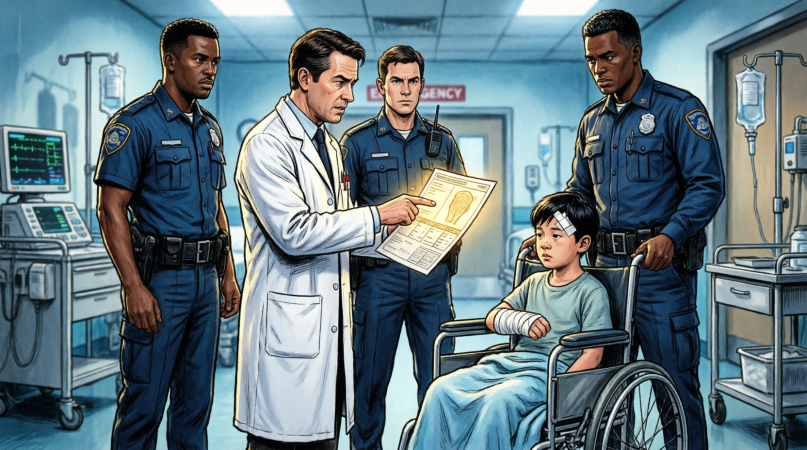
A doctor entered a few minutes later.
He was older, with silver hair, tired eyes, and the kind of calm that did not feel fake.
His badge said Dr. Harlan.
He looked at Mason from the doorway first, not rushing in, not crowding him.
Then he pulled a stool beside the bed and knelt so his face was level with my son’s.
That one choice changed the air.
Mason’s shoulders dropped by half an inch.
“Mason,” Dr. Harlan said, “you are not in trouble.”
My son stared at him.
“Your mom brought you somewhere safe,” the doctor continued. “Can you tell me what happened?”
Mason’s eyes went to me.
I wanted to say no.
I wanted to spare him.
I wanted to tell the doctor that I would carry the words for him if he would only give them to me.
But I had learned something in that short ride through the rain.
This was not about my need to know first.
It was about Mason needing to be believed.
So I nodded.
Mason leaned toward Dr. Harlan’s ear.
The monitor beeped beside us.
Rain clicked against the window.
Somebody laughed too loudly down the hall and then stopped.
My son whispered something so low I could not hear it.
Dr. Harlan’s face changed.
It did not change loudly.
There was no gasp.
No dramatic step back.
Just the color leaving his skin and his hand going still on the bed rail.
A nurse froze with gauze between her fingers.
A tech stopped at the edge of the curtain with a tablet in his hand.
The woman in the next bay, who had been scrolling on her phone, lowered it into her lap.
For one full second, the whole ER seemed to hold its breath.
The printer kept spitting out paper at the nurses’ station.
The monitor kept beeping.
Rain kept tapping the windows.
Nobody moved.
Then Dr. Harlan stood.
He looked at Mason.
Then he looked at me.
I saw professional training in his posture and something painfully human in his eyes.
“Ma’am,” he said softly, “I think you should sit down.”
My knees wanted to obey.
I did not.
I stayed beside my son’s bed because Mason still had two fingers hooked in my sleeve.
“Mason,” I whispered, “who are you afraid of?”
His face crumpled.
The tears finally came then, hot and silent, sliding over the swollen side of his cheek.
“Mommy,” he whispered, “please don’t let him come back here.”
That sentence did something to me I still cannot describe without feeling my hands shake.
For one ugly second, I imagined finding the person who made my child say that and making him afraid.
I imagined rage as a door I could kick open.
Then Mason tightened his fingers in my sleeve.
The fantasy died right there.
Anger is easy.
Evidence is harder.
Evidence survives the room.
I reached for my phone and called 911 from beside the hospital bed.
The dispatcher asked for my location.
I gave it clearly.
“Tampa General Hospital,” I said. “Emergency department. Pediatric bay four.”
She asked Mason’s age.
“Seven.”
She asked whether we were safe at that moment.
I looked at Dr. Harlan, at the nurse, at the bright hallway outside the curtain.
“Yes,” I said. “For now.”
Dr. Harlan was already moving.
He handed the injury chart to the nurse.
She clipped the intake form to the front.
On the top page were Mason’s name, the time, the date, and the first words that made the situation official.
Suspected physical abuse.
The phrase looked too small for what it meant.
It sat there in black ink like a door opening into a hallway I had never wanted to walk down.
A few minutes later, the automatic doors at the end of the ER hall opened again.
A Tampa police officer stepped inside with rain still shining on his shoulders.
He paused near the nurses’ station, scanning the room.
Dr. Harlan did not wait for him to find us.
He walked straight to the officer with Mason’s chart in his hand.
The officer looked at the first page.
Then he looked toward the bed.
His face shifted in a way I recognized from the nurse’s face, from the tech’s face, from every adult who had seen my child that night and understood there was no harmless explanation.
He came toward us slowly.
He did not put his hand on his belt.
He did not crowd Mason’s bed.
He stopped near the foot rail and lowered himself into a crouch, making himself smaller on purpose.
That mattered.
Kids notice who tries not to scare them.
“Hi, Mason,” he said. “I’m Officer Daniels. I’m here to help make sure nobody hurts you tonight.”
I did not know Officer Daniels before that moment.
I will never forget how carefully he said those words.
Mason stared at the blanket.
The officer waited.
No rush.
No pressure.
Just waiting.
Then Mason whispered, “He said nobody would believe me.”
The nurse behind me made a small sound.
Not a sob.
Not exactly.
More like her breath had broken before she could stop it.
Dr. Harlan’s jaw tightened.
Officer Daniels glanced at the doctor, then at the chart, and the whole room seemed to understand the next steps without anyone having to perform them.
The officer asked me for basic information first.
My name.
Mason’s full name.
Our address.
Who had been in the house.
Who had access to him while I was gone.
I answered what I could.
When I did not know, I said I did not know.
That was harder than it sounds.
Mothers want answers immediately.
Mothers want a clean line between before and after.
But a police report is not built out of panic.
It is built out of what can be said, written, checked, and proven.
The nurse stayed close to Mason.
Dr. Harlan kept his voice low.
Officer Daniels wrote everything down.
He asked Mason if he could speak with him only if Mason felt ready and only with me nearby.
Mason looked at me again.
I told him the truth.
“You do not have to protect anyone who hurt you.”
He cried harder at that.
Not loudly.
Mason had always been a quiet crier, even as a toddler.
He would press his face into my shirt and try to swallow the sound.
I used to think that meant he was brave.
That night, I wondered who had taught him to be quiet.
The officer did not make him tell the whole story in one breath.
He asked small questions.
He let Mason point when words were too much.
He repeated back only what he needed to confirm.
Dr. Harlan documented.
The nurse initialed the photo sheet.
The intake form stayed clipped to the front of the chart like the first brick in a wall.
At some point, someone brought me a paper cup of coffee.
It had gone lukewarm before I remembered to touch it.
My phone kept lighting up in my pocket.
I did not answer.
There are moments when the outside world can wait.
There are moments when a mother’s whole life narrows to one hospital bed, one child, one sleeve in his hand.
Mason eventually asked if we had to go home.
The question was so small I almost missed it.
“No,” I said immediately.
Dr. Harlan looked at me then, and I understood I had answered correctly before he even spoke.
“We’ll make a safety plan before discharge,” he said. “Nobody leaves here without one.”
Those words did not fix anything.
They did not erase the bruises.
They did not give my son back the Tuesday night he should have spent eating cereal on the couch and complaining about bedtime.
But they put a floor under us.
A plan is not comfort.
A plan is a handle you can grip when the world has gone slick.
The hospital social worker arrived before midnight.
She carried a folder and wore sneakers that squeaked softly on the tile.
She introduced herself to Mason first.
Then to me.
She did not talk around him like he was furniture.
She explained what would happen next in words he could understand.
There would be a report.
There would be follow-up.
There would be adults whose job was to make sure he was safe.
Mason listened with his eyes on her badge.
When she asked if he wanted a blanket from the warmer, he nodded.
That blanket was the first thing he accepted all night without flinching.
I watched the nurse wrap it around his shoulders.
His little body disappeared into white cotton and hospital warmth.
For the first time since I had opened my front door, he looked like a child instead of a witness.
Officer Daniels finished the first report near the nurses’ station.
Dr. Harlan signed the medical notes.
The photo sheet went into the file.
The intake form stayed on top.
The ordinary machinery of institutions kept moving around us, but that night it did not feel cold.
It felt necessary.
I used to think paperwork was the opposite of love.
Forms.
Signatures.
Case numbers.
Copies.
But in that ER, paperwork became a kind of protection.
It made the truth harder to bury.
It made Mason’s whisper bigger than the person who told him nobody would believe it.
Before we left the hospital, Dr. Harlan came back into the bay.
He pulled the curtain closed halfway, not to hide us, but to give Mason a little softness around the edges.
“You did a brave thing tonight,” he told him.
Mason did not look up.
“I was scared,” he whispered.
Dr. Harlan nodded.
“Brave people usually are.”
That was the first thing all night that made Mason look directly at him.
Then the doctor turned to me.
“You did the right thing bringing him in,” he said.
I almost broke then.
Not because I needed praise.
Because every mother secretly fears the question she did not know to ask sooner.
How did I miss it?
How long had he been carrying this fear?
What would have happened if I had worked one more hour?
Dr. Harlan must have seen some of that on my face, because his voice softened.
“You got him out,” he said. “That matters.”
Officer Daniels walked us through the immediate safety steps before we left the ER.
I signed the discharge papers with my hand shaking.
The social worker gave me copies of numbers and instructions.
The nurse helped Mason into his hoodie.
When she zipped it carefully up to his chin, he let her.
That small permission felt enormous.
Outside, the storm had eased into a mist.
The parking lot shone under the lights.
My car looked exactly the same as it had when we arrived, which felt impossible.
I buckled Mason into the back seat.
He leaned his head against the window and asked, “Are we going back there?”
“No,” I said.
I did not make that promise because I knew every legal answer.
I made it because some promises have to be spoken before the whole road appears.
“No, baby. Not tonight.”
He closed his eyes.
On the drive away from the hospital, I kept both hands on the wheel and watched the city blur through the wet windshield.
Tampa was still awake in the way hospitals and gas stations and late-night intersections stay awake.
A delivery truck rolled past us.
A man in scrubs crossed a parking lot with a paper coffee cup.
Somewhere, somebody’s Tuesday was ordinary.
Ours would never be ordinary again.
But Mason was in the back seat.
Breathing.
Wrapped in a warm blanket.
Believed.
That was where the rest of our life had to begin.
A safe home is not built out of walls.
It is built out of what a child learns happens when he finally tells the truth.
That night, Mason learned that the room could go still and still choose him.
He learned that a whisper could become an intake form, a chart, a police report, a safety plan, and a door that did not open for the person he feared.
And I learned that a mother does not always save her child by fighting in the hallway.
Sometimes she saves him by staying steady long enough for the evidence to speak.