My grandson had not missed three Saturdays in a row since the year my son died.
That was the first fact I could not make gentle, no matter how many excuses I tried to wrap around it.
Dylan was my Saturday boy.
He had been seven when his father, my son, was buried beneath a gray Texas sky four years earlier, standing at the edge of the grave in a navy jacket too stiff for his little shoulders.
He had not cried during the service.
He had held my hand so tightly that my fingers went numb, and when the preacher said words about peace, Dylan looked up at me and whispered, “Does Dad know I wore the tie he liked?”
After that, Saturday became the day grief took a shape we could both survive.
Laura would drop him off in the morning, and he would run across my porch with his backpack bouncing against his shoulders.
Sometimes he brought homework.
Sometimes he brought grass stains and a soccer ball.
Always, he asked for warm milk in the chipped blue mug that had once belonged to my son.
He would sit on the porch swing with both hands wrapped around it, telling me about school, the field near Laura’s house, and which boy had kicked the ball over the fence again.
Those mornings saved me more than I ever told him.
When my son died, I lost the person who still called me Dad with irritation and love in the same breath.
When Dylan kept coming every Saturday, I had one small piece of him still running across my porch boards.
That was why the first missed visit worried me.
Laura said Dylan had a stomach bug.
Her voice was soft and apologetic, and because grief teaches you to fear becoming too demanding, I accepted it.
The second missed Saturday, she said he was behind on schoolwork.
“He’s tired,” she told me. “You know how kids get.”
I did know how kids got.
I also knew how Dylan sounded when he was tired, because he would still ask to call me and complain about it for ten minutes.
No call came.
By the third Saturday, I had started hearing something wrong inside Laura’s pauses.
She had never been a cruel woman in the obvious ways.
She had been exhausted after my son died, and I had tried not to judge the speed with which she let Mark into the house.
Loneliness can make people open doors they should have nailed shut.
Mark was polite when I first met him.
Too polite, maybe.
He shook my hand with both of his, called me sir, and said Dylan needed “a consistent male presence.”
I remember disliking the phrase without knowing why.
It sounded like something printed in a brochure, not something spoken by a man who loved a grieving child.
Still, I wanted to believe Laura had chosen help.
I wanted to believe my grandson had more protection, not less.
So when Laura gave me a spare key six months after Mark moved in and said, “Just in case,” I held on to that key like a sign that I was still trusted.
Sometimes trust is only the door people leave unlocked until they decide to lock someone else in.
On Thursday at 2:14 PM, Mrs. Miller called me.
She lived two houses down from Laura and had known Dylan since he was small enough to chase soap bubbles across her lawn.
She did not start with hello.
“I don’t want to make trouble,” she whispered.
That sentence has ruined more children than almost any lie adults tell themselves.
I stood in my kitchen with the phone pressed to my ear, staring at the calendar where I had circled three Saturdays that no longer made sense.
“What happened?” I asked.
“I haven’t seen Dylan outside in days,” she said. “Not going to school. Not with his ball. Nothing.”
I gripped the counter.
She kept talking, and each word seemed to lower the temperature in my house.
“At night, cars come by with the headlights off. They don’t stay. They just stop, then leave.”
I asked whether she had called Laura.
She said Laura did not answer the door anymore.
Then Mrs. Miller said, “The basement light stays on almost all night.”
That was the detail that got into my bones.
Not the cars.
Not the missed school mornings.
The light.
Because Dylan had hated basements since he was five.
My son once told me Dylan refused to go downstairs alone after a storm knocked out the power and left him crying on the bottom step.
Dylan remembered darkness like some people remember injuries.
I checked my phone after Mrs. Miller hung up.
Fourteen calls to Laura.
Six messages marked delivered.
One voicemail from me that began calm and ended with my voice cracking around Dylan’s name.
Proof does not always arrive in a file folder.
Sometimes it is a screen full of silence.
I drove to Laura’s house on the outskirts of Austin, Texas, without turning on the radio.
The road shimmered with heat.
My palms kept sweating against the steering wheel, and I kept wiping them on my pants at every red light.
I told myself there were explanations.
Maybe Laura was overwhelmed.
Maybe Dylan was sick.
Maybe Mark had taken him somewhere and forgotten to tell me.
Each excuse fell apart before I reached the next intersection.
When I turned onto their street, the neighborhood looked normal in the way places look normal when they are trying to hide what happens behind blinds.
Lawns were trimmed.
A sprinkler ticked in a neat green arc.
Somewhere a dog barked twice and stopped.
Laura’s car was gone.
Mark’s truck was gone.
Only my dead son’s old Nissan pickup sat in the driveway, covered with dust.
That pickup should have been sold years ago, but Laura kept it because Dylan liked to sit in the driver’s seat and pretend he was taking his dad to work.
Seeing it there, abandoned under that gray film, felt like finding a memorial nobody had bothered to clean.
I knocked twice.
No one answered.
I looked once toward Mrs. Miller’s house and saw a curtain move.
Then I used the spare key.
The lock opened too smoothly.
Inside, the silence had weight.
The refrigerator hummed in the kitchen.
A wall clock ticked with an almost rude precision.
Water dripped somewhere, slow and hollow, as if the house itself were counting down.
“It’s me,” I called. “Grandpa.”
I waited.
“Dylan?”
Nothing.
The living room had the arrangement of ordinary life and none of its warmth.
Family photos hung on the wall, but dust dulled the glass.
The couch where Dylan used to bounce was sunken in the middle.
A blanket was folded over the armrest too neatly, like someone had staged it for a guest who never came.
His backpack was not by the stairs.
His soccer bag was not in the mudroom.
That absence frightened me more than any mess would have.
Dylan was not a neat child.
He left evidence of himself everywhere.
A shin guard under a chair.
A pencil on the porch.
A wrapper in the cup holder.
For a house with a child in it, that home had been swept clean of childhood.
In the kitchen, the milk was expired.
The eggs were past date.
A bowl of cereal sat in the sink, dried into gray paste, with a spoon standing upright in it.
It looked like somebody had walked away from breakfast and never come back.
That was when I heard it.
Scrape.
Pause.
Scrape.
It came from below me.
I stood in the kitchen doorway, one hand pressed against the frame, and listened until the sound came again.
There are sounds a house makes when it settles.
There are sounds pipes make when water moves.
This was neither.
This was deliberate.
Weak, but deliberate.
I followed it down the hall.
The basement door was closed.
That alone was not strange.
The padlock on the outside was.
It was new metal, bright against the older wood.
Fresh screws held the latch plate in place, and pale splinters around the edges showed where someone had drilled too fast.
Whoever installed it had not cared how it looked.
They had only cared that the person below could not get out.
I could smell it now.
Damp concrete.
Spoiled food.
Sweat.
Something darker underneath that made my throat tighten.
I placed my palm flat against the door.
At first, I felt nothing.
Then a tiny vibration passed through the wood.
“Grand…pa…”
For a second, my mind refused to place the voice where it belonged.
It was too thin.
Too dry.
Too far away from the boy who shouted across my porch on Saturday mornings.
“Dylan?” I whispered.
A sob came through the door.
“Grandpa… save me…”
The world narrowed to the lock.
I took my phone out with fingers that did not feel like mine and dialed 911.
The dispatcher asked for the emergency.
I gave the address.
I gave Laura’s name.
I gave Mark’s name.
I said locked basement, child inside, nauseating smell, possible injury, hurry.
The words sounded official, almost calm, and that made them worse.
My grandson was on the other side of a door, and I was turning his terror into a report.
But that was what saved me from losing control.
I did not scream.
I did not smash every piece of glass in that hallway.
I did not let the rage climbing my throat become the only thing in charge of me.
I found the old toolbox on the laundry shelf where my son used to keep it.
The red paint was chipped.
The handle was sticky with dust.
Inside were pliers, a hammer, a rusted wrench, and the bolt cutters I had forgotten Laura still had.
I carried them back to the basement door.
“Dylan,” I said, forcing my voice steady, “move away from the door.”
I heard movement below.
Not footsteps.
Dragging.
Once.
Twice.
Then silence.
My hands closed around the bolt cutters.
The first squeeze did nothing.
The second made the metal groan.
The third sent pain shooting through both wrists, but the padlock snapped open and fell hard against the floor.
For one second, nobody breathed.
Then the basement door began to open.
The smell hit me first.
I turned my face into my shoulder and swallowed against it.
The light below was too bright, an exposed bulb burning over concrete steps, making every stain and shadow look cruelly clear.
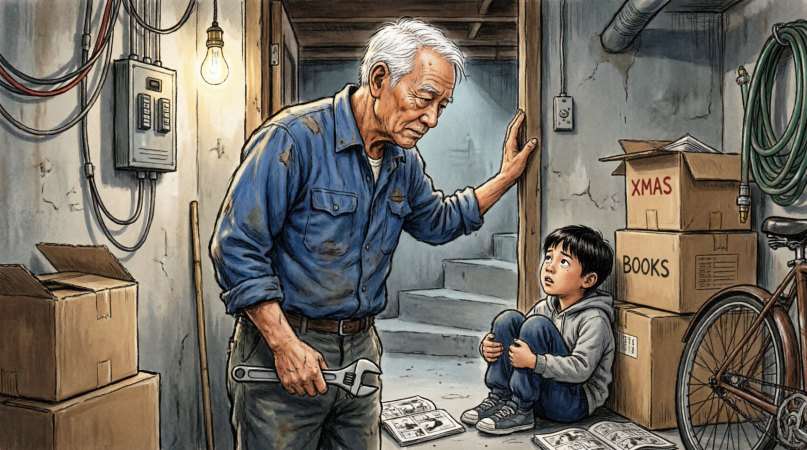
Dylan was at the bottom.
He was curled beside a stained blanket with his knees drawn toward his chest.
His hair was flattened on one side.
His lips were cracked.
His eyes looked too large, as if fear had hollowed out everything around them.
“Grandpa,” he whispered.
I started down the stairs, but he flinched at the sound of my shoes.
That flinch stopped me harder than any hand could have.
A child learns danger through repetition.
By the time he flinches from rescue, someone has already taught him too much.
I crouched on the steps and lowered my voice.
“It’s me, buddy. It’s Grandpa. Police are coming.”
He nodded, but his gaze slipped behind him.
That was when I saw the second blanket in the corner.
Not folded.
Not clean.
Dragged into a shape I did not want to understand.
My breath left me in a sound I had never heard from my own body before.
The dispatcher was still on the line, asking me what I could see.
I could barely answer.
I moved slowly down the remaining stairs and kept one hand open where Dylan could see it.
He tried to crawl toward me, but his arms trembled.
When I reached him, he grabbed my sleeve with both hands.
“Don’t let Mark come back,” he whispered.
“I won’t,” I said.
That was a promise so large I felt it settle over the rest of my life.
I wrapped my jacket around him.
He smelled of sweat, concrete, and old fear.
Behind him, the basement held the proof of what the upstairs had tried to hide.
A paper plate with dried crusts on it.
A plastic cup tipped on its side.
A bucket in the corner.
A notebook half-shoved under the bottom stair.
I did not want to touch anything, but I knew enough not to leave that notebook hidden.
I told the dispatcher what I saw.
She told me officers were close.
Then Dylan lifted one shaking finger.
“Look behind the boxes,” he said.
I did not want to.
That is the truth.
There are moments when the body knows that knowledge will divide your life into before and after.
Still, I picked up my phone, turned on the flashlight, and aimed it toward the far wall.
The beam crossed old paint cans, a cracked plastic bin, and three stacked moving boxes.
On the floor behind them were several small items lined against the concrete.
Dylan’s missing backpack.
His soccer cleats.
A folded school notice with Austin Independent School District printed at the top.
And a phone.
Not Laura’s.
Not Mark’s.
A cheap prepaid phone with a cracked screen, connected to a charger running from an extension cord.
The screen lit when the flashlight hit it.
There were messages visible.
I read only enough to understand that cars coming by with headlights off had not been Mrs. Miller’s imagination.
Then the sirens arrived.
The sound grew from faint to overwhelming in seconds.
Red and blue light washed across the basement window, turning the concrete walls into something unreal.
Dylan began shaking harder.
“They’re here to help,” I told him.
He pressed his face into my jacket and did not answer.
The first officer came through the front door calling out.
I shouted from the basement.
Two officers appeared at the top of the stairs, and I saw their faces change when the smell reached them.
Professionals learn to control their expressions.
Grandfathers notice anyway.
One officer, a woman with dark hair pulled tight at the back of her neck, came down slowly and crouched near Dylan without crowding him.
“My name is Officer Reyes,” she said. “You’re safe right now.”
Dylan looked at me before he looked at her.
That look broke something in me.
Paramedics arrived next.
They checked his pulse, his breathing, his pupils, the marks on his wrists, the dehydration cracking his lips.
They spoke in low voices and used words like transport, evaluation, and possible neglect.
I heard all of it through a rushing in my ears.
Upstairs, another officer was photographing the padlock.
The fresh screws.
The expired food.
The dusty Nissan in the driveway.
The cereal bowl in the sink.
My phone records were later added to the police report.
Mrs. Miller gave her statement before sunset.
The notebook came out in a paper evidence bag.
Dylan had written in it with a dull pencil.
Dates.
Times.
Car colors.
Mom left at 8:10.
Mark came down at 9:03.
No food today.
Light stayed on.
Children should not have to become witnesses to their own suffering.
But Dylan had documented what adults had refused to see.
Laura and Mark were found later that evening.
I will not pretend the confrontation looked like justice right away.
Justice rarely enters like thunder.
Sometimes it arrives as paperwork, handcuffs, a hospital intake form, and a child asking whether he is allowed to sleep with the lights on.
At Dell Children’s Medical Center, Dylan would not let go of my sleeve.
The nurse brought him juice, crackers, and a blanket warmed in a machine.
He touched the blanket like he did not trust softness anymore.
A doctor examined him while Officer Reyes waited outside the curtain.
A child protective services worker came with a folder and a careful voice.
I answered every question I could.
Yes, I was his grandfather.
Yes, my son was deceased.
Yes, I had regular contact before the three missed Saturdays.
Yes, I was willing to take emergency placement if the court allowed it.
Willing was too small a word.
I would have torn my own house down and rebuilt it around that boy if someone told me it would make him feel safe.
That night, a judge approved emergency protective custody.
The next days were a blur of interviews, reports, and the kind of official language that makes horror sound tidy.
Unlawful restraint.
Child endangerment.
Neglect.
Evidence collection.
Digital records.
The prepaid phone mattered.
The basement mattered.
The padlock mattered.
The notebook mattered most to me because it proved Dylan had still believed someone might come.
He had not written goodbye.
He had written records.
Somewhere inside him, under fear and hunger and darkness, my grandson had still been leaving a trail.
Laura cried during her first hearing.
I watched from behind the prosecutor’s table with Dylan’s small hand inside mine.
She looked thinner than I remembered, her hair pulled back, her face pale and trembling.
For one second, the part of me that had once tried to understand her grief almost woke up.
Then Dylan’s fingers tightened.
Compassion has limits when it has been purchased with a child’s terror.
Mark did not look at Dylan.
That told me more than any apology could have.
The case took months.
Dylan started therapy twice a week.
At first, he slept on a mattress beside my bed with every lamp in the room on.
He hid crackers under his pillow.
He asked before opening the refrigerator.
He apologized when he spilled water.
Each apology felt like evidence of a crime nobody had listed on a charge sheet.
Healing did not come as one beautiful moment.
It came in small, stubborn returns.
The first time he left his soccer cleats by my front door, I cried in the kitchen where he could not see me.
The first time he asked for warm milk in the chipped blue mug again, my hands shook so badly I nearly spilled it.
The first Saturday he ran across the porch instead of walking, I heard my son’s footsteps in his and had to grip the doorframe until the feeling passed.
Months later, when the court accepted the plea agreements and the protective orders became long-term, people told me we could finally move on.
They meant well.
People usually do when they are trying to rush pain into a shape that makes them comfortable.
But you do not move on from a locked basement.
You move through it.
You carry the smell, the sound, the scrape against concrete.
You carry the moment a boy flinched from rescue because harm had worn footsteps for too long.
And if you are lucky, you also carry the proof that someone came anyway.
The house on the outskirts of Austin was eventually sold.
I never went back inside after the evidence release.
Officer Reyes called me when the process ended and asked whether I wanted any of Dylan’s belongings recovered from the basement.
I said yes to the backpack.
Yes to the soccer cleats.
Yes to the notebook, if the court allowed it after the case.
When I finally held that notebook months later, I did not read every page again.
I opened only the last one.
At the bottom, in faint pencil, Dylan had written one sentence.
Grandpa will come Saturday.
He had been wrong about the day.
He had not been wrong about me.
Now Dylan lives with me.
He still has bad nights.
Some evenings he checks the front door twice, then looks embarrassed when I notice.
I never tell him to stop.
I just check it with him.
On Saturdays, we sit on the porch with warm milk, and he talks when he wants to talk.
Sometimes he tells me about school.
Sometimes he says nothing at all.
Silence is different now.
It no longer has the weight of that house.
It has porch boards, cicadas, and a boy leaning against my side while the sun goes down.
My grandson had not come to visit me for three weeks, so I decided to go see him unannounced.
That decision saved his life.
But the truth is uglier and simpler than that.
He had been waiting for someone to stop accepting smooth little lies.
He had been waiting for one adult to treat absence like evidence.
And every time he leaves his soccer cleats by my door now, I let them stay exactly where they are.
A house with a child in it should show signs of life.
Mine finally does again.