A five-year-old girl dialed 911 in a whisper, saying, “Someone’s hiding under my bed.” When we got there, what we found was nothing like we expected.
Officer Daniel Hayes had answered all kinds of calls during his twelve years on the force.
Domestic arguments that sounded worse than they were.
Noise complaints, break-ins, welfare checks, frightened elderly neighbors, missing teenagers, and parents who swore their children were simply being dramatic until the truth proved otherwise.
But he never forgot the sound of Mia Turner breathing into that phone.
It was 7:04 p.m. on a Thursday when the call came through dispatch.
Daniel had just poured bad station coffee into a paper cup when the dispatcher lifted one finger, the universal sign for everyone nearby to stop talking.
The room shifted.
Not loudly.
Just enough.
A chair stopped squeaking.
A pen stopped tapping.
Even before anyone knew what the call was, they heard the tone in the dispatcher’s voice change.
“Sweetheart,” she said gently, “can you tell me where you are?”
Daniel looked over.
The child on the line was barely audible.
“My parents aren’t home,” she whispered.
The dispatcher kept her voice steady.
“That’s okay. Are you hurt?”
“No.”
“Are you alone?”
There was a pause.
Then came the sentence that made Daniel set his coffee down untouched.
“Someone’s hiding under my bed.”
Children called about monsters sometimes.
They called because the basement sounded scary, because a branch scraped a window, because older siblings dared them, because the dark makes ordinary furniture grow teeth.
Daniel knew that.
Every officer knew that.
But this was different.
The girl was not crying for attention.
She was whispering because she believed the thing under her bed could hear her.
The dispatcher asked her name.
“Mia,” the child said.
“How old are you, Mia?”
“Five.”
Daniel felt something cold move through his stomach.
Five was small enough to still believe stuffed animals could protect you.
Five was also old enough to know when something was wrong.
At 7:06 p.m., the call was entered as a possible intruder and welfare check involving a minor.
Daniel and his partner, Officer Marcus Reed, were already moving before the address finished printing across the screen.
The house was on Willow Creek Lane, a clean suburban street full of two-story homes, clipped lawns, basketball hoops, and porch lights that came on automatically at dusk.
Nothing about the neighborhood looked dangerous.
That never comforted Daniel.
Over the years, he had learned that danger liked neat houses because neat houses made people hesitate.
A broken window announces itself.
A quiet hallway asks you to doubt yourself.
Marcus drove while Daniel read the call notes from the terminal.
Child caller.
Parents reportedly not home.
Possible unknown person under bed.
Caller whispering.
Dispatcher maintained open line until arrival.
No screaming.
No sounds of forced entry.
No confirmed weapon.
Those last three lines should have helped.
They didn’t.
Daniel had two children of his own, both older now, but he remembered the five-year-old stage with painful clarity.
Small pajamas.
Bedtime cups of water.
Questions asked from doorways after lights-out.
The conviction that a parent’s presence could hold back the entire world.
Mia did not have that presence tonight.
When the patrol car turned onto Willow Creek Lane at 7:14 p.m., the house was easy to spot.
White siding.
Blue shutters.
A child’s bicycle tipped over near the front walk.
One upstairs window glowing behind pink curtains.
Daniel and Marcus got out without slamming the doors.
A second unit was three minutes behind them.
A department child-and-family counselor, Elise Warren, was on her way as well because dispatch had not liked the sound of that call any more than Daniel had.
The front porch smelled faintly of cut grass and rain on concrete.
Daniel knocked once.
Then again.
The door opened before his knuckles fell a third time.
Mia Turner stood in the gap.
She was tiny, barefoot, and wearing pink pajamas with silver stars on the sleeves.
Her hair was tangled from sleep or panic, and she held a teddy bear against her chest with both arms locked around it.
The bear was old enough to have been loved into softness.
One button eye hung loose by a thread.
“My name is Mia,” she said.
Daniel crouched immediately.
He did not want to tower over her.
“I’m Officer Hayes,” he said. “This is Officer Reed. You did a very brave thing calling us.”
Her lower lip trembled.
“Please come,” she whispered. “There’s someone under my bed. I’m really scared.”
Behind her, the entryway was bright and ordinary.
A row of shoes by the wall.
A school drawing taped to a closet door.
A small table holding keys, mail, and a framed vacation photo of Mia between two smiling adults.
Daniel glanced once at Marcus.
Marcus nodded.
No forced entry visible.
No sounds from upstairs.
No adult voices.
Elise arrived just as the second unit pulled in behind them.
She came up the walkway quietly, carrying the kind of soft canvas bag counselors brought when children might need a blanket, a snack, or something to squeeze besides fear.
“Mia,” Daniel said, “Ms. Elise is going to stay right here with you while we check the house.”
Mia’s eyes moved to the staircase.
“Don’t go alone,” she said.
“I won’t,” Daniel promised.
That was not technically true, because officers separate when clearing rooms, but he meant the larger thing.
He meant she would not be dismissed.
He meant her fear had been heard.
Marcus checked the ground floor while Daniel started through the main rooms.
The living room television was on mute, showing a cartoon animal running in circles.
A purple plastic cup sat on the coffee table.
In the kitchen, a glass rested in the sink with a pale ring of milk drying near the bottom.
The refrigerator hummed.
The digital clock on the stove read 7:17.
Daniel opened pantry doors, checked behind curtains, looked under the dining table, and moved through the laundry room.
Marcus cleared the garage.
The back door was locked.
The windows were latched.
The alarm panel near the mudroom was armed in stay mode, which meant no exterior entry had been recorded recently.
At first glance, the house told a boring story.
No break-in.
No burglar.
No intruder.
At 7:19 p.m., Marcus radioed a preliminary clear for the main floor.
Daniel met him at the base of the stairs.
Mia stood in the entry with Elise kneeling beside her.
The little girl had not moved more than two feet from where they found her.
Her gaze remained fixed above them.
Daniel started upstairs.
The carpet was beige and thick enough to swallow footsteps.
Family photographs lined the wall.
Mia as a baby.
Mia in a Halloween costume.
Mia holding a certificate from Brookside Elementary kindergarten orientation.
That detail snagged in Daniel’s mind for no reason he could name.
Brookside Elementary.
A bright laminated school tag in one picture, clipped to a backpack, the kind children wore on the first week when adults were afraid they might forget their bus number.
Daniel checked the upstairs bathroom first.
Clear.
A linen closet.
Clear.
The parents’ bedroom.
Clear.
The closet was full of clothes and storage boxes, but no person.
Marcus checked the guest room.
Clear.
No one behind the curtains.
No one in the bathroom cabinet spaces.
No one in the shower.
Everything pointed toward the simplest explanation.
Mia had been frightened by a noise.
Maybe the house had settled.
Maybe a toy had rolled.
Maybe she had woken from a nightmare and found the shadows arranged like a body beneath the bed.
Marcus believed that.
Daniel wanted to believe it.
They returned downstairs.
Marcus softened his expression before he spoke to Mia.
“Sweetheart,” he said, “we checked the house. It was probably just a noise. You’re safe. We’ll call your parents.”
Mia stared at him.
For one second, she looked more offended than afraid.
Then she broke.
“You didn’t look under the bed!” she shouted.
The sound tore out of her so suddenly that Elise reached for her by instinct.
Mia jerked back.
“You didn’t look,” she cried. “I told you where!”
That sentence stayed with Daniel for years.
I told you where.
Adults often think children are imprecise because they are small.
Sometimes they are the only people in the room still telling the truth plainly.
Marcus looked ashamed.
Daniel felt it too.
They had checked the room, but not the exact place.
They had treated the fear seriously enough to come, but not seriously enough to complete the sentence she had given them.
Daniel crouched again.
“You’re right,” he said. “I’m sorry. I’ll look under the bed now.”
Mia wiped her nose with the back of one sleeve.
“Don’t let it come out,” she whispered.
Daniel stood and went back upstairs.
This time, he went directly to Mia’s room.
The door was open.
The room smelled like baby shampoo, crayons, and the faint plastic sweetness of children’s toys.
A moon-shaped nightlight glowed on the nightstand.
The bedspread was pink and ruffled, pulled loose on one side.
The blanket was tangled in the center of the mattress, as if Mia had not climbed out so much as exploded from it.
One pillow lay on the carpet.
A coloring book sat open near the dresser, one page half-filled with purple scribbles.
Daniel stood still for a moment.
Police work teaches you to look for what does not fit.
The pillow did not bother him.
The tangled blanket did not bother him.
The silence did.
It felt held.
Like someone underneath the room was trying not to exist.
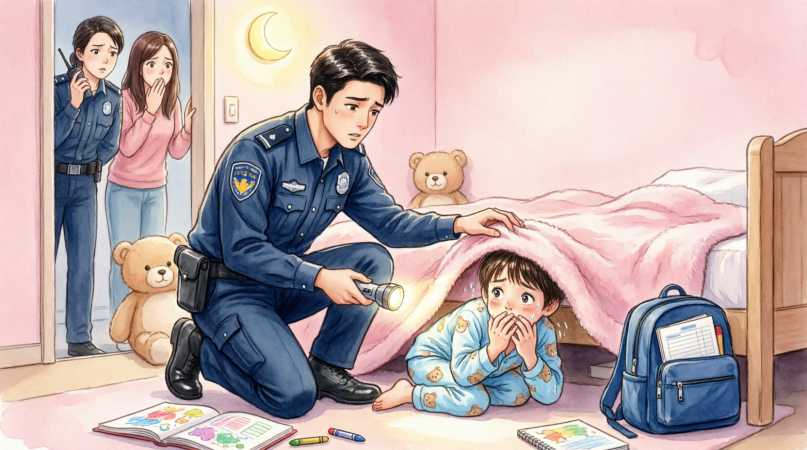
He knelt slowly beside the bed.
His right hand rested near his holster, not on it.
His left hand reached for the bed skirt.
For one breath, he did not move.
That was the restraint nobody talks about afterward.
Not the big heroic kind.
The small kind.
The kind where your body wants to rip the fabric up and your training tells you a frightened person under a bed could be a child, a victim, a suspect, or all three at once.
Daniel lifted the bed skirt.
The beam of his flashlight entered first.
Dust.
A sneaker.
A plastic bead bracelet.
Then eyes.
Wide, wet, and human.
Daniel froze.
Under Mia’s bed, pressed flat against the wall, was a child.
Not Mia.
Older.
Maybe nine.
Maybe ten.
Small enough to fit only by curling sideways, one arm trapped beneath a backpack, one hand clamped over their own mouth.
The child wore a gray sweatshirt with one sleeve torn near the wrist.
A hospital bracelet circled the other wrist.
The flashlight caught the plastic edge and made it shine.
Daniel heard himself whisper, “Oh my God.”
Marcus reached the doorway behind him.
“What is it?”
Daniel did not answer immediately.
The child under the bed lifted one finger to their lips.
A warning.
A plea.
Then, in a voice so raw it seemed to scrape the carpet, the child whispered, “Please don’t tell them I’m here.”
Daniel lowered his flashlight a few inches so the beam would not blind them.
“Nobody is going to hurt you,” he said quietly. “My name is Officer Hayes. I need you to come out slowly.”
The child shook their head so hard their cheek brushed the carpet.
“They’ll hear.”
“Who will hear?”
The child’s eyes moved toward the hallway.
“My dad.”
Marcus stiffened in the doorway.
Daniel kept his voice low.
“Mia’s dad?”
The child did not answer.
That silence answered enough.
Daniel signaled Marcus with two fingers.
Call it in.
Possible additional minor located.
Unknown relation.
Possible abuse or custodial issue.
Secure the scene.
Marcus stepped back and murmured into his radio.
Daniel stayed kneeling.
He could see more now.
The child’s cheek had a faint bruise near the jaw, yellow at the edge and dark red at the center.
There were carpet fibers stuck to damp skin.
Their lower lashes clung together with tears.
The backpack beside them had a laminated tag clipped to the zipper.
Brookside Elementary.
Same school as Mia.
Daniel read the tag upside down.
The first name was scratched, but the last name was not.
Turner.
His heart slowed in that dangerous way it did when a case changed shape.
This was not a stranger hiding in a child’s room.
This was someone connected to the house.
Someone hidden by the house.
“Can you tell me your name?” Daniel asked.
The child swallowed.
“Lena.”
“Lena Turner?”
Her chin trembled.
“My mom says not to use that name.”
Daniel felt the sentence land like a stone.
Downstairs, Mia began crying harder.
Elise’s voice floated up, gentle but tense.
“Mia, honey, stay with me.”
Then Elise called, “Officer Hayes? Mia’s parents just pulled into the driveway.”
Lena’s hand shot out and grabbed Daniel’s sleeve.
Her fingers were small, but her grip was ferocious.
“Please,” she whispered. “That’s not my dad.”
The front door opened below.
A man’s voice called, too cheerful and too loud, “Mia? Honey? Who’s here with you?”
Daniel turned his body between Lena and the hallway.
He keyed his radio.
“Reed, hold them downstairs. Do not let either adult upstairs.”
Marcus answered immediately.
“Copy.”
The man downstairs laughed, a brittle sound.
“Officers? Is everything okay? Mia has quite an imagination.”
Daniel heard Mia cry out.
“No!”
Elise said something sharp and controlled.
A woman’s voice joined the man’s, lower, anxious.
“What is going on? Where is my daughter?”
Daniel looked back under the bed.
“Lena,” he said, “I’m going to get you out of here. But I need you to move slowly toward me.”
She shook her head again.
“He said if I told, they’d send me back.”
“Who said that?”
Her lips parted.
The answer did not come.
Instead, Daniel heard Marcus downstairs switch from polite to command voice.
“Sir, stay where you are.”
The house changed again.
The neat suburban quiet cracked.
The man stopped sounding cheerful.
“What did you find?” he demanded.
Daniel reached under the bed with both hands, palms open.
“Lena. Now.”
She crawled toward him.
Slowly at first.
Then all at once.
She came out shaking, dragging the backpack with her, and Daniel wrapped one arm around her shoulders because she nearly folded onto the carpet.
She was lighter than she should have been.
Her sweatshirt smelled faintly of antiseptic and sweat.
The hospital bracelet was easier to read now.
County Children’s Intake.
3:42 p.m.
Same day.
The printed name had been scratched at with something sharp, but enough remained for Daniel to understand why the man downstairs was suddenly trying to get past Marcus.
Lena had not broken into that house.
She had come back to it.
Or been brought near it.
Or run to the one person she believed might not lie for the adults.
Mia.
Downstairs, Marcus said, “Sir, do not take another step.”
The man shouted, “That child is disturbed. She lies. We’ve been dealing with this for months.”
Lena flinched so hard Daniel felt it through his sleeve.
There it was.
Not surprise.
Recognition.
The line was ready before he knew what had been found.
Daniel had heard adults prepare lies before.
This one sounded rehearsed.
By 7:27 p.m., the second unit had both adults separated in the living room.
Elise brought Mia into the kitchen, away from the stairs, and sat with both girls once Daniel carried Lena down.
Mia saw Lena and ran toward her, but stopped short as if she had been told not to touch.
Lena looked at her.
For the first time, her face changed.
“Mia,” she whispered.
Mia began sobbing.
“I told them,” she said. “I told them where.”
Daniel would later write those exact words in the incident report.
He documented the bracelet, the backpack tag, the visible bruising, the alarm panel status, the 911 call timestamp, and the statements made by both children.
Marcus photographed the room before anything was moved further.
Elise recorded the initial child welfare notes.
A supervisor contacted County Children’s Intake to verify why a girl wearing their bracelet was hiding under a bed on Willow Creek Lane.
The answer came back slowly, then all at once.
Lena Turner was Mia’s half sister.
She had been placed temporarily with a family services unit earlier that day after a school nurse at Brookside Elementary reported bruises and repeated absences.
Her father, Mia’s stepfather, had been notified of an emergency custody review.
He was not supposed to have contact with Lena that evening.
He was absolutely not supposed to know where she had been taken for intake.
But someone had called ahead.
Someone had warned him.
And Lena, terrified she would be forced back into the same house, had run when a transport error left her unattended for less than two minutes near the intake parking area.
She had walked nearly a mile before finding the one address she remembered from years of being told she was not welcome there unless adults allowed it.
Mia’s house.
Her sister’s room.
The bed.
When Daniel learned that, the whole call rearranged itself in his mind.
Mia had not imagined someone under her bed.
She had discovered a secret the adults had tried to bury under language like custody, behavior, and family complications.
A child had hidden beneath another child because children know, before anyone teaches them law, that the safest person in a house is sometimes the only one with no power.
Mia had power that night because she had a phone.
And she used it.
The man in the living room kept talking.
Daniel heard pieces of it while he stood near the kitchen doorway.
“She has problems.”
“She runs away.”
“She manipulates people.”
“Mia must have misunderstood.”
His wife cried quietly into her hands, saying, “I didn’t know he went there. I didn’t know he found out.”
Marcus did not soften.
Elise did not look away.
Lena sat at the kitchen table with a blanket around her shoulders, both hands wrapped around a paper cup of water she did not drink.
Mia sat beside her, still clutching the teddy bear.
At one point, Mia pushed the bear across the table.
Lena stared at it as if kindness were a language she recognized but had not heard in a long time.
Then she took it.
Daniel looked away for a second because his own jaw had locked too tight.
He had children.
He had a badge.
He had training.
Still, there are moments when all the professional language in the world cannot cover the simple rage of seeing a child apologize for needing help.
The parents were not allowed to speak to either girl again that night.
County child protection arrived with an emergency order shortly after 8:10 p.m.
Lena was transported for a medical exam.
Mia was taken to a safe placement with a maternal aunt while investigators sorted out what the adults in that house had known and when they had known it.
The stepfather was detained after officers confirmed he had violated contact restrictions and attempted to interfere with the welfare check.
The rest unfolded through reports, hearings, interviews, and the slow machinery that always feels too slow when children are waiting inside it.
There was a police report.
There was a hospital intake form.
There were school nurse notes from Brookside Elementary.
There were call logs showing who had been contacted after Lena’s emergency custody review.
There was the 911 recording of Mia whispering for help.
That recording mattered most.
Not because it was dramatic.
Because it was clear.
A five-year-old had said exactly where the danger was.
The adults almost missed it because they thought they already understood the house.
Weeks later, Daniel was asked to testify at a custody hearing.
He wore the same uniform, carried the same notebook, and repeated the facts without embellishment.
The time of the call.
The condition of the room.
The bracelet.
The backpack.
The words Lena said when the adults arrived.
The judge listened without interrupting.
Mia did not testify in open court, but her recorded call was entered through proper channels.
When her whisper filled the room, several adults lowered their eyes.
Daniel watched Lena’s hands under the table.
They clenched at first.
Then relaxed when Elise, seated nearby as her advocate, placed a steady hand close enough for Lena to reach if she wanted.
Mia and Lena were not placed back in that house.
The legal case took months, and the emotional one took longer.
There is no clean ending to a story like that, not really.
Children do not become safe simply because paperwork says they are.
They become safe through repetition.
A door that stays locked.
A bed no one has to hide under.
An adult who believes them the first time.
Daniel saw Mia once more almost a year later at a community safety event.
She was taller, missing one front tooth, and still carrying the same teddy bear, though the loose button eye had been repaired with careful black thread.
Lena stood beside her, quieter, watching everything.
Mia recognized Daniel before he recognized her.
“You looked,” she said.
It was not an accusation anymore.
It was a verdict.
Daniel crouched the way he had on the porch that night.
“Yes,” he said. “I did.”
Mia nodded with the solemn authority only children can manage.
“Good,” she said. “Because I told you where.”
Daniel never forgot that.
Not the house.
Not the bed.
Not the hospital bracelet shining in the flashlight beam.
But especially not the lesson Mia left him with.
Sometimes bravery is not loud.
Sometimes it is a five-year-old whispering into a phone, holding a broken teddy bear, and refusing to let adults call the truth a shadow.