The junkyard smelled like heat, rust, old oil, and rainwater trapped inside tires that had not moved in years.
Michael Turner had worked around dead cars long enough to know that every vehicle carried a little history in it.
Loose change under the mat.
A grocery receipt in the glove box.
A child’s toy wedged beneath the back seat.
Most of it meant nothing to anyone except the person who had lost it.
That blue Chevrolet Cavalier was supposed to be no different.
It had arrived at the yard one week earlier on a flatbed, dusty from storage and dull under the sun.
The paint had faded almost gray along the hood.
The tires had cracked.
The inside smelled like mildew, old vinyl, and something chemical underneath.
Michael did not ask many questions when cars came in for scrap.
People sold cars because they needed money, because the vehicle had finally died, or because something sitting in a driveway had started to feel like a problem.
David Miller had said it was taking up space.
He had paid cash.
He had asked for it to be dismantled quickly.
Michael remembered that because most people did not care what order a junkyard worker tore a car apart.
David did.
“Driver’s seat first,” he had said, tapping the roof of the Cavalier with two fingers.
Michael had looked at him then, a little surprised.
“Seat?”
David’s smile had been polite and thin.
“Whole interior, really. But start there.”
At the time, Michael thought the man was just particular.
Some people became strange around things they had stored too long.
By the third hour of dismantling, Michael had the door panel off, the console loosened, and the driver’s seat tilted back far enough to see the rusted bolts underneath.
The Cavalier fought him on every piece.
The screws squealed.
The springs groaned.
The foam tore in dry chunks beneath his knife.
Then his fingers touched something hard.
Not metal from the seat frame.
Not a screw.
Something small, wrapped, and hidden.
Michael stopped moving.
A person learns the difference between lost and concealed by feel.
Lost things roll.
Concealed things sit exactly where someone meant them to stay.
He cut around the foam carefully.
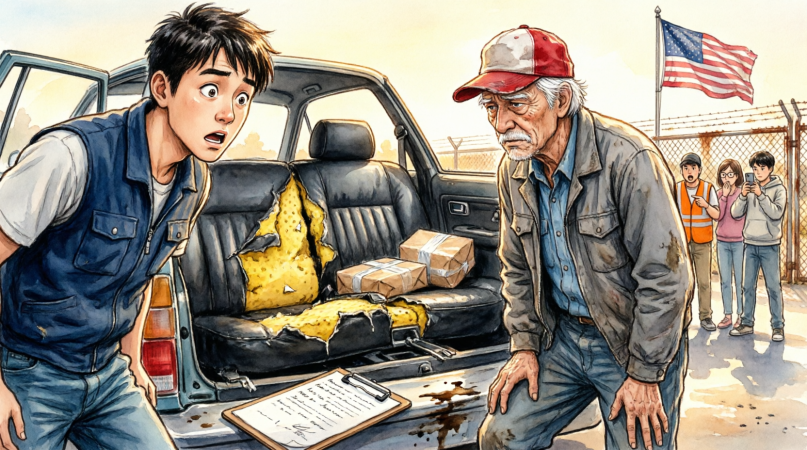
A folded piece of plastic came free from the yellow padding, slick with dust and pressed flat by years of weight.
Inside was a ring.
Michael held it in his palm under the bright yard light coming through the open bay door.
A blue stone.
A high school crest.
Class of 1999.
The engraved initials inside were still readable.
E. Harris.
For several seconds, Michael heard nothing but the distant clank of another worker dropping a chain and the small American flag snapping on the fence outside the office.
Then the name moved through him like cold water.
Emily Harris.
Everybody in town remembered Emily.
She had been seventeen, a senior, one of those girls people described with the same three words because they had never bothered to know more: sweet, quiet, pretty.
She had disappeared on the way to prom in 1999.
Her dress had been left hanging on the back of her bedroom door.
Her mother had thought she was getting ready at a friend’s house.
Her brother Daniel had been at the garage with their father, changing brake pads and pretending he was not annoyed that Emily had borrowed his favorite cassette from the truck.
By midnight, annoyance had become worry.
By morning, worry had become panic.
By the end of that week, the whole town had learned the shape of the Harris family’s pain.
Flyers on diner windows.
Search parties along road shoulders.
Police reports.
Television crews that came for three days and then left.
Rumors that stayed longer than the cameras.
Maybe she ran away.
Maybe there was a boyfriend.
Maybe she was scared.
Maybe the family knew more than they said.
Daniel hated the word maybe.
It let people sound thoughtful while they abandoned the truth.
Michael knew Daniel only casually.
Everybody who owned an old car eventually knew someone at the Harris garage.
Daniel had been nineteen when Emily vanished.
He was twenty-five now, with the same hard eyes his father had developed after the search turned into a memorial.
Michael put the ring in the cleanest plastic bag he could find.
Then he found Daniel’s number through a cousin who still took his pickup to the Harris shop.
Daniel answered on the fourth ring.
“Harris Auto.”
Michael looked at the ring through the plastic.
“My name is Michael Turner. I work at the junkyard off the county road.”
There was a pause.
“Okay.”
“I found something that belonged to your sister.”
The silence on the line changed.
It became the kind of silence a room makes after glass breaks.
“What did you say?” Daniel asked.
Michael swallowed.
“I found Emily’s class ring. It was inside a car that came in last week.”
Daniel closed the shop within minutes.
He left a handwritten note taped to the office door and drove with both windows down because the air inside the truck felt too small.
He had spent six years learning how to keep moving with unanswered questions inside him.
Work helped.
Routine helped.
His father needed him.
His mother needed someone to replace porch bulbs, fix the kitchen sink, and pretend the house was not still waiting for a girl who would never walk in wearing heels and complaining about hairspray.
Two years earlier, Emily had been officially declared dead.
Daniel had stood in a county office hallway with his mother while she signed the papers.
He remembered the pen shaking in her hand.
He remembered wanting to tear the document in half.
A document can close a file.
It cannot close a bedroom door in a mother’s mind.
At 4:36 PM, Daniel pulled into the junkyard.
The gravel popped under his tires.
Rows of stripped cars sat in the sun like old bones.
Michael stood beside the Cavalier, holding the plastic bag with both hands.
Daniel did not reach for it right away.
He just stared.
The ring was smaller than memory should have allowed.
Emily had saved money for it from babysitting and weekend shifts at a small diner near the school.
She had worn it around the house for three days after it arrived, holding her hand under every lamp so the blue stone would catch the light.
Daniel had teased her for it.
“Looks like you’re trying to blind somebody.”
Emily had stuck her tongue out at him.
“It’s senior year. Let me be dramatic.”
That was the last version of her Daniel tried hardest to protect.
Not the missing girl on flyers.
Not the case number.
His sister at the kitchen table, laughing with a ring on her finger and nail polish chipped from opening soda cans at work.
“Are you sure it’s hers?” Daniel asked.
Michael nodded.
“My daughter was in her class. I remember those rings. Same blue stone. Same crest.”
Daniel turned the plastic bag over and saw the engraving.
E. Harris.
His face tightened, but he did not cry.
Not there.
Not in front of a car that had kept his sister’s name hidden for six years.
“Where did it come from?”
Michael glanced toward the office.
“David Miller brought it in.”
Daniel looked up.
“Principal Miller?”
“He said it had been stored on his property for years. Said he wanted it gone.”
The old world shifted under Daniel’s feet.
David Miller had been the principal of Emily’s high school.
He had made announcements over the intercom during the search.
He had stood beside grieving parents at the gym when volunteers gathered with flashlights, maps, and coffee.
He had told reporters that Emily was a bright student and that the school community was heartbroken.
Daniel remembered him touching his father’s shoulder.
He remembered the pressed shirt, the careful voice, the way adults trusted him because he looked like someone who knew procedures.
Trust is easiest to steal when a person wears the uniform of responsibility.
Sometimes the uniform is a badge.
Sometimes it is a tie.
Sometimes it is just a calm voice in a room full of panic.
“Did he say why he kept it?” Daniel asked.
“No.”
“Did he say why now?”
“No.”
Daniel stepped around the car and looked inside.
The driver’s seat had been loosened, the cushion peeled open where Michael had cut into it.
The metal floor beneath was stained in uneven patches.
Old.
Brown-black.
Not enough to prove anything by itself, but enough to make Daniel’s skin go tight.
The steering wheel looked wrong too.
The whole interior was aged, dusty, cracked from heat and time, but the wheel had a dull pale look where the vinyl had been stripped by harsh cleaner.
Daniel had worked on enough cars to know what normal wear looked like.
This did not look normal.
He pulled out his phone.
“What are you doing?” Michael asked.
“Documenting it.”
Daniel photographed the ring in the bag.
He photographed the torn foam.
He photographed the VIN plate through the windshield.
He photographed the floor stains from three angles.
He photographed the steering wheel.
He photographed the receipt clipped to Michael’s board inside the office.
Pickup date.
Vehicle description.
Cash paid.
David Miller’s signature.
At 4:52 PM, Daniel called the county sheriff’s office.
“I need to report evidence in a missing person case,” he said.
The dispatcher asked which case.
Daniel closed his eyes.
“Emily Harris. Missing since prom night, 1999.”
The line went quiet for half a beat.
Then the dispatcher’s voice became careful.
“Where are you now?”
Daniel gave the address.
Michael stood beside him, shifting his weight like a man who had opened a door and realized the floor behind it was gone.
“Don’t touch anything else,” the dispatcher said.
Daniel almost laughed because he was already staring at something else.
Beneath the place where the ring had been hidden, deeper in the torn foam, a second plastic-wrapped corner had appeared.
Small.
Flat.
Wedged into a slit that had not happened by accident.
Daniel reached for it without thinking.
Michael grabbed his wrist.
“Don’t touch that yet.”
The words snapped Daniel back into himself.
He pulled his hand away.
They waited beside the car while the sun lowered over the fence and made every windshield in the yard flare gold.
Michael brought out gloves but did not use them.
He brought out paper bags but left them folded on the hood.
Daniel stood with his arms crossed, hands tucked under his elbows so he would not do something stupid.
Seven minutes later, a sheriff’s cruiser turned off the county road.
No siren now.
Just lights flashing silently across rows of broken cars.
Deputy Karen Wells stepped out first.
She was not the same deputy from 1999, but she knew the case.
Everyone did.
Behind her came an older investigator named Paul Reeves, who had been young when Emily disappeared and had never liked the runaway theory.
Daniel saw that in his face before the man said a word.
Some people arrive curious.
Some arrive already bracing for the truth.
Reeves put on gloves.
He asked Michael to explain exactly how he found the ring.
He asked Daniel when he arrived.
He asked who had touched what.
Michael answered slowly, carefully, looking at the Cavalier like it had become a living witness.
Then Reeves leaned into the car and examined the torn foam.
He did not pull the second item out right away.
He photographed it first.
Then he used tweezers and lifted the plastic from the seat cushion.
Inside was a folded piece of paper, brittle from age but protected from moisture.
A photograph was tucked inside it.
Not a clear photograph.
Not enough to show a full scene.
But enough.
Emily stood beside the blue Cavalier in her prom dress, one hand raised near her face as if telling whoever held the camera to stop.
The timestamp printed along the bottom read 05/14/1999, 7:43 PM.
Daniel made a sound he did not recognize.
The paper inside the plastic was a school office hall pass.
Emily Harris.
Senior prom night.
Authorized early release.
The signature at the bottom was David Miller’s.
For a moment, nobody spoke.
A chain swung somewhere in the yard.
The flag on the fence cracked once in the wind.
Deputy Wells lowered her camera.
Reeves looked at Daniel.
“We’re going to secure the vehicle,” he said.
Daniel nodded, but his eyes were fixed on the signature.
He had spent six years chasing shadows, rumors, and dead ends.
Now the truth had handwriting.
That evening, the Cavalier was towed out of the junkyard as evidence.
Daniel followed at a distance until the cruiser lights disappeared near the sheriff’s lot.
Then he drove home.
His mother was on the porch when he arrived.
She always came outside when she heard his truck, a habit left over from years of waiting for cars that never brought Emily home.
Daniel did not know how to tell her gently.
There was no gentle shape for a thing like this.
He held out the photograph copy Deputy Wells had allowed him to see but not keep.
His mother looked at it for a long time.
Then she sat down on the porch step as if her legs had forgotten their job.
“She was wearing the blue dress,” she whispered.
Daniel sat beside her.
The porch light came on above them.
For six years, that light had meant waiting.
That night, for the first time, it meant someone had finally found the beginning of an answer.
The next morning, investigators served a warrant on David Miller’s property.
The ranch storage shed was photographed, cataloged, and sealed.
Old records were removed in boxes.
A cabinet in the back office held files from the 1999 school year, including sign-out sheets, prom volunteer lists, and a folder labeled SENIOR EVENT TRANSPORTATION.
Daniel was not allowed inside.
He waited by the road with his father, both of them leaning against the truck in the kind of silence men use when words would break them.
By noon, the news had spread.
Not through television first.
Through phone calls.
Through neighbors standing beside mailboxes.
Through old classmates texting each other the same stunned sentence.
They found Emily’s ring.
David Miller was questioned that afternoon.
At first, he denied knowing how the ring got into the car.
Then he said he had bought the Cavalier years after Emily disappeared.
Then investigators showed him the storage records.
Then they showed him his own signature on the tow receipt.
Then they showed him the hall pass.
The story changed again.
Lies often do not collapse all at once.
They sag at the corners first.
Then the roof comes down.
David admitted Emily had come to the school office that evening upset about a phone call.
He claimed he offered her a ride.
He claimed she got out near town.
He claimed he never saw her again.
But the Cavalier told a different story.
The stains on the floor were tested.
The steering wheel showed chemical residue consistent with heavy cleaning.
Fibers from Emily’s prom dress were found caught under the seat rail.
None of it brought Emily back.
But it brought the truth close enough to touch.
Weeks later, divers searched a pond on the edge of Miller’s property after a former grounds worker remembered seeing fresh tire tracks there the weekend after prom.
The search did not unfold like a movie.
There was no dramatic speech.
No sudden confession in the rain.
Just people doing slow, grim work while the Harris family waited behind a line of yellow tape.
When the remains were found, Daniel’s mother did not scream.
She closed her eyes.
Daniel’s father took off his cap.
Daniel stood very still because if he moved, he thought the world might come apart.
Emily came home in the only way left.
The case went to court the following year.
The courtroom was plain, bright, and too small for the number of people who wanted to sit inside it.
Former classmates filled two rows.
Teachers sat together but did not talk.
Michael Turner sat near the back in his cleanest shirt, hands folded so tightly his knuckles whitened.
He did not see himself as important.
Daniel did.
Without Michael stopping at the ring instead of tossing it into a parts bin, Emily might have stayed hidden inside a car meant to be crushed into scrap.
Prosecutors laid out the timeline.
7:12 PM, Emily left home.
7:43 PM, the photograph placed her beside the Cavalier.
The hall pass carried David Miller’s signature.
The storage records placed the car on his property for years.
The tow receipt showed he had ordered the driver’s seat scrapped first.
The forensic report linked the interior to Emily.
Piece by piece, the story people had avoided became the only story left.
Daniel testified about the ring.
His voice shook only once.
It happened when the prosecutor asked what the ring meant to Emily.
Daniel looked down at his hands.
“She was proud of it,” he said. “She saved for it herself. She wore it around the house like it was made of diamonds.”
A few people in the gallery cried then.
Emily’s mother did not.
She watched David Miller the entire time.
When the verdict came, it did not feel like victory.
Guilty was not a word big enough to hold six years of birthdays, holidays, empty chairs, and a prom dress that had stayed in a closet until the fabric yellowed.
But it was a word the family had been denied for too long.
Outside the courthouse, reporters asked Daniel what he wanted people to remember.
He could have talked about the investigation.
He could have talked about David Miller.
He could have talked about the car.
Instead, he said, “My sister did not run away.”
Then he stopped.
His mother reached for his hand.
Daniel looked at the cameras again.
“She was seventeen. She was going to prom. She deserved to come home.”
That sentence moved through town faster than any rumor ever had.
At Harris Auto, Daniel framed a small copy of Emily’s senior photo and placed it near the register.
Not as a shrine for strangers.
As a correction.
People had spent years turning Emily into a question.
Her family wanted her remembered as a person.
A girl who liked blue nail polish.
A girl who saved for a class ring.
A girl who rolled her eyes at her brother and stole his music.
A girl who never got to wear the dress waiting on her bedroom door.
Michael kept working at the junkyard.
He still found loose change, receipts, toys, and the small forgotten evidence of ordinary lives.
But after the Cavalier, he never tore into a seat without thinking about what people try to bury in plain sight.
Sometimes the truth is not hidden in a locked room.
Sometimes it is wrapped in plastic, pushed into foam, and left beneath a person’s weight for years.
Daniel visited the junkyard once after the trial.
He brought Michael a paper coffee cup and stood with him by the fence where the small American flag moved in the wind.
For a while, neither man said much.
Then Daniel said, “You could’ve thrown it away.”
Michael shook his head.
“No,” he said. “Not that.”
Daniel looked out over the rows of dead cars.
The blue Cavalier was gone now, locked away as evidence, but he could still see it when he closed his eyes.
The torn seat.
The ring.
The second plastic corner.
The moment one man’s ordinary work reopened a truth a whole town had buried under maybe.
Six years of rumors had been built on soft words.
Maybe she got scared.
Maybe she left with someone.
Maybe she wanted a new life.
In the end, it was not maybe.
It was evidence.
And because someone finally stopped long enough to see it, Emily Harris came home.