The humidity of the Virginia summer hung heavy over the house, a thick, invisible shroud that seemed to muffle the sounds of the cicadas screaming in the oaks outside. Inside, the air conditioning hummed a low, mechanical lullaby, but it couldn’t touch the chill that had begun to settle in the marrow of my bones.
I tucked Emily in at 8:30 p.m., just as I had done every night for three years since we moved into this colonial-style house on the edge of the woods. The room was an overpriced sanctuary of West Elm furniture and organic cotton.
On the surface, it was a catalog-perfect portrait of suburban security: the amber glow of a nightlight casting long, soft shadows; the rows of porcelain dolls and plush bears standing like silent sentinels on the bookshelves; the heavy, mahogany bed frame that had been an heirloom from Daniel’s side of the family.
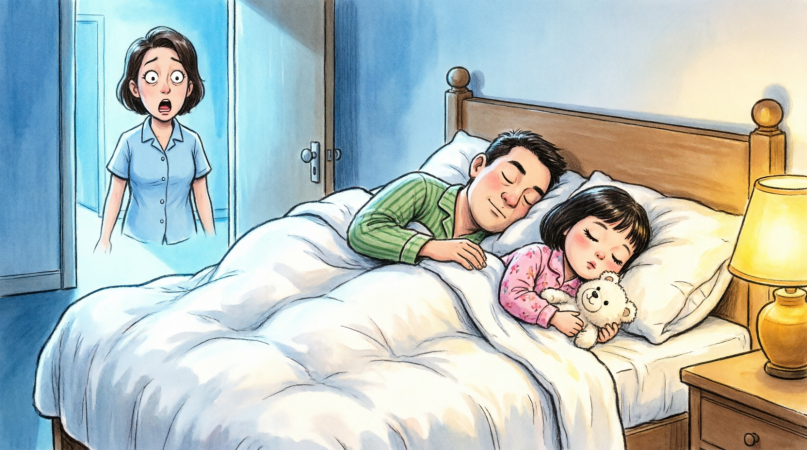
“Mommy?” Emily’s voice was small, drifting up from the center of the vast mattress. She looked tiny in the middle of all that expensive fabric, a speck of white nightgown against a sea of navy blue linens.
“Yes, baby?” I smoothed a stray hair from her forehead. Her skin felt cool, but her eyes were wide, tracking something in the corner of the ceiling where the molding met the shadows.
“It’s getting tight again,” she whispered. She pulled her knees up to her chest, curling into a ball. “I don’t have enough room to breathe.”
I forced a practiced, maternal smile, the kind of smile that hides a fluttering heart. “Sweetheart, this bed is a Queen. You could fit four of you in here. It’s just the blankets, okay? They’re heavy because of the AC.”
She didn’t argue. She never argued. She just nodded, her gaze sliding past me to the empty space on the left side of the mattress. “Okay. But tell them to move. Tell them it’s my turn to sleep in the middle.”
The air in the room seemed to vanish. I stood up, my joints feeling stiff, like rusted hinges. “There’s no one here but us, Em. Just dreams.”
I kissed her forehead—a lingering, desperate press of lips—and retreated. I walked down the hallway, my footsteps silent on the plush carpet, and entered the master bedroom where Daniel was already passed out, his mouth open, his surgical scrubs discarded in a heap on the floor. He lived in a world of biology and trauma, of blood and sutures. To him, the world was a machine that sometimes broke. To him, Emily’s “tight bed” was just a developmental phase, a byproduct of an overactive imagination inherited from a mother who read too many Gothic thrillers.
I lay down beside him, staring at the ceiling. The silence of the house felt predatory.
The “tightness” had started a month ago. At first, it was cute—the quirky logic of an eight-year-old. Then it became anatomical. “My ribs hurt, Mom, like someone is leaning on me.” “I woke up on the floor because there wasn’t any space left.”
Three days ago, I had found a bruise on her upper arm. Not a scrape from the playground, but five distinct, fading yellowish marks. A grip.
Daniel said she’d probably rolled onto a toy. I didn’t tell him that I had cleared every toy from her bed weeks ago.
I reached for my phone on the nightstand. The screen’s glare was a violent intrusion in the dark room. I opened the app for the Nest cam I’d installed secretly two days prior. I hadn’t told Daniel. He would have called it “anxiety-driven parenting.” He would have suggested I go back to therapy.
The feed flickered to life. A grain, night-vision green view of Emily’s room.
She was a pale smudge in the center of the bed. Motionless. Safe.
I exhaled, a ragged sound that caught in my throat. See? I told myself. Empty. Just a girl and her dreams. I set the phone down and drifted into a fitful, shallow sleep.
I woke at 2:14 a.m. to the sound of the house settling—a sharp crack of wood expanding in the heat, or perhaps a door latching. My mouth was dry, tasting of copper and sleep. I sat up, the sheets clinging to my damp skin.
Beside me, Daniel didn’t stir. He was deep in the REM cycle of the exhausted.
I didn’t go for water. I went for the phone.
The screen illuminated my face, casting me in a ghostly light. I tapped the notification. Movement detected in Emily’s Room: 2:02 a.m.
My thumb trembled as I scrolled back the timeline.
2:00 a.m.: Emily is sleeping on her side, facing the door. The room is still. 2:01 a.m.: The duvet begins to depress.
I watched, my breath hitching, as the heavy fabric of the comforter on the empty side of the bed began to sink. It wasn’t a sudden movement. It was slow, deliberate, as if someone—something—was shifting their weight onto the mattress. The indentation was deep, the size of a grown man’s torso.
Then, the second indentation appeared. A knee.
I watched the screen, my eyes burning, refusing to blink. Emily didn’t wake up, but her body reacted. In her sleep, she winced. She began to slide, inch by inch, toward the edge of the bed. Her small frame was being squeezed, physically shoved aside by an invisible mass that was now occupying three-quarters of the Queen-sized mattress.
“Daniel,” I hissed, reaching out to grab his shoulder. “Daniel, wake up.”
He groaned, swatting my hand away. “Mm… not now, Sarah… shift starts at six…”
“Daniel, look at the monitor!”
I looked back at the screen. My heart stopped.
The invisible weight was no longer just sitting. The duvet was being pulled back. Not by a hand, but by a force that puckered the fabric. And then, Emily’s body was lifted.
Just a few inches. Her head was tilted back at an unnatural angle, as if an invisible arm had been slid beneath her neck. Her eyes remained closed, her face a mask of serene, terrifying unconsciousness. She was being cradled.
But it wasn’t the lifting that made me scream. It was what happened next.
As Emily was held in the air, the night-vision camera struggled to focus on the space beneath her. The pixels swirled, green and gray, fighting to render something that wasn’t supposed to be there. And then, for a fraction of a second, the distortion cleared.
Behind my daughter, emerging from the very shadows of the headboard, were hands.
They weren’t human. They were long, translucent, and tipped with nails that looked like shards of smoked glass. They were wrapped around her waist, pulling her tight—so tight her small ribs seemed to flex inward. And then, a face began to manifest in the static. It was a face I recognized from the charcoal sketches in the attic we’d never fully cleared out—the previous owner’s “art.” A face with no eyes, only deep, cavernous pits, and a mouth stitched shut with thick, black cord.
The “thing” wasn’t attacking her. It was cuddling her. It was a horrific, distorted mimicry of a mother’s love.
“Daniel!” I shrieked, throwing the phone at him.
I didn’t wait for him to wake. I bolted from the room, my bare feet slapping against the hardwood of the hallway. I didn’t turn on the lights. I didn’t need them. The image on the screen was burned into my retinas.
I burst into Emily’s room.
“Emily!”
The room was ice cold. The window was shut, the AC was humming, but the air felt like the inside of a meat locker.
I lunged for the bed and grabbed her, ripping her from the blankets. She felt heavy—unnaturally heavy—as if I were pulling her through chest-deep water. For a heartbeat, something resisted. I felt a tug on her ankles, a cold, wet pressure that didn’t want to let go.
I screamed—a primal, guttural sound—and hauled her into my arms.
Emily snapped awake, gasping, her eyes flying open. “Mommy? Mommy, you’re hurting me!”
“We’re leaving. We’re leaving right now.”
I turned to run, but I stopped dead at the threshold.
Daniel was standing in the doorway. But he wasn’t looking at us. He was looking at the bed.
“Sarah,” he whispered, his voice cracking. “The camera… you didn’t see the whole thing.”
I looked back over my shoulder.
The bed was empty now. The indentations were gone. But the heavy mahogany headboard—the heirloom—was bleeding. A dark, viscous liquid was seeping from the grains of the wood, smelling of old Earth and copper.
And then I saw the floor.
Around the perimeter of the bed, the carpet wasn’t just depressed. It was worn away. There were hundreds of footprints. Small, large, distorted. They circled the bed in a continuous, frantic loop, as if dozens of things had been pacing, waiting for their turn to lie down.
“It’s not just one,” Emily whispered into my neck, her voice devoid of fear, filled only with a haunting, hollow realization. “They’re all so cold, Mommy. They just wanted to be warm.”
We didn’t pack. We didn’t grab coats. We ran to the car in our pajamas, the tires screaming as Daniel backed out of the driveway. We drove until the sun came up, ending up in a diner three towns over, the fluorescent lights feeling like a sanctuary.
We never went back. We hired a service to empty the house and sell the furniture. I told them to burn the bed.
A month later, we were settled in a cramped, modern apartment in the city. Steel and glass. No heirlooms. No woods.
I was tucking Emily into her new twin-sized bed. It was small, practical, and pushed into the center of the room, far from the walls.
“Better?” I asked, smoothing the covers.
Emily looked at me. She looked older. The light in her eyes had changed; the childhood innocence had been replaced by a weary, ancient understanding.
“It’s better,” she said.
I kissed her, turned out the light, and walked to the door.
“Mommy?”
I froze, my hand on the light switch. “Yes?”
“The new bed is okay,” she said, her voice drifting through the darkness. “But you should check the closet. They say it’s too dark in there. They want to know if you can leave the door cracked… just a little.”
I didn’t turn around. I couldn’t. I just closed the door and locked it from the outside, standing in the hallway as the silence of the new home began to feel exactly like the old one.
The “tightness” wasn’t about the bed. It was about the space we occupy, and the things that are tired of waiting in the dark for their turn to live.
The air in the motel room smelled of stale cigarettes and industrial-strength bleach—a sterile, sharp scent that usually would have made me gag, but now felt like the only thing keeping me tethered to reality. We had been running for forty-eight hours. Daniel sat at the small, laminate table, his head buried in his hands, the glow of his laptop casting a sickly blue hue over his tired features.
He had gone back. Not to the house, but to the records.
“Sarah,” he said, his voice sandpaper-dry. “I found the provenance of the bed frame. The ‘heirloom’ your mother gave us.”
I stopped pacing the cramped space between the two double beds. Emily was asleep—or pretending to be—her breathing rhythmic and heavy, though her fingers were curled tightly into the scratchy wool of the motel’s top quilt.
“My mother said it was an antique from the Shenandoah Valley,” I whispered, sitting on the edge of the other bed. “She said it had been in the family for generations.”
“It was,” Daniel said, turning the screen toward me. “But not our family. She bought it at an estate auction in 1994. The ‘Blackwood Manor’ sale.”
He clicked through a digitized archive of a local newspaper from the late nineteenth century. The headlines were jagged, printed in that cramped, suffocating font of Victorian sensationalism: THE WEEPING HOUSE OF SHENANDOAH.
“The original owner was a man named Elias Thorne,” Daniel explained, his medical detachment finally crumbling into something resembling terror. “He was a cabinetmaker. He lost his wife and four children to scarlet fever in a single winter. The story goes that he couldn’t bear the emptiness of the house. He began to carve furniture—not for the living, but to ‘house the weight of what was lost.’”
I looked at the screen. There was a grainy photograph of a tall, gaunt man standing next to a bed frame that looked identical to the one we had left behind. The carvings on the headboard weren’t just decorative scrolls; they were stylized, distorted faces, their mouths pulled wide in silent wails.
“He believed wood was a vessel,” Daniel continued. “He used soil from their graves to polish the grain. He invited them back. He made a place for them to lie down. He spent the rest of his life sleeping in that bed, claiming he could feel the ‘crushing warmth’ of his family pressing against him.”
A cold sweat broke across my neck. I remembered the feeling of being unable to pull Emily away—the resistance, the tugging. It wasn’t just a haunting. It was a gravitational pull.
“Where is it now?” I asked. “The bed.”
“The removal service called an hour ago,” Daniel said, his face paling. “They couldn’t get it out of the house. They said the wood had… expanded. It fused with the floorboards. When they tried to saw through it, the blade snapped. They quit, Sarah. They left it there.”
I looked over at Emily. She had sat up. Her eyes weren’t on us; they were fixed on the shadows beneath the motel’s vanity.
“It doesn’t matter,” she said quietly. Her voice sounded older, weighted with a sorrow that didn’t belong to an eight-year-old. “The bed was just the door. Once the door is open, the house doesn’t matter anymore.”
“What do you mean, honey?” I reached for her, but she flinched away.
“They like the new apartment,” she whispered. “It’s tall. They like to look down at the people on the street. They say the people look like ants.”
The realization hit me like a physical blow. We hadn’t escaped. We had simply carried the “tightness” with us in the marrow of our bones, in the memories we couldn’t shed.
I stood up and walked to the motel window, peeling back the heavy, blackout curtains. Outside, the highway was a vein of orange light. But in the reflection of the glass, I didn’t just see my own panicked face.
I saw them.
They were standing in the corners of the motel room, thin as whispers, their translucent limbs intertwined like the roots of an old, suffocating vine. They weren’t looking at me. They were looking at the beds. They were waiting for us to lie down. They were waiting for the lights to go out so they could find their place in the middle.
“We can’t sleep,” I said, my voice breaking. “Daniel, we can never sleep again.”
Daniel didn’t answer. He was staring at the floor. Beneath his chair, the carpet was beginning to depress. A slow, heavy indentation, as if an invisible weight was settling at his feet, tired of waiting for the bed.
I looked back at Emily. She was smiling—a thin, jagged line of a smile that didn’t reach her eyes.
“Don’t worry, Mommy,” she said, her voice a perfect mimicry of my own. “There’s plenty of room. We’ll just have to squeeze.”
The drive back to the valley was a descent into a nightmare we had tried to outrun. We didn’t speak. The air in the car was thick, not with heat, but with a physical density that made every breath feel like pulling silt into our lungs. Daniel drove with white-knuckled intensity, his eyes bloodshot, staring at the winding mountain road as if the asphalt itself might betray us.
In the backseat, Emily sat perfectly still. She wasn’t playing with her tablet. She wasn’t looking at the passing trees. She was staring at the empty seat beside her, her head tilted at that same rhythmic, unsettling angle I had seen on the camera.
“We have to burn the source, Sarah,” Daniel had whispered back at the motel. “The records said Elias Thorne didn’t just build the furniture. He carved his own grief into the wood. If the bed is the door, we have to take the door off its hinges.”
The house looked different when we pulled into the driveway. It no longer looked like a colonial sanctuary; it looked like a mouth. The windows were dark, reflecting the gray, bruised sky of an oncoming storm. As we stepped onto the porch, the silence wasn’t empty—it was expectant.
The front door creaked open before I could turn the key.
The smell hit us instantly: damp earth, ancient dust, and the cloying, sweet scent of rotting lilies. We moved through the foyer, our flashlights cutting through the gloom. The removal service had left their tools scattered—heavy saws, crowbars, and a shattered sledgehammer lay on the floor as if they had been dropped in a panicked flight.
We reached the door to Emily’s room.
“Stay behind me,” Daniel muttered, gripping a canister of industrial accelerant he’d scavenged from the garage.
We stepped inside. The room was no longer a child’s bedroom. The wallpaper was peeling in long, wet strips, revealing the dark, pulsing wood of the house’s frame. In the center of the room, the bed had changed. It hadn’t just “expanded”—it had grown. The mahogany limbs of the bed frame had burrowed into the floorboards, thick wooden “roots” snaking across the carpet, fusing with the walls. The headboard had stretched upward, the carved faces now larger, their wooden eyes seemingly tracking our movement.
And it wasn’t empty.
A dozen translucent figures were draped across the mattress, overlapping, intertwined in a grotesque knot of limbs. They weren’t ghosts in the traditional sense; they were echoes of weight, gray and blurring at the edges, their forms vibrating with a low, humming sound that vibrated in my teeth.
“They’re waiting,” Emily whispered from the doorway. She walked past us, her footsteps light. “They say it’s too cold out here. They want to go back into the wood.”
“Emily, get back!” I reached for her, but my hand passed through her shoulder as if she were made of smoke. My heart plummeted. The “tightness” hadn’t just been physical—it was a colonialization of her soul.
Daniel didn’t hesitate. He doused the bed in the accelerant, the sharp smell of gasoline masking the scent of the lilies. He struck a match.
The flame didn’t flicker. It roared.
But the fire didn’t burn orange. It burned a deep, searing violet. As the heat rose, the figures on the bed didn’t vanish—they began to scream. Not a sound of pain, but a sound of release. The wood of the bed frame began to groan, the carvings of the faces twisting, their mouths opening wide as the violet fire consumed the grain.
“Look,” Daniel gasped, pointing at the wall.
The shadows cast by the fire weren’t our shadows. They were the shadows of a hundred people, standing in a circle around us, their hands linked. As the bed disintegrated into ash, the shadows began to shrink, pulled back into the burning wood like water down a drain.
The weight in the air snapped.
Suddenly, the room was just a room again. The fire died as quickly as it had started, leaving nothing but a charred, blackened crater in the center of the floor where the heirloom had once stood. The cold was gone. The smell was gone.
I turned to Emily. She was slumped on the floor, her eyes closed. I gathered her into my arms, bracing for that icy resistance, that terrifying weight.
She was light. She was just a little girl again.
“Mommy?” she murmured, rubbing her eyes. “I’m tired. Can we go home now?”
We left the house that night and never looked back. We let the bank take it, let the forest reclaim the lot. We moved to a city where the buildings were made of concrete and steel, materials that had no memory, no grain to hold the grief of the dead.
Years have passed. Emily is sixteen now. She’s bright, happy, and has no memory of the “tight bed” or the house in the valley. We never speak of it. We live in the light.
But sometimes, on the quietest nights, when the city noise dies down and the moon is a thin sliver in the sky, I wake up at 2:00 a.m.
I don’t check a camera. I don’t have to.
I lie in my own bed, next to Daniel, and I feel the mattress shift. It’s a tiny movement, the size of a hand pressing down on the edge of the covers. Then comes the familiar, heavy indentation against my side.
I don’t scream anymore. I don’t fight it. I just move over, closer to Daniel, leaving a sliver of space on the edge. Because I know now that some doors, once opened, can never be fully closed. They don’t want to hurt us. They’re just cold.
And the world is so very, very big, and so very, very empty.
The city never truly sleeps, but it hums with a different kind of silence. At twenty-four, Emily lived in a studio apartment on the forty-second floor, a glass box suspended in the sky. There was no mahogany here. No heirlooms. No wood that had tasted the soil of a graveyard. Her furniture was industrial—steel, glass, and pressurized laminate.
She believed she had forgotten. The memories of the Virginia house were like old photographs left in the sun: faded, bleached of their terror, reduced to a vague blur of “childhood nightmares.”
But the body remembers what the mind chooses to discard.
It began with the cold. Not the chill of a drafty window, but a localized, piercing frost that settled only on the left side of her neck. She would wake up in the blue light of 3:00 a.m., her heart hammering a frantic rhythm against her ribs, her lungs feeling as though they were filled with wet sand.
The “tightness” had returned, but it had evolved. It was no longer a physical shove; it was an atmospheric pressure, a gravity that pulled at the edges of her vision.
She sat up in her minimalist bed, the city lights below looking like a circuit board of amber and white. She reached for her phone, her thumb hovering over the camera app she had installed—not out of necessity, she told herself, but out of habit. A lingering tic inherited from a mother who had always been too protective, too anxious.
She tapped the feed.
The night-vision flared. The room was empty. The steel frame of her bed was a sharp, clean line in the dark.
Then she saw the shadow.
It wasn’t standing in the corner. It wasn’t under the bed. It was under her skin.
On the screen, Emily’s own reflection in the darkened window of the apartment showed a second set of ribs overlapping her own. A second pair of hands, translucent and etched with the grain of ancient mahogany, were wrapped around her throat in a permanent, loving chokehold.
She wasn’t being haunted by a house. She was the vessel.
The fire in the valley had destroyed the door, but it hadn’t destroyed the guests. They had simply moved into the only home they had left.
Emily looked at her hands. In the dim light, she could see the faint, yellowish marks of a grip—the same marks her mother had found sixteen years ago. They weren’t fading this time. They were darkening, turning the color of old, polished wood.
“It’s okay,” she whispered, her voice sounding like the creak of a floorboard.
She lay back down. She didn’t fight for the middle of the mattress. She moved to the very edge, her body hanging precariously over the side, leaving the vast, empty space behind her for the things that had traveled through time and fire just to be near her.
The weight settled in. The mattress depressed with a sigh.
For the first time in years, Emily wasn’t afraid. She felt a strange, hollow peace. She closed her eyes and let the “tightness” pull her under, drifting into a sleep that felt like sinking into deep, dark water.
In the morning, the apartment was empty. The bed was made. The glass was clean.
But on the nightstand, carved into the indestructible laminate of the table, was a single word, etched in a script that looked like roots:
THORNE.
The legacy wasn’t a place. It was a debt. And as the sun rose over the steel city, the shadows didn’t retreat. They just waited for the next time the lights went out.