When I arrived, I was confused.
The number 42 was still painted in blue tiles by the door, but the house bore no resemblance to the hazy memory I had of the funeral. The facade was freshly painted white, the flowerpots were overflowing with bougainvillea, and a fairly new gray pickup truck sat in the garage. It wasn’t the image of a sick widow surviving on a meager pension and the $300 I sent her each month. It was the home of someone who, at least, lived far more comfortably than I had imagined.
I turned off the engine, kept my hands on the steering wheel, and felt that icy tingling sensation rise up the back of my neck.
Maybe she had inherited it. Maybe a relative was helping her. Maybe I was jumping to stupid conclusions.
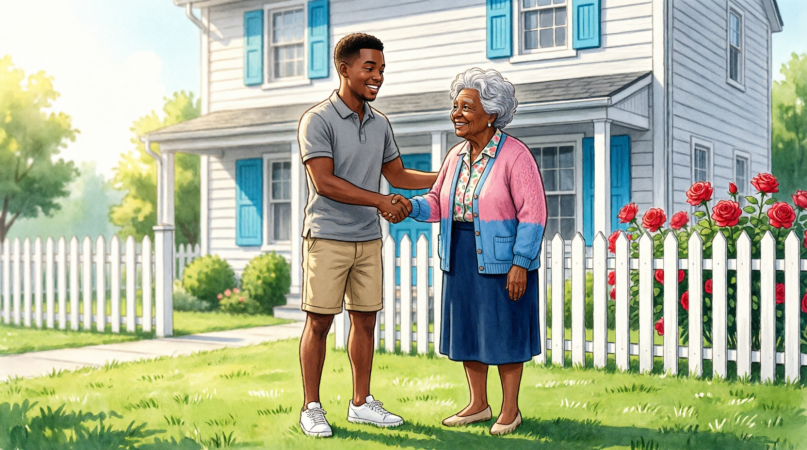
I picked up the box of chocolates and walked to the door. I knocked twice.
Doña Clara didn’t open the door.
The woman who appeared was in her mid-forties, thin, wearing a flowered apron, and had an expression of surprise that soon turned into caution.
“Good afternoon,” I said. “I’m looking for Doña Clara. Does she still live here?”
The woman frowned.
—Mrs. Clara? No, young man. She sold this house almost four years ago.
I felt something tearing away inside me.
—That… that can’t be. There must be a mistake. I… I’m a relative.
The woman looked at the box I was carrying, then at my face, and lowered her voice a little.
—Well, I don’t know what to tell you. The lady did live here, but she left. She said she was moving north with her daughter.
I didn’t understand the words at first. I heard them, but I didn’t understand them.
“With your daughter?” I repeated, and my own voice sounded detached, hollow.
—Yes. With Marina, I think her name was.
The box of chocolates slipped from my hands and fell to the floor. A can rolled across the entryway with a thud. The woman took a step back, startled.
I couldn’t move.
I don’t know how long I stood there, motionless, watching the reflection of the sunset in the window of a house that no longer belonged to my wife’s mother. Then I snapped out of it.
“No,” I murmured. “No, that’s not possible. Marina died. I buried her.”
The woman looked at me the way you look at someone who has just broken down in front of you.
“Look, young man, I don’t know anything about that. I only know what people said when we bought the house. That the lady left very happy because her daughter had finally taken her with her. She even came for some boxes months later. The two of them together.”
The world bowed.
I instinctively bent down to pick up what I had dropped, but my hands were shaking so badly I couldn’t hold anything. The woman helped me pick up the cans and put them in the box, without saying a word. Then, as if compassion overcame her fear, she added:
—Don Esteban works at the corner store. He knew Doña Clara well. Maybe he can tell you where they went.
I thanked him, not knowing if he’d actually spoken. I walked to the store like a sleepwalker.
Don Esteban was an old man, with sun-weathered skin and pale eyes that seemed to have seen too much. As soon as I told him my name, his expression changed. It wasn’t surprise. It was discomfort.
And that confirmed to me that I wasn’t crazy.
“I need to know where Doña Clara is,” I said, bracing myself with both hands on the counter to keep from falling. “And I need you to tell me the truth.”
The old man was silent for a few seconds. Then he closed his ledger, took off his glasses, and sighed.
—I told Clara that sooner or later it was going to come out.
I felt a wild pressure in my chest.
-What thing?
—That he shouldn’t keep accepting that money.
—Where is Marina?
He looked up.
—Viva.
The word entered me like a knife wound.
I leaned back. I felt nauseous. I honestly thought I was going to throw up right there, among sacks of rice and bottles of oil. Don Esteban came from behind the counter and offered me a chair, but I didn’t want it. I needed to be standing. I needed the pain to pierce me without anesthesia.
“Don’t lie to me,” I said, even though I already knew he wasn’t lying.
—I wish I could, boy.
—I saw the coffin.
-Closed.
—There was a police report.
-Arranged.
I was frozen.
Don Esteban spoke slowly, like someone untangling an old knot.
Marina hadn’t died in an accident. She’d run off with another man. A married man who worked for a shipping company and who convinced her to start over far, far away. According to him, if she disappeared the normal way, you would look for her, you would find her, you would fight. But if the whole town believed she was dead, no one would ask questions. Doña Clara objected at first; she cried, she shouted, she said it was madness. But Marina made her choose: either she helped her, or she would never see her again.
“So you set all this up?” I asked, my voice breaking.
“There was a crash, yes. A woman died who had no close relatives. Marina found someone at the city morgue… someone willing to close the coffin and not ask questions. The policeman was a distant cousin of the man she ran off with. Here in town, people heard ‘unrecognizable body’ and didn’t want to know anything more.”
Everything around me seemed grotesquely sharp: the flies next to the sweet bread, the buzzing of the refrigerator, the clock showing six thirteen.
“And the messages?” I asked. “The calls? The thank you notes?”
—At first, Doña Clara did need the money. Then she didn’t anymore. But Marina told her to keep receiving it. “It’s the least she can do,” she said. “After all, I gave her the best years of my life.”
I laughed.
Not because it was funny. I laughed because if I didn’t, I was going to break down right there.
The best years of his life.
I remembered our dinners in the kitchen, the house loan, the time I worked double shifts to pay for her specialty training, the nights I hugged her when she said she was afraid of the future. I remembered how I held her when her father died. I remembered the ring I still kept in my nightstand drawer.
The best years of his life.
“Where is he?” I repeated.
Don Esteban hesitated. Then he wrote an address on a piece of paper. A border city. A subdivision in the north. The name of a street.
“Don’t go in with just courage,” he told me. “Because courage blinds more than pain.”
I didn’t answer. I took the paper and left.
I drove all night. I didn’t cry. I didn’t think. It was something worse: I was empty.
I arrived at the address mid-morning. A two-story house, electric gate, small garden. I knocked. A teenager of about fifteen or sixteen opened the door, with dark hair and eyes that paralyzed me. They were Marina’s eyes.
“Yes?” he asked.
Before I could answer, I heard a voice from inside.
—Who is it, Sofi?
That voice.
Five years, three months and two days dreaming of that voice.
Marina appeared in the hallway with a mug in her hand. When she saw me, the mug fell and shattered.
Neither of them spoke for several seconds.
She was thinner. She had some lines by her mouth that she hadn’t had before. But it was her. Absolutely her. Alive. Warm. Breathing.
“Roberto…” she whispered.
I didn’t yell. I didn’t insult her. I didn’t do any of the things I imagined doing on the way there.
I just said:
—Give me back my due.
Her face fell.
The teenager stared at us, completely bewildered. From the back of the room emerged a robust, gray-haired man, his expression turning from annoyance to alarm.
“What’s going on?” he asked.
“None of your business,” I said without even looking at him. “I’m talking to my wife.”
Marina closed her eyes for a moment. Then she took the girl by the shoulder.
—Sofi, go into your room, please.
-Mother…
-Now.
The girl obeyed, although before leaving she looked at me again, confused.
Mother.
I clenched my jaw until it hurt.
“So that’s why,” I said. “You didn’t die. You ran away.”
Marina began to cry, but her tears no longer had power over me.
She told me a miserable story about feeling trapped, about falling in love, about being pregnant when she planned to disappear. She said she was afraid I wouldn’t let her go. That she thought I would eventually move on with my life. That she never imagined I would keep sending money for so many years.
“Don’t do that to me,” I told him. “Don’t make your cruelty into an accident.”
Then Doña Clara appeared at the end of the corridor, leaning on a cane. More hunched over, older, but perfectly recognizable. When she saw me, she put a hand to her mouth.
—Forgive me, son —he said.
That word pierced me more than all the lies.
—Don’t call me son.
The three of us stayed in an immaculate room, decorated with family photos where I didn’t exist. Of course, Marina’s dead body wasn’t on any of the walls. Marina had continued living, laughing, celebrating birthdays, carrying her daughter, building a story on top of my emotional grave.
I took the bank slip out of my pocket and placed it on the table.
—That’s it. They’re not going to receive another penny.
Marina nodded slowly, as if that were the important consequence.
Then I took out another envelope. I had printed it at an internet cafe before arriving. Copies of transfers, dates, amounts, records.
—And I’m not going to stay silent either. What they did has a name. Fraud. Forgery. Corruption. I don’t know how many were involved, but I’m going to find out.
Doña Clara started pleading. Marina did too. The man in the back muttered something about settling things between adults. They disgusted me.
I didn’t want revenge. I wanted the truth. And for the first time in five years, I understood that the truth wasn’t going to bring back what I lost, but it could stop them from continuing to live off the lie that buried me.
I headed for the door. Marina ran after me.
—Roberto, please… at least listen to me one last time.
I stopped, without turning around.
—I’ve listened to you for five years —I said—. In silence.
I opened the door. The morning sun hit my face.
—I mourned you like one mourns the dead, Marina. But today I understood something. The one who died five years ago wasn’t you. It was me. And the man who came out of that grave no longer belongs to you.
I walked to my car with trembling but firm legs.
That same afternoon I went to a police station. Then I called my bank. Then a lawyer. Then, for the first time in a very long time, I called Jorge, and when he asked if I was okay, I told him the truth:
—No. But I’m finally awake.
That night I slept in a cheap hotel, without tears, without sacred memories, without promises. Marina was no longer the love of my life. She was a living woman who chose to make me a widower so she could flee without guilt.
And that, strangely enough, gave me something back.
No to her. No to the past. No to the lost years.
He brought me back.
The next morning, standing before the opaque bathroom mirror, I saw myself gray-haired, tired, broken. But I also saw something else: a man who could finally stop talking to a grave.
I picked up my phone. I opened the bank’s app. I canceled the automatic transfer.
Then I went outside, took a deep breath, and for the first time in five years, the air didn’t smell like a cemetery.