Came Home To A Frozen Ranch. Stepmother Not Seen. I Found My Grandfather On The Floor, Starving And Freezing. She Had Thrown Away His Heart Medication To Kill Him. She Thought I Was Dead In Afghanistan. I Sat In The Dark With My Service Pistol, Waiting For Her To Return. But She Made One Mistake. When She Finally Walked In…
Part 1
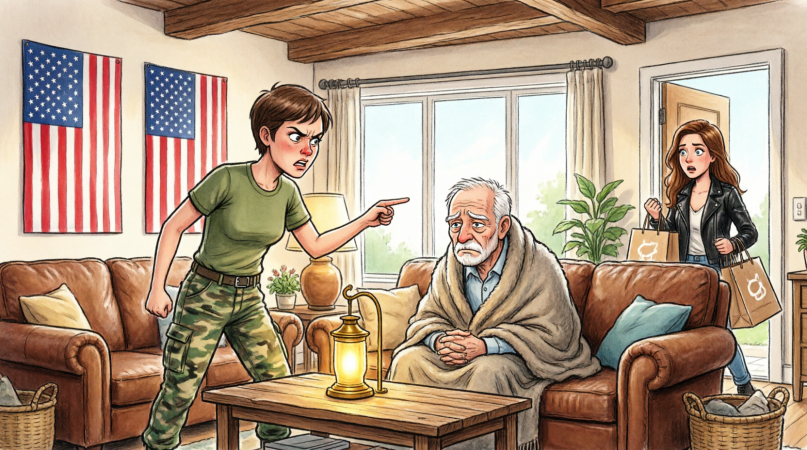
The gravel driveway to my grandfather’s farmhouse was a single lane of dirty ice by the time I arrived. My tires crunched like I was stepping on old glass. Snow had piled up against the fence posts in lopsided drifts, and the porch light flickered in a way that made the house look like it was blinking—tired, annoyed, alive.
I killed the engine and sat there for one second with my hands still on the steering wheel, listening. No TV through the walls. No radio. No dog bark. Just wind shoving at bare branches and the faint ping of cooling metal under my hood.
My phone showed one bar. A voicemail from Mrs. Rourke—the neighbor—still sat at the top of my screen like a bruise.
Hannah, it’s Arthur. I’m worried. Your dad’s wife hasn’t been around and… I saw him through the kitchen window. He didn’t wave back. Call me.
My grandfather’s name was Eli Mercer, not Arthur, and he’d never missed a chance to correct people. That meant Mrs. Rourke had been scared enough to get it wrong.
I shoved my hands into my coat pockets and climbed out. The air slapped my cheeks, wet-cold, the kind that crawls into your sleeves. The porch steps were slick. I grabbed the railing and felt the paint flake under my glove.
The front door was closed but not fully latched. That should have been my first warning.
Inside smelled like old heat that had died hours ago—dust, cold wood, and a sour note underneath like damp laundry left too long in a washer. The entryway light was off. My boots tracked snow onto the runner rug that used to be braided and cheerful and now looked flattened and gray.
“Grandpa?” I called.
My voice sounded too loud in the silence.
I stepped forward, and my foot slid slightly. Something wet. Not water—thicker. My stomach clenched.
The kitchen was to the left. The living room straight ahead. I moved toward the kitchen because I could see the fridge door cracked open, a thin strip of light like a warning sign.
And then I saw him.
Eli Mercer was on the linoleum near the sink, half on his side, one arm pinned awkwardly under him. His bare feet were exposed, skin pale and a little bluish at the toes. His flannel shirt was unbuttoned at the bottom like he’d been fumbling with it, and there was a dark smear on the floor near his temple where he must’ve hit the cabinet.
His eyes were open.
Not focused. Not tracking. But open.
My body went into that strange calm I always hated and always depended on, the kind that shuts off panic and turns your thoughts into bullet points.
Warmth. Airway. Bleeding. Call.
I dropped my bag by the door and knelt beside him, careful not to slip again. “Grandpa, it’s Hannah,” I said, close to his ear. “I’m here.”
His mouth moved, but no sound came out at first. Then a rasp, like dry leaves. “Han…?”
“Yep,” I said. I slid my fingers to the side of his neck. His pulse was there, but weak and fast, like a frightened bird. His skin felt wrong—cold, but not just cold. Cold like something that had been left out.
His breath smelled faintly sweet, which made my throat tighten. He was diabetic. Sweet breath could mean his sugar was high, or worse, that his body was starving itself.
I looked around for the thermostat. The little digital box on the wall blinked 52.
Fifty-two degrees inside.
On purpose. No furnace “accident” does that neatly.
“Okay,” I whispered, more to myself. “Okay. We’re going to get you up.”
I reached for my phone, but my screen flashed NO SERVICE. I tried again. Still nothing. I felt a flare of anger so hot it made my ears ring.
Of course there was no service. The only decent signal out here was by the upstairs window, and everyone knew it.
I didn’t waste time cursing. I ripped off my coat and draped it over Grandpa’s shoulders, then grabbed the dish towel from the counter and pressed it gently to the cut on his temple. The towel came away red immediately.
On the kitchen table, a sheet of paper sat under a ceramic rooster paperweight. My stepmother’s handwriting was all sharp loops and drama, like she thought cursive made her important.
Gone to the spa with Donna. Don’t call me unless it’s an emergency. If he’s on the floor again, handle it. I can’t do everything.
My hands went numb.
Handle it.
Like he was a spill. Like he was a chore. Like the man who taught me to drive on this same gravel road was a broken appliance she was tired of dealing with.
I forced my eyes back to Grandpa. He blinked slowly, eyes watery. His lips trembled.
“Cold,” he whispered.
“I know,” I said. “I’ve got you.”
I dragged a chair closer, hooked my arm under his shoulders, and tried to lift him. He moaned—a thin, helpless sound that made my throat burn. He was too heavy, not because he’d gained weight, but because he’d gone limp. Weak.
I shifted. “Okay. Change plan.”
The pantry door stood open a crack. Inside, shelves that used to be stacked with canned peaches and soup were mostly bare. A box of crackers, half crushed. A single can of beans. And on the bottom shelf, an open bag of dry dog kibble—except Grandpa hadn’t had a dog since I was in college.
My stomach turned.
On the counter by the sink was his medication organizer, the kind with days of the week printed in cheerful colors. The compartments were all empty. Every one.
I stared at it like my brain refused to accept the obvious.
Then I saw his glucometer case on the windowsill, unzipped, strips missing.
I felt the world tilt. Not because I didn’t understand what was happening, but because I did.
This wasn’t just a fall.
This was neglect stacked on neglect until a body hit the floor.
I slid my arms under Grandpa again and pulled him, inch by inch, toward the living room where the couch was. The rug there was thicker. Warmer. I could wrap him in blankets. I could buy time.
He groaned when we crossed the threshold, his heels dragging. “Sorry,” he whispered.
“Stop,” I said, sharp. “Don’t apologize. Not to me.”
I got him against the couch and managed to lever him up enough to get his upper body on the cushion. His head lolled back. His eyelids fluttered.
I ran upstairs two steps at a time, my boots thudding. The house smelled different up there—stale perfume in the hall, like someone had sprayed it and left. In the spare bedroom where my stepmother slept, a suitcase lay open on the bed, filled with bright leggings and a curling iron and a small stack of casino coupons.
Spa, my ass.
By the upstairs window, my phone finally caught two bars. I dialed 911 so fast my fingers slipped.
While it rang, I glanced at the desk in the corner. A manila envelope sat there, thick, with a sticky note slapped on top.
Hannah—sign these if something happens. Make it easy. —Marcy
My stepmother’s name was Marcy.
I stared at that envelope, my heart thudding, and heard the dispatcher pick up.
Because whatever was in those papers, Marcy expected me to “handle” more than a medical emergency.
Part 2
The ambulance took nineteen minutes to get there, which felt like nineteen years.
By the time the EMTs stomped snow off their boots and hauled their gear into the living room, my arms were sore from rubbing Grandpa’s hands, trying to push warmth back into fingers that didn’t want to cooperate. I’d wrapped him in two quilts and my coat. I’d heated water on the stove and held the mug near his mouth so he could sip tiny amounts without choking. He kept trying to talk and then losing the thread halfway through, like his brain was buffering.
When the lead EMT—a woman with freckles and a calm voice—checked his vitals, her expression tightened. “Temp’s low,” she said. “Blood sugar?”
“I can’t find his strips,” I said. “They’re gone.”
She didn’t ask me what that meant. She just nodded once, like she’d seen this kind of family before.
They loaded him onto the stretcher. His eyes found mine as they lifted him, watery and ashamed. “Don’t… fuss,” he rasped.
I leaned close and pressed my forehead to his. “I’m fussing,” I whispered. “You can deal with it.”
At the hospital, fluorescent lights made everyone’s skin look sick. The waiting room smelled like antiseptic and burnt coffee. I paced in a strip of tile between vending machines, my phone buzzing with texts I didn’t want to read.
My dad called once. I let it go to voicemail.
Then my stepmother called.
Marcy’s name lit up my screen like a slap.
I answered because part of me wanted to hear her lie in real time. “Hello.”
Her voice came in sweet and breezy. “Oh good, you picked up. I was going to say—if you’re at the house, can you make sure the porch light’s off? It wastes electricity.”
I stared at the wall, my fingers tightening around the phone. “Eli is in the ER,” I said. “He was on the floor. Hypothermic. Bleeding.”
A pause. Just long enough to be a calculation.
“Oh,” she said, and made the sound people make when they’re pretending to be concerned. “Well, that’s unfortunate.”
Unfortunate.
Not horrifying. Not unacceptable. Not my God, is he alive?
Just… inconvenient weather.
“Where are you?” I asked.
“Out,” she said lightly. “I told you. Spa. Donna’s birthday. I can’t exactly leave.”
I tasted metal in my mouth. “He could have died.”
Marcy sighed, like I was the exhausting one. “Hannah, you’re being dramatic. He falls all the time. He’s stubborn. He refuses help. I can’t babysit a grown man twenty-four seven.”
I closed my eyes and pictured the thermostat blinking 52. The empty pill organizer. The bare pantry.
“This isn’t babysitting,” I said, voice shaking. “This is basic care.”
Marcy’s tone sharpened. “Listen,” she said, dropping the fake sweetness. “I’m glad you’re handling it, okay? That’s what family does. Just… keep me posted if the doctors need something signed.”
My stomach dropped.
Signed.
I thought of the envelope upstairs with my name on it.
“What exactly needs to be signed?” I asked.
Marcy chuckled, low. “Oh, you know. Paperwork. Don’t worry about it. I left it on the desk for you.”
“I saw it,” I said. “I haven’t opened it.”
“Well, open it,” she snapped, then softened again like she remembered to perform. “We can talk later. I’m about to get a massage.”
She hung up.
I stood there staring at my phone, my whole body cold in a different way.
A nurse called my name and led me through swinging doors into a small consult room that smelled like hand sanitizer and tiredness. A doctor with a gray beard and kind eyes sat across from me with a chart.
“Ms. Mercer?” he asked.
“Granddaughter,” I said. “He raised me.”
The doctor nodded slowly. “Your grandfather’s core temperature was dangerously low,” he said. “We’ve warmed him and stabilized his blood sugar, but he has a fractured hip and signs of dehydration. He’ll need surgery.”
My throat tightened. “Okay,” I said. “Do it.”
The doctor hesitated. “We need consent,” he said carefully. “The patient is confused right now. We have a power of attorney on file—Marcy Mercer.”
The room tilted.
My voice came out low and sharp. “Marcy is his daughter-in-law.”
“Yes,” the doctor said, eyebrows lifting slightly. “She filed a medical power of attorney last month.”
“That’s impossible,” I said, too fast. “Eli would never—”
The doctor slid a document across the table. Neat signatures. A notary stamp. Marcy’s name printed clear and bold as the agent.
My hands trembled as I stared at it.
I could see Grandpa’s signature at the bottom.
It looked… wrong. Not totally wrong. But like someone had traced it after watching him write it once. The loops were shaky in places he wasn’t shaky. The slant leaned too hard.
I swallowed hard. “Can we delay until he’s lucid?” I asked.
The doctor’s expression tightened. “Not long,” he said. “A fracture like this in an elderly patient is serious.”
I pulled out my phone and dialed Marcy again. Straight to voicemail.
I tried my dad.
This time he answered, breathless, like I’d interrupted something fun. “Hannah?”
“Dad,” I said, voice tight. “Did you know Marcy filed a power of attorney on Grandpa?”
A pause. Then my dad sighed. “Yeah,” he said. “It’s fine. It’s just paperwork. She’s been taking care of him.”
I almost laughed. “Taking care of him?” I hissed. “He was eating dog kibble, Dad.”
My dad’s voice hardened. “Don’t exaggerate.”
“I’m not,” I snapped. “He was on the floor. Cold. Bleeding. The house was fifty-two degrees.”
My dad went quiet. Then, softer: “Marcy said he refused the heat. He’s cheap. You know how he is.”
My throat burned. “You’re believing her over me?”
“It’s not about believing,” he said, annoyed. “It’s about not tearing the family apart. We’ll deal with it when she gets back.”
“When she gets back from her massage?” I said. “Dad, he needs surgery now.”
Another pause. “Then let Marcy sign,” he said, like it was the easiest solution in the world.
I stared at the wall, my vision blurring at the edges.
Because in that moment, I understood something with brutal clarity: my father wasn’t going to save his own father.
He was going to protect his wife.
And as my phone buzzed with a new notification—an email from a bank I didn’t recognize—I felt my stomach drop all over again.
Subject line: Notice of Delinquency — Mercer Farm Equity Line.
Why was my grandfather’s farm tied to a delinquent loan… and why did the email address it to me?
Part 3
I didn’t sleep that night.
I sat in a stiff hospital chair next to Grandpa’s bed while machines beeped soft, steady reminders that his body was still doing the work of staying alive. The room smelled like plastic tubing and the faint, comforting scent of clean sheets. Grandpa’s hands looked too thin on top of the blanket, veins like blue threads.
He drifted in and out, sometimes muttering old names—his brother, my grandmother, a dog from thirty years ago. Once, around 2:30 a.m., he opened his eyes and focused on me long enough to whisper, “She’s… mean.”
My throat tightened. “I know,” I whispered back. “You don’t have to be alone with her anymore.”
His eyelids fluttered. “Papers,” he rasped. “Desk.”
“Yeah,” I said, though my stomach twisted because I didn’t know which desk he meant—the one at home, or the one in Marcy’s room.
At dawn, I drove back to the farmhouse. The snow had stopped, leaving everything bright and cruel under a pale sky. My headlights swept over the porch where my boot prints from last night had frozen into hard dents.
Inside, the house felt colder than before, like it resented the fact that I’d noticed.
I went straight upstairs, to the envelope on the desk.
It was thicker than I’d realized. Inside were documents with glossy letterheads and the kind of language that makes your brain tired on purpose.
Guardianship petition.
Temporary emergency appointment.
Sale agreement—Mercer Maple Lane Property.
And then the one that made my throat close:
Consent of Interested Family Member.
My name printed neatly at the top, with a signature line waiting for me like a trap.
They wanted me to sign off on declaring my grandfather incompetent, appointing Marcy as his guardian, and selling the farm “for his care.”
Except the buyer name wasn’t a care facility.
It was a real estate LLC.
North Ridge Development.
I sat down hard on the bed, documents spread out in front of me, my pulse pounding. The paper smelled like toner and cheap perfume.
Marcy wasn’t trying to “handle” Grandpa.
She was trying to handle his assets.
The bank email from last night still burned in my mind. I pulled out my phone and checked it again. The delinquency notice listed me as an “alternate contact.” That made no sense unless someone had put my information on file.
I called the bank. A bored-sounding woman confirmed the basics: there was a home equity line of credit opened against the farm six months ago. The mailing address had been changed twice. The current contact email was mine.
“Did I co-sign?” I asked, voice tight.
The woman paused. “Your name is listed as a secondary contact only,” she said. “But the authorized agent is Marcy Mercer. She provided power of attorney documentation.”
My hands shook. “Can you email me the application?”
“We can mail it,” she said. “For privacy.”
“Mail it to the farmhouse,” I said quickly. “Not to Marcy.”
When I hung up, I stood in the bedroom and stared at Marcy’s open suitcase. It was still there, half packed, like she’d expected to waltz back in and continue her life.
On the nightstand, her phone charger sat plugged in. No phone. Of course.
I moved downstairs to Grandpa’s study. The room smelled like old leather and cedar, the familiar scent that always made me think of him reading the newspaper with coffee. The desk drawers were half open, papers disturbed.
I pulled open the bottom drawer and found Grandpa’s checkbook… or what was left of it. Blank checks missing. The register scribbled in sloppy handwriting that wasn’t his.
I felt my stomach churn.
On the desk, a sticky note lay face down. I flipped it.
Donna says the closing can’t move again. Make sure Eli is “confused” when the doctor asks questions.
My skin went cold.
Closing.
Confused.
That wasn’t paperwork. That was a plan.
My phone buzzed. This time it was a text from my dad.
Marcy says you’re overstepping. Stop making trouble. She’s doing her best.
I stared at the message until my vision blurred.
Then I did something I hadn’t done in years: I called Deputy Lane.
He wasn’t a close friend. He’d been a year behind me in high school, the kid who always smelled like motor oil and peppermint gum. We’d nodded at each other at funerals and town events, nothing more.
But he was law enforcement, and he was local, and right now I needed someone who wasn’t hypnotized by Marcy’s performance.
He answered on the second ring. “Lane.”
“Hi,” I said, voice tight. “It’s Hannah Mercer. I need to report suspected elder abuse and fraud involving my grandfather.”
There was a beat of silence. Then his voice shifted, sharper. “Eli Mercer?”
“Yes.”
“Where are you right now?” he asked.
“At the farmhouse,” I said.
“Stay there,” he said. “Don’t touch anything else. I’m on my way.”
When I hung up, my hands were shaking so hard I had to press them flat against the desk.
I looked down at the guardianship packet again.
Marcy wanted me to sign. She wanted me to be the helpful granddaughter who “handled it.”
Instead, I took photos of every page, every signature, every notary stamp, and sent them to myself and to a new folder labeled PROOF.
Then, in the bottom of the packet, I found something that made my throat tighten all over again.
A hearing date.
Tomorrow morning.
And on the last page, under “witness,” the name listed wasn’t Marcy.
It was my father.
My dad wasn’t just enabling her.
He was participating.
And as the sound of tires crunching on the driveway reached my ears, I realized I didn’t know if Deputy Lane was here to help me… or to tell me I was too late.
Part 4
Deputy Lane filled the doorway like a winter coat come to life—hat dusted with snow, cheeks red from the cold, boots leaving wet prints on my entry rug. He didn’t waste time with small talk.
“Hannah,” he said, eyes flicking over the house. “Where’s Eli?”
“Hospital,” I said. “Hip fracture, hypothermia, dehydration.”
Lane’s jaw tightened. “And Marcy?”
“Gone,” I said. “She says she’s on a ‘spa trip.’”
Lane’s eyes narrowed. “Show me what you’ve got.”
I led him to the kitchen table where I’d laid out the guardianship packet like a crime scene. Lane didn’t touch anything at first. He leaned in, reading, lips pressed tight.
“North Ridge Development,” he muttered. “They’ve been sniffing around properties up on Maple Lane.”
My stomach twisted. “They’re buying the farm.”
Lane’s gaze flicked up. “Not if we stop it.”
He took photos with a small evidence camera, then asked me to forward him the bank email and the sticky note.
When I showed him the sticky note—Make sure Eli is “confused”—his expression turned grim.
“This isn’t just civil,” he said. “This is… intent.”
My throat tightened. “Can you stop the hearing?”
Lane exhaled. “Guardianship hearings move fast,” he said. “But we can request an emergency hold. Adult Protective Services needs to be involved. And the county attorney.”
He pulled out his phone and stepped aside, voice low and professional as he made calls.
I used that minute to do something I should have done sooner: I opened Grandpa’s old roll-top desk and searched for the file he kept labeled WILL.
It wasn’t there.
The drawer where he stored his insurance papers was empty too.
Marcy hadn’t just moved paperwork around.
She’d taken the originals.
Lane came back, eyes sharp. “APS is sending someone to the hospital,” he said. “County attorney’s office is aware. But I need you to understand something.”
“What?” I asked, throat tight.
Lane looked at me carefully. “Marcy’s lawyer is…” He hesitated. “He’s aggressive. He knows the system. He’ll try to paint you as emotional. Vindictive. He’ll say you’re just upset because you want the farm.”
A hot wave of anger rose in me. “I don’t want the farm,” I snapped. “I want my grandfather alive.”
Lane nodded. “I believe you,” he said. “But the court needs more than belief.”
“How do we get more?” I asked.
Lane’s eyes flicked toward the window. “We catch her in the act,” he said.
The words landed heavy.
I looked down at the papers again. “She needs Grandpa to be declared incompetent,” I said slowly. “Or she needs his signature.”
Lane nodded. “Exactly.”
My phone buzzed. A text from an unknown number.
Stop digging. You’re making this harder than it has to be.
My skin prickled. I showed Lane. His jaw tightened.
“Keep that,” he said. “Screenshot it. Don’t reply.”
My mind raced. If Marcy was watching, she might rush her plan. Push Grandpa to sign something before the hearing. Or push the doctor to confirm incompetence.
I drove back to the hospital with Lane following in his cruiser.
The hospital lobby smelled like wet coats and stale coffee. I felt eyes on me as I walked—nurses, visitors, security. The world didn’t know my family was collapsing. Everyone just wanted their own pain handled.
In Grandpa’s room, a woman in a cardigan sat near his bed, holding a clipboard. She looked up as I entered, her face gentle but serious.
“Hannah Mercer?” she asked. “I’m Dana from Adult Protective Services.”
I exhaled, relief flooding in. “Yes.”
Dana spoke quietly, explaining the process, the immediate concerns, the need to interview Grandpa once he was lucid enough.
Then the door swung open.
Marcy walked in like she owned oxygen.
Her hair was perfectly curled. She wore a camel coat that smelled like expensive perfume and airport air. Her lipstick was fresh. She didn’t look like someone who’d been worried about an 84-year-old man lying on a cold floor.
She looked annoyed.
“Oh,” she said, eyes landing on Dana. “Who are you?”
Dana introduced herself calmly.
Marcy’s smile snapped into place—bright, practiced. “Wonderful,” she said. “I’m Eli’s wife’s caregiver. I mean—daughter-in-law. I handle his affairs.”
I watched Grandpa’s face. He was awake now, eyes cloudy but open, his mouth set tight. His gaze slid to Marcy and then away, like even looking at her exhausted him.
Marcy stepped closer to the bed, voice soft and sugary. “Eli, sweetheart,” she cooed. “I’m so sorry. You know how you get confused at night.”
Grandpa’s fingers curled slightly around the blanket.
Dana’s voice stayed even. “Ma’am, we’re assessing the circumstances of Mr. Mercer’s injury and his living conditions.”
Marcy’s smile didn’t falter, but her eyes sharpened. “Living conditions are fine,” she said. “He refuses help. He’s stubborn. Hannah is… dramatic.”
My throat burned.
Dana glanced at me, then back to Marcy. “We’ll be speaking privately with Mr. Mercer,” she said. “And we’ll need documentation of your authority.”
Marcy pulled a folder from her bag like she’d been waiting. “Of course,” she said smoothly.
Lane stepped into the doorway behind her, quiet as a shadow. Marcy’s eyes flicked to him, and for the first time, her smile twitched.
“Deputy,” she said, too cheerful. “Is this necessary?”
Lane’s voice was flat. “It is.”
Marcy’s gaze snapped to me, hatred sliding under her sweetness. “What did you tell them?” she hissed quietly.
“Enough,” I said, voice low.
Marcy leaned closer, so only I could hear. “You think you’re saving him,” she whispered. “But you’re just delaying the inevitable. That farm is debt. That man is debt. And you—” her eyes flicked down at my hands— “you don’t even have a right to interfere.”
Then she straightened and turned to Dana, all charm again. “Can we move quickly?” she asked. “We have a hearing tomorrow.”
Hearing.
The word landed like a threat.
Dana’s eyes narrowed slightly. “What hearing?”
Marcy smiled wider. “Guardianship,” she said. “For Eli’s benefit.”
Grandpa suddenly rasped, voice thin but clear enough. “Liar.”
Marcy froze.
The room went still.
And then Marcy did something that made my blood run cold: she glanced at the IV line, then at the nurse’s station door, and murmured, almost casually, “He’s due for his sedative soon, right? He gets so… agitated.”
My stomach dropped.
Because she wasn’t just planning to control the paperwork.
She was planning to control his consciousness.
Part 5
I didn’t realize how fast rage could make you quiet until that moment.
Marcy’s words—sedative—hung in the air like a wet blanket. I could hear Grandpa’s oxygen machine hissing softly, the steady beep of the monitor, the distant squeak of carts in the hallway. Ordinary hospital sounds, suddenly sinister.
Dana’s posture changed. Not dramatic, just… alert. Like she’d moved from social worker to protector.
“What sedative?” Dana asked, voice calm but sharp.
Marcy laughed lightly. “Oh, you know,” she said. “They give him something at night so he doesn’t try to get up and fall again. Safety.”
Lane’s eyes flicked to the medication list posted at the foot of the bed. His jaw tightened.
Grandpa’s hand trembled on top of the blanket. “No,” he rasped. “No more.”
Marcy’s smile tightened. “Eli, honey, you don’t understand what’s best for you right now.”
I stepped forward. “Don’t call him honey,” I said, voice low.
Marcy turned to me with that look she used when she wanted to remind me she’d “won” my father. “Excuse me?”
Dana held up a hand. “I’d like to speak with the nurse in charge,” she said. “Now.”
Marcy’s voice sharpened. “You can’t just barge in and change his meds because his granddaughter is upset.”
Lane spoke, quiet but firm. “Ma’am, I’m going to ask you to step back.”
Marcy’s eyes flashed. “This is ridiculous.”
And then my father walked in.
Of course he did. Like the universe had scheduled his entrance for maximum damage.
Dad smelled like cold air and cologne, his cheeks pink from the wind. He looked at the scene—Dana, Lane, me, Marcy—and his face tightened with irritation, not concern.
“What is going on?” he demanded.
Marcy’s expression flipped instantly into victim mode. “Doug,” she breathed, relief on cue. “Hannah is making accusations. She called the police. She called… whoever this is.”
Dad’s eyes snapped to me. “Hannah,” he said, warning in his tone.
I stared at him. “Grandpa almost froze to death,” I said. “He was on the kitchen floor.”
Dad flinched slightly, but then his gaze slid to Marcy, as if waiting for her to correct me.
Marcy sighed dramatically. “Eli fell,” she said. “He refused to use his walker. I wasn’t home. You know I can’t be there every second.”
Dad turned to me. “You’re blowing this up,” he snapped. “You always do.”
The words hit me harder than I expected, because they weren’t new. They were the same shape as every time I’d spoken up as a kid and been told I was too much, too loud, too sensitive.
Grandpa rasped, “Doug… don’t…”
Dad didn’t even look at him. His attention stayed glued to Marcy.
Dana’s voice cut through, steady. “Mr. Mercer,” she said to my father, “we have concerns of neglect and financial exploitation. We’ll need to review the power of attorney and the proposed guardianship petition.”
Dad’s face went pale. “Financial exploitation?” he repeated, like the words were ridiculous.
Marcy scoffed. “Oh please,” she said. “This is about Hannah wanting the farm. She’s always been obsessed with it.”
“That’s not true,” I said, my voice rising despite myself.
Dad’s eyes narrowed. “Is it?” he snapped. “You live in Boston now. You show up once a year and suddenly you’re the hero?”
My throat burned. “I showed up because he was dying,” I said.
Marcy stepped closer to Dad, hand on his arm, softening her voice. “Doug, don’t let them do this,” she whispered, loud enough for everyone to hear. “They’ll humiliate us. They’ll take everything.”
Everything.
There it was. Not Eli’s health. Not his dignity. Everything.
Lane glanced at Dana, and Dana nodded slightly, like a decision had been made.
“Mr. Mercer,” Dana said to my father, “I need you to understand: if we suspect immediate danger, we can request emergency protective custody. That means decisions may be removed from the current agent.”
Marcy’s eyes widened for the first time. “You can’t,” she snapped.
Lane’s voice was calm. “Watch us.”
Marcy’s face tightened into fury. She stepped toward Grandpa and reached for his hand, squeezing it too hard, like she could squeeze compliance into him.
“Eli,” she hissed softly, “tell them you’re fine. Tell them you want me to handle it.”
Grandpa’s eyes flashed with something I hadn’t seen in a while—stubborn mountain fire.
He whispered, “Thief.”
Marcy jerked back like he’d slapped her.
Dad’s face twisted. “Eli, stop,” he barked, finally addressing his father. “Marcy’s trying—”
“Trying to sell my land,” Grandpa rasped.
Silence crashed down.
Marcy’s face went white for half a second, then snapped back into anger. “He’s confused,” she said too fast. “He doesn’t know what he’s saying.”
Grandpa’s voice was weak, but clear enough. “Closing… tomorrow.”
Dad froze.
I stared at him, heart pounding. “Dad,” I said slowly, “what did you sign?”
Dad swallowed hard. His eyes flicked to Marcy, then away.
Marcy’s mouth tightened. “Doug,” she warned.
Lane stepped forward, gaze sharp. “Sir,” he said, “did you sign documents transferring property while Mr. Mercer was incapacitated?”
Dad’s voice came out small. “It was for his care,” he muttered.
I felt something inside me crack—not loud, not dramatic. Just… a clean break.
My own father had helped plan to strip my grandfather’s life away.
Dana’s phone buzzed. She glanced down, then looked up. “We’re placing an emergency hold,” she said calmly. “No sedatives without review. No paperwork signed without independent counsel.”
Marcy’s face twisted with rage. “You can’t do that!” she shrieked. “He’s mine to manage!”
Lane’s eyes went cold. “He’s not property,” he said.
Marcy whipped toward me, eyes blazing. “You did this,” she hissed. “You think you win? You think you’ll keep that farm? I’ll bury you in court.”
I stared at her, my voice steady. “Try,” I said.
Lane’s phone buzzed. He answered, listened for a second, then looked at me with a grim expression.
“We just got surveillance from the bank,” he said quietly. “Marcy used Eli’s debit card the night of the storm. Multiple withdrawals.”
My stomach dropped.
Because if she was draining his account while he lay on the floor, then “neglect” wasn’t the worst word for what she’d done.
It was theft, timed like a countdown.
Part 6
Two things happened in the next forty-eight hours.
First, the guardianship hearing got postponed because Dana filed an emergency petition and the court appointed an independent attorney to represent Grandpa’s interests. Marcy’s lawyer showed up furious, waving papers like the judge had personally insulted him. The judge didn’t care. Judges rarely care about charm when a frail man has bruises and a hospital bracelet.
Second, Marcy got arrested.
Not in the dramatic way people imagine. No sirens outside a mansion. Just Deputy Lane and a county investigator walking into the hospital hallway while Marcy was at the vending machine buying a bottled latte, like she was the victim of a minor inconvenience.
They cuffed her gently, firmly, and she didn’t scream until she saw me.
“You,” she spat, voice cracking. “You little—”
Lane guided her away. “Save it,” he said.
My dad didn’t speak to me for a full day after that. Then he called at 11:04 p.m., voice slurred like he’d been drinking.
“You happy?” he asked.
I stood in the farmhouse kitchen, staring at the thermostat I’d turned up to 70. The furnace hummed steadily, a sound that felt like a promise.
“No,” I said. “I’m furious.”
Dad sighed. “Marcy made mistakes,” he muttered. “But you don’t have to ruin her life.”
I felt cold spread through my chest. “She ruined Grandpa’s,” I said.
Dad’s voice sharpened. “She was stressed.”
“She left him on the floor,” I snapped. “She tried to sedate him so she could get him to sign.”
Dad went quiet, then said something that made my skin crawl.
“She said you’d take everything,” he whispered. “That you’d lock us out.”
I laughed once, sharp and bitter. “So you thought the solution was to steal it first?”
Dad’s breathing got heavy. “I’m your father,” he said, like that meant something by itself.
“And he’s your father,” I said. “But you chose her.”
Dad’s voice broke, suddenly pleading. “Hannah, please. Drop it. We can fix this quietly.”
Quietly.
Like the house at 52 degrees. Like the empty pill organizer. Like Grandpa’s bruises hidden under sleeves.
“No,” I said, voice flat. “I’m done being quiet for you.”
Dad’s tone turned dangerous. “If you go through with this, you’re dead to me.”
I stared at the kitchen window, where moonlight made the snow outside glow faintly blue. My voice didn’t shake.
“Okay,” I said. “Then be dead.”
I hung up.
The next day, the county investigator called me with an update that made my stomach twist again: Marcy had taken out a life insurance policy on Grandpa eight months ago.
Beneficiary: Marcy Mercer.
No one else listed.
“He didn’t sign it,” the investigator said. “We’re pretty sure it’s forged.”
I stared at the wall, feeling sick. “So she planned this,” I whispered.
“Yes,” the investigator said. “And we found something else.”
He emailed it while we were on the phone.
A scanned document titled Do Not Resuscitate Order.
Signed: Eli Mercer.
Witness: Doug Mercer—my father.
My hands went numb.
A DNR.
Dad hadn’t just helped with paperwork.
He had helped decide whether his father should be saved.
I sat down hard on the farmhouse stairs, the wood cold under me despite the heat running.
That night, I drove to the hospital and sat by Grandpa’s bed. He looked smaller than he used to, but his eyes were clearer now, fire still there behind the fatigue.
He watched me for a long moment, then rasped, “Doug…?”
I swallowed hard. “He signed things,” I said quietly. “Bad things.”
Grandpa closed his eyes for a second, like he’d expected it. “Weak,” he whispered.
Tears stung my eyes, hot and angry. “I’m sorry,” I said.
Grandpa’s hand lifted shakily. He caught my wrist with surprising strength. “Desk,” he whispered again. “False… bottom.”
I leaned closer. “Which desk?”
Grandpa’s eyes opened, sharp. “Roll-top,” he rasped. “Study. Tonight.”
My stomach tightened. “Why tonight?”
His fingers squeezed my wrist. “Before… they come back,” he whispered.
I drove home with my hands tight on the wheel, the farm road dark and quiet, snow reflecting my headlights like scattered bones.
When I walked into the farmhouse, the air felt warm, almost normal.
Until I saw it.
The study window—untouched this morning—now had a thin crack running across the bottom corner like someone had tested it with a tool.
My throat went dry.
Because Marcy might be in custody, but she wasn’t the only one who knew where Grandpa kept what mattered.
And if someone was trying to get into that desk, it meant the false bottom held something worth stealing……….
Part 7
I locked every door before I went into the study.
It wasn’t dramatic. Just practical. Deadbolt. Chain. The old hook latch Grandpa insisted on keeping “because it works.” I turned on every lamp, flooding the room with warm light that made the wood grain look honeyed instead of haunted.
The roll-top desk sat in the corner, worn smooth where Grandpa’s hands had rested for decades. The smell of cedar and paper hit me as I slid open drawers, the little squeak of old wood sounding louder than it should have.
False bottom.
I ran my fingers along the inside of the main drawer, feeling for a seam. My nails caught on a slight lift near the back corner—barely there. I pressed, and the panel popped up with a soft click.
Inside was a thin metal box wrapped in oilcloth.
My hands shook as I pulled it out.
The box was heavier than it looked. Cool against my palms. The key taped to the underside made my throat tighten—Grandpa had been planning for someone to look here.
I opened it.
Inside were three things.
First: Grandpa’s original will, dated five years ago, signed in clean, steady ink. It named me as executor and left the farmhouse and land in a trust—not to me directly, but to “the Mercer Family Preservation Trust,” with Grandpa as beneficiary until death, and then to be managed for “family use and care,” including his medical needs.
Marcy couldn’t sell what Grandpa didn’t personally own outright anymore. She’d been trying to force a sale anyway, but the trust made it harder. It also explained her panic.
Second: a handwritten letter from Grandpa to me, folded carefully.
Hannah,
If you’re reading this, it means I didn’t stop the snake in time. Don’t waste your life trying to make Doug brave. He won’t be. Protect yourself the way you protect me. And don’t you dare feel guilty for cutting rot out of healthy wood.
My vision blurred.
Third: a thin manila folder labeled in Grandpa’s blocky handwriting: Marcy.
Inside were copies. Not guesses. Proof.
Bank statements showing withdrawals timed to Grandpa’s pension deposits. A loan application with Grandpa’s name and an obvious traced signature. A printed email thread between Marcy and North Ridge Development discussing “closing before the old man regains capacity.” And a photocopy of the DNR form—Dad’s signature circled in red pen with one word next to it:
Shame.
I stood there in the lamplight, the folder heavy in my hands, and felt something settle in me.
Not vengeance.
Clarity.
I scanned the room again and noticed the smallest thing: fresh dust disturbed on the windowsill. Someone had been here. Recently. Testing that window.
My phone buzzed.
A text from my dad.
Marcy’s lawyer says if you don’t cooperate, they’ll drag this out for years. Just sign something so we can be done.
I stared at the message until my hands stopped shaking.
Then I replied with one sentence.
No.
And I blocked him.
The rest unfolded the way truth often does when you finally stop cushioning it.
The county attorney filed charges: elder abuse, fraud, forgery, attempted financial exploitation. The life insurance policy got flagged and frozen. The guardianship petition collapsed when Grandpa, now lucid, told the court exactly what he thought of Marcy—without shouting, without drama, just a thin voice with steel in it.
“I want her gone,” he said. “From my house. From my life.”
Marcy’s plea deal came fast once the evidence was stacked neatly in front of her. She cried in court. She blamed stress. She blamed my dad. She blamed Grandpa for being “difficult.”
The judge didn’t care.
She got jail time, restitution, and a permanent protective order barring contact with Grandpa and me. North Ridge Development backed away like a dog that smelled a bigger dog. The farm stayed ours—not in the romantic sense, but in the legal, protected sense Grandpa had built with quiet wisdom.
My dad tried to show up at the farmhouse once.
He stood on the porch with his hands in his pockets, face tight and tired, like he expected me to make it easy for him.
“I didn’t know it was that bad,” he said.
I looked past him at the snow melting slowly off the field, the fence posts emerging again, steady and stubborn.
“You knew enough,” I said.
His eyes filled. “Hannah—”
“No,” I cut him off, calm. “You don’t get to say my name like it’s a key.”
He flinched. “So that’s it?” he whispered. “You’re really cutting me off?”
I nodded once. “Yes.”
He stood there for a moment like he might argue, then he turned and walked back to his truck without looking at me again.
I closed the door and locked it.
Inside, Grandpa sat by the fireplace in a thick sweater, a mug of tea warming his hands. He looked at me with tired eyes and a small, proud smile.
“You did good,” he rasped.
I sat beside him and leaned my shoulder against his. The house smelled like wood smoke and lemon cleaner and something else I hadn’t smelled here in years—safety.
Weeks later, I hung Grandpa’s new house key on a hook by the door and taped his letter inside my own kitchen cabinet where I’d see it every day.
Because I wasn’t “handling” anything for Marcy anymore.
I was protecting what mattered.
And when Grandpa squeezed my hand one evening and asked, “Ready to go on living?” I felt my throat tighten, then I smiled and said, “Yeah.”
What do you call a family after you stop excusing the cruelty?
We called it peace.
Part 8
Grandpa came home from the hospital on a Tuesday afternoon, tucked into the passenger seat of the transport van like a fragile package. The sky was the color of dishwater, and the snow had softened into slush that made the driveway look like it was melting under its own exhaustion.
He hated the walker immediately.
He gripped it like it was an insult and muttered, “I’m not ninety.”
“You’re eighty-four and full of opinions,” I said, guiding him up the porch steps. “That counts.”
Inside, I’d done what I could to make the house feel like his again. I’d replaced the burnt-out bulbs. I’d stocked the pantry with actual food—soup, oatmeal, canned peaches, the good bread Grandpa liked that came in the soft bag. I’d taped a list of emergency numbers beside the landline and put a space heater in the living room even though the furnace now ran steady at seventy.
The house smelled like lemon cleaner and wood smoke and something warm underneath: life coming back.
Grandpa lowered himself into his recliner with a long exhale, like he was settling into a body that still belonged to him. His cheeks were thin, but his eyes were clearer. When he looked around the room, his gaze lingered on small things—his old coffee mug, the quilt on the couch, the framed photo of my grandmother that Marcy had tried to “redecorate away.”
“Still here,” he rasped, nodding toward the photo.
“Still here,” I agreed.
The first hour was almost peaceful. I made him tea. I gave him his meds. I helped him shuffle to the bathroom and back, and he complained the whole time because complaining was one of his love languages.
Then the mail arrived.
The mailbox lid clanged like a warning, and when I opened it, cold air rushed out like it had been holding its breath. The envelopes were mostly boring—catalogs, rehab bills, pharmacy receipts. But one was thick, official, and addressed to:
Eli Mercer and Marcy Mercer
Re: Notice of Pending Transfer
My stomach tightened.
Inside was a copy of a recorded document from the county clerk’s office.
Quitclaim Deed.
Grantor: Eli Mercer
Grantee: North Ridge Development LLC
And at the bottom, a signature.
Eli Mercer.
Not quite shaky. Not quite steady. Close enough to fool a casual glance. Wrong enough to make my skin crawl.
I stood in the kitchen, the paper trembling slightly in my hands. The room felt too quiet, too warm, like it didn’t match what I was holding.
“Han?” Grandpa called from the living room. “What’s wrong?”
I swallowed hard and walked in, keeping my face calm on purpose.
“Grandpa,” I said, holding the paper behind my back, “did you sign anything… about the farm?”
His brows knitted. “No,” he said immediately. “What?”
I pulled the paper out slowly and laid it on the coffee table like it was dirty.
Grandpa leaned forward, squinting. His face changed as his eyes tracked the words.
“That’s…” he rasped, voice tightening. “That’s not mine.”
My throat burned. “It’s filed,” I said. “Recorded. Dated yesterday.”
Grandpa’s hand trembled as he reached for the edge of the paper. He didn’t touch it fully, like he didn’t want it on him.
“Doug,” he whispered.
My stomach dropped. “You think Dad filed it?”
Grandpa’s eyes lifted to mine, tired and certain. “He’s weak,” he said again, like it was a fact of weather. “Weak men do stupid things when their pockets are empty.”
My phone buzzed.
A text from an unknown number.
Stop fighting it. The land is already gone.
My hands went cold.
I didn’t answer. I screenshot it and sent it to Deputy Lane and the county attorney’s office contact Dana had given me. Then I turned to Grandpa, forcing my voice to stay steady.
“We can challenge it,” I said. “We can file fraud. We can—”
Grandpa’s breathing grew shallow, anger stirring under his ribs. “They think I’m dead already,” he rasped. “They think I’m easy.”
He tried to stand without his walker, stubborn as ever, and his knee buckled. I caught him fast, the smell of his soap and old wool rising as I steadied his shoulders.
“Sit,” I ordered.
He glared at me, then slowly lowered himself, breath shaking.
I glanced toward the study window, the one that had been cracked. The crack wasn’t bigger, but something else was wrong now.
The window latch was tilted.
Not fully locked.
Like someone had tested it again.
My pulse spiked.
I moved quietly into the study and checked the window. The cold pressed through the glass. Outside, the yard was empty—just slush, fence posts, and the bare line of trees beyond the pasture.
But on the windowsill, in a smear of dirt, I saw a partial print.
Not a boot tread.
A palm.
Someone had been here today.
I hurried back into the living room and forced a calm smile for Grandpa. “I’m making soup,” I said, loud enough to sound normal.
Grandpa stared at the deed copy, his jaw clenched.
“Han,” he whispered, voice low. “They’ll come.”
I nodded, my stomach tight. “Then we’ll be ready.”
That night, I slept on the couch with my phone on my chest and Grandpa’s bedroom door cracked so I could hear him breathe. The house creaked around us like it was listening too.
At 1:12 a.m., the porch light flickered.
At 1:13 a.m., something scraped against the study window—soft, careful, metal on wood.
And at 1:14 a.m., my phone lit up with a new email from the county clerk:
Recording Confirmation: Deed Transfer Accepted.
My blood went ice-cold as I realized they didn’t just try to steal the farm.
They’d already filed the paperwork—and the county had stamped it official.
Part 9
By sunrise, the sky had turned a brutal, clear blue, like the world wanted to pretend nothing bad ever happened here.
I drove to the county clerk’s office with Grandpa’s deed copy on the passenger seat and my hands tight on the wheel. The heater blasted warm air that smelled faintly like old dust, but my fingers stayed cold.
Grandpa insisted on coming.
He stood in the doorway with his walker and said, “I’m not hiding in my house while they sell my bones.”
So I wrapped him in his thickest coat, tucked a blanket over his knees in the truck, and drove him into town.
The courthouse was one of those old brick buildings that smelled like paper and coffee and stale carpet. The hallway echoed with footsteps and murmured conversations. People were there for divorces, speeding tickets, property disputes—ordinary disasters.
Ours didn’t feel ordinary.
At the clerk’s window, a woman with gray hair and reading glasses looked at the document and sighed.
“This deed was recorded yesterday,” she said, tapping her computer keys. “It’s processed.”
“It’s forged,” I said, voice tight.
She pursed her lips. “Ma’am, if you’re claiming forgery, you need to file a fraud affidavit and request a hearing. We can’t just un-record documents because someone says so.”
Grandpa leaned on his walker and rasped, “That’s not my signature.”
The clerk glanced at him, then back to her screen. Her expression softened slightly, like she could see the human cost.
“I’m sorry,” she said quietly. “I really am. But the system is paperwork.”
I felt rage flare, hot and useless. “Who filed it?” I asked.
The clerk hesitated. “That’s public record,” she said, then clicked a few keys. “Filed by… Clifford Bain, attorney.”
My stomach dropped.
Marcy’s lawyer.
Of course.
“And the notary?” I asked.
The clerk squinted. “Donna Keats.”
My throat tightened.
Donna. The “spa trip” friend.
Grandpa’s face went pale, then red with fury. “That woman’s been in my kitchen,” he rasped. “Drank my coffee.”
I swallowed hard. “So Marcy’s circle did it,” I whispered. “Even after she was arrested.”
The clerk’s voice lowered. “If you’re going to file, you need to do it today,” she said. “North Ridge can move fast once something is recorded.”
I nodded, my pulse pounding. “Where do I file?”
She handed me a packet. The paper was warm from her hands, like it had been waiting.
I wheeled Grandpa into a bench area while I filled out forms. My pen scratched loudly. My handwriting looked angry.
Fraud affidavit. Request for emergency injunction. Notice of lis pendens. Words that felt like a foreign language, but I wrote them anyway.
Halfway through, Grandpa’s breathing went shallow. He pressed his hand to his ribs like the air had turned thick.
“Grandpa,” I whispered. “You okay?”
He shook his head, stubborn. “Fine,” he rasped, which meant not fine.
I glanced down the hallway and saw Deputy Lane walking in, coat open, face set. Relief hit me so hard my eyes stung.
Lane came over, took one look at Grandpa, and his jaw tightened. “You should’ve called,” he said.
“I sent you screenshots,” I replied.
Lane nodded. “I saw. County attorney’s coming.”
As if summoned, a woman in a dark suit strode down the hallway with a folder under her arm. Ms. Hargrove—county attorney—looked like she hadn’t slept, which made me trust her.
She knelt in front of Grandpa. “Mr. Mercer,” she said gently, “did you sign any deed transferring your property to North Ridge Development?”
Grandpa’s voice was thin but steady. “No.”
Hargrove stood, eyes hard now. “Then we’re filing an emergency injunction,” she said. “And we’re going to subpoena Bain’s notary logs.”
Lane’s phone buzzed. He glanced down, then looked up at me, grim.
“Marcy’s been moved from county holding to state,” he said. “But Bain isn’t backing off. He filed this at 8:03 a.m.—today—confirming North Ridge’s ‘right to possession.’”
My stomach lurched. “They’re trying to evict him?”
Lane nodded. “Fast.”
I turned to Grandpa. His eyes were fixed straight ahead, jaw clenched so tight I thought his teeth might crack.
“They’re trying to throw you out,” I whispered.
Grandpa’s voice came out low and dangerous. “Over my dead body.”
A laugh sounded behind us—low, smug, wrong.
I turned.
At the far end of the hallway, my father stood in a clean coat, hands in his pockets, face tight. Beside him was Clifford Bain, tall and polished, holding a leather briefcase like it was a weapon.
Dad’s eyes met mine. Not ashamed. Not guilty.
Tired. Defensive. Ready to fight.
Bain smiled politely as he approached, like this was a business meeting and not a family funeral.
“Hannah Mercer,” he said smoothly. “We were hoping you’d be here. It’ll make this easier.”
My stomach dropped as my dad stepped closer and said, quietly, “Stop, Hannah. Before you ruin everything.”
And in that moment, I realized the forged deed wasn’t the worst betrayal.
The worst betrayal was my father standing next to the man trying to steal my grandfather’s home—like he’d chosen a side, and it wasn’t ours.
Part 10
Bain’s smile never changed as he spoke, which was the most unsettling part.
“Mr. Mercer,” he said, addressing Grandpa like Grandpa was a file number, “we have valid documentation recorded with the county. North Ridge is simply exercising its rights.”
Grandpa gripped his walker so hard his knuckles went white. “My rights are my land,” he rasped.
Bain chuckled softly. “Land is paper,” he said. “And paper is what we have.”
I stepped forward. “The signature is forged.”
Bain’s eyes slid to me, polite and cold. “That’s an allegation,” he said. “One we’ll address in court.”
Lane’s posture stiffened. “Bain,” he said flatly. “You’re playing a dangerous game.”
Bain lifted his hands in mock innocence. “Deputy,” he said. “I’m simply representing my client.”
Hargrove stepped in, voice sharp. “Your client is attempting to take possession of property from a vulnerable adult amid an active elder abuse investigation.”
Bain’s smile tightened slightly. “And your office is overreaching,” he replied. “We’ll let a judge decide.”
My dad stood behind Bain, silent until I looked at him directly.
“Dad,” I said, voice tight, “why are you here?”
His jaw flexed. “Because this is out of control,” he said. “You’re turning Mom—Marcy—into a criminal when she was trying to keep the farm from collapsing.”
“The farm didn’t collapse,” I snapped. “Marcy pushed Grandpa onto the floor and called it ‘handle it.’”
Dad flinched, but only for a second. Then he hardened again. “Eli is old,” he said. “He can’t manage anything anymore. Someone has to.”
Grandpa’s eyes flashed. “Not you,” he rasped.
Dad’s face tightened. “Dad—”
“No,” Grandpa cut in, voice thin but slicing. “You chose her. Now you choose her consequences.”
Bain glanced at his watch like he had better places to be. “We’ll proceed,” he said calmly. “You’ll receive formal notice.”
Hargrove stepped forward, blocking him. “Not without a judge,” she said. “We filed an emergency injunction. You’ll be served.”
Bain’s smile didn’t reach his eyes. “Then I’ll see you in court,” he said.
As Bain turned away, he murmured something to my father—too quiet to hear. Dad nodded once.
The gesture made my stomach twist.
Lane leaned toward me. “Get Grandpa home,” he said quietly. “Now. I’ll have a unit do extra drive-bys.”
We drove back to the farmhouse in tense silence. Grandpa stared out the window the whole time, his jaw set. The blanket over his knees hid how hard his hands were shaking.
At home, I helped him settle into his recliner again. The house smelled like soup I’d left warming on the stove and the faint smoke from the fireplace I’d relit that morning. It should’ve felt safe.
It didn’t.
Grandpa finally spoke, voice low. “Doug’s in debt,” he rasped.
I blinked. “What?”
Grandpa’s gaze stayed fixed on the fire. “Gambling,” he said. “Years. Hiding. Begging. He came to me last spring. Said he needed help.”
My throat tightened. “You helped him?”
Grandpa’s mouth twisted in something like regret. “Once,” he whispered. “Then Marcy found out. And she smelled blood.”
I sat on the edge of the couch, my chest tight. “So this is about Dad’s debt,” I said slowly.
Grandpa nodded. “And her greed,” he rasped.
My phone buzzed.
A new email, this one from a title company.
Subject: Closing Rescheduled — Mercer Property Transfer.
My hands went cold. “They’re still trying,” I whispered.
Grandpa’s eyes narrowed. “They won’t stop until a judge stops them,” he said.
I stood, pacing, trying to think like a person instead of a shaking nerve.
Then Grandpa said, quietly, “There’s another key.”
I froze. “What key?”
He pointed weakly toward the old clock on the mantle. “Behind,” he rasped. “Safe deposit. Not Harbor Crest. First County Bank.”
My heart pounded. “What’s in it?”
Grandpa’s eyes met mine, steady and tired. “Original deed,” he whispered. “And something Doug doesn’t want you to see.”
My stomach dropped.
“Grandpa,” I said, voice tight, “what did Dad do?”
Grandpa opened his mouth, but a sudden spasm hit him. He bent forward, face contorting in pain. His breathing turned ragged.
“Grandpa!” I surged toward him.
He tried to speak, but his words came out as a broken rasp. His hand trembled as it reached for mine.
“Han… don’t… trust—”
His eyes rolled slightly, and his body went limp for a terrifying second.
I grabbed my phone, heart hammering, and dialed 911 with shaking fingers.
Because just as Grandpa was about to tell me what my father didn’t want me to know, his body decided it couldn’t wait.
Part 11
The ambulance came fast this time, lights flashing against snow that had started falling again in lazy, heavy flakes.
Grandpa was conscious when they loaded him, but barely. His skin was clammy, and his eyes looked far away. He kept trying to speak and then losing the strength to finish a sentence.
At the hospital, they rushed him into imaging. The hallway smelled like bleach and burnt toast from the cafeteria. I stood outside the curtain line feeling useless, my hands clenched so tightly my nails cut into my palms.
A doctor finally came out, expression tight. “His heart is under strain,” she said. “And his bloodwork shows something concerning.”
My stomach dropped. “What?”
She hesitated. “There’s a sedative in his system,” she said. “One we did not prescribe.”
The words hit like a slap.
“No,” I whispered. “No, he’s been at home with me.”
The doctor’s eyes stayed serious. “It’s in his bloodstream,” she repeated. “Someone gave it to him.”
My hands went numb. “When?”
“We can’t pinpoint the exact minute yet,” she said. “But it’s recent.”
My throat closed.
Because Marcy wasn’t here.
Marcy was in custody.
So who had access?
I called Deputy Lane with shaking hands. He answered on the first ring, voice sharp. “What’s wrong?”
“They found a sedative in Grandpa’s system,” I said, voice breaking. “Not prescribed.”
Lane went silent for a beat. Then his voice turned cold. “Stay there,” he said. “I’m coming.”
I forced myself to breathe. In. Out. The hospital air tasted like plastic.
A nurse approached with a clipboard. “We need consent for certain interventions,” she said gently. “Power of attorney?”
My stomach twisted. “That’s under investigation,” I said. “APS placed an emergency hold.”
The nurse nodded, but her eyes flicked toward the hallway like she expected a fight.
And then my father walked in.
He moved fast, like he’d been waiting for an opening. His face looked pale and tense, but not shocked. Not horrified.
Prepared.
He walked straight to the nurse and said, “I’m his son. I can sign.”
My blood went cold. “No,” I snapped. “You can’t.”
Dad’s eyes cut to me, hard. “Hannah, stop,” he said. “This is medical. This is serious.”
“I know it’s serious,” I hissed. “That’s why you don’t get to take over now.”
Dad’s jaw tightened. “You’re not next of kin,” he said. “I am.”
The nurse looked between us, uncomfortable.
I forced my voice steady. “There’s an emergency protective order,” I said. “County attorney is involved. Dad doesn’t have authority.”
Dad’s mouth twisted. “You’re poisoning everyone against me,” he snapped.
I stared at him, heart pounding. “Did you give him something?” I asked, low.
Dad froze for half a second. Then his face hardened. “You’re insane,” he said.
The nurse backed up slightly, eyes wide.
Dad turned to her, voice smoother. “My daughter is under stress,” he said. “She’s been… emotional.”
I felt something snap in my chest.
“Don’t,” I said, voice flat. “Don’t you dare try to make me the problem.”
Dad leaned closer, voice low and urgent. “You don’t understand what you’re doing,” he whispered. “If Eli dies, this all gets easier. The court won’t care. The trust—everything—will move.”
My blood turned to ice.
Lane arrived ten minutes later, boots thudding down the hall, face grim. When he saw my father, his eyes narrowed.
“Doug,” Lane said, voice flat. “Step away.”
Dad’s posture stiffened. “I’m his son,” he insisted.
Lane didn’t blink. “And you’re also a person of interest,” he said. “Given the forged documents and active investigation.”
Dad’s face went pale. “You can’t—”
“I can,” Lane cut in. “And I am.”
Lane spoke to the nurse quietly, showing her paperwork. Her expression changed—relief, then alarm.
“Sir,” she said to my father, firmer now, “you need to wait in the lobby.”
Dad’s eyes flashed. “This is ridiculous.”
Lane stepped closer. “Lobby,” he repeated.
Dad backed up slowly, eyes burning into mine like this was my fault.
As he walked away, he said, quietly, “You’ll regret this.”
I watched him disappear down the hall, my hands shaking.
Lane leaned toward me. “We pulled hospital security footage,” he said softly. “From last night.”
My stomach clenched. “Last night?”
Lane nodded once, grim. “Someone visited Eli’s room at 11:48 p.m. before he was discharged,” he said. “They were alone with him for seven minutes.”
My throat went dry. “Who?”
Lane’s eyes didn’t leave mine as he answered.
“Your father.”
And in that moment, the sedative in Grandpa’s blood stopped being a mystery.
It became a message.
Part 12
The hospital has a particular kind of quiet at night—loud enough to make you flinch anyway.
Monitors beep in a steady pattern, doors hiss open and shut, someone always drops a metal tray somewhere down the hall. But between those sounds, there’s a thin, stretched silence that makes every word feel like it’s being recorded.
Deputy Lane stood beside me near the nurse’s station, one hand resting on his duty belt. He didn’t look angry. He looked focused, which was worse.
“Seven minutes,” he said again, like he wanted my brain to accept it as fact. “Curtain closed. No staff inside.”
My mouth felt dry. “What did he do?” I asked, and I hated how small my voice sounded.
Lane pulled out his phone and angled the screen toward me. Grainy footage. The corridor outside Grandpa’s room. 11:48 p.m. stamped in the corner.
My father walked into frame wearing his brown winter coat, the one with the frayed cuff. He paused outside Grandpa’s door like he was checking if anyone was watching, then slipped inside.
Seven minutes of nothing.
Just the hallway camera watching a closed door.
Then my dad stepped out again. Same calm walk. Same coat. He adjusted something at his collar, like he’d been cold, and strode down the hall without looking back.
Lane lowered the phone. “I’m not saying he injected him,” he said quietly. “Could’ve been a pill. Something dissolved in water. Something slipped under the tongue.”
I stared at the floor tiles, trying not to picture Grandpa trusting his own son’s hands.
“Where is he?” I asked.
Lane’s eyes flicked down the hall. “Lobby,” he said. “He’s insisting he has a right to sign medical consent.”
My stomach turned. “He doesn’t.”
Lane’s jaw tightened. “He thinks he does,” he said. “And right now, he’s banking on hospital staff wanting the easiest path.”
We walked toward the lobby. The air smelled like old coffee and disinfectant. A vending machine hummed in the corner, lit up like a tiny casino. My father stood near the reception desk with a nurse, his hands open in that harmless gesture he used when he wanted people to believe he was reasonable.
When he saw Lane, his face tightened.
“Deputy,” Dad said, voice strained. “Can you tell her I’m his son? This is ridiculous.”
Lane didn’t bother with pleasantries. “Doug,” he said, “step away from the desk.”
My dad’s eyes narrowed. “You can’t keep me from my father.”
Lane’s voice stayed calm. “We can keep you from interfering,” he said. “Especially with evidence of medication tampering.”
Dad’s face went pale for a second. Then he recovered fast, anger snapping into place. “Hannah is accusing me of things she doesn’t understand,” he said, loud enough for the nurse to hear. “She’s emotional. She wants the farm.”
My throat burned.
Lane didn’t even look at me. He kept his gaze on my father. “I have video of you visiting Eli’s room late last night,” he said. “And I have a doctor confirming an unprescribed sedative in his blood.”
The nurse’s eyes widened. Her mouth tightened like she’d just swallowed something sour.
My father’s jaw clenched. “That proves nothing,” he snapped.
Lane nodded once. “It proves enough to keep you away from him,” he said. “And the county attorney is filing an emergency order.”
Dad’s eyes flicked to me, and for the first time I saw something raw behind his anger.
Fear.
Not fear for Grandpa.
Fear for himself.
“Han,” he said, softer, like he was trying a new tactic. “You don’t know what you’re doing.”
I stared at him. “I know you were alone with him,” I said, voice flat. “And now there’s a sedative in his blood. Explain that.”
Dad’s lips pressed together. “He was agitated,” he said. “He was confused. I just wanted him calm.”
My stomach dropped.
“So you gave him something,” I whispered.
Dad flinched. “It wasn’t like—”
Lane’s voice cut in. “Doug,” he said, “you’re done talking. Leave.”
Dad’s eyes flashed. “Or what?”
Lane’s gaze didn’t change. “Or you’ll be escorted,” he said.
For a second, Dad looked like he might blow up right there in the lobby. But then his shoulders dropped slightly, and he turned toward me again, voice low.
“Marcy is going to prison,” he murmured. “Do you want me to go too?”
The question was meant to guilt me. To pull me back into the old pattern: Hannah, be reasonable. Hannah, make it easy. Hannah, clean up the mess.
I felt something cold settle in my chest.
“Yes,” I said quietly. “If you did this, yes.”
My father stared at me like he didn’t recognize me.
Then he turned and walked out, the automatic doors whooshing open to let him into the cold.
Lane exhaled. “We’ll need a warrant for his phone,” he said. “And we’ll need to move fast.”
I nodded, throat tight. “Grandpa’s going to survive this,” I said, more like a command than a hope.
Lane’s eyes softened slightly. “He’s tough,” he said. “But Hannah… this isn’t just about the deed anymore.”
I swallowed. “I know.”
My phone buzzed in my pocket.
A bank notification.
First County Bank: Attempted Access — Safe Deposit Box 214.
Name on request: Doug Mercer.
My blood went cold as I read it twice.
Lane leaned in. “What is it?”
I turned the screen toward him, my voice barely working. “He’s trying to get into Grandpa’s safe deposit box,” I whispered.
Lane’s face tightened like a door slamming shut. “Then we’re going,” he said.
And as we headed for the exit, my stomach twisted with one sharp, terrifying thought:
If Dad was rushing for the safe deposit box now, what was he trying to destroy before we could see it?
Part 13
First County Bank was one of those places that still smelled faintly like carpet glue and printer toner, like it hadn’t fully updated itself since the ’90s. The lobby was warm, but the warmth didn’t touch me. My coat stayed on. My hands stayed cold.
Lane walked beside me with that steady, unhurried pace cops use when they don’t want anyone to know they’re moving fast.
At the front desk, a young teller looked up and froze slightly when she saw Lane’s badge.
“Can I help you?” she asked, voice careful.
Lane spoke calmly. “We need the branch manager,” he said. “Now.”
A few minutes later, a woman with tight curls and a neat blazer led us into a glass-walled office. She introduced herself as Ms. Kirsch. Her smile was polite, professional, and strained.
“I understand there’s concern about a safe deposit box,” she said.
Lane slid paperwork across the desk—APS emergency hold documentation, the county attorney’s notice, the ongoing investigation. “Doug Mercer attempted access,” Lane said. “We need to secure the contents before they’re removed.”
Ms. Kirsch’s smile slipped. “The box is registered to Eli Mercer,” she said carefully. “Access is limited to him and any listed co-signers.”
“Is Doug Mercer listed?” I asked, my throat tight.
Ms. Kirsch clicked on her computer, eyes scanning. “No,” she said. “He is not.”
Relief hit me so hard my knees felt weak.
Lane leaned forward. “Then why was there an access attempt in his name?”
Ms. Kirsch’s jaw tightened. “Because he presented himself at the counter,” she said. “With documents.”
My stomach dropped. “What documents?”
Ms. Kirsch hesitated. “A power of attorney,” she admitted.
Lane’s eyes went cold. “A power of attorney signed by Eli Mercer?”
“Yes,” she said quietly.
My chest tightened. “It’s forged,” I said. “Everything she touches is forged.”
Ms. Kirsch’s expression softened with a kind of weary sympathy. “Ma’am,” she said, “I didn’t allow access. The signature didn’t match the sample we had on file, and Mr. Mercer became… agitated.”
“Agitated?” Lane repeated.
Ms. Kirsch nodded. “He raised his voice. He demanded I ‘stop stalling’ and said the contents ‘belonged to him anyway.’”
My stomach turned. That sounded like my father when he was backed into a corner—loud, righteous, desperate.
Lane exhaled. “We need to lock the box down,” he said. “Now. No access without court order.”
Ms. Kirsch nodded quickly. “Already done,” she said. “After his behavior, I placed an internal hold.”
Lane’s shoulders eased slightly. “Good,” he said. “Now we need to inventory it with law enforcement present.”
Ms. Kirsch’s eyes flicked to me. “You’re not listed,” she said gently.
“I know,” I said. “But Grandpa told me about it.”
Lane slid another document forward. “APS hold gives us authority to protect the vulnerable adult’s assets,” he said. “And the county attorney is requesting immediate preservation.”
Ms. Kirsch hesitated, then nodded. “Okay,” she said. “Follow me.”
The safe deposit room was colder than the rest of the bank, metal and fluorescent light. The air smelled like cold steel and paper that had been shut away for too long. Ms. Kirsch unlocked a narrow box and slid it onto the table.
I didn’t breathe until it was open.
Inside were neatly stacked items, like Grandpa had packed his truth in layers.
A rolled deed in a plastic sleeve. A small velvet pouch. A sealed envelope with my name written in Grandpa’s shaky block letters. And a thin folder labeled DOUG.
My throat tightened.
Lane put on gloves. “We’re documenting,” he said, voice firm. “Nothing leaves without record.”
Ms. Kirsch watched, lips pressed together like she wanted no part of the family poison.
Lane opened the folder labeled DOUG first.
Inside was a promissory note—my father’s signature on it, bold and unmistakable. Amount: $186,000. Lender: North Ridge Development LLC. Collateral: Mercer Farm. Clause highlighted in yellow: In event of default, borrower agrees to facilitate transfer of property title upon lender request.
My stomach dropped.
This wasn’t just Marcy being greedy.
This was my father using Grandpa’s land like a credit card.
Lane’s jaw tightened. “This is leverage,” he muttered.
I flipped to the next page.
An email printed out, dated eight months ago, from Cliff Bain to my father:
Doug—once we have Eli declared incompetent, transfer is smooth. Keep Hannah out. If she shows up, play the unstable card.
My hands started shaking.
Lane glanced at me. “That’s strategy,” he said quietly. “They planned this.”
Then I opened the sealed envelope with my name.
Inside was Grandpa’s handwriting, shaky but clear.
Hannah,
Doug borrowed money against the farm. He lied. When I refused to sign the deed, Marcy said she’d “handle it.” I found pills missing after Doug visited. If I end up quiet or confused, it’s not age. It’s them.
My throat burned. Tears blurred the page.
Lane exhaled slowly. “We’ve got him,” he said.
I reached for the velvet pouch, hands trembling, and opened it.
Inside was Grandpa’s original will, the trust documents, and a small brass key with a tag that read: Tool Shed Safe.
My stomach twisted.
Another safe.
Another layer.
Lane looked at Ms. Kirsch. “We need copies,” he said. “And we need you to keep this box sealed.”
Ms. Kirsch nodded quickly. “Absolutely.”
As we stepped out of the vault room, my phone buzzed again.
This time, not a bank alert.
A security camera notification—from the farmhouse system I’d installed last week after the window crack.
Motion detected: Study Window.
I opened it.
A blurry figure in a dark coat was pressed close to the window, tool in hand, working at the latch.
My blood went ice-cold.
Lane leaned in, saw the screen, and his face hardened.
“Is that your house?” he asked.
“Yes,” I whispered. “That’s Grandpa’s study.”
Lane’s voice turned sharp. “Then we go now,” he said.
And as we ran for the exit, one thought slammed through me:
If someone was breaking into the farmhouse while we were at the bank, they weren’t after the land anymore.
They were after the evidence.
Part 14
The driveway was a rutted mess of slush and tire tracks by the time we reached the farmhouse.
Lane’s cruiser fishtailed slightly as he turned in, tires throwing mud and snow. My truck followed, engine whining. My heart was hammering so hard I felt it in my throat.
The porch light was off.
The front door was closed.
But the study window—Grandpa’s study window—was cracked open an inch.
Lane got out first, hand on his holster. He didn’t run. He moved like he expected someone to be waiting just inside.
I followed, my hands empty but my body buzzing with adrenaline. The house smelled warm from the furnace, which made the intrusion feel worse. Like someone had walked into our safety and touched it.
Lane motioned for me to stay back. I didn’t.
The study door was ajar.
Inside, the roll-top desk was half-open, drawers yanked out like someone had rummaged in panic. Papers were scattered over the floor, Grandpa’s old receipts and property tax forms trampled.
Lane stepped in, scanning corners. “Sheriff’s department!” he called. “Show yourself.”
No answer.
Then a sound—soft, quick footsteps toward the back of the house.
Lane moved fast, cutting through the hallway toward the mudroom. I followed, heart pounding, hearing the old floorboards creak under boots.
The back door slammed.
Lane burst out onto the porch just in time to see a figure sprinting toward a truck parked crooked near the barn.
My father’s truck.
My stomach dropped.
Lane shouted, “Doug! Stop!”
My dad didn’t stop. He yanked the door open, threw himself inside, and the engine roared.
Lane raised his weapon—but didn’t fire. He sprinted to his cruiser, jumped in, and hit the siren.
Red and blue lights splashed across the snow like a violent sunrise.
I stood frozen on the porch, breath visible, watching my father try to flee from the home he’d once promised to protect.
The chase lasted less than five minutes.
Dad’s truck couldn’t handle the icy turn by the old cattle gate. He slid into the ditch, tires spinning, engine revving uselessly. Lane’s cruiser blocked him in. Another unit arrived—sirens loud, lights flashing.
When I finally reached the ditch, Dad was out of the truck, hands raised, face twisted in fury and fear.
“Are you serious?” he shouted. “Over paper?”
Lane’s voice was cold. “Turn around,” he said. “Hands behind your back.”
Dad’s eyes flicked to me. “Hannah!” he yelled. “Tell him to stop! This is family!”
I didn’t move.
Lane cuffed him. The sound of the cuffs clicking shut felt louder than the sirens.
Dad’s face crumpled—not into remorse, but into something like betrayal. “You’d really do this?” he hissed.
I stared at him, my voice steady. “You did it first,” I said.
Lane searched Dad’s coat pockets. He pulled out a small orange prescription bottle.
Grandpa’s name was on the label.
My stomach lurched.
Lane’s jaw tightened. “Where did you get this?”
Dad’s mouth opened, then shut.
Lane held it up. “This matches the sedative found in Eli’s blood,” he said.
Dad’s face went pale.
And then, like a drowning man grabbing for a lie, he snapped, “Marcy made me. She said she’d leave. She said she’d ruin me. I was trying to—”
“To what?” I cut in, voice shaking now. “To finish him? To make him quiet so you could sell his land?”
Dad’s eyes flashed. “I was trying to save us!” he shouted. “You don’t understand what it’s like to be trapped!”
“Grandpa was trapped,” I said, voice low. “On the kitchen floor.”
Dad’s breathing turned ragged. His shoulders shook. For a second, I almost saw the version of him from my childhood—the man who used to lift me onto his shoulders at county fairs.
Then he spat, “You’ll regret this,” like that was all he had left.
Lane guided him toward the cruiser.
As Dad was pushed into the back seat, he turned his head and looked at me through the glass, eyes wet and furious.
“I’m still your father,” he whispered.
I stared back, my throat tight. “Not in the ways that count,” I said.
The cruiser pulled away, tires crunching, lights flashing across the pasture and disappearing down the road.
Silence rushed in behind it.
I walked back into the farmhouse, my legs shaking. The study looked violated—papers scattered, drawers yanked open, dust disturbed.
On the floor near the desk, something caught my eye.
A notary stamp.
Donna Keats.
It had fallen from someone’s pocket during the scramble.
My stomach turned.
Marcy wasn’t here, but her people still were.
Lane stepped back into the house and exhaled. “We’ve got enough now,” he said. “Attempted exploitation. Evidence tampering. Medication theft. And the promissory note ties North Ridge to Doug.”
I nodded, throat tight. “What happens to the farm?”
Lane’s eyes were steady. “County attorney filed the injunction,” he said. “Court hearing is tomorrow morning. With Doug in custody, Bain’s deed is going to look real ugly.”
Tomorrow.
My stomach clenched again.
Because tomorrow was when a judge would decide whether Grandpa’s land stayed ours… or whether the system would reward forged paper over an old man’s life.
And as I stood in Grandpa’s study, staring at the torn-open desk where his truths had been hidden, one thought pressed hard against my ribs:
If they were willing to drug him and forge deeds, what else would they try before morning?
Part 15
The courthouse felt colder than the farm.
Not temperature—emotion.
Wood benches. Fluorescent lights. A faint smell of copier toner and old coffee that never quite goes away. People whispered in clusters, their voices bouncing off tiled walls like gossip couldn’t help itself.
Grandpa wasn’t there.
The doctor said travel would be too hard after everything. Dana from APS stayed with him at the hospital, and an independent attorney—Mr. Sloane—represented Grandpa’s interests with a calm, careful voice that didn’t bend for charm.
I sat behind Hargrove, the county attorney, with Deputy Lane a row back. My hands were clasped so tightly my fingers ached.
Cliff Bain stood at the opposing table in a sharp suit, jaw set. My father wasn’t beside him—Doug Mercer was in custody. Marcy wasn’t there either. But Bain still walked like he expected to win.
North Ridge’s representative sat behind him, a man with smooth hair and dead eyes who didn’t look at me once.
The judge entered, and the room stood. The judge’s face was tired in the way people get when they’ve seen too many families treat each other like assets.
Hargrove spoke first. She didn’t dramatize. She laid facts down like stones.
Elder neglect. Hospital records. Unprescribed sedative. Security footage of Doug Mercer visiting alone. A forged deed filed while Eli Mercer was incapacitated. A promissory note tying Doug to North Ridge. Evidence of attempted access to a safe deposit box using a forged power of attorney. A notary stamp found during an attempted break-in.
Bain stood and tried to sound offended. “This is all assumption,” he said smoothly. “My client relied on recorded documents—”
Hargrove cut in, calm. “Recorded documents can be fraudulent,” she said. “And when a vulnerable adult is targeted, the court does not have to wait for him to die before acting.”
The judge’s eyes narrowed slightly.
Mr. Sloane, Grandpa’s attorney, stepped forward with a thin folder and a quiet voice. “Your Honor,” he said, “Mr. Mercer is lucid. He has stated clearly he did not sign any deed. He has also provided his original trust documents and will, which place the property in a preservation trust.”
Bain’s face tightened. “Those documents—”
“Are original,” Sloane said, still calm. “And notarized years ago.”
The judge glanced at the papers, then at Bain. “Mr. Bain,” the judge said, voice flat, “this deed signature appears inconsistent with verified samples.”
Bain’s smile faltered for the first time.
Hargrove added, “We have a notary stamp tied to Ms. Donna Keats recovered at the scene of evidence tampering.”
The judge’s gaze sharpened. “Donna Keats?” he repeated.
Bain’s throat moved as he swallowed. “Notary error,” he tried.
The judge leaned back slightly. “An error,” he said, “that coincides with elder abuse allegations and medication tampering.”
Bain’s mouth opened, then closed.
The judge didn’t drag it out.
He issued the emergency injunction: no transfer, no sale, no encumbrance, no eviction. The deed was flagged for fraud review. North Ridge was barred from contacting Eli Mercer or entering the property. The court ordered a forensic signature analysis and referred Bain’s filings for investigation.
Then the judge looked directly at Hargrove. “And Mr. Doug Mercer?” he asked.
Hargrove’s voice was steady. “Held on charges,” she said. “Additional charges pending.”
The judge nodded once, then said, flat and final: “Good.”
I didn’t cry in the courtroom. I didn’t want Bain to see satisfaction. I didn’t want anyone to think this was about winning.
It was about stopping harm.
Outside, the cold air hit my cheeks like a slap. Snowflakes drifted down slowly, soft and stupidly beautiful.
Lane stepped beside me. “Farm’s safe,” he said.
I exhaled shakily. “For now.”
Lane nodded. “For good,” he said. “Doug’s done. Marcy’s done. Bain’s paper trail is a mess.”
A week later, Grandpa signed a new legal document from his hospital bed.
Not a deed.
Not something Marcy could use.
A simple amendment, witnessed and recorded properly, removing Doug from any role in his affairs.
When Grandpa’s pen scratched across the paper, his hand trembled from weakness, but his eyes were steady.
Afterward, he looked at me and rasped, “No more rot.”
“No more,” I promised.
My father tried to send a message through his public defender two days after his arraignment.
He wanted to “talk.” He wanted me to “remember family.” He wanted me to “help.”
I didn’t reply.
Marcy’s lawyer tried too. She wanted a statement saying she’d “made mistakes” but “didn’t mean harm.” She wanted sympathy for sentencing.
I didn’t reply to that either.
Because forgiveness isn’t a requirement for survival.
It’s a gift, and gifts go to people who didn’t try to kill your grandfather for a closing date.
In early spring, Grandpa came home again.
He moved slower, but he moved. The house smelled like wood smoke and stew, and the furnace hummed steady at seventy. The pantry stayed stocked. The pill organizer stayed full.
One evening, Grandpa sat in his recliner and listened to the wind outside rattle the branches gently, like the blizzard was only a memory now.
He looked at me and rasped, “Warm.”
“Yeah,” I said, swallowing hard. “Warm.”
I hung the new key on the hook by the door and locked it, not out of fear, but out of certainty.
Some doors don’t reopen.
And as the old farmhouse settled around us—creaking, alive, finally safe—I understood the last lesson Grandpa had been trying to hand me the whole time:
You don’t “handle” abuse.
You end it.
THE END!
Disclaimer: Our stories are inspired by real-life events but are carefully rewritten for entertainment. Any resemblance to actual people or situations is purely coincidental.