She kept the empty boxes from work, and no one knew why… the Millionaire followed her one day and…
Camila Reyes kept the empty boxes from work as if they were gold, and everyone at Monte Real Corporate thought it was very strange. No one dared ask her directly, but eyes followed her through the gleaming hallways of the twelfth floor every time she bent down to retrieve a box of paper, toner, or files. While the other cleaning staff emptied their bins and moved on, Camila stopped, carefully smoothed the cardboard, folded the corners with almost loving precision, and placed it next to her cart.
It was her third week at the company, and there were already rumors.
“She must be selling something with those,” one said.
“Or maybe she’s half-crazy,” another whispered. Camila pretended not to hear. At six in the evening, when her shift ended, she packed the boxes into an old backpack and left without explaining anything. She didn’t do it out of mystery, but because she had learned that people judge faster than they understand, and explaining poverty always leaves a bitter taste, as if one had to apologize for surviving.
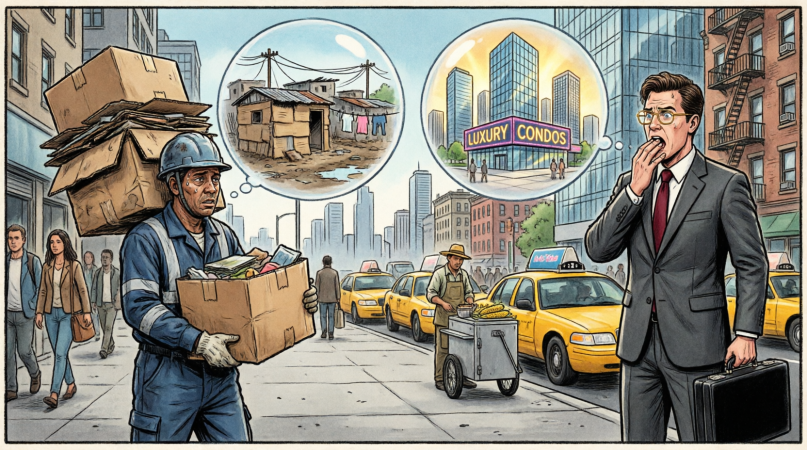
That afternoon, she left through the back door of the building, her body tired and her hands dry from the chlorine. Mexico City roared as always: trucks, tamale vendors, quesadilla stands, horns blaring, smoke, people rushing around with their watches glued to their backs. She took the minibus to Iztapalapa and sat by the window, clutching her backpack to her chest. Inside, the boxes creaked softly.
She thought about Nico, her nine-year-old brother, who would be waiting for her with his Spanish homework. She thought about her grandmother Refugio, who had been coughing more at night lately. She thought about the house made of wood, sheet metal, and tarpaulins, about the leaks she still hadn’t quite managed to plug, about the corner where the wind blew in during winter. And she thought, above all, about what she would do that night with the new boxes.
What Camila didn’t know was that someone had been watching her for days.
Alejandro Villaseñor was thirty-five years old, with a weighty surname, an inherited fortune and another he had multiplied, and he was used to everything around him having an explanation. He owned the corporation where Camila worked cleaning floors, and he was one of those men who appear in business magazines in impeccable suits with practiced smiles. He never went down to the maintenance floors. He never stopped to look at the people pushing cleaning carts. Until he saw Camila.
The first time was by accident. She was on her knees picking up the pieces of a broken flowerpot on the eighth floor before the executives arrived. She didn’t know he was watching her from the other end of the hallway. Alejandro stood motionless, watching the concentration of those small, quick, sure hands. It wasn’t just that she cleaned well. It was the way she did everything, as if even the smallest detail deserved respect.
Then he began to notice her more. The strand of hair that always came loose from her ponytail. The fine scars on her fingers. The seriousness with which she arranged things. And those boxes. Always those boxes.
At first, he thought she was selling them. Then he imagined that perhaps she was reinforcing walls or improvising furniture. But there was something in the almost reverential care with which she treated them that told him there was more. Something personal. Something that he, with all his money, couldn’t understand.
Curiosity turned into obsession.
And that afternoon, when he saw her get on the minibus with her backpack full of cardboard, he made an absurd decision for a man like him: he followed her. His black car followed the public transport along increasingly broken avenues, ever narrower streets, neighborhoods where sidewalks were a luxury and dust clung to everything. Finally, he saw her get out in front of a dirt alley. Camila walked among makeshift stalls, children playing with a deflated ball, and scrawny dogs sleeping in the shade. She greeted a woman selling corn on the cob and stopped in front of a small house that could barely be called a home.
It was a structure stubbornly erected: old boards, gray tarps tied with rope, rusty sheet metal, uneven cinder blocks. And, reinforcing parts of the wall, there was cardboard. Lots of cardboard.
Alejandro felt a sharp pang in his chest.
It wasn’t pity. It was something more unsettling. Shame, perhaps. Admiration. A brutal blow of reality. He remained in the car for a moment, staring at the obscene difference between his leather seats and that house held together by ingenuity and necessity. He should leave. She should have driven off and forgotten what she’d seen. But she couldn’t.
She went downstairs.
Camila was inside when she heard the cough from the entrance. She pulled back the curtain that served as a door and froze when she saw him there, his shoes sinking into the dust, his expensive watch gleaming in the afternoon sun.
For a second she didn’t know what humiliated her more: that he had followed her or that he was now seeing this.
PART 2
“Mr. Villaseñor…” she murmured.
Alejandro swallowed. All the confidence he had in a business meeting vanished at once.
“I’m sorry. I shouldn’t have come like this.”
Before Camila could reply, an elderly voice came from inside.
“Who is it, my dear?”
Doña Refugio, her grandmother, appeared, hunched over but with eyes as sharp as an old knife. She looked Alejandro up and down and then Camila, who was red with embarrassment.
“He doesn’t look like a debt collector,” the old woman said. “If he’s already here, let him in. We don’t leave people standing in the doorway.”
Camila wanted to protest, but it was too late.
Alejandro went inside, and the interior gripped him even more. The floor was packed dirt. There was a plastic table with three mismatched chairs, a small stove, a mattress against the wall, and, in the brightest corner of the house, something that left him speechless: a bookcase made entirely of reinforced cardboard. It wasn’t just a pile of boxes stacked up. It was an ingenious, sturdy, well-thought-out structure, with separate levels, double corners, a wide base, and internal reinforcements. On it rested carefully covered books, notebooks, used dictionaries, and a small globe without a base. On the floor, reading under a bare lightbulb, was Nico.
The boy looked up.
“Good afternoon.” Alejandro replied automatically, unable to tear his eyes away from the bookcase. Camila, mortified, placed a glass of juice in front of him.
“The boxes… that’s what they’re for,” she finally said, almost in a whisper. “For my brother’s books. If you fold them properly and reinforce them, they hold up. And when it rains, they also help keep the rain out.”
Nico chimed in proudly.
“My sister made it all herself. And every Saturday she takes me to the downtown library. She says that even if we don’t have money, no one can take away what we learn.” That sentence finally broke something inside Alejandro.
He didn’t say any sympathetic nonsense. He didn’t ask why they lived like that. He didn’t offer money. He just looked at Camila with a clean, newfound respect that she noticed and that, for some reason, moved her more than charity.
Before leaving, he said:
“I’d like to talk to you tomorrow. But if you don’t want to, I’ll understand.”
PART 3
I didn’t sleep that night.
Not because of fear, but because of the strange way he had looked at me. Not pity. Not curiosity anymore. Something steadier. Something that made me feel seen in a way I wasn’t used to. I kept replaying his words—“If you don’t want to, I’ll understand.” Men like him didn’t usually give options. By morning, I had decided something simple: I would go, but I would not beg, and I would not be small.
When I arrived at Monte Real, everything felt sharper. The floors I cleaned, the whispers behind me, the boxes in my cart. Around noon, a secretary approached me, stiff and formal. “Mr. Villaseñor is expecting you.” Eyes followed me as I walked upstairs—not to the maintenance floor, but to the executive level no one like me ever entered. For a moment, my hands trembled. Then I remembered Nico’s voice: “No one can take away what we learn.” I knocked.
Alejandro stood when I entered, as if I were someone important.
“I won’t waste your time,” he said, his voice quieter than I expected. “What you built… that structure… it wasn’t just necessity. It was design.” I frowned, unsure where this was going. He slid a folder across the desk. Inside were sketches—mine. The same folding techniques, the reinforcements, the layered support. Cleaned up. Measured. Professional. “We throw away thousands of tons of cardboard every month,” he continued. “You turned it into something that holds knowledge.”
My chest tightened. “It’s just for my brother,” I said.
He shook his head slowly. “No. It’s a system. And systems can change lives.”
I didn’t answer right away. I had heard promises before—people who came into neighborhoods like mine with cameras and good intentions that disappeared by the next week. He seemed to read that in my silence.
“I’m not offering charity,” he added. “I’m offering a partnership. You design. We fund production. Schools, shelters, communities. Cheap, strong, modular furniture made from what we already waste. And you lead it.”
For a moment, the room felt too small.
“Why me?” I asked.
Alejandro didn’t hesitate. “Because you didn’t build it to impress anyone. You built it so someone you love could learn.”
That was when my voice broke.
I thought about Nico reading under that weak bulb. About my grandmother coughing through the night. About the leaks, the cold, the weight of surviving every single day. And suddenly, the boxes didn’t feel small anymore. They felt like something bigger than all of us.
“I have one condition,” I said, my hands steady now.
He nodded. “Name it.”
“No photos of my house. No story about ‘the poor girl you saved.’ If we do this… we do it with dignity. For everyone.”
For the first time, he smiled—not the practiced one from magazines, but something real.
“Agreed.”
Three months later, the whispers in the building had changed.
They still talked about me—but now it was different. Not about the girl who collected boxes, but about the woman who redesigned how the company used its waste. About the pilot program in public schools. About the waiting list from communities asking for more.
And every night, when I went home, Nico no longer studied under a leaking roof.
He sat at a desk we built together—strong, clean, made from the same cardboard everyone once laughed at.
Sometimes people think power looks like money, or titles, or offices on the twelfth floor.
But I learned something else.
Power is taking what the world throws away… and turning it into something no one can ignore.
The first words my husband said after our daughter was born weren’t joy. They weren’t relief. They weren’t even my name. They were an accusation. “This is NOT my child. I want a DNA test.” The words didn’t just land—they detonated, shattering the moment before it even had a chance to exist. 0002
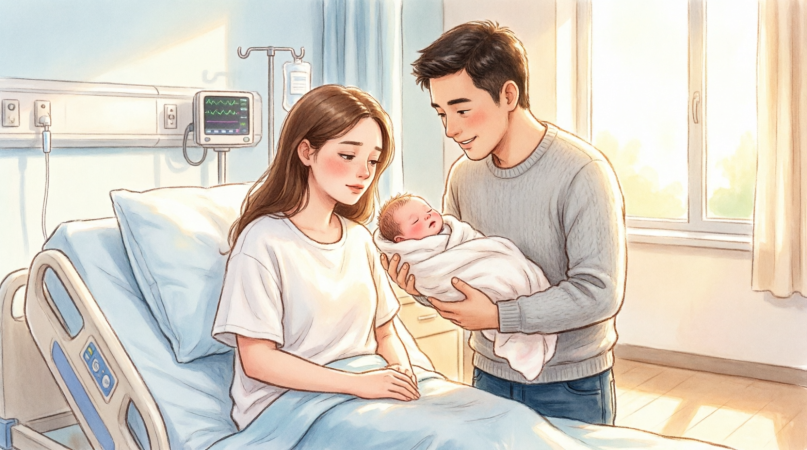
The silence after Ethan spoke wasn’t empty.
It was loaded.
Heavy with everything unsaid. Heavy with the kind of tension that makes even breathing feel like a decision.
Addison slept in the nurse’s arms, completely unaware of the storm circling around her tiny, fragile life.
But I wasn’t.
I felt every second of it.
Every glance.
Every breath.
Every shift in the room as people tried to decide where they stood.
The nurse adjusted her hold on my daughter, her movements careful, deliberate—protective in a way that made my chest ache.
“Let’s keep the baby calm,” she said softly. “Stress isn’t good for her.”
Ethan scoffed under his breath.
“She’s fine,” he muttered. “I just want the truth.”
I turned to face him fully now.
And for the first time since he’d spoken…
I looked at him differently.
Not as my husband.
Not as the man I had built a life with.
But as someone standing across from me in a moment I couldn’t undo.
“You don’t get to do this,” I said quietly.
His brows tightened.
“Do what?”
“Accuse me,” I said. “Like I’ve done something to you. Like I’ve done something to her.”
His jaw clenched.
“You’re acting like this is coming out of nowhere,” he said. “It’s not.”
That caught me off guard.
“What does that mean?” I asked.
For a second… he hesitated.
Just a flicker.
But it was enough.
Because I saw it.
He knew something.
Or thought he did.
Ethan ran a hand through his hair, pacing a step before stopping again, his frustration boiling just beneath the surface.
“Look,” he said, his voice lower now, “I didn’t want to believe it either. But I’ve been thinking about this for weeks.”
Weeks.
The word echoed in my mind.
“What exactly have you been thinking about?” I asked.
He looked at me then.
Really looked.
And what I saw wasn’t just anger.
It was suspicion that had already been growing.
Quietly.
Secretly.
Before today.
“You’ve been distant,” he said. “Avoiding me. Making excuses.”
I blinked, stunned.
“Are you serious right now?”
“Yeah,” he shot back. “I’m serious. And now—this.” His gaze flicked toward Addison. “Tell me that’s not convenient timing.”
The words hit hard.
Not because they were true.
But because they were absurd.
“I just gave birth to our child,” I said, my voice rising despite myself. “That’s not ‘convenient timing.’ That’s called reality.”
“Is it?” he snapped.
The nurse shifted slightly, her voice cutting in before things could escalate further.
“Sir, this is not appropriate behavior in a maternity ward.”
Ethan ignored her.
His eyes stayed locked on mine.
“You think I don’t see it?” he continued. “You think I haven’t noticed the way people look at you? The way you act when I’m not around?”
My stomach dropped.
“What are you talking about?”
“Don’t play innocent,” he said coldly. “I know what I know.”
That phrase again.
I knew then.
This wasn’t just suspicion.
This was belief.
And whatever had planted that belief… had already taken root.
My mother let out a sharp breath beside me.
“That’s enough,” she said firmly, stepping closer. “You don’t come into a hospital and accuse your wife of something like this.”
Ethan didn’t even look at her.
“Stay out of it.”
“Excuse me?” she snapped.
“I said stay out of it,” he repeated, his voice sharper now. “This is between me and her.”
“No,” I said immediately.
My voice was steady.
Stronger than before.
“This involves my daughter too.”
That word landed differently.
Daughter.
Not suspicion.
Not accusation.
Daughter.
Ethan’s expression flickered again.
But instead of softening…
it hardened.
“Then let the test speak,” he said.
Silence followed.
Final.
Unavoidable.
The nurse cleared her throat gently.
“I’ll need to explain the process,” she said. “A DNA test will require a sample from both parents and the baby. It’s routine in situations like this—”
“Then do it,” Ethan cut in.
She didn’t flinch.
But her eyes shifted slightly toward me.
Checking.
Assessing.
Asking, without words, if I was okay with this.
I nodded once.
“Do it,” I said.
Because I already knew something Ethan didn’t.
If he thought this test would prove something against me…
he was wrong.
And when the truth came out…
it wouldn’t just defend me.
It would expose him.
Hours later.
The hospital room felt different.
Quieter.
Not peaceful.
Just… waiting.
Addison slept in the bassinet beside my bed now, her tiny chest rising and falling with soft, steady breaths.
Safe.
For the moment.
Ethan sat across the room.
Watching.
Waiting.
Suspicion still etched into every line of his face.
The results were supposed to arrive by morning.
But neither of us slept.
Because something about the way he acted…
something about the certainty in his voice…
told me this wasn’t just about doubt.
It was about something else.
Something deeper.
Something I didn’t yet understand.
At exactly 7:12 a.m., the door opened.
A doctor stepped in.
Holding a sealed envelope.
And in that moment—
the air shifted again.
Like the room itself knew.
This was the moment everything would change.
The doctor glanced between us.
Measured.
Professional.
Careful.
“I have the results,” he said.
Ethan leaned forward instantly.
I didn’t move.
Didn’t speak.
Didn’t breathe.
Because deep down…
I already knew—
This wasn’t going to end the way he expected.
And when the doctor finally opened that envelope…
it wasn’t just a test result.