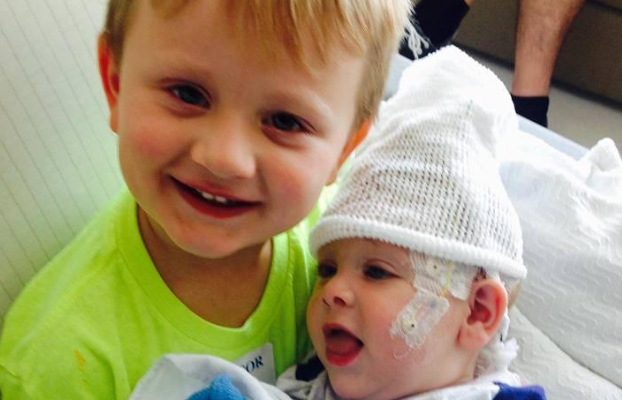
Before he even took his first breath, doctors warned his parents that he might not survive. Born with two extremely rare conditions affecting his brain, skull, and face, little Dominic Gundrum faced challenges that most people could never imagine. His appearance was so unusual that even experienced medical specialists knew his case would require extraordinary care. But behind his tiny smile was a remarkable story of survival, courage, and a family’s determination to never give up.
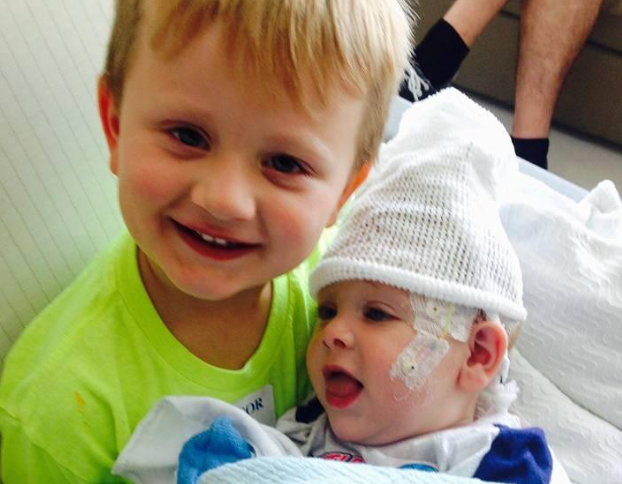
At just five months old, Dominic would undergo a complex operation that could change his entire future.
His parents knew the risks. They knew there were no guarantees. And they knew that the little boy they loved more than anything in the world was about to face one of the greatest challenges of his life.
What happened next became an unforgettable story of hope and medical achievement.
But to understand just how extraordinary Dominic’s survival was, we have to go back to the moment his parents first learned something was wrong.
A Mother’s Joy Turned Into Her Worst Nightmare
For most expectant mothers, a pregnancy ultrasound is one of the happiest moments of the journey toward parenthood.
It is a chance to see a baby’s tiny hands, little feet, and developing face. It is a moment filled with excitement, anticipation, and dreams about the future.
For Mary Gundrum, a mother from Wisconsin, that special moment became the beginning of an emotional journey she never could have anticipated.
Mary and her husband, Mark Gundrum, were expecting their eighth child.
Their home was already filled with the sounds of children, family activities, and the ordinary chaos that comes with raising a large family.
Another baby meant another little person to love, another personality to discover, and another life to welcome into their household.
But during a routine ultrasound around the twentieth week of pregnancy, doctors noticed something unusual.
The developing baby’s face and skull did not appear as expected.
Instead of receiving only the reassuring news they had hoped for, Mary and Mark were told that their unborn child had serious abnormalities requiring further investigation.
Additional medical examinations revealed something extraordinarily rare.
Their baby had two complex congenital conditions affecting the development of his brain, skull, and face.
The diagnosis would change everything.
Suddenly, the couple found themselves facing questions that no parent ever wants to ask.
Would their baby survive?
Would he be able to breathe?
Would he experience pain?
Would he ever be able to live outside the hospital?
And perhaps the most heartbreaking question of all:
Would they even have the chance to bring their son home?
Two Extremely Rare Conditions — One Fragile Little Life
Doctors diagnosed Dominic with an encephalocele and a Tessier midline facial cleft.
Both conditions are rare, and their combination made his medical situation particularly complicated.
An encephalocele is a congenital condition in which brain tissue, protective membranes, or fluid protrude through an opening in the skull.
Normally, the skull develops as a protective structure surrounding the brain.
But in babies born with an encephalocele, part of that protective structure does not close completely during early development.
Depending on the location and severity, the condition can cause serious neurological complications.
Dominic’s second condition, a Tessier midline facial cleft, affected the formation of his face.
Facial structures normally develop and join together during the earliest stages of pregnancy.
In Dominic’s case, some of those structures had not joined in the usual way, leaving a significant opening through the center of his face.
The combination produced a large protrusion in the facial area, along with abnormalities involving his nose and surrounding structures.
His condition was not simply a matter of appearance.
The opening in his skull and the involvement of brain tissue created medical risks that required highly specialized treatment.
For his parents, understanding the medical terminology was only one part of the challenge.
They also had to confront the terrifying uncertainty surrounding their son’s survival.
The Warning No Parent Wants to Hear
As doctors explained the seriousness of Dominic’s condition, Mary and Mark received devastating news.
Their unborn baby might not survive pregnancy or delivery.
Even if he made it through birth, his survival afterward remained uncertain.
The possibility that he could live for only a short time was something his family had to consider.
Imagine preparing to welcome a baby while simultaneously wondering whether you will ever hear him cry.
Imagine folding tiny clothes without knowing whether he will get to wear them.
Imagine choosing a name while being told that your child may never come home.
For Mary and Mark, the pregnancy became a period of hope mixed with fear.
Every appointment carried emotional weight.
Every new medical discussion could bring encouragement or another difficult possibility.
There were questions about neurological development, breathing, feeding, infection, and whether surgery would be possible.
Yet amid the uncertainty, one thing remained clear.
Dominic was already a deeply loved member of their family.
His parents continued preparing for his arrival while searching for specialists who might be able to help.
They understood that the road ahead could be difficult.
But they wanted to give their son every possible opportunity.
A Family That Refused to Lose Hope
The Gundrums faced a situation in which there were few simple answers.
The rarity of Dominic’s conditions meant that his medical team needed to consider a highly individualized approach.
Some congenital abnormalities can be treated through relatively familiar surgical procedures.
Dominic’s case was different.
His surgeons would need to address a defect involving the skull and brain while also reconstructing complex facial structures.
The procedure would require expertise from multiple medical specialties.
His parents began exploring treatment options and learning as much as possible about his condition.
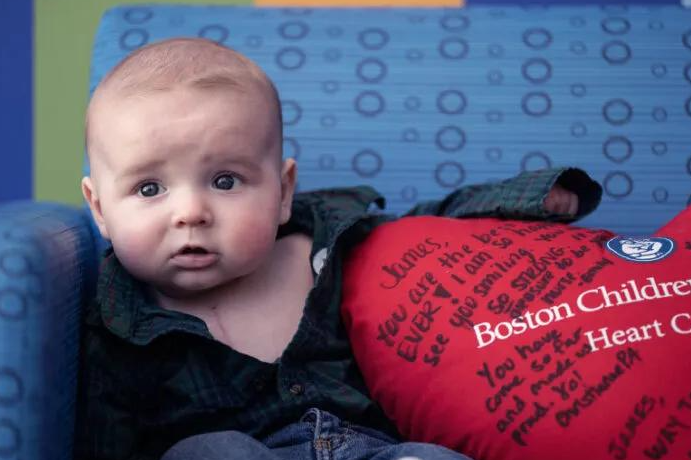
Their search eventually connected them with specialists at Boston Children’s Hospital, a medical center known for treating complex pediatric conditions.
Among the physicians involved was Dr. John Meara, a craniofacial surgeon experienced in reconstructive procedures involving the skull and face.
For the Gundrum family, finding specialists willing to evaluate Dominic’s case offered a measure of hope.
There was still uncertainty.
There were still risks.
But there was also the possibility that a carefully planned operation could improve his chances of a healthier future.
And before any surgery could happen, Dominic first had to survive his birth.
June 18, 2012 — The Day Dominic Surprised Everyone
On June 18, 2012, Dominic Pio Gundrum was born in Milwaukee, Wisconsin.
It was a moment his parents had awaited with both excitement and fear.
After months of hearing about the dangers associated with his conditions, they were finally able to meet their little boy.
And Dominic had already overcome a major challenge.
He was alive.
Despite the severe abnormalities affecting his face and skull, he had survived delivery.
He weighed nearly eight pounds, giving his family a precious reason to celebrate.
His appearance was noticeably different from that of most newborns.
A large protrusion occupied part of the center of his face, and his facial structures had developed unusually because of his rare conditions.
But his parents saw more than a medical diagnosis.
They saw their son.
They saw the newest member of their family.
They saw a little boy who had already overcome frightening expectations.
For a family that had spent months wondering whether they would ever hold him, Dominic’s arrival was extraordinary.
Yet surviving birth was only the beginning.
The next stage of his journey would be even more demanding.
Behind His Unusual Appearance Was a Baby Who Needed Love and Care
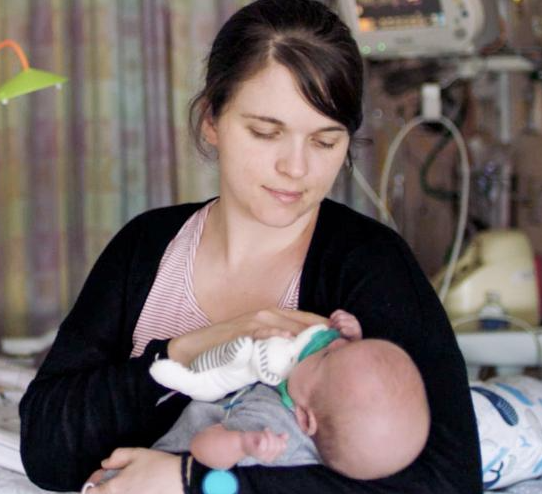
As Dominic grew during his first months of life, his family learned to navigate the challenges associated with his medical condition.
Caring for a baby with complex congenital abnormalities can involve frequent appointments, specialized feeding considerations, careful monitoring, and constant communication with healthcare professionals.
For parents, even ordinary moments can carry extra significance.
A peaceful nap.
A tiny hand gripping a finger.
A familiar expression.
A smile.
These are the moments that help families see beyond medical uncertainty.
Dominic’s early photographs captured something especially touching.
Despite the significant differences in his facial development, he could still express the unmistakable charm of a baby.
His family continued to bond with him while preparing for the medical intervention that might give him a better chance at long-term survival.
But the upcoming surgery was unlike anything they had experienced before.
Doctors would need to perform delicate work involving structures that are among the most sensitive in the human body.
A mistake or unexpected complication could have serious consequences.
The stakes were enormous.
The Surgery That Could Change Everything
By the time Dominic was approximately five months old, specialists had developed a surgical plan.
The operation would take place at Boston Children’s Hospital.
The team included craniofacial surgeon Dr. John Meara and neurosurgeon Dr. Mark Proctor.
Their task was exceptionally complex.
They needed to address the encephalocele, repair the skull defect, and reconstruct the facial structures affected by the cleft.
The surgery was about far more than changing Dominic’s appearance.
It was intended to protect vulnerable structures, address potentially dangerous abnormalities, and improve the conditions necessary for his future development.
The medical team had to consider the relationship between his skull, brain tissue, facial bones, and surrounding soft tissue.
Each part of the operation depended on careful planning.
For a baby only a few months old, the procedure presented substantial challenges.
The surgeons would have to work with exceptionally small anatomical structures while minimizing the risks associated with anesthesia, blood loss, infection, and neurological injury.
This was not a routine operation.
It required coordination between specialists with different areas of expertise.
And for Dominic’s parents, the day of surgery brought an emotional test unlike anything they had faced before.
They had already watched their son overcome the uncertainty surrounding his birth.
Now they had to place his life in the hands of a surgical team and wait.
Hours of Surgery — And a Family Waiting for News
While Dominic underwent surgery, his family faced the uncertainty of what would happen next.
For parents whose child is undergoing a major operation, waiting can be one of the most difficult parts of the experience.
There is little