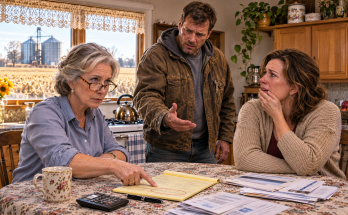
“Your grandfather didn’t leave you a dime.”
Those were the exact words my father had spoken thirteen years earlier.
I remembered the conversation.
I remembered the kitchen table.
I remembered the stack of college tuition bills in front of me and the way my father had barely looked up from his newspaper.
I had been nineteen years old.
My grandfather had been dead for six months.
And I had been desperate.
Now, standing on the deck of the $2.8 million beach house my family had just tried to steal, I was staring at a bank statement showing that my grandfather had apparently left me $1,850,000.
Almost two million dollars.
Money I had never known existed.
Money that could have changed everything.
My hands began to shake.
For the first time that day, I had to sit down.
Not because I was afraid.
Because thirteen years of memories were suddenly rearranging themselves in my head.
The nights I worked double shifts cleaning research equipment to pay my tuition.
The summer I slept in my truck because I couldn’t afford rent.
The semester I nearly dropped out when my scholarship didn’t cover the laboratory fees.
The countless times my father told me poverty would teach me responsibility.
All those years.
All that humiliation.
And somewhere, possibly sitting in an account under my name, had been enough money to change my entire life.
My phone vibrated again.
The unknown number had sent another message.
“Before you ask who I am, look at the second page.”
A new photograph appeared.
I opened it.
There was a transfer record.
The original account showed a withdrawal of $1,200,000.
The date was September 18, thirteen years earlier.
Three days after my father told me there was no inheritance.
The receiving account belonged to a private investment entity.
Vance Family Capital Partners.
I stared at the name.
I’d heard it before.
Not often.
But enough.
It was the company my father claimed he’d established with Julian when my brother started working in finance.
The company my father had proudly called their first real family business.
The company I’d been told I was too irresponsible to join.
My stomach twisted.
Had they built their investment business using money meant for me?
I immediately called Detective Rustova.
She answered on the second ring.
“Marcus?”
“I just received documents concerning a trust my grandfather supposedly left me.”
“What documents?”
“Bank statements. Transfer records. Almost two million dollars.”
Her voice sharpened.
“Who sent them?”
“An unknown number.”
“Forward everything to me. Don’t assume they’re authentic yet.”
“I understand.”
“And don’t confront your father about this until we’ve had an opportunity to verify the records.”
I looked at the bank statement again.
“I don’t think I can talk to him without losing my temper.”
“Then don’t.”
That was the first advice I’d received all day that felt simple enough to follow.
I forwarded the photographs.
Then I sent the unknown number one question.
“Who are you?”
The answer came almost immediately.
“Someone who should have spoken up thirteen years ago.”
I stared at the screen.
“Name.”
There was a long pause.
Then the reply appeared.
“Margaret Ellis. I was your grandfather’s estate administrator.”
I stopped breathing.
Margaret Ellis.
I knew that name.
I hadn’t heard it in more than a decade, but I remembered her.
She was a woman with silver hair, round glasses, and a voice that always sounded as though she were reading from a legal textbook.
She’d been at my grandfather’s funeral.
She’d spoken quietly to my father afterward.
And a week later, she’d disappeared from our lives.
I typed:
“Why are you contacting me now?”
Her response came slowly.
“Because I saw the public filing associated with the attempted property transaction. And when I recognized your father’s name, I realized what he was trying to do again.”
Again.
That word hit harder than anything else.
“Tell me what happened.”
She didn’t answer immediately.
Then my phone rang.
The same number.
I answered.
“Marcus?”
Her voice was older than I remembered.
But unmistakable.
“Mrs. Ellis?”
“Hello, Marcus.”
For several seconds, neither of us spoke.
Then she said something that made my chest tighten.
“You look so much like your grandfather in the photographs I’ve seen.”
I swallowed.
“Why didn’t you tell me?”
She exhaled slowly.
“Because I made a terrible mistake.”
I stared at the ocean.
“What mistake?”
“I believed your father.”
My jaw tightened.
“About what?”
“Your grandfather established a trust for you before his death. He intended it to support your education, your first business, and eventually whatever life you chose to build.”
I closed my eyes.
My grandfather had been the only person in my family who understood why I loved the ocean.
He used to take me fishing at sunrise.
He taught me how tides worked.
He bought me my first microscope.
When my father called my interests useless, Grandpa would smile and say, “The world needs people who notice what everyone else walks past.”
I had carried those words with me for years.
And now I was learning he’d apparently tried to give me more than encouragement.
“What happened to the trust?” I asked.
Margaret’s voice trembled.
“Your father was named as one of the people responsible for administering it while you were young. There were restrictions, reporting obligations, and provisions intended to protect your interest.”
I listened carefully.
“Then how did the money move?”
“Your father presented documents claiming the trust needed to be restructured because of a significant tax and investment issue.”
“Were those documents legitimate?”
“At the time, I believed they were. Later, I discovered serious inconsistencies.”
My pulse quickened.
“What kind?”
“Signatures. Dates. Supporting authorizations.”
I almost laughed.
Of course.
Thirteen years later, the same pattern.
Documents.
Signatures.
Paperwork that supposedly proved I had agreed to something.
Margaret continued.
“I raised concerns, Marcus. I want you to know that.”
“Then why didn’t you contact me?”
There was silence.
A long, painful silence.
“Because your father told me you were aware of the arrangement.”
I stared at the ocean.
“He lied.”
“I believe he did.”
“He told me Grandpa left nothing.”
Margaret made a small sound.
Almost a gasp.
Then she whispered:
“Oh, Marcus.”
Those two words carried more regret than any apology I’d heard in years.
I took a breath.
“Do you still have the original documents?”
“Yes.”
“All of them?”
“Most of them. The original trust agreement, correspondence, account statements, and a copy of the distribution schedule.”
My heart pounded.
“Why keep them this long?”
“Because when I realized something was wrong, I couldn’t bring myself to destroy the records.”
I stood.
“Mrs. Ellis, I need those documents.”
“I know.”
“And I need you to speak with my attorney.”
“I will.”
Then she said something I wasn’t prepared for.
“Marcus, there’s another reason I’m contacting you.”
I tightened my grip on the phone.
“What?”
“Your grandfather didn’t leave everything to you.”
I frowned.
“What do you mean?”
“He made separate provisions for both grandsons.”
I went still.
“Julian had a trust too?”
“Yes.”
“How much?”
“Seven hundred and fifty thousand dollars.”
My chest tightened.
Julian had inherited $750,000.
And I’d supposedly inherited $1.85 million.
That meant Grandpa had provided more than $2.5 million for his grandsons.
“Did Julian receive his money?”
Margaret hesitated.
“According to the records I have, a substantial portion was distributed to him after he reached the required age.”
I thought about Julian’s first luxury car.
His expensive apartment.
His sudden entry into the financial industry.
All the times my father praised him for becoming successful so young.
I’d assumed Julian had worked hard and gotten lucky.
Now I wondered how much of that success had come from inheritance.
And how much had come from pretending he’d earned something he was simply handed.
“Did Julian know about my trust?” I asked.
Margaret paused.
“I don’t know how much he knew at the time.”
“But you think he knew something?”
“Marcus, I have correspondence indicating that your father and Julian discussed the management of family investment funds years ago.”
My stomach sank.
“Was my trust mentioned?”
“Yes.”
The answer landed like a stone.
My brother had spent more than a decade mocking me for struggling financially.
He’d called my first apartment pathetic.
He’d laughed when I bought a used truck.
He’d told family members I was too stubborn to accept good financial advice.
And there was now reason to believe he’d known money intended for me had been moved into the family’s investment operation.
I sat down again.
Margaret spoke gently.
“Marcus, are you all right?”
I looked at the Pacific.
“No.”
It was the first time I’d admitted that all day.
“No, Mrs. Ellis. I’m really not.”
She let the silence sit between us.
Then she said:
“Your grandfather loved you very much.”
My throat tightened.
“He was the only one who believed in me.”
“He was proud of you long before you had anything to prove.”
I covered my eyes.
Because suddenly, I was nineteen again.
Standing beside Grandpa’s hospital bed.
Listening as he told me to keep studying the ocean even if nobody understood.
I’d thought those were his final gifts.
Encouragement.
Faith.
Love.
Now I was learning he’d also tried to protect my future.
And someone I trusted had apparently hidden that protection from me.
When the call ended, I contacted my attorney, Nathan Brooks.
Nathan had handled the legal work for my company for five years.
He was calm, meticulous, and nearly impossible to intimidate.
I explained everything.
The forged foreclosure.
The attempted property transfer.
The suspicious lending applications.
And now the trust.
Nathan listened without interrupting.
When I finished, he said:
“Marcus, I need to see the original trust documents before we draw conclusions about ownership, distributions, or liability.”
“I understand.”
“But if those records are authentic, your father may have some very serious questions to answer.”
“How serious?”
“Potential breaches of fiduciary duty, misappropriation, falsified records, and possibly other issues depending on what the evidence establishes.”
I leaned back.
“Can we recover the money?”
“First, we need to trace it. We need to determine what was authorized, what was distributed, and what remains.”
I looked at the statement.
“There’s a transfer of $1.2 million to Vance Family Capital Partners.”
“Then we start there.”
Nathan paused.
“And Marcus?”
“Yes?”
“Don’t tell your family about Margaret yet.”
“Why?”
“Because right now, they don’t know exactly which records you’ve obtained.”
That made sense.
For the first time, my family didn’t control the information.
I did.
And they had no idea how much I was beginning to uncover.
At 4:36 that afternoon, Julian called me.
I almost ignored it.
Then I remembered Detective Rustova’s instructions not to confront anyone or discuss evidence.
I declined the call.
He left a voicemail.
I listened.
His voice was shaking.
“Marcus, look, I know things got out of hand today. But you need to understand something. Dad pushed this harder than anyone. Sarah handled the paperwork. I was just trying to keep everyone from going under.”
I stared at the screen.
Then he continued.
“You’ve always had money, Marcus. You don’t understand what it’s like to have people depending on you.”
I nearly threw my phone.
I’d spent years working myself sick.
I’d missed birthdays.
Holidays.
Family events.
I’d slept in my truck and eaten instant noodles while building a company that most investors said would fail.
And Julian was telling me I didn’t understand financial pressure?
Then came the part that made me freeze.
“Besides, if Dad hadn’t used that old trust money to start the investment company, none of us would have what we have now.”
I stopped the voicemail.
Replayed the last sentence.
Once.
Twice.
Three times.
Julian had just acknowledged the existence of the old trust money.
In his own voice.
Without me asking a single question.
I forwarded the recording to Nathan and Detective Rustova.
Nathan called almost immediately.
“Marcus, don’t respond to him.”
“I wasn’t going to.”
“Good. Preserve the original voicemail.”
I sat motionless.
Because the picture was becoming clearer.
For thirteen years, my father had told me there was no inheritance.
Yet Julian was now speaking casually about using trust money to establish the family investment company.
And they had spent years telling everyone that business was proof of Julian’s brilliance.
I felt sick.
Then my mother’s name appeared on my screen.
A text message.
“Marcus, your father is willing to apologize if you’ll agree to stop this investigation.”
I stared at those words.
An apology.
After a forged foreclosure.
After a fake transfer agreement.
After attempts to use my property and business as collateral.
After thirteen years of apparently concealing a substantial inheritance.
My father was willing to apologize.
As though forgiveness were a button I could press to make everything disappear.
I didn’t answer.
A second message arrived.
“Please understand that Julian could lose everything.”
I looked around my beach house.
The same house my family had tried to take.
Then I typed:
“Mom, what did you think would happen to me?”
She never replied.
At 6:10 that evening, Margaret called again.
Her voice sounded different.
Urgent.
“Marcus, I found something.”
I straightened.
“What?”
“A letter.”
“From whom?”
“Your grandfather.”
My heart stopped for a moment.
“A letter?”
“Yes. He wrote it before he died. It was included with the trust instructions.”
I swallowed.
“Was it addressed to me?”
“Yes.”
“Why didn’t I receive it?”
Margaret hesitated.
“Your father told me he’d delivered it to you personally.”
I closed my eyes.
Another lie.
“Do you still have a copy?”
“I do.”
“Can you send it?”
“I’ve scanned it. I’m sending it now.”
A notification appeared.
One attachment.
A handwritten letter.
I opened it.
The first line made my chest ache.
“My dear Marcus, if you’re reading this, I hope you’ve found a life that lets you wake up excited to see what the ocean has taught you overnight.”
I could almost hear Grandpa speaking.
I kept reading.
He wrote about the summers we’d spent on his fishing boat.
About how I was never afraid to ask questions.
About how I could spend hours studying a tiny crab in a tide pool while everyone else wanted to hurry home.
He wrote that curiosity was not weakness.
That kindness was not foolishness.
That doing meaningful work mattered more than impressing people who cared only about appearances.
Then I reached the paragraph that changed everything.
“I have arranged funds to help you pursue your education and build something worthwhile. You do not owe anyone your dreams in exchange for this gift. It is yours to use responsibly, according to the terms I have established.”
My vision blurred.
I’d built my company without knowing the money existed.
I’d spent thirteen years wondering whether Grandpa would have been proud.
And he’d left me a letter telling me exactly what he’d hoped for.
But the next paragraph was different.
The handwriting became slightly smaller.
More deliberate.
“Marcus, I have watched how your father treats you. I have tried to help him see the young man you are becoming, but he continues to measure his sons by the wrong things.”
I stopped reading.
My grandfather had noticed.
All those years, I’d thought nobody saw.
But he had.
I continued.
“I am putting safeguards around your inheritance because I am concerned that family pressure may one day be used to influence your decisions. If anyone tells you that you must surrender what I’ve left you for the good of the family, I want you to remember that love does not require you to give up your independence.”
I covered my mouth.
Then I read the final lines.
“Do not spend your life trying to convince people who refuse to see your worth. Build something good. Protect it. And never mistake someone’s disappointment in you for proof that you’ve failed.”
I sat there for a long time.
The sun was beginning to set.
The ocean had turned orange and gold.
And I realized that thirteen years earlier, the man who loved me most had seen the danger coming.
He’d tried to protect me.
He’d even written it down.
But my father had apparently kept the warning from me.
I called Margaret.
“Mrs. Ellis?”
“Yes, Marcus?”
“Thank you.”
Her voice trembled.
“I wish I’d done more.”
I looked at the letter.
“We can’t change thirteen years ago.”
“No.”
“But we can find out what happened.”
“Yes,” she whispered. “We can.”
Then she said something unexpected.
“Marcus, there’s one more document I haven’t sent you.”
My stomach tightened.
“What document?”
“A memorandum your grandfather signed shortly before his death.”
“What does it say?”
“It explains why he structured the trusts differently.”
I frowned.
“Differently?”
“Yes.”
“Why?”
Margaret hesitated.
“Because your grandfather had discovered something about your father and Julian.”
I sat forward.
“What?”
“He believed they had been using his money without permission.”
The room seemed to tilt.
“Before he died?”
“Yes.”
I stared at the letter.
My grandfather hadn’t merely suspected that my father might mistreat me.
He had apparently discovered financial wrongdoing while he was still alive.
“What did he do?”
“He confronted them.”
My heart pounded.
“When?”
“About six weeks before his death.”
I remembered that period.
Grandpa had been sick, but he was still mentally sharp.
My father suddenly began visiting him every day.
Julian started joining those visits.
I’d thought they were finally trying to spend more time with him.
Now I wondered what those conversations had really been about.
“Mrs. Ellis,” I asked slowly, “what happened during that confrontation?”
She took a long breath.
“According to his memorandum, your grandfather demanded that your father account for a series of withdrawals.”
“How much money?”
“Approximately four hundred thousand dollars.”
I froze.
“From which account?”
“His personal investment accounts.”
I gripped my phone.
“And?”
“He instructed his attorney to review the transactions and revise his estate plan.”
My mind raced.
“What happened to the review?”
“It wasn’t completed before he died.”
I closed my eyes.
“And the memorandum?”
“I have it.”
“Send it.”
“Marcus, I want you to be prepared.”
“For what?”
“Because your grandfather named the person he believed was responsible for initiating those withdrawals.”
I stared at the darkening ocean.
“My father?”
Margaret’s answer came quietly.
“No.”
I stopped breathing.
“Julian?”
“Yes.”
For several seconds, I couldn’t speak.
Then Margaret continued.
“But that’s not the worst part.”
I felt the hair rise on my arms.
“What is?”
“Your grandfather wrote that after confronting Julian, he received a threat.”
I stood.
“A threat from whom?”
“He didn’t identify the sender conclusively.”
“Do you have the message?”
“Yes.”
I heard paper moving on her end.
Then she read it aloud.
“If you keep interfering with the family’s financial future, you may not live long enough to see what happens next.”
I felt the blood drain from my face.
My grandfather had died six weeks later.
The doctors had said it was complications from his illness.
I’d never questioned it.
Not once.
And I wasn’t going to assume a threatening message proved anything about his death.
But hearing those words made me realize there was another part of my family’s history I had never understood.
“Mrs. Ellis,” I whispered, “did anyone report that threat?”
“I don’t know whether your grandfather made a formal report. I encouraged him to speak with his attorney and the authorities.”
I closed my eyes.
Then she said:
“Marcus, I need to tell you something else.”
I barely had the strength to answer.
“What?”
“I found an envelope attached to the memorandum.”
“An envelope?”
“It contains copies of several financial records and a handwritten note.”
“What note?”
Margaret’s voice broke.
“It says, ‘If anything happens to me before this matter is resolved, make sure Marcus receives these documents when he is old enough to understand.’”
I stared at the horizon.
My grandfather had anticipated trouble.
He had left a trail of evidence.
And somehow, that evidence had remained hidden for thirteen years.
I was about to ask Margaret another question when my phone vibrated.
A message from Rebecca, my CFO.
“Marcus, call me immediately. Our IT team completed the preliminary access review.”
I frowned.
I called her.
“Rebecca?”
Her voice was tight.
“We found unusual downloads from your home office computer during the week Sarah was there.”
My stomach sank.
“How many files?”
“Hundreds.”
I closed my eyes.
“Financial records?”
“Yes. But there’s something else.”
“What?”
“Someone also accessed an archived document folder.”
I frowned.
“What folder?”
Rebecca took a breath.
“The one containing the records you digitized after your grandfather died.”
I stopped moving.
Years earlier, I’d scanned a handful of Grandpa’s old papers.
Fishing photographs.
Boat registrations.
Some letters.
Things I’d thought were simply family keepsakes.
“Why would Sarah access those?”
“I don’t know.”
Then Rebecca continued.
“But the download records include a file with a very specific name.”
“What name?”
She read it slowly.
“Vance Trust — Original Beneficiary Schedule.”
I stared at the floor.
The inheritance documents.
My own computer had apparently contained information about the trust.
Information Sarah had accessed.
And I had never even known what the file meant.
“Rebecca, where did that file come from?”
“We’re still tracing it. The archived folder appears to have been copied from an older backup.”
I swallowed.
“Can you recover it?”
“We’re trying.”
Then she paused.
“Marcus, there’s another problem.”
I felt my chest tighten.
“What?”
“The access records suggest Sarah wasn’t the only person who used that computer.”
My mouth went dry.
“Who else?”
“We found a remote session associated with an account created shortly before the downloads.”
I gripped my phone.
“What account?”
Rebecca hesitated.
“The display name is Harold Vance.”
My father’s name.
My own father had apparently had a remote-access account connected to my home office computer.
An account I had never knowingly authorized.
I stared at the screen.
And suddenly, everything my family had done looked less like a desperate scam and more like something that had been developing for years.
The stolen documents.
The fabricated debt.
The fake foreclosure.
The suspicious loan applications.
The hidden inheritance.
Someone had been gathering information about my assets long before Julian walked into that courthouse.
“Rebecca,” I said, “preserve the records. Don’t let anyone delete anything.”
“Already secured.”
I ended the call.
Then I looked at Grandpa’s letter again.
One sentence stood out above all the others.
“Protect what you build.”
I had thought he meant my career.
My future.
My independence.
Now I understood he might have been warning me about the people closest to me.
I walked to the filing cabinet in my home office.
Opened the bottom drawer.
And removed a small wooden box Grandpa had given me when I was seventeen.
I’d kept it for fifteen years.
Inside were fishing photographs, an old compass, and a folded chart of the California coastline.
But as I lifted the chart, I noticed something I’d never seen before.
A small envelope was taped beneath the wooden tray.
Yellowed with age.
My name was written across the front.
MARCUS.
In Grandpa’s handwriting.
My heart began to pound.
I carefully removed it.
Inside was a single sheet of paper.
And a small brass key.
The note contained only three sentences.
“Marcus, there are things about our family you deserve to know.”
“If the papers I’ve left with my attorney are ever hidden from you, this key will lead you to the originals.”
“Do not give it to your father.”
I stared at the key.
Then turned the paper over.
On the back was a handwritten address.
A private storage facility forty minutes away.
And beneath it, a unit number.
B-17.
I stood frozen in my office.
For thirteen years, the answer might have been sitting in a wooden box less than twenty feet from where I worked.
Then my phone lit up again.
A message from an unknown number.
Different from Margaret’s.
Only seven words.
“Do not go to storage unit B-17.”
I stared at the screen.
Another message appeared.
“Your father already knows you found the key.”
I felt my pulse hammer against my ribs.
Then a photograph arrived.
It showed the entrance to the storage facility.
Taken that evening.
And parked directly outside was a black Porsche.
The same model Julian drove.
I looked at the photograph again.
Then at the brass key in my hand.
And for the first time since the courthouse call, I felt something I hadn’t expected.
Not anger.
Not betrayal.
Fear.
Because whoever had sent that photograph knew about a secret my grandfather had hidden fifteen years earlier.
And apparently, Julian was already trying to reach it.
END OF PART 4 — TO BE CONTINUED IN PART 5: THE LOCKED STORAGE UNIT THAT HELD MY GRANDFATHER’S FINAL SECRET
PART 5 — THE LOCKED STORAGE UNIT THAT HELD MY GRANDFATHER’S FINAL SECRET
“Your father already knows you found the key.”
I stared at the message while the little brass key rested in my palm.
For thirteen years, I had believed my grandfather left me nothing but memories.
Now I was holding a key to a storage unit he had apparently arranged for me to discover.
And my brother Julian was already there.
I looked again at the photograph of his black Porsche parked outside the facility.
Something about it bothered me.
Not the car.
Not the location.
The timing.
I had discovered the envelope less than five minutes earlier.
How could my father possibly know?
I turned toward my home office.
The computer.
Rebecca had just told me someone had created a remote-access account using my father’s name.
Someone had been accessing confidential files.
Maybe that access hadn’t ended eight months ago.
Maybe someone was still watching.
I immediately called Rebecca.
“Tell me something,” I said when she answered. “Is there any chance someone still has remote access to my home office computer?”
She didn’t hesitate.
“Marcus, disconnect that computer from the network. Our security team is already reviewing the suspicious account, but we haven’t completed the investigation.”
I walked to my desk.
Unplugged the network cable.
Then powered down the machine.
“Done.”
“Good. Don’t erase anything. We need to preserve the evidence.”
I looked toward the wooden box.
“Rebecca, how much of my personal information could someone have accessed?”
“We don’t know yet.”
That was not the answer I wanted.
But it was the truth.
And after everything my family had done, the truth was the only thing I was interested in hearing.
I explained the message about the storage unit.
Rebecca went quiet.
Then she said, “Marcus, please don’t go there alone.”
“I wasn’t planning to.”
“Promise me.”
“I promise.”
After we hung up, I called Detective Rustova.
She answered immediately.
“Marcus?”
“I found something that belonged to my grandfather.”
“What kind of thing?”
“A key. A handwritten note. An address.”
I told her about Unit B-17.
About the anonymous warning.
About Julian’s Porsche.
And about the fact that someone appeared to know I’d discovered the key.
The detective listened without interrupting.
Then she said, “Send me the photographs and the messages. Don’t go to the storage facility yet.”
“Understood.”
“Do you know who has access to that unit?”
“No.”
“Do you know whether it’s still rented under your grandfather’s name?”
“No.”
“Then we need to establish that before anyone attempts to enter it.”
I looked at the brass key again.
“Detective, what if Julian gets inside first?”
“We’ll contact the facility and ask them to preserve relevant records and footage. If there’s evidence of a crime, we’ll pursue the appropriate legal process.”
I nodded.
Then something occurred to me.
“Wait.”
“What?”
“My grandfather died thirteen years ago. Who has been paying the storage fees all this time?”
Detective Rustova paused.
“That’s a very good question.”
I stared at the key.
Thirteen years.
One hundred fifty-six months.
Someone had kept that storage unit active through every birthday, every Christmas, and every year I struggled to build a life without knowing it existed.
Someone knew.
Someone remembered.
And someone wanted whatever was inside to remain hidden.
At 7:42 that evening, Margaret Ellis called.
I answered before the second ring.
“Mrs. Ellis, did you know about storage unit B-17?”
There was silence.
Then I heard her inhale.
“Where did you hear that number?”
“My grandfather left me a key.”
“Marcus.”
Her voice changed.
Not surprised.
Afraid.
“Do you still have it?”
“Yes.”
“Good. Keep it somewhere safe.”
“What’s inside?”
She hesitated.
“Your grandfather told me there was a separate set of records. But he never told me exactly where he kept them.”
“Why?”
“Because he’d lost trust in nearly everyone handling his financial affairs.”
I sat down.
“Did he suspect my father?”
“Yes.”
“Julian?”
“Yes.”
“Anyone else?”
Margaret was quiet for so long that I thought the call had disconnected.
Then she whispered:
“Your grandmother.”
I froze.
“My grandmother died when I was eleven.”
“I know.”
“What does she have to do with this?”
Margaret sighed.
“Your grandparents had disagreements about how the family wealth should be managed. Your grandmother believed your father should eventually control the family investments.”
“And Grandpa disagreed?”
“He believed your father was making reckless decisions. He wanted to protect the money set aside for both grandsons.”
I stared toward the darkened ocean.
“Did my grandmother know about the missing money?”
“I can’t say for certain. But there were financial arrangements made years before your grandfather died that he later regretted.”
“What arrangements?”
“A series of joint accounts and investment authorizations.”
My stomach tightened.
“And my father could access them?”
“Yes.”
I closed my eyes.
The history was older than I realized.
This wasn’t simply a desperate scheme Julian had created after losing money.
It might have grown from years of family members treating inherited assets as though the ownership rules didn’t matter.
Margaret continued.
“Marcus, your grandfather knew there were records he couldn’t safely leave in the family house.”
“Is that why he rented the unit?”
“Possibly.”
“Did he ever tell you what he was protecting?”
She hesitated.
“Only one thing.”
“What?”
“A ledger.”
I frowned.
“A ledger?”
“He said it recorded financial transfers that other family members were trying to conceal.”
My pulse quickened.
“Do you think it’s in B-17?”
“I don’t know.”
Then her voice became serious.
“But if it is, Marcus, there may be people who will do almost anything to prevent you from seeing it.”
I looked down at the key.
And suddenly, I understood why my grandfather had hidden it beneath the tray of an old wooden box.
He hadn’t wanted the wrong person to find it.
But someone else knew about it.
And my brother was parked outside the building.
The next morning, Nathan Brooks arrived at my house just after eight.
He carried a briefcase, two coffees, and the expression of a man who hadn’t slept.
“Marcus,” he said as I opened the door, “your family is becoming a full-time legal department.”
I almost smiled.
“Tell me something I don’t know.”
He handed me a coffee.
“Your father has been calling my office.”
I stopped.
“What?”
“Three times since seven this morning.”
“What does he want?”
“He wants to discuss a private settlement.”
I laughed once.
A short, humorless sound.
“Of course he does.”
Nathan followed me into the kitchen.
“He says the family can resolve the misunderstanding without outside involvement.”
“A misunderstanding?”
“Yes.”
“Did he mention the forged signatures?”
“No.”
“The fake foreclosure?”
“No.”
“The credit applications?”
“No.”
“The trust?”
Nathan raised an eyebrow.
“He didn’t mention that either.”
I shook my head.
“He wants to negotiate before I know how much he took.”
“That possibility occurred to me.”
We sat at the kitchen island.
Nathan opened his briefcase.
“I’ve reviewed the documents Margaret sent.”
My pulse quickened.
“And?”
“The trust agreement appears internally consistent with the records she provided. But we’ll need certified copies and the complete administration history.”
“Was the $1.85 million real?”
“The statement is evidence that the amount was reported. We’re not yet in a position to establish exactly what you were entitled to receive or what happened to every dollar.”
I nodded.
“Okay.”
“However, there is something important.”
He slid a printed page toward me.
It was a clause from the trust agreement.
I read it slowly.
The document named an independent trustee who was supposed to assume certain responsibilities when I reached twenty-one.
I looked up.
“Who was the trustee?”
Nathan tapped the bottom of the page.
“Margaret Ellis.”
I stared at him.
“But Margaret said my father was administering it.”
“Your father had a role while you were younger. The agreement also provided for an independent transition.”
“Did that transition happen?”
“We haven’t found evidence of it yet.”
I leaned back.
“I’m thirty-two.”
“I know.”
“That’s eleven years.”
Nathan nodded.
“If the records are authentic and the terms apply as written, there are serious questions about how the trust was administered after you turned twenty-one.”
I stared at the document.
At twenty-one, I’d been working two jobs while trying to finish my degree.
My father had told me I needed to grow up and stop expecting help.
And somewhere, documents had apparently existed giving me rights I’d never been told about.
Nathan turned another page.
“There’s more.”
My stomach tightened.
“What?”
“The original records include a provision requiring regular accounting to the beneficiary.”
“Meaning me?”
“Yes.”
“I never received anything.”
Nathan looked at me carefully.
“That’s something we need to investigate.”
I shook my head.
“Every time I think I’ve reached the bottom of this, there’s another level.”
Nathan closed the folder.
“That’s why we follow the documents, not the emotions.”
Then he glanced at the brass key on the counter.
“Now. Tell me about B-17.”
I explained everything.
The note.
The warning.
The anonymous photograph.
Julian’s car.
Nathan listened.
Then he said, “Detective Rustova called me this morning. The facility has confirmed the unit exists.”
I straightened.
“Who rents it?”
“According to the facility’s current account records, it remains associated with your grandfather’s estate.”
I frowned.
“Who pays for it?”
Nathan hesitated.
“That’s where it gets interesting.”
I leaned forward.
“Who?”
“The payments have been coming from a separate account for years.”
“Whose account?”
“They haven’t verified the beneficial owner yet.”
I stared at him.
“So we still don’t know?”
“Not yet. But they have preserved the payment history.”
“Can we open it?”
“Detective Rustova is coordinating the process. The facility requires proof of authority, and we need to ensure nothing is disturbed improperly.”
I stood.
“Then let’s get that authority.”
Nathan nodded.
“We’re working on it.”
At 10:16, Detective Rustova called.
Her voice was unusually brisk.
“Marcus, we have an update regarding the storage unit.”
I put the phone on speaker so Nathan could hear.
“Go ahead.”
“Facility security confirmed a man matching Julian’s description visited last night.”
My chest tightened.
“Did he get inside?”
“He entered the building, but staff did not permit him to access Unit B-17 because he couldn’t establish authorization.”
I exhaled.
“What did he tell them?”
“He claimed the contents belonged to his late grandfather and that he was acting for the family.”
I laughed bitterly.
Of course.
Everything belonged to the family whenever Julian wanted it.
“Did they identify the Porsche?”
“They preserved the camera footage and entry records.”
“Good.”
Then she continued.
“There’s something else. He wasn’t alone.”
I felt my stomach drop.
“Who was with him?”
“A woman.”
“Sarah?”
“We’re verifying her identity.”
I closed my eyes.
My brother and my ex-fiancée.
Again.
The same two people whose names appeared on Vance Coastal Holdings.
The same two people connected to the forged foreclosure packet.
Now they were showing up at the storage unit where Grandpa had hidden his records.
“Detective, Sarah’s been contacting me. She claims she’s trying to help.”
“Then preserve her messages. We still need to establish what she knew and what she did.”
I looked at Nathan.
He nodded.
Then Detective Rustova said something unexpected.
“The facility also has an older visitor log.”
“How old?”
“Eleven years.”
My pulse quickened.
“Who visited?”
She hesitated.
“Your father.”
I stood completely still.
“Eleven years ago?”
“Yes.”
“Did he enter the unit?”
“The log indicates an attempted access. We’re checking what authorization was presented.”
I stared at the key on the counter.
My father had apparently known about B-17 for more than a decade.
And Grandpa had specifically warned me not to give him the key.
Nathan spoke.
“Detective, can you confirm whether the facility ever issued duplicate keys or changed the lock?”
“We’ve requested that history.”
“Thank you.”
The call ended.
I looked at Nathan.
“He knew.”
Nathan didn’t answer.
“He knew about the unit. He knew about the trust. He knew Grandpa had documents. And he spent thirteen years telling me there was nothing.”
“Marcus, we need to distinguish what we suspect from what we can prove.”
I nodded.
“I know.”
But there was one thing I understood with absolute certainty.
My father had never intended to tell me any of this voluntarily.
At 11:38, Nathan received a message from Detective Rustova.
After additional verification with the estate records, the facility had agreed to arrange a supervised inspection involving the appropriate authorized representatives.
Nathan looked up.
“Marcus, they’re allowing us to attend.”
My heart pounded.
“When?”
“This afternoon.”
I reached for the brass key.
For the first time since Grandpa’s death, I felt like I was moving toward something he’d wanted me to discover.
But I was also afraid.
Not of the storage unit.
Of what the truth might do to the few good memories I had left of my family.
We reached the facility shortly after two.
It was an ordinary building on the edge of town.
Concrete walls.
Security cameras.
Rows of numbered doors.
Nothing about it looked important.
Nothing suggested that a family secret worth millions of dollars might be hidden inside.
Detective Rustova was waiting with a facility manager and another investigator.
She greeted Nathan first.
Then she looked at me.
“Marcus, are you ready?”
I glanced at the key.
“As ready as I’ll ever be.”
We followed the manager down a long hallway.
The fluorescent lights hummed overhead.
Our footsteps echoed against the concrete.
B-11.
B-13.
B-15.
Then we stopped.
B-17.
A gray metal door.
A heavy lock.
And thirteen years of unanswered questions.
The manager checked the paperwork.
The investigator documented the door and seal.
Then, after the authorized representatives completed the necessary verification, I was permitted to try the key.
My hands were shaking.
I inserted it.
Turned it.
The lock clicked.
For a moment, nobody moved.
Then the manager lifted the door.
It rolled upward with a metallic rattle.
And I saw what my grandfather had left behind.
Not furniture.
Not old clothes.
Not boxes of forgotten junk.
Shelves.
Metal filing cabinets.
Sealed document cases.
A large wooden trunk.
And dozens of carefully labeled storage boxes.
Everything was organized.
Everything was protected.
Everything looked as though someone had expected it to matter years later.
I stepped inside.
The air smelled of paper, dust, and old wood.
On the nearest shelf sat a framed photograph.
My grandfather and me.
I couldn’t have been older than twelve.
We were standing beside his fishing boat, both smiling into the sun.
I picked up the frame carefully.
My throat tightened.
“Hi, Grandpa,” I whispered.
Nathan stood quietly behind me.
Even Detective Rustova gave me a moment.
Then I noticed the label on the first filing cabinet.
VANCE FAMILY INVESTMENTS — 2001–2013.
My heart began to pound.
The second cabinet read:
TRUST ACCOUNTS AND BENEFICIARY RECORDS.
And the third:
PRIVATE CORRESPONDENCE — HAROLD AND JULIAN.
I stared at the labels.
My father.
My brother.
Their names were right there.
Grandpa had been collecting information about them long before he died.
The investigators documented the arrangement before any records were reviewed.
Then Nathan pointed toward the wooden trunk.
“Marcus, look at this.”
I turned.
A brass plaque was attached to the lid.
It read:
FOR MARCUS — WHEN THE TIME IS RIGHT.
I felt something break inside my chest.
The words were in Grandpa’s handwriting, engraved into the metal.
I knelt beside the trunk.
There was a second lock.
Smaller.
Older.
And attached to the handle was a folded note.
My name was written across it.
I looked at Detective Rustova.
She nodded for the note to be documented and examined.
Afterward, I was allowed to read it.
“My dear Marcus, if you’ve reached this place, then something has happened that I hoped would never happen.”
My vision blurred.
I continued.
“I have spent many years building a future for this family. I now fear that some of the people I trusted most care more about controlling that future than protecting it.”
I swallowed.
“Inside this trunk are records of decisions that must one day be explained. Some will hurt you. Some may change how you remember people you love.”
I paused.
The next sentence made my hands tremble.
“But none of them should make you question whether you were loved by me.”
A tear fell onto the page.
I wiped it away.
Then I continued.
“Whatever you discover, do not confuse the actions of others with your own worth. You are not responsible for the choices they made.”
I closed my eyes.
For thirteen years, I’d carried the feeling that I wasn’t enough.
Not successful enough.
Not impressive enough.
Not worthy of the same respect Julian received.
And here was Grandpa, reaching across time to tell me something my father had never managed to say.
I was enough.
I always had been.
Nathan gently touched my shoulder.
“Take your time.”
I nodded.
Then I unfolded the final section.
There were instructions for where to find the matching key in the authorized estate records.
Margaret had apparently kept it without realizing what it opened.
Nathan called her.
When he explained, she went silent.
Then she said:
“I have a sealed envelope in the estate archive.”
My pulse quickened.
“What envelope?”
“One your grandfather told me never to open unless Marcus personally requested the release.”
I looked at the trunk.
“Mrs. Ellis, I’m requesting it.”
She took a breath.
“Then I’ll bring it to Nathan’s office.”
We couldn’t open the trunk that afternoon.
Not without the second key and the proper documentation.
But the investigators were able to begin reviewing the accessible records.
And what they found in the first cabinet made everyone go quiet.
There were years of account statements.
Investment reports.
Copies of checks.
Correspondence with financial institutions.
And a handwritten ledger.
Grandpa’s handwriting.
Neat.
Precise.
Organized by date.
Nathan examined the first pages.
Then the next.
His expression changed.
“Marcus.”
I looked up.
“What?”
“You need to see this.”
He pointed to an entry from fourteen years earlier.
A transfer of $125,000.
The recipient:
JULIAN VANCE.
The description:
UNAUTHORIZED ADVANCE — FAMILY INVESTMENT ACCOUNT.
The next entry listed another transfer.
$90,000.
Then another.
$185,000.
I stared at the amounts.
They added up to four hundred thousand dollars.
The same missing money Margaret had mentioned.
And beside each transfer, Grandpa had written a single word.
DISPUTED.
Nathan turned the page.
There was a handwritten note.
“Harold states these transfers were approved for Julian’s business development. No written authorization exists. Requesting independent review.”
I felt my jaw tighten.
My father had apparently been defending Julian’s access to Grandpa’s money long before anyone knew about my trust.
Then Nathan found another page.
This one was dated just weeks before Grandpa died.
At the top, in red ink, was written:
FINAL ACCOUNTING — FAMILY ASSETS.
Below were several figures.
Bank accounts.
Investment holdings.
Property interests.
Trust balances.
And one line that made Nathan stop.
“Marcus, look at this.”
I leaned closer.
The entry read:
MARCUS VANCE TRUST — ORIGINAL ALLOCATION: $1,850,000.
There it was.
Not just a photograph from an anonymous source.
Not merely a statement sent by Margaret.
My grandfather’s own ledger contained the same amount.
I stared at it.
For years, my father had called me irresponsible for struggling financially.
Yet Grandpa had apparently recorded an inheritance intended specifically for me.
Nathan pointed to the next line.
“Look at the notation.”
I read it.
“Beneficiary notification required at age twenty-one. Independent accounting mandatory.”
I shook my head.
“I was never notified.”
Nathan looked at me.
“I know.”
Then he turned another page.
And something changed in his expression.
He stopped.
Read the entry again.
Then asked Detective Rustova to look.
The detective examined it carefully.
“What is it?” I asked.
Nathan looked at me.
“There’s a record of a planned transfer.”
“To whom?”
“Vance Family Capital Partners.”
My stomach sank.
“How much?”
Nathan paused.
“Not one point two million.”
I frowned.
“What?”
He pointed to the amount.
$1,650,000.
I stared at the number.
Nearly the entire reported allocation.
“And look at the date,” Nathan said.
I did.
The transfer was scheduled for two weeks after Grandpa’s death.
I felt sick.
“Grandpa wrote about this before he died?”
“It appears he documented a proposed transaction that he opposed. We’ll need to verify whether it actually occurred.”
I stared at the handwriting.
Beside the entry, Grandpa had written:
DO NOT AUTHORIZE.
Three words.
Underlined twice.
And beneath them:
HAROLD REQUESTED OVERRIDE.
My father had apparently tried to move the money before Grandpa even died.
I leaned against a shelf.
The detective carefully photographed the page.
Then Nathan said:
“Marcus, the final amount your family actually controlled may be different from what we’ve seen so far. We need the complete banking records.”
I nodded.
I understood.
But I also understood something else.
My grandfather had tried to stop the transaction.
And my father had apparently found a way around him.
Then Detective Rustova called from the back of the unit.
“Mr. Brooks, could you come here?”
Nathan walked over.
I followed.
She was standing beside a small metal cabinet.
Inside were several sealed envelopes.
Each labeled with a name.
HAROLD VANCE.
JULIAN VANCE.
MARGARET ELLIS.
And one more.
SARAH WHITMORE.
I froze.
Sarah.
My ex-fiancée.
The woman I hadn’t met until years after Grandpa died.
Her name was written on a modern white label.
Not in Grandpa’s handwriting.
I stared at it.
“That’s impossible.”
Nathan looked at me.
“What?”
“Grandpa died thirteen years ago. I met Sarah five years ago.”
Detective Rustova examined the envelope.
“Then someone added this later.”
My pulse quickened.
Someone had been inside the unit after Grandpa’s death.
Someone had organized the records.
Someone had left information about Sarah.
And they had done it recently enough to know who she was.
I looked around the room.
“Who has been maintaining this place?”
The detective didn’t answer.
But the facility manager was already checking the account history.
A few minutes later, he returned.
His expression was tense.
“I found something.”
We turned.
“The rent has been paid through an automatic account transfer. But there was a billing contact change approximately eight months ago.”
My heart stopped.
Eight months.
The same time Sarah moved out.
The same time someone downloaded confidential information from my home office computer.
“Who changed it?” I asked.
The manager looked at the records.
“A person identifying herself as an authorized representative of the estate.”
“What name?”
He swallowed.
“Sarah Whitmore.”
I stared at him.
Sarah had been managing the storage unit.
Or at least someone using her name had.
She had apparently known about Grandpa’s records before I did.
And she had spent months pretending none of this existed.
Nathan looked at the detective.
“We need the complete access logs.”
She nodded.
Then my phone vibrated.
Sarah.
A message.
“I know you found B-17.”
I stared at it.
A second message appeared.
“Please don’t open the envelope with my name on it until we’ve spoken.”
I showed Detective Rustova.
Her expression hardened.
“Don’t reply.”
I didn’t.
Then another message appeared.
“Marcus, I didn’t betray you the way Julian thinks I did.”
I felt anger rise.
The stolen files.
The forged paperwork.
The company she co-owned with my brother.
And now the storage unit.
What exactly was I supposed to believe?
Another message arrived.
“I was trying to find out what happened to your grandfather’s money.”
I stared at the screen.
For a moment, I almost laughed.
Then she wrote:
“Your father knows I found the original records. That’s why Julian tried to get into the unit.”
I looked at Nathan.
He read the messages.
Then he looked at the sealed envelope.
“Marcus, I think we need to examine that document.”
Detective Rustova agreed.
The envelope was photographed and logged.
Then, with the authorized representatives present, it was carefully opened.
Inside was a single-page letter.
Dated eight months earlier.
Signed by Sarah Whitmore.
I read the first paragraph.
And felt my stomach drop.
“To whoever eventually discovers these records: I began investigating the Vance family finances after finding evidence that Marcus’s inheritance may have been diverted.”
I stared at the page.
Sarah had known.
For eight months.
She had known about my inheritance.
And she had never told me.
I kept reading.
“I believed that if I confronted Harold directly, the records would disappear. I therefore obtained access to the storage unit and began preserving copies.”
My chest tightened.
Then came the next paragraph.
“I made a terrible mistake by involving Julian. He convinced me that he wanted to correct the financial wrongdoing. By the time I realized his intentions were different, I had already provided him with information he should never have possessed.”
I closed my eyes.
She was admitting that she’d given Julian access to confidential information.
Whether she was telling the whole truth was another matter.
I continued.
“The holding company was originally presented to me as a vehicle for recovering and separating disputed assets. I now believe Julian intended to use it to obtain financing against property that did not belong to him.”
My hands shook.
Then I reached the final paragraph.
“If Marcus ever reads this, I need him to know that I did not stop loving him because of his work. I left because I discovered something about his family that I was afraid to tell him.”
I stared at the page.
Then I read the last sentence.
“And if Harold tells Marcus that the money was lost years ago, ask him about the offshore account opened in Julian’s name.”
I stopped breathing.
An offshore account.
Another account.
Another piece of money hidden from me.
Nathan read the last sentence over my shoulder.
Then looked at Detective Rustova.
“We need to trace that claim.”
She nodded.
I stood motionless.
Sarah had claimed she was trying to protect me.
But she’d also admitted giving Julian sensitive information.
She had signed documents connected to the holding company.
She had kept secrets from me for months.
And now she wanted me to believe she was helping.
I didn’t know what to think.
But I knew one thing.
Her letter contained information worth investigating.
At 4:52 that afternoon, we left the storage facility.
The documents had been secured for further examination under the appropriate procedures.
The trunk remained locked.
Margaret was bringing the second key.
And the investigators were working to identify everyone who had accessed B-17.
I thought the worst discoveries of the day were behind me.
I was wrong.
At 6:13, Nathan called.
His voice was unusually serious.
“Marcus, are you sitting down?”
I looked around my kitchen.
“Should I be?”
“Yes.”
I sat.
“What’s happened?”
“Margaret arrived with the sealed envelope.”
My heart pounded.
“The key?”
“Yes. But the envelope also contained a separate document.”
“What document?”
Nathan paused.
“A notarized statement your grandfather signed shortly before his death.”
I gripped the phone.
“What does it say?”
“Marcus, it describes a conversation your grandfather had with your father and Julian.”
I closed my eyes.
“About the missing money?”
“Yes. But that’s not all.”
I waited.
Nathan continued.
“Your grandfather believed someone had been using his investment accounts without permission. He said he intended to report the transactions.”
My pulse quickened.
“And?”
“The statement says your father asked him to delay that report.”
I stared at the wall.
“Why?”
“Because Julian’s financial career could have been ruined.”
Of course.
Julian’s future.
Julian’s reputation.
Julian’s career.
Everything always came back to protecting Julian.
But Nathan wasn’t finished.
“Marcus, there’s something else in the statement.”
“What?”
“Your grandfather documented that a person threatened him after he refused to withdraw his concerns.”
I stood.
“Who?”
Nathan hesitated.
“He identified the person he believed had made the threat.”
My mouth went dry.
“Julian?”
“No.”
I stopped.
“Dad?”
Nathan took a breath.
“Yes.”
For several seconds, I couldn’t speak.
My father.
My own father.
The man who had stood beside me at Grandpa’s funeral.
The man who told me Grandpa’s death was just one of those terrible things life forces us to accept.
Grandpa had apparently documented a threat from him weeks before he died.
“What exactly did Grandpa write?”
Nathan’s voice softened.
“He wrote that Harold warned him the family would suffer if he took the financial records to the authorities.”
I sat back down.
“That doesn’t prove Dad caused his death.”
“No,” Nathan said immediately. “And we shouldn’t make that assumption. The medical records and circumstances would need to be reviewed separately.”
I nodded.
But the thought was already there.
A dark possibility I didn’t want to touch.
Then Nathan said:
“There’s a final page.”
I swallowed.
“What does it say?”
“Your grandfather listed the person he trusted to protect the original records if anything happened to him.”
I frowned.
“Margaret?”
“No.”
“Then who?”
Nathan paused.
“Someone named Evelyn Carter.”
I had never heard the name.
“Who is she?”
“We’re trying to locate her.”
I stared at the wall.
“Why would Grandpa trust someone outside the family?”
“That’s one of the questions we need answered.”
Then Nathan continued.
“But here’s the strange part.”
I closed my eyes.
“What now?”
“Evelyn Carter signed a receipt for the documents eleven years ago.”
Eleven years.
Two years after Grandpa died.
The same year my father had reportedly visited the storage facility.
“Where is Evelyn now?”
Nathan hesitated.
“According to the contact information attached to the receipt, she was living in Oregon.”
“Was?”
“We haven’t confirmed her current address.”
I stood again.
“Then find her.”
“We’re working on it.”
I ended the call.
And for the first time all day, I allowed myself to feel exhausted.
Not physically.
Emotionally.
Because every answer led to another question.
Every document revealed another lie.
And every lie seemed to have been told by someone who claimed to love me.
I walked outside.
The sun was setting.
The Pacific stretched endlessly before me.
I thought about Grandpa.
About how he used to sit beside me on his boat and tell me that the ocean could hide things for centuries, but eventually the tides brought something back.
Maybe that’s what was happening now.
Maybe thirteen years of secrets were finally coming ashore.
Then my phone vibrated.
An unfamiliar number.
A text message.
“Marcus Vance?”
I hesitated.
Then replied.
“Who is this?”
The answer came almost immediately.
“My name is Evelyn Carter.”
I froze.
The woman Nathan was trying to locate.
The person Grandpa had trusted with his records.
I stared at the screen.
Then another message arrived.
“Your grandfather made me promise I would contact you if your father ever tried to take your property.”
My heart began pounding.
“How did you know?”
She replied:
“Because Harold called me this morning.”
I stopped breathing.
My father had contacted her.
Today.
Before we even knew she existed.
Then she sent another message.
“He offered me $500,000 to destroy what I have.”
I stared at the screen.
Five hundred thousand dollars.
My father was apparently willing to pay half a million dollars to make evidence disappear.
I typed:
“What do you have?”
For almost a minute, there was no response.
Then three photographs appeared.
The first showed a sealed file box.
The second showed an old handwritten note from Grandpa.
The third showed a document with my father’s name printed across the top.
I opened it.
And froze.
It was a written agreement dated thirteen years earlier.
The title read:
CONFIDENTIAL FAMILY ASSET REALLOCATION.
Below were two signatures.
Harold Vance.
Julian Vance.
Then, on the final line, was a third name.
Marcus Vance.
My name.
Beside it was a signature.
And a handwritten notation:
BENEFICIARY CONSENT OBTAINED.
I stared at the date.
I remembered exactly where I’d been that day.
I was nineteen years old.
Working aboard a research vessel.
Two hundred miles offshore.
Without internet access.
Without cell service.
And I hadn’t signed a single legal document.
My hands began to shake.
Then Evelyn sent one final message.
“Marcus, that document was used to justify the transfer of your inheritance.”
I looked at my forged signature.
And suddenly, I understood why my father had spent thirteen years telling me I had inherited nothing.
Because if I ever discovered the money, the next question would be obvious.
Who signed it away?
Then Evelyn wrote something that made my heart stop.
“Your father didn’t forge your signature.”
I stared at the screen.
Another message appeared.
“Your brother didn’t either.”
My mouth went dry.
Then came the final sentence.
“The person who signed your name is someone you’ve trusted your entire life.”
END OF PART 5 — TO BE CONTINUED IN PART 6: THE PERSON WHO FORGED MY SIGNATURE WAS THE LAST ONE I SUSPECTED
 PART 6 — THE PERSON WHO FORGED MY SIGNATURE WAS THE LAST ONE I SUSPECTED