PART1
The first thing I heard was the crying.
Not the normal, tired little whimper that meant a bottle or a pacifier or a lullaby was due. This was sharp and broken, like someone had been pulling the same alarm cord for too long. It slipped under the front door and climbed up my ribs, and I stood on Melissa’s porch with my hand hovering over the doorbell, unsure if I wanted to announce myself or just get inside.
I rang anyway. Once. Twice. I knocked. The crying didn’t stop. It didn’t even change.
Through the living room window I could see the TV glowing blue in a dark room. No movement. No shadow.
The spare key in my pocket felt heavier than it had any right to. Melissa had shoved it into my hand after Noah was born, like giving me access would quiet her guilt for not calling. “In case of emergencies,” she’d said. She’d smiled like it was a joke.
I didn’t smile back.
Another long, ragged wail came from inside, and whatever hesitation I had left dissolved.
The key turned with the familiar click, and I stepped into a silence that felt staged. The crying came from down the hallway, but the rest of the house was still, as if the walls had learned to ignore it.
The smell hit me next. Sour milk. Dirty laundry. That damp, sweet-sour scent that meant a diaper had been overdue for a long time. My stomach tightened the way it used to when I walked onto job sites and found a beam cut wrong, something structural compromised. Not anger first. Alarm.
“Noah?” I called, stupidly, as if a baby could answer. “Melissa?”
The crying turned into a hoarse scream. My shoes stuck slightly to the kitchen floor. There were bottles in the sink with curdled formula crusted around the rims, and a trash can overflowing with takeout containers. A pile of unopened mail sat under a glittery coupon booklet. A pink suitcase, half-unzipped, leaned against the couch like it had been abandoned mid-thought.
I walked down the hallway the way you walk toward bad news you already know is waiting.
Noah’s door was cracked. I pushed it open with two fingers.
He was in his crib, standing on shaky legs, his cheeks wet, his face swollen and red like he’d been crying for hours. His onesie was soaked through at the front and sagging at the bottom. His tiny hands gripped the rail and trembled. When he saw me, he didn’t smile. He didn’t reach. He just cried harder, as if recognizing an adult was permission to finally fall apart.
“Oh, buddy,” I whispered, and the words scraped out of me.
I lifted him, and his whole body curled into mine like a frantic animal finding warmth. He smelled like sweat and urine and that sour, spoiled milk smell that didn’t belong on a child. His diaper was heavy enough to be a hazard. He was hot, not feverish-hot, but overheated from crying and being left to stew in his own discomfort. When I tried to set him on my hip, he clung to my shirt with a grip that didn’t match his size.
I held him there, rocking without thinking, and looked around the room.
That’s when I saw the note.
It was taped to the wall above the changing table with a strip of blue painter’s tape. Melissa’s handwriting, bubbly and casual, like she was leaving directions for a plant.
Went to the Bahamas with girlfriends – back next week. Baby will be fine.
For a second my mind refused to process it. The words were too wrong to sit together. Bahamas. Girlfriends. Back next week. Baby will be fine. Like the baby was a crockpot. Like he could just be left on “warm.”
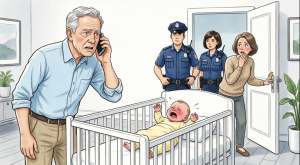
My hands shook so hard I almost dropped him. I tightened my hold and pressed my face to his hair. He smelled like him under the mess, like baby shampoo and skin and that faint clean sweetness babies carry when they’ve been cared for.
I carried him to the changing table and laid him down gently. He wailed, throwing his arms and legs in protest, terrified I was leaving too. I worked quickly, fingers clumsy, anger making me clumsier. The diaper tabs were stuck to his skin. When I peeled them away, he screamed like it hurt, and it probably did.
“I know, I know,” I murmured. “I’ve got you.”
His skin was red where the diaper had rubbed. I dabbed carefully with wipes until the wipes came away clean, then slathered on diaper cream like I was icing a cake. I found a fresh diaper in the drawer. I found a clean onesie under a pile of unfolded laundry that smelled like it had been sitting damp.
When I picked him up again, he kept crying, but it softened into exhausted hiccups. He buried his face in my shoulder and clutched me like I was a life raft.
I took him to the kitchen, made a bottle with the formula I found in the pantry, and tested it on my wrist the way my wife, Mary, had taught Melissa when she was little. Memory flashed like a camera bulb: Mary at our old kitchen table, laughing as Melissa insisted she could feed her doll. Mary’s hands guiding hers.
Mary would have known what to do next without thinking. Mary would have known what to say to our daughter to make her hear reality.
Mary was gone, and I was the one standing in this filthy kitchen with a starving baby on my hip.
Noah sucked the bottle down like he hadn’t eaten in a day. Maybe he hadn’t. I watched his eyelids flutter, his body finally unclench. When he finished, he looked at me with huge wet eyes and a bottom lip that still quivered, like he didn’t trust the relief.
“Where is your mother?” I asked him softly, then felt sick for even saying the word.
I pulled my phone out with one hand and called Melissa.
It rang three times. She answered on the fourth, her voice bright and airy like she’d been laughing at something. I could hear music in the background and the distant crash of waves, or at least the kind of sound people play when they want their life to feel like a vacation.
“Hey, Dad,” she said, like I’d called to ask about the weather. “What’s up?”
“What’s up?” My voice came out low, not loud. It scared me how calm it sounded. “I’m at your house. I used my spare key.”
A pause. Then a little laugh. “Oh my God, why? I told you I was out of town.”
“I found Noah in his crib,” I said. “He’s been screaming. He’s soaked. He—”
“He’s fine,” she said, cutting me off like I was boring her. “Relax. He cries. Babies cry.”
“Melissa,” I said, and now my voice shook, “you left him. Alone.”
Another laugh, sharper this time. “Dad, don’t be dramatic. He’s got diapers. He’s got formula. I set everything up. He’s okay.”
“You taped a note to the wall,” I said. “You went to the Bahamas with your friends. You wrote, ‘Baby will be fine.’”
“Well, he is,” she said, like she’d solved a math problem. “And I needed a break. You of all people should understand. You and Mom used to go out all the time.”
The mention of Mary hit me like a slap. We used to go out because we had a sitter, because we didn’t leave a baby alone in a house to scream until his voice broke. Because we came home.
“You come home,” I said. “Now.”
“Dad,” she sighed, and I could picture her rolling her eyes. “My flight is next week. Stop being controlling. I’m not changing it because you’re having a meltdown.”
I stared at the note again, at the casual tilt of her handwriting. Something in me went very quiet.
“I’m not having a meltdown,” I said. “I’m making a decision.”
“About what?” she asked, suddenly suspicious.
“About Noah,” I said, and then I ended the call.
I stood there for a moment with the phone in my hand, listening to Noah breathe. The house was still filthy. The TV still glowed in the dark living room. Outside, the neighborhood went on with its ordinary afternoon sounds: a dog barking, a car door slamming, someone mowing a lawn.
Inside, everything had changed.
I laid Noah in the crook of my arm and walked back to his room, where the note still stared at me.
I peeled it off the wall and folded it carefully, not because it deserved care, but because I knew, suddenly, that I would need proof. I didn’t fully understand what proof would be used for yet. I only knew I would never forgive myself if I let that paper disappear.
I took a photo of the room: the crib, the scattered diapers, the overflowing trash. I took a photo of the sink full of spoiled bottles. I took a photo of the suitcase by the couch.
Then I called the police.
My hands were steadier dialing 911 than they’d been in years. My voice was clear when the operator asked what the emergency was.
“My grandson has been left alone,” I said. “His mother is out of the country. I have him now, but I need someone here. I need this documented.”
“Is the child injured?” the operator asked.
“He’s been neglected,” I said. “He was left. Alone.”
While I waited, I walked through the house like a man inspecting a crime scene. Not out of spite. Out of necessity. I opened the fridge and found it mostly empty except for a bottle of white wine and a half-eaten yogurt. I opened drawers and found more bills, more late notices. I found a stack of printed boarding passes on the counter, like she hadn’t even tried to hide it.
Noah dozed against my shoulder, finally worn out. Every time his eyes closed, his hand tightened on my shirt as if he thought sleep was a trap.
When the knock came at the door, I almost jumped.
Two officers stood on the porch, a man and a woman, both with the practiced calm of people who have seen too much and still show up anyway.
I let them in, Noah still in my arms.
“Sir,” the female officer said gently, looking at Noah’s red cheeks, “tell us what happened.”
I held up the folded note.
And I began.
Part 2
The officers moved through Melissa’s house with a careful kind of professionalism, like they were trying not to step on broken glass even when there wasn’t any. The male officer, Officer Dunn, took photos with his phone and wrote notes in a small pad. The female officer, Officer Ramirez, crouched near Noah’s crib and looked at the diaper rash I’d tried to cover with cream.
“How long do you think he was alone?” she asked me.
“I don’t know,” I said. “I came as soon as I heard from a neighbor that he’d been crying. I called Melissa. She’s in the Bahamas. She said she’d be back next week.”
Officer Dunn’s eyebrows went up. “Next week.”
I handed him the note. He read it once, then again, like his brain didn’t want to accept it either. He looked at me. “Is this her handwriting?”
“Yes,” I said. My mouth tasted like metal. “She left it on the wall.”
Officer Ramirez stood and looked around the room, taking in the dirty bottles, the mess, the way the curtains were drawn in the middle of the day. “Do you have legal custody of the child?” she asked.
“No,” I admitted. “I’m his grandfather. I watch him sometimes. I have a spare key. That’s all.”
“Okay,” she said, and her tone shifted into something that sounded like procedure but felt like compassion. “We’re going to contact Child Protective Services. They’ll do an emergency assessment. In the meantime, the child needs to be somewhere safe. Can you take him?”
“I can,” I said immediately. There was no question. “I already have a crib at my house from when Melissa brought him over.”
Officer Dunn looked at the note again. “We’ll need to open a case for child endangerment and abandonment,” he said. “CPS will decide on placement, but family placement is usually preferred if you pass the screening.”
“Screening,” I repeated, as if he’d said “trial by fire.”
“It’s a background check,” Officer Ramirez explained. “Home visit. Questions. It’s standard.”
Noah stirred in my arms, letting out a soft, exhausted grunt. His face was still blotchy from crying, but his breathing had settled. I held him tighter. “Whatever you need,” I said. “I’ll do it.”
Officer Dunn nodded. “Do you have any way to reach your daughter besides her phone?”
“She has friends,” I said. “But she’s not answering now. She laughed when I called. She told me to relax.”
Officer Ramirez’s jaw tightened just slightly. “Do you have that call recorded?”
I looked at my phone. “No,” I said, and then hated that I didn’t.
Officer Dunn wrote something down. “CPS will ask for any texts or messages. Keep everything,” he told me. “Don’t delete anything. Don’t engage in arguments over text. Just document.”
I wanted to tell him I wasn’t the kind of man who argued over text anyway. I was the kind of man who fixed things with my hands and kept my mouth shut when I was angry. But this wasn’t a loose cabinet hinge. This was a baby left like luggage.
Within an hour, a CPS worker arrived. Her name was Dana Hargrove, and she wore a simple cardigan and carried a worn leather bag like someone who’d been in this line of work long enough to know it wasn’t about appearances. Her eyes went to Noah first, then to the note, then to me.
“Mr. Grayson?” she asked.
“Yes,” I said. “Frank Grayson.”
She offered a hand. Her grip was firm. “I’m sorry we’re meeting like this,” she said. “But I’m glad you were able to get here.”
I didn’t know what to say to that. I didn’t feel glad. I felt sick.
Dana asked me to sit at the kitchen table while she did her initial assessment. She checked Noah’s diaper rash, listened to his chest, looked at his hands and feet. Noah fussed but didn’t scream again, as if he’d spent all his fear already.
“He looks dehydrated,” Dana said quietly. “When did you last see him before today?”
“Two days ago,” I said. “Melissa said she had to ‘run errands’ and asked me to take him for a couple hours. That was Tuesday.”
“And she didn’t mention leaving town,” Dana said.
“No,” I said. “She didn’t mention anything.”
Dana’s expression didn’t shift much, but something in her eyes hardened. She pulled out forms. “Okay,” she said. “Here’s what’s going to happen. We’re going to request an emergency protective custody order. That means Noah will be placed somewhere safe tonight. Because you’re family and you’re here, you’re the first option. But we need to verify your home is safe, and we need to run a background check. We also need to establish a safety plan.”
“A safety plan,” I repeated, again feeling like I’d stepped into a world with its own language.
“It’s basically an agreement about who will care for Noah and how we’ll make sure his mother can’t remove him without approval,” Dana said. “We’ll also file a petition in family court. There will be a hearing within a few days.”
I imagined a judge in a black robe, imagined myself standing there with my hands in my pockets like a teenager called to the principal’s office. “And Melissa?” I asked.
Dana’s eyes flicked to the note. “If she’s out of the country, we can’t interview her immediately. But we will. The police may pursue charges. That’s separate from CPS, but we coordinate.”
I swallowed. “Will they take him away from me?” I asked, and the fear in my voice surprised me.
Dana softened. “We don’t want to take him away from family,” she said. “We want him safe. If you’re willing and able, that’s the best outcome for him right now.”
Right now.
Those words mattered. Right now meant the future was still a question mark. Right now meant Noah’s life could still be pulled into a tug-of-war between a mother who thought a note was enough and a grandfather who was suddenly being asked to become a parent again.
Dana asked me questions that felt intimate in a way I wasn’t used to.
“Do you live alone?”
“Yes,” I said. “My wife passed three years ago.”
“I’m sorry,” she said, and then, gently, “Do you have any health issues that would prevent you from caring for an infant?”
“No,” I said, though my knee ached and my blood pressure wasn’t what it used to be. But I wasn’t going to offer my weaknesses like ammunition.
“Do you have a support system?” she asked.
I thought of Mary’s sister, Linda, who lived two towns over. I thought of my neighbor, Mrs. Patel, who brought me curry on Sundays because she said no man should eat alone. I thought of the guys from the hardware store who still called me “Frankie” even though I was sixty-two and had more gray than hair.
“Yes,” I said. “I do.”
Dana nodded and wrote it down.
Officer Dunn stepped into the kitchen with his phone. “We got a confirmation from her airline,” he said. “Looks like she flew out yesterday morning.”
Yesterday morning. That meant Noah had been alone since at least yesterday.
My vision tunneled for a moment. I gripped the edge of the table.
Dana watched me carefully. “Mr. Grayson,” she said, “I know this is a lot. But your grandson needs you steady right now.”
I inhaled slowly through my nose. Mary used to tell me to breathe when I got angry. “Okay,” I said. “Tell me what to do.”
Dana arranged for an emergency home visit that evening. Officer Ramirez offered to follow me to my house, not as an escort, she clarified, but as support. “We just want to make sure you get there safely,” she said, like she knew I was driving with a storm inside my chest.
Before I left, I walked through Melissa’s living room one more time and looked at the life she’d built. It wasn’t all bad. There were photos of Noah on the wall, his tiny face smiling in a way that made my throat ache. There were baby toys scattered near the couch. There were signs, too, that she loved him in her own inconsistent way.
But love without responsibility was just a feeling. It didn’t change diapers. It didn’t feed a hungry child. It didn’t come home.
As I strapped Noah into the car seat, he started to whimper again, that panicked sound of a baby who didn’t trust the world. I leaned in close. “You’re coming with me,” I told him. “You’re safe.”
He stared at my face like he was memorizing it.
On the drive home, my phone buzzed twice. Melissa. A text.
Why are you at my house? Stop being weird.
Then another.
If you call CPS I swear to God, Dad.
I didn’t respond. Officer Dunn’s words echoed in my head: Keep everything. Don’t engage.
I pulled into my driveway and looked at my small, quiet house. It had been too quiet since Mary died. The silence had settled into the corners like dust no broom could reach. For the first time in three years, the quiet felt like something I could change, not just endure.
Officer Ramirez parked behind me. Dana arrived ten minutes later in her own car, carrying a clipboard and a tired seriousness.
She walked through my home, checking outlets, looking at smoke detectors, glancing at the spare bedroom where I’d kept the crib folded against the wall. I’d never gotten rid of it, even when I told myself Melissa had her own and didn’t need mine. Keeping it had felt like superstition. Like if I kept a place for Noah, maybe my family would stay connected.
Dana ran her hand along the crib rail. “This will work,” she said. “Do you have formula? Diapers?”
“I can get them,” I said. “Tonight.”
Officer Ramirez nodded toward Noah, who had fallen asleep in the car seat, his cheeks still raw. “He’s exhausted,” she said softly. “Poor kid.”
Dana sat at my kitchen table and slid papers toward me. “This is the safety plan,” she said. “This is temporary placement documentation. This is consent for background checks. Sign here, here, and here.”
My hand hovered over the pen. Signing felt like crossing a line I couldn’t uncross. It felt like admitting my daughter had failed in a way that wasn’t just a bad day, not just a mistake.
But then Noah stirred, made that tiny sigh, and his hand curled into a fist in his sleep.
I signed.
Dana collected the papers. “Okay,” she said. “Noah stays with you tonight. We’ll file the emergency petition first thing in the morning. There will be a hearing within seventy-two hours. You’ll get a call.”
“And Melissa?” I asked again, my voice rough.
Dana’s eyes held mine. “When she comes back,” she said, “she will have to answer for this.”
I thought of her laughing on the phone. Dad, relax.
I looked down at my grandson sleeping in the car seat, still wearing the onesie I’d found in a damp pile, still marked by the hours he’d cried without help.
“No,” I said quietly. “She’ll have to answer for him.”
Part 3
That first night, I didn’t sleep.
I set Noah’s crib up in the spare bedroom, the one that used to be my workshop before arthritis convinced me to stop building cabinets for neighbors. The room still smelled faintly of sawdust and old paint, but I cleaned like a man trying to erase a crime. I wiped down surfaces, vacuumed corners, hauled boxes out to the garage. I found myself moving with the frantic focus of someone in a storm shelter listening to the wind.
Noah woke every two hours. Sometimes he cried. Sometimes he just made small restless noises like he didn’t know how to settle without someone near him. I’d pick him up, pace the room, whisper nonsense. I’d warm bottles and test them on my wrist like Mary had taught us. I’d rock in the chair by the window, watching the streetlights blink on and off through the curtains.
Each time he fell asleep again, I’d stare at his face and feel two things at once: love and rage.
In the early hours of the morning, I sat at my kitchen table with my phone and began a folder the way the officers had told me to. Photos. Screenshots of texts. A picture of the note. A screenshot of Melissa’s social media profile, public posts glowing like a slap: a selfie with her friends on a beach, captions about “finally breathing again.” The timestamp on the post was less than twelve hours after Noah’s airline-confirmed abandonment.
I hated that word, abandonment. It sounded too final, too cruel. Yet there it was, wearing my daughter’s handwriting.
At 7:30 a.m., Dana called.
“Court hearing is set for tomorrow morning,” she said. “Family court. Emergency protective custody. The judge will decide temporary placement while we investigate.”
“Tomorrow,” I repeated, my voice hoarse.
“Yes,” she said. “You’ll need to be there. I’m going to recommend kinship placement with you. But the judge will want to hear from you, and we’ll have to document everything.”
“Will Melissa be there?” I asked.
“She’s still out of the country,” Dana said. “We’ll serve her notice electronically and by mail. The court can proceed without her for an emergency order.”
A strange relief washed over me, followed by guilt. Relief that I wouldn’t have to look her in the eye yet. Guilt that I felt relief at all.
After the call, I made coffee I didn’t drink and watched Noah kick on a blanket in my living room. He looked like any baby now that he’d been fed and cleaned: curious, soft, innocent. If I didn’t know what I knew, if I hadn’t smelled what I smelled, I might have believed Melissa’s lie. He will be fine.
But “fine” wasn’t the goal. Fine was the minimum standard, and my grandson deserved more than the minimum.
I called Linda, Mary’s sister, around noon.
“Frank,” she said immediately, the worry already in her voice. “Dana called me. What happened?”
I told her. As I spoke, the story sounded unreal, like I was describing a movie I’d seen rather than something I’d lived. Linda went quiet for a long time.
“She did what?” she finally whispered.
“I found a note,” I said. “She left him.”
Linda made a sound that was half gasp, half sob. “Oh, Mary,” she said, like my wife could hear her from wherever she was.
“I need help,” I admitted, and saying it made something in my chest loosen. I’d spent most of my life pretending I could handle everything alone. I’d been a husband, a father, a provider. Asking for help felt like failure. But this wasn’t about my pride anymore.
“You have it,” Linda said firmly. “I’ll be there tonight. I’ll bring supplies. Diapers, formula, whatever you need.”
“Thank you,” I said, and meant it more than she could know.
That afternoon, I went to the store with Noah in his car seat. People smiled at him in the aisle, made comments about how cute he was. I nodded politely, but inside I felt raw, like my skin had been peeled off. I bought more than I knew how to use: diapers in two sizes because I wasn’t sure which one he needed, wipes, baby shampoo, rash cream, little jars of puree he was probably too young for. I bought a pack of tiny socks because the ones he’d had at Melissa’s were stained.
At the checkout, the cashier said, “New dad?”
I hesitated. “Grandpa,” I said finally.
She smiled. “Lucky baby,” she said.
My throat tightened. I didn’t trust myself to answer.
Back home, I laid Noah down for a nap and sat at my dining room table with a yellow legal pad, writing a timeline the way I used to write estimates for construction jobs.
Tuesday: watched Noah, Melissa did not mention travel.
Wednesday: neighbor heard crying, I entered house, found note.
Wednesday: called Melissa, she laughed, refused to come home.
Wednesday: police and CPS contacted, Noah placed with me.
Thursday: court hearing scheduled.
Seeing it in ink made it harder to deny.
That evening, Linda arrived with three grocery bags and a kind of fierce energy I hadn’t seen since Mary’s funeral. She swept into my house like she was on a mission.
“Where is he?” she demanded, already taking off her coat.
“In the living room,” I said.
Linda knelt beside Noah on the blanket and made a silly face. Noah blinked, then smiled, a wide gummy grin that made Linda’s eyes fill with tears.
“Oh, sweetheart,” she whispered. She looked up at me, anger blazing. “How could she?”
I didn’t have an answer. I didn’t know if there was an answer that didn’t make the world uglier.
Linda helped me organize supplies. She set up a changing station in my bathroom, rearranged my kitchen so bottles and formula were within reach. She moved with the muscle memory of someone who’d raised kids, and I realized how unprepared I was. Mary had done so much of the nurturing when Melissa was young. I’d been the steady one, the fixer, the one who worked late.
And now the baby needed nurturing, not carpentry.
That night, Linda stayed in the spare room and took one feeding shift so I could sleep. I lay in my bed staring at the ceiling, but sleep didn’t come. My phone buzzed with another message from Melissa.
I saw you used my key. That’s creepy. Stop trying to control me.
Then:
I’m not a bad mom. You’re just old and dramatic.
My fingers hovered over the keyboard. A decade ago, I might have snapped back. I might have written something sharp, something that would make her feel as wounded as I was.
Instead, I took screenshots and put the phone down.
In the morning, I put on the only suit I owned, the one I wore to Mary’s funeral. It hung looser on me now. I strapped Noah into his car seat, handed Linda the diaper bag, and drove to family court with my stomach in knots.
The courthouse was a squat building that smelled like stale coffee and worn carpet. People sat on benches in the hallway, holding manila folders, staring at the floor like the floor had answers. A woman rocked a toddler who cried quietly. A man in a wrinkled shirt argued into his phone.
Dana met me near the courtroom door. She looked tired, but her expression was steady. “You ready?” she asked.
“No,” I said truthfully. Then I looked down at Noah, who was chewing on his own fist and looking around like the world was a new puzzle. “But it doesn’t matter,” I added. “I’m here.”
Inside, the judge was a woman with silver hair and a voice that could cut through noise without raising volume. She asked Dana to summarize the case. Dana spoke calmly, outlining the abandonment, the note, the police report, the placement with me.
Then the judge looked at me. “Mr. Grayson,” she said, “do you understand why we are here today?”
I stood, my knees stiff. “Yes, ma’am,” I said. “Because my daughter left her baby alone for days.”
The judge’s gaze was sharp. “And you are requesting temporary custody?”
“I’m requesting that Noah be safe,” I said, and felt my voice crack. I cleared my throat. “If that means with me, then yes.”
The judge nodded slowly. “Do you have the capacity to care for him?” she asked. “Financially, physically?”
“I’m retired,” I said. “I have savings. I have a home. I have family support. And I will learn what I don’t know.”
Dana handed the judge copies of my documentation: photos, the note, printed screenshots of Melissa’s travel-related posts. The judge’s face remained composed, but her eyes narrowed at the note.
“This is… extraordinary,” she murmured.
She looked up again. “Given the immediate risk, I am granting emergency protective custody to CPS with kinship placement to Mr. Grayson pending further investigation. The mother will have no unsupervised contact until she appears before this court. A full hearing will be scheduled upon her return and service.”
A gavel hit wood softly.
Just like that, Noah’s life shifted onto a different track.
Outside the courtroom, Dana exhaled. “This is a good outcome,” she said. “For now.”
“For now,” I echoed.
As I walked out of the courthouse holding my grandson’s car seat, I felt the weight of what I’d done settle into my bones. I had stepped into the system. I had put my daughter’s motherhood on trial.
I told myself it wasn’t betrayal. It was protection.
But protection comes with a price.
And I had a feeling we were only at the beginning of paying it.
Part 4
In the week that followed, time moved in two different ways.
With Noah, each day was measured in small human needs: bottles warmed, diapers changed, naps fought, giggles coaxed from a baby who had learned too early that silence could mean abandonment. He started startling when I set him down, his hands reaching for me like he was afraid the floor would swallow him. I learned to keep one hand on him even when I was doing something else. I learned to hum without feeling embarrassed. I learned that a baby’s trust is built in inches.
With Melissa, time moved like a ticking bomb.
She didn’t know the full shape of what was coming. Not yet. All she knew was that I’d used the spare key, that I’d “overreacted,” that I was “being dramatic.” She texted and called from numbers I didn’t recognize, probably friends’ phones, probably hotel phones.
The first voicemail came in with a background of laughter.
“Dad,” she said, voice slurred just enough to make me think there were drinks involved, “why are you being like this? I’m literally fine. Noah is literally fine. Stop trying to ruin my life. Just… stop.”
Then another voicemail, sharper, angrier.
“If you take my baby from me, I’ll never forgive you. You hear me? Never.”
I saved them all.
Linda stayed with me the first few days, then went home with promises to return on weekends. Mrs. Patel from next door saw me carrying bags of diapers in and knocked on my door without hesitation.
“Frank,” she said, holding up a casserole dish like a peace offering, “Linda told me. I made food.”
I tried to refuse, but she shook her head like refusing was an insult to her dignity.
“You cannot eat frozen pizza and care for baby,” she scolded. “Also, you will need sleep. I can hold him while you shower.”
Mrs. Patel became part of my support system in the way neighbors used to be in this country before everyone started pretending they didn’t know each other. She came over in the afternoons sometimes, sat on my couch, and bounced Noah on her knee while telling him stories in a language I didn’t understand. Noah didn’t care. He smiled anyway.
Dana visited twice for check-ins. She watched me feed Noah, watched me change him, asked questions about his sleeping patterns, his appetite, his mood. She was looking for signs of distress, she said. But she was also, I realized, looking at me. Measuring whether I could keep this up when the adrenaline wore off.
“Have you heard from your daughter?” she asked on the third day, sitting at my kitchen table.
“Yes,” I said. I slid my phone across to her with the saved voicemails and screenshots.
Dana listened, her face unreadable. When she finished, she set the phone down carefully. “Okay,” she said. “This helps.”
“It feels awful,” I admitted.
Dana met my eyes. “It’s allowed to feel awful,” she said. “But it’s still necessary.”
The police called me on day four to update me. Officer Dunn told me they had filed a warrant request for child endangerment based on evidence and the duration of abandonment. Whether it would be approved depended on the prosecutor.
“It’s not a guarantee,” he cautioned. “But given the note and the timeframe, it’s serious.”
“What happens when she comes back?” I asked.
Officer Dunn’s voice went professional. “If there’s an active warrant, she can be arrested at the airport or when she’s located. If not, CPS still has the court order. She’ll have to appear in family court regardless.”
After the call, I sat in my recliner while Noah napped in his crib and stared at the wall. I tried to picture Melissa walking off a plane with a tan and a suitcase, smiling, thinking she’d left her problems behind in an ocean breeze.
I tried to picture the moment she realized she hadn’t.
Part of me wanted her to be scared. Part of me wanted her to feel the same panic Noah must have felt. Another part of me, the part that still remembered holding Melissa as a baby, wanted to scoop her up and make it all better.
Those parts fought inside me until I felt exhausted.
On day five, my phone buzzed with a message that wasn’t from Melissa. It was from someone named Kenzie, one of Melissa’s friends. I recognized the name from tagged photos: bright hair, big sunglasses, captions about “living our best life.”
Kenzie’s text was a wall of indignation.
Frank, this is insane. Melissa is having the first break she’s had since the baby was born. You can’t call cops on her. You’re ruining her mental health. He’s fine. You’re just mad she’s having fun.
I stared at the screen. The entitlement took my breath away. It was like they lived in a world where babies were accessories and “breaks” were earned by ignoring responsibility.
I typed one sentence and then deleted it. Typed another. Deleted it.
Finally, I wrote only: Noah is safe. Do not contact me again.
Then I blocked the number.
That night, after Noah fell asleep, I sat at the dining table and opened a shoebox I’d kept in the closet since Mary died. Inside were photos, letters, small objects that held the weight of a life. There was a hospital bracelet from when Melissa was born. There was a tiny knit hat Mary had made for her. There was a letter Mary wrote to Melissa on her eighteenth birthday, full of love and advice and the kind of optimism only mothers seem to manage.
I ran my thumb over Mary’s handwriting, then looked at the empty chair across from me.
“I don’t know how to do this without you,” I said aloud, feeling ridiculous, feeling desperate.
In my mind, Mary answered the way she always had when I doubted myself: You do it because it’s your child. And because it’s your grandchild. And because someone has to.
I slept a little that night, but I dreamed of Noah’s crying, the sound looping endlessly down a hallway.
On Thursday, a full week after I’d found him, Dana called again.
“She’s flying back today,” Dana said.
My stomach dropped. “How do you know?”
“She posted about it,” Dana said. “Public story. ‘Home sweet home.’ The police have the flight info.”
I closed my eyes. I imagined Melissa sipping airport coffee, scrolling through her phone, oblivious to the fact that her posts were now evidence.
“Is there a warrant?” I asked.
Dana hesitated. “The prosecutor approved charges,” she said. “A warrant was issued this morning.”
My heart thudded painfully. The system had moved faster than I expected, like even it couldn’t pretend this was normal.
“What do I do?” I asked.
“Nothing different,” Dana said gently. “Keep Noah with you. Keep the routine. The police will handle the warrant. We’ll handle family court. You don’t have to confront her alone.”
But confrontation wasn’t optional anymore. It was coming whether I wanted it or not.
That afternoon, Officer Ramirez called me directly. “Mr. Grayson,” she said, “we’re going to have officers at your daughter’s residence. If she goes there first, we’ll make contact. She may also be detained at the airport, but we can’t guarantee it. Do you know where she’ll go?”
“She’ll go home,” I said. “She’ll assume everything is the same.”
Officer Ramirez’s voice softened slightly. “Are you safe at your residence?”
“Yes,” I said, though my hands were sweating.
“Okay,” she said. “If she contacts you, don’t engage. Let us know.”
After the call, I sat on my couch with Noah in my lap. He was chewing on a teething ring and babbling at the ceiling fan like it was his best friend. He had no idea his mother was about to step into the consequences of her choices. He just knew that when he cried now, someone came.
I pressed my forehead to his hair. “Whatever happens,” I whispered, “I’m not going anywhere.”
At 6:12 p.m., my phone lit up with Melissa’s name.
I didn’t answer.
It rang again. Then again.
Then a text came through.
Dad. Open the door. I’m home. Why is my house locked?
My throat went tight. She was there. At her house. Walking up to the same porch I’d stood on. Holding a suitcase. Thinking the world owed her a smooth return.
Another text.
This isn’t funny. Where is Noah?
I stared at the screen until the letters blurred. For a moment, I wanted to respond with everything I’d held inside: You left him. He screamed until his voice broke. You don’t get to demand him back.
Instead, I forwarded the message to Officer Ramirez and put my phone face-down on the table.
Then I picked up Noah and held him close, waiting for the knock that would change everything again.
Part 5
The knock didn’t sound like a dramatic hammering, the kind you hear in movies right before someone gets dragged away. It sounded ordinary. Polite, even. A calm rhythm against wood.
I stood in Melissa’s living room, Noah tucked against my shoulder, and watched through the window as two uniformed officers stepped onto the porch. Behind them, Melissa stood with her suitcase angled like she was ready to shove past anyone in her way. Her hair was sun-lightened, her skin bronzed, her outfit bright and careless. She looked like she’d stepped off an ad for vacation packages.
She also looked furious.
Officer Dunn spoke first. I couldn’t hear his words through the glass, but I could see his posture: professional, controlled. Melissa’s hands flew up in disbelief. She pointed at the door, then at her phone, then at the officers like she was trying to argue her way out of physics.
The doorbell rang once. Then Officer Dunn knocked again.
I opened the door.
Melissa’s eyes locked on me instantly. “Dad!” she snapped, the word sharp as a slap. “What the hell is going on? Why are cops at my house?”
Her gaze flicked to Noah. The moment she saw him, something like relief flashed across her face, quickly replaced by outrage. “Give him to me,” she said, stepping forward.
I shifted my body slightly, not threatening, but protective. Noah’s hand gripped my shirt, sensing tension in the air.
Officer Dunn stepped between us. “Ma’am,” he said, “we need to speak with you
Melissa blinked like she didn’t understand English. “About what?”
Officer Ramirez stood to the side, watching Melissa’s reaction closely. “About your child,” she said.
Melissa scoffed. “My child is right there. He’s fine. This is ridiculous.”
Officer Dunn held up a paper. “Melissa Grayson?” he asked.
“Yes,” she said, chin lifting. “What is this? A prank? Did my dad call you because he’s being dramatic again?”
Officer Dunn’s voice stayed calm. “Ma’am, there is an active warrant for your arrest on charges related to child endangerment and abandonment.”
For a second, Melissa didn’t move. The words didn’t land. Her face stayed frozen in confusion, like she was trying to translate what she’d just heard.
Then her laugh burst out, loud and incredulous. “No. No, that’s insane. You can’t arrest me. I’m his mother.”
Officer Dunn’s expression didn’t change. “Ma’am, you left your infant child unattended for an extended period. We have a note, documentation, and evidence. Please turn around and place your hands behind your back.”
Melissa’s eyes snapped to me, wide and wet. “Dad,” she breathed. “What did you do?”
I didn’t answer. I couldn’t. If I opened my mouth, I wasn’t sure whether grief or fury would come out first, and neither would help Noah.
Melissa’s breathing quickened. “This is your fault,” she hissed, and then to the officers, “This is a misunderstanding. He was fine. My dad is overreacting. He hates me. He’s always hated me.”
Officer Ramirez spoke gently but firmly. “Melissa, this is not the time. We’ll explain the process. Right now we need you to cooperate.”
Melissa looked like she might bolt. Her shoulders tensed, her eyes darting toward the driveway, the street, the illusion of escape. But then she saw Noah’s face peeking over my shoulder, and something in her expression softened for half a heartbeat.
“Baby,” she said, voice trembling. “Come here. Mommy’s here.”
Noah didn’t reach for her. He stared, uncertain, then buried his face in my shoulder.
Melissa’s face crumpled. “Why won’t he come to me?” she whispered, as if the baby was betraying her.
Officer Dunn moved closer. “Hands behind your back, ma’am,” he repeated.
Melissa turned to me one last time. Her eyes begged and accused at the same time. “You called CPS?” she said, voice breaking. “You did this to me.”
I finally spoke, quiet and steady. “You did this,” I said. “When you left him.”
Her mouth opened, but no words came out. Tears spilled down her cheeks as Officer Dunn guided her hands behind her back and the cuffs clicked into place.
The sound wasn’t loud. It wasn’t dramatic. But it echoed in my chest like a door slamming shut.
Melissa sobbed suddenly, ugly and real. “Dad, please,” she whispered. “Please. I made a mistake.”
Officer Ramirez looked at me, her eyes soft. “Do you need a moment?” she asked quietly.
I shook my head. There wasn’t a moment big enough to hold what I felt.
They led Melissa down the porch steps. She stumbled, suitcase forgotten by the door. Neighbors’ curtains twitched. Someone across the street paused with a trash can, pretending not to watch.
Melissa twisted her head toward me as she walked. “I needed a break!” she shouted, voice raw. “I needed one week! One week!”
Officer Dunn guided her toward the patrol car. “You can explain that to the judge,” he said.
Melissa’s face pressed against the window as they put her in the back seat. She looked suddenly young, not like a sun-kissed woman back from vacation, but like a child who’d been told no for the first time.
Before the door shut, she screamed, “He’s my baby!”
Then the door closed.
I stood on the porch holding Noah as the patrol car pulled away. Melissa’s suitcase sat abandoned near the entry like a symbol of everything she’d chosen.
Officer Ramirez stayed behind a moment. “Mr. Grayson,” she said, “CPS will continue with the family court process. The criminal case will move separately. She’ll be booked tonight.”
“Will she… will she go to jail?” I asked, and felt sick asking it.
Officer Ramirez didn’t sugarcoat it. “She may spend the night in holding,” she said. “Depending on bail. After that, it’s up to the court.”
Holding. That’s what it was. A holding cell. A small room where people sit with their choices.
Melissa had gone to the Bahamas to feel free. Now she was going to spend her first night back in town behind a locked door, staring at concrete walls.
Officer Ramirez touched Noah’s foot gently, then looked at me. “You did the right thing,” she said.
I didn’t feel righteous. I felt hollow.
Inside the house, I sat on the couch with Noah and let the quiet settle. He squirmed, restless, sensing that something big had happened even if he didn’t know what.
I checked my phone. There were missed calls and messages from unknown numbers. Melissa’s friends, probably. Maybe Melissa herself, if she’d gotten one last text out before her phone was taken. I ignored them.
Dana called an hour later. “I heard,” she said softly. “Are you okay?”
“No,” I said honestly. “But Noah is.”
“That’s what matters,” she said. “We’ll have another hearing in family court. Likely in two weeks. Melissa will be assigned a case plan. There will be supervised visitation once it’s appropriate.”
“She doesn’t deserve him,” I said, and the words came out harsher than I intended.
Dana didn’t argue. “Right now, she’s not safe,” she said. “But the goal of the system is often reunification if the parent can demonstrate change.”
Change. Demonstrate. Words that sounded clean and legal, nothing like the messy truth of a baby screaming in a crib.
After the call, Linda arrived, eyes wide. “I saw the police car,” she said, breathless. “Is it true?”
I nodded.
Linda sat heavily at my kitchen table. “Oh, Frank,” she whispered. “Mary would be proud of you.”
The thought almost broke me. Proud wasn’t what I wanted. I wanted my daughter back. The real daughter, the one Mary used to braid hair for, the one who used to run to me when she scraped her knees. I wanted that girl to have grown into a mother who wouldn’t leave her baby alone.
But I didn’t get what I wanted. I got what was real.
That night, Noah woke twice, crying softly. Each time, I went to him immediately, lifting him from the crib, murmuring comfort. Each time, he calmed faster, as if his body was slowly learning a new truth: crying didn’t mean being abandoned anymore.
In the early morning hours, as I rocked him, I found myself whispering words I didn’t plan.
“She wanted freedom,” I murmured, looking at the dark window. “Now she has it.”
Outside, the world was quiet. Somewhere across town, my daughter sat in a holding cell, maybe for the first time in her life facing silence she couldn’t escape.
And here in my arms, my grandson finally slept.
Part 6
Melissa’s first call from jail came the next afternoon.
I almost didn’t answer. My hand hovered over the phone, my pulse pounding. Part of me was still that father who wanted to fix things, who believed if you just talked enough, you could steer a child back onto the right road.
Another part of me remembered the note on the wall.
I answered anyway, because not answering felt like cruelty, and I didn’t want to become cruel.
“Dad,” Melissa said immediately. Her voice was thin, stripped of its vacation brightness. “They said you’re the one who did this.”
“I called the police,” I said. “Yes.”
A shaky breath. “Why would you do that?” she asked, like she genuinely didn’t understand. “You could’ve just watched him until I got back.”
“Until next week?” I asked.
Silence.
“They’re treating me like a criminal,” she whispered.
“You left a baby alone,” I said, and my voice stayed calm only because I forced it. “That’s not a parenting style, Melissa. That’s a crime.”
Her breath hitched. “He was fine,” she insisted, weaker now. “I set everything up. I thought… I don’t know. I thought he’d sleep most of the time.”
I closed my eyes. “He screamed,” I said quietly. “His diaper was soaked through. He was shaking when I picked him up.”
Another pause. Then, softly, “He was shaking?”
“Yes,” I said. “He was terrified.”
A sound came through the phone that might’ve been a sob, might’ve been a laugh breaking into pieces. “I didn’t mean to hurt him,” she whispered.
Intent didn’t change impact. Mary used to say that. When Melissa was a teenager and wrecked my truck because she “didn’t mean” to speed, Mary had looked at the dented hood and said, It doesn’t matter what you meant. Look what happened.
“I know you didn’t mean it,” I said, because I believed that was true. “But you did it anyway.”
“They said CPS took him,” she said, panic rising again. “Where is he? I need to see him.”
“He’s with me,” I said. “He’s safe.”
“Give him back,” she begged, then snapped, “You can’t keep him from me.”
“I’m not keeping him from you,” I said. “The court is. Because you made a choice that put him in danger.”
Melissa’s breathing grew fast and ragged. “I can’t lose him,” she said. “Dad, please. Tell them I’m fine. Tell them you overreacted. I’ll do better. I swear.”
The pleading should have softened me. It would have, once. But all I could hear under her words was the same carelessness that had laughed on the phone.
“You don’t get to swear your way out of this,” I said. “You have to prove you can be trusted.”
A click sounded in the background, and a voice said something about time. Melissa rushed, desperate. “Dad, if you loved me, you wouldn’t do this,” she said.
The words hit like a knife meant to make me bleed.
I swallowed. “If I didn’t love you,” I said slowly, “I would’ve let you ruin your life without consequences. And I would’ve let Noah suffer for it. I can’t.”
The line went quiet for a beat, then Melissa’s voice cracked. “I hate you,” she whispered.
I didn’t respond. A moment later, the call ended.
Two days after Melissa’s arrest, we were back in family court. This time, Melissa appeared via video from the county jail, wearing a plain jumpsuit, hair pulled back in a way that made her look smaller. Her eyes were swollen. Her bravado was gone, replaced by something shaky and defensive.
She had a public defender beside her on screen. Dana sat at a table with her supervisor. I sat with Linda behind me and a stack of papers in front of me: the note, the photos, the texts, the timeline.
The judge looked at Melissa on the screen. “Ms. Grayson,” she said, voice cool, “do you understand why your child has been removed from your care?”
Melissa swallowed hard. “Because my dad freaked out,” she said, then winced as if she knew it sounded wrong.
The judge didn’t blink. “Try again,” she said.
Melissa’s eyes flicked toward her attorney, then back. “Because I left him alone,” she said quietly.
“Yes,” the judge said. “And because leaving an infant unattended is a severe safety risk. This court is not interested in excuses. This court is interested in the child’s welfare.”
Melissa’s attorney spoke about postpartum stress, about a “support system failure,” about Melissa being “overwhelmed.” He didn’t deny the abandonment. He tried to wrap it in softer language, like if he made it sound like exhaustion, the note would read differently.
Dana presented evidence. I was asked to testify.
When I stood, I felt every eye in the courtroom on me. I held the note up. “This was taped to the wall,” I said. “This is what she left. And when I called her, she told me to relax.”
Melissa’s face tightened. “I was joking,” she said sharply through the video. “He wasn’t dying.”
The judge’s gaze turned cold. “Ms. Grayson,” she said, “your child does not need to be dying for this to be unacceptable.”
Melissa’s voice wobbled. “I just needed a break,” she whispered. “Everyone told me I deserved one.”
“Deserving rest is not the same as abandoning a child,” the judge replied. “If you needed help, you ask for help. You do not leave an infant alone for days.”
The judge looked at Dana. “What is CPS recommending?”
Dana spoke clearly. “We recommend continued kinship placement with Mr. Grayson,” she said. “We also recommend a reunification plan contingent on Ms. Grayson completing a full parenting course, mental health evaluation, substance use assessment, stable housing verification, and supervised visitation only, at CPS discretion.”
Melissa’s head snapped up. “Substance use?” she protested. “I don’t do drugs!”
Dana didn’t flinch. “We assess because we have concerns about judgment and potential impairment,” she said. “The posts from the trip include heavy drinking.”
Melissa’s cheeks flushed. “That was vacation,” she said. “Everyone drinks!”
The judge held up a hand. “Enough,” she said. “Ms. Grayson, you will comply with the plan if you wish to regain custody. Otherwise, the court will consider permanent placement options.”
Melissa’s eyes widened in horror. “Permanent?” she whispered.
The judge’s voice stayed steady. “Your father is providing a safe home for your child,” she said. “That is not punishment. That is protection. Whether you see it that way or not is irrelevant.”
Melissa looked at me through the screen, tears slipping down her cheeks. “Dad,” she mouthed, like she wanted me to undo everything with one word.
I stared back, my face heavy. In that moment, I didn’t feel like the hero of anyone’s story. I felt like the last adult standing.
The judge issued the order: Noah would remain with me under kinship care. Melissa would have supervised visitation once CPS approved, starting after her release and initial assessments. The criminal case would proceed separately.
Outside the courtroom, Melissa’s public defender approached me. “Mr. Grayson,” he said, “I’m not here to argue with you. But I will tell you she’s terrified. Jail has a way of sobering people up.”
I nodded stiffly. “Good,” I said, then hated how bitter I sounded.
Dana walked with me to the exit. “This is going to be a marathon,” she warned. “Not a sprint.”
I looked down at Noah in his carrier, his eyes bright, his fingers clutching a toy giraffe Linda had bought him. He babbled at the courthouse lights like the world was just interesting, not frightening.
“I can do a marathon,” I said. “I’ve already done grief. This is just… different grief.”
Dana’s gaze softened. “He’s lucky you found him,” she said.
I thought of the neighbor who’d called me. If she hadn’t, how long would Noah have cried before someone noticed? How long before his body shut down from thirst or hunger? The thought made my throat close.
That night, back home, I opened my mailbox and found a letter addressed to Melissa from the court. It had been delivered to my house because Melissa had listed it as her emergency contact after Mary died. I stared at her name on the envelope, feeling the strange twist of being both father and opposing party.
In my living room, Noah giggled at a stuffed bear Mrs. Patel had given him. He was starting to laugh more now. Starting to trust.
I sat on the couch beside him and watched, feeling something settle in my chest like a vow.
Melissa could be terrified. She could be angry. She could hate me.
But Noah would not be left alone again.
Not on my watch.
Part 7
By the time Melissa made bail and got out, Noah had already changed.
It was subtle, the way babies change every day without permission. His cheeks looked less inflamed. His eyes tracked me more steadily. He began to smile when he saw me walk into the room, a wide, delighted grin that felt like sunlight after a long winter.
He also clung.
If I set him down too quickly, he’d cry. If I walked out of the room, he’d fuss as if the space between us was dangerous. Dana called it an attachment response, common after neglect. “He’s learning whether adults are reliable,” she explained. “You’re teaching him they are.”
I didn’t feel like a teacher. I felt like a man trying to right a boat in rough water with hands that weren’t as strong as they used to be.
Melissa’s first supervised visit was scheduled at the child welfare center two weeks after her release. The building was bland, painted in neutral colors like it wanted to disappear. A receptionist checked IDs. A security guard watched everyone with tired eyes.
Melissa sat in a small room with toys lined against one wall and a couch that looked like it had absorbed years of tears. A case aide named Jordan supervised, clipboard in hand, posture alert but not hostile.
When Melissa walked in, she looked different. The tan was fading. The bright clothes were gone. She wore jeans and a sweatshirt and carried herself like someone trying to look normal under a weight.
Her eyes went straight to Noah. “Hi, baby,” she said, voice trembling.
Noah stared at her, expression blank. He didn’t reach. He didn’t smile.
Melissa’s face cracked. “Noah,” she whispered, moving closer.
Jordan held up a hand slightly. “Let him come to you,” she advised. “He’s been through a lot.”
Melissa nodded quickly, wiping her cheeks with her sleeve like a kid. She sat on the couch and opened her arms. “Come here,” she said softly.
Noah leaned toward me instead.
My chest tightened. This was the consequence no court order could write down: the way a baby’s trust can shift away from you when you walk out.
Melissa began to cry, quietly at first, then harder. “I’m sorry,” she whispered, not sure if she was talking to Noah or to the air. “I’m sorry, I’m sorry.”
I stood near the door, hands shoved into my jacket pockets so I wouldn’t reach for Noah out of instinct. This visit wasn’t about my comfort. It was about giving Melissa a chance to show she could be present without demanding.
Jordan spoke gently. “Melissa, tell him who you are,” he suggested. “Talk to him.”
Melissa sniffed, took a shaky breath. “I’m your mommy,” she said to Noah. “I’m your mom. I… I messed up. But I’m here now.”
Noah blinked and babbled something meaningless, then shoved his fist in his mouth and gnawed like the room was too much. Melissa reached out slowly, touching his foot. Noah flinched, then pulled away.
Melissa made a sound like pain.
I wanted to tell her, This is what you did. But the words felt like cruelty, and cruelty wouldn’t help Noah.
The visit lasted an hour. Melissa played with toys, trying too hard, laughing too loudly at things that weren’t funny. Noah stayed mostly close to me, watching her like she was a stranger. When the hour ended, Melissa’s shoulders slumped.
“Can I hold him?” she asked Jordan, desperate.
Jordan looked at Noah, then at me. “If he’s okay with it,” he said.
I crouched beside Noah. “It’s okay,” I murmured. “You’re safe. I’m right here.”
Noah hesitated, then leaned slightly toward Melissa. She lifted him carefully, like she was afraid he’d break. Noah stiffened, then started to cry, a thin, distressed sound.
Melissa panicked instantly. “What do I do?” she asked, eyes wide.
Jordan kept his voice calm. “Rock him,” he said. “Speak softly. He needs to feel steady.”
Melissa rocked, whispering, “Shh, shh,” but her own panic made her movements jerky. Noah cried harder, twisting toward me.
I stepped closer and placed a hand on Noah’s back, steadying him. “It’s okay,” I repeated, for both of them.
After a minute, Jordan said gently, “Let’s give him back to Grandpa for now.” Melissa’s eyes filled with fresh tears, but she handed Noah to me, and the moment he was in my arms, his crying eased like a switch flipped.
Melissa looked at me like I was stealing something. “He loves you more,” she whispered.
“He trusts me right now,” I said, choosing words carefully. “That can change. But you have to earn it.”
Melissa’s jaw trembled. “I’m trying,” she said.
I believed she was trying in that moment. The question was whether she could keep trying when it stopped being about her feelings and became about Noah’s needs.
Outside in the parking lot, she followed me, clutching her purse like a lifeline. “Dad,” she said, voice low, “please. Don’t take him away from me forever.”
“I’m not the one deciding forever,” I said. “Your choices are.”
She flinched. “I’m doing the classes,” she said quickly. “I’m doing therapy. They made me do a drug test, and it was clean. I’m doing everything.”
“That’s good,” I said. “Keep doing it.”
Melissa looked at Noah, asleep in his carrier now, thumb in his mouth. “I didn’t know it would be like this,” she whispered. “I thought being a mom would feel… different. I thought I’d still be me.”
I studied her face. For the first time, I saw not just selfishness but fear. “You are still you,” I said quietly. “But you’re also someone’s whole world now. You don’t get to put that down because it’s heavy.”
Melissa’s eyes dropped. “Mom would’ve known what to do,” she whispered.
My throat tightened. “Yes,” I said. “She would have.”
After she left, I drove home with Noah sleeping in the back seat and my mind spinning. I didn’t want to hate Melissa. Hate would make everything simpler in a way I didn’t trust. But forgiveness felt impossible, too, like trying to patch a hole in a dam with a bandage.
Weeks turned into months. Noah grew chubbier, louder, more curious. He learned to crawl, then to pull himself up on furniture. He laughed easily now, especially when Mrs. Patel sang to him. He started saying sounds that almost resembled words.
And I became, in ways I never expected at sixty-two, a parent again.
I attended a kinship caregiver support group at the community center, sitting in a circle with grandparents and aunts and uncles who all looked like they’d been drafted into a war they didn’t ask for. We traded tips about formula shortages and court paperwork and how to keep toddlers from climbing everything. We also traded grief, quietly, the kind that doesn’t need explaining.
At night, after Noah slept, I sometimes stared at the unopened letters Melissa began to send. The first one arrived three months after her arrest. The envelope was plain, her handwriting careful, as if she was trying to look like a different person.
I didn’t open it. Not yet.
I didn’t know what was inside. Apologies, probably. Excuses, maybe. Promises.
But a promise was just air until it held weight.
So I kept the letters in a neat stack on my desk, not as a punishment, but as a reminder: trust isn’t demanded. It’s built.
And every morning, when Noah woke and reached for me, I chose to build.
Part 8
Noah turned three on a bright Saturday in April, and my house looked like a cartoon exploded in it.
Linda hung streamers across the living room. Mrs. Patel brought cupcakes with blue frosting and insisted Noah needed a tiny candle because “every child deserves a wish.” Friends from the support group came with their own kids, and suddenly my quiet widower’s home was full of squeals and sticky hands and plastic dinosaurs.
Noah ran in circles wearing a paper crown that kept slipping over his eyes. He laughed so hard he fell down, then popped back up like falling was part of the fun.
I watched him from my chair, heart full in a way that scared me. Loving someone this much felt like handing the universe a weapon. But I’d learned you don’t get to keep your heart safe by keeping it closed. Not with a child.
Melissa arrived ten minutes late.
That was progress, oddly. A year ago, she would’ve been hours late, or not shown at all, blaming traffic or “mental health” or someone else. Now she texted when she was running behind. Now she looked me in the eye when she apologized.
When she walked in, Noah stopped running and stared. His face tightened as if he was deciding what this person meant to him. Then, cautiously, he stepped toward her.
“Mommy?” he asked.
Melissa’s face folded in on itself. She dropped to her knees right there in the doorway. “Hi, baby,” she whispered.
Noah didn’t launch into her arms. He didn’t do the effortless trust toddlers give the adults who have always been there. But he didn’t back away either.
He held out his hand.
Melissa took it like it was fragile glass. Tears shimmered in her eyes, but she blinked them back fast, like she’d learned crying too much could scare him.
“I brought you something,” she said, pulling a small gift bag from behind her back. Inside was a toy fire truck.
Noah’s eyes widened. “Vroom,” he said immediately, and then he smiled, just a little.
Melissa exhaled like she’d been holding her breath for years.
For the last eighteen months, Melissa’s life had been a slow grind of consequences and rebuilding. The criminal case ended in a plea deal: probation, mandatory parenting classes, community service, and a standing order that she comply fully with family court requirements or risk harsher penalties. The judge had been blunt: “Your child’s safety is non-negotiable.”
Melissa had moved into a small apartment with a roommate and a strict lease agreement that required quiet hours and no parties. She found a job at a dental office answering phones. She attended therapy twice a week. She showed up to supervised visits, then to unsupervised daytime visits, then to short weekend blocks approved by CPS.
Each step forward came with a test. Some she passed. Some she stumbled through.
There had been one night, eight months into the plan, when she’d missed a scheduled visit. She’d called me at 10:30 p.m., voice slurred, sobbing. “I messed up,” she admitted. “I drank. I’m sorry.”
The old anger had surged in me like a wildfire. But Noah had been asleep, safe in his crib, and I’d realized my rage didn’t protect him. My actions did.
So I’d called Dana. I’d documented. I’d enforced the consequences: Melissa’s visits moved back to supervised for three months, and she had to attend additional substance counseling. She screamed at me over the phone. She called me cruel. She called me controlling.
Then, a month later, she apologized without being asked.
It wasn’t a clean redemption story. It was messy and uneven and exhausting.
But standing in my living room on Noah’s third birthday, watching Melissa help him push the fire truck across the carpet, I saw something different in her face than I’d seen on that Bahamas phone call.
I saw effort.
Linda came to stand beside me, arms folded, eyes soft. “She looks… different,” she murmured.
“She is different,” I said. “Not enough to erase what happened. But different.”
Mrs. Patel drifted by with a tray of cupcakes. “People can change,” she said, as if reading my thoughts. Then she added, “Some people.”
At cake time, Noah insisted on blowing out his candle three times. Everyone laughed. Melissa laughed too, her laugh quieter now, less careless.
When the party wound down, the kids left, the streamers sagged, and Noah fell asleep on the couch with frosting on his chin. Linda went to the kitchen to pack leftovers. Mrs. Patel hugged me and left with a promise to bring curry tomorrow.
Melissa stayed.
We sat at my dining table with two mugs of coffee between us. The stack of her unopened letters still sat on my desk in the corner. She looked at them, then looked away.
“You never read them,” she said softly.
“I didn’t,” I admitted.
“Why?” Her voice wasn’t accusing. It was tired.
I thought about it. “Because I didn’t want words to soften what you did,” I said. “I didn’t want apologies to rush me into pretending it didn’t happen.”
Melissa’s throat worked. “I was ashamed,” she whispered. “I didn’t know how to say it to your face. I still don’t.”
I looked at her for a long moment. “Say it now,” I said.
Melissa’s eyes filled. “I left him,” she said, voice shaking. “I left my baby alone because I wanted to feel free. I thought I deserved it, like I was the victim of my own life. And I didn’t think about him. Not really. Not the way a mother should.”
The honesty landed heavier than any apology. It was the first time she hadn’t tried to wrap it in excuses.
“I hate who I was,” she whispered.
“I do too,” I said, and it was the truth.
Melissa flinched, tears spilling. “Do you hate me?” she asked.
I exhaled slowly. “I don’t hate you,” I said. “But I don’t trust you the way I used to. And I don’t know if I ever will.”
She nodded, wiping her face. “That’s fair,” she said. “I’m trying to become someone you can trust again.”
I glanced toward the living room where Noah slept, small chest rising and falling. “Then keep trying,” I said. “Not for me. For him.”
Melissa followed my gaze. “Does he…” Her voice broke. “Does he love me?”
I didn’t answer quickly. Love was complicated. But Noah was a child, and children have a kind of hope that adults lose.
“He knows you,” I said finally. “He’s learning you. Love comes from consistency. Show up long enough, and it grows.”
Melissa nodded slowly, absorbing it like a lesson she couldn’t skip.
Before she left, she stood by the desk and touched the top letter, the oldest one, with the tips of her fingers. “You can read them someday,” she said quietly. “Or not. They’re not… they’re not payment.”
“I know,” I said.
She walked to the door, then paused. “Dad,” she said, “thank you for saving him.”
I swallowed the sudden ache. “Don’t thank me,” I said. “Do the work.”
Melissa nodded once and left.
That night, after I carried Noah to bed and wiped the frosting from his chin, I sat at my desk and stared at the stack of letters.
Then I opened the first one.
Inside, in careful handwriting, Melissa had written a single sentence that made my eyes sting.
I don’t want forgiveness. I want a chance to become safe.
I folded the paper and set it back down, feeling something shift inside me. Not forgiveness. Not trust.
But maybe, for the first time since the note on the wall, a narrow path forward.
Part 9
When Noah turned five, he started asking questions the way kids do when the world becomes bigger than their immediate needs.
“Why do I live here?” he asked one evening as I tucked him in.
“Because this is your home,” I said, smoothing his hair.
“But why not Mommy’s?” he pressed, brow furrowed.
I sat on the edge of the bed, heart tightening. This moment had been coming for years, waiting behind milestones like a shadow you can’t avoid.
“Your mom loves you,” I said carefully. “But when you were a baby, she made choices that weren’t safe. So you stayed with me to make sure you were okay.”
Noah stared at the ceiling for a long time. “Was I scared?” he asked quietly.
I swallowed. “Yes,” I admitted. “You were scared.”
“Did you come?” he asked, voice small.
“I came,” I said, and my voice cracked. “I came as fast as I could.”
Noah turned his head toward me. “You always come,” he said matter-of-factly, like it was the law of the universe.
I pressed my lips to his forehead. “I always will,” I whispered, even as part of me feared the day my body wouldn’t let me.
That fear made me practical. I updated my will. I set up a trust for Noah. I named Linda as his backup guardian if anything happened to me, and Linda accepted with tears and a firm, “Of course.” Mrs. Patel, in her own blunt way, told me she’d “keep an eye” on him no matter what, as if neighborhood loyalty was stronger than legal paperwork.
Melissa remained in Noah’s life, carefully, steadily, like someone walking on ice. After three years of compliance and consistent progress, the court modified the order: Noah would remain primarily with me, but Melissa earned extended unsupervised visitation and shared decision-making on certain matters. Not full custody. Not the clean happy ending she once would’ve demanded.
But it was something real.
On Sundays, she picked him up for lunch and brought him back by evening. She didn’t miss anymore. If she was running late, she called. If she felt overwhelmed, she reached out to her therapist instead of running to a beach.
Sometimes, I watched her with Noah and felt grief for the years that could’ve been different. Other times, I felt pride in the hard, unglamorous work she’d done to become safer.
And sometimes, usually late at night when the house was quiet, I still felt rage.
Rage isn’t logical. It doesn’t care about progress. It remembers the crib, the smell, the note, the way Noah’s body had trembled.
One evening in late summer, Melissa came over after dropping Noah off and asked if we could talk. We sat on my porch while cicadas buzzed in the trees. She looked tired, but it was the tired of responsibility, not the tired of partying.
“I got offered a job promotion,” she said. “More money. Better hours.”
“That’s good,” I said.
She nodded, then stared at her hands. “I want to ask the court eventually for more time with him,” she said softly. “Not to take him from you. Just… more time. I want to be a bigger part of his life.”
I studied her face. “Why?” I asked, and it wasn’t a challenge. It was a test of honesty.
Melissa swallowed. “Because he deserves it,” she said. “And because I don’t want to be the kind of person who runs when life gets hard. I already know what that costs.”
The cicadas buzzed. A car passed on the street. Somewhere inside, Noah laughed at a cartoon.
I thought about the first time Melissa had called me from jail, terrified and angry. I thought about the first supervised visit when Noah wouldn’t reach for her. I thought about the relapse she admitted instead of hiding. I thought about the sentence in her letter: I want a chance to become safe.
“You can ask,” I said finally. “And if you keep doing what you’re doing, I won’t stand in your way.”
Melissa’s eyes filled with tears. She blinked them back. “Thank you,” she whispered.
I didn’t say you’re welcome. This wasn’t a favor. This was the slow repair of something she’d shattered.
A few weeks later, we stood in another courtroom, older and wearier than the first time. Melissa presented her progress reports, her therapy documentation, her stable housing lease, her letters of recommendation. Dana was no longer our caseworker, promoted to a different department, but she sent a note wishing us luck.
The judge, the same silver-haired woman, reviewed the file and looked at Melissa. “You have made measurable progress,” she said. “That does not erase what happened. But it does matter.”
Melissa’s hands shook slightly as she nodded.
The judge looked at me. “Mr. Grayson,” she said, “you have provided exemplary care. Do you have objections to a gradual increase in maternal parenting time?”
I thought of Noah’s voice: You always come.
“I have one condition,” I said.
The judge’s eyebrows lifted. “Go on.”
“That Noah’s stability stays first,” I said. “No surprises. No impulsive decisions. If Melissa struggles, we address it immediately. No pride. No pretending.”
Melissa swallowed hard, then nodded firmly. “Yes,” she said. “I agree.”
The judge made the order: a gradual increase, monitored by periodic reviews, with Noah’s primary residence remaining with me for now.
Outside the courthouse, Melissa turned to me. “I know you may never forgive me,” she said quietly.
I looked at her, really looked. She wasn’t the carefree woman with the Bahamas tan anymore. She was a mother learning the cost of responsibility, a daughter learning that love doesn’t protect you from consequences.
“I don’t know what forgiveness looks like,” I said honestly. “But I know what accountability looks like. Keep choosing it.”
Melissa nodded, tears in her eyes, and then she smiled, small and real.
Years passed the way years do, unstoppable, full of ordinary miracles. Noah learned to read. He lost teeth. He played soccer badly but enthusiastically. He called my house “home” with the unquestioning certainty of a child who has been loved.
When he turned twelve, he found the journal I’d been writing since the week I found him. I’d planned to give it to him when he was older, but kids are curious, and drawers aren’t sacred.
He didn’t read it all. He brought it to me, eyes wide. “Is this about me?” he asked.
“Yes,” I said, heart pounding.
He hesitated. “Is there… bad stuff in it?” he asked.
“There’s truth,” I said. “Some of it is hard.”
Noah nodded slowly. “I want to know,” he said. “Not because I’m mad. Because it’s my story.”
So we sat together, and I told him, gently, what happened when he was a baby. I didn’t paint Melissa as a monster. I didn’t soften the danger. I told him about choices and consequences and how people can change if they decide to do the work.
When I finished, Noah sat quietly for a long time. Then he asked, “Did Mom get better?”
“She worked to become safer,” I said. “And she kept showing up.”
Noah nodded. “I’m glad you didn’t leave,” he said simply.
“I didn’t,” I said, and the words felt like a prayer I’d been living for years. “I won’t.”
Later that evening, after Noah went to his room, Melissa called. Noah had told her we talked. She sounded nervous. “Is he okay?” she asked.
“He’s okay,” I said. “He’s thoughtful. He’s brave.”
Melissa exhaled shakily. “Does he hate me?” she whispered, like she’d carried that fear in her bones.
I looked out my window into the quiet street, remembering another quiet street years ago, a note on a wall, a baby’s screams.
“No,” I said. “He doesn’t hate you. But he knows the truth now. So keep being worthy of the second chance you’ve been given.”
Melissa’s voice broke. “I will,” she said.
When I hung up, I sat in the dark living room and let the silence settle. It wasn’t the old silence of grief anymore. It was the kind of silence that comes after storms, when the house is still standing, when the people inside it have scars but also warmth.
I thought about that day I used my spare key, the moment my life split into before and after. I thought about how justice hadn’t been loud. It had been paperwork and court dates and hard conversations and a baby finally sleeping.
And I thought about the ending people always want: a villain punished, a hero rewarded, a clean line drawn.
Real endings aren’t clean. They’re lived.
My daughter went to the Bahamas chasing freedom and came home to a warrant, a holding cell, a courtroom, and a reality she couldn’t filter. She found herself in consequences, in mandatory change, in the long work of becoming safe.
My grandson found himself in arms that came when he cried.
And me?
I found myself doing what Mary would have done without hesitation: showing up, again and again, until love wasn’t just a feeling in my chest but a fact in his life.
Every night, before I turn off the light, I check on Noah. I watch his steady breathing. I listen for the quiet that means peace, not neglect.
Then I whisper the same sentence I whispered the first night I brought him home.
She left him.
I didn’t.
THE END!
Disclaimer: Our stories are inspired by real-life events but are carefully rewritten for entertainment. Any resemblance to actual people or situations is purely coincidental