Jasmine continued. “You didn’t just steal money. You tried to steal my voice. My choices. My name.”
She lifted her chin. “You failed.”
The judge sentenced him. Not dramatically. Just firmly. Consequence, delivered in plain language.
Outside the courthouse, Jasmine exhaled and looked at the sky like she’d been holding her breath for years.
“That’s it,” she whispered.
“That’s it,” I agreed.
That fall, we hosted Thanksgiving at my place.
Not because we needed a holiday to prove anything, but because we wanted one without performance. My assistant tried to hire a chef. Jasmine vetoed it immediately.
“We’re cooking,” she declared.
We made a mess. We burned one batch of rolls. We laughed. We ate anyway.
A small group came: friends who’d become family, a couple of employees from the scholarship program, and Ryan from my board who’d grown up in foster care and understood what it meant to build your own table.
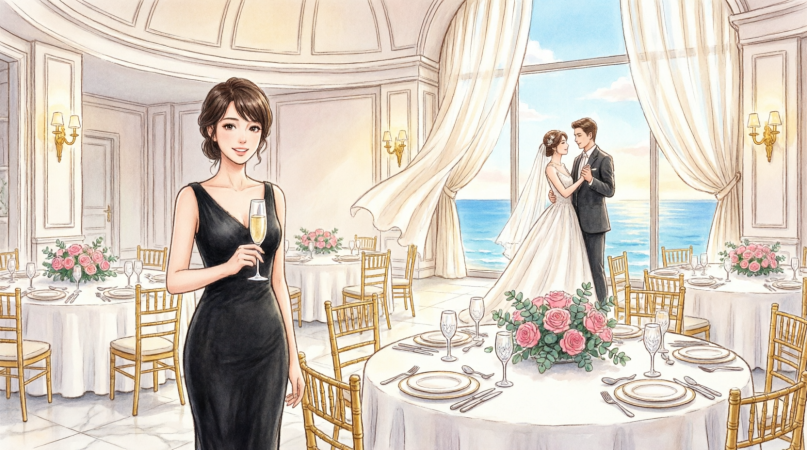
After dinner, Jasmine stood up holding a glass of sparkling cider and looked around the room.
“I used to think family was the people who gave you a seat,” she said. “But I learned family is the people who stand up when you’re being erased.”
She turned toward me.
“And this is the part that matters,” she said, voice steady. “Sophia raised me. Alone. She didn’t do it because she had to. She did it because she loved me.”
My throat tightened.
Jasmine smiled through shining eyes. “And I’m done letting anyone pretend she’s the help.”
Everyone lifted their glasses. The room felt warm, not because of money or crystal or candles, but because nobody in it was trying to make anyone smaller.
Later, after the guests left and the dishes were stacked, Jasmine sat with me on the couch.
“I used to want a prince,” she said, laughing softly at her old self.
I glanced at her. “What do you want now?”
She thought for a moment, then said, “A life where I don’t have to ask permission to exist.”
I smiled. “That’s a good life.”
She leaned her head on my shoulder like she used to as a kid.
“You know what the craziest part is?” she murmured.
“What?”
“I really thought you were going to leave me there,” she admitted. “At the wedding. I thought you were finally done.”
I swallowed. “I was done being quiet,” I said. “I wasn’t done being your sister.”
Jasmine nodded slowly. “Thank you,” she whispered.
Outside, the city lights blinked like distant stars.
Inside, the quiet felt clean.
And somewhere far away in Napa, a vineyard that used to be a stage for humiliation now held classrooms full of kids learning how to write contracts, how to read fine print, how to build something that couldn’t be taken by someone with a louder voice.
That was the real ending.
Not Preston’s face going pale.
Not the FBI lights.
Not the dramatic mic-drop.
The ending was this:
My sister came home.
And this time, she knew exactly who she was.
Part 9
The first time Jasmine drove herself somewhere after the wedding, she didn’t tell me.
I found out because I walked past the garage one morning and my spare set of keys was missing from the hook. For a second, that old instinct flared in my chest, sharp and protective. Where is she. Is she safe. Is someone bothering her.
Then I caught myself.
Jasmine wasn’t fourteen anymore. She was twenty-six. She wasn’t hiding behind my legs during thunderstorms. She was learning how to move through the world without waiting for permission, and my job was to let her.
When she came back, she had flour on her jeans and a paper bag in her hands. She placed it on the kitchen island like it was evidence.
“Don’t get mad,” she said.
I raised an eyebrow. “That’s a terrible opening.”
She pulled out two plastic containers. One held a lemon loaf. The other held a small pie with a sloppy handwritten label: peach.
“Mrs. Hartman still runs the bakery,” she said, voice soft. “I drove by our old neighborhood.”
I stared at the pie. Then at her face.
“Why?” I asked, not harsh, just careful.
Jasmine shrugged like it didn’t matter, but her eyes said it did. “I needed to see if it was still real,” she admitted. “The place where we came from. I kept thinking… maybe I imagined it. Maybe it wasn’t as bad as I remember.”
That made me laugh once, short and bitter. “You didn’t imagine it.”
“I know,” she said quickly. “I know. But sometimes my brain tries to rewrite it, like it rewrites everything. Like it rewrote Connor into someone good.”
I sat at the counter and watched her open the pie container. The crust was cracked. The peaches looked too glossy, like syrup had been poured over them. It smelled like cinnamon and childhood.
“You went to the apartment?” I asked.
She nodded. “The building is still there. Different paint. Same stairs.” She paused. “There’s a family living in our old unit. A little girl was on the balcony. She waved at me like she knew me.”
My throat tightened in a way I didn’t expect.
Jasmine slid a plate toward me, then another toward herself. She cut the pie into uneven slices with a kitchen knife, the way we used to because we never had a proper pie cutter.
“I didn’t go in,” she said. “I just stood there for a minute. And I realized something.”
“What?” I asked.
She stared down at her plate. “I always thought you were strong because nothing ever hurt you,” she said quietly. “But standing there, I realized… it did hurt you. You just didn’t have the option to fall apart.”
The words landed heavy.
I’d spent years acting like strength was a natural resource, something I simply had. Like it wasn’t built out of exhaustion and fear and the quiet panic of being a kid raising another kid.
Jasmine lifted her fork, then set it down again without eating. “Connor used to tell me you were cold,” she said. “That you didn’t understand love. That you only understood control.”
I felt heat rise in my chest. “He said that?”
She nodded, embarrassed. “Yeah. He’d say, ‘Sophia is trying to run your life because she can’t stand you having your own.’”
I leaned back, staring at the ceiling for a second. “I wasn’t trying to run your life,” I said slowly. “I was trying to keep you alive.”
“I know,” Jasmine said quickly. “I know that now.”
She finally took a bite of pie, chewed, swallowed. Her eyes softened with the taste. “Mrs. Hartman asked about you,” she said. “She said she still remembers you coming in every Friday night after work. You’d buy day-old bread because it was cheaper.”
I smiled without meaning to, because I could see it: sixteen-year-old me, still in a fast-food uniform, hands smelling like fryer oil, buying bread like it was a luxury.
Jasmine looked up. “Sophia,” she said, voice steady, “I don’t want to be your project.”
The sentence hit me like a slap. Not because it was cruel, but because it was true.
I had been building her recovery the way I built everything: with systems, protection, boundaries, contingency plans. Like if I could control the environment enough, she’d never get hurt again.
But people don’t heal in cages, even gilded ones.
“I’m not trying to make you a project,” I said carefully.
“I know,” she replied. “But it’s happening anyway. And I need to learn how to stand without leaning on you every second.”
My instinct was to argue. To list reasons. To say, I’m not controlling, I’m caring. The difference matters.
But then I thought about the apartment building, the stairs, the little girl waving from our old balcony. I thought about how I’d grown up too fast because I didn’t have anyone to lean on.
Maybe letting Jasmine lean forever wasn’t love.
Maybe love was letting her build her own spine.
So I nodded once. “Okay,” I said. “What do you need from me?”
Jasmine’s shoulders loosened slightly, like she hadn’t expected me to ask that. “I want to move into my own place,” she said. “Not far. But… mine.”
My chest tightened anyway. “Okay,” I said again, forcing steadiness into the word.
“And I want to work,” she added. “Not just painting. I want to do something that helps people like me.”
I pictured her on that stage at the courthouse, voice clear. I pictured her walking out of the reception tent, shoulders squared under my blazer.
“You’d be good at that,” I said.
Jasmine smiled, small and real. “I know.”
Later that day, I went to my office for the first time in a week.
Aurora Tech’s headquarters sat in a glass tower downtown with clean lines and too much natural light. My assistant, David, walked beside me with a tablet and a worried expression.
“The board wants a meeting,” he said. “They’re concerned about… the vineyard.”
I didn’t blink. “Concerned how?”
David hesitated. “They think you’re using company resources for personal… vendettas.”
Vendettas. Like protecting my sister was a hobby.
In the boardroom, twelve people sat around a long table, faces polite and tense. I knew all of them. Some were brilliant. Some were careful. All of them were watching me like I was a risk.
One board member cleared his throat. “Sophia, the Sterling situation has been… high-profile.”
I folded my hands. “Yes.”
“And now Aurora Tech is being mentioned in articles about federal investigations and asset seizures,” another added. “We need to ensure the company isn’t exposed.”
I looked at them, calm. “Aurora Tech is not exposed,” I said. “I handled the Sterling debt acquisition through Sophia Holdings. Separate entity. Separate risk.”
A woman near the end of the table leaned forward. “But you’ve been using the vineyard for your scholarship retreats,” she said. “That’s tied to Aurora Tech’s brand.”
“It’s tied to our values,” I replied.
A beat of silence.
Then the first man said, gently, “Sophia, we support philanthropy. We support community investment. But the perception is… you bought a vineyard to punish a family who insulted you at a wedding.”
I felt something cold slide into place behind my ribs.
“Do you think that’s what happened?” I asked.
A few people looked away.
I leaned forward slightly. “Because if you think I did all this because my feelings got hurt,” I said, voice calm but sharp, “then you don’t understand me, and you don’t understand what I built Aurora Tech to be.”
They watched me carefully.
“I bought that debt because Preston Sterling was committing fraud,” I said. “Because he was harming workers and clients and banks. Because he stole from my sister. Because he used power like a weapon and thought nobody would check the math.”
I paused, letting the room feel the weight.
“And yes,” I added, “he insulted me. But that wasn’t the crime. That was the warning.”
No one spoke for a moment.
Finally, the woman who’d questioned the brand said quietly, “So what’s next?”
I thought about Jasmine’s words: I don’t want to be your project.
I thought about the kids who’d come through our scholarship program, faces bright and hungry, learning to read contracts like they were maps.
“We build something that outlives all of this,” I said. “Not vengeance. Not headlines. Something real.”
And for the first time, I saw a few board members relax.
Because business people understand one thing better than apologies.
They understand legacy.
And I was done letting the Sterlings define what that word meant.
Part 10
If you give the internet a story with a wedding, a billionaire, and handcuffs, it will chew it down to bone.
The first article that really took off wasn’t even accurate. It framed the whole thing like a dramatic takedown—wronged CEO buys vineyard, humiliates groom’s father, sends FBI to the gate. The writer made it sound like I snapped my fingers and the government arrived like personal security.
It was stupid.
It also went viral.
Within a week, Aurora Tech’s PR inbox was flooded. Interview requests. Opinion pieces. People arguing about whether I was “iconic” or “unhinged.” A podcaster with a neon logo wanted me to “tell my side.” A business magazine wanted a profile titled The Dragon of Logistics.
I hated the nickname. Jasmine loved it in a guilty, amused way.
“It’s better than Cinderella,” she said, grinning as she scrolled on her phone.
I took the phone out of her hand and set it facedown. “Don’t feed it.”
Jasmine leaned back on my couch, arms crossed. “Sophia, it’s already fed,” she said. “It’s not going away just because you ignore it.”
I didn’t answer, because she was right, and being right didn’t make it less annoying.
The bigger problem wasn’t the internet.
It was our clients.
Aurora Tech ran tracking and optimization software for major shipping and manufacturing companies. Those companies didn’t like uncertainty. They didn’t like their vendors being associated with federal investigations, even if the investigation wasn’t ours.
David walked into my office one morning with his jaw tight. “Henderson Steel wants reassurance,” he said. “So does Davis Textiles. They’re getting calls from competitors saying Aurora Tech is ‘distracted.’”
“Of course they are,” I muttered.
Competitors love chaos. They don’t have to build a better product if they can make your clients nervous.
I called Henderson myself. The CEO answered on the second ring, voice clipped.
“Sophia,” he said. “Tell me this doesn’t affect my shipments.”
“It doesn’t,” I said. “You’ll get your materials on schedule. Our support team is staffed. Our systems are stable. Your contract is protected.”
A pause. “And the headlines?”
“I can’t control headlines,” I admitted. “But I can control performance.”
Henderson exhaled. “That’s what I needed to hear.”
When I hung up, Jasmine was standing in my doorway. She’d come by my office with lunch like she used to bring me snacks during finals week, back when we were kids pretending school problems were the biggest problems.
“You should let me talk,” she said.
I frowned. “To who?”
“To the press,” she said. “To the clients. To whoever.”
My stomach tightened. “Absolutely not.”
Jasmine’s eyes narrowed. “Why?”
“Because they’ll eat you alive,” I said, too fast. “They’ll twist your words. They’ll make you the villain or the victim. They’ll take your pain and monetize it.”
Jasmine stepped into the office, closing the door behind her. “Sophia,” she said carefully, “I’m not fragile.”
I opened my mouth, then closed it.
Because my brain still saw her at ten years old, legs swinging under the kitchen table, trusting me to handle everything.
And that was the problem.
“I know you’re not fragile,” I said, voice quieter. “But I don’t want you hurt again.”
Jasmine nodded slowly. “I don’t either,” she said. “But avoiding everything isn’t protection. It’s just hiding.”
I stared at my desk, at the neat stacks of contracts, the calendar of meetings, the little systems that made me feel like I could manage life.
“What do you want to say?” I asked, finally.
Jasmine’s eyes sharpened with purpose. “I want to say the truth,” she said. “That Connor lied. That his family tried to make me smaller. That I let it happen because I was scared. And that I walked away.”
My throat tightened.
“And,” she added, “I want to say you didn’t save me because you’re rich. You saved me because you loved me. And I saved myself by choosing to leave.”
I looked at her for a long moment.
This wasn’t just about PR. This was Jasmine stepping out of the shadow of my protection and telling the world she belonged to herself.
David knocked once and stepped in before I answered. “Sophia, the board’s PR committee wants to know if we’re issuing a statement,” he said.
I glanced at Jasmine. Her chin was lifted. Her hands were steady.
I nodded. “We are,” I said.
David looked relieved. “Great. I’ll schedule—”
“No,” I said, cutting him off gently. “Not just a statement.”
David blinked. “What do you mean?”
I stood up, walked around my desk, and faced them both. “We’re doing one interview,” I said. “One. With someone serious. No podcasts. No drama channels.”
David opened his mouth to argue, then caught the look on my face and nodded. “Understood.”
Jasmine’s eyes widened. “You’re letting me?”
“I’m not letting you,” I corrected. “You’re doing it. I’m supporting it.”
Jasmine smiled, and for a second I saw the kid who used to wave her art assignments in my face, desperate for me to see her. But now the desperation was gone. The pride remained.
We chose a journalist from a national business outlet known for long-form profiles and minimal sensationalism. The interview was scheduled for the following week.
On the day of, Jasmine wore a simple black blazer and jeans. No wedding drama costume. No victim outfit. Just herself.
The journalist, a woman named Elise, set her recorder on the table and asked Jasmine, “Why did you go through with the wedding if things were so bad?”
Jasmine didn’t flinch. “Because I wanted to be chosen,” she said. “And I confused being chosen with being loved.”
Elise nodded slowly. “And when did that change?”
Jasmine looked at me briefly, then back at Elise. “When I saw my sister being treated like garbage and realized I’d been helping them do it,” she said. Her voice didn’t shake. “They made me believe love meant shrinking. My sister reminded me love means standing.”
Elise asked about the debt acquisition, the vineyard, the legal fallout. Jasmine answered with calm honesty.
Then Elise leaned in and asked the question I’d been waiting for.
“People say your sister’s power saved you,” she said.
Jasmine smiled slightly. “Her power gave me a door,” she replied. “But I had to walk through it.”
After the interview, we walked outside into the bright afternoon. Jasmine exhaled like she’d been holding something heavy in her lungs for years.
“How do you feel?” I asked.
She thought for a second. “Tired,” she said. “But clean.”
A week later, the article came out.
It didn’t call me a dragon.
It called Jasmine a survivor.
And it called what we built next the only part of the story that mattered.
Part 11
The first time we invited former Sterling employees to the vineyard, I expected anger.
I expected people to show up ready to spit in my face, because when a company collapses, the people at the top have parachutes. The people on the ground have rent due.
I’d already seen the reports: unpaid wages, delayed benefits, vendors left holding invoices, crews stranded when ships were impounded.
Preston had called it legacy.
Workers called it theft.
We held the meeting in the old tasting room, the one with floor-to-ceiling windows overlooking rows of vines like a postcard. The Sterlings used to bring investors there and pour expensive wine while pretending their numbers were clean.
Now the room held folding chairs and a pot of coffee that smelled like reality.
About thirty people showed up. Men with weathered hands. Women with tired eyes. A few younger employees who looked like they still didn’t believe adulthood could be this unfair.
They stared at me like I was a villain with better lighting.
A tall man in a navy jacket spoke first. “So what, you bought the place and now you’re the queen?” he asked, voice sharp. “You gonna tell us to smile and be grateful?”
Jasmine shifted beside me, jaw tight.
I kept my voice calm. “No,” I said. “I’m going to tell you the truth.”
I gestured to the chairs. “Sit if you want,” I said. “Leave if you want. Nobody’s trapped here.”
They sat, slowly, suspiciously.
I pulled out a folder and placed it on the table. “This is a list of outstanding wage claims filed against Sterling Shipping and the vineyard operations,” I said. “This is the amount owed. This is the legal status.”
The tall man scoffed. “And you’re gonna pay it?”
 :
: