I opened my banking app, severed the lifeline, and typed a message that would hit harder than any birthday song. Every Friday at nine on the dot, like a church bell, $550 slipped out of my checking account. The first time I set it up, I cried into my sleeve.
I was finally the kid who could give back. They raised me on casseroles and lectures about doing the right thing; when Dad’s hours got cut and Mom said the salon had slowed to a crawl, I didn’t hesitate. Family helps family. I typed my routing number the way you write a prayer.
Three years later, “help” looked like duct tape inside Lily’s sneakers. Rent late—again. Groceries on a credit card. Marcus dragging himself home from a second shift, hands split from corrugate and cold. He tapped the statement with a bandaged finger. “Just a month,” he said. “Ask them to scale back.” I kissed his knuckles.
“They need it,” I said, and tried not to do the math on my daughter’s shoes. Mom promised they’d be at Lily’s party. “Wouldn’t miss it—with bells on.” I believed her, because believing is cheaper than admitting you’ve been financing a story you’re not even in. Saturday arrived cotton-candy pink. Dollar-store balloons. Paper streamers.
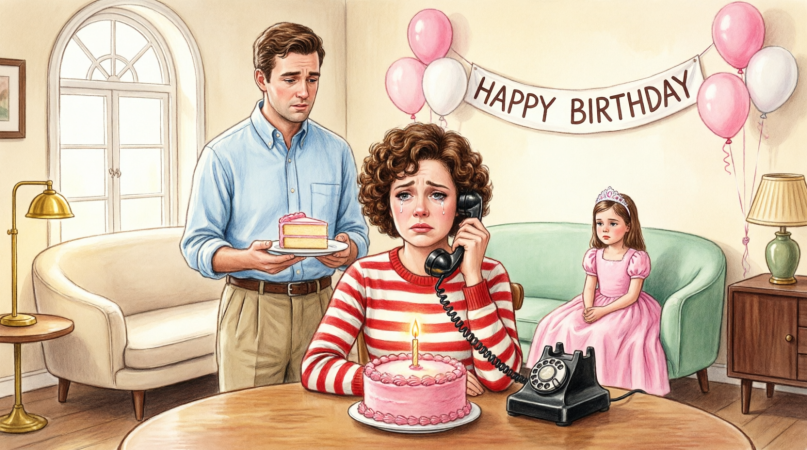
I frosted a leaning chocolate cake with Lily’s favorite swirls because, according to my six-year-old, “pink tastes like cake.” Two o’clock softened into 2:30. Musical chairs got loud in the best way. Lily kept glancing at the door like it could grow grandparents on command. By three, a princess dress and a still-wrapped present sat on the couch together.
By four, the last goodie bag left, and the quiet landed sticky and sweet. I called. Dad answered over laughter and clinking glasses. “Oh—today? We’re at Danny’s. He insisted. Busy house, you know how it is.” “You knew,” I said. “I reminded you yesterday.” He sighed like I was the unreasonable one. “We can’t drop everything for every little thing, Sarah. We have other grandkids. It’s easier there.” “How’d you afford the trip?”
I asked, even though I already knew. “We saved,” he snapped. “What we do with our money is our business. You offered to help. Nobody forced you.” Then the cut that cauterized: “We don’t count your family the same way. Danny’s is… better established. You understand.” I hung up before Lily could hear my voice crack through the bedroom door.
The kitchen went very still. My bank app threw a blue square of light across the counter. A balloon’s reflection drifted over the microwave door. Marcus stared at the empty cake plates like they’d said something ugly. Down the hall, one small sniffle. I canceled the transfer. Then I pulled every thread they’d tied to me. The car loan I’d co-signed “just to lock a better rate”—closed, title rerouted.
The two extra phone lines on my plan—removed, port-out codes generated. The “emergency” credit card they treated like a punch card for takeout—frozen, statements downloaded, charges highlighted like evidence. Fifteen minutes of taps unraveled three years of obligation. Mom called, voice high and shiny.
“What did you do? That’s our money!” I looked at the crayon crown Lily had left on the table, the frosting smear shaped like a question mark, the photo taped to the wall from last July—Lily with a sparkler and a little U.S. flag she’d colored herself—and felt something old and heavy lift. I opened Photos. Screenshot of the transfers. The text where Mom promised “bells on.”
Dad’s message from last winter—not our problem—when our car died and Marcus took the bus in the dark for a week. A picture of Lily in her purple dress, smiling at a door that never opened. I opened the family thread. The cousins who “stay out of it.” The aunts who forward prayers. Danny with his perfect-lawn thumbs-ups. I typed two sentences. Clean.
No swearing, no apology, no ladder back down. I attached the screenshots, the statement PDF, and a photo of Lily’s cake with two empty chairs behind it. Marcus watched my face. “You sure?” he asked. I looked down the hall where my daughter slept with glitter still on her cheek. My thumb hovered over Send I pressed send.
The little circle spun for a heartbeat, a digital pendulum swinging between the life I had and the life I was choosing. Then it vanished. Delivered.
For ten seconds, nothing happened. The kitchen remained still, save for the hum of the refrigerator and the distant sound of Marcus running water in the bathroom sink. I set the phone down on the counter, screen up. It looked like a bomb waiting to detonate.
“Done,” I said. My voice sounded foreign to my own ears. Flat. Final.
Marcus dried his hands on a towel and came to stand beside me. He didn’t look at the phone. He looked at me. He saw the tension in my shoulders drop, the way my hands stopped trembling. He wrapped an arm around my waist and pulled me into his side. He smelled like cardboard dust and laundry detergent. He smelled like safety.
“They’re going to call,” he said.
“Let them,” I replied.
“Your mom… she’s not going to take this well, Sarah. She’ll call everyone. She’ll tell them you’re selfish. That you abandoned them.”
“I didn’t abandon them,” I said, looking at the crayon crown on the table. “I stopped funding their rejection of me.”
We stood there for a long time, watching the phone screen dim until it went black. Then, as if on cue, it lit up. A notification. Then another. Then a cascade.
I didn’t pick it up. I walked down the hall to Lily’s room.
She was asleep, curled around a stuffed rabbit that had lost an ear years ago. There was glitter on her cheek, exactly where Marcus had said it would be. I sat on the edge of her bed and brushed the glitter away with my thumb. She stirred but didn’t wake.
“I’m sorry,” I whispered to the quiet room. “I’m sorry they weren’t here. But I promise… I’m going to be enough. Just me.”
I went back to the kitchen. The phone was buzzing continuously now. A steady, angry vibration against the laminate counter. I picked it up.
Mom: What is this? Why did the transfer fail? Mom: Sarah? Call me immediately. Dad: This is childish. Turn it back on. Aunt Carol: Is everything okay? Your mother is very upset. Danny: Hey cuz, heard there’s some drama. Everything cool?
I scrolled through the notifications. Thirty-two messages in five minutes. The group chat, usually a stream of birthday wishes and prayer emojis, had become a tribunal.
I typed one more message. Not to the group. To Dad.
You said we don’t count the same way. So I stopped counting you in my budget. Use Danny’s establishment to pay the bills now.
I blocked the number. Then I blocked Mom. Then I muted the group chat.
The silence that followed was louder than the buzzing had been.
The first week was the hardest. Not financially—that relief was immediate and intoxicating. For the first time in three years, when I logged into my banking app, I didn’t feel a knot of dread in my stomach. I saw the $2,200 a month that used to vanish every Friday. I saw it sitting there. Waiting.
I used the first week’s surplus to buy Lily new sneakers. Not the ones with the duct tape. Real ones. White and pink with velcro straps she could fasten herself. When she put them on, she marched around the living room stomping loudly, laughing every time the squeak echoed off the walls.
“Look, Mama! They fit!”
“They fit,” I agreed. My throat tightened.
But while Lily marched, my phone sat in the drawer, occasionally lighting up with calls from numbers I didn’t recognize. Blocked. Voicemails full of heavy breathing, sighs, and sometimes, sharp accusations.
“How could you do this to your own blood?” “We raised you.” “You’re punishing us for being human.”
I didn’t listen to all of them. I listened to enough to know the narrative was shifting. I was no longer the helpful daughter. I was the ungrateful child. The one who turned her back when things got tough.
Marcus handled the logistics. He changed our passwords. He put a fraud alert on our credit reports because Dad had co-signed nothing, but he had access to enough information to be dangerous. We fortified the perimeter.
On Wednesday of that first week, Mom showed up at our apartment.
I was at work. Marcus called me during my lunch break, his voice low. “She’s in the parking lot. She says she won’t leave until you talk to her.”
“Did you let her in?”
“No. But she’s making a scene. Talking to the neighbors.”
I left work early. When I pulled into the lot, I saw her car—a sedan I had helped pay the insurance on for two years—parked across two spaces. Mom was standing by the entrance, arms crossed, wearing the coat I bought her last Christmas. She looked small against the brick building, but her posture was rigid with indignation.
I walked toward her. I didn’t run. I didn’t hide.
“Sarah,” she said when I was ten feet away. Her voice was loud, intended for the windows above us. “You think you can just cut us off? After everything we did?”
“You didn’t come to Lily’s birthday,” I said. My voice was calm. I was surprised by how calm it was. “You went to Danny’s.”
“Danny’s mother was there,” she snapped. “It was a family gathering. You know how your father gets about being outnumbered.”
“So I should have brought Lily to Danny’s? Instead of you coming here?”
“We’re the parents,” she said, as if that explained the geometry of the universe. “We go where we want. You send the money because you can. Because you’re stable. Why are you punishing us for your own success?”
That was the core of it. I realized then. It wasn’t about need. It was about hierarchy. They needed me to be the ATM because it kept me in the child role. As long as I was paying, I was subordinate. If I stopped paying, I became an equal. And they couldn’t tolerate an equal.
“I’m not punishing you,” I said. “I’m balancing the books. You said my family doesn’t count the same way. So I removed you from the ledger.”
“Your father is going to have a heart attack,” she said, playing the final card. The health scare. The guilt trip that had worked for decades.
“If he’s sick, take him to the hospital,” I said. “I’m not paying the bills anymore. But I will call 911 if you think he’s in danger.”
She stared at me. Her mouth opened, then closed. She had no script for this. In her story, I was supposed to crumble. I was supposed to apologize and double the transfer to prove my love.
“You’re cold,” she whispered. “Just like your father said.”
“Maybe,” I said. “Or maybe I’m just warm enough for my own daughter now.”
I turned my back and walked into the building. I didn’t look to see if she was crying. I didn’t look to see if she was leaving. I just kept walking.
Month two brought the extended family pressure.
Thanksgiving was approaching. Usually, this was the week I spent stressing about the ham, the pie, the travel costs to get to my parents’ house. This year, my phone buzzed with a text from Aunt Carol.
We need to talk about Thanksgiving. Your mother is hurt. She says she doesn’t know if she can cook for everyone if she’s struggling.
It was a threat disguised as a concern. If I didn’t show up (and presumably bring money), the holiday would be ruined.
I called Aunt Carol. She was the mediator, the one who claimed to stay out of it while constantly passing messages.
“Aunt Carol,” I said. “I’m not coming this year.”
“Sarah, be reasonable. It’s one day.”
“It’s never one day,” I said. “It’s the judgment all week. It’s the comments about Marcus’s job. It’s the questions about why Lily doesn’t have a tutor. It’s the expectation that I pay for the groceries I cook.”
“We’re family,” she said.
“Family shows up,” I replied. “They didn’t show up for Lily. So I’m not showing up for them.”
“What about Danny?”
“Danny is fine,” I said. “He’s established. Remember?”
There was a silence on the other end. She knew I was quoting Dad. She knew the game had changed.
“Your mother says you’re going to regret this,” Carol said finally. “When they get older. When they need care.”
“I’m preparing for that now,” I said. “By ensuring I have the resources to care for my own child. If they need care, they have Danny. He’s established.”
I hung up.
That Thanksgiving, we stayed home. Marcus made a turkey that was slightly dry. Lily made a centerpiece out of construction paper and glue. We watched movies. We wore pajamas until noon.
For the first time in my adult life, I wasn’t tired on Friday morning. I wasn’t dreading the weekend. I wasn’t checking my bank account to see if the overdraft fee had hit.
I took the $550 I would have sent that Friday and put it into a college fund for Lily. I set up an automatic transfer. Every week, without fail, money went to her future. Not my parents’ present.
Month six brought the financial reality check for them.
I heard through the grapevine—actually, through a cousin who liked to talk—that Dad’s hours had been cut again. That Mom’s salon visits had stopped. That the car needed repairs they couldn’t afford.
Part of me felt a pang of guilt. It was instinctual. The conditioning of thirty years doesn’t vanish in six months. I wondered if they were eating properly. I wondered if the heat was on.
Then I remembered Lily’s sneakers. I remembered the duct tape. I remembered the empty chairs at the birthday party.
Guilt is a habit. I was breaking it.
Danny tried to reach out in December. He sent a friend request on social media. I ignored it. Then he sent a message.
Hey, looks like things are tense. Just wanted to say, I didn’t know they were using the money like that. I thought it was for bills.
It was a weak olive branch. He benefited from the hierarchy. He knew it. But he was trying to keep the door open in case I ever came into money again.
You knew, I replied. You posted photos from the birthday party while Lily was waiting for the door to open. You liked the photos.
He didn’t reply.
The silence from that side of the family grew heavier. They were learning to live without me. It was painful for them, I’m sure. But it was necessary.
One year later.
It was Lily’s seventh birthday.
We weren’t having a big party. Just a few friends from school. The backyard was decorated with real lights, not paper streamers. The cake was from a bakery, not made from a box.
I was standing by the grill, flipping burgers, when Marcus came out with the phone.
“It’s your dad,” he said.
My hand didn’t slip. The spatula hovered over the meat. “Why are you answering?”
“He kept calling until I picked up. He says it’s an emergency.”
I wiped my hands on my apron and took the phone. “This is Sarah.”
“Sarah,” Dad’s voice was rough. Older. “I… we need to talk.”
“You blocked me,” I said. “I remember.”
“I unblocked you. Look, your mother… she fell. At the house. She broke her hip.”
My heart skipped a beat. Not out of fear for her, but out of that old reflex. Is she okay? Is she safe?
“Is she in the hospital?”
“Yes. They’re saying she needs rehabilitation. Home care. It’s… it’s expensive.”
I looked out at the backyard. Lily was running through the sprinkler, screaming with laughter. She was wearing the dress I bought her. The one without stains.
“And you’re calling me because…?”
“Because you’re the only one who understands the finances,” he said. “Danny… he’s got his own issues now. His business isn’t doing well. He can’t help.”
There it was. The reversal. The established son was no longer established. The ATM daughter was the only option left.
“I’m sorry to hear about Mom,” I said. And I meant it. I didn’t wish harm on them. But I couldn’t fix it.
“Sarah,” he said, his voice dropping. “Please. We’re your parents.”
“You told me I don’t count the same way,” I said. “You told me Danny was better established. So I let him be the establishment.”
“That was… that was pride talking,” he said. “I was wrong.”
It was the first admission I had ever heard. It hung in the air, fragile and strange.
“I know you were,” I said. “But being wrong doesn’t erase the cost.”
“What cost?”
“The cost of trust,” I said. “The cost of showing up. You spent three years teaching me that my support was conditional. That my family was secondary. I can’t unlearn that overnight.”
“So you’re just… letting her suffer?”
“I’m not letting her suffer. The hospital is treating her. Insurance is covering the rehab. You have savings. You have the house. You have Danny.”
“The house is leveraged,” he admitted quietly. “We… we took out a loan. Against the equity.”
Of course they had. Because the $550 a week was gone. Because the safety net I provided had allowed them to take risks they couldn’t afford.
“I can’t help you financially, Dad,” I said. “But I can send you a list of social services. I can help you apply for Medicaid waiver programs. I can give you time.”
“Time doesn’t pay bills,” he snapped. The old anger flared, brief and weak.
“No,” I said. “But boundaries do.”
I heard him breathe on the other end. It sounded like a sigh of defeat.
“Will you… will you come see her?” he asked. “At the hospital?”
I looked at Lily. She had stopped running. She was looking at me, waiting for me to come join the game.
“I’ll come,” I said. “But I’m not paying. And I’m not staying long. And if anyone makes a comment about my family… I leave.”
“Okay,” he whispered. “Okay.”
“Happy Birthday, Lily,” I said to the phone, though he wasn’t the one celebrating.
“What?”
“Nothing,” I said. “I’ll be there tomorrow.”
I hung up.
Marcus touched my shoulder. “You okay?”
“I will be,” I said.
I went to join Lily. She grabbed my hand and pulled me into the sprinkler. The water was cold. I shrieked. She laughed.
“Again!” she yelled.
We ran again. I got soaked. My hair plastered to my head. My shoes squished.
For the first time in my life, I didn’t care about the mess. I didn’t care about the impression. I didn’t care about the cost.
The hospital visit was quiet. Mom looked smaller in the bed. Her leg was elevated. Dad sat in the chair beside her, looking at his hands.
They didn’t mention the money. They didn’t mention the transfer. They talked about the weather. About the nurse. About the food.
It was civil. It was distant. It was a relationship reset to factory settings.
When I left, I didn’t promise to come back next week. I didn’t promise to call. I just said, “Feel better.”
Driving home, I felt a strange sensation in my chest. It wasn’t guilt. It wasn’t anger. It was grief. I was grieving the parents I wanted. The ones who would have come to the birthday party. The ones who would have cheered for Lily without calculating the cost.
They didn’t exist. Accepting that was the final step.
Two years later.
We moved. Not far, just to a different complex with better security and a playground that didn’t have broken glass.
The rent was higher. But we could afford it. Because I wasn’t sending $550 a week. Because Marcus got a raise. Because we stopped bleeding money into a void.
I ran into Danny at the grocery store. He looked tired. He was buying generic brand cereal. He saw me and hesitated.
“Hey,” he said.
“Hey.”
“Mom’s doing okay,” he said. “Walking with a cane now.”
“That’s good,” I said.
“We… we sold the house,” he said. “Downsizing.”
“Okay.”
“I get it now,” he said, looking at the cart. I had fresh fruit. Milk. Real cheese. “About the money. About… everything.”
“Do you?”
“Yeah. I got into some debt. Trying to keep up the image. The establishment.” He laughed, a dry, humorless sound. “Turns out establishment is just a word people use when they’re scared.”
“We all are,” I said.
He nodded. He didn’t ask for help. He didn’t ask for a loan. He just checked out and left.
I watched him go. I didn’t feel superior. I felt sad for him. He was still trapped in the hierarchy. I had climbed out.
Three years later.
Lily is nine. She’s in fourth grade. She plays soccer. She hates math. She loves to draw.
We were sitting at the kitchen table doing homework. The Friday transfer notification used to ping at 9 AM. Now, at 9 AM on Fridays, I get a notification from her college fund. Deposit Successful.
It’s a different sound. A happier sound.
Marcus came in from the garage. He put a envelope on the table.
“What’s this?” I asked.
“Tax return,” he said. “We’re getting a refund.”
“We never get refunds,” I said.
“We do now,” he said. “Because we claimed everything. Because we didn’t give half of it away.”
He kissed the top of my head. “Proud of you,” he said.
It wasn’t about the money. Not really. It was about the message. The message I sent that day when I hovered over the send button.
We don’t count your family the same way.
He was right. We don’t.
My family is the people who show up. The people who eat the dry turkey. The people who run through the sprinklers. The people who protect the peace instead of selling it.
My parents are still alive. We talk on holidays. Sometimes. They send cards for Lily’s birthday. They never come. They never ask to visit. They know the terms.
I think they respect me more now than they ever did when I was paying them. Because I proved I could walk away. And power only respects power.
Last week, I found the old phone. The one I used before I changed my number. It was in a box in the closet, buried under winter scarves.
I charged it. It turned on. There were hundreds of voicemails from three years ago. From the week I cut them off.
I listened to one. It was Mom.
Sarah, please. We’re sorry. We didn’t mean it. Call us back.
Her voice sounded desperate. Scared.
I deleted it.
I didn’t need to hear the apology anymore. I had lived the consequence. That was worth more than words.
I put the phone back in the box. I put the box back in the closet.
I walked out to the living room. Lily was on the floor, building a tower out of blocks. It was tall. Unsteady.
“Don’t let it fall,” I said.
“I won’t,” she said. “I built the base strong.”
She looked at me. “Like you taught me.”
“Yeah,” I said. “Like I taught you.”
I sat down beside her. I handed her a blue block.
“Where does this go?” I asked.
“Here,” she said. “On the top.”
She placed it gently. The tower held.
We sat there in the quiet apartment. The rent was paid. The lights were on. The fridge was full.
And for the first time in my life, I wasn’t waiting for the other shoe to drop. I wasn’t waiting for the phone to ring. I wasn’t waiting for permission to be happy.
I was just here.
The lifeline was severed. But I hadn’t fallen. I had learned to fly.
And the view from up here… it was beautiful.
THE END.